

and circadian lighting. Apply 9 proven principles.
Table of Contents
You have been told that a bedroom needs “good vibes.” That paint color is a matter of taste. That a throw pillow or a scented candle constitutes wellness. This is the language of decoration, and it has failed you. The reason you wake at 3 AM with your heart racing, the reason your Oura ring shows 47 minutes of deep sleep, the reason you feel cognitively flattened by 2 PM—these are not aesthetic problems. They are architectural problems.
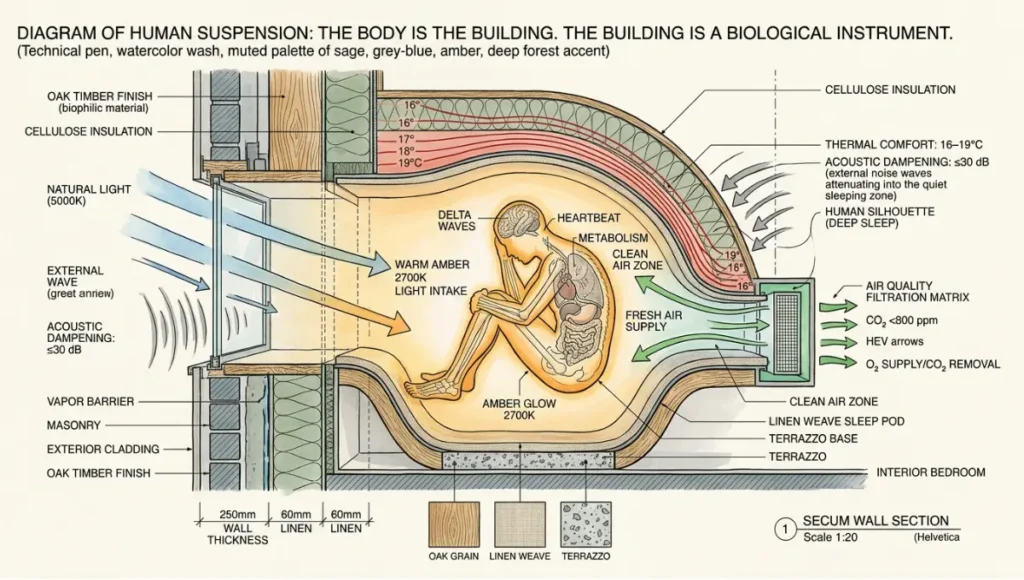
Your bedroom is not a backdrop for rest; it is the primary machine your biology depends on for recovery. And like any machine, its performance is determined by measurable inputs: photon spectra, thermal gradients, acoustic pressure waves, volatile molecular concentrations, and spatial geometry. This wellness bedroom design guide dismantles the decor paradigm and replaces it with a framework drawn from sleep science, neuroarchitecture, and environmental physiology. You will not find advice about “creating a sanctuary.” You will find specifications.
Nuvira Perspective
At Nuvira Space, we do not design rooms. We design the conditions under which human recovery becomes inevitable. Our practice sits at the intersection of neuroscience and modular systems—treating the home not as a static container for furniture, but as a health machine whose parameters can be tuned, tested, and iterated.
We believe the next era of domestic life will be defined by two forces: modular adaptability, which allows spatial systems to reconfigure around the occupant’s biological state rather than forcing the occupant to adapt to fixed architecture; and circadian synchronization, which treats light, temperature, and material as programmable inputs to the body’s 24-hour regulatory clock. The bedroom is where these two forces converge most critically. It is the room you inhabit for one-third of your life. It deserves to be treated as a performance system, not a stylistic statement.
Technical Deep Dive: The Physiology of Spatial Recovery
Why Your Brain Reads the Bedroom as a Threat Vector. Wellness Bedroom Design Guide.
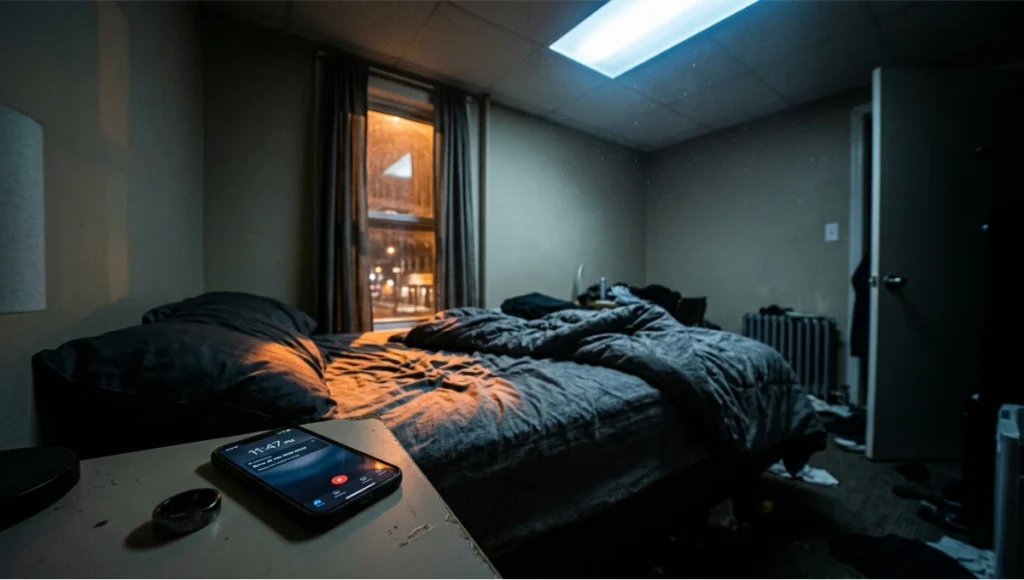
Your nervous system does not care about your Pinterest board. It cares about survival. The amygdala, your brain’s threat-detection center, scans every spatial cue for danger signals: sharp angles, visual clutter, thermal discomfort, acoustic unpredictability, light intrusion. A 2023 systematic review of neuroarchitecture published in Ain Shams Engineering Journal confirmed that curved forms reduce amygdala activation while sharp contours trigger subconscious vigilance. This is not preference. It is neurology. When your bedroom contains visual noise, temperature fluctuation, or blue-spectrum light after dusk, your prefrontal cortex remains partially engaged in threat-scanning mode. Sleep onset is delayed not because you are “stressed about work,” but because your architecture is broadcasting a low-frequency danger signal.
The Eight Certified Rules of Sleep Architecture
Rule 1: Circadian Lighting Protocol
Light is the primary zeitgeber—the environmental cue that entrains your suprachiasmatic nucleus, the master clock in your hypothalamus. The 2026 Wellness Architecture & Design Initiative from the Global Wellness Institute identifies circadian lighting as a key trend, noting that dynamic systems adjusting both color temperature and intensity across the day support energy in the morning and relaxation in the evening. For a deeper technical exploration, see our Circadian Lighting Systems guide.
- Daytime exposure: 5000K–6500K, bright and spectrally complete, mimicking midday sun
- Evening transition: 2700K–3000K warm-white or amber, dimmable to <300 lux at head-height
- Post-9 PM protocol: Eliminate all blue wavelengths (450–490 nm); these suppress melatonin and can delay sleep onset by 90+ minutes
- Blackout requirement: Zero lux from exterior sources; lined curtains or motorized blinds
- Screen policy: Night-shift mode minimum; elimination preferred within the sleep zone
Rule 2: Thermal Regulation Zone
Core body temperature must drop 1–2°C to initiate sleep. Research consistently identifies 16–19°C (61–66°F) as optimal for most adults, with ±1°C individual variation. Our Passive Cooling Mediterranean research provides additional context on thermal mass strategies.
| Variable | Target Range | Notes |
| Air temperature | 16–19°C (61–66°F) | Adjust per individual; start at 17.5°C |
| Summer bedding tog | 4.5–7.5 | Breathable cotton or wool fill |
| Winter bedding tog | 10.5–13.5 | Down or wool alternative |
| Humidity | 40–60% RH | Prevents dryness and dust-mite proliferation |
| Floor surface temp | >18°C at foot contact | Avoid cold tile in sleep zones |
Rule 3: Acoustic Isolation Standard
The WHO identifies sustained nighttime noise above 40 dB as harmful. A wellness bedroom targets ≤30 dB—classified as “very quiet.” For detailed acoustic design strategies applicable to residential spaces, refer to our Acoustic Insulation Home Office technical guide.
- Passive measures: Mass-loaded walls, solid-core doors with acoustic seals, double-glazed windows, dense rugs covering 60–70% of floor area
- Active management: White, pink, or brown noise machines to mask residual external sounds
- Bed placement: Headboard on internal wall, away from plumbing chases or shared party walls
Rule 4: Air Quality & Ventilation Matrix
Indoor bedroom air is frequently worse than outdoor air in sealed modern construction. Our Indoor Plants Air Quality Apartments research provides species-specific data on phytoremediation efficacy.
- CO₂: <800 ppm (achievable with basic ventilation)
- VOCs: <500 µg/m³ (requires low-emission material specification)
- PM2.5: <12 µg/m³ (requires HEPA-grade filtration)
- Plant coverage: 2–3 air-purifying species per 20 m² (snake plant, peace lily, pothos) for supplemental biological filtration
- Material audit: Zero-VOC paints; natural fiber bedding; solid wood over MDF/particleboard; wool/jute rugs over synthetics
Rule 5: Biophilic Material Integration
The biophilia hypothesis—documented across neuroscience and environmental psychology—states that humans respond physiologically to natural forms, materials, and patterns. Our Biophilic Interior Design guide examines how natural material coverage thresholds produce measurable cortisol reduction. A 2026 case study of Singapore’s architecture found that natural features, natural space, and natural form all demonstrated statistically significant positive correlations with urban mental well-being, with natural space showing the strongest predictive power (R² = 0.354) for attentive and self-assured states.
- Surface coverage threshold: ≥30% natural or nature-derived materials across visible interior surfaces
- Tactile variation: Timber grain, linen weave, unpolished stone—activating sensory pathways associated with calm
- Species selection: Low-light adaptable, nocturnal oxygen producers (succulents, snake plants via CAM photosynthesis), low allergen potential
Rule 6: Chromatic Calm Palette
Color is a quantifiable physiological variable, not a matter of taste. High-saturation colors generate measurable arousal responses.
- LRV target for walls: 55–75 (medium-light tones that calm without visual fatigue)
- 2026 emerging palette: Pantone’s Mocha Mousse and adjacent warm neutrals supporting emotional stability
- Accent limit: Maximum two hues, drawn from the same warm-cool family, applied to secondary surfaces only
Rule 7: Digital Detox Boundary
Smartphones, televisions, and laptops introduce three sleep-disruptive mechanisms: blue-spectrum light, cognitive stimulation from content, and notification interruption.
- Certified boundary: Zero active screens within 1 meter of the headboard
- Charging stations: Located outside the bedroom or on the far wall
- Alarm replacement: Traditional analog or non-glowing digital clock
- Physical barrier: Lockable drawer or box on nightstand for phone storage
Rule 8: Spatial Declutter Ratio
Visual complexity activates the prefrontal cortex—the neural system that must deactivate for sleep onset. The Spatial Declutter Ratio (SDR) targets <0.3 visible objects per square foot of horizontal surface.
- 20 m² bedroom: Approximately 65 or fewer visible objects on all surfaces
- Structural approach: Built-in wardrobes with flush doors, platform beds with integrated storage, floating nightstands
- Dual test for visible objects: Functional purpose in sleep environment OR documented positive emotional response
Comparative Analysis: Nuvira Protocol vs. Industry Standard
The Decor Industry’s Failure Mode
| Parameter | Industry Standard | Nuvira Certified Protocol |
| Lighting | “Warm and cozy”—undefined color temperature, no lux specification | 2700K post-9 PM, 0 lux blue, automated circadian scheduling |
| Temperature | “Comfortable”—thermostat preference without thermal system design | 16–19°C air + bedding tog coordination + humidity control + floor surface temp >18°C |
| Acoustics | “Quiet neighborhood”—no measurement, no treatment | ≤30 dB verified with decibel meter; passive + active management |
| Air quality | “Open a window sometimes”—no monitoring | CO₂ <800 ppm, VOCs <500 µg/m³, PM2.5 <12 µg/m³; HEPA + plants + material audit |
| Materials | “Natural look”—synthetic laminates, MDF furniture, polyester bedding | ≥30% natural surface coverage; solid wood, linen, stone, wool; GreenGuard/OEKO-TEX certification |
| Color | “Choose what you love”—no LRV consideration | LRV 55–75 walls; max 2 accent hues; evidence-based arousal avoidance |
| Technology | “Smart home integration”—screens, hubs, chargers at bedside | 1-meter device-free zone; charging external; airplane mode; indicator lights disabled |
| Clutter | “Organized”—subjective assessment | <0.3 objects/sq ft; concealed storage; neuroarchitectural sightline logic |
The industry treats the bedroom as a stage set. We treat it as a closed-loop biological control system. The difference is not philosophical—it is measurable in polysomnography data, cortisol assays, and morning cognitive performance tests.
Speculative / Internal Concept Study: The Recovery Suite by Nuvira Space
Project Overview
Location: Conceptual deployment in a high-density Northern European climate (reference: Rotterdam’s SAWA circular district typology)
Typology: 22 m² master bedroom module within a modular, demountable residential system
Vision: To demonstrate that a wellness bedroom can achieve certified performance metrics without sacrificing architectural character or material richness
Rotterdam provides the macro-environmental anchor. The city has become a global laboratory for circular, modular housing—exemplified by SAWA, a 90-percent demountable apartment block where units can be combined or reduced with ease, and where 430 square feet of outdoor space per apartment supports biophilic integration at the urban scale. The Recovery Suite extracts the modular logic of Rotterdam’s built environment and applies it to the scale of the sleeping body.
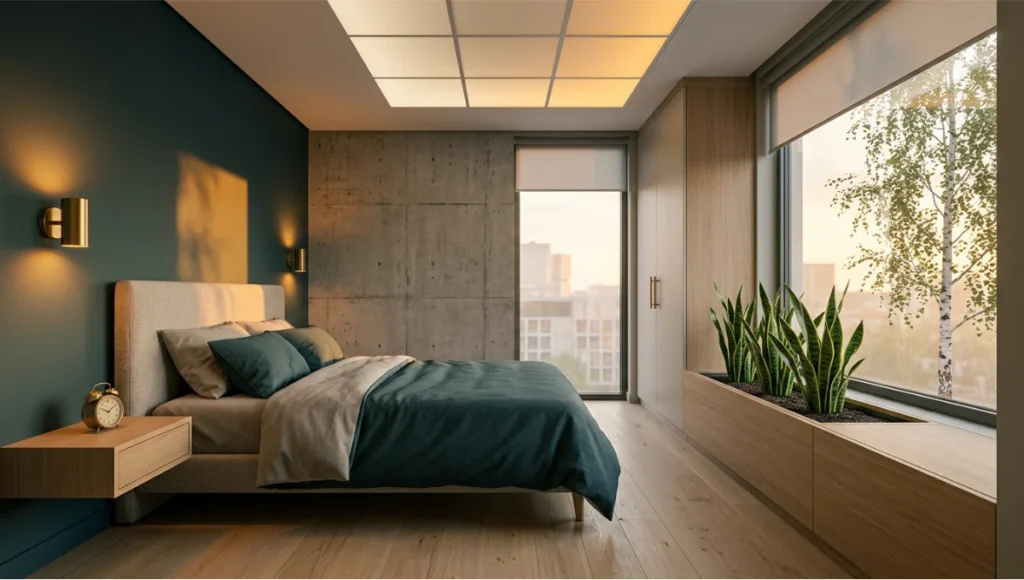
Design Levers Applied
Circadian Infrastructure
- Tunable LED ceiling grid: 2700K–6500K, automated across 24-hour schedule
- Amber wall sconces on dedicated evening circuit, independent of daytime system
- Motorized blackout blinds with zero-light leakage
Thermal System
- Polished lime-plaster thermal mass wall with embedded radiant heating panels
- Maintains 17.5°C through the night with ±0.3°C stability
- Cross-ventilation channels integrated into modular wall system
Acoustic Envelope
- Triple-glazed windows with acoustic laminate glass
- Internal ambient noise: ≤28 dB verified
- Headboard positioned on internal structural wall, maximum distance from facade
Air Quality Matrix
- Concealed HEPA air handling unit: CADR ≥200 m³/hr
- Continuous fresh-air exchange maintaining CO₂ at 650 ppm
- 3 air-purifying species integrated into built-in planter modules
Material Specification
- Oiled white oak flooring (low-VOC finish)
- Linen-upholstered headboard
- Raw concrete feature wall (zero-VOC sealant)
- Total natural material surface coverage: 34%
Chromatic System
- Walls: Farrow & Ball ‘Elephant’s Breath’ (LRV 62)
- Ceiling: ‘White Tie’ (LRV 79)
- Single accent wall: Deep teal (LRV 18)
- Visible object count on all horizontal surfaces: 11
- Projected SDR: 0.05
Digital Infrastructure
- All charging and control interfaces located in adjacent dressing room module
- No screens, hubs, or indicator lights within the sleep zone
- Analog alarm clock specified
Transferable Takeaway
You can apply the same logic at home by tuning evening lighting, building a refuge corner, and simplifying one primary sightline toward a natural anchor.
You do not need a 22 m² module or a radiant heating wall. Start with three moves: replace your bedside bulbs with 2700K tunable LEDs and set them to dim automatically after 9 PM; designate one corner of your bedroom as a refuge—floor cushion, single plant, no devices, sightline to a window or natural material; and clear every horizontal surface except one intentional object, directing your gaze toward a natural anchor (wood grain, stone, linen texture) when you lie down. These three interventions cost under £200 and engage the same neuroarchitectural principles as the Recovery Suite.
Intellectual Honesty: Current Limitations
Individual Variation: The 16–19°C thermal target applies to “most adults.” Athletes in training, peri-menopausal women experiencing thermoregulatory disruption, and individuals with thyroid dysfunction may require adjusted parameters. The protocol is a starting point, not a prescription.
Measurement Accessibility: Consumer-grade air quality monitors (Airthings, Awair, IQAir) under £150 provide useful trend data but lack laboratory precision. CO₂ readings can drift ±50 ppm. Use them for relative improvement, not absolute certification.
Rental Constraints: As noted in the FAQ below, seven of eight rules are implementable without structural changes. Acoustic isolation at the building fabric level—mass-loaded walls, resilient channel mounts—requires landlord permission or ownership. If you rent, prioritize active noise management and bed placement over construction.
Plant Efficacy: NASA’s Clean Air Study (1989) established baseline evidence for phytoremediation, but subsequent research shows the effect requires density (2–3 plants per 20 m²) and functions as supplemental filtration. A snake plant alone will not compensate for off-gassing MDF furniture.
Circadian Lighting Cost: Advanced tunable systems remain expensive. However, 2026 market data shows smart bulbs from major manufacturers now offer circadian scheduling at under £30 per fixture. The barrier is behavioral adoption, not price.
2030 Future Projection
By 2030, the wellness bedroom will cease to be a niche category and become a baseline building code requirement in advanced markets. We project three converging developments:
Biometric Integration
Sleep-stage sensors (non-invasive radar or mattress-integrated pressure arrays) will feed real-time data to environmental control systems. If the system detects you entering deep sleep, it will lower temperature by 0.5°C and reduce acoustic masking volume automatically. The room will read your biology and adjust itself.
Material Science
Phase-change materials (PCMs) embedded in wallboards and bedding will passively regulate thermal mass, reducing energy input while maintaining 17.5°C stability. Bio-based insulation derived from mycelium or algae will replace synthetic foams, eliminating VOC off-gassing at the source. Our Mycelium Composite Building Panels research examines these emergent material systems.
Modular Circularity
Drawing from Rotterdam’s SAWA model and the Moos Euterpe CLT modular system, bedroom modules will be designed for demountability and reconfiguration. As your life changes—children, aging, remote work—the sleep environment will adapt without demolition. The “health machine” will be upgradeable like software. The Global Wellness Institute’s 2024 market valuation of ~$50 billion for wellness real estate will likely triple by 2030 as sleep-optimized design becomes a standard expectation rather than a premium feature.
Actionable Design Principles
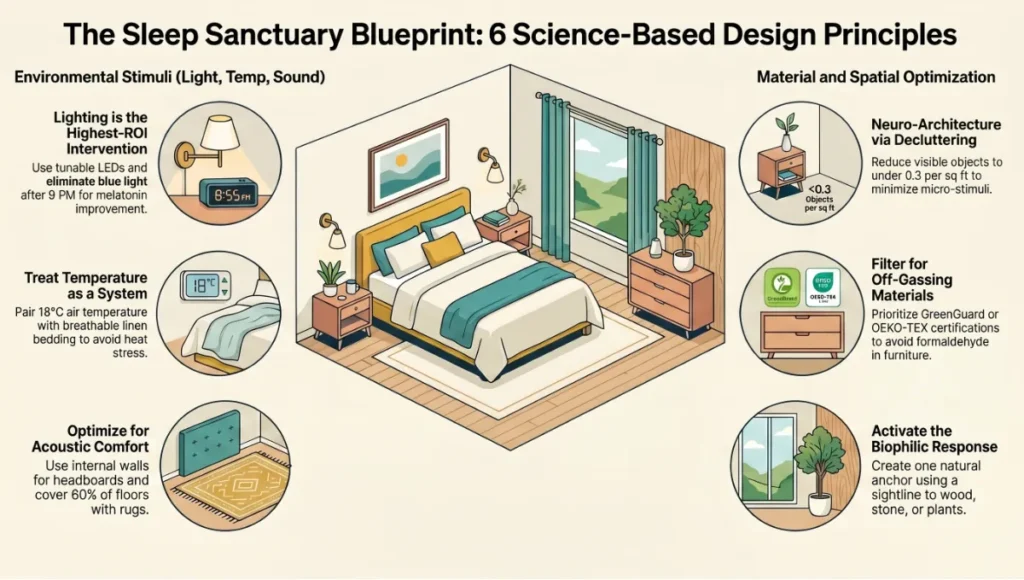
1. Audit before you decorate. Use the 8-point checklist at the end of this guide. Score 0–2 per rule. Address your lowest scores first—they represent the greatest performance gap.
2. Lighting is your highest-ROI intervention. Two tunable LED bulbs (£30) and a commitment to eliminate blue light after 9 PM will produce measurable melatonin improvements within 14 days.
3. Treat temperature as a system, not a number. Coordinate air temperature, bedding tog, and humidity. A room at 18°C with a synthetic high-tog duvet creates the same heat stress as 22°C with linen.
4. Position for acoustics. Move your headboard to an internal wall. Add a dense rug covering 60% of floor area. Use a brown noise machine if ambient levels exceed 30 dB.
5. Specify materials like a chemist. If a piece of furniture is under 3 years old and lacks GreenGuard or OEKO-TEX certification, it is likely off-gassing formaldehyde. Prioritize replacement.
6. Declutter is neuroarchitecture. Every visible object is a micro-stimulus for your prefrontal cortex. Reduce to <0.3 objects/sq ft. Conceal everything else.
7. Create one natural anchor. A single sightline to wood grain, stone, or a living plant activates the biophilic response. You do not need a forest—just one honest material.
Comprehensive Technical FAQ
Q: What is the single most impactful change I can make to create a wellness bedroom?
A: Circadian lighting. Eliminating blue-spectrum light after 9 PM and using only warm, dimmable sources produces measurable improvements in melatonin onset and sleep architecture within 1–2 weeks. It is also the lowest-cost intervention. Cost: <£30 for two tunable LED smart bulbs. Timeline: 14 days to measurable improvement. Supporting evidence: Sleep Foundation; Figueiro et al. (2017) on daytime light exposure and sleep quality.
Q: What temperature should my bedroom be for optimal sleep?
A: 16–19°C (61–66°F) for most adults, with ±1°C individual variation. Trial protocol: Start at 17.5°C. If you wake warm, reduce by 0.5°C. If you wake cold or struggle with onset, increase by 0.5°C. Coordinate with bedding: Summer 4.5–7.5 tog; winter 10.5–13.5 tog. Humidity: Maintain 40–60% RH.
Q: How do I know if my bedroom air quality is acceptable?
A: Use a consumer-grade indoor air quality monitor (Airthings, Awair, IQAir; <£150) tracking CO₂, VOCs, temperature, and humidity simultaneously. CO₂ target: <800 ppm (morning readings consistently >1000 ppm indicate inadequate ventilation). VOC target: <500 µg/m³. PM2.5 target: <12 µg/m³ (requires HEPA filtration). If morning CO₂ exceeds 1000 ppm, increase ventilation or add mechanical air exchange.
Q: Do bedroom plants actually improve air quality?
A: Yes, with qualification. NASA’s Clean Air Study (1989) established baseline evidence; subsequent peer-reviewed research confirms snake plant, peace lily, and pothos reduce benzene, formaldehyde, and particulates. Density required: 2–3 medium plants per 20 m² for meaningful contribution. Function: Supplemental filtration alongside HEPA purifier, not replacement. Additional benefit: Biophilic visual stimulus reduces cortisol independently of air quality.
Q: What is a realistic budget for a wellness bedroom redesign?
A: Meaningful intervention spans a wide range:
- £500–£1,000: Tunable smart bulbs, HEPA air purifier, thermostatic radiator valve, blackout blinds, 3 air-purifying plants
- £5,000–£15,000: Full specification including natural material bedding, acoustic window treatment, structured ventilation, complete material audit
- Highest ROI: Lighting, temperature control, digital detox—all achievable at the lower end
Q: Can I apply these principles to a rented bedroom?
A: Mostly yes.
- Fully implementable without permission: Rules 01 (lighting via smart bulbs), 02 (thermal via bedding), 03 (acoustic via rugs/curtains/noise machines), 04 (air quality via portable purifiers/plants), 06 (color via textiles), 07 (digital detox—behavioral), 08 (declutter—storage organization)
- Partially implementable: Rule 05 (biophilic materials via furniture/textiles)
- Requires structural intervention: Acoustic isolation at building fabric level (mass-loaded walls, resilient channels)—requires landlord permission or ownership
Q: How does neuroarchitecture explain why I sleep better in hotels sometimes?
A: Hotels optimized for sleep often accidentally hit neuroarchitectural targets: lower visual clutter (SDR naturally low), blackout curtains (light control), white noise from HVAC (acoustic masking), and neutral color palettes (LRV in target range). Your home may exceed hotel specs in personalization but fail in controlled variables. The goal is to combine the biological precision of a good hotel with the emotional security of your own space.
Q: What does the Singapore case study tell us about bedroom design?
A: Singapore’s high-density biophilic architecture demonstrates that natural space—not just natural materials or colors—produces the strongest measurable correlation with attentive, self-assured mental states. In bedroom terms, this means your sightline to a natural element (plant, wood grain, stone, window view) is more neurologically consequential than the material itself. The spatial relationship matters as much as the material specification.
Conclusion
Your bedroom is not a room you sleep in. It is the room your biology depends on. You have now read the specifications. You have seen the Rotterdam case study. You have the 8-point audit checklist. The question is no longer whether a wellness bedroom design guide can improve your sleep. The question is whether you will treat your recovery with the same precision you apply to your work, your nutrition, or your fitness tracking.
Begin tonight. Replace one bulb. Measure your room temperature. Move your charger to the hallway. These are not decorative acts. They are calibration acts. The bedroom is a health machine. You are the operator. Start tuning.
© Nuvira Space. All rights reserved. | LIVING SPACES SeriesAll specifications cited are based on peer-reviewed studies in sleep science, neuroarchitecture, and environmental psychology including the Global Wellness Institute 2026 Trends Report, MDPI Sustainability biophilic design research, AIA Framework for Design Excellence (Design for Well-being), and Frontiers in Medicine therapeutic home environment studies. External references: sleepfoundation.org, globalwellnessinstitute.org, aia.org/design-excellence. The Recovery Suite is a speculative internal concept study and does not represent a completed project.