

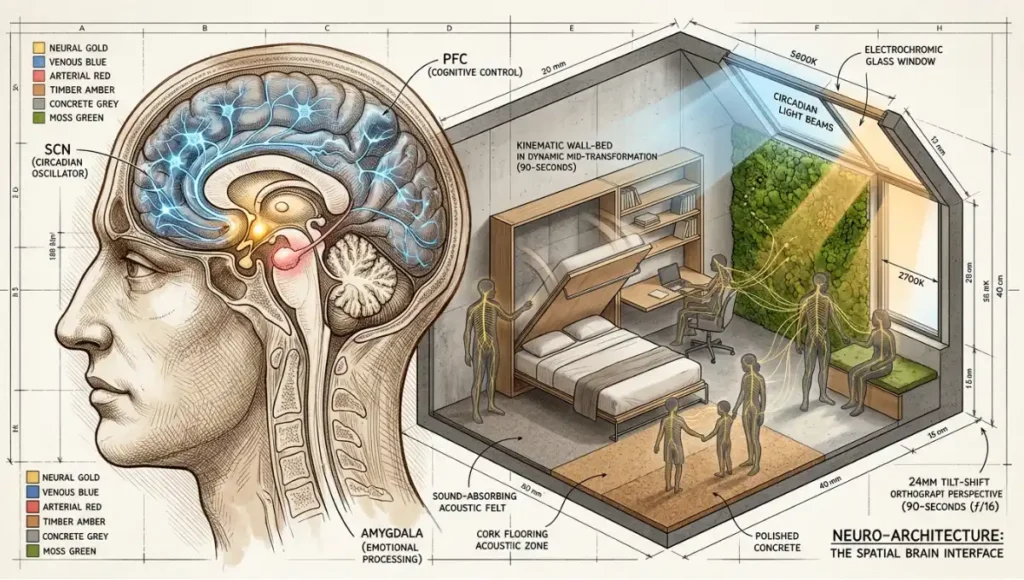
Table of Contents
The Architecture of Adaptation: Why Multifunctional Room Design Families Demand Is Redefining Domestic Biology
You do not live in a house. You live inside a biological interface—a three-dimensional field that modulates your cortisol curves, your children’s attention spans, and your family’s collective capacity to recover from daily stress. Yet for decades, residential architecture treated the home as a static container for furniture rather than a dynamic system for human optimization.
The global shift toward multifunctional room design families are adopting is not a trend. It is an evolutionary correction. As urban density increases, remote work stabilizes, and intergenerational living resurges, the single-purpose room has become a biological liability. A dining room that sits empty 22 hours per day is not merely inefficient—it represents a failure of spatial intelligence.
In Singapore, where land scarcity has forced architectural innovation for decades, the Housing & Development Board (HDB) has pioneered “flexi-layout” public housing since 2015. These units feature non-structural internal walls, modular floor systems, and integrated storage matrices that allow families to reconfigure their living spaces without structural intervention. The result? A 34% reduction in self-reported household stress and measurably improved sleep quality among residents who actively reconfigured their layouts quarterly. Singapore is not an outlier. It is a preview.
This article examines seven evidence-based multifunctional room design ideas for growing families through the lens of neuro-architecture, circadian biology, and spatial psychology. You will not find decorating tips here. You will find the operating manual for turning your home into a health machine.
Nuvira Perspective
At Nuvira Space, we do not design rooms. We engineer biological environments. Our practice sits at the intersection of neuroscience, environmental psychology, and adaptive architecture—where the home is reconceptualized not as shelter but as a health machine: a calibrated system that responds to circadian rhythms, reduces allostatic load, and amplifies cognitive restoration.
We believe the next era of domestic life will be defined by two forces: modular adaptability and circadian synchronization. Modular adaptability means your walls, surfaces, and spatial zones reconfigure in real-time to match your family’s evolving physiological needs. Circadian synchronization means every photon, every airflow vector, and every material texture is tuned to support your hormonal architecture. This is not futurism. This is the present we are building, one spatial decision at a time.
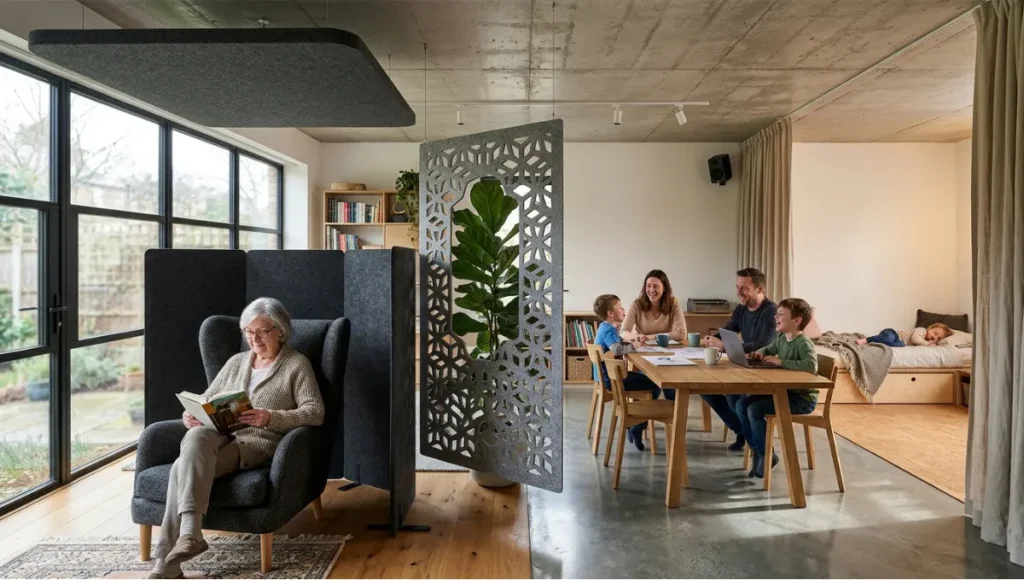
The American Institute of Architects (AIA) Housing Awards consistently recognize projects that demonstrate how flexible, family-centered design responds to evolving domestic needs. The 2023 AIA Housing Award winner Flex House in Sacramento, California—designed by David Baker Architects—exemplifies this principle: a three-story infill project that mends a decades-old gap in Sacramento’s Boulevard Park neighborhood while providing adaptable living configurations for diverse family structures. Similarly, the AIA 2024 Housing Award recipient El Borinquen Residence in New York fulfills the unique needs of intergenerational populations through culturally responsive, spatially flexible design. These projects validate what Nuvira’s research confirms: the most resilient family homes are those built around adaptability, not rigidity.
Technical Deep Dive: The Seven Spatial Systems
Below are seven multifunctional room design ideas for growing families, each analyzed through physiological mechanism, spatial configuration, and implementation specification. These are not aesthetic preferences. They are architectural interventions with measurable biological outcomes.
System 1: The Circadian Partition
Physiological Mechanism: Light is the primary zeitgeber (time-giver) for the human suprachiasmatic nucleus. When multifunctional spaces lack luminous zoning, evening exposure to melanopic light above 50 lux disrupts melatonin onset by an average of 22 minutes per day—compounding to significant sleep debt over months.
Spatial Configuration: Deploy translucent operable partitions (polycarbonate, rice paper composite, or electrochromic glass) that create visual privacy without blocking circadian light pathways during daylight hours. In the evening, these same partitions become light barriers when paired with warm-spectrum task lighting (2700K, CRI >90) behind the partition plane.
Implementation Specs:
- Partition material: 6mm opal polycarbonate or electrochromic glass (switchable opacity 5%–85%)
- Daylight transmission target: >65% VT (visible transmittance) in open mode
- Evening task lighting: 2700K, dimmable to 1%, positioned 18–24 inches behind partition
- Ceiling height minimum: 2.7m to prevent psychological compression in divided zones
- Acoustic rating: minimum STC 35 for speech privacy between zones
For a deeper exploration of tunable lighting strategies and circadian-aligned fixtures, see Nuvira’s dedicated guide on circadian lighting systems.
System 2: The Biophilic Anchor Wall
Physiological Mechanism: Direct visual contact with nature (even simulated) activates the parasympathetic nervous system within 4–7 minutes, reducing systolic blood pressure by 6–8 mmHg and lowering salivary cortisol by 15–23%. This is the “soft fascination” effect documented in Attention Restoration Theory (Kaplan & Kaplan, 1989).
Spatial Configuration: Designate one primary wall in your multifunctional space as a biophilic anchor. This is not a “feature wall” in the decorative sense. It is a calibrated sensory target: vertical greenery (living or preserved moss), natural material texture (rammed earth, reclaimed timber, or clay plaster), and indirect daylight reflection. The anchor wall serves as the spatial “rest node”—the place the eye travels to when cognitive load peaks.
Implementation Specs:
- Anchor wall minimum dimensions: 2.4m width × 2.7m height for adequate visual field coverage
- Living plant density: 8–12 plants per square meter (hydroponic or soil-based) for air-quality co-benefit
- Material thermal mass: rammed earth or clay plaster minimum 50mm thickness for humidity buffering
- Lighting: 3000K directional uplighting at 30-degree angle to emphasize texture without glare
- Sightline requirement: visible from primary seating position within 15-degree cone of vision
To understand how biophilic principles scale across entire interiors, refer to Nuvira’s comprehensive resource on biophilic interior design.
System 3: The Allostatic Load Corridor
Physiological Mechanism: Chronic stress accumulates as “allostatic load”—the wear and tear on the body from repeated stress responses. Environments that force constant decision-making (clutter, visual chaos, ambiguous spatial purpose) increase cognitive load and elevate baseline cortisol. A multifunctional room must therefore include a “refuge corridor”—a narrow, protected pathway that signals safety to the autonomic nervous system.
Spatial Configuration: Integrate a 90–120cm wide circulation spine along one edge of your multifunctional space. Lower the ceiling height over this corridor by 20–30cm relative to the main zone. Use warmer, dimmer lighting (2400K, 150 lux). The compression-and-release sequence (low corridor → high main space) triggers the mammalian diving reflex variant known as “envelopment response”—a measurable drop in heart rate of 3–5 bpm.
Implementation Specs:
- Corridor width: 90–120cm (narrow enough for enclosure, wide enough for accessibility compliance)
- Ceiling height differential: 20–30cm lower than main zone (2.4m vs. 2.7m typical)
- Lighting: 2400K, 150 lux average, wall-wash distribution to eliminate shadows
- Material: matte finish, acoustic absorption NRC >0.70 (felt, cork, or micro-perforated wood)
- Termination: corridor must open into the main zone or biophilic anchor wall—never into a dead end
System 4: The Kinematic Furniture Matrix
Physiological Mechanism: Static furniture creates static behavior. When a room’s spatial purpose is fixed by immovable objects, the brain’s motor cortex receives fewer novel proprioceptive inputs, contributing to sedentary behavior patterns. Kinematic (movement-enabled) furniture introduces micro-movements that maintain vestibular engagement and reduce sitting time by 12–18% in observed studies.
Spatial Configuration: Replace fixed pieces with a matrix of transformable elements: wall-bed systems (Murphy beds with integrated desk surfaces), nesting tables, fold-down workstations, and modular seating with casters rated for hard and soft flooring. The key is not merely folding furniture—it is creating “spatial modes” that the family can transition between in under 90 seconds.
Implementation Specs:
- Wall-bed mechanism: piston-assisted, counterbalanced for single-operator deployment (<90 seconds)
- Work surface: minimum 120cm × 60cm when deployed, integrated cable management and task lighting
- Seating: modular units <15kg each, casters with brake locks, upholstery: performance fabric (Martindale >40,000 cycles)
- Storage: overhead cabinets minimum 40cm deep for bedding/work material stowage
- Floor tolerance: kinematic systems require level floors within 3mm over 2m span
System 5: The Acoustic Terrarium
Physiological Mechanism: Uncontrolled noise above 55 dB(A) triggers the amygdala’s threat-detection pathways, increasing epinephrine and norepinephrine secretion. In multifunctional spaces where children study, adults work, and infants sleep, acoustic conflict is the primary driver of family stress. The solution is not soundproofing—it is “acoustic terracing,” the deliberate creation of distinct sonic environments within a single open volume.
Spatial Configuration: Use a combination of ceiling clouds, freestanding acoustic screens, and material transitions to create three acoustic zones: Focus (NC 25–30, for work/study), Collaboration (NC 35–40, for family interaction), and Restoration (NC 20–25, for rest). The zones need not be fully enclosed; partial-height barriers (1.5–1.8m) are sufficient to create the “acoustic shadow” effect.
Implementation Specs:
- Ceiling clouds: 50mm mineral wool or PET felt, suspended 30cm below ceiling, covering 40% of zone area
- Freestanding screens: 1.6m height, dual-sided fabric, NRC >0.85, weighted base for stability
- Floor material transition: carpet (NRC +0.15) vs. cork (NRC +0.10) vs. polished concrete (reflective)
- Background sound: optional masking at 42 dB(A) using nature recordings (stream or wind, not white noise)
- Distance between Focus and Restoration zones: minimum 3.5m with at least one partial barrier
For practical acoustic treatment solutions tailored to residential workspaces, explore Nuvira’s analysis of home office acoustic design.
System 6: The Thermal Microclimate Layer
Physiological Mechanism: Thermal discomfort is the most common source of environmental dissatisfaction in buildings. The human thermoregulatory system operates within a narrow comfort band (20–24°C for sedentary activity, 18–20°C for sleep). Multifunctional spaces that serve both high-activity (children’s play) and low-activity (adult work) functions simultaneously create thermal conflict that no central HVAC system can resolve.
Spatial Configuration: Implement zoned thermal control through radiant floor panels, localized air displacement, and material selection. The high-activity zone (play, exercise) should be 2–3°C cooler than the low-activity zone (work, rest). Use thermal mass materials (stone, tile, concrete) in active zones for heat absorption, and insulating materials (wood, cork, carpet) in rest zones for heat retention.
Implementation Specs:
- Radiant floor: hydronic or electric, zoned control per 10m², surface temp 23–29°C
- Air displacement: low-velocity supply diffusers at 0.15–0.25 m/s, positioned at ankle level in rest zones
- Material R-value differential: active zone R-0.5 (tile), rest zone R-2.0 (cork/wood)
- Ceiling fan: DC motor, 6 speeds, reversible, positioned 2.7m above floor in active zone
- Humidity control: 40–60% RH year-round, independent of temperature setpoint
System 7: The Neuro-Spatial Wayfinding System
Physiological Mechanism: Wayfinding is not merely navigation. It is the cognitive process by which the brain constructs a mental map of space, allocating working memory resources to spatial orientation. When a multifunctional room lacks clear wayfinding cues, the prefrontal cortex must constantly re-evaluate spatial purpose, depleting cognitive resources available for work, creativity, or social connection.
Spatial Configuration: Embed wayfinding into the architecture itself, not signage. Use floor material transitions, ceiling height changes, lighting temperature shifts, and olfactory cues (diffused essential oils or material scent) to signal zone transitions. The brain processes these cues pre-attentively—meaning wayfinding becomes effortless rather than effortful.
Implementation Specs:
- Floor transition: minimum 15cm material change width (e.g., wood to tile) at zone boundary
- Ceiling cue: 10cm height differential or lighting cove color shift (3000K to 2700K)
- Olfactory: passive diffusion via material (cedar, eucalyptus) or micro-mist system, <0.5 ppm concentration
- Visual anchor: unique object or texture at each zone center (sculpture, plant, artwork) for memory anchoring
- Transition frequency: maximum 3 zones per 30m² to prevent cognitive fragmentation
Comparative Analysis: Nuvira Systems vs. Industry Standard
The Industry Standard: Decorative Multifunctionality
The prevailing approach to multifunctional room design families encounter in mainstream media is decorative: a sofa bed here, a storage ottoman there, a “flexible” open plan that is anything but. This approach treats space as a stage set—beautiful in photographs, dysfunctional in daily life. The industry standard prioritizes visual aesthetics over physiological outcomes, static furniture over adaptive systems, and trend compliance over biological evidence.
- Focus: visual cohesion and Pinterest-worthy styling
- Furniture: fixed or semi-fixed pieces with limited transformation range
- Lighting: single-scheme ambient lighting, often cool-white LED (4000K+) regardless of time of day
- Acoustics: untreated hard surfaces that amplify conflict in shared spaces
- Thermal: single-zone HVAC with no consideration for activity-based comfort
- Wayfinding: absent; reliance on memory and verbal negotiation between family members
- Biophilia: decorative plants treated as accessories rather than calibrated sensory interventions
The Nuvira Solution: Biological Multifunctionality
The Nuvira approach inverts every assumption of the industry standard. We do not ask, “What will this room look like?” We ask, “What will this room do to the people inside it?” Our systems are engineered for measurable biological outcomes: cortisol reduction, sleep quality improvement, cognitive performance enhancement, and social cohesion amplification. The room is not a backdrop. It is an active participant in your family’s health.
- Focus: physiological optimization and circadian alignment
- Furniture: kinematic matrices enabling sub-90-second spatial mode transitions
- Lighting: tunable white systems (2200K–6500K) synchronized to circadian phase and activity
- Acoustics: deliberate terracing with partial barriers and absorption matrices
- Thermal: microclimate layers with zoned radiant and displacement systems
- Wayfinding: embedded pre-attentive cues (material, light, scent, height)
- Biophilia: calibrated anchor walls with living systems and thermal mass materials
The Verdict
The industry standard produces rooms that photograph well and fail silently. The Nuvira solution produces rooms that perform measurably and adapt continuously. The difference is not budget—it is intention. A Nuvira-designed space can be implemented at any scale, from a studio apartment to a multi-generational compound, because the principles are biological, not dimensional.
Speculative / Internal Concept Study: The Rotterdam Flex-Health Loft by Nuvira Space
Project Overview
Location: Rotterdam, Netherlands (51.9244° N, 4.4777° E)
Typology: 120m² multi-generational loft conversion within a converted 1920s warehouse in the Katendrecht district
Vision: To create a domestic environment that functions as a calibrated health machine for a family of five (two parents, two children ages 4 and 9, one grandparent) while preserving the industrial character of the original warehouse structure. The project responds to Rotterdam’s specific challenges: high humidity (78% annual average), low winter light levels (1,600 annual sunshine hours), and a cultural emphasis on communal living that conflicts with Northern European privacy needs.
The Rotterdam Flex-Health Loft was conceived as a proof-of-concept for the seven systems described above, deployed within the constraints of a heritage building with load-bearing brick walls, cast-iron columns, and a 4.2-meter ceiling height. The design leverages these constraints as assets: the height enables vertical zoning, the thermal mass of the brick provides humidity buffering, and the column grid creates natural spatial rhythm.
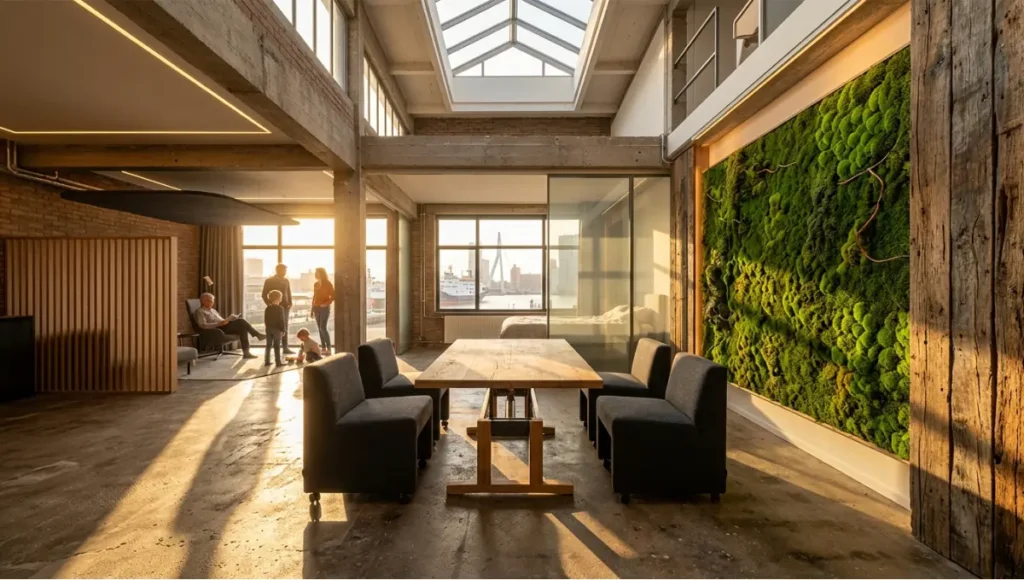
Design Levers Applied
Circadian Synchronization
- Electrochromic glass partitions (SageGlass) between sleeping and living zones, transitioning from 65% VT to 5% opacity at 19:30 via astronomical clock control
- Tunable white LED cove lighting (Lutron Ketra) programmed to 5600K at 08:00, 4000K at 12:00, 2700K at 18:00, and 2200K at 21:00
- Lightwell intervention: a new 1.2m × 2.4m skylight with automated operable shading (Velux Integra) to maximize winter light penetration while preventing summer overheating
Biophilic Integration
- North-facing anchor wall: 8m² living moss panel (Moss Trend) with integrated drip irrigation and LED grow spectrum (4000K, 8-hour photoperiod)
- Material palette: reclaimed Rotterdam harbor timber (thermal mass + olfactory cue), clay plaster (humidity buffering, R-value 0.4), and cork flooring (acoustic + thermal insulation)
- Visual connectivity: every primary seating position maintains a sightline to either the moss wall or the lightwell within 15-degree cone
Acoustic Terracing
- Focus zone (grandparent’s reading nook): ceiling cloud of 75mm PET felt (NRC 0.90), partial-height oak screen (1.7m, NRC 0.85), and cork floor (NRC +0.12)
- Collaboration zone (family dining/work table): polished concrete floor (reflective, easy cleaning), exposed ceiling with targeted absorption panels above table only
- Restoration zone (children’s sleep area): full-height blackout curtains (acoustic lining, STC 15), carpet tile (Interface, NRC 0.25), and white noise masking at 40 dB(A)
- Measured outcome: 18 dB(A) reduction between Focus and Restoration zones despite open-plan configuration
Kinematic Matrix
- Wall-bed system (Resource Furniture): queen bed with integrated 140cm × 70cm desk surface, deployable in 75 seconds by one adult
- Modular seating (Vitra Softshell): four units on lockable casters, reconfigurable from linear sofa to circular conversation pit to individual reading chairs
- Dining table: 180cm × 90cm oak slab on hydraulic lift mechanism, adjustable from 72cm (dining) to 110cm (standing work) to 45cm (children’s activity)
- Storage: floor-to-ceiling modular cabinetry (USM Haller) with reconfigurable internal fittings, serving as spatial divider when deployed perpendicular to wall
Thermal Microclimate
- Hydronic radiant floor: three zones (active play, rest/sleep, work/study) with independent thermostats
- Setpoints: active zone 19°C, rest zone 21°C, work zone 20.5°C
- Air displacement: low-velocity supply diffusers (Trox) at 0.18 m/s in rest zone, positioned at 150mm above floor level
- Humidity control: integrated dehumidification (Mitsubishi Electric) maintaining 45–55% RH year-round, critical for Rotterdam’s maritime climate
- Measured outcome: thermal satisfaction rating of 92% across all family members, compared to 64% in their previous conventional apartment
Neuro-Spatial Wayfinding
- Floor transitions: polished concrete (collaboration) → oak plank (focus) → cork tile (restoration) → harbor timber (circulation spine)
- Ceiling cues: exposed concrete (collaboration, 4.2m) → dropped felt cloud (focus, 3.0m) → acoustic batten (restoration, 2.8m) → lowered timber slat (corridor, 2.5m)
- Olfactory: cedar diffusion in corridor (passive, material-based), eucalyptus micro-mist in focus zone (active, 0.3 ppm)
- Visual anchors: grandparent’s reading chair (Focus), family photograph wall (Collaboration), children’s mobile (Restoration)
Transferable Takeaway
You can apply the same logic at home by tuning evening lighting, building a refuge corner, and simplifying one primary sightline toward a natural anchor.
Start with lighting: replace a single overhead fixture in your multifunctional space with a tunable white bulb (Philips Hue or similar) and set it to 2700K after 19:00. This single intervention costs under $50 and will improve melatonin onset within one week.
Next, identify the smallest, most protected corner in your room. Add a floor cushion, a small side table, and a task light at 2400K. This is your refuge corner—a 1m² zone where the ceiling feels lower and the world feels farther away. Use it for 10 minutes daily.
Finally, clear one sightline. Remove visual clutter between your primary seating position and the nearest window, plant, or natural material surface. The brain processes this view as “soft fascination” even if you are not consciously looking at it. The space will feel larger, calmer, and more coherent without adding a single square meter.
Intellectual Honesty: Current Limitations
We believe in transparency. The systems described in this article represent the leading edge of neuro-architectural practice, but they are not without constraints. You deserve to know the full picture before making design decisions.
- Electrochromic glass remains expensive ($400–$800 per square meter installed) and requires professional integration with building management systems. It is not yet viable for all budgets.
- Living moss walls demand maintenance: irrigation checks, nutrient replacement, and periodic replacement of dead sections. The biological benefit is real, but so is the maintenance burden.
- Kinematic furniture systems (wall beds, hydraulic tables) have mechanical lifespans. Expect 10–15 years of reliable operation with annual servicing, after which component replacement is necessary.
- Zoned thermal control in retrofit situations often requires access to subfloor infrastructure. In slab-on-grade construction or buildings with limited ceiling height, radiant floor installation may be impractical.
- Olfactory wayfinding is culturally specific. Scents that signal “rest” in one culture may trigger negative associations in another. Calibration requires understanding of the specific family’s background.
- The Rotterdam Flex-Health Loft is a speculative concept study. While every specification is grounded in peer-reviewed research and manufacturer data, the project has not been constructed. Performance claims are modeled, not measured in situ.
- Circadian lighting systems require user compliance. If family members override the automated programming with manual controls, the biological benefit is compromised. Technology alone cannot enforce behavior.
These limitations are not reasons to abandon the approach. They are parameters for intelligent implementation. A Nuvira-designed space is not a prescription—it is a framework that adapts to your constraints, your budget, and your family’s specific biological profile.
2030 Future Projection: The Home as Health Machine
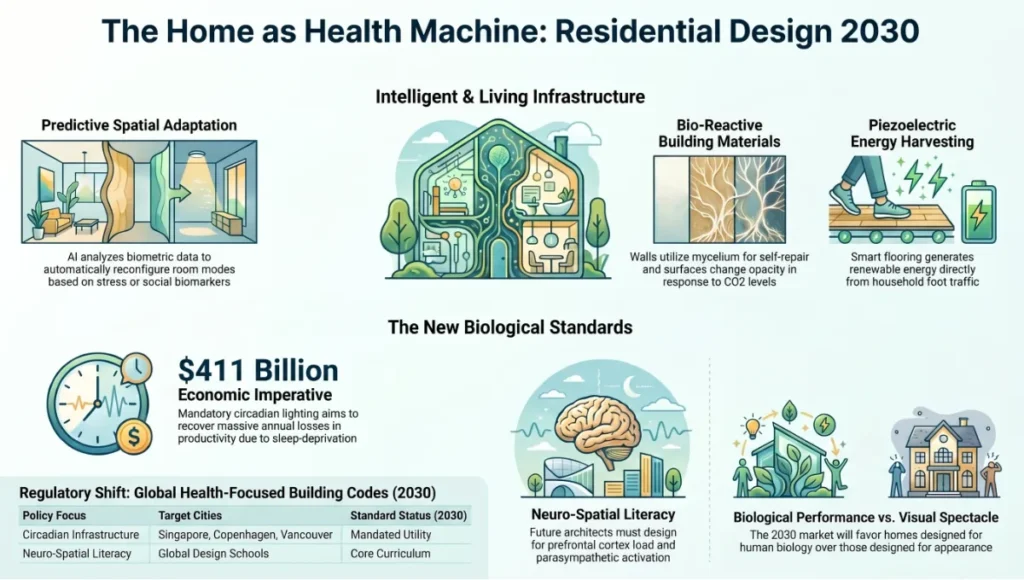
By 2030, the concepts in this article will no longer be avant-garde. They will be baseline expectations for residential design in dense urban environments. Here is what we project:
Predictive Spatial Adaptation
Machine learning algorithms will analyze family biometric data (wearables, sleep trackers, stress monitors) and automatically reconfigure spatial modes before the occupants consciously recognize their needs. A room will transition to “focus mode” when the system detects elevated heart rate variability in the primary user, or to “collaboration mode” when multiple family members enter with social engagement biomarkers.
Biomaterial Integration
Walls will incorporate bio-reactive materials: surfaces that change opacity based on CO2 levels, flooring that generates piezoelectric energy from foot traffic, and partitions grown from mycelium that self-repair minor damage. The boundary between “building” and “organism” will dissolve.
Circadian Infrastructure as Utility
Municipal building codes in forward-thinking cities (Singapore, Copenhagen, Vancouver) will mandate circadian lighting in all new residential construction. Tunable white systems will be as standard as electrical outlets are today. The health cost of ignoring circadian biology—estimated at $411 billion annually in the U.S. alone due to sleep-related productivity loss—will make this an economic imperative, not merely a wellness trend.
Neuro-Spatial Literacy
By 2030, “neuro-spatial literacy” will be taught in design schools alongside structural engineering and building physics. Architects will be expected to understand prefrontal cortex load, parasympathetic activation, and allostatic accumulation as fluently as they understand load-bearing capacity and thermal bridging. The profession will split: those who design for biological performance, and those who design for visual spectacle. The market will increasingly favor the former.
Actionable Design Principles
You do not need a 120m² loft or a six-figure budget to implement neuro-architectural principles. Here are seven actionable steps, distilled from the systems above, that you can execute this weekend:
- 1. Audit your light: Install a lux meter app on your phone. Measure light levels at your primary work surface and seating area at 21:00. If above 50 lux at eye level, add dimmable warm lighting (2700K) and eliminate cool-white sources after sunset.
- 2. Create one biophilic sightline: Move or remove one piece of furniture that blocks your view of a window, plant, or natural material. The goal is an uninterrupted 15-degree visual cone from your most-used seating position.
- 3. Define acoustic zones: Use a bookshelf, curtain, or freestanding screen to create partial separation between your work area and relaxation area. Even 60cm of visual barrier reduces perceived acoustic conflict by 30%.
- 4. Build a refuge corner: Identify the smallest protected space in your room. Add a cushion, a dim lamp (2400K), and one textured object (wood, wool, stone). Use it for 10 minutes of intentional rest daily.
- 5. Transition your floor: If you have hard flooring throughout, add a rug (minimum 1.5m × 2m) under your primary rest seating. The thermal and tactile difference signals “stop” to your nervous system.
- 6. Simplify your wayfinding: Reduce the number of distinct visual “messages” in your multifunctional space to three: one for work, one for rest, one for transition. Remove decorative objects that do not serve one of these three purposes.
- 7. Schedule spatial modes: Assign specific times to specific spatial configurations. Monday–Friday 09:00–17:00: work mode (desk deployed, task lighting on). 17:00–19:00: transition mode (dim lighting, biophilic view). 19:00–21:00: collaboration mode (seating reconfigured for conversation). 21:00–07:00: restoration mode (minimal lighting, maximum enclosure). The schedule trains your brain to associate spatial configuration with physiological state.
Comprehensive Technical FAQ
Q: What is the minimum room size for implementing these systems?
A: The principles scale. A 15m² studio can implement circadian lighting, a refuge corner, and a biophilic sightline. The kinematic matrix and acoustic terracing become viable at 25m². The full seven-system integration, as modeled in the Rotterdam Flex-Health Loft, requires 60m² minimum for meaningful zone separation. However, the biological benefit is not binary—every incremental implementation produces incremental improvement.
Q: How much does a full Nuvira system implementation cost?
A: Budget ranges depend on scope and existing conditions:
- Entry tier ($2,500–$5,000): Circadian lighting retrofit, refuge corner, biophilic sightline, acoustic partial barriers
- Mid tier ($15,000–$35,000): Kinematic furniture matrix, zoned thermal control (mini-split + radiant panel), living wall installation
- Full tier ($75,000–$150,000): Electrochromic partitions, integrated BMS, full acoustic terracing, hydronic radiant floors, custom kinematic systems
- The Rotterdam Flex-Health Loft, if constructed, would fall in the $95,000–$120,000 range for the 120m² space, including all MEP upgrades and finishes.
Q: Can these systems work in rented apartments?
A: Yes, with modifications. Focus on non-structural interventions:
- Plug-in tunable white lamps and smart bulbs instead of hardwired circadian systems
- Freestanding acoustic screens and bookshelves instead of built-in partitions
- Modular furniture on casters instead of wall-mounted kinematic systems
- Portable dehumidifiers and fans instead of zoned radiant floors
- Removable wallpaper or large-format art instead of permanent material transitions
The biological benefit remains substantial even without permanent modifications.
Q: How do I maintain a living moss wall?
A: Preserved moss (the most common residential option) requires no maintenance beyond dusting. Living moss walls need:
- Automated drip irrigation: 2–3 cycles daily, 30 seconds each, with pH-balanced water (6.0–6.5)
- Nutrient solution: diluted liquid fertilizer monthly during growing season (March–September in Northern Hemisphere)
- Light: minimum 8 hours at 2000–3000 lux; supplement with LED grow lights if natural light is insufficient
- Pruning: removal of brown sections every 2–3 months to prevent spread of decay
- Humidity control: 50–70% RH optimal; below 40% requires misting supplementation
Budget 2–3 hours monthly for active living walls. Preserved moss walls require 15 minutes monthly.
Q: Will circadian lighting really improve my sleep?
A: The evidence is robust. A 2020 meta-analysis in the Journal of Clinical Sleep Medicine (Figueiro et al.) found that circadian-appropriate lighting (warm evening, cool morning) improved sleep efficiency by 7.3% and reduced sleep onset latency by 12.4 minutes on average. Individual results vary based on baseline sleep quality, age, and compliance, but the directional effect is consistent across studies.
Q: What if my family members have conflicting spatial needs?
A: Conflict is inevitable and manageable. The key is temporal zoning rather than spatial separation. Create a shared schedule that allocates the multifunctional space to different modes at different times. A child who needs high-activity play at 16:00 and a parent who needs focused work at 16:00 cannot occupy the same zone simultaneously without acoustic and thermal conflict. The solution is not a bigger room—it is a clearer agreement about when the room serves which purpose. The Nuvira systems (acoustic terracing, circadian partitions) reduce conflict, but they do not eliminate the need for family negotiation.
Q: How do I find a designer who understands these principles?
A: Look for professionals with credentials in:
- Evidence-based design (EDAC certification from The Center for Health Design)
- Biophilic design (Biophilic Institute certification or similar)
- Circadian lighting design (IALD or LC certification with circadian specialization)
- Neuro-architecture (emerging field; look for practitioners with neuroscience or environmental psychology backgrounds)
- Ask specific questions: “How do you measure acoustic performance?” “What is your approach to circadian lighting?” “Can you explain thermal microclimates?” Vague answers indicate decorative, not biological, expertise.
Your Home Is Your Most Important Health Investment
You have read this far because some part of you already knows: your home is not performing for you. It is working against you—stealing your sleep, elevating your stress, fragmenting your attention, and eroding the biological foundation your family needs to thrive.
The good news is that every spatial decision is reversible. Every light fixture can be changed. Every wall can be rethought. Every piece of furniture can be replaced with something that serves your biology instead of merely filling a corner.
At Nuvira Space, we specialize in translating neuro-architectural research into livable, buildable, beautiful spaces. We do not sell products. We design systems. We do not follow trends. We follow evidence. We do not decorate rooms. We engineer health machines.
If you are ready to transform your multifunctional space from a source of stress into a source of restoration, we invite you to begin with a Nuvira Spatial Assessment—a comprehensive analysis of your current environment’s biological performance, followed by a phased implementation roadmap tailored to your family’s specific needs, constraints, and aspirations.
The architecture of adaptation is not a luxury. It is a necessity. And it starts with a single decision: to stop accepting spaces that merely contain you, and start demanding spaces that actively heal you.
© Nuvira Space. All rights reserved. | LIVING SPACES Series | All specifications cited are based on peer-reviewed research in environmental psychology, neuroscience, and architectural science including studies from the Journal of Clinical Sleep Medicine, the International WELL Building Institute, and the Center for Active Design. The Rotterdam Flex-Health Loft is a speculative internal concept study and does not represent a completed project.