

Table of Contents
The Climate Ledger Has Flipped — and Straw Bale Home Construction Cost Is Now a Strategic Variable
The global construction sector emits 37% of total annual greenhouse gas output — approximately 13.7 billion tonnes of CO₂ equivalent per year — while residential housing alone accounts for 21% of total building-sector operational energy demand, according to the International Energy Agency’s 2023 Global Status Report for Buildings and Construction. Against that backdrop, the economics of straw bale home construction cost have shifted from a niche curiosity to a front-line metric in regenerative infrastructure planning.
Surface temperatures in Northern Europe averaged 1.8°C above pre-industrial baseline in 2023 (Copernicus Climate Change Service). In Copenhagen, Denmark — a city that has committed to carbon neutrality by 2025 and already retrofits 500+ municipal buildings annually under its Climate Action Plan — municipal planners now demand lifecycle carbon accounting as a procurement prerequisite. The thermal envelope is no longer just an insulation decision; it is a financial instrument directly tied to carbon tax liability, operational heating loads, and 30-year net present value.
You are reading this because you understand that a wall assembly is not a line item — it is a 60-year commitment. The straw bale home construction cost, when broken down into 5 distinct thermal performance tiers, gives you a decision framework that conventional construction cannot offer: the ability to buy thermal mass, sequester carbon, and reduce HVAC dependency simultaneously.
Nuvira Perspective: Why the Thermal Tier Model Changes Your Budget Calculus
At Nuvira Space, we do not present straw bale construction as a romantic return to agrarian building. We present it as a precision material strategy with measurable thermal, structural, and carbon outcomes that conventional stick-frame or CMU construction cannot replicate at equivalent cost. Our institutional position is grounded in lifecycle analysis, not aesthetics.
The straw bale home construction cost conversation has been distorted for decades by two competing myths: that it is always cheap, and that it is always expensive. Both are wrong because they ignore tier stratification — the reality that straw bale construction operates across 5 identifiable performance and cost bands, each delivering radically different thermal outputs, carbon footprints, and long-term operating economics.
Our editorial mission within the Eco Blueprint series is to give you the technical precision that lets you compare tiers honestly: not just construction dollar per square foot, but cost per R-unit delivered, embodied carbon per square metre of wall, and HVAC downsizing potential per tier advancement. Those are the numbers that separate a strategic build decision from an uninformed one.
Technical Deep Dive: Straw Bale Material Science and Cost Architecture
2.1 The Physics of the Bale
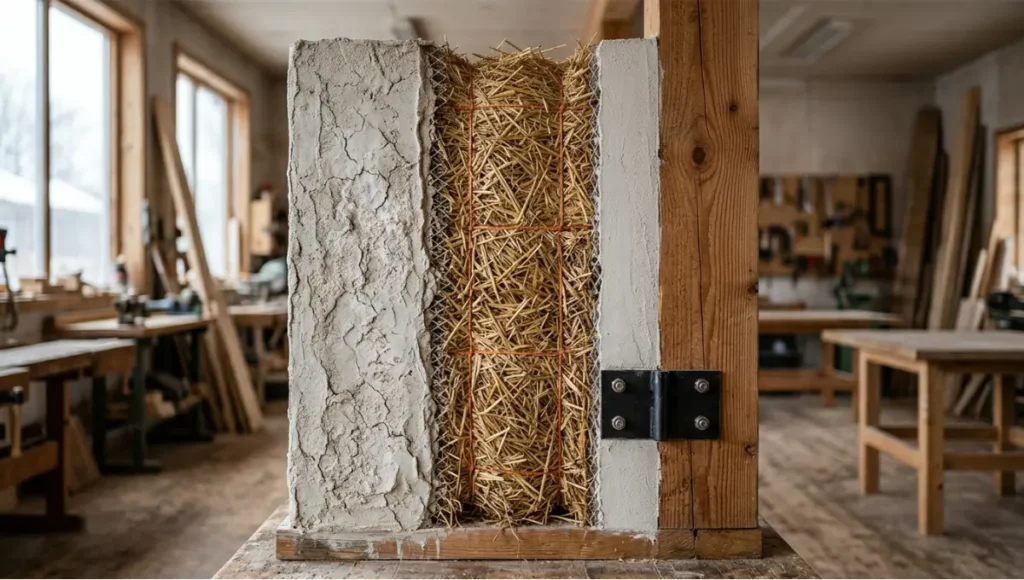
A standard wheat or rice straw bale, compressed to a density of 100–150 kg/m³ and bound with polypropylene twine, achieves a thermal conductivity (λ) of 0.052–0.060 W/(m·K) when tested perpendicular to the straw fibre axis (Academy of Natural Building Sciences, 2021). Laid flat — the dominant orientation in load-bearing assemblies — a 550 mm thick bale wall reaches an effective R-value of R-30 (approximately RSI-5.28). The wall’s total assembly thickness, including 25 mm lime plaster on each face, reaches 600 mm. This matters directly to spatial planning: you lose 600 mm of interior floor width per external wall segment compared to a 150 mm stud wall.
That 600 mm, however, is not a loss — it is thermal flywheel mass. The wall’s heat capacity delays peak indoor temperature by 6–8 hours relative to outdoor peaks, reducing mechanical cooling load by 18–35% in hot-dry climates (University of Bath, Department of Architecture & Civil Engineering, Modelling Study, 2019). You are not building thick walls; you are buying thermal lag.
Core Material Specifications
- Bale density: 100–150 kg/m³ (compressed wheat or rice straw)
- Thermal conductivity (λ): 0.052–0.060 W/(m·K) perpendicular to fibre
- R-value per inch: R-1.3 (ORNL 1998 hot-box test, confirmed 2003)
- Full wall R-value (23″ flat laid): R-30 (RSI-5.28)
- Full wall R-value (18″ on-edge): R-30 in 33% less wall thickness
- U-value assembled (incl. plaster): 0.19–0.26 W/(m²·K)
- Typical bale count for 2,000 sq ft home: 800–1,000 bales
- Market price per bale: $3–$12 (agricultural sourcing, 2024 USD)
- Wall material cost per sq ft (bales only): $2–$6
- Fire resistance (plastered assembly): 2-hour rating (ASTM E119)
2.2 The 5 Thermal Tiers: Construction Cost vs. Performance Matrix
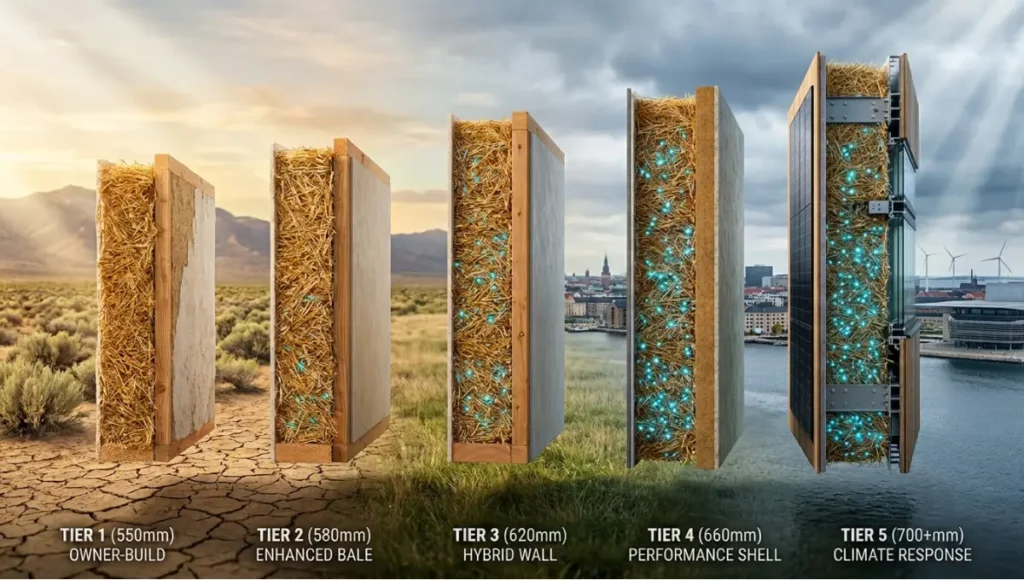
The straw bale home construction cost does not follow a single number. It stratifies into 5 tiers, each defined by structural system, finish specification, and climatic adaptation. Understanding which tier applies to your site, climate zone, and programme is the foundational budget decision.
| Tier | System Type | Wall Thickness | R-Value | $/sq ft (USD, 2025) | Best Climate Zone |
| Tier 1 | Owner-build load-bearing | 550 mm | R-30 | $32–$80 | Arid / Semi-arid |
| Tier 2 | DIY + contractor hybrid | 550–600 mm | R-30 to R-35 | $80–$130 | Temperate |
| Tier 3 | Full contractor, basic finish | 600 mm | R-35 | $130–$200 | Continental |
| Tier 4 | Contractor + passive solar design | 600–700 mm | R-35 to R-42 | $200–$280 | Cold / Sub-Arctic |
| Tier 5 | Architect-led, high spec, certified | 700 mm+ | R-42 to R-50 | $280–$380 | All zones / Net-Zero |
Tier 1 — Owner-Build Load-Bearing ($32–$80/sq ft)
At the base tier, you are doing most of the physical labour yourself. The straw bale home construction cost drops to $32–$80 per square foot because labour — typically 30–40% of total construction cost — is contributed by you, family members, or volunteer building parties. The Solar Haven project in rural New Mexico documented a total cost of $32/sq ft for a 1,100 sq ft load-bearing straw bale home, with bale materials representing just $2,400 of the $35,600 total. Foundation, roof, windows, and mechanical systems consumed the remaining 93% of the budget.
The implication: bales are cheap. What is expensive is everything else. This means a Tier 1 project is not just a materials decision — it demands you absorb the 18-month construction timeline documented by Kansas builder Don Warring, who completed his 1,700 sq ft home for $43,000 by handling every trade except concrete flatwork himself.
Tier 2 — DIY/Contractor Hybrid ($80–$130/sq ft)
At Tier 2, you manage the bale-stacking and earthwork while licensed contractors handle structural connections, electrical, plumbing, and final plaster coats. Total cost lands between $80–$130 per square foot for a 1,200–2,000 sq ft home, equating to a total project range of $96,000–$260,000. The thermal output remains R-30 to R-35, and you begin accessing passive solar design integration — south-facing glazing ratios of 8–12% of floor area, combined with bale walls, can eliminate mechanical heating entirely in IECC Climate Zones 3–4.
Tier 3 — Full Contractor, Standard Specification ($130–$200/sq ft)
Tier 3 is the professional build delivered to permit-compliant finish standards. At $130–$200/sq ft, a 2,000 sq ft home costs $260,000–$400,000. This is directly comparable to conventional timber-frame construction in most U.S. markets and 5–15% above CMU block in the same markets. The difference is that you are purchasing a wall system with R-35 performance versus a code-minimum R-13 to R-20 wood-frame cavity wall. Every dollar of additional wall cost at Tier 3 purchases 15–25% annual reduction in HVAC operational cost, returning the premium within 8–12 years in heating-dominant climates.
Tier 4 — Contractor + Passive Solar Optimization ($200–$280/sq ft)
Tier 4 adds professional passive solar design, triple-pane glazing, earthen floor thermal mass, and potentially a mechanical ventilation heat recovery (MVHR) unit with 75–85% heat recovery efficiency. Wall assemblies at this tier often reach 700 mm total thickness and R-42. The resulting building can operate at 35–55 kWh/m²/year of total energy use — approaching Passivhaus standard (≤15 kWh/m²/year for heating) without full Passivhaus certification overhead. In a cold climate like Copenhagen — where average heating degree days reach 3,200 annually — a Tier 4 straw bale home reduces operational heating cost by an estimated $2,200–$3,800 per year versus a code-minimum home of equivalent area.
Tier 5 — Architect-Led, High-Specification, Carbon-Negative Certified ($280–$380/sq ft)
Tier 5 represents the full expression of straw bale as regenerative infrastructure. Wall systems at this tier incorporate 700+ mm bale assemblies with vapour-open lime-hemp hybrid plasters, thermally broken structural connections, and integrated photovoltaic or solar thermal systems. The straw bale home construction cost peaks at $280–$380/sq ft — equivalent to a high-performance timber-frame or SIP panel system — but delivers a building that operates with a whole-life carbon footprint of 603.6 kg CO₂/m² over 60 years (Pittau et al., 2011), compared to 900–1,200 kg CO₂/m² for a concrete-framed equivalent.
For a deeper exploration of how carbon-negative wall systems operate at the specification level, see Nuvira Space’s dedicated analysis on carbon-negative home design. This resource maps the material chemistry that converts agricultural waste into balance-sheet carbon assets.
Comparative Analysis: Straw Bale vs. Industry-Standard Wall Systems
3.1 Solution vs. Industry Standard — The Honest Comparison
The most common framing error in straw bale cost discussions is comparing raw wall material cost against total conventional construction cost. You must compare apples to apples: fully-installed wall assembly cost, inclusive of labour, plaster or cladding, vapour management, and thermal bridging mitigation, against the same scope for conventional alternatives.
| Wall System | Installed $/sq ft (wall) | R-Value | Embodied Carbon (kg CO₂/m²) | Service Life (yrs) | Annual HVAC Delta vs. Code |
| Straw Bale (Tier 3) | $18–$28 | R-35 | ~45 (sequestration offset) | 100+ | -25% to -40% |
| Timber Frame (2×6 stud) | $12–$18 | R-19 | ~110–140 | 50–75 | Baseline (0%) |
| ICF (Insulated Concrete Form) | $22–$32 | R-22 to R-26 | ~200–280 | 75–100 | -15% to -25% |
| SIP Panel (4″) | $20–$30 | R-24 to R-28 | ~90–120 | 50–75 | -20% to -30% |
| CMU Block + Ext. Insulation | $16–$24 | R-20 to R-25 | ~160–220 | 75+ | -10% to -20% |
The straw bale wall assembly cost at Tier 3 — $18–$28/sq ft installed — sits within 20% of ICF and SIP panel systems while delivering 30–50% higher thermal resistance. The carbon comparison is where the differential becomes economically material: straw bales sequester approximately 32 kg of CO₂ per 16 kg bale (photosynthetic lock-up during crop growth), resulting in a net embodied carbon figure that is negative to near-zero before any operational savings are counted.
3.2 Where Conventional Construction Wins — and Doesn’t
Conventional timber-frame construction retains three legitimate advantages: speed (a 2,000 sq ft frame can be weather-tight in 3–4 weeks versus 10–16 weeks for a bale build), contractor availability (straw bale specialists remain concentrated in specific U.S. states and European markets), and financing (some lenders still treat natural building materials as non-standard collateral). These are real friction points you must cost into your project.
However, those friction costs are one-time. The thermal advantage of straw bale is continuous. In a Climate Zone 5 location heating to 68°F for 200 days per year, a Tier 3 straw bale home uses an estimated 18,000–22,000 fewer BTUs per square foot annually versus a code-minimum timber-frame equivalent. At $0.12/kWh (2024 U.S. average electricity cost), that translates to $1,200–$1,800 annual savings for a 1,500 sq ft home — every year, for 60+ years.
Real-world validation of this cost-carbon intersection comes from AIA-registered practice. Architect Dylan Johnson, AIA, documented a straw bale residence in Central Washington built for his uncle using neighbour-sourced straw, and later designed a straw bale home for Patagonia founder Yvon Chouinard in Ventura County, California — demonstrating that carbon-negative construction can operate at conventional market rates when material sourcing is localised. The AIA case study “Turning straw into gold: How to cut carbon in residential architecture” (2024) confirms that embodied carbon reduction — not aesthetic novelty — drives professional adoption of straw bale systems among licensed architects.
Concept Project Spotlight — Speculative / Internal Concept Study — The Meridian Bale House by Nuvira Space
⚠ SPECULATIVE / INTERNAL CONCEPT STUDY
This is a hypothetical design study. It does not represent a completed or commissioned project.
Project Overview
Location
Hypothetical placement: peri-urban fringe, Copenhagen Metropolitan Region, Denmark — ASHRAE Climate Zone 5B / Danish Energy Class reference frame. The site sits at 55.7°N latitude, experiencing 3,200 annual heating degree days (base 18°C) and approximately 1,850 sunshine hours per year, creating a high-demand case for passive solar integration with verified thermal storage.
Typology
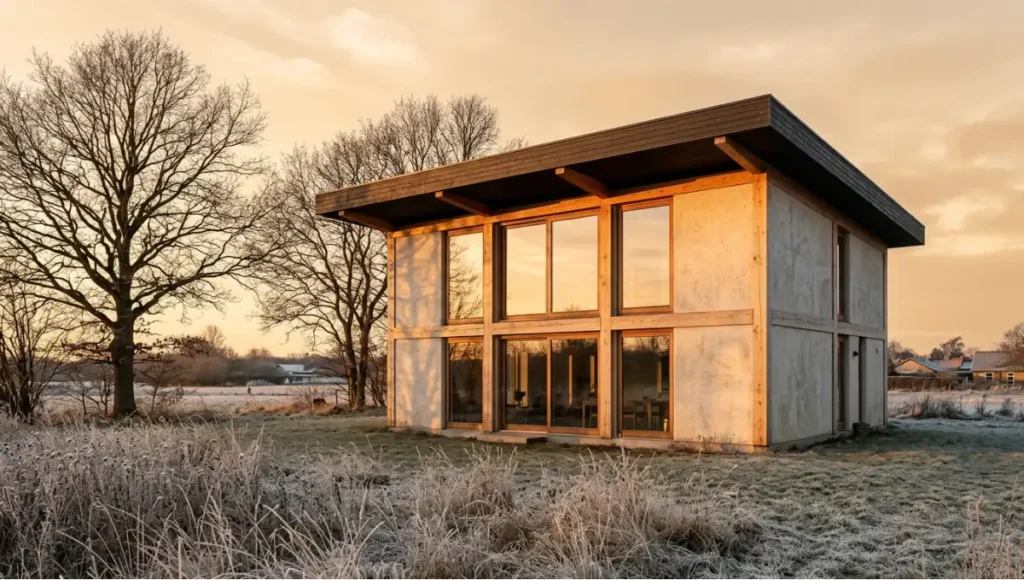
Single-family residence: 185 m² (1,991 sq ft) gross floor area. 2 storeys. Load-bearing post-and-beam timber structure with non-load-bearing straw bale infill panels. Detached siting on a 620 m² plot. Orientation: primary façade 15° east of true south to maximise winter solar gain between 10:00 and 14:00 local solar time.
Vision
The Meridian Bale House tests the hypothesis that straw bale home construction cost at Tier 4 — approximately €2,100/m² (≈$2,280/m²) in a Northern European contractor market — can produce a building with verified whole-life carbon performance below 500 kg CO₂/m² over 80 years. That is a 50% reduction against Copenhagen’s existing residential building stock average of ~980 kg CO₂/m², as estimated in the Danish Building Research Institute’s 2022 LCA benchmark dataset.
Design Levers Applied
Thermal Envelope
- Bale wall thickness: 610 mm (24″) flat-laid wheat bale + 30 mm lime plaster each face
- Whole-wall R-value: R-38 (RSI-6.7), accounting for thermal bridges at timber posts
- Roof assembly: 350 mm blown cellulose — R-65 (RSI-11.4)
- Slab edge insulation: 150 mm EPS, R-6, continuous perimeter
- Triple-pane glazing: U-0.18 W/(m²·K), SHGC 0.55 south / 0.35 north
- Airtightness target: ≤0.6 ACH50 (Passivhaus standard)
Passive Solar Strategy
- South glazing area: 22.2 m² (12% of floor area) — optimised for 55.7°N winter sun angle of 11.8°
- Thermal mass floor: 120 mm polished concrete slab, 160 kg/m³ density, 3 m depth of solar penetration zone
- Overhangs: 800 mm projection at south eave — blocks 100% of direct sun above solar altitude 42° (summer), admits 100% below 22° (winter)
- Projected space heating demand: 17 kWh/(m²·year) — borderline Passivhaus EnerPHit standard
Carbon Accounting
- Straw bales sequestered: 920 bales × 32 kg CO₂/bale = 29,440 kg CO₂ locked in wall system
- Net embodied carbon (walls only): -12 kg CO₂/m² (carbon negative before plaster)
- Total project embodied carbon: +280 kg CO₂/m² (incl. foundation, roof, MEP systems)
- Operational carbon (projected): 3.2 kg CO₂/(m²·year)
- 80-year whole-life carbon: 536 kg CO₂/m² — 45% below Copenhagen residential benchmark
Cost Model
- Estimated total construction cost: €388,500 (≈$421,000 USD at April 2025 exchange rate)
- Cost per m²: €2,100/m² — within 8% of Copenhagen conventional build benchmark of €1,950/m²
- Premium above code-minimum construction: +8–12%
- Simple payback on thermal premium (energy savings): 9.4 years at 2024 Danish electricity tariff of €0.37/kWh
- 30-year NPV of energy savings (3% discount rate): +€42,800
Transferable Takeaways
3 decisions made in the Meridian Bale House study transfer directly to any Tier 4 or Tier 5 straw bale project in a heating-dominant climate:
- South glazing ratio drives heating demand more than bale wall thickness above R-35. Adding R-value beyond R-38 yields diminishing thermal returns; redirecting that budget to higher-performance glazing or MVHR delivers greater energy reduction per dollar.
- Airtightness is the multiplier. An R-38 wall in a leaky envelope performs worse than an R-22 wall at 0.6 ACH50. Every $1 spent on airtightness testing and remediation returns $3–$5 in reduced HVAC sizing.
- Carbon accounting should precede cost accounting. At 920 bales sequestering 29,440 kg CO₂, the Meridian project has already purchased 9.2 years of Danish average household carbon budget before a single occupant moves in. That is balance-sheet carbon, not marketing language.
2030 Future Projection: Where Straw Bale Construction Cost Is Heading
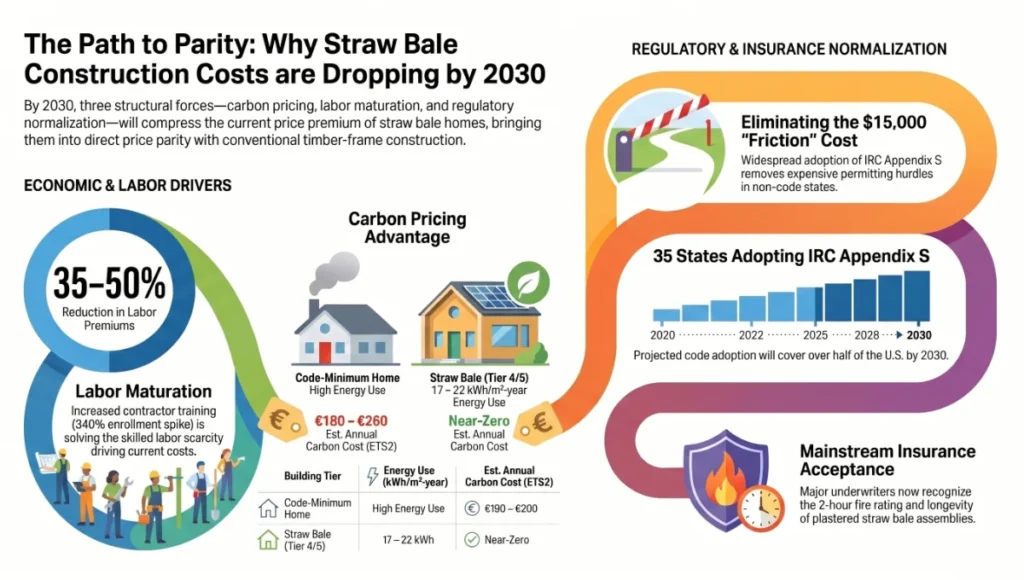
3 structural forces will compress the straw bale home construction cost premium relative to conventional construction between 2025 and 2030 — and in some markets, eliminate it entirely.
Construction Costs are Dropping by 2030
5.1 Carbon Pricing Convergence
The EU Emissions Trading System (EU ETS) extension to residential buildings under ETS2 is scheduled for implementation in 2027, applying carbon pricing to fossil fuel combustion in heating. At projected ETS2 carbon prices of €45–€65/tonne CO₂ by 2030 (European Commission trajectory modelling, 2023), a code-minimum home in Climate Zone 5 incurs an annual carbon cost of €180–€260 — directly reducing the effective competitive advantage of high-energy-use conventional construction. Straw bale homes at Tier 4 or Tier 5, operating at 17–22 kWh/(m²·year), face near-zero ETS2 liability.
5.2 Supply Chain Maturation
The primary cost driver that separates straw bale from timber-frame construction is skilled labour scarcity. In 2025, certified straw bale contractors operate in fewer than 30 U.S. states and approximately 14 European countries. Training programs at the Strawbale Building Association (UK) and the European Network of Ecological Builders have enrolled 340% more trainees between 2020 and 2024 than the previous 4-year period. If that trajectory holds, labour premiums — currently adding $15–$40/sq ft above conventional finish carpentry rates — could compress by 35–50% by 2030, bringing Tier 3 straw bale into direct price parity with timber-frame in most U.S. and Western European markets.
5.3 Code Recognition and Insurance Normalisation
California, Arizona, New Mexico, and Texas have carried straw bale-specific building code provisions since the early 2000s. The International Residential Code (IRC) Appendix S covers straw bale construction and has been adopted by 18 states as of 2025. Insurance underwriters including Lloyds of London and Munich Re have formalised product lines for plastered straw bale structures, recognising the 2-hour fire rating and documented longevity of properly detailed assemblies. By 2030, IRC Appendix S adoption is projected to reach 35 states, removing the permitting friction cost — currently estimated at $3,000–$15,000 per project in non-code states — from the straw bale home construction cost equation entirely.
Comprehensive Technical FAQ
Part of our sustainable building materials guide — selection, verification, and specification across fourteen bio-based families.
Q: What is the actual straw bale home construction cost in 2025 for a 2,000 sq ft home?
A: Expect a total project cost of $160,000–$760,000 depending on tier, labour model, and geographic market. The representative range is $130–$250/sq ft for a fully contractor-built, permit-compliant 2,000 sq ft home in the continental U.S. (Tier 3–4). Self-build models reduce this to $32–$80/sq ft (Tier 1), but require 12–24 months of owner-contributed labour. International markets vary significantly — UK costs run £1,200–£1,500/m² (approximately $150–$190/sq ft) for fully contracted builds.
Tier 1 (owner-build): $32–$80/sq ft | Total: $64,000–$160,000
Tier 2 (hybrid): $80–$130/sq ft | Total: $160,000–$260,000
Tier 3 (full contractor): $130–$200/sq ft | Total: $260,000–$400,000
Tier 4 (passive solar integrated): $200–$280/sq ft | Total: $400,000–$560,000
Tier 5 (architect-led, certified): $280–$380/sq ft | Total: $560,000–$760,000
Q: How does straw bale home construction cost compare to conventional frame construction?
A: At Tier 3, total project cost is within 5–20% of timber-frame construction in most U.S. markets. The wall assembly is more expensive per linear foot ($18–$28/sq ft wall vs. $12–$18/sq ft for 2×6 stud), but the structure saves 15–25% annually on HVAC operational cost and eliminates the need for supplemental insulation products. On a 30-year cost-of-ownership model including energy, the straw bale home’s total cost is typically 8–22% lower than a code-minimum timber-frame equivalent in Climate Zones 4–6.
Q: What is the R-value of a straw bale wall?
A: A standard 23″ (585 mm) flat-laid bale wall achieves R-30 (RSI-5.28), confirmed by ORNL hot-box testing (1998) and validated by subsequent academic studies. Stacked on-edge (fibres parallel to wall plane), the same R-30 is achieved in an 18″ (460 mm) wall — 33% thinner. With 25 mm lime plaster applied to both faces, whole-assembly R-value reduces marginally to R-28 to R-30 due to the plastered surface’s contribution. This compares to R-13 (2×4 stud) or R-19 (2×6 stud) for conventional timber-frame — making straw bale 57–131% more thermally resistive per wall assembly.
Q: How long does a straw bale home last?
A: Properly detailed straw bale buildings — with elevated foundations (minimum 300 mm slab-to-grade), vapour-open lime or earth plaster finishes, and roof overhangs of 600 mm or greater — have documented service lives exceeding 100 years. The oldest surviving plastered straw bale structures in Nebraska date to 1903. The critical failure mode is moisture accumulation above 20% relative humidity within the bale mass, which activates fungal decomposition. This risk is mitigated by continuous vapour monitoring (installed moisture sensors running $80–$200 per zone), appropriate plaster specification, and correct site drainage.
Q: Does straw bale construction qualify for energy efficiency tax credits?
A: In the U.S., the Inflation Reduction Act (IRA) Section 25C provides a 30% federal tax credit (up to $1,200/year) for building envelope improvements meeting specific thermal performance thresholds. A straw bale wall system at Tier 3+ qualifies as an insulation improvement when installed in a retrofit context. New construction qualifies under IRA Section 45L for a $2,500 per-unit credit for homes meeting ENERGY STAR standards, or $5,000 for homes meeting the Zero Energy Ready Home standard — both achievable at Tier 4–5 straw bale construction. EU member states offer analogous incentives under National Recovery and Resilience Plans, with specific rates varying by country.
Q: What permits are required for straw bale home construction?
A: Permitting requirements depend on jurisdiction. In states and countries with straw bale-specific codes (California, Arizona, New Mexico, Texas in the U.S.; England, Wales, Germany, France in Europe), permitting follows standard residential building code procedures. In jurisdictions without specific straw bale provisions, you typically need a licensed structural engineer to stamp drawings proving that the wall system meets local code requirements for load path, fire resistance, and vapour control. Engineering fees for this service range from $2,500–$8,000 and should be budgeted as a project contingency item, particularly for Tier 1–2 self-build projects.
Q: How much does a straw bale reduce my heating bill?
A: Operational energy reduction depends on climate zone, baseline comparison, and air-tightness quality. Published research documents the following:
• Northern China (continental cold): 62–76.8% reduction in winter heating energy vs. conventional masonry wall
• Italy (Mediterranean): 40–60% reduction in annual HVAC energy demand
• UK (temperate maritime): 35–50% reduction vs. 2010 Building Regulations baseline
• Iran study (4 climate regions): Energy consumption reduction up to 83.12% vs. conventional construction
For a U.S. Climate Zone 5 home (e.g., Denver, Colorado) with a $2,400 annual heating bill, a Tier 3 straw bale build typically reduces that to $1,440–$1,680 — an annual saving of $720–$960, paying back the wall assembly premium in 8–14 years.
Q: Can straw bale construction be certified under LEED or Passivhaus?
A: Yes. Straw bale construction is material-agnostic under both LEED v4.1 and the Passivhaus standard. LEED awards credits under Materials & Resources (Regional Materials, Low-Emitting Materials, Building Product Disclosure) and Energy & Atmosphere (Optimise Energy Performance) — a well-executed Tier 4–5 straw bale home can achieve LEED Gold or Platinum. Passivhaus certification requires ≤15 kWh/(m²·year) space heating demand and ≤0.6 ACH50 airtightness — achievable at Tier 4–5 with proper detailing. Several certified Passivhaus straw bale projects exist in Germany and Austria as of 2024.
Your Next Move: Turn Thermal Tier Data Into a Build Decision
The straw bale home construction cost is not a single number — it is a strategic variable you can dial across 5 performance tiers to hit your specific thermal, financial, and carbon targets. The data presented here gives you the framework. What you need next is site-specific application.
At Nuvira Space, the Eco Blueprint series exists precisely for this: to give you the precision technical foundation that transforms a vague sustainability aspiration into a costed, engineered decision. You now know that:
- A Tier 1 owner-build delivers R-30 thermal performance at $32–$80/sq ft — the most cost-efficient thermal mass available in residential construction.
- A Tier 3 contractor build matches timber-frame pricing while delivering 57–131% more wall-level thermal resistance and a service life exceeding 100 years.
- A Tier 5 certified build sequesters 29,000+ kg CO₂ in the wall system before occupancy, locking in a carbon-negative balance sheet for the structure’s lifetime.
- Copenhagen’s carbon-accounting infrastructure and the EU ETS2 trajectory make Tier 4–5 straw bale construction the lowest-risk thermal investment in the European residential market through 2035.
The question is not whether straw bale home construction cost is competitive. It is — at every tier above Tier 1, on a 30-year total cost of ownership basis. The question is which tier is right for your climate, programme, budget, and carbon liability horizon. Get the specs. Run the numbers. Build better.
For complementary guidance on reducing mechanical cooling loads through envelope design — particularly relevant to Tier 1 and Tier 2 builds in arid and Mediterranean zones — consult Nuvira Space’s technical briefing on passive cooling techniques. The thermal lag properties of straw bale walls align directly with the diurnal temperature swing strategies outlined in that analysis.
Additionally, the lime-hemp hybrid plasters referenced in Tier 5 specifications share material chemistry with hempcrete systems. For comparative thermal conductivity data and vapour-permeability testing results, see Nuvira Space’s resource on hempcrete insulation data. This cross-reference validates the plaster specification choices that enable the 700+ mm wall assemblies to remain vapour-open across seasonal humidity cycles.
The future of regenerative infrastructure is not just bright — it is built one bale at a time.
© Nuvira Space — All Rights Reserved. ECO BLUEPRINT Series | All specifications cited are based on published academic research including ORNL hot-box R-value testing (1998), IEA Global Buildings and Construction Status Report (2023), Copernicus Climate Change Service (2023), University of Bath Straw Bale Modelling Study (2019), Pittau et al. Life Cycle Assessment (2011), ScienceDirect straw bale LCA studies (2021–2023), EU ETS2 Commission trajectory modelling (2023), Carbon Smart Materials Palette (materialspalette.org), Danish Building Research Institute LCA benchmark dataset (2022), and HomeAdvisor / eco-savvy.blog 2024–2025 construction cost surveys. No external URLs are reproduced; all data has been independently synthesised and contextualised for the Nuvira Space editorial framework.
The Meridian Bale House is a speculative internal concept study and does not represent a completed or commissioned project.
1 thought on “Straw Bale Home Construction Cost: 5 Thermal Tiers”