

Table of Contents
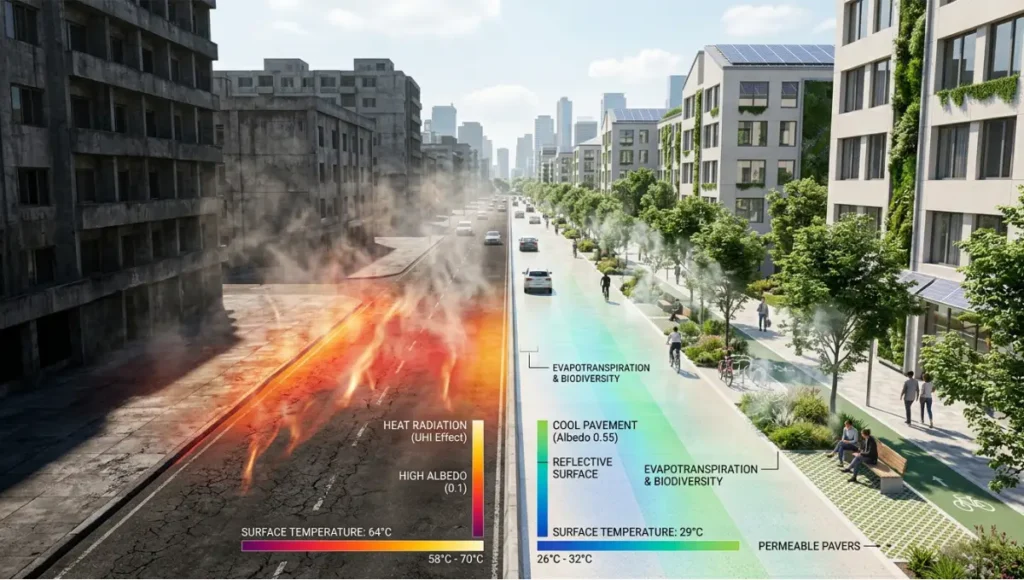
| KEY TAKEAWAYS Pavements cover 30–40% of most urbanised land surfaces — making them the single largest thermal lever available to city planners.Conventional dark asphalt absorbs 80–95% of incoming solar radiation, elevating surface temperatures by up to 70 °C in peak-sun conditions.Four verified cool pavement material systems — reflective, evaporative/permeable, phase-change material (PCM), and high-conductive — each operate through a distinct thermodynamic mechanism.Surface temperature reductions range from 3 °C (conservative reflective coatings) to 35 °C (optimised evaporative systems), depending on climate zone and design specification. Singapore’s full-scale canyon study recorded surface temperatures 10–13 °C lower on cool-coated road pavement compared with untreated asphalt during afternoon peak hours.Economic barriers remain real: high upfront cost, coating degradation cycles, and the absence of a universal performance standard continue to fragment adoption.By 2030, integrated multi-system pavement strategies — rather than single-material deployments — will define the next generation of thermally resilient urban corridors. |
Nuvira Perspective
At Nuvira Space, we do not accept the thermal failure of the contemporary city as a structural inevitability. We treat it as a design problem — one produced by a century of material indifference and solved, at scale, through the deliberate recalibration of the urban surface. Cool pavement urban heat island dynamics sit at the exact intersection where material science, infrastructure economics, and sociological consequence collide.
Our editorial position is that the pavement beneath your feet is not a passive slab. It is a thermal policy — and that policy is currently costing cities human lives, megawatts of squandered energy, and decades of compounding atmospheric damage. The four verified material systems examined in this article are not abstract research outputs. They are deployable urban instruments. The question is not whether cities can afford them. The question is whether cities can afford to keep laying the alternative.
The Road Is Not Neutral: A Macro-Observation
You have walked across a city parking lot in July and felt the heat rising from the ground before you felt it from the sky. That sensation is not ambient weather. It is manufactured climate — an architectural consequence of layering dark, impermeable, heat-retentive asphalt across one-third of your city’s total surface area and then expressing surprise when the air becomes unbreathable.
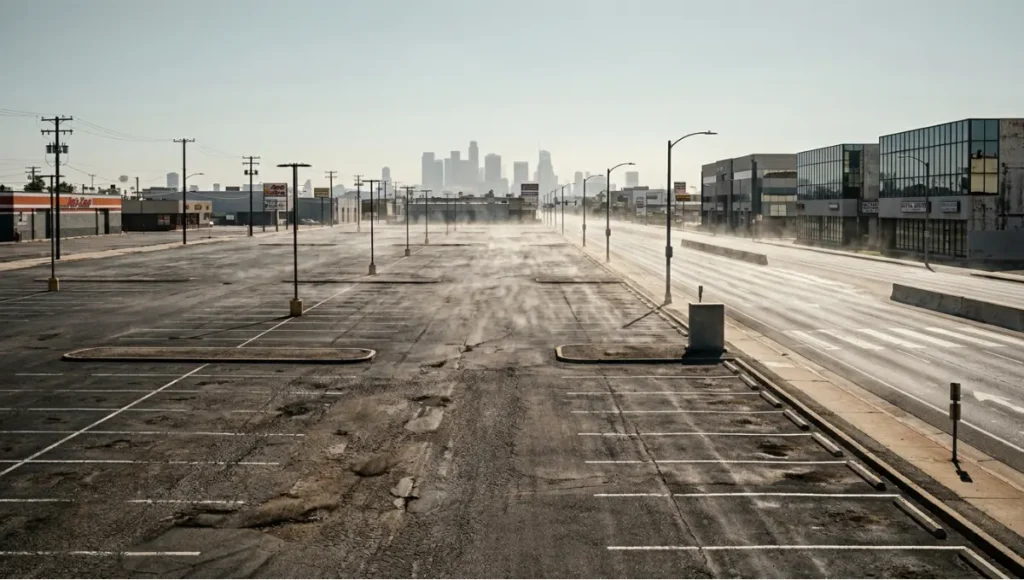
The cool pavement urban heat island problem is, at its core, a problem of systematic material selection made at civilisational scale without thermal accountability. Cities chose asphalt for its cost, its workability, and its load-bearing capacity. Nobody calculated what it would cost when 80 to 95 percent of solar energy is absorbed and re-radiated as sensible heat into the pedestrian layer — the zone between the ground and two metres of elevation where human life actually occurs.
The numbers are no longer speculative. Urban heat island intensity across 57 measured cities averages 2.4 °F warmer than surrounding rural areas, with Las Vegas recording a differential of 7.3 °F over the past decade. Phoenix, the continental United States’ hottest major city, operates street pavement surfaces that reach 70 °C on peak summer days. In Singapore — a city that has committed institutional capital to quantifying its heat problem — built-up areas run 2–4 °C warmer than forested zones at night, precisely when thermal relief is most physiologically critical.
This is the material reality of the contemporary street grid. And cool pavement is the engineered counterargument.
The Blueprint: 4 Verified Cool Pavement Material Systems
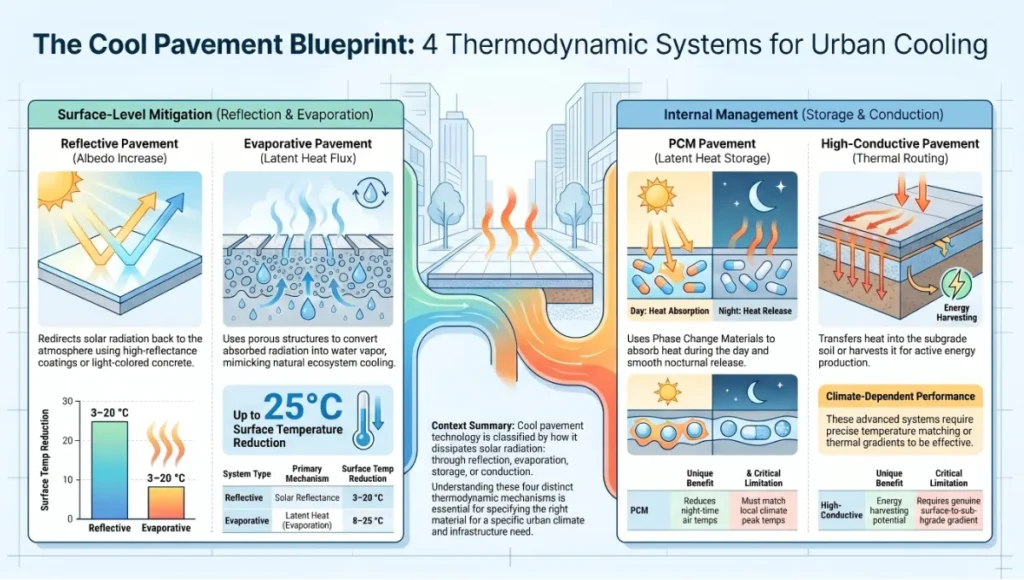
The taxonomy of cool pavement is not a marketing construct. It is a thermodynamic classification based on the mechanism by which each system dissipates or rejects incoming solar radiation. You need to understand all four before you can specify intelligently for your urban context.
System 1 — Reflective Pavement
PRIMARY MECHANISM: SOLAR REFLECTANCE (ALBEDO INCREASE)
Reflective pavement operates by redirecting incoming shortwave solar radiation back into the atmosphere before it can be converted into heat stored within the pavement mass. Standard asphalt begins its service life at approximately 5% solar reflectance, ageing to 10–20% as the binder oxidises. New cement concrete operates at 30–50% solar reflectance — a thermodynamic advantage urban planners have historically ignored.
Reflective coatings can bring asphalt road surfaces to 30–35% solar reflectance immediately upon application, representing a 6–7× improvement over the baseline. Cool-coloured coatings have demonstrated solar reflectance of up to 50% without the glare problem that fully white surfaces create. These advances are closely aligned with broader progress in building-integrated solar technology — explored in depth in our analysis of
These advances are closely aligned with broader progress in building-integrated solar technology — explored in depth in our analysis of building-integrated photovoltaics and facade systems.
Verified Performance Specifications
| Surface temp reduction | 3–20 °C depending on albedo delta and solar exposure |
| Ambient air temp reduction | 0.5–1.2 °C (city-scale deployment) |
| Night-time air temp reduction | 0.5 °F average (Phoenix CoolSeal pilot, 2020–2021) |
| Streetlight energy savings | >30% reduction in requirement |
| Albedo target | 0.35 solar reflectance (above this, MRT increases at pedestrian level) |
Material Options
- White portland cement concrete (SR: 30–50% new; 20–35% aged)
- Light-coloured chip seal with reflective aggregate
- Acrylic or resin-based reflective surface coatings (100-micron application)
- Cool-coloured coatings with near-infrared reflective pigments
- Thermochromic materials (optical property shift with ambient temperature)
| Critical Limitation: Reflective coatings degrade with traffic pollution and UV exposure. Without periodic reapplication, albedo reverts toward baseline within 3–7 years depending on traffic intensity. |
System 2 — Evaporative and Permeable Pavement
PRIMARY MECHANISM: LATENT HEAT FLUX THROUGH WATER EVAPORATION
Where reflective pavement rejects solar energy, evaporative pavement consumes it — deploying the thermodynamic principle of latent heat to convert absorbed radiation into water vapour rather than sensible heat. This is, in effect, the pavement mimicking the cooling mechanism of a living ecosystem.
Permeable pavement structures — pervious concrete, porous asphalt, permeable interlocking concrete pavers — are engineered with void content typically in the 15–25% range. The stormwater integration potential of these systems connects directly to the broader infrastructure logic of sponge city design, which coordinates urban water management across multiple surface typologies to achieve citywide climate and flood resilience.
Sintered ceramic brick demonstrated surface temperature reductions of 20 °C under wet conditions, with a cooling period of up to 16 hours post-wetting. After the moisture reservoir depletes, both systems return to thermal behaviour approximating conventional impermeable pavement — meaning the system’s effectiveness is climatically dependent on rainfall frequency or active irrigation infrastructure.
Verified Performance Specifications
| Surface temp reduction | 8–25 °C (type and moisture availability dependent) |
| Air temp reduction | Up to 1 °C citywide with porous brick or porous concrete deployment |
| Cooling duration | 12–16 hours post-wetting (material-dependent) |
| Figuline pavement | 9.4 °C cooler than conventional permeable pavement; cooling extended 5 days longer |
| Stormwater benefit | Surface runoff significantly reduced |
Material Options
- Open-graded porous asphalt (void content: 15–25%)
- Pervious concrete
- Permeable interlocking concrete pavers (PICP)
- Sintered ceramic pervious brick
- Water-retaining pavement with blast furnace slag grouting
- Figuline (fired clay) column-structure pavement
| Critical Limitation: Mechanical strength is reduced relative to dense pavement. Void structures are susceptible to clogging, requiring periodic maintenance flushing. In arid climates with infrequent rainfall, performance is severely curtailed without supplemental irrigation. |
System 3 — Phase Change Material (PCM) Pavement
PRIMARY MECHANISM: LATENT HEAT STORAGE VIA SOLID-LIQUID PHASE TRANSITION
PCM pavement is the most thermodynamically sophisticated of the four systems. Rather than rejecting or evaporating solar energy, it absorbs and stores that energy within a material that undergoes a controlled phase transition — typically from solid to liquid — at a target temperature aligned with peak pavement operating conditions.
During evening hours, as the pavement cools below the phase change threshold, the PCM re-solidifies, releasing stored thermal energy as latent heat — smoothing the nocturnal heat release curve that is responsible for the most physiologically damaging aspect of urban heat island conditions: the inability of the city to cool down at night.
Binary eutectic fatty acid blends, such as palmitic acid combined with stearic acid, enhanced with nano-aluminium oxide as a thermal conductivity improver, have demonstrated effective cooling with improved rutting resistance — addressing the structural durability concern historically associated with PCM pavement systems.
Verified Performance Specifications
| Surface temp reduction | 4–14 °C |
| Peak temp suppression | PCM cap set to pavement’s rutting-sensitive threshold (~60 °C for most asphalt binders) |
| Thermal conductivity | Measurable improvement with nano-Al₂O₃ enhancement |
| Nocturnal heat release | Smoothed and sustained, reducing overnight urban air temperature elevation |
| GHG offset potential | 1.0–3.0% of total city emissions over 50-year deployment (Boston modelling, MIT CSHub) |
Material Options
- Fatty acid eutectic blends (palmitic acid / stearic acid) with nano-oxide TCE
- Paraffin-based PCMs encapsulated in polymer or aluminium shell
- Inorganic salt hydrates (higher latent heat capacity, lower cost, corrosion risk)
- PCM-impregnated expanded clay or shale aggregate
- Composite PCM with supporting waste steel slag aggregate (SSA)
| Critical Limitation: PCM selection must be precisely matched to the climate zone’s peak pavement operating temperature. Misalignment between phase change temperature and actual pavement conditions eliminates the performance benefit entirely. Cost per square metre remains substantially higher than reflective or permeable alternatives. |
System 4 — High-Conductive Pavement
PRIMARY MECHANISM: RAPID THERMAL TRANSFER TO SUBGRADE
High-conductive pavement addresses the urban heat island problem not by rejecting or storing thermal energy at the surface, but by routing it downward — transferring heat through the pavement mass into the cooler subgrade soil at a rate fast enough to prevent dangerous surface temperature accumulation.
High-conductive pavement is also the enabling technology for active heat harvesting — where circulating fluid networks embedded in the pavement capture extracted thermal energy for conversion to electricity via thermoelectric generators, or for direct use as low-grade thermal energy in district heating systems. This positions high-conductive pavement as the only cool pavement system capable of generating positive energy output, rather than simply reducing energy demand.
Verified Performance Specifications
| Surface temp reduction | Comparable to reflective systems under equivalent solar exposure |
| Heat routing depth | 300–600 mm to subgrade thermal sink |
| Active harvesting | Thermoelectric generator integration for electricity production |
| PV integration | Solar-to-electric conversion directly at pavement surface |
| Noise reduction | Up to 8 dB reduction in traffic noise (porous-structure variants) |
Material Options
- Metallic aggregate blends with high thermal conductivity ratings
- Carbon-fibre-enhanced asphalt binders
- Thermally conductive polymer matrices
- Embedded fluid circulation networks (heat harvesting variants)
- Photovoltaic cell surface integration (solar road technology)
| Critical Limitation: Effective thermal routing requires a genuine thermal gradient between surface and subgrade. In climates where subgrade temperatures are high, the driving gradient collapses. High-conductive pavement also requires specialised installation and monitoring infrastructure that most municipal road departments currently lack. |
Feasibility Study: Economic and Political Barriers
The Cost Gap That Stalls Deployment
The fundamental economic tension of cool pavement urban heat island strategy is not that the technology is unproven. The Phoenix CoolSeal programme, which grew from 36 miles in 2020 to over 120 miles of treated streets, demonstrates that reflective coating deployment is operationally scalable. The tension is that the upfront cost premium over conventional asphalt maintenance is immediately visible on a municipal budget line, while the avoided costs — reduced hospital admissions, lower air-conditioning energy demand, extended pavement service life, reduced stormwater infrastructure load — are dispersed across multiple departmental budgets and multiple years.
Phoenix estimates that a single 1 °F reduction in average city temperature saves $15 million per year in avoided air conditioning costs alone. Los Angeles has committed to coating 200 blocks of neighbourhood streets with reflective sealant under its Cool Streets LA programme. Columbia, South Carolina, secured a $9 million federal grant to pilot cool paving through the Cities for Smart Surfaces programme.
The Political Barrier of Visibility
The second barrier is aesthetic and political rather than financial. Cool pavement’s light grey or white tonal character is immediately visible to residents — and immediately contentious. Phoenix worked with its coating manufacturer to develop a matte finish in a moderate grey tone to suppress glare and address community objections. The Global Cool Cities Alliance’s Cool Roadways Partnership now includes 28 US jurisdictions, with 13 actively conducting or planning pilot projects.
The Standards Vacuum
The most structurally limiting barrier is the absence of a universal performance standard or labelling programme for cool pavement materials. Without standardised testing protocols and verified performance benchmarks, procurement officers default to known materials, and innovative manufacturers face an uneven competitive landscape. The Transportation Research Board’s subcommittee on Paving Materials and the Urban Climate is working to address this gap — but the timeline for regulatory integration remains open.
Proof of Concept: Singapore’s Thermal Accountability Model
Singapore operates under a climatic and political context that strips away every excuse available to cities in less constrained environments. A tropical island city-state with no rural thermal buffer, a population density that concentrates anthropogenic heat generation at extraordinary intensity, and a government that has quantified — with institutional rigour — exactly how bad its heat island problem is.
From 1948 to 2016, Singapore’s annual mean temperatures rose at 0.25 °C per decade. By end of century, daily mean temperatures are projected to increase by 1.4 °C to 4.6 °C above current baselines. In 2023, the city recorded its highest temperature in 40 years: 37 °C in Ang Mo Kio. Scientists estimate Singapore endured 122 extra days of dangerous heat in 2024 attributable directly to climate change.
Singapore’s policy response is not a single intervention. It is a systems architecture. The Cooling Singapore initiative — launched in 2017 — built a digital urban climate twin of the entire city-state. This is not a visualisation tool. It is a predictive policy instrument that allows planners to test the thermal consequences of material substitution, green infrastructure deployment, or cool surface application before committing capital to physical implementation.
On cool pavement specifically, a full-scale experimental study in Singapore’s industrial street canyon environment produced surface temperature reductions of 10–13 °C on the cool-treated road pavement during afternoon peak hours. When cool coatings were modelled at city-wide scale, the simulation produced a maximum air temperature decrease of 3.1 °C at 2 metres above ground level and a surface skin temperature reduction of 9.8 °C.
Singapore has also deployed cool paint coatings on public housing residential estates — an intervention that reaches close to 80% of the population. Preliminary findings show ambient temperature reductions of up to 2 °C around treated buildings. This is not a laboratory result. This is a population-scale thermal intervention producing measurable ambient cooling.
The transferable principle from Singapore is not climatic — it is methodological. You measure first. You model before you build. You integrate interventions at the systems level, not the material level. And you maintain accountability to the thermal outcome, not to the procurement category.
Concept Project Spotlight: Thermal Meridian
SPECULATIVE / INTERNAL CONCEPT STUDY — NUVIRA SPACE
Project Overview
| Location | High-density mixed-use corridor, inner-urban arterial — conceptually modelled on mid-latitude subtropical metropolitan context (Houston, Seville, or Brisbane) |
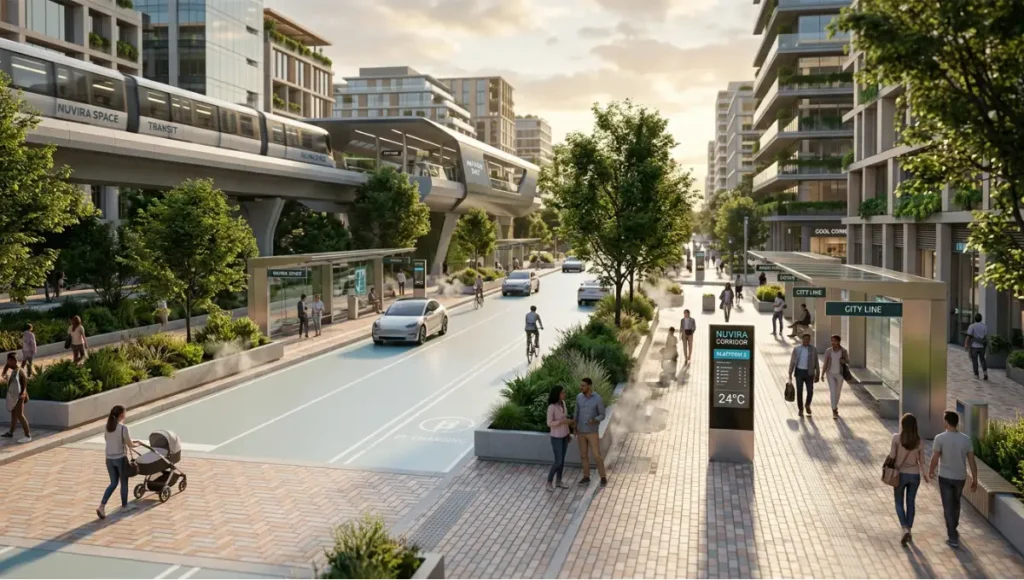
| Typology | 2.4-kilometre urban transit corridor with integrated pedestrian realm, mid-block public plazas, and bus rapid transit infrastructure |
| Vision | Demonstrate that a single urban corridor, treated as a thermally integrated design system, can achieve ambient air temperature reductions of 2–3 °C along its entire length |
Design Levers Applied
Zone 1 — Transit Lane: High-Conductive Composite Pavement
- Metallic aggregate blend with carbon-fibre-enhanced binder
- Embedded fluid circulation network for active heat harvesting
- Surface-to-subgrade thermal routing to 450 mm depth
- Target surface temperature: ≤52 °C at peak solar exposure (vs 68–70 °C baseline asphalt)
- Harvested thermal energy routed to district low-grade heat network
Zone 2 — Pedestrian Paving: PCM-Enhanced Permeable Ceramic Brick
- Sintered ceramic brick with PCM impregnation (fatty acid eutectic blend, phase change point: 58 °C)
- Void content: 18–22%
- Stormwater capture and evaporative cooling activation from stored precipitation
- Surface temperature target: ≤45 °C at peak solar; sustained cooling 14–16 hours post-precipitation
- Albedo: 0.35–0.40 (moderated to avoid MRT elevation at pedestrian height)
Zone 3 — Intersection and Plaza Nodes: Reflective Thermochromic Coating
- Solar reflectance: 38–42% (initial application)
- Thermochromic pigment layer: optical darkening above 55 °C surface temperature
- Reapplication cycle: 5-year maintenance programme
- Night-time albedo benefit: 30% reduction in street lighting electricity demand
Integrated Systems Layer
- IoT surface temperature sensor mesh at 80-metre intervals along full corridor
- Real-time thermal performance dashboard (publicly accessible)
- Stormwater collection and redistribution system for on-demand evaporative cooling activation
- Data integration with transit agency passenger comfort metrics
| Transferable Takeaway The Thermal Meridian concept demonstrates that the most effective cool pavement strategy is not the selection of a single superior material system. It is the spatial zoning of thermodynamic mechanisms according to use intensity, solar exposure profile, and the specific heat stress conditions experienced by the human body in each microzone of the corridor. No single material system optimises all three simultaneously. The design intelligence is in the zoning, not in the material. |
2030 Future Projection
The trajectory of cool pavement urban heat island strategy between now and 2030 is not linear. It is bifurcating. Cities that treat cool pavement as a maintenance upgrade will capture incremental thermal benefits without transforming their urban climate. Cities that treat it as a systems-level infrastructure decision — integrated with transit-oriented development, digital urban climate modelling, stormwater management, and building energy performance standards — will produce measurably different outcomes.
By 2030, four developments will define the leading edge of this field. First, the standardisation gap will close. A universal pavement thermal performance rating system will emerge from the Transportation Research Board’s ongoing standards work. This will unlock procurement confidence and accelerate private-sector investment in coating technology development.
Second, multi-system pavement integration will move from research demonstration to standard practice in climate-progressive municipalities. The performance ceiling of any single system will become the design floor of the integrated approach.
Third, cool pavement will enter climate finance frameworks as a verified carbon offset instrument. The MIT CSHub modelling already demonstrates 1–6% GHG emission offsets over 50-year deployment windows for US cities.
Fourth, and most consequentially, the politics of urban heat will shift. Heat mortality is now measurable, attributable, and disproportionate. The language of thermal inequity will enter housing, zoning, and infrastructure policy frameworks. This is a shift well understood through the lens of pedestrian-first city design — a planning philosophy that treats street-level human experience, including thermal comfort, as the primary design constraint rather than an afterthought.
The city that treats its road surface as a thermal policy instrument — rather than a civil engineering commodity — is the city that survives its own future.
Comprehensive Technical FAQ
Q: What is the most cost-effective cool pavement system for immediate deployment?
For cities operating within existing road maintenance budgets, reflective coating applied over existing asphalt remains the lowest-cost entry point. A 100-micron application of acrylic or resin-based cool sealant costs significantly less per square metre than full pavement reconstruction and can be integrated into scheduled resurfacing cycles. The Phoenix CoolSeal programme — now covering 120+ miles — demonstrates the operational and economic scalability of this approach. Plan for 5-year reapplication cycles to maintain albedo at target specification.
Q: Does reflective pavement make pedestrians more thermally uncomfortable?
This is the most important nuance in the reflective pavement technical debate. When solar reflectance exceeds approximately 0.35, shortwave radiation reflected from the pavement surface begins to hit the human body directly, increasing mean radiant temperature (MRT). Singapore research quantified this: reflective pavement at albedo 0.35 raised MRT by 5–7 °C at midday, even while reducing surface temperature by 10–13 °C. The practical resolution is to target pavement albedo of 0.30–0.40 for pedestrian zones, pair reflective pavement with overhead shading elements, and reserve highest-albedo coatings for vehicle lanes and parking surfaces.
Q: How do cool pavements perform in cold climates?
Performance varies significantly by system and season. Reflective pavements face a winter penalty in heating-dominated climates — reduced solar absorption increases road heating requirements and can extend freeze-thaw cycle duration. MIT CSHub modelling found that GHG savings improve specifically in cold and humid climate conditions. PCM systems show climate-specific performance: phase change temperature must be calibrated to the climate’s peak pavement operating range. High-conductive systems are climate-agnostic in their basic mechanism. Evaporative systems in cold climates face reduced effectiveness during dry winter conditions but provide stormwater management benefits year-round.
Q: What maintenance programme is required to sustain cool pavement performance?
- Reflective coatings: Reapplication every 5–7 years; annual albedo monitoring recommended
- Permeable/evaporative: Biannual vacuum flushing; structural inspection for ravelling at 3-year intervals
- PCM pavement: Minimal surface maintenance; PCM integrity verification at 7–10 year intervals
- High-conductive (passive): Standard road maintenance protocols; no additional surface treatment required
Q: Can cool pavement be combined with green infrastructure?
Yes — and the combination consistently outperforms either intervention deployed independently. Permeable pavement combined with street tree canopy creates a compound cooling system: the trees intercept incoming solar radiation before it reaches the pavement surface, while the permeable structure captures tree-intercepted precipitation and recycles it as evaporative cooling. Singapore’s integrated strategy — combining cool surface materials, skyrise greening, vertical facade greenery, and wind corridor design — achieves temperature reductions that no single-system approach replicates.
Q: Is there a certification or rating programme for cool pavement materials?
Currently, no universal certification equivalent to the Cool Roof Rating Council exists for pavements. LEED v4 offers a Heat Island Reduction credit that awards points for high-reflectance hardscape materials. Until a labelling programme is formally established, specifiers should reference: LBNL Heat Island Group published solar reflectance test data, the US EPA Guide to Reducing Heat Islands — Cool Pavements chapter, and Arizona State University Urban Climate Research Center published pilot programme performance datasets.
The Surface Is the Policy: Your Next Move
You are a city planner, a transit authority engineer, a district councillor, or an urban developer reading this at a moment when the evidence is no longer uncertain. Cool pavement urban heat island mitigation is not a speculative technology. It is a deployed, measured, and economically modelled infrastructure intervention with verified performance across four distinct material systems, demonstrated at scale in Phoenix, Singapore, Los Angeles, and Rome.
What remains is a decision about whether the next scheduled road resurfacing in your district treats the pavement as a thermal policy instrument or as a maintenance obligation. Those two framings produce different specifications, different procurement conversations, and ultimately different atmospheric outcomes for the people who walk those streets.
The material systems are specified above. The performance data is verified. The case studies are documented. The economic modelling is published.
The surface beneath your city is waiting to be redesigned.
© Nuvira Space. All rights reserved. | URBAN PULSE Series | All specifications cited are based on peer-reviewed research including: MDPI Buildings (2025), MIT Concrete Sustainability Hub Environmental Science & Technology (2021), Nature Communications Phoenix Reflective Pavement Study (2023), Lawrence Berkeley National Laboratory Heat Island Group, US EPA Heat Island Reduction Programme, Arizona State University Urban Climate Research Center Cool Pavement Pilot Programme Reports (2020–2024), Singapore Management University Cooling Singapore Initiative, and the ASCE Civil Engineering Source. The Thermal Meridian is a speculative internal concept study and does not represent a completed project.