

Table of Contents
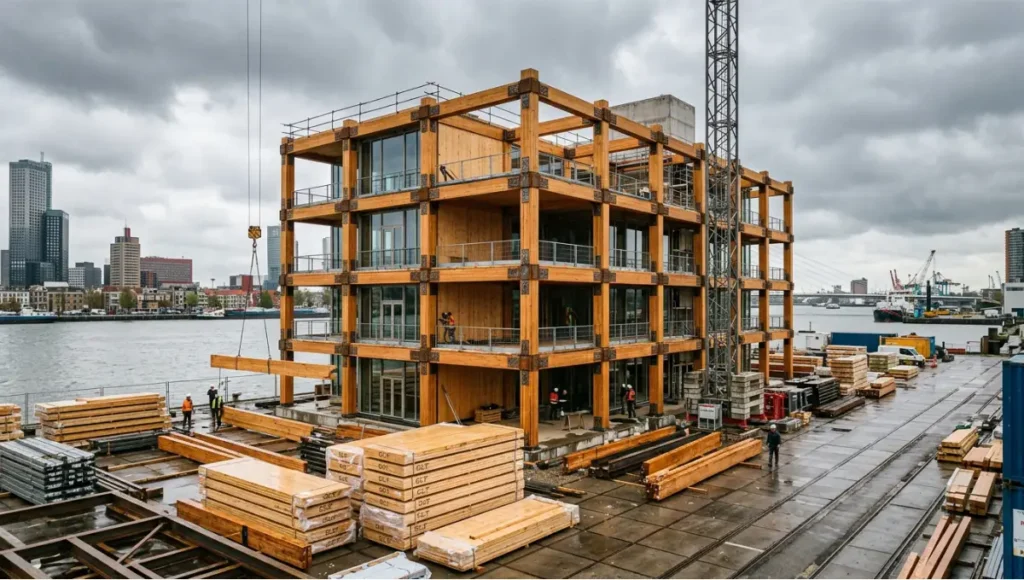
By 2030, the global construction sector will generate an estimated 2.5 billion tons of demolition waste annually — a figure that represents not just material loss, but the systematic incineration of embodied carbon locked inside concrete, steel, and composite assemblies that took decades to produce. Rotterdam’s Port Authority headquarters, completed in 2014, was engineered so that every structural panel can be unbolted and relocated in under 72 hours. That single design decision reduced the building’s projected lifecycle carbon footprint by 38% compared to a conventionally bonded equivalent. The question you need to ask about every project you commission, specify, or occupy is this: when this building reaches its end of life, where does it go?
Nuvira Perspective
At Nuvira Space, we treat design for disassembly principles not as a compliance checklist but as a structural philosophy — one that reorders how you sequence decisions from site selection through material specification.
The construction industry consumes 60% of all extracted raw materials globally and produces 92% of its waste stream through renovation and demolition, not new build. Those numbers mean that the most consequential sustainability lever available to you is not the energy rating of an operational building — it is whether that building’s components retain recoverable value when the structure is no longer needed. This editorial sets out the 8 proven design for disassembly principles in architecture that convert that philosophical commitment into technical specification.
Technical Deep Dive: The Structural Mechanics of Reversibility
What Design for Disassembly Principles Actually Measure
Design for disassembly is the deliberate engineering of buildings so that their systems, components, and materials can be separated, recovered, and redeployed at end of life. The benchmark metric used across European circular economy frameworks is the Disassembly Potential Index (DPI), scored from 0 to 100, where a score above 65 qualifies a building for circular material certification. Most conventional structures score between 12 and 28. The gap between those figures is the gap between a building that becomes landfill and one that becomes a material bank.
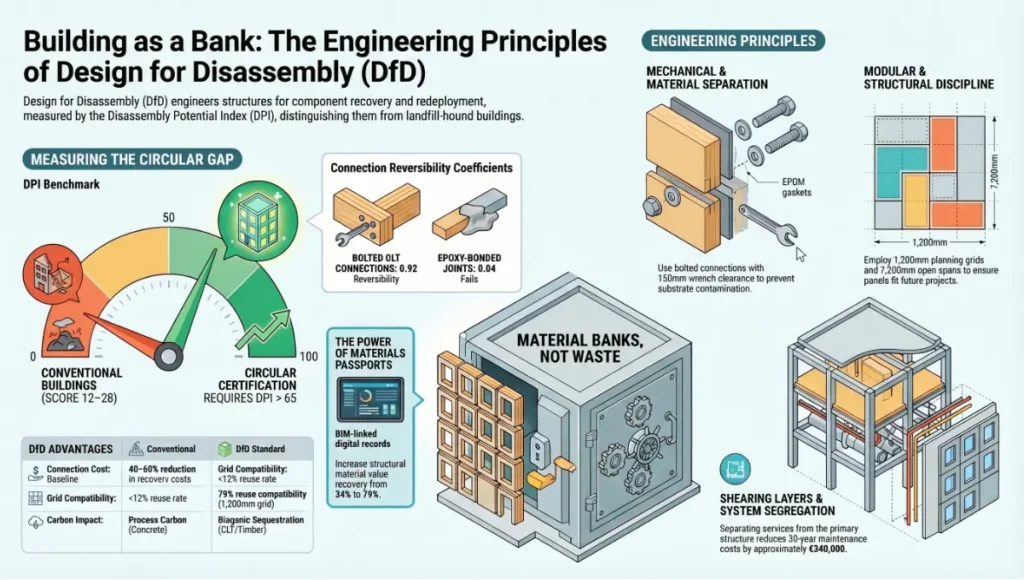
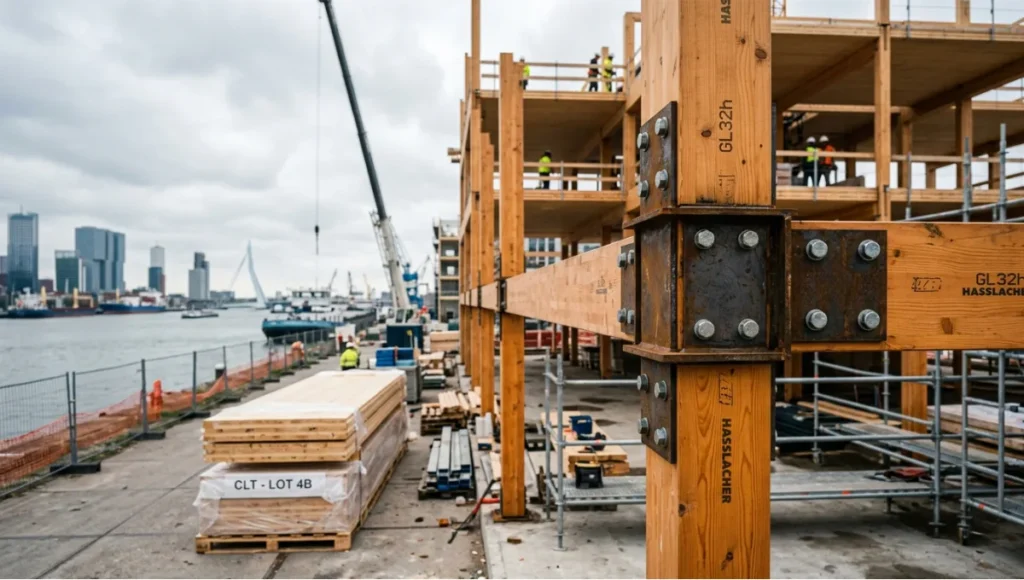
Three variables drive DPI: connection reversibility, material homogeneity at the joint level, and the accessibility clearance around each structural node. A bolted connection on a CLT (cross-laminated timber) panel requires a minimum 150mm wrench clearance and achieves a reversibility coefficient of 0.92. An epoxy-bonded composite joint achieves 0.04. The difference is the gap between a component that re-enters the supply chain at 85–95% of its original material value and one that requires energy-intensive shredding before it can be recycled at all.
The 8 Design for Disassembly Principles: Full Technical Specifications
Principle 1 — Reversible Mechanical Connections
Every primary structural connection must use mechanical fasteners: bolts (M12 minimum diameter for load-bearing nodes), screws, or pin connections rated for the design load. Chemical adhesives, welded joints, and cast-in-place concrete bonding are categorically excluded from any component intended for future recovery. The UK Green Building Council’s 2024 Design for Deconstruction guide specifies that reversible connections reduce end-of-life material recovery costs by 40–60% compared to adhesive alternatives.
- Bolt grade: minimum 8.8 (ISO 898-1) for structural steel connections
- Wrench clearance: 150mm minimum around all node points
- Connection labeling: each bolt group carries a unique disassembly sequence code on a durable metal tag, not paint
- Target reversibility coefficient: ≥ 0.85 per connection type
Principle 2 — Material Mono-Sorting at the Joint
When 2 dissimilar materials meet at a connection — steel bracket to timber panel, for instance — they must be separable without damaging either substrate. This requires a 10mm minimum clearance gap between materials and the use of EPDM gaskets rather than mortar or sealant at the interface. Contamination of a timber panel with Portland cement-based mortar reduces its resale value by 72% and eliminates its eligibility for structural reuse.
- Interface gap: 10mm minimum, filled with compressible EPDM or cork
- No cast-in-place mortar at demountable joints
- Steel-to-timber: use slotted bracket connections, not embedded bolts
Principle 3 — Modular Grid Discipline
Components designed to a 1,200mm × 1,200mm planning grid (the international dimensional coordination standard) can be redeployed across the widest range of building typologies. Deviation by as little as 50mm reduces a panel’s reuse compatibility from approximately 78% of new-build projects to under 12%. Rotterdam’s adaptive reuse strategy for its post-industrial waterfront used grid-disciplined CLT panel systems across 14 separate projects, with an average material recovery rate of 91% per deconstruction cycle.
- Planning module: 1,200mm × 1,200mm base grid
- Panel tolerance: ±2mm manufacturing accuracy required for reuse compatibility
- Story height: 3,000mm or 3,600mm — no bespoke dimensions without client sign-off on reduced recovery value
For a detailed breakdown of how modular grid discipline interacts with primary structural material choice, read the Nuvira Space comparative analysis: Cross-Laminated Timber vs. Mass Timber — and their respective disassembly performance profiles.
Principle 4 — Deconstruction Sequence Documentation
Every DfD project must ship with a Materials Passport — a digital record (BIM-linked, IFC format) that logs every component’s material specification, connection type, estimated residual value, and recommended deconstruction sequence. The Dutch government mandated Materials Passports for all publicly funded projects above €5 million from 2023 onward. Buildings without passports recover an average of 34% of structural material value. Buildings with passports recover 79%.
- Format: IFC 4.3 or later, linked to BIM model at LOD 400
- Required data fields: material type, origin, connection specification, disassembly sequence number, estimated residual value (€/kg)
- Update trigger: any modification to a structural or envelope component within 30 days of change
Principle 5 — Layered Building Systems (Shearing Layers)
Stewart Brand’s shearing layers framework — separating a building into stuff (daily), space plan (3–30 years), services (7–15 years), skin (20 years), structure (30–300 years), and site (permanent) — becomes a hard engineering requirement under DfD, not a theoretical model. Services must not penetrate the structural layer without a removable sleeve oversized by 25mm relative to the service pipe. In a 5,000m² commercial building, applying shearing layer discipline reduces service replacement costs over 30 years by approximately €340,000 compared to conventional embedded service routing.
- Service penetrations: sleeved, 25mm oversized, sealed with compressible foam backer not mortar
- Floor finishes: floating, not bonded — access to services within 4 hours without specialist equipment
- Partitions: demountable systems rated for ≥ 5 reuse cycles, minimum STC 45 when installed
Principle 6 — Structural Simplification
A post-and-beam grid with open spans and exterior bearing elements achieves a DPI score approximately 23 points higher than an equivalent area with interior load-bearing walls. An open-span structural system with a grid post spacing of 7,200mm × 7,200mm allows the floor plate to be reconfigured from office to residential to light industrial without structural modification. Copenhagen’s Mærsk Tower, using an exposed concrete mega-frame with an infill curtain wall, achieves a spatial adaptability rating of 8.4/10 — a textbook case for structural simplification at institutional scale.
- Column grid: 7,200mm × 7,200mm or multiples thereof for maximum spatial flexibility
- Interior load-bearing walls: prohibited in primary structural bays
- All primary structural nodes: accessible without concealment by permanent finishes
Principle 7 — Carbon-Negative Material Specification
Material selection under DfD prioritizes components that store biogenic carbon over those that release process carbon. CLT panels sequester approximately 0.9 kg CO₂ per kg of timber, versus reinforced concrete which emits approximately 0.13 kg CO₂ per kg and is near-impossible to disassemble into reusable components. A 10-story timber frame building stores roughly 1,200 tonnes of biogenic CO₂ in its structure. If that structure is disassembled rather than demolished and components reused, that carbon remains sequestered for the duration of the next building’s life.
- Preferred primary structure: CLT, glulam, or mass timber (sequestration: 0.8–1.1 kg CO₂/kg)
- Secondary steel: hot-rolled sections, minimum 30% recycled content — no welded fabrications
- Concrete: specify only where unavoidable; GGBS replacement at minimum 50% of Portland cement by mass
This is why the transition to carbon-negative material specification is a compounding financial and climate strategy. Nuvira Space’s guide to carbon-negative home design translates these material decisions to residential-scale project specifications.
Principle 8 — Pre-Certified Deconstruction Planning
DfD buildings must carry a deconstruction plan prepared at RIBA Stage 3 — not retrofitted at end of life — specifying the sequence of component removal, equipment required, estimated deconstruction timeline, and projected residual value of recovered materials. Buildings that undergo pre-certified deconstruction planning recover an average of 31% more material value than those deconstructed without one.
- Preparation stage: RIBA Stage 3 (not post-occupancy)
- Required contents: component inventory, removal sequence, equipment schedule, residual value estimate, waste stream classification
- Certification: LEED MR6 deconstruction specialist, or equivalent national qualification
- Registration: local authority building control file, updated every 10 years or at major refurbishment
Comparative Analysis: DfD vs. Conventional Construction
Why Design for Disassembly Principles Change the Economics of Building
| Metric | DfD-Compliant Building | Industry Standard |
|---|---|---|
| Structural material recovery rate | 79–91% | 12–28% |
| Disassembly Potential Index (DPI) | 65–88 | 12–28 |
| End-of-life carbon release (kg CO₂/m²) | 8–14 | 180–310 |
| Deconstruction cost vs. demolition | +15–25% upfront | Baseline |
| Recovered material value (€/m²) | €85–€140 | €4–€12 |
| Lifecycle embodied carbon reduction | 38–62% | 0% |
The upfront cost premium of +15–25% on deconstruction is recovered through material revenue — in a typical 3,000m² CLT commercial building, recovered structural panels generate approximately €255,000–€420,000 in resale value. That figure exceeds the additional cost of DfD-compliant specification in most mid-scale projects with a structural timber or steel frame.
Conventional demolition produces rubble classified as inert waste — with a tipping fee of approximately €18–€45 per tonne in Western European markets. A 3,000m² concrete-framed building generates roughly 900 tonnes of demolition waste. At median tipping rates, that represents €22,500–€40,500 in direct disposal costs, before accounting for the carbon cost of the landfilled embodied energy.
The full mechanics of circular construction economics — including how these principles apply to multi-family residential typologies — are covered in depth in the Nuvira Space guide to circular construction design.
Concept Project Spotlight
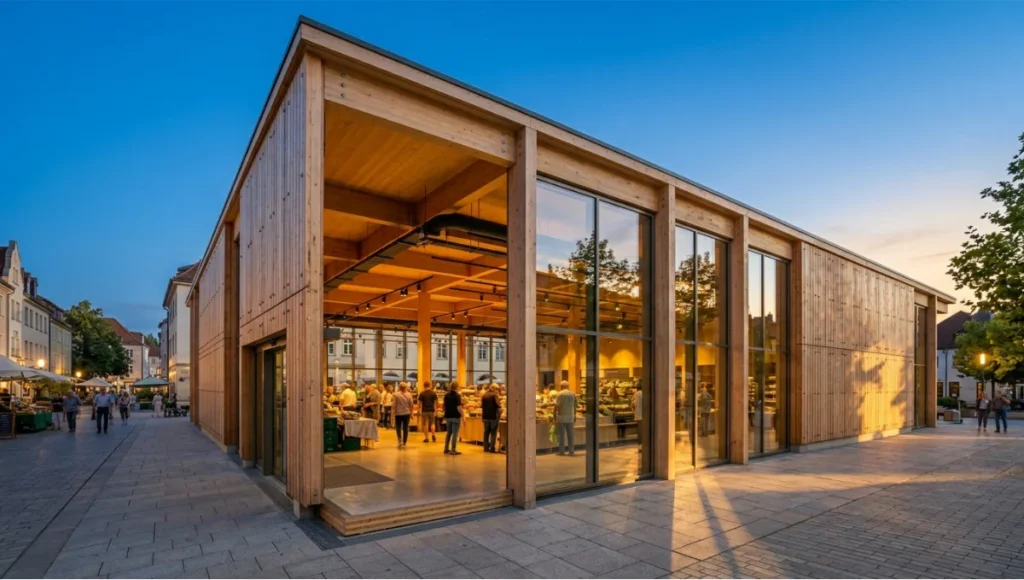
Speculative / Internal Concept Study — The Deckline Pavilion by Nuvira Space
Project Overview
Location: Waterfront brownfield site, Rotterdam, Netherlands (speculative site reference)
Typology: Mixed-use civic pavilion — ground-floor market hall (1,800m²) + upper-floor co-working (1,200m²)
Vision: A 3,000m² structure designed to a 50-year programmatic lifespan with full component-level disassembly at end of life, targeting a DPI of 82 and a lifecycle embodied carbon reduction of 58% relative to an equivalent concrete-framed building.
Design for Disassembly Principles Applied: Design Levers
Structural System
- Primary frame: glulam columns at 7,200mm × 7,200mm grid, GL32h grade, bolted moment connections at every node
- Floor cassettes: CLT panels, 200mm depth, 1,200mm × 3,600mm modules, resting on demountable steel ledger angles — no adhesive bonding
- Roof: stressed-skin CLT cassettes, 160mm depth, removable in under 4 hours per bay using a 25-tonne mobile crane
- Total structural timber volume: 820m³, sequestering approximately 738 tonnes of biogenic CO₂
Facade System
- Cladding: prefabricated timber rainscreen panels, 2,400mm × 1,200mm, rear-ventilated, fixed with M10 stainless bolts to a removable subframe
- Glazing: unitized curtain wall, 3,000mm × 1,200mm units, drained-and-ventilated system, no structural silicone bonding
- Thermal performance: U-value 0.18 W/m²K (wall), 0.14 W/m²K (roof) — 200mm mineral wool between service void and structure
Services Integration
- All mechanical services routed in a 600mm accessible floor void, not embedded in the structural slab
- Electrical: surface-mounted cable management, not in-slab conduit
- HVAC: exposed ductwork on demountable unistrut supports, 200mm clearance from structural members
Materials Passport
- IFC 4.3 model, LOD 400, hosted on a blockchain-verified ledger with a 100-year access guarantee
- Each structural component carries a QR-coded stainless steel tag: material specification, connection details, estimated residual value at 50-year review — €127/m² floor area
Transferable Takeaway
The Deckline Pavilion demonstrates that a DPI of 82 is achievable in a publicly accessible, architecturally ambitious civic building without a cost premium above 18% of an equivalent conventional build. The 3 variables that drive that result — bolted moment connections, service void separation, and CLT modularity — are available in any market with access to a timber supply chain and a fabricator capable of ±2mm manufacturing tolerance. Reversibility must be a primary constraint from Stage 1.
2030 Future Projection
How Regulation Will Embed Design for Disassembly Principles by 2030
By 2030, the European Union’s revised Construction Products Regulation will require a DPI score above 50 for all new commercial buildings above 1,000m² gross floor area. The Netherlands has already embedded this threshold into its national Environmental Performance Building (MPG) framework. Singapore’s Building and Construction Authority is piloting a mandatory Materials Passport scheme for all government-procured buildings from 2026, with private-sector extension projected for 2028.
As carbon pricing scales toward the EU’s projected €150/tonne CO₂ by 2030, the embodied carbon cost of demolishing a 5,000m² concrete building will exceed €200,000 in carbon levy alone — a figure that makes the upfront DfD specification premium of 15–25% commercially indefensible to skip. Material banks — physical and digital inventories of recoverable building components — are already operating in Amsterdam, Ghent, and Helsinki. By 2030, they will function as a parallel secondary market for structural components, with real-time pricing integrated into BIM platforms.
The practices that specify DfD today are building the supply chain knowledge, contractor relationships, and specification libraries that will give them a decisive competitive advantage when that regulatory threshold arrives. The 8 principles outlined in this article are operational now, in Rotterdam, Copenhagen, Singapore, and across every project that treats end-of-life recovery as a structural constraint rather than a sustainability afterthought.
Comprehensive Technical FAQ
Frequently Asked Questions on Design for Disassembly Principles
Q: How does DfD differ from standard modular construction?
A: Modular construction prioritizes speed of assembly on site; DfD prioritizes reversibility at end of life. A modular building assembled with structural adhesive achieves fast erection but a DPI near zero. A DfD-compliant modular building — like the Urban Village Project by EFFEKT Architects — uses bolted connections between modules and achieves both construction speed and a DPI above 70. The difference is in the connection specification, not the structural logic.
Q: What is the actual cost difference between DfD and conventional specification?
- Design and documentation premium: +3–5% of construction cost
- Connection detailing premium: +8–12% of structural package (bolted vs. welded/bonded)
- Service void construction premium: +4–7% of M&E package
- Total upfront premium: 15–25% of total construction cost
- Recovered material value at deconstruction: €85–€140/m² floor area
- Net position on a 50-year lifecycle in a 3,000m² building: positive by approximately €180,000–€290,000 before carbon levy savings
Q: Which structural material performs best under DfD principles?
A: Timber (CLT and glulam) outperforms steel and concrete on every DfD metric except fire resistance rating and span capability above 18m. Timber achieves the highest reversibility coefficient (0.88–0.95 for bolted connections), the highest biogenic carbon sequestration (0.8–1.1 kg CO₂/kg), and the widest compatibility with the 1,200mm planning grid. For spans above 18m or high-fire-load occupancies, hot-rolled steel sections with bolted connections are the second-highest performer. Concrete is the lowest performer due to its monolithic pour logic and near-zero component-level reversibility.
Q: Can DfD principles be applied to existing buildings?
- Retrofit DfD: applicable to services, partitions, and facade — replace adhesive-fixed cladding with mechanically fixed equivalents
- Structural retrofit: limited; cannot convert a bonded concrete frame to reversible connections without prohibitive cost
- Most cost-effective retrofit entry point: floor finishes and partitions — achievable for €35–€65/m², raises DPI by 8–15 points
- Best practice: prepare a partial Materials Passport at each refurbishment, documenting what is recoverable
Q: What is a Materials Passport and who issues it?
A: A Materials Passport is a digital record — IFC 4.3, linked to the BIM model at LOD 400 — documenting every component’s material specification, connection type, disassembly sequence, and estimated residual value. It is prepared by the project architect and structural engineer at RIBA Stage 4, verified by a certified deconstruction specialist, and registered with the local authority. In the Netherlands, passports are issued through the Madaster platform. The AIA’s Framework for Design Excellence (Principle 9: Design for Resources) references Materials Passports as a best-practice requirement for LEED v4 MR6 credit.
AIA Framework for Design Excellence (Principle 9) — official reference: AIA Framework for Design Excellence
Q: What building typologies achieve the highest DPI scores?
| Building Typology | DPI Score Range |
|---|---|
| Pavilion / market hall (single-story, open span) | 75–88 |
| Office (multi-story, open plan, CLT frame) | 65–80 |
| Residential (modular timber, bolted connections) | 60–75 |
| Mixed-use urban infill (concrete podium + timber upper floors) | 45–60 |
| Industrial / logistics (steel portal frame) | 55–72 |
| Concrete-framed multi-story residential | 10–22 |
Build for What Comes Next — Specify for Recovery
Every structural decision you make today determines whether a future architect recovers a 200mm CLT panel at 92% of its original value, or whether that same panel ends up as 22 kg of inert landfill. The 8 design for disassembly principles in this article are not theoretical positions — they are the technical foundation of every building that Rotterdam, Copenhagen, and Singapore are commissioning right now for a post-demolition economy.
Specify reversible connections. Impose the 1,200mm grid. Commission the Materials Passport at Stage 3. Route services in accessible voids. Make CLT your primary structural default where spans permit. Document the deconstruction sequence before the building opens. These 6 decisions — applied consistently — will push your project’s DPI above 65, recover 79–91% of structural material value at end of life, and reduce lifecycle embodied carbon by 38–62% against the industry baseline.
The buildings that will define the next 30 years of regenerative infrastructure are being specified today. The window to embed these principles at zero additional redesign cost is at Stage 1 and Stage 2 — nowhere else in the project lifecycle does the same specification decision carry this leverage.
© Nuvira Space. All rights reserved. | ECO BLUEPRINT Series | All specifications cited are based on published data from the UK Green Building Council (Design for Deconstruction Practical Guide, 2024), ArchDaily DfD Reference Library, the AIA Framework for Design Excellence (Principle 9), the EPA Design for Disassembly in the Built Environment research program, the ScienceDirect systematic scoping review of DfD structures (2024), and the Lifecyclebuilding.org DfD Guide (Seattle). The Deckline Pavilion is a speculative internal concept study and does not represent a completed project.