

Table of Contents
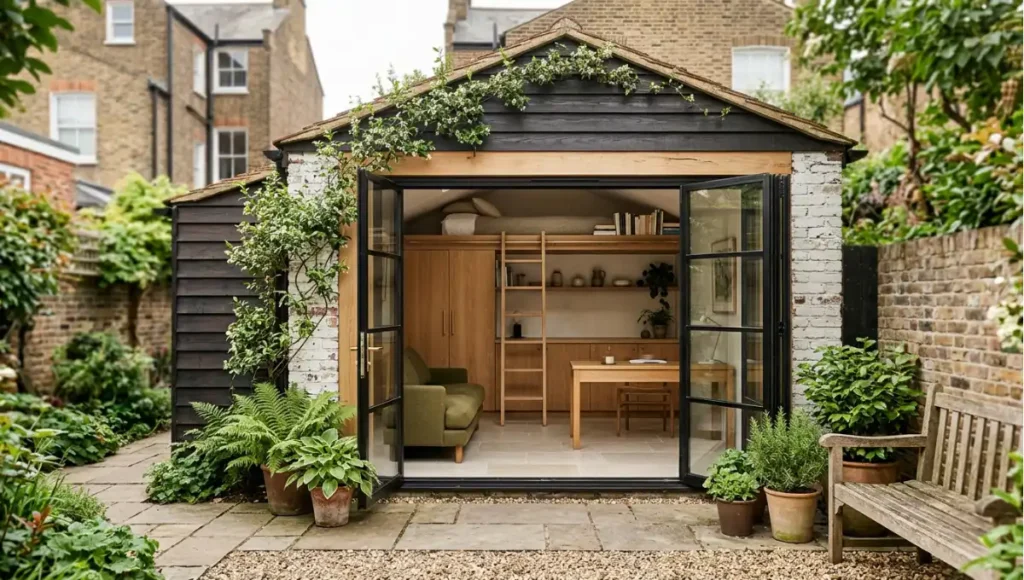
Millions of garages sit underused — half-storage, half-workshop, fully wasted. As housing costs rise and remote work reshapes how people use their homes, the garage is emerging as one of the most structurally ready, cost-efficient spaces a homeowner can convert into something genuinely useful. A garage conversion studio space can become a rental unit, a recording studio, an artist’s workshop, a full ADU, or a remote work retreat — depending on what you build and how carefully you build it.
This guide covers seven layout strategies, insulation specifications by climate zone, HVAC sizing rules, cost breakdowns by tier, and the design decisions that separate a conversion that performs from one that disappoints.
Nuvira Perspective
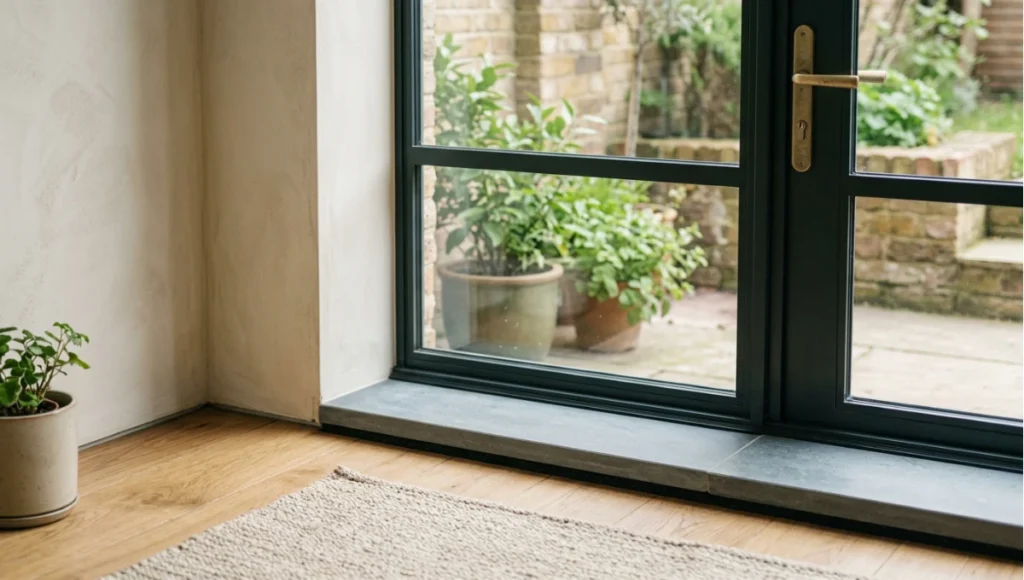
At Nuvira Space, we approach garage conversions not as construction problems but as spatial design problems. The garage shell is already there — structurally sound, weatherproofed, and positioned. The question is never whether it can be converted. It almost always can. The question is whether the conversion will produce a space worth spending time in.
That requires the same rigour of materiality, light control, acoustic performance, and proportional logic that goes into any purpose-built studio. The seven layouts below reflect that standard.
What “Studio Space” Actually Means in a Garage Conversion
The term studio carries different technical requirements depending on intended use. Before selecting a layout, establish which category your conversion falls into — this determines your permit path, insulation targets, and total cost range.
- Type A — Habitable Studio Unit: Meets IRC requirements for a living space. Requires egress window (min. 5.7 sq ft net clear opening), full HVAC with permit, minimum 7-ft finished ceiling height (IRC Section R305), plumbing rough-in, and Certificate of Occupancy in most jurisdictions.
- Type B — Creative/Professional Studio: Non-habitable workspace. Lighter permit requirements in most areas. Electrical and insulation upgrades are still required for comfort and function, but plumbing and habitable-unit compliance are not.
The Baseline: What You’re Working With
- Single-Car Garage: ~10×20 ft to 12×22 ft (200–264 sq ft). Workable for Type B or a minimal Type A unit.
- Double-Car Garage: ~20×20 ft to 22×24 ft (400–528 sq ft). Most versatile — allows genuine zone separation.
- Tandem / L-Shaped Garage: Footprint varies. Depth-forward layouts allow natural zone sequencing.
In all cases, the first structural assessment must confirm: finished ceiling height after insulation and drywall, slab condition and moisture history, drainage, and the structural status of the garage door opening.
The Science of Space
A converted garage is a spatial experiment with an unusual starting condition: a deep, wide, low-slung shell built for machines rather than people, usually with one long wall that can be opened to light and one end that can be closed to the house. The research domain that governs comfort in it is the same one that governs any dwelling — stress physiology, attention restoration, prospect and refuge, sensory load — but the garage’s proportions concentrate the decisions, because a single-zone room of this depth has fewer places to hide a poor choice. Two disciplines apply. First, the evidence base is developed for workplaces, classrooms, and housing generally; its transfer to a converted garage studio is an extension rather than a separate literature. Second, this page gives directions, not magnitudes — the studies carry their own numbers, and the specification figures further down this page carry their sources.
Neuroscience Foundation: What A Converted Garage Changes
- Attention is the studio’s working capital. Restoration research points to the value of environments that hold attention without demanding it; in a room used for sustained work, glare, reverberation, and visual clutter draw on exactly the resource the work requires.
- Acoustic load is a performance variable, not a comfort nicety. For any studio used for concentration or recording, unwelcome sound is a direct cost to output quality — which is why decoupling and absorption appear as structural decisions in the layouts below, not as finishing touches.
- Daylight anchors the working day. Light exposure patterns support alertness and sleep-wake regulation, which is why a glazed door infill is a schedule decision as much as an aesthetic one — and why glare control matters as much as light quantity.
- Thermal discomfort is cumulative. A slab-on-grade room with an infill wall at its coldest plane creates exactly the uneven conditions that make long sessions uncomfortable; the insulation and vapour strategy below exists to flatten that gradient.
- Refuge still applies in a single room. Even in one open volume, a person needs somewhere to sit enclosed and look out — a reason the mezzanine and the rear-corner desk recur across the layouts.
Design Translation
- Recovered ceiling height is the first spatial measure. Finishing a raw ceiling costs headroom; an unvented assembly applied directly to the sheathing recovers several inches, which changes how the whole room reads.
- Open the long wall, control the light. A full-width glazed infill facing north or east delivers diffuse light without direct sun — the studio’s most valuable single move, and one that requires an engineered header.
- Depth is an asset when the plan sequences it. A 22-foot span reads generous when zones sequence along it and oppressive when it is left as one undifferentiated box.
- A partial partition beats a full one. Stopping a partition short of the ceiling keeps acoustic openness and visual continuity while still dividing function.
- One raw material, allowed to dominate. Polished slab, board-formed plaster, or exposed CLT carries the room; mixing finishes dilutes it.
- Sightlines decide whether the studio feels separate. What you see from the work position — and what the house sees of it — determines whether the conversion reads as a studio or as a spare room with a mini-split.
Biophilic Response Patterns
- Visual connection with nature: the glazed infill and the garden beyond it, kept uncluttered by storage.
- Non-visual connection: moving air and rain on the roof, delivered by the ventilation strategy rather than added later.
- Refuge: the mezzanine platform or the rear-corner work position — enclosed, with an outlook.
- Mystery: the partial partition and the depth-sequenced plan, so the room reveals itself in stages rather than all at once.
- Material connection with nature: exposed CLT, board-formed plaster, and polished concrete read as themselves.
- Light and shadow: a recessed shadow-gap detail that hides the source and shows only the light; north light that shifts through the day.
Room-by-Room Breakdown
A garage studio is rarely rooms — it is zones — and each zone carries its own requirement. The table keeps the standard four columns and reads them for a conversion.
| Space | Psychological Need | Design Response | Measured Effect |
|---|---|---|---|
| Entry and threshold | Arrival clarity — the studio must feel like its own address | Rear or side door oriented to a garden path; a material change at the threshold | Direction: the room reads as a destination; magnitudes belong to the studies |
| Main work zone | Sustained attention | Glazed long wall with glare control, mechanicals and lighting recessed, one dominant material | Direction: attention less contested; no figure restated here |
| Mezzanine or sleep platform | Refuge with outlook | Platform sized for a bed or storage, positioned to overlook the volume without blocking light | Direction: usable refuge in a single-zone plan |
| Bathroom pod (Type A) | Privacy, dignity, moisture control | Enclosed pod at the rear, wet-wall clustered to shorten runs, independent extraction | Direction: privacy and durability; measurement belongs to building science |
| Machine room (acoustic layouts) | Noise containment | Outer zone housing the air handler and noisy equipment, decoupled from the inner room | Direction: isolation targets become reachable rather than aspirational |
| Garage door infill wall | Prospect and daylight — and the coldest plane | Engineered header, full-height glazing or insulated stud infill, continuous insulation on the exterior face | Direction: the thermal bridge and the light strategy are the same decision |
Technical Deep Dive: 7 Proven Layout Strategies
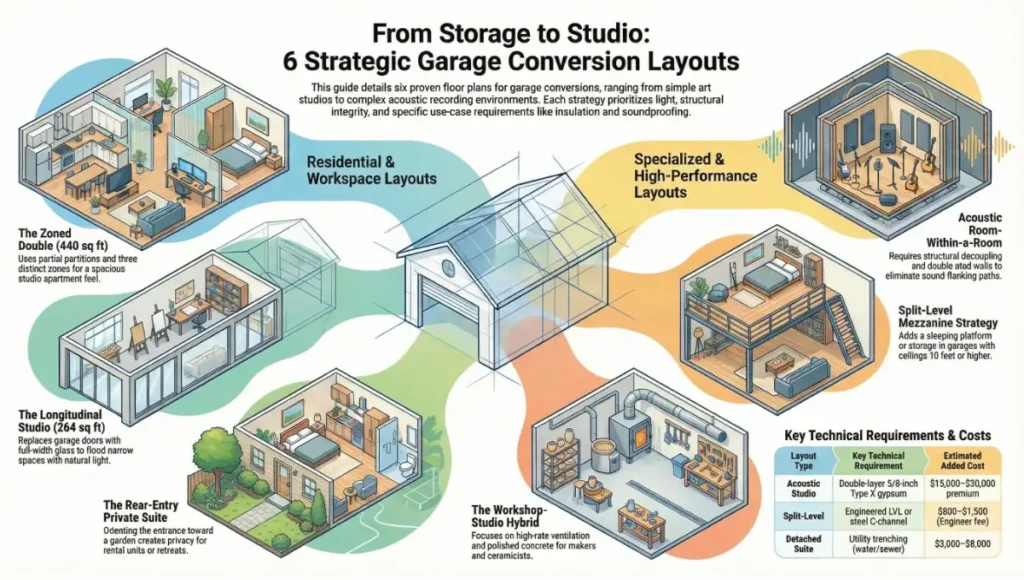
Layout 1 — The Longitudinal Studio (Single-Car, Type B)
Best for: Artist’s studio, photography space, home office Dimensions: 12×22 ft (264 sq ft)
The entire depth of the garage is used as a single working zone. The garage door opening is replaced with a full-width glazed wall — fixed glass panels flanking a central door — flooding the space with north or east light. Work surfaces run along both long walls, overhead storage on the rear wall. No partition walls. The 22-foot visual depth becomes a psychological asset.
- Walls: R-13 batt minimum (R-15 in cold climates)
- Ceiling: R-30
- Slab: 1-inch rigid foam under new flooring if moisture is present
- Structural note: glazed infill requires engineered header to span opening
Layout 2 — The Zoned Double (Double-Car, Type A)
Best for: Residential studio apartment, in-law unit, rental ADU Dimensions: 20×22 ft (440 sq ft)
Three zones are created using a partial partition wall and a rear bathroom pod. Thoughtful zone sequencing and natural light strategy are what separate a studio apartment that feels spacious from one that feels compressed — see: small-apartment-layout-natural-light
- Zone 1 (front, ~180 sq ft): Open living/sleeping area. Glazed or French-door front wall. Kitchenette.
- Zone 2 (centre, ~140 sq ft): Flexible — dining, desk, or Murphy bed.
- Zone 3 (rear, ~120 sq ft): Enclosed bathroom (IRC minimum 30 sq ft) and utility closet.
- Partial partition stops 18 inches from ceiling — preserves acoustic openness and visual continuity.
- Egress window required in sleeping zone: 5.7 sq ft net clear opening minimum.
- Exterior walls: R-15 + R-13 batt (double-stud or staggered-stud for thermal break)
- Ceiling: R-38 (climate zone 4+)
- Door infill: R-21 cavity + 1-inch continuous rigid foam
Layout 3 — The Split-Level Studio (High-Ceiling Double-Car)
Best for: Multi-use space, live/work studio, recording space Dimensions: 22×24 ft with ceiling height ≥10 ft (528 sq ft + mezzanine)
Where ceiling height exceeds 10 feet, a mezzanine platform adds a functional second level without expanding the footprint. The ground level remains fully open as the studio workspace; the mezzanine (typically 8×14 ft) holds a sleeping platform or storage.
- Mezzanine framing: engineered LVL or steel C-channel floor joists (structural engineer required)
- Budget for structural engineer: $800–$1,500
- Acoustic isolation for recording use: floating floor with resilient mat + 3/4-inch plywood decoupled from main framing
- Garage door wall becomes double-height glazed entry wall — industrial character retained as design asset
Layout 4 — The Rear-Entry Private Studio (Detached Garage)
Best for: Detached garage, rental unit, guest suite, remote work retreat Dimensions: 20×20 ft (400 sq ft)
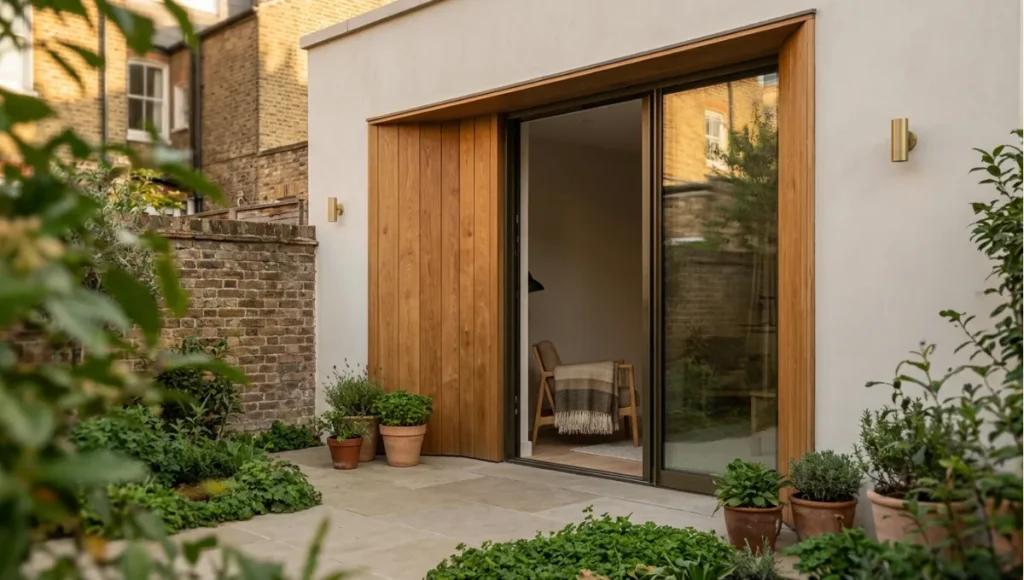
A new door is created in the rear or side wall, oriented toward a private garden — separating pedestrian entry from the garage door aesthetic and creating a genuine arrival threshold. Sleeping zone at the front; living zone at centre; kitchenette and bathroom pod at the rear near the new entry (minimising utility trench length).
- Detached utility runs (water, sewer, electrical): $3,000–$8,000 depending on distance and site conditions
- Wet-wall plumbing positioned at rear — closest point to main house connections
Layout 5 — The Workshop-Studio Hybrid (Single-Car, Type B)
Best for: Maker space, craft studio, photography darkroom, ceramics or woodworking studio Dimensions: 12×22 ft (264 sq ft)
This layout retains or upgrades the garage door for large-item access and cross-ventilation. The design principle is reversibility — no permanent changes that cannot be undone. Acoustic design principles apply directly to concentration and output quality: home-office-acoustic-design
- Flooring: sealed and polished concrete — $3–$8/sq ft depending on slab condition and finish level
- Ventilation: exhaust fan rated at minimum 10 air changes/hour (mandatory for solvents, spray paints, or adhesives)
- No plumbing permit required if no new plumbing is added
Layout 6 — The Acoustic Studio (Double-Car, Type B)
Best for: Music recording, podcast production, voice-over booth, film scoring Dimensions: 22×24 ft (528 sq ft) with room-within-a-room construction
Sound isolation requires structural decoupling — the inner room must share no rigid connection with the outer garage shell. Flanking paths through shared structure are the most common failure mode in amateur acoustic conversions.
Room-Within-a-Room Construction Sequence
- Build inner room floor as floating slab or resilient mat + plywood, isolated from concrete with neoprene isolators
- Frame inner walls on floating floor — do not attach to garage’s exterior walls
- Double-stud inner walls: outer leaf 2×4 at 16-inch centres / 1-inch air gap / inner leaf 2×4 — each cavity filled with R-15 mineral wool (not fibreglass — superior acoustic absorption)
- Double-layer 5/8-inch Type X gypsum with Green Glue damping compound between layers
- Floating ceiling: resilient channels or isolation clips supporting drywall — no direct attachment to roof structure
- Minimum STC target: 55–60 for music production; 45 for podcast/voice-over
- Machine room (outer zone): houses HVAC air handler, patchbay, noisy equipment
- Cost premium for room-within-room construction: $15,000–$30,000 over a standard conversion
Layout 7 — The Workbench-and-Studio Pair (Tandem or L-Shaped)
Best for: Hobbyist workshops that also need a clean working end, tandem garages with depth to spare Dimensions: footprint varies; the depth-forward plan is the asset
The tandem plan’s depth is the reason it converts well: a bench and dirty-trade zone occupies the far end, a clean studio zone occupies the near end, and the sequencing does the separating that walls would otherwise have to. The far zone keeps the garage door for large-item access and cross-ventilation; the near zone gets the glazed or glazed-infill end and the conditioned envelope. A single partial partition between them stops short of the ceiling, as in Layout 2, so the two ends share light without sharing mess. Because the plan is narrow, keep storage vertical — full-height along one wall — and hold the centreline clear, or the depth that made the plan work becomes a corridor. Treat reversibility the same way Layout 5 does: bench and service connections that can be unbolted keep the option to return the room to vehicle storage or to a future habitable unit.
Nuvira Space · Living Spaces
Garage studio conversion planner
The shell is already there. Tell the planner which garage you have and what the space must do, and it will point you at the layout that fits — plus the checks to settle before anyone draws.
Planner result
Layout 1 — The Longitudinal Studio
0 of 5 checks settled.
The full depth of a single-car garage used as one working zone, with the door opening replaced by a full-width glazed wall for north or east light. No partitions; the visual depth becomes the asset.
Still to settle: the structural assessment (headroom, slab, drainage, door opening); slab moisture testing and the barrier strategy; the type decision and permit path; insulation by climate zone and the door-infill thermal bridge; heating and cooling sizing by calculation.
Governing check: the glazed infill needs an engineered header to span the opening, and the infill wall is the coldest plane in the room — glazing and continuous insulation are the same decision.
Orientation aid only. This planner applies the layout logic published on the article; it does not size systems, quote costs, or replace a structural assessment. © Nuvira Space. All rights reserved. | LIVING SPACES Series.
Insulation Specifications by Climate Zone
Based on the 2021 International Energy Conservation Code (IECC):
| Component | Zones 1–2 (Hot) | Zones 3–4 (Mixed) | Zones 5–6 (Cold) | Zones 7–8 (Very Cold) |
|---|---|---|---|---|
| Exterior walls | R-13 | R-15 | R-20 | R-21 + R-5 CI |
| Ceiling / roof | R-30 | R-38 | R-49 | R-60 |
| Slab perimeter | — | R-10 (2 ft) | R-10 (4 ft) | R-15 (4 ft) |
| Garage door infill | R-15 min | R-21 min | R-21 + CI | R-30 min |
- Thermal bridge at door infill: Most common insulation failure. 1–2 inches of rigid polyisocyanurate or mineral wool board on the exterior face of infill framing is required to break the conductive path.
- Vapour control (cold climates, Zones 5+): Class II vapour retarder (kraft-faced batts) on the warm side of wall cavity.
- Vapour control (hot-humid, Zone 2A): Control layer moves to the exterior — a common and costly error in conversions that apply a single strategy regardless of geography.
Comparative Analysis: Garage Studio vs. Industry Standard New Build
Cost Comparison
| Tier | Garage Conversion | Equivalent New Build |
|---|---|---|
| Basic workspace (Type B) | $8,000–$15,000 | $40,000–$70,000 |
| Studio apartment (Type A) | $20,000–$40,000 | $80,000–$150,000 |
| Full ADU | $45,000–$80,000 | $150,000–$300,000+ |
| Acoustic studio | $35,000–$65,000 | $100,000–$200,000 |
HVAC: Mini-Split Sizing and Placement
The ductless mini-split is the standard HVAC choice for garage conversions. Sizing targets:
- Single-car studio (200–264 sq ft): 6,000–9,000 BTU single-zone unit
- Double-car studio (400–440 sq ft): 12,000 BTU single-zone unit
- Double-car with bathroom (440–528 sq ft): 18,000 BTU or dual-zone system
- Placement: Interior sidewall at ~7 ft above finished floor — never on the door infill wall where thermal load is highest
- Cold-climate spec: Units rated for operation to -15°F/-26°C (Mitsubishi Hyper Heat, Daikin Fit, Bosch Climate 5000)
- Installed cost: $3,000–$7,000
Speculative / Internal Concept Study — Nuvira Light Studio — by Nuvira Space
Everything in this section is a speculative internal concept study. It is not a built project and it has no client; the performance figures below are design targets carried from the concept brief, not measured results.
Project overview
- Location: Detached double-car garage, temperate urban residential site (Climate Zone 4) — speculative
- Typology: Photography and visual arts studio, Type B non-habitable
- Vision: A conversion conceived not as a practical fix but as a considered piece of architecture — a space that reads as purpose-built, not retrofitted
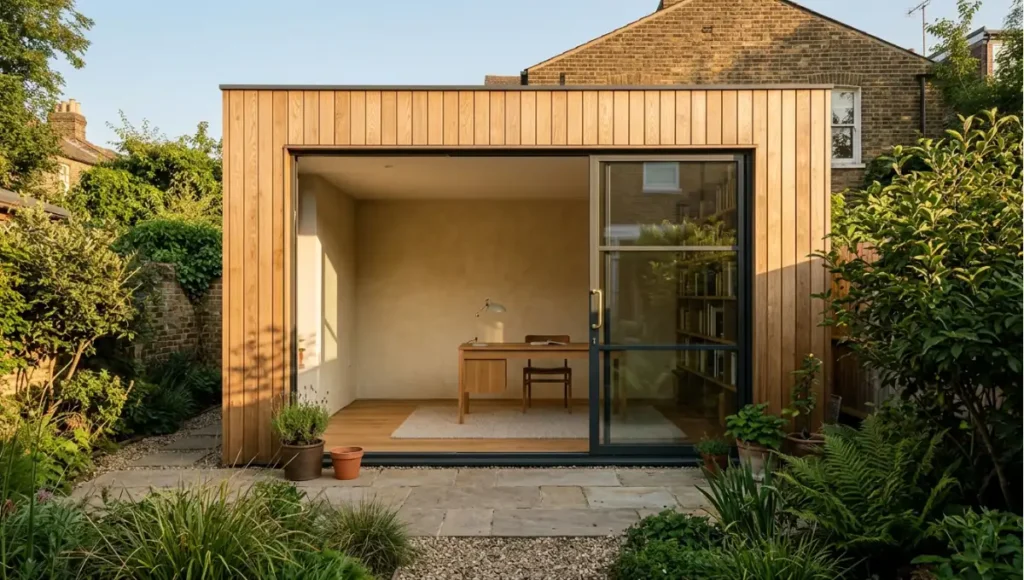
Design levers applied
Facade and glazing
- Garage door opening replaced with custom structural glazing: fixed low-iron glass panels (800mm height) at floor level, transitioning to operable aluminium-framed windows above
- North-facing orientation for consistent, diffuse light without direct sun
- Glazed wall U-value: 0.28 W/m²K (triple-pane equivalent performance) — design target from the concept brief, not a measured result
Floor
- Existing concrete slab polished to 400-grit finish, sealed with matte water-based polyurethane
- Calcium chloride moisture test conducted prior to finishing — transmission confirmed below 3 lbs/1,000 sq ft/24 hrs
- No additional flooring layer — slab exposed and celebrated
Walls
- Three walls: board-formed concrete plaster (cement render applied in horizontal lifts, left with formwork texture — the quality of cast concrete without structural complexity)
- Rear wall: 105mm cross-laminated timber (CLT) panel — structural, exposed, serving simultaneously as rear zone retaining wall, warm acoustic surface, and visual counterpoint — see: cross-laminated-timber-vs-mass-timber
Lighting
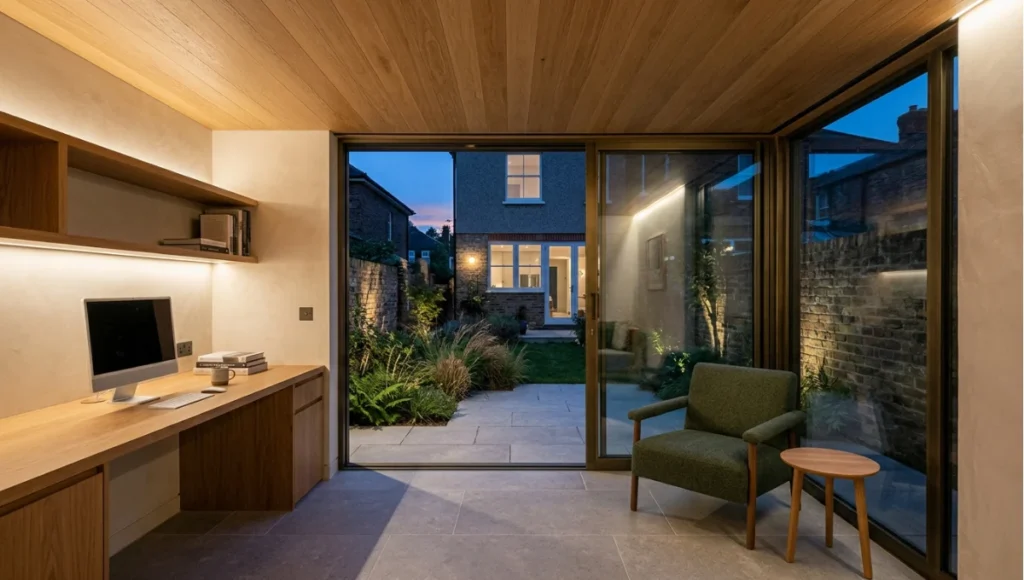
- Continuous LED strip recessed into 50mm shadow gap at ceiling/rear-wall junction — 3000K, CRI 95+
- Three articulated track heads on ceiling-mounted rail for task-specific direction
- No overhead diffusers, no suspended fittings — light sources hidden; only the light is visible
HVAC
- Single 9,000 BTU cold-climate mini-split on east sidewall
- Supplementary radiant panel (400W) at rear CLT wall for shoulder-season use
- Exhaust-only ventilation via HRV (Heat Recovery Ventilator) — 0.35 ACH minimum per ASHRAE 62.2
Transferable takeaway
You can apply the same spatial logic at home by replacing the garage door with a full-width glazed wall to collapse the boundary between inside and outside, choosing one raw material (polished concrete, board-formed plaster, or exposed CLT) and letting it dominate rather than mixing multiple finishes, and positioning artificial light sources so that only the light is visible — not the source. These three moves — threshold, material honesty, hidden light — are what make the Nuvira Light Studio feel designed rather than converted.
Intellectual Honesty: Current Limitations
- Zoning restrictions remain the primary barrier in many US jurisdictions. While California’s ADU legislation has significantly liberalised garage conversion rules, other states impose setback requirements, owner-occupancy mandates, or outright prohibitions on accessory dwelling units. Always verify local zoning before committing to a Type A conversion.
- Acoustic studio conversions are routinely underestimated. Room-within-a-room construction requires specialist knowledge. Amateur execution — particularly at the floor isolation layer — frequently produces STC values 15–20 points below design target, rendering the space unusable for recording.
- Slab moisture is underdiagnosed. Surface sealers are inadequate for high-moisture slabs; a full polyurea coating or epoxy moisture barrier system is required. This is regularly identified post-conversion, adding unplanned cost.
- Mini-split sizing by rule-of-thumb is unreliable for well-insulated spaces. Manual J calculation is the correct method — especially for year-round use in extreme climates.
- The seven layouts are strategies, not guarantees: each one assumes the structural assessment clears, and a conversion that fails the slab or headroom check is a different project rather than a harder version of the same one.
2030 Future Projection
Three trends are converging to make garage conversion studio spaces more viable, more sophisticated, and more regulated over the next four years:
- EV adoption is reducing garage utilisation. As electric vehicle charging moves to driveways and kerb-side infrastructure, the garage-as-car-storage rationale weakens. By 2030, the AIA projects that residential garages will increasingly be redesigned as flexible-use secondary structures rather than vehicle storage.
- Mass timber components will reach residential-scale pricing. CLT and glulam panels are forecast to reach cost parity with dimensional lumber in North American markets by 2028–2029 as domestic production scales.
- Permit pathways will continue to standardise. Following California’s lead, multiple states are progressing ADU-enabling legislation. By 2030, a majority of US jurisdictions are projected to have streamlined permit pathways for garage-to-habitable-unit conversions.
Actionable Design Principles
- Establish type before layout. Type A or Type B — this single decision determines your permit path, insulation targets, and budget range.
- Test the slab before specifying the floor. If transmission exceeds 3 lbs/1,000 sq ft/24 hrs, budget for a polyurea or epoxy moisture barrier system, not a surface sealer.
- Treat the garage door opening as an architectural opportunity. Infill with a stud wall if budget is the constraint; glaze it fully if design quality is the priority. There is no neutral choice.
- Specify insulation by climate zone, not rule-of-thumb. The thermal bridge at the door infill is the single most common failure point.
- Size the mini-split to a Manual J calculation. Oversizing wastes capital and produces inconsistent humidity control.
- For acoustic studios, budget for structural decoupling before anything else. Room-within-a-room construction cannot be retrofitted.
- Account for detached utility runs in your budget before breaking ground. Trenching for water, sewer, and electrical is the most frequently underestimated line item in detached conversion projects.
Comprehensive Technical FAQ
Q: Do I need a permit to convert my garage into a studio space?
A: Almost always yes. Even for a Type B non-habitable workspace, a building permit is typically required for structural changes, electrical upgrades, and HVAC installation. For Type A habitable units, expect building, electrical, plumbing, and mechanical permits, plus possible planning/zoning approval. California’s SB 9 and related legislation has streamlined this for ADU conversions, but compliance requirements vary by city.
Q: What is the minimum ceiling height for a habitable garage conversion?
A: IRC Section R305 specifies 7 feet minimum finished ceiling height. This is after insulation and drywall. A raw 9-foot garage ceiling typically finishes at 8’7"–8’9" — comfortable. An 8-foot raw ceiling may land at 7’5"–7’9" — above the minimum but psychologically constraining. Consider spray foam applied directly to the roof sheathing (unvented assembly) to recover 3–4 inches of finished height.
Q: Can I convert a single-car garage into a habitable studio apartment?
A: Yes, but the constraints are real. A 12×22 ft single-car garage (264 sq ft) is at the lower boundary of liveable. Most jurisdictions require a minimum ADU size of 150 sq ft (California) to 220 sq ft (other states). Verify local minimums before designing.
Q: What’s the ROI on a garage conversion?
A: A well-executed garage conversion typically recoups approximately 80% of its cost at resale, based on aggregated data from Remodeling Magazine’s Cost vs. Value report. For Type A units generating rental income, payback periods of 4–7 years are common in high-demand rental markets.
Q: What insulation R-value do I need for a garage conversion?
A: It depends on your climate zone (per the IECC). Zones 3–4 (mixed): R-15 walls, R-38 ceiling, R-21 door infill. Zones 5–6 (cold): R-20 walls, R-49 ceiling, R-21 + continuous insulation at door infill. Always add a continuous insulation layer at the former garage door opening regardless of climate zone.
Q: What STC rating should an acoustic studio achieve?
A: STC 55–60 for music production (live instruments, amplified sound). STC 45 for podcast and voice-over production. Standard drywall construction achieves STC 35–40. Room-within-a-room construction with mineral wool, double-layer gypsum, and Green Glue damping compound reliably achieves STC 55–60.
Step inside the Living Spaces archive
A garage conversion studio space is one of the most structurally advantaged home improvement projects available. The shell is already there — weatherproofed, positioned, and built to last. What it becomes is a function of how precisely you define its purpose, how rigorously you address insulation and moisture, and how seriously you treat the design decisions that determine whether the space feels considered or merely finished.
Explore the Living Spaces archive → living-spaces
The AIA’s Design for Human Health resource series offers evidence-based guidance on acoustic comfort, thermal performance, and spatial quality thresholds that translate directly to studio conversion design — a useful reference for any homeowner or designer working through the specification phase.
Seven layouts. One question: which one is yours?
© Nuvira Space. All rights reserved. | LIVING SPACES Series | All specifications cited are based on the 2021 International Energy Conservation Code (IECC), IRC Section R305, ASHRAE 62.2 ventilation standards, and 2025–2026 national cost averages compiled from Remodeling Magazine Cost vs. Value Report, Angi, and Homeadvisor contractor data. Nuvira Light Studio is a speculative internal concept study and does not represent a completed project.
3 thoughts on “Garage Conversion Studio Space: 7 Proven Layouts That Work”