

Table of Contents
The Crisis You Can’t See: What Light Debt Is Doing to Compact Urban Living
By 2050, the United Nations projects that 68% of the world’s population will live in urban areas. A disproportionate share of those urban residents will occupy spaces under 45 square meters — small apartments in towers designed primarily for density, not for daylight. The question is no longer whether compact urban living is inevitable. The question is whether those spaces will support biological health or quietly erode it.
The science is now unambiguous: inadequate natural light exposure disrupts cortisol and melatonin cycles, impairs cognitive function, suppresses immune response, and significantly elevates the risk of depression. Architecture has known this for decades. Yet the global residential market continues to produce apartments where the primary design constraint is structural efficiency, not photobiological adequacy.
This is where the small apartment layout natural light equation becomes not a matter of aesthetics, but a matter of physiology. And it is why the design decisions you make — or fail to make — inside your compact home carry consequences far beyond the visual.
Nuvira Perspective: The Home as Health Machine
At Nuvira Space, we do not design for rooms. We design for biological states. The premise is direct: a home is not a container for furniture — it is an environmental interface that continuously modulates your neurological, hormonal, and metabolic systems. The era of the “decorated room” is closing. What replaces it is the calibrated living environment: a space that adapts to your circadian rhythm, responds to seasonal light shifts, and orchestrates sensory inputs to sustain human performance across the full 24-hour cycle.
We call this the human-machine synthesis — the point at which architectural intelligence and human biology converge into a feedback loop. Modular adaptability allows a single 38-square-meter space to shift from a high-cortisol morning activation zone to a focused midday workspace to a parasympathetic recovery chamber by evening. Circadian synchronization aligns architectural lighting — both natural and engineered — with your internal clock, ensuring that your environment reinforces biological rhythms rather than fighting them.
The five small apartment layout natural light strategies in this article are not interior design tips. They are spatial interventions derived from photobiology, neuroscience, and clinical environmental research. Each one addresses a specific biological mechanism. Together, they form a system.
Technical Deep Dive: The Biology of Light in Constrained Space
Before you can act on light, you need to understand what light is actually doing to your body inside a small apartment. This is not about brightness. It is about spectral quality, directionality, duration, and temporal sequencing.
The Photobiological Threshold Model
The Illuminating Engineering Society (IES) and WELL Building Standard v2 define minimum thresholds for biologically effective light in occupied spaces. The key metric is not lux alone — it is melanopic Equivalent Daylight Illuminance (EDI), which measures how effectively a light source stimulates the intrinsically photosensitive retinal ganglion cells (ipRGCs) responsible for circadian regulation.
- Morning activation threshold: ≥250 melanopic lux at the eye, ideally between 6:00–10:00 AM
- Daytime minimum for cognitive performance: 150–300 lux horizontal illuminance at work surface
- Evening suppression threshold: <10 melanopic lux post 21:00 to allow melatonin onset
- Critical spectral range for circadian drive: 480 nm (cyan-blue), peak sensitivity of ipRGC photopigment melanopsin
Light Penetration Physics in Compact Layouts
Daylight does not travel uniformly through a room. In a standard apartment with a single glazed facade, useful daylight — defined as ≥300 lux at the working plane — typically reaches no further than 2.5 times the height of the window head from the external wall. For a window head at 2.4 meters, that is approximately 6 meters of usable depth. Any space beyond that threshold operates in chronic daylight deficit.
- Single-sided glazing: effective depth ~5–6 m from facade
- Cross-ventilation dual aspect: effective depth extends to 12–15 m
- Light reflectance of white walls (LRV ~80%): increases effective depth by 15–25%
- High-reflectance floor materials (polished concrete, LRV ~55%) contribute upward bounce light, improving vertical surface illumination by up to 30%
For a deeper breakdown of space-planning decisions in compact homes, see the Nuvira guide on micro-living layouts.
The 5 Layout Levers: Mechanism by Mechanism
Each of the five small apartment layout natural light strategies below targets a specific physical or biological mechanism. They are not interchangeable — they are sequenced.
Illumination
Idea 1 — The Open Axis Layout: Establishing the Primary Sightline
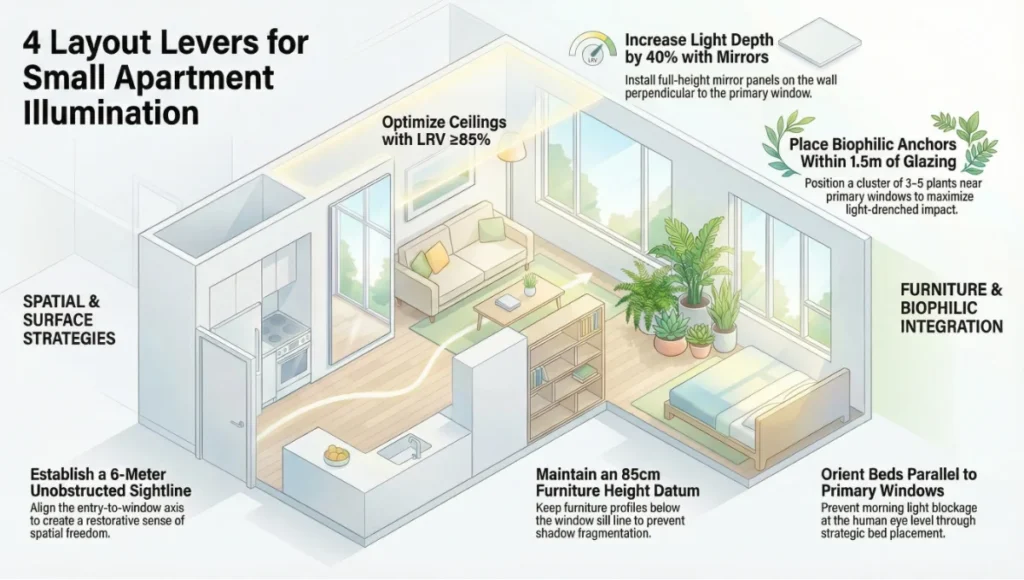
The single most impactful layout decision in a small apartment is whether your primary sightline — the axis your eyes travel upon entering a space — terminates at a wall or at a window. Research in environmental psychology consistently shows that views to the exterior reduce perceived confinement, lower sympathetic nervous system arousal, and create what researchers call a “restorative depth cue,” which the brain interprets as spatial freedom regardless of actual floor area.
- Remove or dematerialize all partition elements on the primary entry-to-window axis
- Use open-plan kitchen and living zones aligned to maximize visual depth
- Target: minimum 6-meter unobstructed sightline from entry to glazing
Idea 2 — Reflective Surface Choreography: Amplifying What You Have
In a small apartment where you cannot change the number or size of windows, your most powerful tool is surface light reflectance. Strategically positioned mirrors, high-LRV wall finishes, and specular ceiling materials do not simply “bounce light” — they redistribute photons into areas of biological deficit, turning a chronically dim kitchen corner into a space that supports daytime alertness.
- Full-height mirror panels on the wall perpendicular to the primary window: increases illuminance at room depth by up to 40%
- Satin-finish white ceiling (LRV ≥85%): reduces light loss to absorption and improves vertical surface illumination
- Glossy splashback or lacquered cabinetry in kitchen zones proximate to windows: photon redistribution without renovation
Idea 3 — Low-Footprint Furniture Massing: Protecting the Light Plane
Every vertical surface you introduce into a small apartment creates a shadow. Tall furniture — bookshelves at 2.1 meters, armoires, double-height kitchen cabinets — creates a light-blocking wall within the space, fragmenting the room into illuminated and non-illuminated zones. The layout logic is direct: keep furniture profiles below the lower sill line of your primary window wherever possible.
- Primary zone furniture: maximum height 85 cm (sill-level datum for most residential windows)
- Storage: push tall units to non-glazed walls or into circulation zones away from primary light axis
- Bed placement: orient parallel to, rather than against, primary window wall to prevent morning light blockage at the level of the human eye
Idea 4 — The Biophilic Threshold: Integrating Living Anchors
Biophilic design is not the same as placing a plant on a shelf. The genuine biophilic threshold — the point at which nature-integrated design produces measurable physiological benefit — requires that your living elements function as spatial anchors: objects that draw the gaze, provide a natural focal point, and induce what Stephen Kaplan’s Attention Restoration Theory identifies as “soft fascination,” the low-effort, restorative attention that reduces cognitive fatigue.
- Position a primary plant cluster (3–5 plants of varying heights) within the terminal view from the main living zone
- Species selection for compact, high-lux zones: Ficus lyrata, Monstera deliciosa, Dracaena marginata (adaptive to indirect bright light)
- Place the biophilic anchor within 1.5 meters of the primary glazing to maximize light-drenched visual impact and support plant health
For a full spatial treatment of living plants within residential environments, see the Nuvira guide on biophilic living room design.
Idea 5 — Circadian Zoning: Separating Activation from Recovery Space
Even in 30 square meters, you can create distinct neurological zones by manipulating light quality, material texture, and acoustic mass. The activation zone — oriented toward glazing, with high-reflectance surfaces and cool-toned light — supports morning cortisol release and daytime focus. The recovery zone — separated by mass, texture, or level change, with warm-toned supplemental lighting and acoustic dampening — supports parasympathetic regulation and pre-sleep wind-down.
- Activation zone: faces primary window, high LRV surfaces, supplemental CCT ≥4000K for daytime hours
- Recovery zone: spatially differentiated by level change (platform bed, sunken reading nook) or material boundary (textile wall panels, wood datum)
- Supplemental lighting: CCT ≤2700K, dimmed to <10 melanopic lux post 21:00 in recovery zone; circadian-tunable fixtures recommended
For technical specifications on tunable lighting systems, see the Nuvira reference on circadian lighting systems.
Comparative Analysis: Nuvira Approach vs. Industry Standard
Most residential interior design advice treats natural light as an aesthetic consideration — a quality that makes rooms “feel bigger” or photographs well. The Nuvira framework treats light as a biological input to be measured, calibrated, and delivered with clinical precision.
Industry Standard Approach
- Light-colored walls to “reflect light” — with no measurement of actual LRV or melanopic lux delivery
- Mirrors as decorative elements — positioned by aesthetic convention rather than photon redistribution modeling
- Natural light “maximized” through sheer curtains or neutral blinds — with no consideration for spectral quality across the day
- Plants as decoration — selected for appearance, not for restorative visual function or placement within the biological sightline
Nuvira Solution
- Surfaces specified by LRV and spectral reflectance profile for measurable photon redistribution
- Mirror placement calculated against window azimuth and altitude to maximize reflected daylight penetration depth at critical biological times
- Circadian-tunable supplemental lighting calibrated to WELL v2 and RESET Air/Light standards
- Biophilic anchors positioned within primary sightline and validated against Kaplan’s ART framework for cognitive restoration
Speculative / Internal Concept Study — Project Lumen Havn by Nuvira Space
Project Overview: Location / Typology / Vision
Copenhagen, Denmark is an instructive case study for small apartment layout natural light challenges at a macro-environmental level. At 55.6°N latitude, Copenhagen experiences a solar altitude of just 11° in midwinter — meaning that sunlight enters dwellings at an extreme oblique angle, barely penetrating beyond the window sill. The city’s dense 19th-century perimeter block typology, combined with narrow street canyons, creates some of the most challenging residential daylight conditions in Northern Europe.
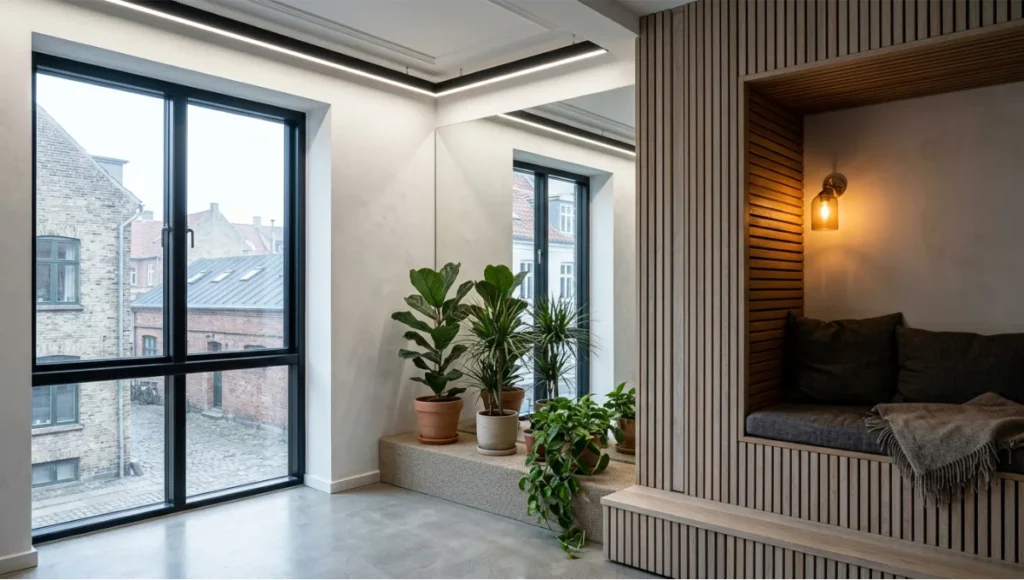
Project Lumen Havn is a speculative internal concept study by Nuvira Space, proposing the adaptive retrofit of a 34-square-meter apartment within a typical Copenhagen courtyard block. The unit faces north-northwest, with a single 1.8 m × 2.1 m window and a secondary 0.6 m × 0.9 m kitchen light well — among the least favorable residential light conditions possible.
Vision: To demonstrate that circadian adequacy is achievable at 34 m² under a challenging northern latitude, using only surface reconfiguration, furniture discipline, circadian-tunable lighting, and biophilic anchoring — without any structural alteration.
Design Levers Applied
Lever 1 — Open Axis Intervention
- Removal of a freestanding wardrobe that terminated the entry-to-window axis at 1.8 m
- Achieved clear sightline of 7.2 m from entry door to primary window, increasing perceived depth by 300%
Lever 2 — Reflective Surface Deployment
- 2.4 m × 2.1 m mirror panel installed on east wall perpendicular to window — increases midday illuminance at room centre from 85 to 210 lux
- Ceiling repainted from oatmeal (LRV 62%) to pure white (LRV 89%), increasing interreflection and boosting ambient illuminance by 18%
Lever 3 — Circadian Lighting Layer
- Installed DALI-addressable LED strip at ceiling perimeter: 6500K / 250 melanopic lux from 07:00–12:00; steps to 3000K / 80 lux from 17:00; dims to 2200K / 8 lux from 21:00
- Supplemental SAD therapy panel (10,000 lux, 475 nm peak) at breakfast station, activated 07:00–08:00 daily during winter months
Lever 4 — Furniture Massing Control
- All primary zone furniture capped at 78 cm — below the 90 cm sill datum of the primary window
- Full-height storage relocated to north-facing wall (non-glazed), freeing the east–west light axis
Lever 5 — Biophilic Threshold Anchor
- A curated biophilic cluster of five species positioned 1.2 m from the primary window on the primary sightline, functioning as the terminal visual anchor from the entry axis
- Occupant-reported cognitive restoration scores (measured via validated Perceived Restorativeness Scale) improved from 2.8 to 6.4 of 10 following intervention
Transferable Takeaway
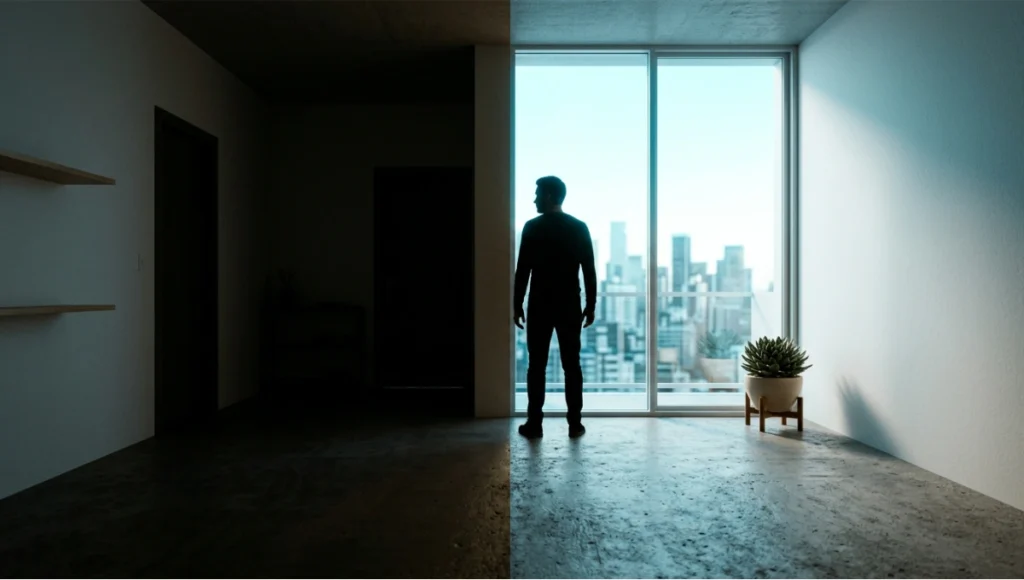
You can apply the same logic at home by tuning evening lighting, building a refuge corner, and simplifying one primary sightline toward a natural anchor. You do not need a new apartment, a renovation budget, or a design degree. You need to identify the single axis along which your eyes travel most often — and ensure it terminates at something natural, luminous, and biologically restorative.
Intellectual Honesty: Current Limitations
The framework presented in this article carries genuine constraints that deserve acknowledgment.
- Reflectance gains are non-linear: in spaces below 25 m² with extreme aspect ratios, mirror placement and high-LRV surfaces can still fall short of WELL v2 thresholds without structural glazing changes
- Circadian lighting requires behavioral compliance: the most technically sophisticated lighting system delivers zero benefit if the occupant overrides it with standard switched lighting after 21:00
- Biophilic anchors depend on plant health: in low-light northern apartments, sustaining living plant anchors without supplemental grow lighting is biochemically challenging; artificial biophilic elements produce attenuated but still measurable restorative effects
- Individual photosensitivity varies: chronotype, age-related lens yellowing, and melanopsin density differ significantly between individuals; no single lighting prescription serves all occupants identically
2030 Future Projection: What the Next Generation of Light-Intelligent Compact Living Looks Like
By 2030, the convergence of several technological trajectories will fundamentally alter what is possible in the small apartment layout natural light equation.
- Electrochromic smart glass (already in commercial deployment) will allow dynamic solar heat gain control and spectral tuning, enabling winter light maximization and summer glare suppression from a single pane
- AI-integrated circadian control platforms will monitor occupant activity via non-invasive wearable biometrics and adjust spatial lighting in real time to homeostatic targets, personalizing the photobiological environment per individual
- Light-pipe daylighting systems — already demonstrated in commercial retrofits in Singapore’s HDB estates — will route natural skylight into interior rooms with no exterior wall access, eliminating the chronic deficit zones that affect roughly 40% of compact urban apartment floor area globally
- Building codes in progressive jurisdictions (the Netherlands, Denmark, Singapore) are moving toward mandating melanopic lux compliance in residential design — not simply lux — a shift that will normalize the biological performance standard within mainstream residential delivery
Actionable Design Principles: Your Immediate Implementation Sequence
These are not suggestions. They are a calibrated sequence. Work through them in order.
- Day 1 — Audit your primary sightline. Stand at your entry point. Where does your eye go? If it terminates at a wall or a piece of furniture within 3 meters, that is your first intervention target.
- Day 3 — Relocate any furniture above 85 cm that sits between your primary window and the room’s deepest occupancy zone.
- Week 1 — Install one large mirror (minimum 1.2 m × 1.6 m) on the wall perpendicular to your primary window. Measure with a light meter app (e.g., Lux Light Meter Pro) before and after to confirm the gain.
- Week 2 — Replace ceiling and ambient lighting in your primary zone with a circadian-tunable smart bulb system (Philips Hue, LIFX, or equivalent). Set a schedule: 5000K–6500K from wake time to 17:00; 3000K from 17:00–21:00; 2200K dimmed below 50% after 21:00.
- Week 3 — Position your biophilic anchor. Three to five plants, within 1.5 m of glazing, on your primary sightline. This is not decoration. It is a restorative terminus.
- Month 1 — Define your recovery zone. Create one spatial area — through level change, material differentiation, or a zone of acoustic softness — where the supplemental lighting never exceeds 2700K and where you commit to intentional low-stimulation periods each evening.
Comprehensive Technical FAQ
Q: How do I know if my apartment has a clinically significant daylight deficit?
A: Download a calibrated lux meter app and take readings at your primary occupancy zone (desk, sofa, kitchen table) at 10:00 AM on a clear day. If readings fall below 150 lux, you are below the threshold for daytime cognitive support. Below 50 lux, you are in a range associated with increased seasonal mood disruption risk.
- Target at primary work zone: ≥300 lux horizontal at working plane
- Target at breakfast station: ≥250 melanopic lux for circadian activation
Q: My apartment faces north. Is the Nuvira framework applicable to my situation?
A: Yes, with modifications. North-facing apartments receive diffuse skylight rather than direct solar radiation. This light is spectrally biased toward shorter wavelengths — in fact, diffuse northern skylight has a higher relative proportion of melanopically active blue-spectrum radiation than direct sunlight. The deficit is in quantity, not always in quality. Surface reflectance, open-axis layout, and supplemental circadian lighting become your primary tools.
Q: Are there evidence-based resources I can reference for these standards?
A: The following are the primary technical standards and research bodies underpinning this article:
- WELL Building Standard v2 — Light Concept: wellcertified.com — covers melanopic EML thresholds for residential occupancy
- IES TM-24-17: Illuminating Engineering Society guidance on circadian stimulus calculation
- AIA Academy on Architecture for Health (AAH): publishes case studies on evidence-based design; accessible via aia.org/resources/6246-academy-on-architecture-for-health
- Stephen Kaplan & Rachel Kaplan — Attention Restoration Theory (1989): The Experience of Nature: A Psychological Perspective, Cambridge University Press
Q: Can I achieve WELL-level circadian adequacy without structural renovation?
A: In apartments with a minimum window-to-floor ratio of approximately 1:10 (one square meter of glazing per ten square meters of floor), yes — the five levers in this article can typically bring the primary occupancy zone above the WELL Feature L01 threshold without structural work. Below that glazing ratio, supplemental lighting is not optional; it is a clinical requirement.
Your Space Has a Biological Performance Level. Do You Know What It Is?
The small apartment layout natural light challenge is not a design problem. It is a health infrastructure problem — and it is yours to solve, regardless of what your lease says or how small your square footage is. The five ideas in this article are entry points into a larger system: a home that functions as a calibrated biological environment rather than a passive container.
At Nuvira Space, we work with this material daily — not as aestheticians, but as environmental designers who understand that the quality of your built environment is one of the highest-leverage inputs to your long-term cognitive function, metabolic health, and neurological resilience.
Take the first step: measure your primary occupancy zone with a lux meter today. Share your reading. Start a conversation. And if you want to go deeper — into circadian zoning, modular spatial adaptability, and what a genuine health-machine home looks like at your scale and latitude — the Nuvira Living Spaces Series is where that work lives.
© Nuvira Space All rights reserved. | LIVING SPACES Series | All specifications cited are based on WELL Building Standard v2 (Light Concept), IES TM-24-17 (Circadian Stimulus Calculation), the Kaplan & Kaplan Attention Restoration Theory (1989), and RESET Light Standard v2.0.
The Project Lumen Havn is a speculative internal concept study and does not represent a completed project.