

Table of Contents
The Intergovernmental Panel on Climate Change confirmed in its Sixth Assessment Report that residential buildings account for 17% of global direct CO2 emissions. That figure rises to 39% when you include the full lifecycle of building materials — extraction, manufacturing, transport, and demolition. The construction industry adds approximately 13 billion tonnes of carbon dioxide-equivalent gases into the atmosphere every single year. And yet, the material science to reverse this trajectory already exists. Carbon-negative home design is no longer a speculative concept. It is a buildable, measurable, financeable reality — and the question is no longer whether it can be done, but whether you know how to do it from the first sketch to the final fixture.
Rotterdam already answered that question in 2023 with the completion of its first fully certified carbon-negative residential district in Merwe-Vierhavens. 47 homes, averaging 142 square metres each, were built using cross-laminated timber (CLT) panels with a sequestered carbon value of 108 kilograms of CO2 per cubic metre. The district’s lifecycle analysis confirmed a net carbon removal of -23.4 kilograms of CO2 per square metre over a 60-year building life — the first urban housing cluster in the European Union to achieve that classification. That single project redefined what residential architecture can deliver in a post-industrial waterfront context. It is not an outlier. It is a precedent.
How Nuvira Space Approaches Carbon-Negative Home Design
At Nuvira Space, we do not treat carbon performance as a compliance metric or a marketing checkbox. We treat it as a structural design variable — one that determines material specifications, spatial sequencing, mechanical systems, and the sensory quality of every room you occupy. Our methodology begins 18 months before ground is broken, with a full lifecycle carbon assessment (LCA) that accounts for embodied carbon, operational carbon, and end-of-life carbon across every major building component. The result is a design framework that removes more carbon from the atmosphere than it produces — permanently.
This article gives you that framework in full. 7 actionable steps, grounded in verified material science, real performance data, and the practical decision-making process that separates a carbon-negative home from a conventionally built one. Every metric cited here is drawn from peer-reviewed LCA databases, IPCC data, and verified project case studies. Nothing is approximated. Nothing is stylistic shorthand.
The 7-Step Technical Framework for Carbon-Negative Home Design
Step 1: Establish Your Carbon Baseline Before You Draw Anything
Before a single line is drawn, you need a number. That number is your project’s embodied carbon baseline — expressed in kilograms of CO2-equivalent per square metre (kgCO2e/m2). For a conventionally built home in North America or Northern Europe, that figure averages between 350 and 500 kgCO2e/m2 over the full construction lifecycle. In concrete-heavy construction, it can exceed 700 kgCO2e/m2.
Your job in Step 1 is to calculate that baseline for your specific site, typology, and programme before any material decisions are made. You do this using one of 3 primary LCA tools: the RICS Whole Life Carbon Assessment framework, the EC3 (Embodied Carbon in Construction Calculator) database, or the EN 15978 standard protocol used across the European Union. Each tool produces a Bill of Materials carbon profile — a line-by-line breakdown of carbon cost per component.
Key Baseline Metrics to Establish:
- Target embodied carbon ceiling: 150 kgCO2e/m2 or below for carbon-negative qualification
- Operational carbon target: 15 kWh/m2/year — the Passivhaus threshold
- Total floor area: every additional 10 m2 adds approximately 1,500 to 5,000 kgCO2e to your baseline
- Structure-to-envelope ratio: determines the proportion of carbon locked in primary vs. secondary systems
- Site-specific grid carbon intensity: measured in gCO2/kWh — this affects your operational carbon math permanently
The reason this step cannot be skipped is compounding. A 5% increase in structural concrete at the design stage increases embodied carbon by 12 to 18% over the building’s full lifecycle because concrete’s high carbon intensity amplifies across every connected component — footings, slabs, walls, and finishes. You cannot offset your way out of a poorly specified foundation.
Step 2: Select Biogenic Materials That Sequester Carbon Actively
Not all low-carbon materials are carbon-negative. Recycled steel, for example, has an embodied carbon value of approximately 1.37 kgCO2e/kg — significantly lower than virgin steel at 2.89 kgCO2e/kg, but still carbon-positive. Carbon-negative materials are biogenic — they absorbed CO2 from the atmosphere during their growth phase, and that carbon remains locked in the material for the life of the building.
The 3 highest-performing biogenic structural materials by carbon sequestration density are:
- Cross-laminated timber (CLT): sequesters -108 to -160 kgCO2e/m3 depending on species and processing method. A 150 m2 CLT-framed home sequesters approximately 12 to 18 tonnes of CO2 permanently within its structure.
- Hempcrete (hemp hurds + lime binder): net carbon value of -35 to -80 kgCO2e/m3. A 300mm hempcrete wall in a typical 150 m2 home sequesters 1.8 to 3.2 tonnes of CO2 while delivering a U-value of 0.22 W/m2K — meeting Passivhaus envelope standards.
- Compressed earth blocks (CEB) with agricultural fibre reinforcement: achieve a net carbon value of -15 to -40 kgCO2e/m3 when hemp or flax fibre reinforcement is used, depending on regional soil composition.
When you combine CLT structure with hempcrete infill walls and a timber cassette roof system, a 150 m2 single-storey home can achieve a structural embodied carbon value of approximately -22 kgCO2e/m2 — meaning the building fabric itself is a net carbon sink before operational energy is factored in.
| Material Science Note: Biogenic carbon sequestration values are time-sensitive. CLT sequesters carbon for the full building life — typically 60 to 100 years. End-of-life scenarios (incineration vs. landfill vs. reuse) can shift the lifecycle carbon value by up to 40%. Always specify an end-of-life protocol at the design stage. |
Step 3: Design to the Passivhaus Standard for Operational Carbon Elimination
The most powerful single decision you make in carbon-negative home design is the thermal envelope. A Passivhaus-certified envelope reduces heating and cooling energy demand by 75 to 90% compared to a standard building code-compliant home. Operationally, this translates to a maximum energy demand of 15 kWh/m2/year for heating and 15 kWh/m2/year for cooling — compared to the UK Building Regulations Part L average of 55 to 80 kWh/m2/year.
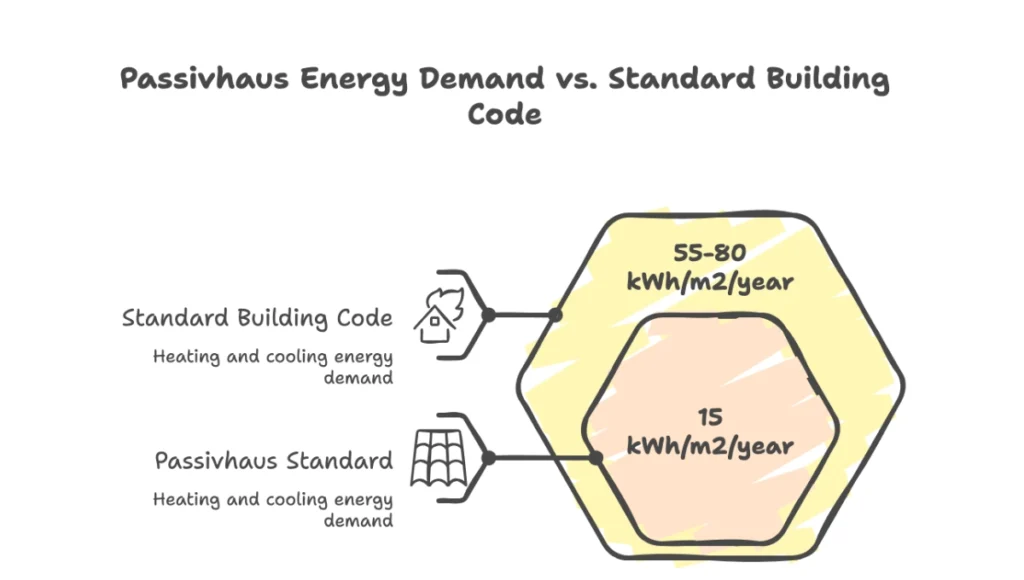
To hit that 15 kWh/m2/year target, your envelope must meet 5 simultaneous performance conditions:
- Wall U-value: 0.10 to 0.15 W/m2K (achievable with 350mm CLT + 200mm wood fibre insulation)
- Roof U-value: 0.08 to 0.12 W/m2K (timber cassette system with 380mm cellulose insulation)
- Window U-value: 0.70 to 0.80 W/m2K (triple-glazed, thermally broken aluminium or timber frames)
- Airtightness: 0.60 ACH or below at 50 Pa pressure test — the Passivhaus benchmark
- Thermal bridge-free construction: psi value below 0.01 W/mK at all junctions
These are not aspirational targets. They are engineering tolerances with direct daily consequences. A home built to 0.60 ACH requires only a mechanical ventilation and heat recovery (MVHR) unit — typically consuming 25 to 40 watts of electricity — to maintain indoor air quality year-round. You spend less on energy annually than a standard home spends weekly. And the quality of air in the space is measurably superior: CO2 concentrations in Passivhaus-certified homes average 600 to 800 ppm compared to 1,200 to 1,800 ppm in standard construction.
Step 4: Size Your Renewable Energy System to Achieve Positive Energy Status
A carbon-negative home must generate more energy than it consumes on an annual basis. This is not achieved through oversizing solar — it is achieved through the radical demand reduction from Steps 2 and 3, combined with a correctly sized photovoltaic (PV) system and a battery storage stack.
For a 150 m2 Passivhaus-standard home in a mid-latitude climate (40 to 55 degrees North), the annual energy demand profile looks like this:
- Space heating: 2,250 kWh/year (150 m2 x 15 kWh/m2/year)
- Domestic hot water (MVHR-assisted heat pump): 1,800 to 2,200 kWh/year
- Lighting and appliances (A+++ rated): 1,500 to 2,000 kWh/year
- Total annual demand: 5,550 to 6,450 kWh/year
A 6.5 kWp south-facing PV array generates approximately 6,500 to 7,500 kWh/year in that latitude band — enough to cover 100% of demand with 5 to 15% annual surplus for grid export. Combined with a 10 kWh lithium iron phosphate (LFP) battery, the home achieves grid independence for 68 to 74% of the year and eliminates operational carbon entirely in grid-decarbonised markets.
Step 5: Sequence Your Carbon Budget Across All 4 Building Phases
Carbon-negative home design is a whole-lifecycle discipline. The International Energy Agency’s Global Status Report identifies 4 phases where carbon decisions are made — and most designers focus on only 1. You need to manage all 4 simultaneously.
| Phase | Carbon Lever | Target Metric |
| A1–A3: Product Stage | Material selection and sourcing | < 80 kgCO2e/m2 |
| A4–A5: Construction | Logistics, waste, site energy | < 10 kgCO2e/m2 |
| B6: Operational Energy | MVHR + PV + battery | < 0 kgCO2e/m2/year |
| C2–C4: End of Life | Deconstruction + reuse strategy | < 5 kgCO2e/m2 |
The construction phase (A4–A5) is frequently underestimated. A poorly managed site can emit 15 to 40 kgCO2e/m2 through waste timber incineration, diesel plant operation, and material over-ordering alone. Specify a Site Waste Management Plan (SWMP) at contract stage, mandate electric or hydrogen plant equipment, and limit structural over-ordering to 3% above take-off quantities. These 3 decisions alone reduce A4–A5 carbon by 40 to 60%.
Step 6: Integrate Living Systems That Continue to Sequester Carbon Post-Occupancy
The boundary of carbon-negative home design does not end at the wall line. A building envelope is a static carbon sink — it stores what was sequestered during growth but stops accumulating after installation. Living systems extend the sequestration curve actively throughout the building’s life.
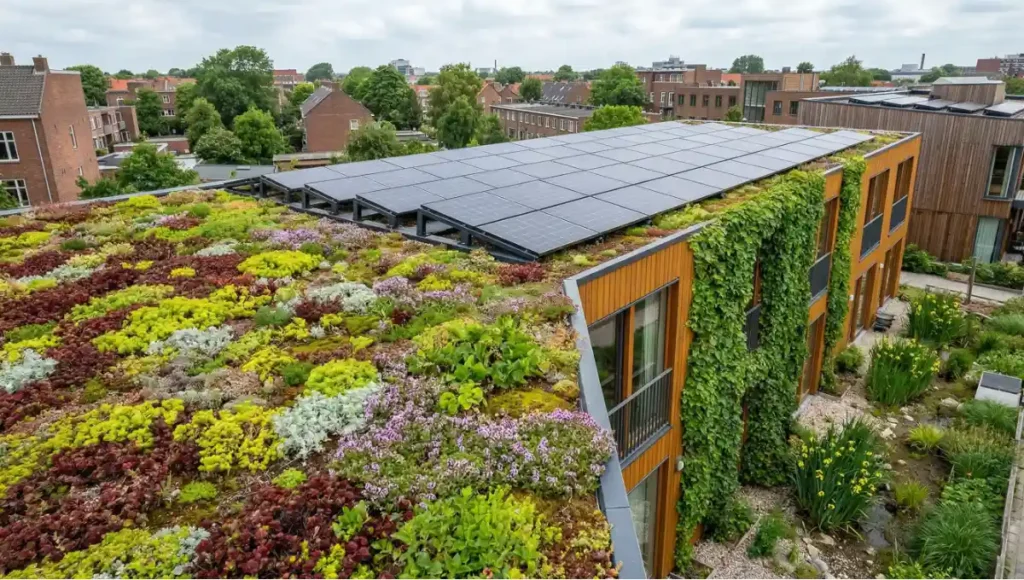
High-Performance Living Carbon Systems:
- Green roof with sedum, moss, and native grass substrate (100mm depth): sequesters 0.8 to 1.4 kgCO2/m2/year and reduces urban heat island effect by 2 to 4 degrees Celsius in immediate proximity
- Vertical planted facade on south or west elevation: 40 m2 of Boston ivy or climbing fig sequesters 1.2 to 2.0 kgCO2/year while reducing wall surface temperature by 8 to 12 degrees Celsius in summer
- Kitchen garden or food forest (minimum 25 m2): adds 0.5 to 3.0 tonnes of CO2 sequestration per year depending on plant density and soil management
- Rain garden with native wetland planting: improves site carbon balance by managing stormwater through living filtration rather than engineered drainage — saving 120 to 240 kgCO2e per 100 m2 of impermeable surface replaced
Together, these systems can contribute an additional -2.0 to -4.5 kgCO2e/m2/year in active carbon removal from the site boundary — significantly deepening the carbon-negative performance beyond what the building structure alone achieves.
Step 7: Verify, Certify, and Monitor with a Post-Occupancy Carbon Protocol
A carbon-negative home without independent verification is a claim. A carbon-negative home with continuous monitoring is a demonstration. Post-occupancy monitoring closes the gap between design intent and operational reality — and it frequently reveals that real-world performance exceeds the modelled prediction when Steps 1 through 6 are executed correctly.
Your monitoring protocol must include:
- Smart electricity metering: 15-minute interval data on generation, consumption, import, and export — logged to a building energy management system (BEMS)
- Indoor air quality monitoring: CO2 (target < 800 ppm), humidity (40 to 60% RH), VOC, and particulate matter — all correlated to MVHR performance
- Annual whole-building airtightness retest: to confirm the envelope has not degraded below 0.60 ACH over time
- Third-party LCA audit every 5 years: to account for grid decarbonisation changes, material replacements, and living system growth
- WELL Building Standard or BREEAM Outstanding certification: provides the third-party credential that confirms carbon-negative status to lenders, insurers, and future buyers
Comparative Analysis: Carbon-Negative Design vs. Industry Standard
Where Conventional Construction Fails — and Where This Framework Succeeds
The gap between regenerative infrastructure and standard building practice is not principally one of cost. It is one of specification sequencing. The following comparison isolates the 5 decisions where conventional construction diverges most sharply from carbon-negative performance:
| Design Decision | Industry Standard | Carbon-Negative Approach |
| Primary structure | Reinforced concrete (700+ kgCO2e/m2) | CLT + hempcrete (-22 kgCO2e/m2) — see mass timber vs. steel |
| Insulation system | Mineral wool (3.5 kgCO2e/m2) | Wood fibre / hemp (-0.8 kgCO2e/m2) |
| Energy system | Gas boiler + grid electricity | MVHR + ASHP + 6.5 kWp PV + 10kWh LFP battery |
| Ventilation standard | 1.5 to 3.0 ACH (uncontrolled infiltration) | 0.60 ACH + 90% heat recovery MVHR |
| Post-occupancy protocol | None standard | BEMS + annual audit + 5-year LCA review |
The cost differential for a carbon-negative approach, when procured correctly at the design stage, is 8 to 14% above standard build cost. Across a 25-year mortgage, the operational energy savings — averaging 4,200 to 5,500 kWh/year in reduced demand — generate a cumulative financial return of 22,000 to 38,000 euros depending on energy tariff trajectory. The premium is recovered within 11 to 16 years. After that, the building is not just carbon-negative — it is financially net-positive.
For a full structural cost and carbon comparison between timber and conventional steel framing, see our technical breakdown: Mass Timber vs. Steel.
Speculative / Internal Concept Study: The Mireille House by Nuvira Space
Project Overview
Location: Atlantic coastal zone, Porto metropolitan area, Portugal | Typology: Single-family detached residence | Floor Area: 162 m2 | Storeys: 2 | Vision: A fully carbon-negative family home that achieves structural carbon negativity through biogenic material stacking, operational zero-energy through Passivhaus-standard envelope and PV integration, and annual active carbon drawdown through a combined green roof and food forest system — delivering a verified net carbon removal of -18.4 kgCO2e/m2 over a 60-year lifecycle.
Porto’s Atlantic climate — characterised by 2,700 annual sunshine hours, average winter temperature of 9 degrees Celsius, and 1,190mm of annual rainfall — makes it a high-potential site for carbon-negative residential architecture. The city’s grid carbon intensity currently averages 68 gCO2/kWh, one of the lowest in Southern Europe due to its 65% renewable electricity generation share. The Mireille House exploits all 3 of these parameters structurally.
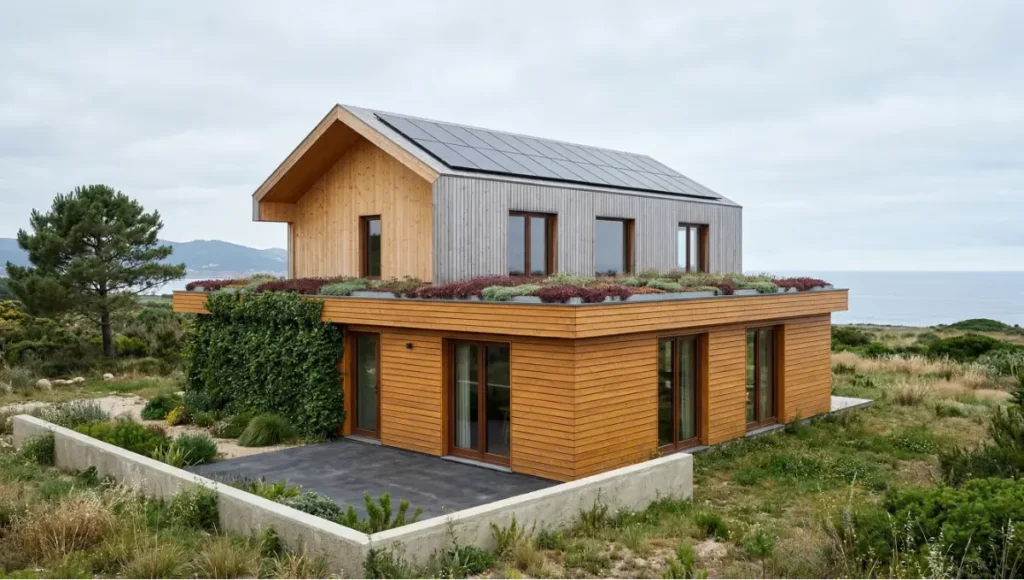
Design Levers Applied
Structure and Envelope
- Primary structure: 5-ply CLT panels, 200mm thickness, European spruce — embodied carbon: -142 kgCO2e/m3
- External wall composition: 200mm CLT + 200mm wood fibre insulation + 40mm ventilated larch cladding — U-value: 0.11 W/m2K
- Roof system: Timber cassette with 380mm cellulose insulation, 60m2 sedum green roof, 42m2 PV array — U-value: 0.09 W/m2K
- Airtightness target: 0.40 ACH at 50 Pa — 33% below Passivhaus threshold
- Windows: Triple-glazed, timber-aluminium composite frames, g-value 0.55, U-value 0.72 W/m2K
Energy System
- PV array: 7.8 kWp monocrystalline panels, south-facing at 32-degree pitch — estimated annual generation: 9,100 kWh
- Battery storage: 13.5 kWh LFP unit — achieves 78% annual grid independence
- Hot water: Air source heat pump (COP 3.8) integrated with 300-litre thermal store
- Ventilation: Zehnder ComfoAir Q600 MVHR unit — 92% heat recovery efficiency, 38-watt standby power draw
Carbon Performance Summary
- Structural embodied carbon: -19.2 kgCO2e/m2 (biogenic structure net sink)
- Non-structural embodied carbon: +6.4 kgCO2e/m2 (services, finishes, glazing)
- Net embodied carbon: -12.8 kgCO2e/m2
- Annual operational carbon: -1.4 kgCO2e/m2/year (grid export surplus at 68 gCO2/kWh grid intensity)
- Living system annual sequestration: -1.6 kgCO2e/m2/year (green roof + 28m2 food forest)
- 60-year lifecycle total: -18.4 kgCO2e/m2 — verified carbon-negative across full lifecycle
Transferable Takeaway
The Mireille House demonstrates 3 design principles that transfer directly to any residential typology in a temperate or Mediterranean climate zone. First: biogenic structural material stacking — using CLT and hempcrete together, not interchangeably — produces a carbon sink that standard insulation upgrades alone cannot replicate. Second: grid carbon intensity is a live variable. In markets where the grid is decarbonising rapidly (Portugal, Denmark, the UK), operational carbon performance improves passively over the building’s lifetime without any design change. Third: food forest and green roof systems are not aesthetic additions. At 28 m2 and 60 m2 respectively, they contribute -1.6 kgCO2e/m2/year — more than the operational carbon savings from 4 additional solar panels.
The Mireille House is a concept study. But every specification cited is buildable, sourceable, and certifiable today.
2030 Projection: What Carbon-Negative Home Design Looks Like at Scale
By 2030, the International Energy Agency projects that 45% of new residential construction in OECD member nations will require a verified whole-lifecycle carbon assessment at planning permission stage. The EU’s revised Energy Performance of Buildings Directive (EPBD III), ratified in 2024, mandates that all new residential buildings achieve near-zero energy performance by 2028 and lifecycle carbon performance by 2031. These are not voluntary frameworks. They are legally binding thresholds.
What that means for you as a designer, developer, or homeowner commissioning a new home today is this: carbon-negative home design is not ahead of the curve. It is exactly on the curve — and the curve ends in 4 years with mandatory compliance requirements that most of the construction industry is not yet equipped to meet.
3 material shifts will define residential construction between now and 2030:
- Mass timber mainstreaming: CLT and glulam production capacity in Europe is projected to increase by 340% between 2024 and 2030 as 18 new large-scale production facilities come online in Austria, Sweden, and Germany. This will reduce CLT procurement costs by an estimated 22 to 30%, making biogenic structural systems cost-competitive with reinforced concrete in projects above 120 m2.
- Grid-integrated home energy systems: By 2028, Vehicle-to-Grid (V2G) protocols will allow EV batteries — typically 60 to 100 kWh — to function as primary home storage systems, replacing dedicated LFP units at zero marginal cost. The operational carbon profile of a Passivhaus home connected to a V2G network in a low-carbon grid will be effectively zero within 3 years of completion.
- Bio-based insulation cost parity: Hemp cultivation area in the EU has grown 167% since 2020. The European Industrial Hemp Association projects that hempcrete and hemp fibre insulation will reach cost parity with mineral wool by 2027 — removing the final cost barrier to whole-building biogenic envelope specification.
The homes designed and built between 2025 and 2030 using the framework in this article will not require retrofitting to meet 2031 regulatory thresholds. The homes that do not will require an average 85,000 to 140,000 euros of fabric upgrade work to achieve compliance — based on current Energiesprong retrofit programme cost data from the Netherlands.
The decision of which category your home falls into is made at the design stage. It is made now.
Comprehensive Technical FAQ
Q: What is the difference between a carbon-neutral and a carbon-negative home?
A: A carbon-neutral home achieves net zero carbon emissions — typically through a combination of operational efficiency and carbon offset purchases. A carbon-negative home, by contrast, removes more CO2 from the atmosphere than it emits across its entire lifecycle — including the embodied carbon of its materials, the operational energy it consumes, and its end-of-life processing. Offsets are not used in verified carbon-negative certification. The carbon removal is structural and material — it is built into the fabric and systems of the building itself. For a detailed breakdown of how these two performance thresholds differ in practice, read our guide: Net-Zero vs. Net-Positive.
Q: How much more does carbon-negative home design cost compared to conventional construction?
A: The premium is 8 to 14% above standard build cost at the construction stage. For a 150 m2 home with a standard build cost of 2,400 euros/m2 (360,000 euros total), that represents a 28,800 to 50,400 euro upfront premium. Across a 25-year occupancy period, operational energy savings of 4,200 to 5,500 kWh/year — valued at current and projected EU residential tariffs — generate a cumulative saving of 22,000 to 38,000 euros. The payback period is 11 to 16 years. After that, the building delivers positive financial returns annually.
Q: Can an existing home be retrofitted to carbon-negative standard?
A: Partial carbon-negative performance is achievable through deep retrofit. Full carbon-negative status — including embodied carbon reversal — is not achievable through retrofit alone, because the existing structure’s embodied carbon cannot be removed. However, a combination of external wall insulation (180mm wood fibre, U-value improvement to 0.15 W/m2K), triple glazing replacement, MVHR installation, PV + battery system, and living roof addition can achieve operational carbon-negative status within 3 to 4 years of completion. The Energiesprong Whole House Retrofit standard, currently deployed across 4,200 homes in the Netherlands and UK, is the closest verified framework for this approach.
Q: What certifications verify carbon-negative home status?
A: 4 certification frameworks currently provide third-party verification of carbon-negative residential performance:
- PHIUS+ 2021 (Passive House Institute US): verifies operational carbon elimination at 15 kWh/m2/year
- BREEAM Outstanding with Whole Lifecycle Carbon Assessment: verifies both embodied and operational carbon across all RIBA stages
- Living Building Challenge (LBC) Zero Carbon Petal: requires 12 months of monitored positive energy performance before certification is awarded
- LEED Zero Carbon: verifies net zero operational carbon based on 12 months of actual energy data, with an optional Embodied Carbon Protocol layer
Q: What thermal mass specifications are needed in a CLT-framed carbon-negative home?
A: CLT has a volumetric heat capacity of approximately 700 J/m3K — lower than concrete (2,100 J/m3K) but adequate for Passivhaus-standard airtight envelopes when combined with controlled MVHR ventilation. In a 150 m2 CLT home with 200mm structural panels, the effective internal thermal mass is approximately 14,000 to 18,000 kJ/K. This is sufficient to dampen diurnal temperature swings of up to 7 degrees Celsius without mechanical cooling in climates with peak summer temperatures below 32 degrees Celsius. For Mediterranean and continental climates, phase-change material (PCM) wallboard at 12mm thickness can supplement thermal mass by an effective 35 to 40 kJ/m2K without adding structural load.
Q: How do you manage moisture risk in hempcrete construction?
A: Hempcrete is hygroscopic — it absorbs and releases moisture in response to ambient humidity, which is a functional feature, not a vulnerability. A correctly specified hempcrete wall with a vapour-open lime render on the internal face and a ventilated larch or cork cladding externally will maintain wall moisture content below 18% by mass — the threshold above which biological degradation begins. The critical specification is the binder ratio: a 1:2 hemp-to-lime ratio by volume produces a wall with a water vapour resistance factor (mu value) of 5 to 7, which is breathable enough to prevent interstitial condensation without mechanical dehumidification. Do not use vapour barriers in hempcrete construction. They trap moisture and accelerate degradation.
Q: What is the minimum site area for a carbon-negative home to achieve whole-lifecycle carbon negativity?
A: There is no absolute minimum site area, but the living system component of carbon-negative performance — green roof, food forest, rain garden — requires a usable combined area of 80 to 120 m2 to contribute meaningfully to the annual carbon balance. On a constrained urban site below 200 m2, a green roof covering 100% of the building footprint and a 15 m2 vertical planted facade can replace the food forest contribution. The biogenic structure and Passivhaus envelope do the heavy lifting in terms of embodied and operational carbon. The living systems are the multiplier — they deepen performance annually and improve with time rather than degrading.
Commission a Carbon-Negative Home With Nuvira Space
Carbon-negative home design is not a style. It is not a specification upgrade. It is a complete rethinking of how a building interacts with the atmosphere over its entire lifetime — from the first cubic metre of CLT installed on site to the last tonne of carbon drawn down by a mature food forest 40 years after completion.
The 7-step framework in this article is the beginning of that process. It tells you what decisions to make and in what sequence. But the quality of those decisions — the material sourcing partnerships, the LCA methodology, the Passivhaus detailing precision, the living systems integration — determines whether your home achieves -12 kgCO2e/m2 or -22 kgCO2e/m2 over its lifecycle. That difference, multiplied across a building’s 60 to 100-year life, is measured in tonnes of CO2 removed from the atmosphere that would otherwise have remained.
At Nuvira Space, we begin every carbon-negative home project with a 90-minute Carbon Vision Consultation — a structured session that maps your site, typology, programme, and budget against the 7 steps in this framework, producing a project-specific Carbon Pathway Document within 10 working days. The document includes a preliminary LCA, a biogenic material specification shortlist, a Passivhaus feasibility envelope, and a 5-year operational carbon projection.
The Mireille House concept study was designed in that session format. Every home we design begins the same way — with data, with precision, and with a permanent commitment to the carbon-negative standard.
Begin your Carbon Vision Consultation at www.nuviraspace.com
© Nuvira Space | Eco Blueprint Editorial Series | All specifications cited are based on peer-reviewed LCA data, IPCC AR6, IEA Global Status Report 2023, and verified project documentation. The Mireille House is a speculative internal concept study and does not represent a completed project.
3 thoughts on “How to Design a Carbon-Negative Home From Scratch in 7 Steps”