

Table of Contents
Key Takeaways
- Hostile architecture is a systemic failure of empathy, using physical barriers to mask socio-economic crises rather than solving them.
- The AIA Mandate: Equity in the built environment is a fundamental right; exclusionary design often violates the spirit—and sometimes the letter—of universal accessibility laws.
- The Silent Purge: Defensive design creates “Urban Dead Zones” that diminish property value and social trust over time.
- Recalibration: Data-driven, transit-oriented development (TOD) must replace “defensive” spikes with “resilient” multi-functional infrastructure.
- Synthesis: Nuvira Space advocates for a human-machine urban interface where technology serves to include, not isolate.
Nuvira Perspective
At Nuvira Space, we view the city not as a static collection of concrete and steel, but as a living, breathing digital-physical organism. We believe that current hostile architecture analysis reveals a primitive attempt at social control that fundamentally ignores the potential of human-machine synthesis. While traditional planning seeks to repel “unwanted” behavior through spikes and leaning bars, we seek to recalibrate the metropolitan fabric through data-driven design and hyper-resilient infrastructure. Our mission is to move beyond the binary of ‘public vs. private’ to create a high-fidelity urban interface where every square millimeter provides societal value through intelligent adaptability.
The Macro-Observation: Hostile Architecture Analysis of a Dystopian Present
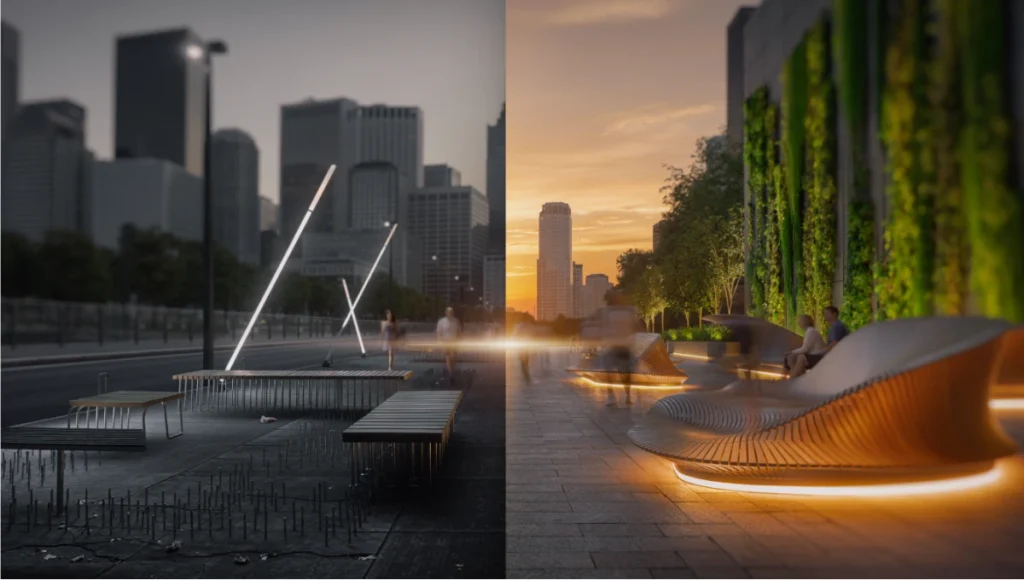
You walk through the modern downtown, and you see it: the subtle curvature of a bench that makes sleeping impossible, the “artistic” spikes on a windowsill, the high-frequency “Mosquito” alarms that target the ears of the youth. This is not architecture; it is an interrogation. A comprehensive hostile architecture analysis proves that these elements do not reduce crime—they merely displace the “problem” to the periphery of your vision.
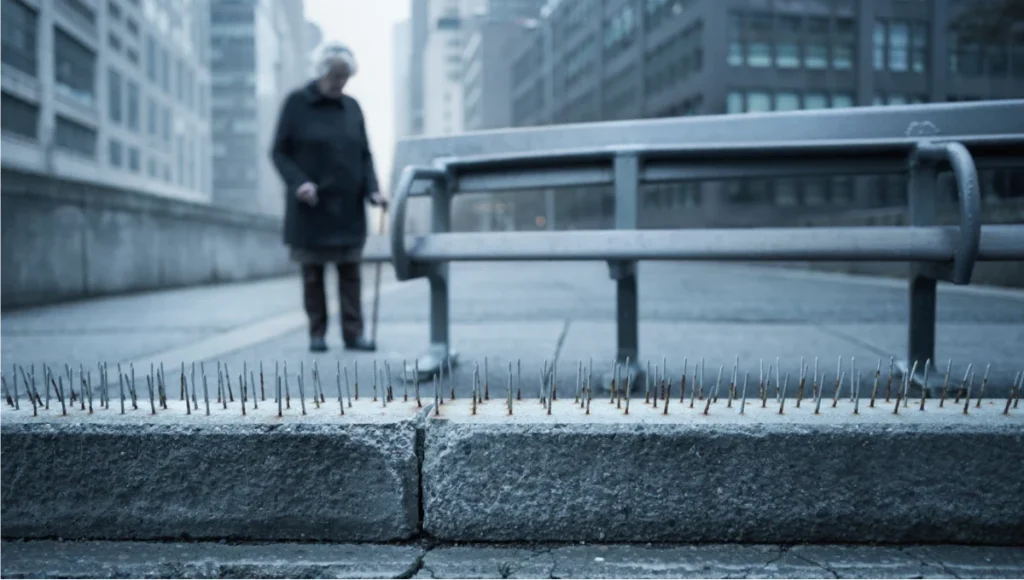
By weaponizing the public realm, cities are effectively self-sabotaging their own resilience. When you design a space to be uncomfortable for the most vulnerable, you inadvertently make it inhospitable for everyone—the elderly, the pregnant, and the weary traveler. We are witnessing the birth of the “Anti-City,” a space that functions only for the transaction, never for the inhabitant. This erosion of the “public living room” is exactly why we advocate for Pedestrian-First City Design, where the rhythm of the street is dictated by human movement, not by the fear-based metrics of property management.
The 7 Brutal Truths of Urban Exclusion
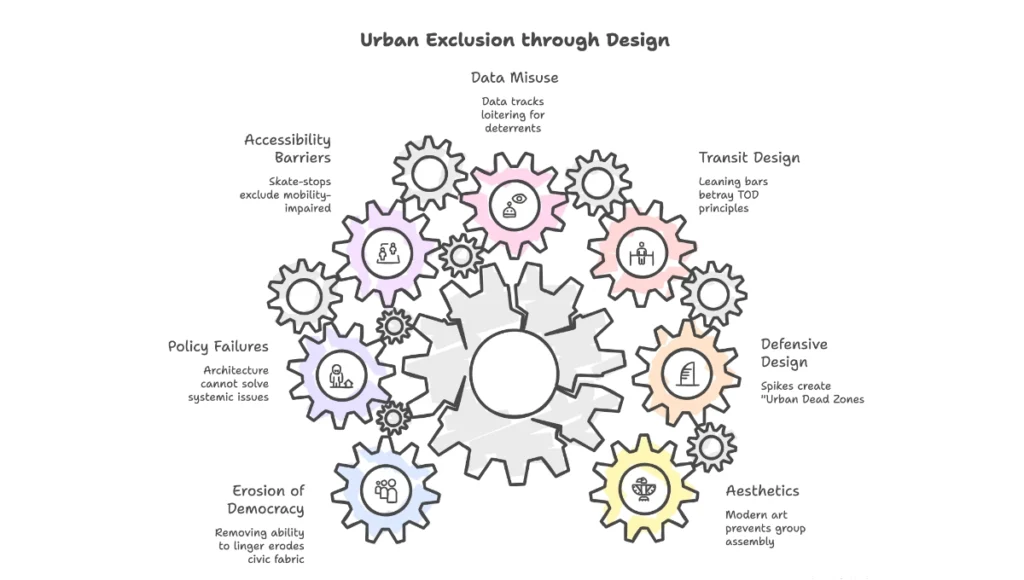
Truth I: Aesthetics are the Trojan Horse of Hostility
The most dangerous forms of exclusion are those camouflaged as “modern art.” A jagged sculpture in a plaza or a “designer” planter is often strategically placed to prevent the assembly of groups. These are “non-spaces,” designed to be looked at but never inhabited.
Truth II: Defensive Design is an Economic Net-Negative
While property owners believe spikes protect their investment, they actually create “Urban Dead Zones.” These areas lack the “eyes on the street” necessary for organic safety, leading to long-term stagnation in foot traffic and retail vitality. To revitalize these zones, we often look toward Mall Adaptive Reuse Housing as a way to convert sterile commercial voids into vibrant, inclusive residential hubs.
Truth III: Transit-Oriented Development (TOD) is Being Hijacked
The transition from benches to “leaning bars” in subway stations is a betrayal of TOD principles. If the goal of the city is efficiency, removing the ability for a passenger to rest is a fundamental failure of the user interface.
Truth IV: Data is Currently Used for Surveillance, Not Support
Modern sensors track loitering to trigger deterrents. In a recalibrated city, that same data should trigger social service alerts or environmental adjustments. Our research into Smart City Sensors suggests a future where data acts as a digital safety net rather than a digital fence.
Truth V: The Elderly and Disabled are Collateral Damage
A “skate-stop” on a handrail or an armrest on a bench creates a physical barrier for those with mobility issues. As the American Institute of Architects (AIA) notes in their Guides for Equitable Practice, design that excludes one group inevitably creates a “design-induced disability” for others.
Truth VI: Architecture Cannot Solve Policy Failures
Using concrete to “solve” homelessness is like using a band-aid to treat a broken limb. It is a visual fix for a systemic collapse. Architecture should be an enabler of social mobility, not a gatekeeper.
Truth VII: The “Quiet Purge” Erodes Democracy
Public spaces are the last vestiges of democratic interaction. When you remove the ability to linger, you remove the ability to participate in the civic fabric.
The AIA Framework: Designing for Equitable Communities
The American Institute of Architects (AIA) has increasingly signaled that “hostile” design is a violation of the professional code of ethics regarding social equity. The AIA Framework for Design Excellence explicitly challenges architects to ask: “Who is this project forgetting?”
By centering “Design for Equitable Communities,” the AIA encourages a shift from defensive posturing to proactive inclusion. This involves:
- Trauma-Informed Design: Recognizing that public spaces should be places of healing, not triggers for anxiety.
- Universal Access: Moving beyond mere ADA compliance toward a “Design for All” philosophy that accommodates neurodiversity and the varying physical needs of an aging population.
The “Blueprint” Solution: Resilient Infrastructure
To counter these truths, we propose a disruptive shift toward Adaptive Infrastructure. The goal is a city that responds to human needs in real-time.
- Multi-Modal Surfaces:
- Kinetic street furniture that adjusts its form based on time-of-day data.
- Integrated IoT sensors that detect thermal needs rather than loitering duration.
- Socially Generative Lighting:
- Replacing harsh, high-intensity LEDs with bio-luminescent, warm-spectrum lighting that encourages evening community gathering.
- Active Ecology Buffers:
- Replacing metal spikes with dense, carbon-sequestering greenery that provides soft barriers while improving urban air quality.
Feasibility Study: Economic and Political Barriers
The implementation of inclusive design faces two primary hurdles: the Insurance-Industrial Complex and Short-Termist Governance.
- Liability Logic: Current insurance models reward “defensive” environments, fearing that a comfortable bench is a “liability.” We must shift toward “resilience-based” insurance that values high-occupancy, high-trust environments.
- The “Out of Sight” Policy: Politicians favor hostile architecture because it provides an immediate, visual “fix” for social unrest without requiring the budget of long-term housing projects.
Proof of Concept: Rotterdam, The Netherlands
In Rotterdam, the city has experimented with “Water Squares” (Waterpleinen). Unlike the hostile plazas of London or New York, these spaces are designed to flood during heavy rain (climate resilience) and serve as dynamic skate parks and amphitheatres during dry periods. Rotterdam demonstrates that you don’t need spikes to manage a space; you need multi-functional design that grants the public agency over their environment.
The Benthemplein Water Square is a masterclass in anti-hostile design. Instead of preventing people from lingering, it invites them into a sunken “basin” that serves as a basketball court. When the rains come, the basin fills, managing the city’s stormwater. This is “Resilient Infrastructure” in its purest form—it solves a technical climate problem while providing a social “Yes” to the community.
Concept Project Spotlight
Speculative / Internal Concept Study: THE KINETIC HUB by Nuvira Space
Project Overview
- Location: High-Density Transit Nodes (Global Template)
- Typology: Adaptive Public Interface / Micro-Habitat
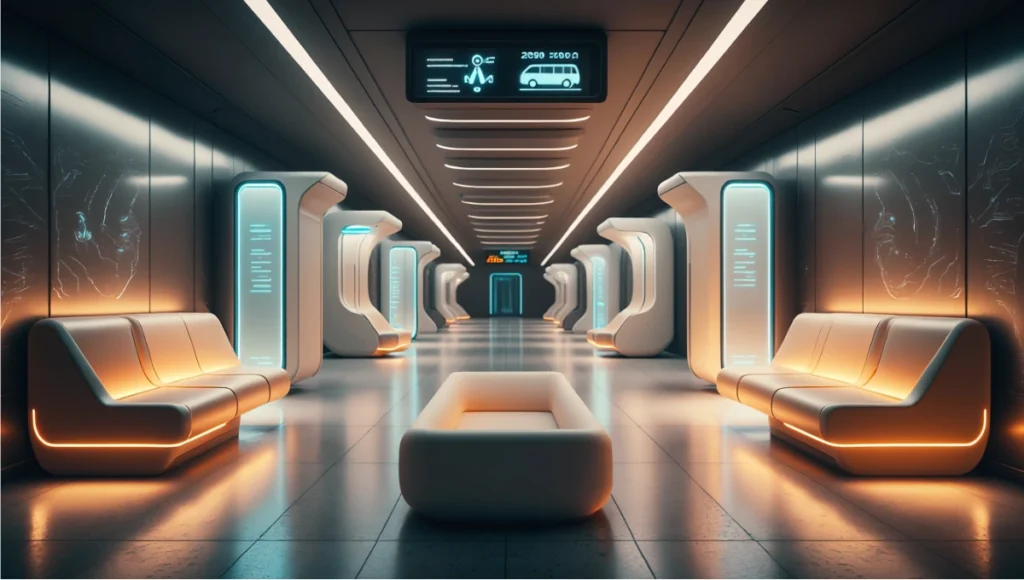
- Vision: A 24/7 urban organ that synthesizes transit, rest, and social services.
anti-hostile architecture solutions.
Design Levers Applied
- Thermal-Responsive Seating: Surfaces that use recovered heat from the subway tunnels to provide warmth in winter, eliminating the need for individuals to sleep on dangerous exhaust vents.
- Data-Transparent HUDs: Interactive glass panels providing real-time data on local shelter availability, healthcare, and job opportunities, turning a “transit stop” into a “support hub.”
- Modular Shelter Units: Retractable pods that can be deployed during extreme weather events, controlled by municipal weather-tracking AI.
Transferable Takeaway
Urban design must move from Restrictive (No) to Permissive (Yes/And). The Kinetic Hub proves that infrastructure can protect the city’s “order” while actively caring for its inhabitants.
2030 Future Projection: The Pulse of the Inclusive City
By 2030, the “Hostile Architecture Analysis” we perform today will seem like a post-mortem of a primitive age. The “Cognitive City” will emerge—a metropolitan fabric that recognizes the presence of a human being as a data-point of value, not a nuisance. We project a shift toward Algorithmic Urbanism, where the physical environment adapts—widening sidewalks for crowds, softening surfaces for the tired, and glowing for the lonely.
In this future, the “Anti-City” is replaced by a high-fidelity interface. We will see the rise of autonomous zones where the architecture itself breathes with the population. The spikes will be melted down to create the sensors for a more empathetic world.
Comprehensive Technical FAQ
Q: Does removing hostile architecture increase crime?
A: Paradoxically, no. Based on the “Jane Jacobs” principle of urban vitality:
- Increased Occupancy: More people in a space equals more “natural surveillance” (Eyes on the Street).
- Reduced Friction: Hostile design creates a “sense of threat” that actually heightens social tension and aggressive behavior.
Q: How does Nuvira Space balance “comfort” with “public safety”?
A: We define safety through Human-Machine Synthesis:
- Intelligent Monitoring: Using computer vision to detect actual distress or violence rather than mere presence.
- Environmental Cues: Using light and sound frequency to soothe, rather than repel.
Q: What are the technical specs of Nuvira’s “Resilient Bench”?
- Material: 3D-printed recycled polymer with self-healing properties.
- Modular Dividers: Removable armrests that can be adjusted via a municipal app for events or emergency use.
- Integrated Power: Induction charging for mobile devices, ensuring the “digital citizen” stays connected.
Architectural Recalibration
The era of the “Spike and the Slab” is over. The architectural profession is standing at a crossroads where it must choose between being a tool of exclusion or an agent of equity. Recalibrating the metropolitan fabric requires moving beyond fear-based metrics and toward a synthesis of the human experience and the machine’s efficiency.
The city is a pulse. It must not be allowed to flatline in the name of order.