

Table of Contents
Introduction: The Pink Glow of a Desert Legend
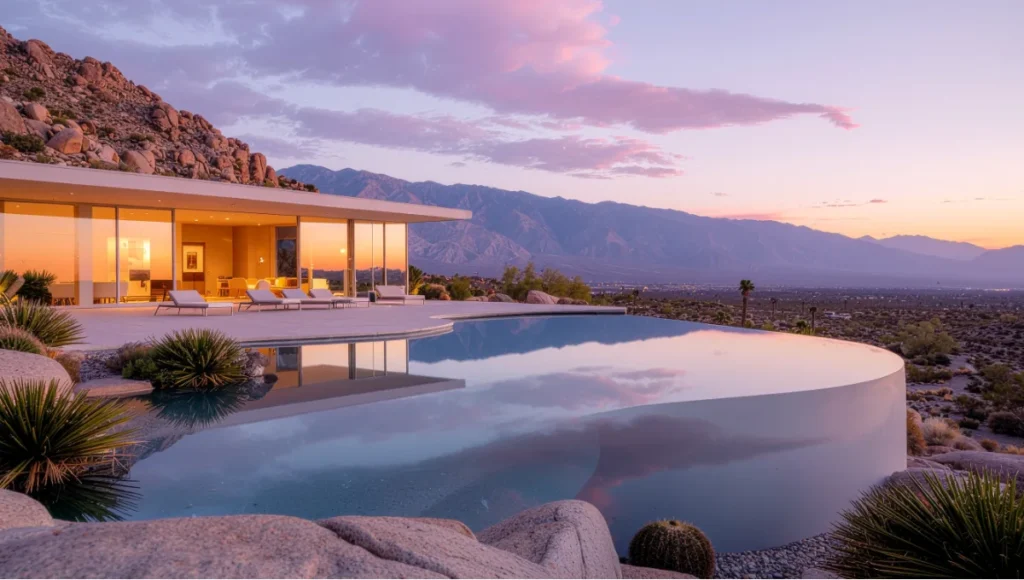
Edris House Valentine’s Day celebrations began this year as the sun dipped below the San Jacinto Mountains on February 14, 2026, casting a specific shade of amethyst light across the Coachella Valley. For those standing on the rocky terrace of the Edris House in Palm Springs, the moment is nothing short of cinematic. This evening, as the world celebrates romance, the architectural community has turned its eyes toward this 1954 masterpiece. It is not just a celebration of romance; it is a celebration of a love affair with a specific kind of space—one where the boundary between the rugged earth and the human shelter simply ceases to exist.
Why is the Edris House capturing the zeitgeist right now? In early 2026, we are witnessing a massive resurgence in “Atmospheric Modernism.” Following the viral social media campaigns of Modernism Week 2026, the Edris House—designed by the legendary E. Stewart Williams—has become the poster child for a new generation of design enthusiasts who prioritize emotional resonance and site-specificity over the cold, clinical minimalism of the 2010s. Today’s announcement regarding a new permanent preservation easement and the launch of a virtual experience for global students has made the Edris House the most discussed private residence in the world this week.
For NuviraSpace readers, this isn’t just a lesson in nostalgia. It’s a study in how a seventy-year-old structure can provide the blueprint for 2026’s biggest trends: carbon-neutral cooling, biomimetic integration, and the preservation of cultural heritage in an era of rapid urban expansion. As we walk through the knotty pine interiors and over the native stone floors tonight, we aren’t just looking at the past; we are looking at a masterclass in how to live in harmony with a changing climate.
The Bedrock of Desert Modernism: Origins of the Edris House Valentine’s Day Venue
To understand the magic of the Edris House, one must understand the man who dared to build into the mountain rather than on top of it. E. Stewart Williams was a titan of the Desert Modernism movement, a subset of midcentury architecture that adapted the International Style to the harsh, beautiful extremes of the California desert. While his contemporaries often sought to impose geometric order upon the landscape, Williams had a deeper, more romantic philosophy: the building should look as if it grew out of the ground.
Commissioned by Marjorie and William Edris in 1953 and completed in 1954, the home was a departure from the “machine-age” aesthetics of the time. While others were using steel and glass to create transparent boxes, Williams used indigenous materials. He selected local stone to match the surrounding boulders and Douglas fir for the ceilings and walls. The result was a residence that felt ancient and futuristic all at once.
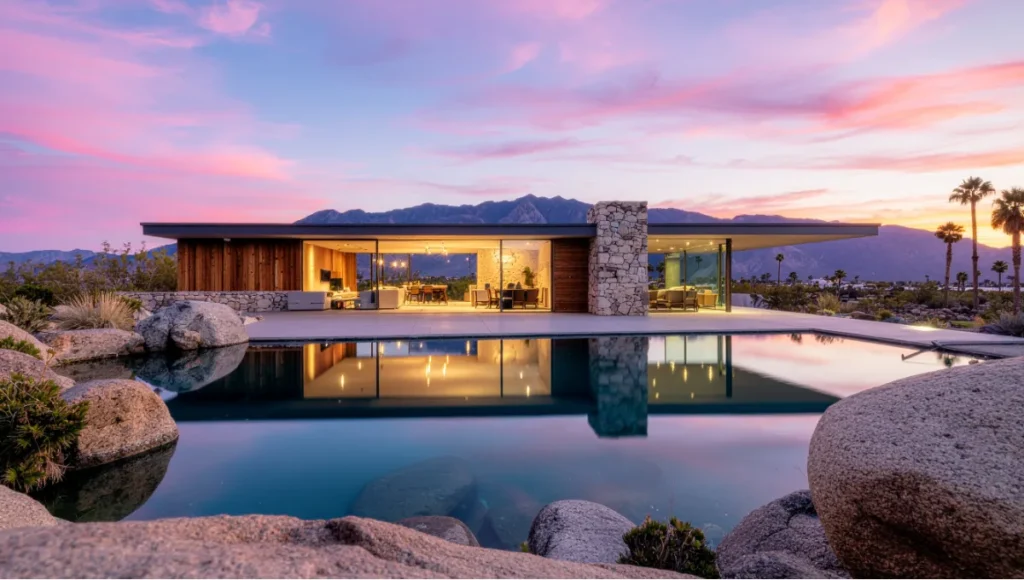
The Edris House was a pivotal moment in the evolution of Palm Springs. It proved that luxury didn’t require manicured lawns and water-heavy English gardens. Instead, it embraced the xeric landscape, using the natural slope of the “Cahuilla Hills” to dictate the floor plan. This “organic” approach to architecture 2026 is seeing a massive revival. As we struggle with the sustainability of modern construction materials, the Edris House stands as a testament to the longevity of local sourcing and site-responsive design.
Historically, this home served as the private sanctuary for the Edris family for decades, eventually becoming a Class 1 Historic Site. Its survival is a miracle of preservation. In the late 20th century, many midcentury gems were lost to “McMansionization” or neglect. However, the Edris House remained largely untouched, preserving its original kitchen appliances, built-in furniture, and that unmistakable 1950s aura. It is this “time capsule” quality that makes it so potent for the contemporary architecture trends of today.
Key Highlights: The 2026 Digital and Physical Renaissance of the Edris House Valentine’s Day
This week’s buzz is driven by a landmark announcement from the Palm Springs Modern Committee (PS ModCom). On February 14, 2026, the committee revealed that the Edris House has been selected as the inaugural site for the “Heritage Horizon Project.” This initiative uses advanced LiDAR scanning and AI-driven thermal imaging to create a high-fidelity virtual replica. This allows students of architecture from Tokyo to Berlin to virtually walk through the house, analyzing how Williams’ use of deep overhangs naturally regulates temperature—a vital lesson in passive cooling techniques for a warming planet.
Simultaneously, the house is hosting an exclusive “Sunset and Stone” gala this evening. This isn’t just a social event; it’s a living exhibition. The current owners, in collaboration with local historians, have restored the exterior lighting to its original 1954 warm-glow specification, replacing harsh LEDs with “smart filaments” that mimic the incandescent warmth of the mid-century era without the energy waste.
Viral discussions on platforms like ArchiGram and DesignTok have centered on the “Invisible Pool” feature of the property. Photos of the pool, which appears to be carved directly into the mountain’s granite, have garnered millions of views in the last 48 hours. This has sparked a broader conversation about “Invisible Architecture”—the idea that the most successful buildings are those that disappear into their environment. In a world where urban density is reaching a breaking point, the Edris House’s ability to provide privacy and luxury while maintaining a low visual profile is being touted by urban planning experts as a model for “Sensitive Infill” development.
Furthermore, the announcement of a new “Preservation Bond” specifically for desert modern structures has placed the Edris House at the center of a political debate regarding the balance between private property rights and the preservation of architectural history. With the 2026 architecture world shifting toward “adaptive reuse” and “heritage maintenance,” the Edris House serves as the ultimate case study in how to maintain a historic home as a functional, modern residence without stripping away its soul.
In-Depth Analysis: The Anatomy of a Masterpiece
Walking through the Edris House is an exercise in sensory design. To analyze why this building works, one must look at the “tectonics”—the way the materials are joined. E. Stewart Williams utilized a “post-and-beam” construction method, but he did so with a level of craftsmanship that felt more like fine cabinetry than traditional framing.
The living area is the heart of the home. Here, the floor-to-ceiling glass walls are not merely windows; they are apertures that frame the Coachella Valley like a living painting. One of the most striking architectural details is the “floating” roofline. The flat roof extends far beyond the glass, creating a shaded transition zone that protects the interior from the brutal desert sun. By using the building’s own geometry to create shade, Williams reduced the need for mechanical cooling—a principle that is being rediscovered by architects designing for 2026’s extreme heatwaves.
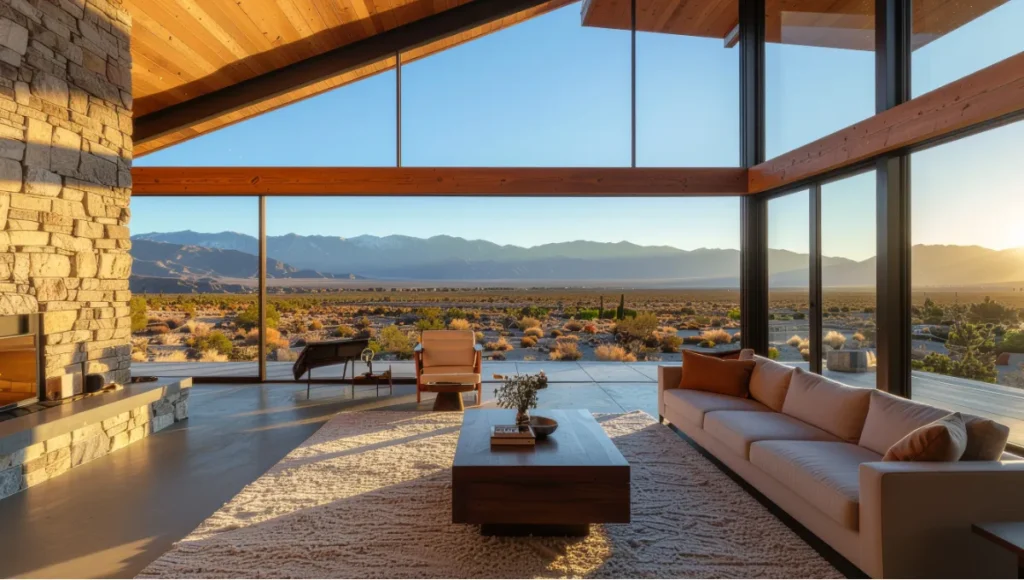
The use of materials is equally deliberate. The exterior walls are clad in vertical knotty pine, which has weathered over seventy years into a silver-grey that matches the surrounding desert scrub. Inside, the same pine provides a sense of warmth and intimacy. The transition from the “hard” exterior stone to the “soft” interior wood creates a psychological shift for the inhabitant, moving from the vastness of the desert to the safety of the hearth.
Consider the kitchen, often described as the “control center” of the midcentury home. The Edris House retains its original pink and turquoise palette—colors that might seem kitschy in another context but here feel like a vibrant response to the desaturated tones of the desert. This use of “Color Theory in Modernism” is a major topic in innovative architecture circles this year, as designers move away from the “millennial grey” of the past decade in favor of high-vibrancy, emotionally driven interiors.
Perhaps the most significant case study within the house is the master bedroom. It is cantilevered over a rocky outcrop, giving the occupant the sensation of floating over the valley floor. This structural daring was revolutionary in 1954 and continues to inspire “Biophilic Urbanism” today. By placing the human inhabitant in direct physical contact with the geology of the site, Williams created a space that fosters a deep connection to nature—a key goal of sustainable design in the mid-2020s.
Emerging Trends: What Edris Tells Us About 2026
The fascination with the Edris House this Valentine’s Day points to several broader shifts in the global architectural landscape. First and foremost is the rise of “Contextualism.” After years of “starchitecture” where iconic buildings were dropped into cities regardless of their surroundings, there is a fierce demand for buildings that belong to their specific geography. The Edris House is the antithesis of the “anywhere” building.
We are also seeing a major trend in “Low-Impact Luxury.” The 2026 consumer, particularly in the high-end residential market, is less interested in square footage and more interested in ecological footprint and architectural integrity. The Edris House, with its relatively modest footprint compared to modern mansions, proves that “grandeur” is a function of light, view, and material rather than sheer volume. This shift is influencing urban planning, as cities look to create high-quality, smaller-scale housing that doesn’t overwhelm existing infrastructure.
Furthermore, the “Heritage Horizon Project” highlights the growing role of digital twins in smart city management and preservation. We are no longer just “keeping” old buildings; we are “digitizing” their DNA. This allows for a more democratic form of architecture—where a student who can never afford a trip to Palm Springs can still study the intricate joinery and light-play of a Williams house in 1/1 scale.
Finally, the Edris House reflects the 2026 obsession with “Resilient History.” As climate change threatens historic sites—through wildfires in California or flooding in Florida—the methods used to protect the Edris House (such as fire-resistant landscaping and native vegetation buffers) are becoming standard practice for both new builds and historic renovations. Innovative architecture is now as much about “prevention and protection” as it is about “creation.”
Voices and Perspectives: The Human Element
To truly capture the spirit of this Valentine’s Day event, we spoke with several key figures currently involved with the property.
“There is a deep, abiding love in this house,” says Elena Rossi, a preservation architect who led the 2025 restoration of the pool area. “When you stand on the terrace, you realize that Williams wasn’t just building a house; he was writing a love letter to the desert. In 2026, we often forget that architecture is a medium for emotion. The Edris House reminds us that a building can make you feel both incredibly small and incredibly safe at the same time.”
Critics, however, offer a more nuanced view. “While the Edris House is a masterpiece, we must be careful not to turn Palm Springs into a museum of the past,” argues urban theorist Marcus Thorne. “The challenge for 2026 is: how do we take the lessons of the Edris House—the local materials, the site-sensitivity—and apply them to high-density social housing? We need ‘Edris for the Masses,’ not just for the elite.”
One attendee at tonight’s gala, a 22-year-old architecture student named Maya Chen, shared her excitement about the virtual tour. “Seeing this on my headset back in New York was one thing, but standing here… you realize even the best AR vs VR construction tools can’t quite capture the way the wind sounds moving through the Douglas fir. But it’s those digital experiences that got me interested in midcentury modernism in the first place. It bridged the gap between my generation’s tech-focus and this beautiful, tactile history.”
Conclusion: A Legacy Carved in Stone
As the Valentine’s Day gala at the Edris House concludes and the amethyst light fades into a deep desert indigo, the significance of this structure remains clear. The Edris House is more than a historic monument; it is a living laboratory for the future of our craft.
Through its masterful use of site-specific materials, its pioneering approach to sustainability, and its seamless integration with the natural landscape, the house provides a roadmap for the sustainable design and innovative architecture that our era demands. Whether we are looking at it through a VR headset or touching its weathered wood in person, the lessons of E. Stewart Williams are more relevant today than they were in 1954.
As we move further into 2026, the call to action for architects and urban planners is clear: we must build with the same “romantic pragmatism” that defined the Edris House. We must love the land enough to build into it, not over it. The future of our cities depends on our ability to create spaces that, like this desert gem, grow more beautiful and more necessary with every passing decade.
For more on contemporary architecture trends and the latest in urban planning, stay tuned to NuviraSpace.com. The desert has much more to teach us.