


Table of Contents
The traditional architectural workflow—a linear, entropic path from schematic design to static BIM handover—is officially obsolete. It is a relic of the pre-sensor era, producing “completed” models that begin thPicture a last-mile structural joint, robotically milled to the twin’s live geometry, then scanned in place and compared against the model before the next panel is set. The traditional architectural workflow ran in one direction — schematic design to a static BIM handover — and produced “completed” models that start decaying the moment the keys turn. A digital twin in the smart-city sense is the opposite arrangement: a live model that stays synchronised with the physical asset, fed by sensors and building systems, used for operation rather than only for delivery. Once a city runs on that arrangement, post-occupancy evaluation stops being a retrospective report and becomes a data stream. This page covers the stack, the workflow integration, the adoption reality, the ten strategies that make city-scale twins viable, the limits, and the tooling.
Nuvira Perspective
At Nuvira Space, we treat the built environment as an interface between spatial design and computational logic rather than a collection of structural members. A twin earns its keep when it changes a decision: which panel goes next, which plant is serviced before failure, which block overheats at four in the afternoon. Our methodology replaces speculative drafting with parametric feedback, where sensor data re-routes a thermal load or flags a structural anomaly while there is still time to act on it. We do not treat the simulation as a deliverable or the model as a monument — we treat the feedback loop as the asset. The pages below report what works today, what breaks, and what arrives by 2030+.
Technical deep dive
The stack: digital twins for a city
A city-scale twin is not one product; it is a stack of layers that have to be integrated deliberately. Geometry and semantics: a 3D city model where every object carries attributes — Singapore’s Virtual Singapore is the reference implementation at national scale, holding semantic models of the city’s building stock. Sensor and telemetry layer: smart-city sensing supplies the live signal — environmental, occupancy, flow, structural — through fixed arrays and traverses. Connectivity and edge compute: local processing at the sensor or gateway so that high-bandwidth data such as video is reduced to an insight before transmission. The graph: a unified model of relationships — this asset feeds that load, this valve isolates that branch — which is what separates a twin from a collection of dashboards. Tooling: Unreal Engine 5 architecture workflows and comparable engines supply the high-fidelity visual layer for stakeholder engagement, while dedicated infrastructure platforms handle the engineering graph. Governance: identity, access, and audit across every feed.
- Semantics before visual fidelity. A photoreal model that knows nothing about asset relationships cannot answer operational questions; attribute the model before you beautify it.
- Edge first where bandwidth is the constraint. Transmit insight, not footage — the same privacy pattern that makes sensor programmes politically survivable.
- One graph, not five files. Separate GIS and CAD registers rebuilt per project are the root cause of most integration overruns.
- Version the model like code. A twin without change history cannot be audited, and cannot be trusted with a safety decision.
- Named platforms, not categories. Omniverse, Azure Digital Twins, Bentley iTwin and equivalents each solve different layers of the problem — name the platform and the version before claiming a capability.
Workflow integration
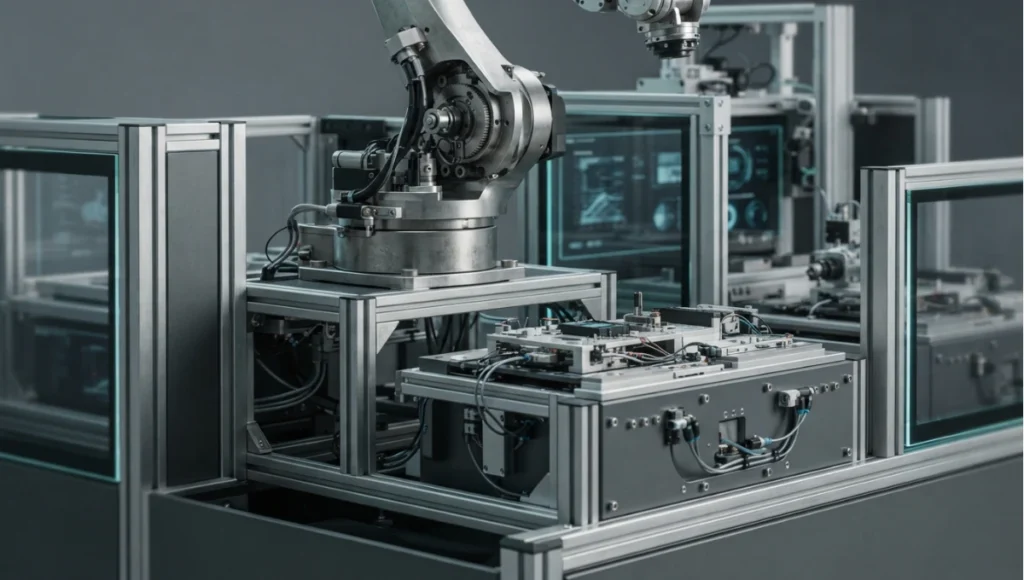
The twin changes four handoffs, and each one has a characteristic failure mode. Design → simulation: parametric models feed physics simulation, so a facade change ripples into daylight, thermal and structural checks in the same session; the failure mode is a one-way export that blinds the downstream tools to the change. Simulation → fabrication: files flow to robotic cells and CNC equipment with tolerances checked against the live model; the failure mode is tolerance mismatch between the design model and the machine’s actual work envelope. Fabrication → documentation: as-built scanning compares reality to the model and produces the deviation record; the failure mode is scanning without a defined acceptance threshold, which turns data into noise. Documentation → operation: handover passes the model to the operator with the sensor map, the graph and the maintenance logic intact; the failure mode is a handover that transfers geometry and nothing else, leaving the operator with a file rather than a twin.
- Interoperability is the recurring cost centre. Different vendors in the sensing, control and modelling layers speak different dialects, and custom middleware is where integration budgets go.
- Define the acceptance threshold before scanning. A deviation record without a tolerance is an argument generator.
- Design the handover as a deliverable. The operator needs the graph and the logic, not the polygon count.
- Instrument for the decisions you actually make. Feeds no decision consumes are cost wearing the costume of insight.
- Data contracts before data flows. Agree ownership, format, cadence and retention at the start, not in the dispute.
Adoption reality
Who actually runs twins in 2026, and where does the value land first? Large asset owners and operators — campuses, airports, transit authorities, utilities — adopt earliest, because they already carry maintenance budgets and failure costs that a twin can move. Infrastructure and civil programmes adopt twins as an owner-side requirement, particularly where 4D (time) and 5D (cost) tracking has to be demonstrated on funded projects. Design studios adopt the simulation and visual layers more readily than the operational layers, because the first two change their deliverables while the third changes their liability. Municipal governments adopt at pilot scale, held back by procurement capacity and by the integration overhead that consumes a large share of any first programme’s effort. The pattern across all four: the twin arrives where an operational decision already exists to consume it, and stalls where it is commissioned as a showcase.
- Time to value is short for operations, long for planning. Maintenance and energy decisions pay back quickly; masterplanning twins pay back on multi-year cycles.
- Learning curve concentrates at the handoffs. Teams rarely struggle with a single tool; they struggle where data crosses between them.
- Licensing reality bites at scale. Per-seat and per-asset licensing models make city-scale twins a procurement negotiation, not a purchase — budget for it.
- Skills are the binding constraint. The scarce role is not the modeller but the integrator who understands both the asset and the data contract.
- Pilot scope should be one decision, not one district. Prove the loop on a single recurring decision before widening.
Intellectual honesty: current limitations
Interoperability: there is no universal city operating system, so a sensor from one vendor and an actuator from another may require custom middleware before they can act together; integration work, not modelling, is the largest hidden cost in first programmes. Liability: data ownership and the consequences of a wrong prediction remain unsettled — if a twin’s maintenance alert is wrong and an outage follows, the responsibility question is contractual rather than technical, and the AIA’s digital practice documents are where practitioners track the current frameworks. Security: a twin is an attractive target, because compromising the model can reach into the physical world through connected plant and machinery; zero-trust architecture (ZTA) is the current mitigation pattern, and the risk is reduced rather than eliminated. Hardware obsolescence: software environments outlive the sensors they depend on, so sensor replacement cycles — not model capability — set the practical horizon of any twin. Data quality: a twin inherits every calibration error in its sensor layer, and a confident model built on drifting sensors is worse than no model. Cost floors: the entry cost is not the licence but the integration, commissioning and the permanent staffing that keeps feeds alive.
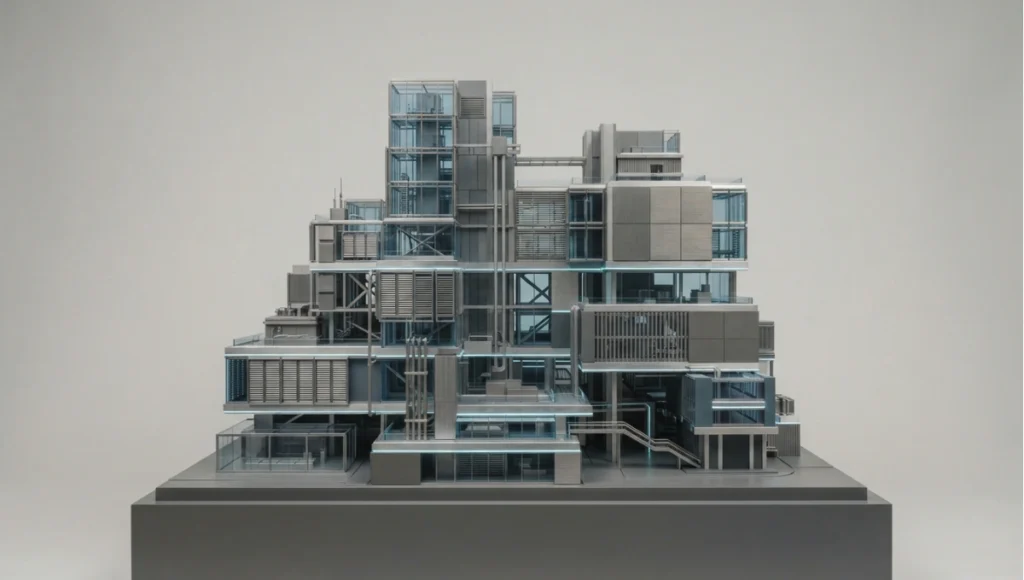
The toolset: 5 key tools
Each entry names what it does, who it is for, its cost tier, its 2026 maturity, and its 2030+ trajectory. No version claims are made beyond what the vendor publishes.
- NVIDIA Omniverse — what: physics-accurate simulation and collaboration across design and robotics workflows, including robotic assembly simulation before site mobilisation. Who: teams running digital fabrication and large-scale simulation. Cost tier: enterprise. 2026 maturity: production for visualisation and robotics simulation; operational asset twins still require integration work. 2030+ trajectory: tighter coupling between simulation and construction robots, with physics accuracy becoming the differentiator rather than visual fidelity.
- Azure Digital Twins — what: the relationship graph for assets, spaces and systems at district and city scale, with IoT ingestion and query. Who: municipal and campus-scale operators with large asset counts. Cost tier: enterprise, consumption-based. 2026 maturity: production, with the graph model doing the heavy lifting and the integration effort sitting around it. 2030+ trajectory: governance features — access, audit, data contracts — becoming the primary purchase reason.
- Rhino 8 + Grasshopper — what: parametric design logic and the canvas that pipes live data into geometry; the practical entry point for computational design. Who: architects, computational designers, research labs. Cost tier: professional / per-seat. 2026 maturity: mature and ubiquitous in computational design practice. 2030+ trajectory: increasingly the front-end to machine-learning workflows rather than a standalone design tool.
- Bentley iTwin — what: infrastructure and civil twins with time and cost dimensions, used where asset registers and construction sequencing must stay aligned. Who: infrastructure owners, civil engineering teams, programme managers. Cost tier: enterprise. 2026 maturity: production for infrastructure programmes that already require 4D/5D tracking. 2030+ trajectory: consolidation of owner-side asset data into a single auditable register.
- Unreal Engine 5 — what: real-time visualisation layer for stakeholder engagement and operator interfaces, using Nanite and Lumen for high-fidelity rendering of large models. Who: visualisation teams, public engagement leads, operators needing legible interfaces. Cost tier: free-to-start with commercial licensing above revenue thresholds — confirm current terms. 2026 maturity: production for visualisation; operational interfaces increasingly common. 2030+ trajectory: the visual layer becomes the operator’s primary interface rather than a presentation asset, and Unreal Engine 5 architecture workflows become standard in design documentation.
Ten strategies for scalable growth
Nuvira Space · Future Tech
Digital twin readiness planner
A twin earns its keep when it changes a recurring decision. Name the decision, mark the stack layers you actually have, and the planner returns what is missing and which limitation you are exposed to.
Planner result
Maintenance first — the fastest operational return
0 of 6 stack layers in place.
Maintenance is the fastest place to prove a twin, because the decision recurs on a schedule and the cost of failure is already visible in the operating budget. Instrument the recurring round first — condition monitoring against a baseline, with a threshold that triggers work — rather than modelling the whole estate.
Missing layers: semantics in the model (attributes, not just geometry); sensing at the decision points; edge processing; a unified relationship graph; an operator-facing visual layer; data governance across the feeds.
First loop: none of the response-side pieces are designed yet. Define the threshold that triggers action and name the owner before the first sensor ships — instrumentation without a response protocol is data collection, not control.
Limitation you are exposed to: integration and ownership — vendors that do not interoperate, plus a graph nobody owns. Mitigate contractually: data contracts agreed up front, a named owner for the model, and audit built in.
Orientation aid only. This planner applies the readiness logic published on the article; it does not quote licences, size systems, or replace a platform evaluation. © Nuvira Space. All rights reserved. | FUTURE TECH Series.
1 · Unified geospatial graph
Replace separate GIS and CAD registers with one graph that attributes metadata to every asset. Why it matters: analysis — signal propagation, shadow studies, service capacity — depends on relationships rather than on file formats. What it needs: a named asset register, a schema discipline, and an owner for the graph. Honest note: consolidation is organisational work before it is technical work, and it is where most programmes stall.
2 · Structural health monitoring
Strain, vibration and displacement monitoring compared continuously against a baseline modal signature, so deviation is detected before it is visible. Why it matters: inspection cycles are periodic while structural change is continuous. What it needs: named sensor types, a baseline campaign, and an acceptance threshold that triggers action. Honest note: a monitoring system without a response protocol is a data collection exercise.
3 · Thermal and environmental management
Zone-level environmental control driven by measured occupancy and comfort rather than fixed schedules. Why it matters: it is the fastest operational return in most buildings, because it removes conditioning from empty rooms. What it needs: zone-level sensing, controllable plant, and a control logic owner. Honest note: savings claims belong to the building’s own measurement, not to a vendor headline — commission the measurement with the system.
4 · Robotic fabrication feedback
Fabrication files checked against the live model, with the machine’s actual output recorded back into it. Why it matters: it closes the loop between design tolerance and what the cell can actually hold. What it needs: named equipment, a tolerance map, and deviation records. Honest note: the gain is repeatability, not spectacle — the value shows up in reduced rework.
5 · Multi-agent simulation
Occupancy, evacuation and mobility modelled as discrete agents to test circulation and safety decisions before construction. Why it matters: some decisions — stair widths, exit counts, platform capacity — are cheap to change on a model and ruinous to change later. What it needs: scenario definitions tied to the actual decision. Honest note: simulation output is only as good as the behaviour assumptions behind it, and those need stating alongside the result.
6 · Edge-cloud continuum
Processing split between local nodes and cloud services, with latency-critical functions kept local. Why it matters: safety-relevant responses cannot wait on a round trip. What it needs: a defined latency budget per function and a fallback behaviour when the link fails. Honest note: the hard part is the failure mode, not the throughput.
7 · Material passports
Every component tagged with its material composition, so the asset can be read as a material stock rather than a sunk cost. Why it matters: it turns demolition from an expense into a supply decision, and it is the practical form of circular construction design. What it needs: tagged materials, a deconstruction map, and second-use markets. Honest note: passports without a market for recovered material are documentation, not circularity.
8 · Acoustic environment mapping
Noise modelled and measured across the envelope and the public realm, so quieter configurations can be tested before glazing budgets are spent. Why it matters: acoustic complaints are among the most persistent post-occupancy failures. What it needs: measurement points, a reference spectrum, and a design team that can act on the result. Honest note: modelling the street is harder than modelling the building, because the source is uncontrolled.
9 · Generative masterplanning
Layout and massing options generated against multiple performance criteria — wind, daylight, energy, carbon — and scored against each other. Why it matters: it widens the option set at the stage where options are cheapest. What it needs: performance metrics defined up front, or the generator optimises the wrong thing. Honest note: generated options still need an author — someone must own the choice.
10 · Data governance and auditability
Identity, access, provenance and audit across every feed, with records that can be interrogated later. Why it matters: performance claims, carbon accounts and safety decisions all depend on data nobody has tampered with. What it needs: an access model, an audit trail, and a retention policy agreed at the outset. Honest note: this is the least glamorous strategy and the one that decides whether any of the other nine survive an audit.
Comparative analysis: traditional workflow versus future tech stack
| Capability | Traditional Workflow | Future Tech Stack | Delta |
|---|---|---|---|
| Workflow | Linear: schematic design to a static handover, with decisions frozen at issue | Circular: design, simulate, fabricate and operate against a model that keeps updating | Feedback replaces rework where the loop is genuinely closed |
| Iteration cost | High per cycle, so options are narrowed early to protect the schedule | Low per simulated cycle, so more options survive into testing | Widens the option set, but moves the cost to integration and discipline |
| Data fidelity | Static documents and model exports, accurate at the moment of issue | Live telemetry and as-built scanning compared against the model continuously | Fidelity becomes a maintenance obligation rather than a delivery milestone |
| Human oversight | Reviews concentrated at milestone gates | Continuous monitoring with defined thresholds for intervention | Oversight shifts from periodic judgement to threshold management |
| Failure mode | Errors discovered in operation, after handover | Errors surface in the model and in deviation records — provided the thresholds exist | Fails silently if nobody owns the response protocol |
| Operations | Maintenance reactive, energy managed by schedule | Maintenance predictive against baselines; energy managed by measured occupancy | The value lands in operating budgets, not in the design fee |
| Governance | Document control exercised through issue and revision | Access, provenance and audit designed into every feed | Requires a data contract before the first sensor ships |
The comparison is not an argument that the twin replaces judgement; it is an argument about where the cost of being wrong lands. A traditional workflow concentrates its errors late, in operation, where they are expensive; a twin-managed workflow moves them early into the model — but only for organisations that also build the response protocol, because a signal nobody acts on is a cost rather than a control.
Speculative / Internal Concept Study — NEURO-SYNC — by Nuvira Space
Everything in this section is a speculative internal concept study. It is not a built project and it has no client; the quantities below are modelled concept targets used to make the reasoning concrete, and every one of them is a target rather than a measured result.
Project overview
- Location: a high-density district in a humid tropical city — speculative and deliberately unnamed
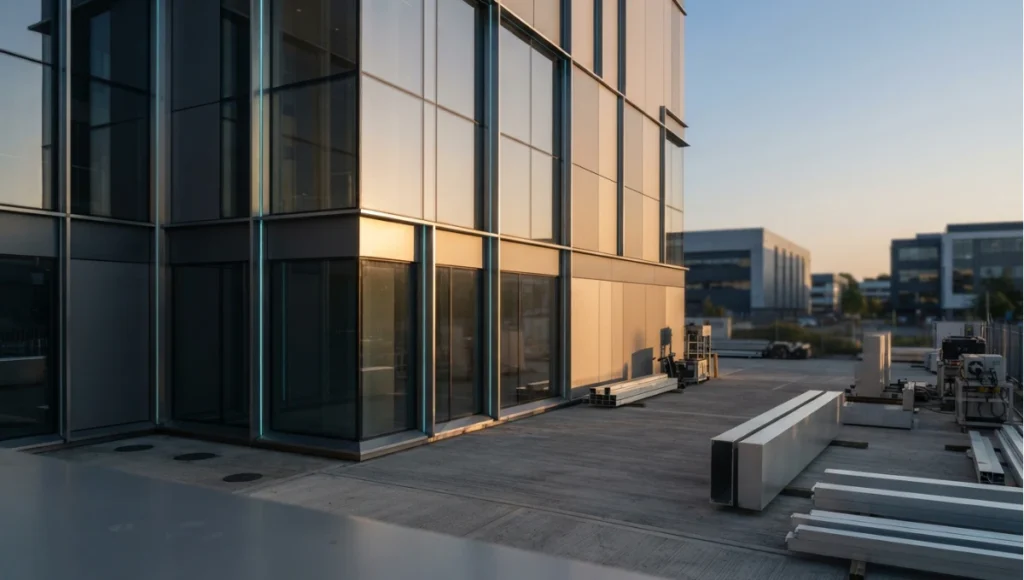
- Typology: vertical tech-agronomy hub with a photo-reactive envelope and integrated growing floors
- Scale: a mid-rise tower with a mixed public/market ground floor, modelled as a node within a district-scale twin
- Vision: a building that adjusts to measured air quality and comfort conditions rather than to a fixed schedule, and whose operating data feeds the district model
- Completion target: 2030+
Design levers applied
- Photo-reactive envelope: individually addressable panels driven by measured solar gain and interior comfort targets — concept target: a substantial reduction in peak-hour solar heat gain, verified through the model rather than asserted (concept target, not a measured result).
- Rainwater and greywater managed against forecast: irrigation and reuse scheduled from rainfall prediction, with a manual fallback when the forecast is wrong (concept target, not a measured result).
- Growing floors coupled to building services: transpiration and lighting loads modelled inside the same twin as the HVAC system, so the agronomy and the conditioning are designed against one energy balance (concept target, not a measured result).
- Circadian lighting control: lighting spectra adjusted through the day against measured conditions, with occupant override as a design requirement rather than an exception to be managed (concept target, not a measured result).
- District coupling: the tower modelled as a thermal and electrical node in the district twin, so its surplus and demand are visible to neighbouring assets (concept target, not a measured result).
Transferable takeaway
NEURO-SYNC’s claim is not that a building can think; it is that a building’s systems are worth coupling when the model reaches across design, construction and operation. Any team can apply the sequence tomorrow: name the decisions you will make repeatedly, sense only what those decisions consume, define the thresholds that trigger action, and keep the model as the single reference through handover. The tooling is mature enough for that today; the discipline is the scarce part.
2030+ projection
By 2030, expect twin readiness to appear in procurement and performance requirements rather than only in marketing — clients asking for the model, the graph and the telemetry register as handover deliverables. The design debate is likely to shift from balance-sheet framing such as net zero vs. net positive toward operating evidence: what the asset actually did, reported from its own instruments. The architect’s role shifts toward systems orchestration — specifying the data contract, the thresholds and the response protocol alongside the spatial design. Two cautions hold: forecasting claims need named platforms and versions behind them, and projections are directional rather than dated.

Frequently asked questions
Q: Does the AIA provide guidance on digital twins?
A: The AIA has published digital practice documents addressing model ownership, data use and the responsibilities that attach to digital deliverables, and these are being adapted by practitioners to cover twin handover. For the current position, refer to the AIA’s own documents rather than to secondary summaries, and have the data-ownership terms reviewed as a contract question rather than a technical one.
Q: How many sensors does a smart-building twin need?
A: There is no universal count, and any figure quoted as a standard should be treated with suspicion. The defensible method is to define the decisions the twin will support — comfort control, energy management, structural monitoring, space utilisation — and specify the sensing each one requires, zone by zone. Two organisations in the same building type routinely end up with different sensor inventories, because they make different decisions.
Q: What data volume does a real-time twin generate?
A: It depends on what is sensed rather than on the building’s size: video and vibration streams are orders of magnitude heavier than temperature or state data. The architectural response is the same as for privacy — process at the edge and transmit the insight, keeping raw high-bandwidth streams local where they are needed. Any specific volume claim belongs to the project’s own instrumentation plan.
Q: Can a digital twin help with pandemic or air-quality protocols?
A: Yes, within limits. A twin that models airflow and occupancy can adjust ventilation rates and zoning when conditions change, which is a genuine operational benefit for resilience planning. The limits matter: modelled airflow depends on assumptions about leakage, door behaviour and system commissioning, so the twin should be used to prioritise interventions with a measured verification loop rather than to assert a transmission outcome.
Q: Where should a first twin project start?
A: With one recurring operational decision and the data it consumes — a maintenance round, an energy schedule, a comfort complaint pattern. Instrument that loop, define the threshold that triggers action, and prove the response works before widening the scope. Programmes that begin as showcases tend to end as showcases; programmes that begin with one decision tend to grow.
Q: What breaks first in practice?
A: Integration and ownership, not modelling. Sensors from different vendors, a graph nobody owns, and a handover that transfers geometry without the operating logic are the three most common failure points. The mitigation is contractual and organisational: data contracts agreed up front, a named owner for the graph, and a handover specification that includes the sensor map, thresholds and maintenance logic.
This article is part of our smart building technology guide, the state-of-play synthesis across generative AI, robotics, and sensing layers.
Step into the Future Tech archive
Step into the Future Tech archive → nuviraspace.com/future-tech
© Nuvira Space All rights reserved.| FUTURE TECH Series | All tools and specifications cited are based on publicly available data as of 2026. NEURO-SYNC is a speculative internal concept study and does not represent a completed project.
1 thought on “10 Formidable Strategies for Digital Twins Smart City Growth”