

Table of Contents
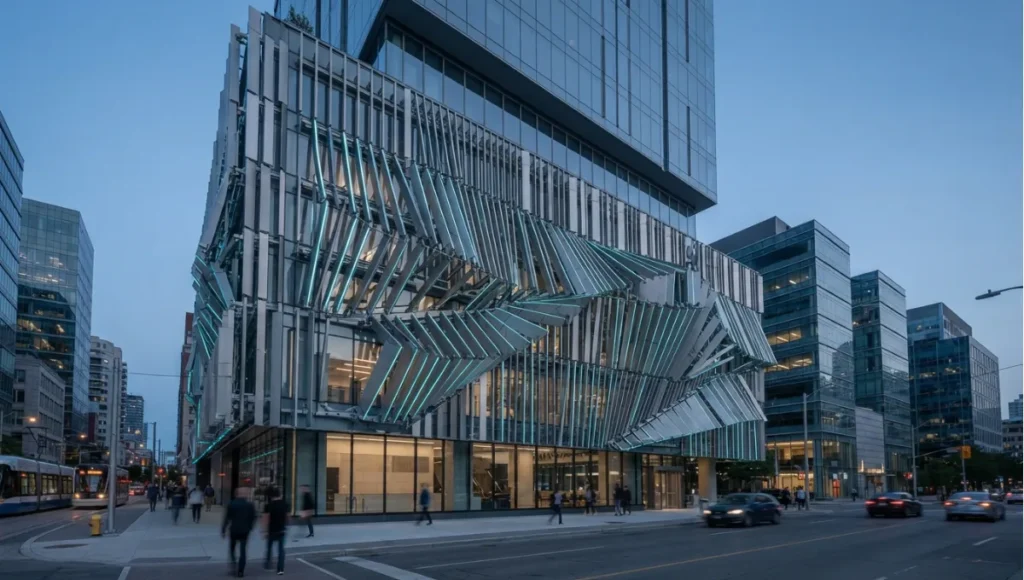
A kinetic facade is a maintenance commitment disguised as a design feature. The building moves, which means it has actuators, controllers, sensors, software and a service regime — and the moment the mechanism stops, the building is left with a permanently closed screen and no way to open it. Every project on this list is worth studying for exactly that reason: not because the movement is impressive, but because each one is a case study in how much machinery a building can carry, who services it, and what happens when the weather arrives faster than the control logic expects.
For decades the industry treated “frozen music” as its highest ideal, and a static envelope as the definition of a finished building. A climate of greater extremes and more volatile urban conditions unsettles that assumption: an envelope that cannot change how much sun and air it admits is now a liability in a way it was not fifty years ago. Kinetic architecture facades are the mechanised response — envelopes that move under control rather than through material properties.
Nuvira Perspective
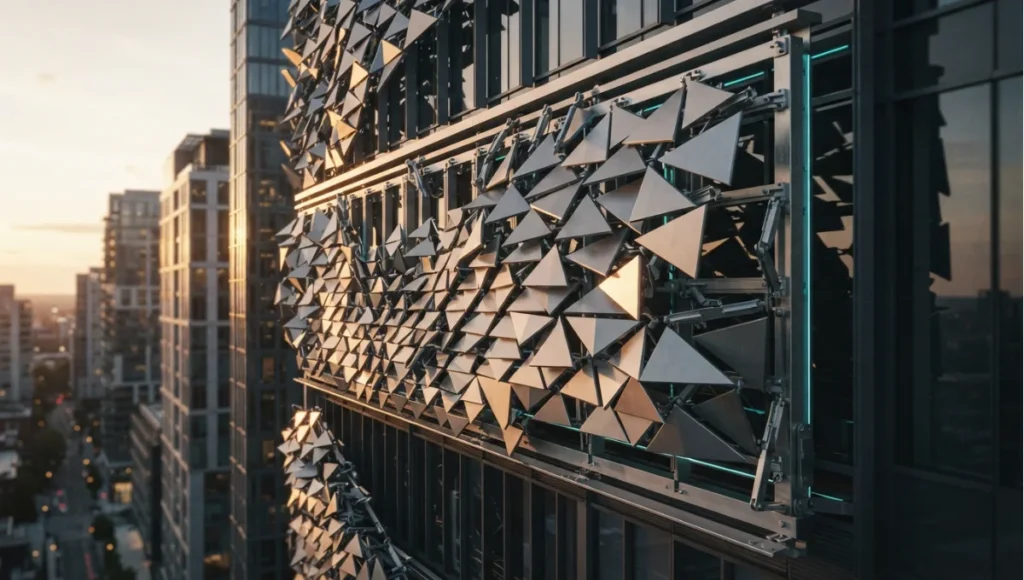
At Nuvira Space, we view the building envelope not as a barrier but as an interface — the part of a building that negotiates with the weather on the occupants’ behalf. We are sceptical of movement for its own sake, because every actuator added to a facade is a component that will need replacing, and a building’s envelope is the hardest part of it to service. Our position is that a kinetic facade should be judged on three questions before its form: does the movement replace a larger system, who services it for the life of the building, and what happens when it stops. Where a facade moves continuously rather than abruptly, that behaviour also has a perceptual dimension — the territory our neuroarchitecture coverage explores. Projects that answer those three well tend to be the ones still working a decade after handover; projects that treat movement as an aesthetic default tend to become static screens with expensive history. What follows examines seven built facades through that lens — mechanism first, spectacle second — alongside the digital fabrication and control layer that makes them possible.
Nuvira Space · Future Tech
Kinetic facade servicing planner
Every actuator added to a facade is a component that will need replacing, in the least accessible part of a building. Say what the movement is for and how reachable the facade is, then check the servicing plan — the planner returns where the lifetime cost sits and which decisions have to be made before the mechanism is specified.
Planner result
Solar shading · reachable from within — the movement must replace a larger system
0 of 6 servicing elements in place.
Shading is the strongest environmental case, because the movement reduces a load the building would otherwise meet mechanically. The test is whether the facade replaces something larger — smaller plant, less cooling — rather than being added to a system that stays the same size.
Where the lifetime cost sits: Reachable from within is the most favourable case in the field — the mechanism can be inspected and replaced without a cradle, which is the single biggest determinant of whether a kinetic facade still works in its third decade.
Watch for: a facade whose environmental case depends on it being in its designed position. If occupants can override it, the strategy has to work anyway. (Not yet in place: maintenance strategy defined; access route designed; units replaceable individually; failure position defined; control logic owner named; route back to static documented.)
Orientation aid only. This planner sets out where the lifetime cost of a kinetic facade sits and which servicing decisions must precede specification; it does not certify a facade system, a control installation or a maintenance regime, and it does not replace structural, safety and facade-engineering review. Specifications cited are based on publicly available data as of 2026. © Nuvira Space. All rights reserved. | FUTURE TECH Series.
Technical deep dive: seven built kinetic facades
These seven are built, documented projects rather than concepts. They are worth reading in sequence because they escalate in control sophistication, and because the later ones show where the real constraint sits: not in the movement, but in the servicing and the control logic.
1. Al Bahr Towers, Abu Dhabi
The reference project for large-scale kinetic shading, and the one most often cited in the literature. Aedas designed the responsive facade around the mashrabiya, the traditional Islamic lattice screen, and Arup engineered the mechanism — a secondary skin of umbrella-like units that open and close as a single coordinated surface rather than as individual windows.
- The mechanism: each unit is driven by a linear actuator, and the units are orchestrated as a group, so the building’s shading responds to the sun’s position continuously rather than to a daily schedule.
- Why it matters: it demonstrated that thousands of moving units could be engineered as one system on a commercial office building, which is the achievement every later project builds on.
- The maintenance consequence: the value of the modular approach is not the movement but the servicing — individual units can be reached and replaced, which is what makes a kinetic skin viable on a real building rather than a prototype, and what connects a serviced facade to the wider logic of circular construction principles.
- The caveat: the facade is the building’s most serviced system and its most visible one. Both facts are permanent.
2. SDU Campus Kolding, Denmark
Where Al Bahr responds to the sun as a group, the Kolding campus responds zone by zone. Henning Larsen’s design for the University of Southern Denmark uses roughly 1,600 triangular shutters of perforated steel, moving in three dimensions to screen sunlight from any angle (re-verify the count and specification at implementation).
- The mechanism: a decentralised sensor network measures conditions across multiple facade zones rather than at a single reference point, so different parts of the building behave differently at the same moment.
- Why it matters: it is the clearest built example of zone-level control, and zone-level control is what makes a facade behave like a building system rather than a single moving object.
- The daylight question: the facade’s purpose is to admit daylight without glare, which is a fundamentally different performance target from blocking solar gain — the two require different control logic, and both require the internal layout to be decided first.
- The caveat: the more zones a facade has, the more ways it can behave in ways nobody predicted, which is a commissioning problem before it is a design one.
3. One Ocean Thematic Pavilion, Yeosu, South Korea
The most explicitly bio-inspired of the seven. Designed by SOMA for Expo 2012, the pavilion’s kinetic facade is made of glass-fibre reinforced polymer lamellas whose movement was derived from research into how plants move — deformation distributed along a member rather than concentrated at a hinge.
- The mechanism: around 108 kinetic lamellas, controlled by a small number of computers, moving as a continuous wave rather than as discrete panels (re-verify the count at implementation).
- Why it matters: it established the GFRP lamella as a viable kinetic element, using the material’s own flexibility rather than a mechanism at every joint.
- The wind story: the movement is not only shade — a moving lamella field also moderates wind pressure across the surface, which is a structural benefit rather than an environmental one.
- The caveat: a pavilion is a building with an expiration date. Expo structures are not asked to perform for decades, so the durability case for a kinetic facade cannot be argued from a pavilion.
4. Kiefer Technic Showroom, Bad Gleichenberg, Austria
The clearest example of a kinetic facade used for something other than environmental performance. Ernst Giselbrecht and Partner’s showroom facade consists of large folding aluminium panels that change the building’s appearance continuously, with individual users able to override the global behaviour.
- The mechanism: folding panels on a track, driven to create geometric patterns, with local control available in addition to the building-wide logic.
- Why it matters: it demonstrates the control-layer distinction that runs through this whole list — a facade can be automated centrally, controlled locally, or both, and that choice is a design decision with consequences for the occupants’ relationship to the building.
- The lesson: movement as architectural expression has a different business case from movement as environmental control, and mixing the two arguments weakens both.
- The caveat: when occupants can override the facade, they will — so the environmental strategy cannot depend on the facade being in its designed position.
5. Media-TIC, Barcelona
A different mechanism entirely: instead of panels or lamellas, Media-TIC, designed by Enric Ruiz-Geli, uses inflated ETFE cushions whose optical behaviour changes when gas is moved between layers.
- The mechanism: the cushions change from transparent to diffusing as the inflation state changes, so the facade alters its light transmission without any panel moving in the conventional sense.
- Why it matters: it separates “kinetic” from “moving”, which the industry tends to conflate. A facade can change its performance without a mechanical cycle at every element, and the mechanism can be a fluid rather than a linkage.
- The material context: the building was designed around environmental performance more broadly, with a photovoltaic roof contributing to its energy strategy — the facade is one element of a systems approach rather than a standalone gesture.
- The caveat: inflatable systems depend on pressure, sealing and gas handling, which are their own maintenance regime — different from actuators, not simpler.
6. Bund Finance Center, Shanghai
The largest-scale example here, and the one that shows kinetic facades as cultural and urban devices. The moving element — a curtain of bronze-coloured pipes around the building’s perimeter — was designed as part of a facade scheme involving Foster + Partners and Heatherwick Studio, and it moves as three independent layers rather than as a single screen.
- The mechanism: layered tracks of pipes that shift relative to one another, so the facade reads as a woven veil that opens and closes.
- Why it matters: it establishes that a kinetic facade can be justified on an urban and cultural basis — what the building presents to the city as it changes through the day — rather than on energy alone.
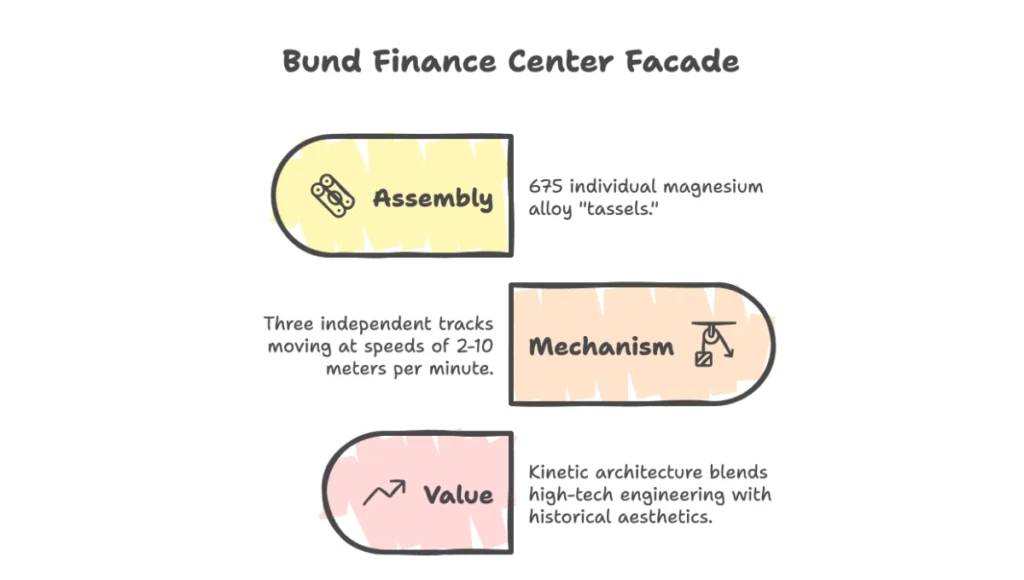
- The commercial consequence:* the same mechanism creates a distinctive identifier for the building, which is a value proposition measured in leasing and identity rather than in kilowatt-hours.
- The caveat: three moving layers is three times the mechanism, the track length and the service access. A facade justified on identity has to keep earning that identity after the novelty has passed.
7. Institut du Monde Arabe, Paris
The pioneer, and still the best case study in the risks. Jean Nouvel’s Institut du Monde Arabe, completed in the late 1980s, was the first building to bring the moucharabieh into a mechanised facade at scale, using a wall of motorised apertures.
- The mechanism: many identical ocular apertures, each containing a large number of small mechanical parts, opening and closing like camera irises in response to light sensors on the facade.
- Why it matters: it is the original proof that a building-scale kinetic facade is buildable, and it is the original warning about what such a facade demands — the number of small parts per aperture is precisely why the failure of one aperture is a repair job rather than a replacement.
- The honest note: the building’s kinetic system has been documented over its life as having been progressively problematic, and it is widely described as no longer operating as designed. That history is worth more to a designer than any of its original specification figures, because it is the only long-term dataset this field has.
- The caveat: the project that proved the concept also proved the maintenance argument. Thirty-odd years on, the mechanism is the part that did not survive.
What the seven have in common
Read together, the seven establish a pattern that no individual project shows. The movement is the least difficult part — actuators, linkages and control logic are solved engineering. The hard parts are the ones that arrive afterwards: servicing access at height, the number of small parts per element, the control logic’s behaviour in weather nobody designed for, and the fact that a facade with an expiry date is acceptable in a pavilion and not in a building. The dominant cost of a kinetic facade over its life is almost certainly the mechanism’s maintenance, not its installation — and the projects that have aged well are the ones designed to be serviced, not the ones that moved most impressively.
Digital fabrication and the control layer
The reason these facades exist at all is the convergence of parametric design with industrial control hardware. A facade like Al Bahr’s is not designed panel by panel; it is authored as a rule set in a parametric environment — Rhino and Grasshopper being the working default in this field — and then translated into machine instructions and control sequences.
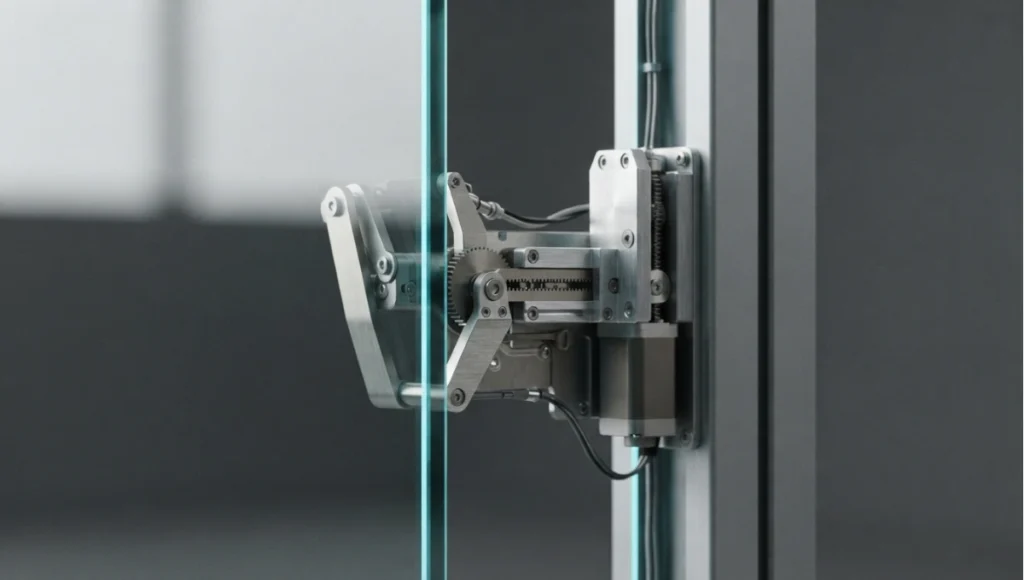
Two consequences follow. First, the facade is a software artefact before it is a physical one: the logic that decides when panels move is authored, versioned and commissioned like code, and a change to that logic changes the building’s behaviour without any physical work. Second, before it is industrial the logic is tested visually: moving assemblies are reviewed in real-time engines such as Unreal Engine 5 so that clashes and awkward sequences are found in the model. And third, the control layer is industrial rather than architectural — programmable logic controllers and building management systems designed for factories — which is why the skills required to deliver a kinetic facade are not the skills a conventional facade contractor has.
Comparative analysis: kinetic control versus a static envelope
The comparison below sets a mechanised kinetic facade against a high-performance static one. The delta column states the direction of difference; no figure is asserted for either column, because the honest comparison is between strategies rather than between products.
| Capability | Traditional Workflow | Future Tech Stack | Delta |
|---|---|---|---|
| Environmental response | Fixed performance designed for a worst-case condition | Continuously variable response to measured conditions | Direction: performance tracks the weather instead of being sized for its extreme |
| Envelope composition | One facade system, procured and installed by one trade | A static envelope plus a mechanism, a control layer and the interface between them | Direction: scope grows, and the interfaces are where the risk accumulates |
| Design artefact | A drawn assembly and a specification | A rule set authored parametrically, then commissioned as control logic | Direction: the building’s behaviour becomes software that has to be versioned and maintained |
| Failure mode | Degradation over time, visible as weathering or sealant failure | A mechanism that stops, usually without announcing itself, leaving a fixed position | Direction: failure becomes a state rather than a decline, and it must be detectable |
| Maintenance | Periodic inspection and cleaning | Periodic inspection plus actuated-system servicing with access at height | Direction: lifetime cost shifts decisively from construction to operation |
| Occupant control | Windows, blinds and thermostats | Facade behaviour that may be automatic, locally overridable, or both | Direction: the control philosophy becomes a design decision with consequences for behaviour |
| Justification | Thermal performance and compliance | Environmental response, architectural expression, or identity — and the business case follows the justification | Direction: mixing justifications weakens both, so the primary one has to be chosen deliberately |
The pattern across the table is the one the seven projects demonstrate: a kinetic facade does not make a building simpler, it makes the envelope more capable and the operation more demanding. The trade is usually worth taking where the movement replaces a larger system, and rarely worth taking where it is added to one.
Intellectual honesty: current limitations
Four constraints matter, and none of them is the technology’s capability.
- Maintenance is the dominant lifetime cost. A kinetic facade is a large number of small mechanisms in the least accessible part of a building. The Institut du Monde Arabe is the field’s longest-running evidence: a facade that was engineering history on completion and is widely described as no longer operating as designed. Any proposal should carry a servicing plan, an access strategy and a replacement-parts position before it carries a form.
- Capex is genuinely higher than high-performance static glazing. A mechanism, a control system, the sensors and the commissioning all sit on top of the envelope’s own cost, and the payback — where it exists — comes from reduced plant size, reduced energy and, in some projects, commercial identity. Those three returns should be quantified separately rather than blended into one figure, because they accrue to different parties.
- Sensor and control drift is a real maintenance item. The sensors that drive the facade degrade in polluted urban air, which means recalibration is a recurring task; the control logic also ages, since it was written for a building that has since been refitted. Neither is an argument against kinetic facades — both are items to schedule rather than discover.
- Approval and responsibility are unsettled. An envelope whose geometry changes is not covered by the same set of assumptions as a fixed one, and the question of who is responsible for a facade’s behaviour after handover — designer, facade contractor, controls integrator, or operator — is the question most likely to be left unanswered. Write it down.
The toolset: 5 key tools
These five cover the workflow from geometric logic to the hardware that actually moves the facade. Cost tiers are expressed as tiers rather than figures because licensing moves faster than this page; verify current versions at implementation.
| Tool | What it does | Who it is for | Cost tier | 2026 maturity | 2030+ trajectory |
|---|---|---|---|---|---|
| Rhino + Grasshopper | Parametric authoring of the facade logic — the rule set that generates panel positions and movement sequences | Computational designers, facade engineers | Perpetual licence, per-seat | Mature; the working default in this field | Tighter coupling between geometric logic and control-code generation |
| Karamba3D | Structural analysis inside the parametric environment, including moving and varying load cases | Structural and facade engineers | Commercial licence or free tier, per-seat | Established in engineering practice | Analysis of moving assemblies becomes routine rather than specialist |
| Ladybug Tools | Environmental analysis — sun, wind and daylight — to establish what the facade needs to respond to | Environmental designers, facade engineers | Free and open source | Mature and widely used | Environmental drives feed control logic directly rather than through a document |
| Twinmotion / Unreal Engine 5 | Real-time visualisation of moving assemblies for design review and stakeholder sign-off | Design teams, clients | Free or subscription tiers plus hardware | Established; increasingly used for interaction rather than presentation | Movement review becomes an interactive design step rather than a rendering exercise |
| Beckhoff / Siemens PLC systems | The industrial control hardware that sequences and drives the actuators, and the layer that site teams actually commission | Controls integrators, facade contractors | Commercial hardware and licence | Mature industrial technology, applied to buildings | Building control consolidates onto standard industrial platforms rather than bespoke systems |
Note the seam between the last two rows and the first three: the design tools and the control hardware come from different industries with different conventions, and the handoff between them is where a facade’s intended behaviour and its delivered behaviour diverge.
Speculative / Internal Concept Study — PULSE-X — by Nuvira Space
Everything in this section is a speculative internal concept study. It is not a built project, it has no client, and every quantity below is a modelled concept target used to make the reasoning concrete — never a measured result.
Project overview
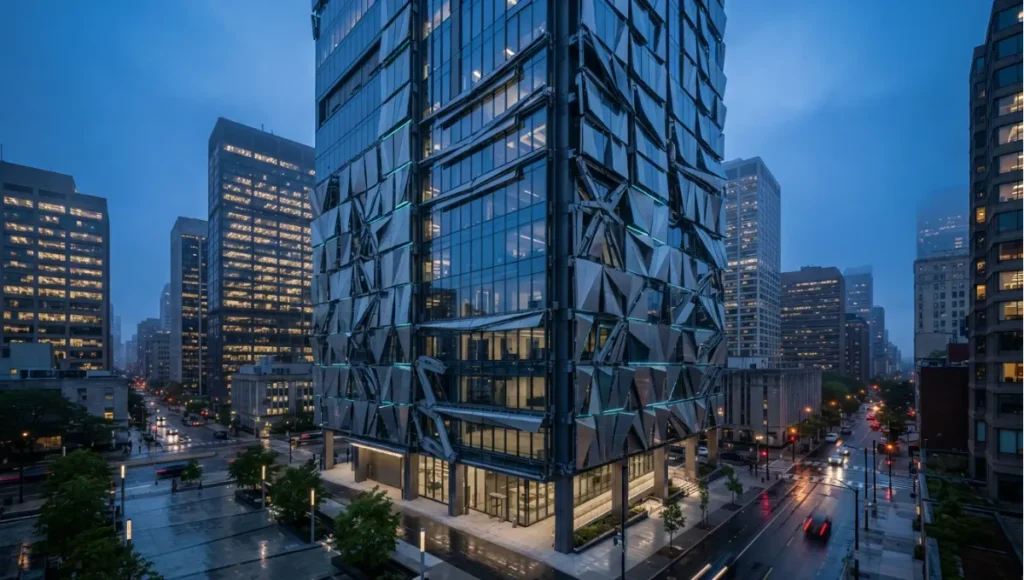
PULSE-X is a speculative mixed-use high-rise on a Singapore waterfront, conceived to test the servicing question rather than the spectacle: what a practice has to design into a kinetic envelope for it to still be working in its third decade. The proposal is not a client project and no site is secured; its purpose is to make the maintenance and control consequences of a moving skin explicit at the outset. Completion horizon is 2030+.
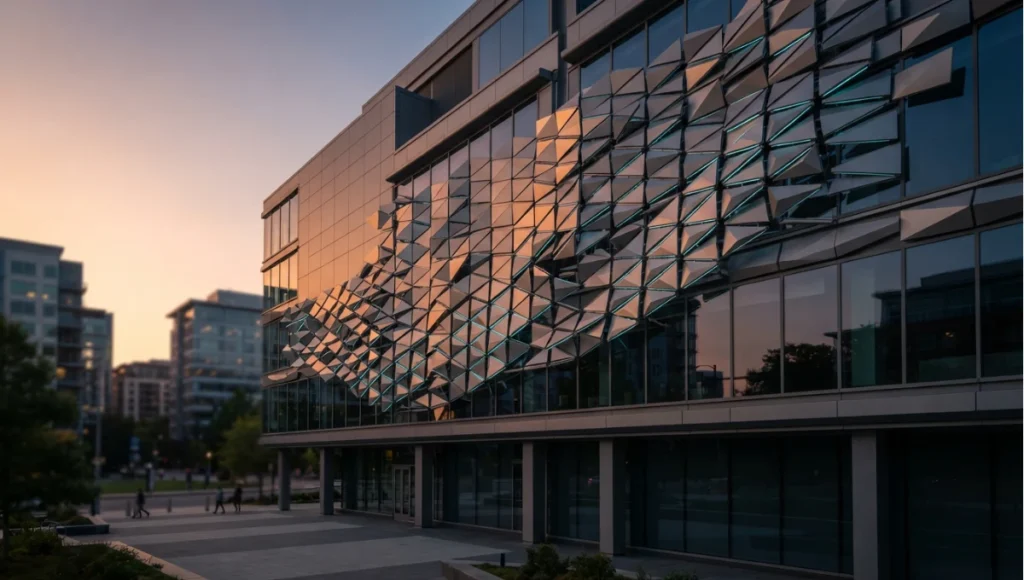
Design levers applied
- Service access designed with the facade: a maintenance strategy — reachable units, replaceable mechanisms and a defined intervention cycle — is developed alongside the geometry rather than after it (concept target, not a measured result).
- Failure position specified per zone: every zone has a defined position it fails into, chosen so that a non-responding facade still performs acceptably rather than leaving the building exposed (concept target, not a measured result).
- Local overrides with a global default: occupants can adjust their immediate environment, but the building-wide strategy remains the default so the environmental case does not depend on individual behaviour (concept target, not a measured result).
- Control logic treated as a maintained artefact: the software that moves the facade is versioned, documented and handed over like any other building system, with an owner named for its upkeep (concept target, not a measured result).
- Capex and opex modelled separately: the business case presents construction cost and servicing cost as distinct lines, so the mechanism’s lifetime burden is visible at the point of decision rather than absorbed into an operating budget later (concept target, not a measured result).
- Movement mapped to a specific load: each moving element is justified against the system it replaces — reduced plant, improved daylight, or reduced solar gain — rather than against a general ambition for responsiveness (concept target, not a measured result).
- A stated end-of-life position: the facade is detailed so the mechanism can be removed and the envelope returned to a static state if servicing becomes uneconomic, which is the decision the Institut du Monde Arabe effectively reached without planning for it (concept target, not a measured result).
Transferable takeaway
Treat the facade as a product with a service life, not as a material with a specification. That single shift changes what you draw: access routes, replaceable units, a defined failure position, a named owner for the control logic, and a documented route back to a static envelope if the mechanism stops earning its keep. It is the difference between a building that moves for a decade and one that moves for its life — and it costs nothing except deciding it early.
2030 and beyond
Three directions, each a projection rather than a forecast.
- Movement without mechanism. The most consequential direction is not better actuators but fewer of them: materials whose response comes from how they are made rather than from a linkage, which moves the facade’s servicing burden from mechanical maintenance toward material behaviour.
- Control consolidating into standard platforms. Kinetic facades currently require bespoke control integration from industrial suppliers. As building management platforms absorb this, specifying a moving envelope should become less exotic and more like specifying any other controlled system — with the same expectation of documentation and handover.
- The servicing model maturing into a product. The direction that would change adoption most is a facade supplied and maintained as a service, with a defined replacement cycle and an availability guarantee. That converts a maintenance risk into a contractual one, which is a trade building owners already know how to price.
Frequently asked questions
This article is part of our smart building technology guide, the state-of-play synthesis across generative AI, robotics, and sensing layers.
Q: Do kinetic facades consume more energy than they save?
**A:**The mechanism’s own consumption is small relative to the building’s loads, so the honest answer is that the energy question is not the deciding one. The deciding questions are maintenance, capex and control: a facade that reduces cooling load but needs servicing at height every year may still not pay, and a facade that only expresses identity is not an energy measure at all. Separate the three returns and judge each on its own terms.
Q: How do you handle extreme weather, such as typhoons or sandstorms?
**A:**Through a defined storm state: a position the facade locks into when wind exceeds a threshold, chosen so the assembly presents the least vulnerable profile to the load. That state has to be specified for the building’s actual wind climate, tested, and included in the maintenance schedule — and the more important point is that the failure position and the storm position should be the same, so an unpowered facade is also a safe one.
Q: Is kinetic architecture compatible with net-zero goals?
**A:**It can contribute, but only where the movement replaces something larger — a smaller plant, less cooling, better daylight — and the embodied carbon of the mechanism is counted against it. A moving facade that reduces operational energy while adding a large quantity of aluminium, motors and control hardware has to be assessed over its whole life, and the assessment often lands close to the static alternative unless the mechanism is doing substantial work.
Q: Which of these projects should a designer study first?
**A:**The Institut du Monde Arabe, because it is the only one with a long enough operating history to show what the maintenance argument actually costs. Study the others for what they established technically — Al Bahr for group control at scale, Kolding for zone-level response, One Ocean for material-based movement — but study the IMA before proposing a kinetic facade, because it is the field’s only complete life-cycle lesson.
Q: Who is responsible when the facade stops working?
**A:**Whichever party the contract says, and that ambiguity is the most common governance failure on kinetic projects. A moving facade involves the designer, the facade contractor, a controls integrator and the operator, and behaviour that emerges from their interaction belongs to nobody by default. Name the responsible party for the control logic, the warranty position for the mechanism, and the operator’s role in reporting faults — in the contract, before the facade is installed.
Step into the Future Tech archive
Step into the Future Tech archive → future-tech
© Nuvira Space All rights reserved.| FUTURE TECH Series | All tools and specifications cited are based on publicly available data as of 2026. PULSE-X is a speculative internal concept study and does not represent a completed project.
1 thought on “7 Kinetic Architecture Facades: Bold Responsive Design”