

Table of Contents
The modern residential landscape is undergoing a tectonic shift, moving from static “decoration” toward a biological imperative. As you observe the Japandi style evolution, you are witnessing more than a visual trend; you are seeing the birth of a neuro-architectural framework designed to regulate the human nervous system in an increasingly chaotic world.
In a post-industrial society where the boundaries between “work” and “recharge” have dissolved, the built environment must step in as a surrogate for the natural world. This article dissects the evolution of Japandi from a stylistic choice into a clinical instrument for cognitive preservation, engineered to facilitate deep neurological rest.
Nuvira Perspective
At Nuvira Space, we view the domestic environment not as a collection of furniture, but as a “health machine”—a sophisticated interface between human biology and the built world. We believe the next era of domestic life will be defined by human-machine synthesis, where modular adaptability and circadian synchronization are the standard. By treating the home as a responsive ecosystem, we move beyond aesthetics to engineer spaces that actively repair the inhabitant’s physiological state.
We are moving toward a future where smart home ecosystems 2026 act as the central nervous system of the residence, ensuring that every spatial adjustment serves a measurable biological purpose. Through this lens, the home becomes a sanctuary of precision—a place where the Japandi style evolution meets the cutting edge of domestic technology.
Technical Deep Dive: The 7 Pillars of Biological Resonance
To understand the Japandi style evolution, you must look past the surface-level fusion of Scandi-minimalism and Japanese rusticity. You must analyze the specific “design levers” that trigger parasympathetic nervous system activation. This approach aligns with recent initiatives by the American Institute of Architects (AIA) regarding “Design for Health,” which emphasizes that architects have a professional responsibility to mitigate stress through spatial configuration and material selection.
1. Adaptive Circadian Geometry
Traditional Japandi utilized light as a passive element—a simple window or a paper lantern. The evolution demands an active, technical role that mimics the solar arc with mathematical precision.
- Spectral Engineering: We move beyond “warm” or “cool” light. The evolution requires a spectrum that avoids “blue spikes” during evening hours, which are known to suppress melatonin.
- Spec: Integration of tunable white light (2700K to 6500K) following the Black Body Locus to prevent “spectral gaps” that distort the perception of natural wood grains.
- Spec: Reflection-coefficient analysis of wall finishes (LRV – Light Reflectance Value) to prevent glare-induced cortisol spikes. Walls should ideally sit between 50% and 70% LRV to balance brightness with visual comfort.
- AIA Reference: Following the AIA’s Framework for Design Excellence, we prioritize “Design for Energy,” which includes maximizing daylighting while using circadian lighting systems to supplement natural cycles during darker months or in subterranean zones.
- Impact: By aligning your home’s “sun” with your internal clock, you stabilize melatonin production, reducing sleep latency and improving morning alertness.
2. Low-Frequency Tactility (The Haptic Anchor)
The Japandi style evolution has largely been a revolt against the “Screen Era.” As our visual sense becomes overstimulated by digital interfaces, the importance of haptic (touch) feedback increases. This is the “Haptic Anchor”—the use of texture to ground the inhabitant in the physical present.
- Subcortical Processing: Touch is the only sense that bypasses complex cognitive processing to reach the emotional centers of the brain directly.
- Spec: Use of open-pore wood (matte oil finishes) that allows for tactile feedback without the “cold” sensation of stone or the “plastic” feel of polyurethane coatings.
- Spec: Specific Gravity of materials—using heavier, denser woods like charred cedar or solid oak for furniture legs to provide a sense of “unshakeable” structural stability.
- Impact: Touch-based grounding through natural textures reduces the frequency of “ambient anxiety” signals sent to the amygdala, providing a physical anchor in a digital world.
3. The “Ma” of Neural Rest (Spatial Void Logic)
The Japanese concept of Ma (negative space) is no longer a poetic suggestion; it is a cognitive necessity. Cognitive load theory suggests that every object in a room—no matter how small—requires “background processing” by the brain. A cluttered room is a noisy room for your neurons.
- Visual Saliency: The brain automatically prioritizes high-contrast or complex objects. By creating “voids,” you allow the visual cortex to enter a state of “Default Mode Network” activation.
- Spec: 40/60 Void-to-Volume ratio in primary living zones. This means 40% of your visual field should be intentionally unoccupied.
- Spec: Clearance zones of 90cm minimum for primary circulation paths to prevent the “claustrophobic reflex” and promote fluid, unhindered movement.
- Impact: Reducing visual clutter lowers the energy expenditure required for your brain to “map” the room, freeing up cognitive resources for deep work or recovery. This logic is essential in micro-living layouts, where every square inch must be curated to avoid mental fatigue.
4. Fractal Biophilia: The Math of Calm
The Japandi style evolution has moved beyond the “potted plant” phase. It now utilizes the mathematical language of nature to soothe the eye through fractal geometry. Nature is not random; it is self-similar across scales.
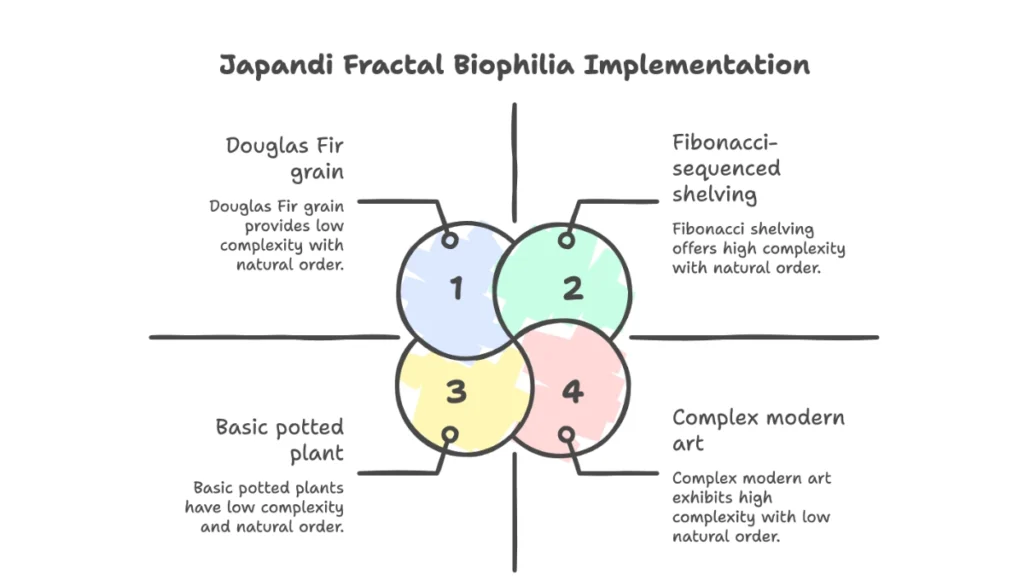
- Statistical Fractals: These are patterns that are not identical but have the same “complexity” at different scales—like the grain of a Douglas Fir or the pattern of a woven jute rug.
- Spec: Implementation of “Statistical Fractals” (D-values between 1.3 and 1.5) found in specific timber grains and stone veining. This “Goldilocks zone” of complexity is most pleasing to the human eye.
- Spec: Fibonacci-sequenced shelving heights to create a subconsciously recognizable “natural” order that feels “correct” without the inhabitant knowing why.
- Impact: Research supported by the AIA’s health committees indicates that viewing these specific fractal patterns can reduce stress levels by up to 60%. The human eye is evolutionarily “tuned” to process these shapes with minimal effort, unlike the harsh right angles of traditional modernism.
5. Acoustic Softening and Damping
Zen is not just a visual state; it is a decibel level. In the Japandi style evolution, the “silence” of a room is engineered. We treat sound as a physical material that must be shaped and absorbed.
- Reverberation Time: High-ceilinged modern homes often suffer from “Flutter Echo,” which keeps the brain in a state of high-alert.
- Spec: NRC (Noise Reduction Coefficient) target of 0.65+ in “refuge” zones. This is achieved using felted wool, PET acoustic panels hidden behind fabric, or slatted timber backings with acoustic batting.
- Spec: Strategic placement of “soft” boundaries—heavy linen partitions that absorb sound rather than reflecting it back into the center of the room.
- Impact: Minimizing high-frequency echo prevents the “startle response” common in modern open-plan living, allowing the brain to enter the “Alpha” state associated with relaxation and creative flow.
6. Chromatic Neutrality and Saccadic Movement
Your eyes move thousands of times per hour (saccades). High-contrast environments (bright red on white, or high-gloss black on neon) trigger more frequent, jerky movements that exhaust the ocular muscles and the brain.
- Visual Smoothness: The goal is to create a “Low-Contrast Sanctuary.”
- Spec: Muted ochres, slate greys, and bleached oaks within a tight 3-point contrast range on the Munsell Color System.
- Spec: Use of “Earth-Pigment” paints which provide a depth of color and light diffusion that synthetic, flat pigments cannot replicate.
- Impact: A low-contrast environment allows the ocular muscles to relax, signaling safety to the brain and preventing the “visual fatigue” that often manifests as afternoon headaches.
7. Modular Fluidity: The Home as an Organism
The final pillar of the Japandi style evolution is the acknowledgement that a room should not be one thing all the time. A rigid space creates a rigid mind.
- Dynamic Zoning: Using the concept of flexible home design, we create spaces that expand and contract.
- Spec: Kinetic joinery and concealed storage that can hide technology during “Zen hours.” A TV should not be a permanent focal point; it is a temporary utility.
- Spec: Lightweight, multi-functional furniture with a “low-center-of-gravity” design, allowing the inhabitant to reconfigure their environment to match their internal state.
- Impact: By allowing the home to transition from “productivity” to “restoration,” you create a clear psychological boundary between different modes of existence, preventing “Work-from-Home burnout.”
Comparative Analysis: Neuro-Spatial Outcomes
To truly appreciate the Japandi style evolution, we must compare it to the traditional industry standard of “Luxury Decor,” which often prioritizes ego and status over biology.
| Metric | Industry Standard (Modern Decor) | Nuvira Standard (Japandi Evolution) |
|---|---|---|
| Primary Goal | Visual Status / Trend Adherence | Biological Regulation / Cognitive Restoration |
| Materiality | Synthetic / High-Gloss / High-VOC | Carbon-Negative / Open-Pore / Bio-sourced |
| Lighting | Static On/Off (Blue-weighted) | Dynamic Circadian-Synced (Spectrum-tuned) |
| Spatial Logic | Maximum Density (Storage-heavy) | Intentional Void (Ma) / Sightline Anchors |
| Acoustics | High Echo / Minimal Treatment | Damped / Diffused / Low-Decibel |
| Neural Impact | High Cognitive Load (Stressing) | Low Cognitive Load (Restorative) |
| Sustainability | Planned Obsolescence | Long-Form Design (Generational) |
| Cognitive Mode | Beta State (High Alert) | Alpha/Theta State (Deep Rest) |
Concept Project Spotlight: Speculative / Internal Concept Study: NEURO-SANCTUARY 2030 by Nuvira Space
Project Overview: The Singapore “Cloud Forest” Unit
Location: Singapore (High-Density Urban Context)
Typology: Adaptive Micro-Apartment
Vision: To prove that the Japandi style evolution can survive—and thrive—in a hyper-urban, high-humidity environment.
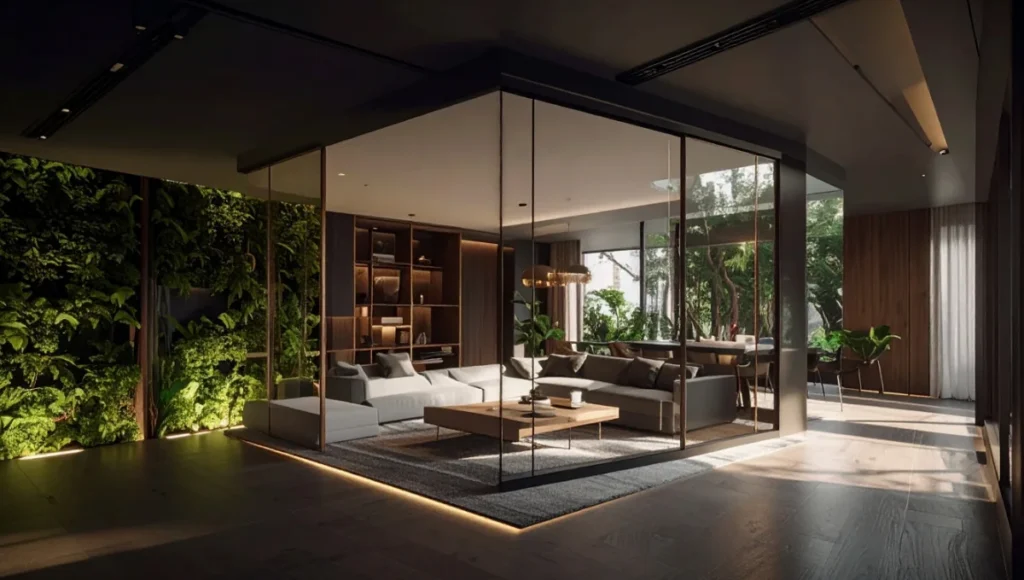
As global urbanization intensifies, cities like Singapore serve as the ultimate testing ground for neuro-architecture. Here, the “External Noise”—both literal and visual—is at its peak. The NEURO-SANCTUARY 2030 project was designed to be a pressurized cabin of calm within the skyscraper.
Design Levers Applied
- Atmospheric Management: Integration of HEPA-filtered vertical greening that acts as a natural “lung.” This managed ecosystem regulates CO2 levels and volatile organic compounds (VOCs) to prevent the “brain fog” often associated with high-rise, air-tight living.
- Tactile Transitions: Using the AIA’s research on “Healing Environments,” we implemented a “Sensory Airlock” at the entrance. Transitioning from cold-stone entryways to warm, “haptic-first” cork flooring signals to the brain that the “Hunt” (work) is over and the “Rest” (home) has begun.
- Light Sculpting: Smart-glass partitions that mimic the dappled light (Komorebi) of a forest floor. Using algorithmic control, the shadows shift across the floor throughout the day, providing the inhabitant with a subconscious sense of passing time even when the outside world is obscured by smog or rain.
Transferable Takeaway
You do not need a Singapore penthouse to benefit from these insights. You can apply the same logic at home by:
- Tuning evening lighting: Swap 5000K bulbs for 2200K amber tones after 7 PM.
- Building a refuge corner: Dedicate 4 square feet to a “zero-tech” zone with a floor cushion and a natural texture.
- Simplifying sightlines: Choose one wall. Remove everything. Place one natural anchor (a stone, a branch, a plant). Focus your primary seating toward this “Ma.”
Intellectual Honesty: Current Limitations
While we can optimize the interior, we must remain grounded in the reality of the macro-environment. An internal “health machine” cannot fully negate the “External Noise” of urban living. The effectiveness of a Japandi health machine is often capped by external environmental factors such as local air quality, seismic vibrations, and extreme light pollution.
Furthermore, the high cost of authentic, low-VOC materials and hand-rubbed timber remains a barrier to entry. At Nuvira, we are investigating how 3D printing and recycled polymers might democratize these neuro-architectural benefits, but for now, “True Zen” remains a high-investment endeavor. We are also looking at how modular vs prefab homes could streamline the delivery of these healthy environments at scale.
2030 Future Projection: The Bionic Home
By 2030, the home will no longer be a passive shell. We predict the integration of “Bio-Sensing Environments” where your walls change texture or color based on your heart rate variability (HRV).
The Japandi style evolution will culminate in the “Bionic Home.” Imagine a residence where:
- Sliding doors (Fusuma) move automatically based on your proximity and stress levels—opening to reveal a garden when your heart rate is high.
- The “Scent of the Morning” is algorithmically synthesized based on your sleep quality, using cedar and citrus to stimulate the cortex.
- Furniture that “breathes”—surfaces that adjust their firmness based on the inhabitant’s posture and muscle tension.
The distinction between “Natural” and “Technological” will disappear entirely, replaced by a seamless “Life-Support Ecosystem” that treats the inhabitant as a biological organism in need of constant, subtle recalibration.
Actionable Design Principles for the Modern Home
- The 3-Texture Rule: Limit any room to three primary tactile sensations (e.g., rough linen, smooth oak, cool clay). This prevents sensory “over-coding.”
- Horizon Alignment: Keep furniture below 60cm in height. This maximizes the perception of “Spatial Air” and mimics the low-profile living of traditional Japanese homes, which lowers blood pressure.
- The Scent of Safety: Olfactory cues bypass the thalamus and go straight to the emotional center. Use Hinoki, Cedar, or Sandalwood to “anchor” your home as a place of safety.
- Analog Anchors: Ensure every room has at least one object that requires manual interaction—a ritualized tea set or a hand-wound clock—to pull the user out of digital loops.
Comprehensive Technical FAQ
Q: How does the Japandi style evolution interact with modern sustainability?
A: They are inseparable. The “Evolution” focuses on “Long-Form Design”—building things once so they last for generations. By using carbon-negative materials and avoiding synthetic glues (High-VOC), you are protecting both the planet and your own respiratory health.
Q: Is Japandi just for large, minimalist homes?
A: No. In fact, it is most effective in small spaces where “Visual Noise” is usually the highest. By applying the “Ma” principle and using hidden storage, a 400sqft apartment can feel more restorative than a 4000sqft mansion that lacks intentional void space.
Q: What is the single most important “Pillar” to start with?
A: Circadian Lighting. Because your eyes are the primary “input” for your brain’s clock, changing your light spectrum is the fastest way to see a measurable change in your stress levels and sleep quality.
Q: How do I handle technology in a Japandi-evolved space?
A: “Conceal and Reveal.” Technology should be invisible when not in use. Use motorized panels, furniture with integrated charging, and avoid “Black Mirror” syndrome (large TVs as the room’s center).
Q: Does this style work for families with children?
A: Absolutely. The “Tactility” pillar is especially beneficial for childhood development. By choosing durable, natural materials like cork or solid wood, the home becomes a robust learning environment that encourages sensory exploration rather than just “careful” living.
Designing for Biological Harmony
The evolution of your home is the evolution of your health. Stop decorating and start engineering. The Japandi style evolution is your blueprint for a life lived in biological harmony.
Join the Nuvira Space community to receive our monthly “Neuro-Architecture Blueprint”—a curated guide to the latest in spatial psychology, built-environment tech, and evidence-based design. Begin your journey toward a biologically-synced lifestyle today.