

Table of Contents
As global climate shifts accelerate, the urban heat island effect has transformed the 35°C afternoon from a seasonal anomaly into a structural baseline for metropolitan design. In this new climatic reality, the reliance on high-load mechanical HVAC systems is no longer a viable engineering solution; it is a design failure that exacerbates the very warming it attempts to mitigate. To secure the future of our urban centers, we must pivot toward passive cooling techniques that treat the building envelope as a dynamic thermal regulator rather than a static barrier.
Nuvira Perspective: The Architecture of Biological Resilience
At Nuvira Space, we view the built environment not as a consumer of resources, but as an extension of the local ecosystem. Our institutional mandate is to move beyond the industry standard of “efficiency” toward a paradigm of regenerative infrastructure. We believe that a home should breathe, pulse, and regulate itself without the intervention of carbon-heavy machinery. By treating thermal mass as a battery and airflow as a fluid kinetic force, we engineer spaces that achieve carbon-negative operation while providing a sensory-rich lived experience. We reject the “glass box” legacy of the 20th century in favor of porous, intelligent skins that harmonize with the physics of their specific latitude.
Technical Deep Dive: The Mechanics of Passive Regulation
The transition to regenerative infrastructure requires a granular understanding of thermodynamics. Every material choice and spatial void must be justified by its contribution to the building’s thermal equilibrium.
1. Kinetic Airflow: The Bernoulli Fluid Dynamic
Natural ventilation is often misunderstood as merely “opening a window.” In high-performance design, we utilize the Bernoulli Principle and the Stack Effect to create pressure differentials that drive air movement at velocities of 0.5 to 1.5 m/s, even on windless days.
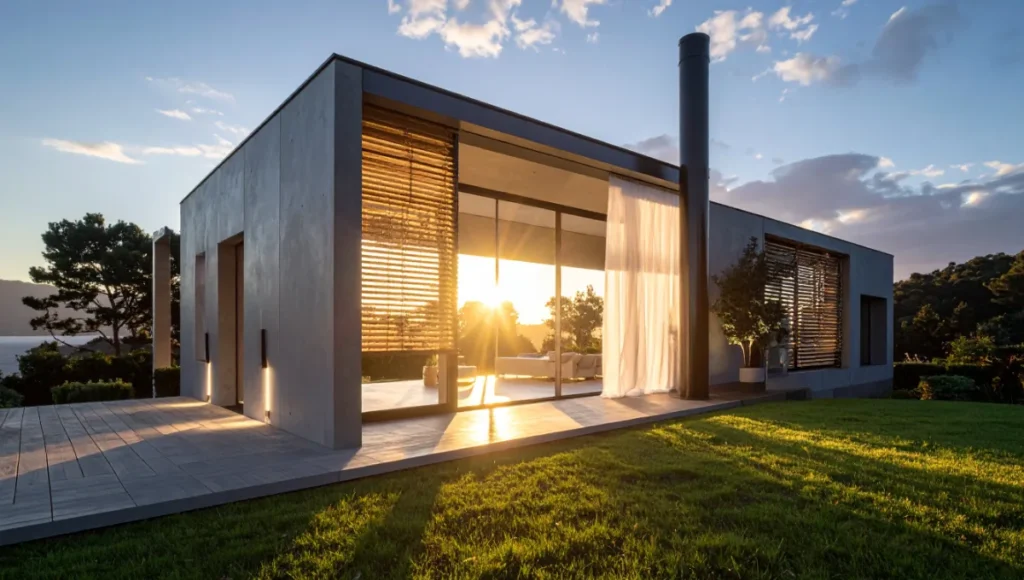
- Solar Chimneys: By constructing a 10-meter vertical shaft with a blackened glass thermal collector at the summit, we create a 15-20°C temperature delta between the base and the top. This force-extracts hot air from the living zones at a rate of 250 cubic meters per hour.
- Cross-Ventilation Ratios: To ensure effective air exchange, your “inlet-to-outlet” ratio must be maintained at 1:1.2. The larger outlet creates a low-pressure zone that pulls air through the structure, ensuring a complete air change every 8 to 12 minutes.
- Venturi Effect Apertures: Narrowing the air intake points and widening the internal volume accelerates airflow, providing a physiological cooling effect equivalent to a 3°C drop in perceived temperature.
2. Thermal Mass Optimization: The Phase-Shift Battery
In climates like Singapore, where humidity remains above 70% and temperatures rarely dip below 25°C, the strategic use of high-density materials is critical. We utilize 200mm-thick high-albedo concrete or rammed earth walls to delay heat transfer by 6 to 8 hours. At Nuvira, we recommend integrating carbon-negative concrete to ensure the structural shell actively sequesters CO2 while providing this essential thermal inertia.
- Thermal Lag: A material with high volumetric heat capacity (approx. 2,000 kJ/m³K) absorbs solar radiation throughout the day. By the time this heat reaches the interior surface, the external temperature has dropped, allowing you to flush the heat via “night purging.”
- Night Purging Metrics: By maintaining window openings at 15% of the total floor area during 22:00 to 06:00 hours, we can lower the core temperature of the structural slab by 4-6°C.
- Specific Heat Capacity: We prioritize materials with a specific heat capacity of at least 1,000 J/kg·K to maximize the “thermal flywheel” effect, stabilizing the indoor environment against 15°C diurnal swings.
3. High-Performance Shading: The 15-Degree Solar Cut-Off
Standard glazing accounts for nearly 40% of a home’s heat gain. According to the American Institute of Architects (AIA) Framework for Design Excellence, optimizing the window-to-wall ratio (WWR) and solar shading are the most impactful levers for reducing peak cooling loads.
- Fixed Horizontal Overhangs: For north/south facades, we calculate eaves with a depth-to-height ratio of 0.5. This blocks the high-angle summer sun (75-80°) while allowing 100% of the low-angle winter sun to penetrate.
- Automated Louvers: Utilizing 300mm-wide aluminum louvers with a Solar Heat Gain Coefficient (SHGC) of 0.22, we reflect 78% of incident radiation before it reaches the glass.
- Bio-Reactive Layers: For projects requiring a visionary aesthetic, we integrate algae bio-curtains, which provide adaptive shading while producing oxygen and capturing 2 kilograms of CO2 per square meter annually.
4. Evaporative Heat Sinks: The Micro-Climate Buffer
Water is the ultimate thermal stabilizer. By integrating 500-liter reflection pools or “bio-walls” at the primary air inlets, we leverage the latent heat of evaporation to cool incoming air. This approach is a cornerstone of biophilic interior design, connecting occupants to natural rhythms while performing vital engineering functions.
- Adiabatic Cooling: As air passes over a 15-square-meter water surface, it can drop in temperature by 3-5°C. This is a carbon-negative process that simultaneously boosts indoor humidity to the 45-55% comfort range.
- Micro-Mist Systems: Utilizing 0.2mm nozzles at 1,000 psi, we can reduce courtyard temperatures by 8-10°C with a water consumption of less than 2 liters per hour per zone.
5. Radiative Roof Barriers: The Sky-Coupled Radiator
The roof is the most vulnerable point of any structure, receiving up to 1,000 W/m² of peak solar radiation.
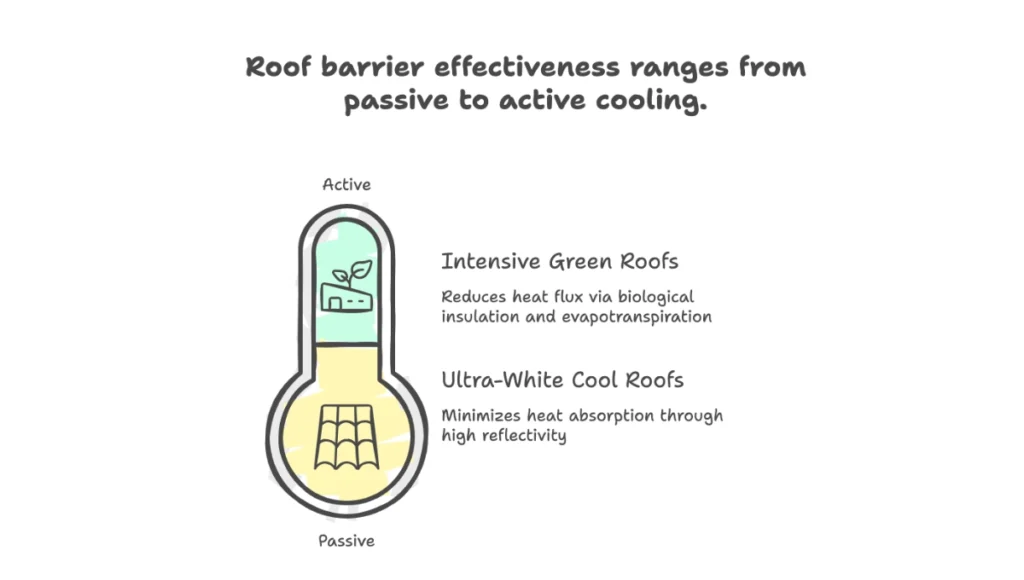
- Ultra-White Cool Roofs: By applying coatings with a Solar Reflectance Index (SRI) of 100+, we keep roof surface temperatures within 5°C of ambient air, avoiding the 75°C peaks seen on standard bitumen.
- Intensive Green Roofs: A 300mm substrate layer acts as a biological insulator. Through evapotranspiration, a green roof reduces heat flux into the building by 60-90%.
Comparative Analysis: Solution vs. Industry Standard
| Metric | Industry Standard (Mechanical) | Nuvira Passive Solution |
|---|---|---|
| Operational Carbon | 3.5 – 5.0 Tons CO2e / year | 0.0 Tons CO2e / year |
| Energy Consumption | 4,500 – 7,000 kWh / year (AC) | < 150 kWh / year (Sensor-only) |
| Internal Temp Stability | +/- 0.5°C (High Energy) | +/- 2.5°C (Natural Regulation) |
| Lifecycle Cost (30yr) | $45,000 (Install + Energy + Repair) | $12,000 (Initial Structural CAPEX) |
| Occupant Health | Recirculated Air / Dry Sinuses | 100% Fresh Air / Natural Humidity |
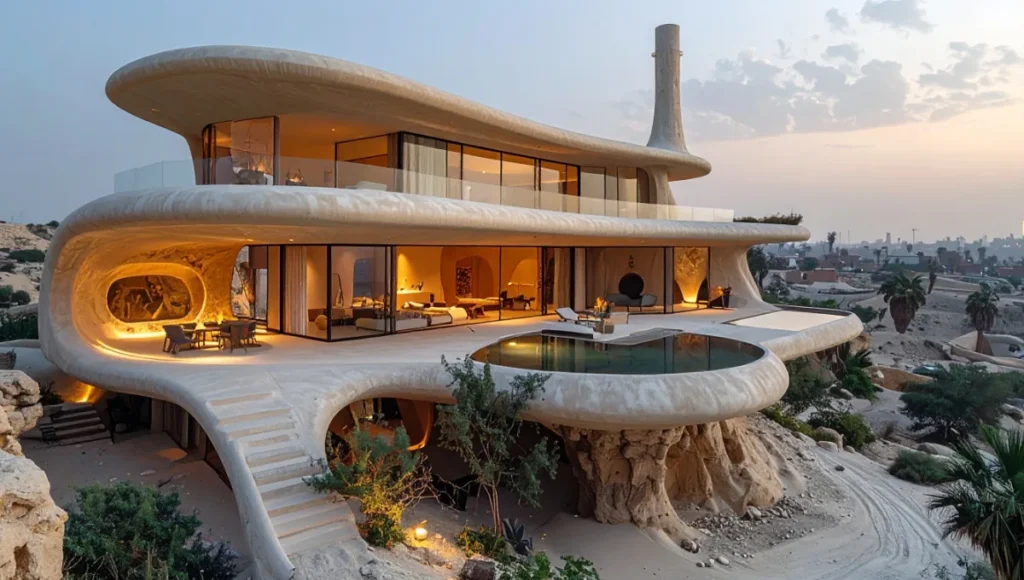
Speculative / Internal Concept Study: AERIS 01 by Nuvira Space
Project Overview: Arid Zone Residential Hub
- Location: Cairo, Egypt (Selected for its 42°C summer peaks)
- Typology: Single-Family Regenerative Villa
- Vision: A zero-energy sanctuary that utilizes the thermal mass of the desert to create a subterranean-inspired cooling effect without the need for traditional excavation.
Design Levers Applied
- The Wind Catcher (Badgir): A 12-meter reinforced ceramic tower that captures high-altitude breezes traveling at 5-7 m/s.
- Earth-Tubes: 30 meters of 400mm diameter pipes buried 3 meters underground. Air entering the home is pre-cooled by the 20°C constant soil temperature, entering the living room at a stable 22°C regardless of the 40°C exterior heat.
- Phase Change Materials (PCM): 25mm layers of Bio-PCM integrated into the ceiling tiles, melting at 24°C to absorb latent heat during peak occupancy hours (12:00 – 16:00).
Transferable Takeaway
The “Earth-Tube” strategy is the most scalable lever for modern homeowners. By utilizing the 20°C thermal stability of the ground just 2-3 meters below the surface, you can eliminate the need for traditional compressors entirely. This is the foundation of regenerative infrastructure: using the Earth as your primary heat exchanger.
2030 Future Projection: The End of the Compressor
By 2030, we anticipate that building codes in G20 nations will mandate a “Passive-First” certification, similar to the AIA’s push for the 2030 Challenge. The aesthetic of the modern home will shift from sealed glass boxes to porous, multi-layered “living skins.” We will see the rise of 3D-printed ceramic cooling blocks and bio-integrated HVAC where living moss walls handle 100% of air filtration and 40% of thermal regulation. The air conditioner will be viewed as a relic of the fossil-fuel era—an inefficient crutch for poorly designed envelopes.
Comprehensive Technical FAQ
Designing for a hot-dry climate? See how these principles are applied in our Mediterranean passive cooling vernacular guide — courtyards, thermal mass and shading geometry.
This article is part of our climate adaptive homes guide, the passive-first home base for cooling, retrofit, resilience, and certification.
Q: Can passive cooling techniques work in 90% humidity?
A: Yes, but the strategy shifts from evaporative cooling to kinetic airflow. In high-humidity zones like Singapore, you must prioritize “ventilation air change” (ACH) rates. A target of 20-30 ACH is required to facilitate skin-surface evaporation.
- Key Metric: 0.3 m/s to 0.5 m/s air velocity at the occupant level.
Q: How do I measure the success of thermal mass?
A: Use the “Time Lag” metric. A successful 200mm masonry wall should provide a 6.8-hour delay.
- Peak Heat Outside: 14:00
- Peak Heat Inside: 20:48 (When the building can be flushed with night air).
Q: What is the maximum depth for a naturally ventilated room?
A: To maintain effective airflow, the depth of a room should not exceed 2.5 times the height of the ceiling. For a standard 3-meter ceiling, your room depth limit is 7.5 meters. Beyond this, you require a central atrium or “breezeway” to prevent stagnant air pockets.
Q: Does regenerative infrastructure cost more upfront?
A: Initially, CAPEX can increase by 8-12% due to high-performance glazing and structural mass. However, when you subtract the $15,000 – $20,000 cost of a central HVAC system and its ductwork, the net difference is often less than 3%.
Design for a Carbon-Negative Legacy
The technology to eliminate mechanical cooling already exists in the physics of our environment. Continuing to design homes that rely on the grid is a choice to remain tethered to an expiring era. At Nuvira Space, we are ready to help you engineer a residence that breathes with the planet.
Contact Nuvira Space to audit your project’s thermal blueprint and join the move toward regenerative infrastructure.
2 thoughts on “5 Innovative Passive Cooling Techniques for Modern Homes”