

Table of Contents
A printed neighbourhood is decided by what happens between the nozzle and the inspection. The extrusion is the visible part; the real project is the mix design, the open-time window, the reinforcement strategy and the approvals route behind it. That is why the seven projects below are worth comparing on the same axis — not which one printed fastest, but which one had to solve the problem that actually limits the method.
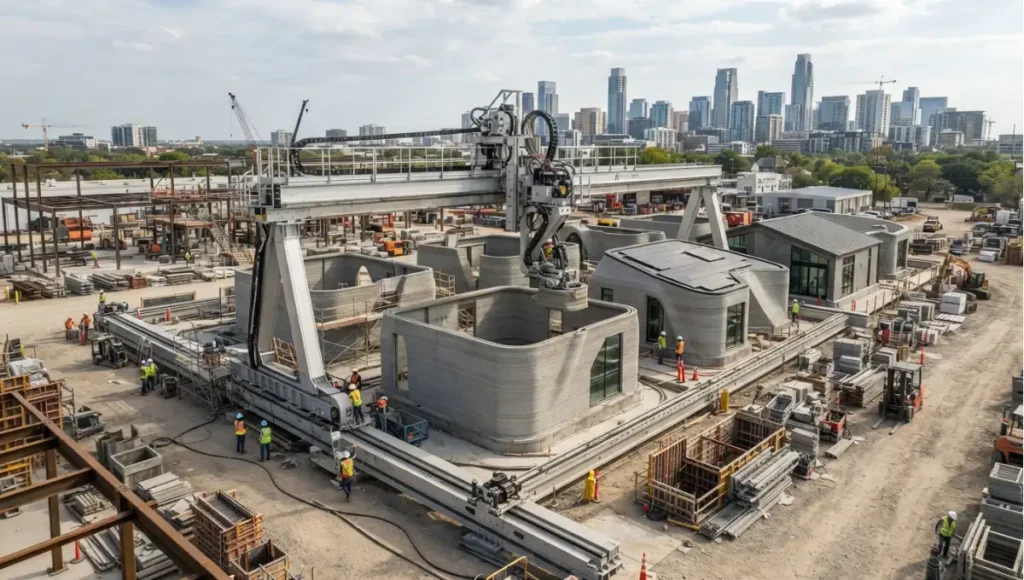
The global housing shortfall is no longer a localised shortage of labour but a systemic mismatch between how fast demand accumulates and how slowly conventional construction responds. 3D printed neighborhoods are the most direct attempt to close that gap, because they move a large part of the work from the site into a machine. The traditional workflow — where an architect draws, a contractor interprets and a trade executes — is joined here by a third participant that produces the structural shell directly from the model.
Nuvira Perspective
At Nuvira Space, we view the built environment as the physical manifestation of software logic. We do not see 3D printing as a mere “tool” but as the final stage of a human-machine synthesis where the architect’s intent is translated directly into structural performance without the static noise of traditional contracting. The seven neighbourhoods analysed below represent the first instances where hardware and software integration has bypassed the obsolescence of the manual grid. This is not “automated construction” — it is the beginning of the programmable site.
Our position is that the interesting metric is not speed alone but information gain: the delta between a wall that merely separates space and one whose geometry, material distribution and data record are all specified deliberately. We prioritise dimensional precision over the “good enough” tolerance of manual masonry, and we treat the fabrication record — not the render — as the evidence that a printed building performed.
Technical deep dive: seven built projects
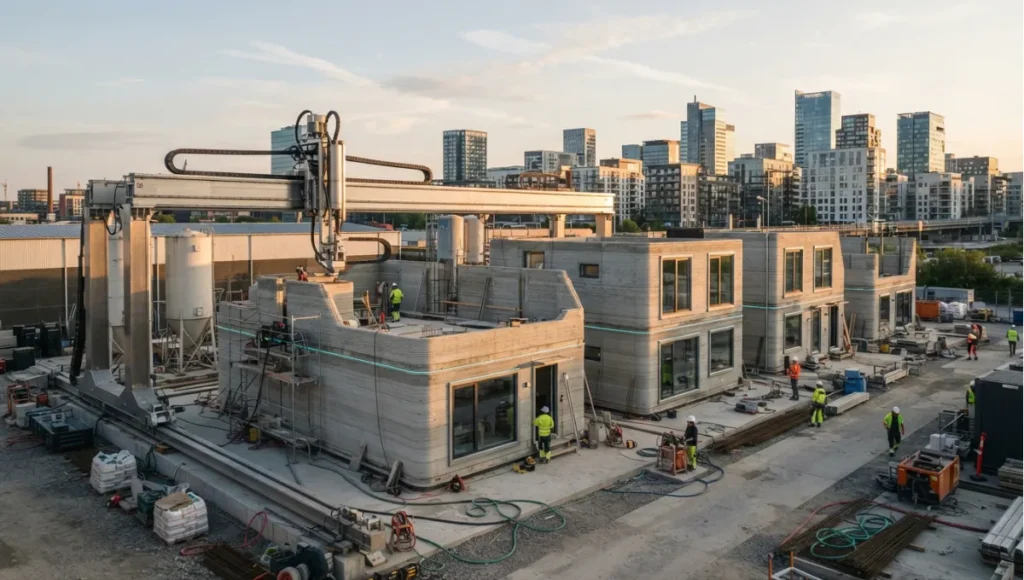
These seven are real, documented projects. Each entry describes what it actually established, because the value of the list is the sequence of problems the industry solved in order — commercial scale, cost per unit, legal habitability, material circularity, bio-based feedstock, social housing, and multi-storey printing.
1. Wolf Ranch, Georgetown, Texas
The commercial-scale proof. Wolf Ranch is a 100-home community developed by ICON with Lennar and designed with BIG (Bjarke Ingels Group), described by its developers as the world’s first 100-home 3D-printed community — which makes it the project that moved printed housing out of demonstration and into the mass-market suburban sector.
- Hardware: ICON’s gantry printing system (verify the current model designation and specifications at implementation).
- Scale: 100 single-storey homes, reported at roughly 1,500 to 2,100 square feet, with rooftop solar included in the package.
- Why it matters: the project’s significance is not the print itself but the delivery model — a national homebuilder selling printed homes through an ordinary sales channel at ordinary market pricing.
- The caveat to carry: a suburban community of single-storey printed shells is the easiest version of the problem. What it does not answer is density, height or the multi-storey case.
2. The Tabasco community, Mexico
The cost proof. Built by ICON with the non-profit New Story and the local organisation Échale, this is widely documented as the first 3D-printed community to house families — around 50 homes at roughly 500 square feet each, with two bedrooms, a living space, kitchen and bathroom.
- Why it matters: it demonstrated that the method could reach a price point and a delivery model relevant to housing need rather than to showcase. That is a harder test than printing a house twice the size for a design-conscious client.
- What it established: printed concrete can satisfy a real housing programme in a hot, humid climate, and the constraint on scale is funding and land rather than the printing itself.
- The caveat to carry: cost leadership in a non-profit build is a different claim from cost leadership in a commercial market, where financing, land and margin dominate the number.
3. Project Milestone, Eindhoven, Netherlands
The legal proof. Project Milestone, in the Bosrijk area of Eindhoven, produced what is consistently described as Europe’s first legally habitable 3D-printed homes, with Saint-Gobain Weber Beamix and academic partners attached, and a 2024 continuation adding multi-storey homes to the original cluster.
- Why it matters: habitability and permitting, not printing, were the bottleneck. Getting a printed dwelling through European residential regulation is the achievement that opened the market rather than the extrusion itself.
- What it established: printed concrete can satisfy a European residential approval route, and the design can aim at a specific character — the homes are deliberately shaped rather than extruded as boxes, which tests whether the method can be architectural rather than merely structural.
- The caveat to carry: a small, individually designed cluster proves capability, not scale economics. Five distinctive homes are a different business from a hundred similar ones.
4. WinSun, Suzhou, China
The circularity proof, and the earliest demonstration on this list. WinSun printed ten single-room houses in 24 hours in 2014, using a mix incorporating recycled construction waste, with the widely reported unit cost sitting in the low thousands of dollars (the figure should be treated as contemporaneous press reporting rather than audited cost data — re-verify before citing).
- Why it matters: the recycled-content mix made the waste question part of the material rather than the logistics. Turning demolition arisings into feedstock is the circular-economy claim most printed projects make and few demonstrate at unit scale.
- The caveat to carry: speed records from 2014 have aged poorly as evidence. Ten simple single-room structures are not comparable to a code-compliant dwelling, and the durability and certification record of that generation of mixes is not well documented.
5. BioHome3D, University of Maine, USA
The material proof. BioHome3D, from the University of Maine’s Advanced Structures and Composites Center, is described as the first 3D-printed house made entirely from bio-based material — a 600-square-foot prototype with printed floors, walls and roof of wood fibres and bio-resins, produced in four modules on a printer recognised by Guinness World Records as the largest polymer 3D printer.
- Why it matters: it removes cement from the question entirely. Wood-fibre and bio-resin systems change the carbon arithmetic of the feedstock, and the prototype is described as fully recyclable at end of life.
- What it established: printing need not mean concrete. The material palette of printed housing is genuinely open, which is why we cover carbon-capturing concrete. as one option among several rather than as the default.
- The caveat to carry: a single prototype module set, printed in a research facility, is capability rather than product. Climate performance, fire performance and code acceptance for bio-based printed elements are open questions, not settled ones.
6. Community First! Village, Austin, Texas
The social proof. ICON printed homes at Community First! Village with Mobile Loaves & Fishes for people moving out of chronic homelessness — the residents there were the first people in the United States to live in 3D-printed homes — with a further 100-home phase announced in 2024.
- Why it matters: this is printed housing used as social infrastructure rather than as a product launch. It tests the method against the constraint that actually matters in supported housing: durable, low-maintenance, simple to operate.
- What it established: printed homes can perform as permanent supported housing with an operator managing them, which is a more demanding service-life test than a market-rate house sold once.
- The caveat to carry: a charitable delivery model absorbs cost pressures that a commercial one cannot, so the economics of this project do not transfer directly to a speculative development.
7. PERI 3D Construction, Beckum and Lünen, Germany
The multi-storey and public-funding proof. PERI 3D Construction built Germany’s first 3D-printed residential building in Beckum, North Rhine-Westphalia — a two-storey detached house printed with a robotic system and a small crew — and followed it with a multi-storey social housing building in Lünen described as the first publicly funded 3D-printed residential building there.
- Why it matters: public funding means the building had to satisfy an institutional procurement route, not just an enthusiastic client. The move from a detached house to a stack of apartments is also where the method meets its structural ceiling.
- What it established: the printed shell survives contact with subsidised-housing compliance, and multi-storey printed residential construction is buildable today — with the caveats below.
- The caveat to carry: height is still the method’s boundary. Above a few storeys, hybrid structure, internal reinforcement and conventional floor construction return, and with them much of the labour the method was meant to remove.
What the seven establish together
Read in order, the list is a sequence rather than a collection: commercial scale (Wolf Ranch), affordability (Tabasco), legal habitability (Milestone), material circularity (WinSun), bio-based feedstock (BioHome3D), social permanence (Community First!), and height with public procurement (PERI). What none of them establishes is a printed high-rise, and what all of them share is that the printed shell is a minority of the construction work.
Comparative analysis: printed neighbourhoods versus the conventional subdivision
The comparison below sets the printed approach against a conventional low-rise development. The delta column states the direction of difference; no figure is asserted for either column, because the honest comparison is between methods rather than between brochures.
| Capability | Traditional Workflow | Future Tech Stack | Delta |
|---|---|---|---|
| Structural shell | Masonry or framed by trades, in sequence, weather-dependent | Extruded by machine from the model, in continuous passes | Direction: the shell leaves the critical path, and the schedule moves to everything else |
| Labour profile | Multiple overlapping trades on site | A small machine crew plus conventional fit-out trades | Direction: site labour concentrates into a smaller, higher-skilled crew and a larger off-site scope |
| Material waste | Waste arises from cutting to fit and from over-ordering | Extrusion places material where the model puts it, with recycled content possible in the mix | Direction: waste falls where the mix and the model are faithful, and rises where rework is needed |
| Design freedom | Constrained by the economics of repetition and standard units | Geometry is limited mainly by what the machine and the mix can hold | Direction: curved and varied layouts become affordable, which matters most on tight or irregular sites |
| Multi-storey capability | Routine at any height with established systems | Currently limited, with hybrid structure and reinforcement returning above a few storeys | Direction: printed typologies are low-rise for now, and that is the binding constraint |
| Approval route | Prescriptive codes and familiar testing | Project-specific evidence: mix testing, structural demonstration, and inspection of what was printed | Direction: the technical case strengthens and the administrative burden grows |
| Cost driver | Site labour and programme duration | Machine, mix, operator skill and the fit-out stage the method does not touch | Direction: cost moves from labour to capital and materials, and the shell is not the whole building |
The pattern is the same one that runs through every printed project on this list: the method compresses the shell and leaves the rest — services, fit-out, glazing, finish — exactly where it was, which is why the whole-building saving is always smaller than the shell printing time suggests.
Nuvira Space · Future Tech
Printed project comparator
The saving in a printed project is capped by everything the printer does not produce. Say what the method will actually print and what the site demands, then check the evidence list — the comparator returns where the saving stops and what the approvals route will ask for.
Comparator result
Structural shell only · large greenfield parcel — the saving stops at the wall
0 of 6 evidence items in place.
A printed structural shell is a minority of a completed dwelling. Services, windows, kitchens, finishes and commissioning remain conventional trades on a conventional programme, so the shell leaves the critical path and the schedule is then set by everything that follows it.
Site consequence: A large greenfield parcel is where the method works most easily — one printer, one setup, repeated layouts — and also where it proves the least, because density and height are exactly what it does not yet solve.
Watch for: a cost claim whose scope is unstated. A unit cost for the printed portion is not a unit cost for a dwelling.
Orientation aid only. This comparator sets out where the saving in a printed project is capped and what evidence the approvals route will demand; it does not certify a system, a mix or a building, and it does not replace structural, code and procurement review. Specifications cited are based on publicly available data as of 2026. © Nuvira Space. All rights reserved. | FUTURE TECH Series.
Intellectual honesty: current limitations
Four constraints matter, and the first is structural.
- The height ceiling. Printed residential construction is overwhelmingly low-rise. Above a few storeys, printed walls need internal reinforcement and hybrid structural systems, which reintroduces complexity and erodes the advantage that justified the method. The projects above demonstrate this at small scale; PERI’s multi-storey work shows how much conventional structure returns when height increases.
- The fit-out phase is untouched. A printer produces walls, and walls are a fraction of a completed dwelling. Services, windows, kitchens, finishes and commissioning remain conventional trades on a conventional programme — which is why a shell printed in days still sits inside a build measured in months.
- Approval is the real bottleneck. Printed elements generally require project-specific evidence — mix testing, structural demonstration, inspection records — rather than falling under a familiar prescriptive clause. That is a documentation burden carried by the design team, and it does not shorten because the technology works.
- Cost claims need their scope stated. A headline unit cost for a printed structure usually describes the printed portion, sometimes the structure alone, and rarely a serviced, finished, occupiable dwelling. Whenever a printed-housing cost is cited, the first question should be what is inside the number and what is excluded — for the projects above, the practical answer varies by project and by country, and no single figure should be carried across them.
The toolset: 5 key tools
These five cover the bridge from parametric model to machine code. Names are carried from the live page; verify that each remains current and supported before specifying it into a workflow, and note that cost tiers are expressed as tiers rather than figures because licensing moves faster than this page.
| Tool | What it does | Who it is for | Cost tier | 2026 maturity | 2030+ trajectory |
|---|---|---|---|---|---|
| Grasshopper for Rhino | Parametric geometry definition — the environment where the constraints that generate a wall are authored | Computational designers, fabricators | Bundled with Rhino licence, per-seat | Mature; the working default in printed-concrete design | Tightening links between geometry, mix behaviour and machine code |
| Autodesk Tandem | Digital-twin environment for asset and condition data | Project teams, operators | Subscription, project-based | Growing; adoption concentrated in larger owners | Becomes the handover format for the fabrication record rather than an add-on |
| NVIDIA Omniverse | Physics-based simulation and visualisation for multi-tool workflows | Computational teams, visualisers | Subscription, per-seat | Established and expanding | Simulation moves earlier, from confirmation into design decisions |
| Speckle | Open data exchange so the machine controller and the designer work from the same model version | Computational designers, fabricators | Open source, with hosted options | Mature in advanced practice; specialist elsewhere | Version-matched data exchange becomes an expectation rather than an achievement |
| KUKA.PRC | Translates authored geometry into robotic machine code and motion | Fabricators, robotics integrators | Commercial licence, project or seat | Established specialist tooling | Absorbs more of the safety-check and simulation burden for on-site work |
The weak seam in every stack is the same one: the handoff from parametric model to machine code to site execution, where an error can survive inspection because it looks deliberate. Match the tool to the task and keep the handover visible.
Speculative / Internal Concept Study — Sundial Fields — by Nuvira Space
Everything in this section is a speculative internal concept study. It is not a built project, it has no client, and every quantity below is a modelled concept target used to make the reasoning concrete — never a measured result.
Project overview
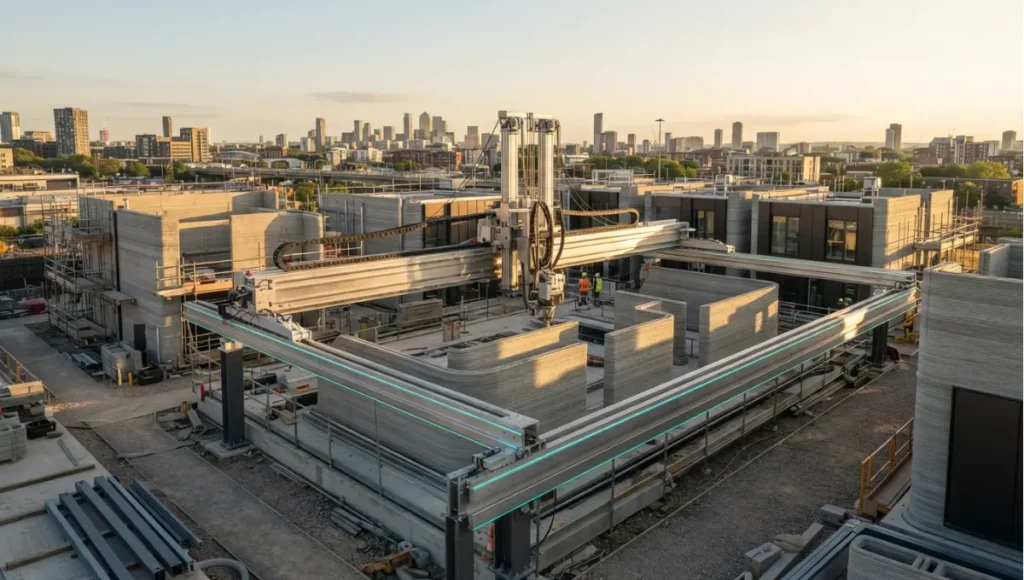
Sundial Fields is a speculative printed infill neighbourhood used here to test the one thing this list shows is unsolved: how much of a dwelling the method can genuinely absorb before conventional trades resume. The concept takes a modest urban infill parcel, prints the shells in a single mobilisation, and deliberately treats the fit-out, services and roof as the critical path rather than the printing. Completion horizon is 2030+; no site and no client are involved.
Design levers applied
- Print campaign scheduled around the fit-out, not the shell: the printing window is set by when the trades can follow it, so the sequence removes the shell from the critical path rather than celebrating its speed (concept target, not a measured result).
- Geometry used for daylight rather than decoration: the freedom the method offers is spent on orientation, shading and internal layout quality rather than on surface pattern (concept target, not a measured result).
- Recycled content specified into the mix with a declared origin: aggregate and supplementary material sourced locally, with the mix design declared rather than assumed (concept target, not a measured result).
- Cavities and service routes resolved in the printed section: the wall profile is designed to carry services so the drilling phase that normally follows the shell is reduced rather than deferred (concept target, not a measured result).
- Approvals treated as a design workstream: mix testing and structural demonstration are planned from the start, with the evidence programme running alongside design rather than after it (concept target, not a measured result).
- A single mobilisation as the economic premise: the business case assumes one printer, one site and one setup, because a printer that moves between sites loses the advantage it was bought for (concept target, not a measured result).
- A published evidence pack as the deliverable: mix tests, print records and inspection data are handed over as the building’s technical dossier, so the next project on the same system starts with evidence rather than with a promise (concept target, not a measured result).
Transferable takeaway
Take the ordering, not the printer. Decide first what the method genuinely removes from the programme, resolve the services and the approvals route before the shell is designed, spend the geometric freedom on performance rather than pattern, and hand over the evidence pack. A project that does those things gets a printed shell inside a conventional programme; a project that prints first and thinks second gets a fast wall and a slow building.
2030 and beyond
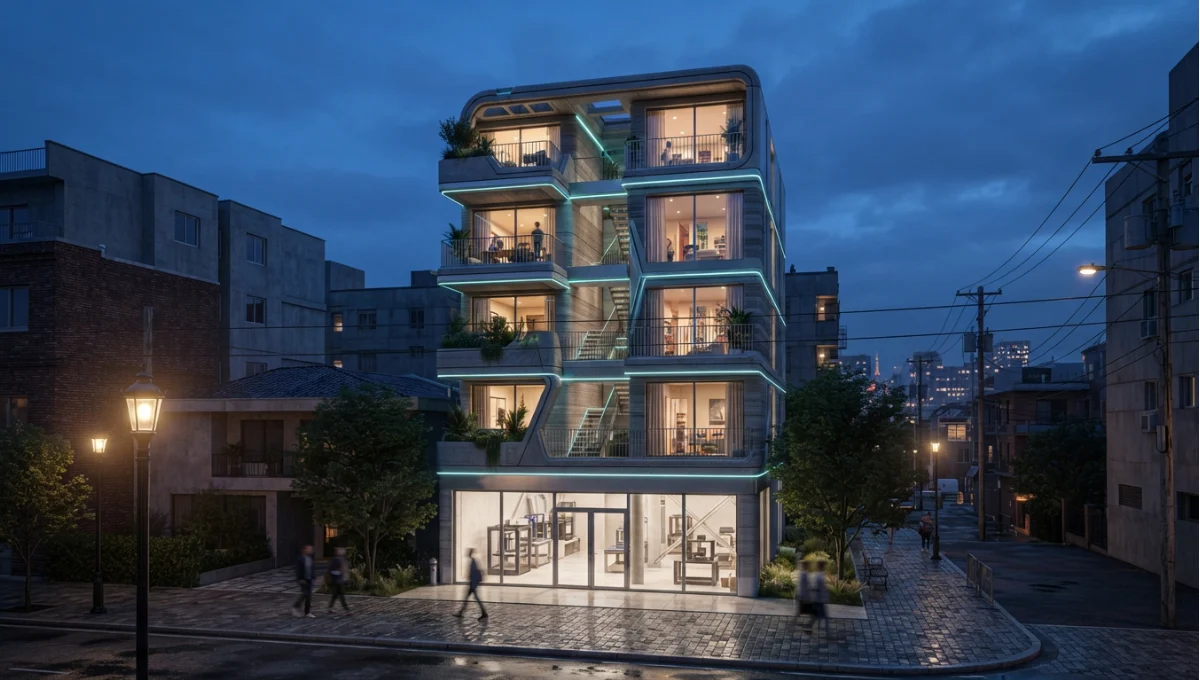
Three directions, each a projection rather than a forecast. First, mobile and smaller-scale printing should move the method from large single-site campaigns toward infill and constrained parcels, which is where housing need is concentrated and where a fixed gantry struggles. Second, the printed shell should begin to include more of what currently follows it — service voids and printed cores are the plausible next step, and they matter more than taller walls because they attack the fit-out phase that currently caps the method’s total saving. Third, the evidence pack should become an accepted substitute for prescriptive approval: once a system has a documented testing and inspection history, project-by-project demonstration becomes a formality rather than a research project. None of these depends on a dramatic hardware advance. All of them depend on approvals and on the fit-out, which is where the constraint actually sits.
Frequently asked questions
This article is part of our smart building technology guide, the state-of-play synthesis across generative AI, robotics, and sensing layers.
Q: How does the software prevent “cold joints” during a pause?
**A:**It manages the mix’s open time — the window in which a new layer will bond properly to the one below. If the pause exceeds that window, the material has to be treated as a joint rather than a continuation, which means either a bonding measure or a designed joint. Every printed project carries a defined open time and a stated procedure for exceeding it; a printer that simply resumes is producing a defect.
Q: Can these structures be recycled at the end of their life?
**A:**Potentially, and the mechanism depends on reinforcement. A printed element that is fibre-reinforced or unreinforced can in principle be crushed and reused as aggregate, which is the circularity claim printed projects make. An element containing conventional steel reinforcement is a demolition material, not a feedstock. The recyclability of a printed building is therefore decided at design stage by the reinforcement strategy, not at end of life.
Q: How do printed walls handle thermal performance?
**A:**Printed wall sections are typically two leaves with a cavity, and the cavity is where insulation goes. That gives the method a genuine advantage over a single-skin masonry wall, because the cavity is designed rather than improvised — but the wall’s performance is then determined by what is put in it and how the joints are detailed, not by the fact that it was printed. Treat the printed leaf as the structure and the cavity as the thermal system, and specify both.
Q: How is a 3D-printed house financed and insured?
**A:**Through conventional routes with an additional evidence requirement: lenders and insurers want to see the approvals position and the construction records, because an unfamiliar method concentrates risk in a small number of parties. The projects on this list show that it is achievable — a national homebuilder has sold printed homes through ordinary channels, and a publicly funded multi-storey building has been built — but the pathway is documentation-led rather than precedent-led.
Q: Does the layer-line finish have to stay?
**A:**No, though it is often kept because it is honest about how the wall was made. Where a smoother finish is wanted, it is achieved by adjusting the outer pass, by post-treatment, or by cladding — and each of those options adds a trade back to the programme, which is the trade-off worth understanding before specifying a finish.
Q: What single question best predicts whether a printed project will work?
**A:**What fraction of a completed dwelling the method actually produces. If the answer is the structural shell alone, the project’s savings are capped by everything that follows, and the schedule will be set by services and fit-out. Projects that answer that question honestly before committing tend to be the ones that deliver.
Step into the Future Tech archive
Step into the Future Tech archive → future-tech
© Nuvira Space All rights reserved.| FUTURE TECH Series | All tools and specifications cited are based on publicly available data as of 2026. Sundial Fields is a speculative internal concept study and does not represent a completed project.
3 thoughts on “7 Breakthrough 3D Printed Neighborhoods: Speed & Cost Analysis”