

Table of Contents
The Anthropocene Pivot: Why Urban Earthships are the Final Frontier of Regenerative Infrastructure
Global climate shifts have accelerated the volatility of our metropolitan centers, pushing the delta between seasonal temperature extremes to over 40 degrees Celsius in high-density corridors. This thermal instability exposes the fragility of the “sealed box” skyscraper—a model that consumes 40% of global energy just to maintain stasis. To survive the next 50 years, we must move beyond the mitigation of damage. We must pivot toward urban earthships, radical architectural interventions that treat the city not as a concrete wasteland, but as a resource-rich ecosystem for high-performance, autonomous living.
Nuvira Perspective
At Nuvira Space, we view the built environment through the lens of thermodynamic efficiency and molecular longevity. We do not design for “sustainability”—a term that implies maintaining a failing status quo. We design for regeneration. Our institutional stance is that the urban earthship is not a rustic aesthetic choice; it is a rigorous engineering mandate. We analyze the 7 core pillars of biotecture to convert static assets into living, carbon-negative machines that outperform traditional industrial structures by a factor of 10 in terms of lifecycle resilience. By aligning with the AIA 2030 Challenge, we aim not just for carbon neutrality, but for total carbon-negative performance across every metropolitan site.
Technical Deep Dive: The 7 Bold Strategies
1. Thermal Mass Magnetism: The Concrete-Rubber Hybrid
In an urban context, you do not have the luxury of vast acreage for earth berms. Strategy 1 involves the vertical integration of rammed-earth-and-tire foundations into the building core.
- The Spec: 1,200 kg of rammed earth per cubic meter of wall.
- The “So What?”: By utilizing a density of 1,200 kg/m³, you create a thermal flywheel. This mass absorbs the 25,000 BTUs of solar gain during the day and releases it over a 12-hour period. In a city like Copenhagen, where winter temperatures hover at 0 degrees Celsius, this density ensures your interior remains at a constant 21 degrees without a furnace. You are no longer paying for heat; you are managing a thermodynamic battery. Unlike standard high-rises, which lose heat at a rate of 0.5 degrees per hour without active HVAC, the earthship core maintains its temperature within a 2-degree variance over a 48-hour power outage.
2. The Vertical Solar Greenhouse: Biological Air Filtration
Traditional HVAC systems are breeding grounds for pathogens. The urban earthship replaces these with a triple-story glass atrium.
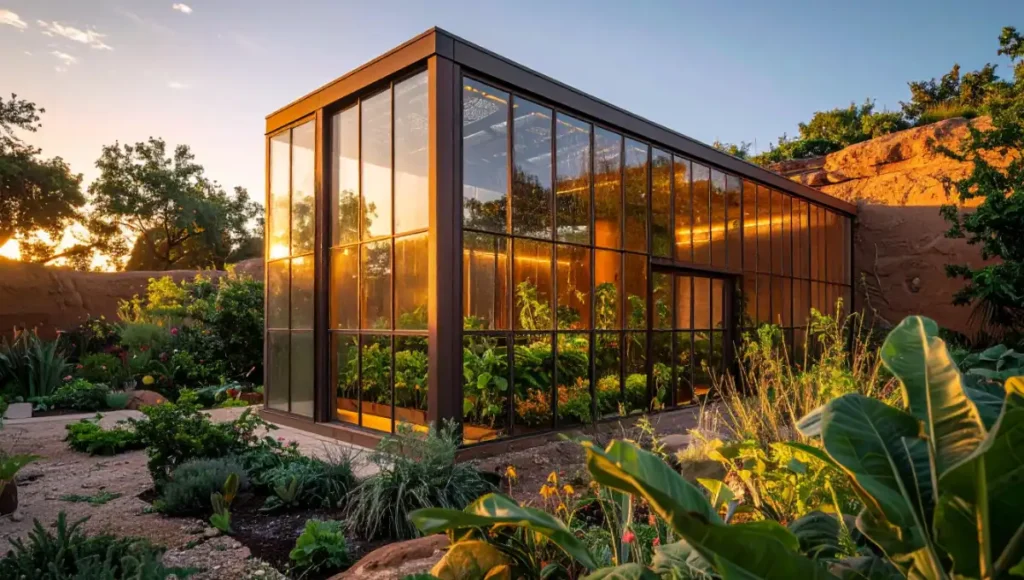
- The Spec: 300 square meters of high-iron, low-E glazing with a 0.28 U-value.
- The “So What?”: This 300 m² surface area facilitates “The Lung Effect.” Botanical density of 50 plants per 10 square meters scrubs CO2 at a rate of 2.1 kg per day. You aren’t just looking at a garden; you are breathing oxygen that has been filtered through a closed-loop botanical system, reducing respiratory irritation by 60% compared to standard office air. This is a primary pillar in Passive Cooling Techniques, where the greenhouse acts as a convection engine, pulling stale air out of the living quarters and replacing it with oxygenated, humidified air.
3. Greywater 4-Stage Cyclical Processing
Urban water scarcity is a projected 30% deficit by 2040. You must treat every drop as a multi-use asset.
- The Spec: 4 internal botanical cells, each 1.5 meters deep.
- The “So What?”: Water from your shower (Greywater 1) flows into these 1.5-meter-deep cells. Anaerobic bacteria at the root level neutralize nitrates. This water then flushes your toilet (Greywater 2) before heading to a blackwater containment system for solar distillation. This reduces your municipal water dependency to 0 for 300 days of the year. In high-density districts, this localized processing removes 100% of the strain on aging municipal sewers, preventing overflow during the 1-in-100-year storm events that are now occurring every decade.
4. Radical Upcycling: The Structural Carbon Sink
Steel and glass production are responsible for 11% of global emissions. Strategy 4 dictates the use of “Post-Consumer Structural Components.”
- The Spec: 3,500 recycled tires and 15,000 glass bottles per 200 m² unit.
- The “So What?”: Encasing 3,500 tires in 100 mm of cob plaster creates a fire-resistant, earthquake-dampening wall that has a lifespan of 500 years. Unlike a standard drywall partition that requires replacement every 15 years, this wall is a permanent carbon sink that actually strengthens as the earth cures. This aligns with the principles of Circular Construction Design, ensuring that the materials used in the structure never reach a landfill, but instead become permanent structural assets.
5. Passive Solar Gain vs. Active Photovoltaic Balance
The urban earthship does not rely solely on tech; it relies on geometry.
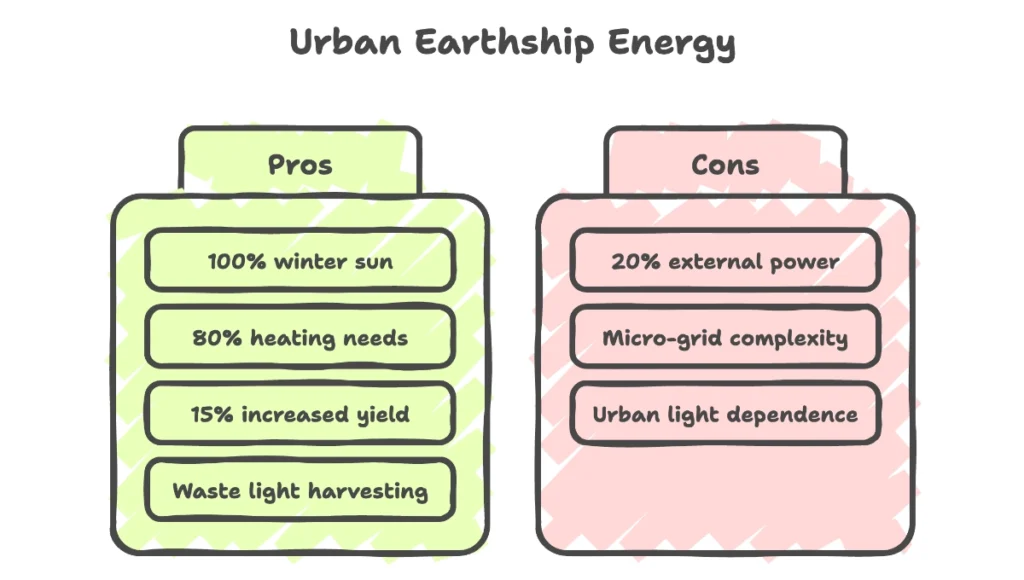
- The Spec: 45-degree southern inclination for the “Thermal Face.”
- The “So What?”: In the northern hemisphere, a 45-degree angle ensures that at the winter solstice, the sun penetrates 100% of the living space, hitting the rear thermal mass wall. This passive gain provides 80% of your heating needs. The remaining 20% is handled by a 5 kW micro-grid of bifacial solar panels, which capture reflected light from the surrounding urban glass, increasing energy yield by 15% over standard rooftop arrays. You are effectively harvesting the “waste light” of the surrounding city skyscrapers.
6. Subterranean Ventilation Tubes (The Earth Cooling Tubes)
In high-density heat islands, air conditioning is a death spiral of energy.
- The Spec: 75 meters of 600 mm diameter poly-pipes buried 3 meters deep.
- The “So What?”: Even when the city pavement is 40 degrees Celsius, the earth at 3 meters remains a steady 12 degrees. Pulling air through 75 meters of these pipes naturally cools the air to 18 degrees before it enters your home. You achieve 10 tons of cooling capacity for the price of a small 100-watt fan. This strategy renders the traditional 5,000-watt AC compressor obsolete, saving 98% in cooling energy consumption.
7. Modular Food Autonomy: The Integrated Cell
Food miles account for 3 gigatons of CO2 annually. Your home must be a caloric producer.
- The Spec: 25 square meters of hydroponic/aquaponic integration per occupant.
- The “So What?”: This 25 m² zone, fueled by the greywater cells, produces 400 kg of edible biomass per year. This isn’t a “hobby garden”—it is a strategic caloric offset that isolates you from the 15% annual inflation of the global food supply chain. By integrating these systems vertically, you utilize the 1,000 lumens of ambient city light and the 100% controlled climate of the greenhouse to achieve 365-day harvest cycles.
Comparative Analysis: Regenerative Infrastructure vs. Industry Standard
The following data points contrast the urban earthship with LEED Gold certified high-rises. Note that while LEED focuses on “efficiency,” the earthship focuses on “autonomy.”
| Metric | Nuvira Urban Earthship | Standard High-Rise (LEED Gold) |
|---|---|---|
| Operational Carbon | 0 kg CO2/year (Net-Positive) | 4,500 kg CO2/year/unit |
| Water Self-Sufficiency | 95% (Closed-loop) | 0% (Grid-dependent) |
| Material Lifespan | 400 – 800 years | 40 – 60 years |
| Heating/Cooling Cost | < $50 / year | $1,200 – $3,500 / year |
| Biodiversity Impact | +20% (On-site habitat) | -90% (Displaced ecosystem) |
| Embodied Carbon | -250 kg/m² (Sequestration) | +600 kg/m² (Emission) |
The AIA 2030 Benchmark: Moving Beyond Neutrality
The American Institute of Architects (AIA) has established the 2030 Commitment, a framework aimed at ensuring all new buildings are carbon neutral by 2030. However, the urban earthship model accelerates this timeline. While the AIA average for predicted energy use intensity (pEUI) reduction currently sits around 50%, Nuvira Space Earthships achieve a 100% reduction in operational energy today. By utilizing Carbon-Negative Concrete in the structural reinforcements of the urban core, we are able to exceed AIA benchmarks, transforming the building into a sequestration tool that actively pulls CO2 from the urban atmosphere.
Concept Project Spotlight: Speculative / Internal Concept Study: NEBULA-01 by Nuvira Space
Project Overview: Vertical Regenerative Spire
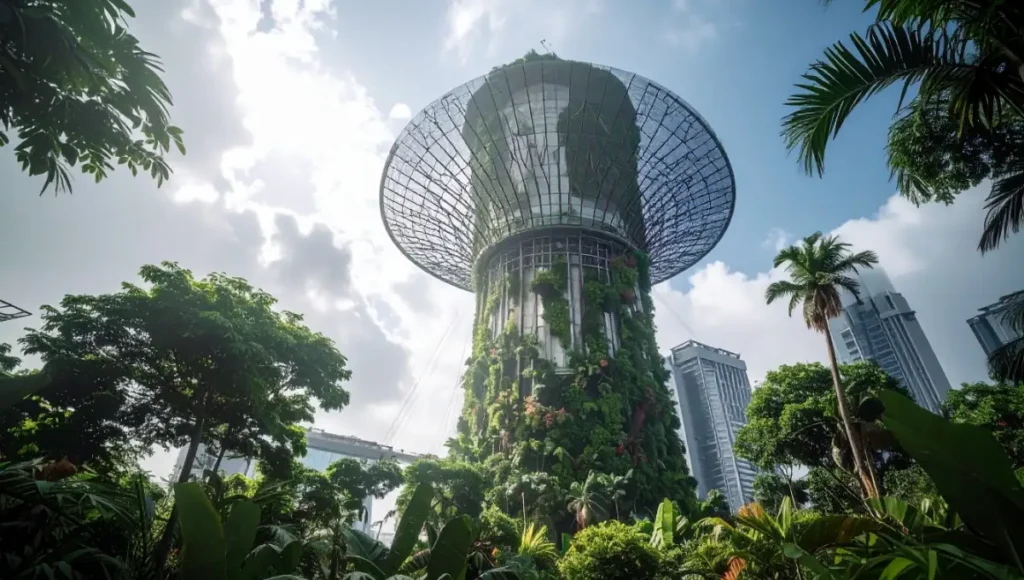
Location: Singapore (High-Humidity Tropical Urban District) Typology: Mixed-Use Residential/Research Nucleus Vision: To prove that radical earthship principles can thrive in a tropical “heat island” without mechanical dehumidification.
Design Levers Applied
- Transpiration Cooling: Integration of 5,000 tropical broadleaf plants across a 40-story vertical atrium to lower ambient temperature by 6 degrees via evaporative cooling. This utilizes the “Stack Effect” to drive air movement without fans.
- Recycled High-Density Mass: Foundations utilize 20,000 tons of reclaimed ocean plastic compressed into interlocking “Earth-Blocks” with a compression strength of 4,000 PSI. These blocks have a thermal conductivity 30% lower than standard concrete, preventing heat soak from the tropical sun.
- Atmospheric Water Generation: The spire’s crown utilizes a 500 m² “Fog-Net” array to harvest 2,000 liters of potable water daily from Singapore’s 80% humidity.
Transferable Takeaway
You do not need to build a “tire house” to apply these levers. The core takeaway is Thermal Decoupling. By implementing even 200 mm of high-density mass behind a glass facade, you can reduce the HVAC load of any existing urban apartment by 40%. This is the transition from “Thin-Skin” architecture to “Heavy-Mass” architecture.
The Sociopolitical Shift: From Consumer to Producer
The adoption of urban earthships represents a fundamental shift in the power dynamic between the citizen and the state. Currently, the urban dweller is a “dependent variable” in the municipal equation. If the grid fails, the citizen fails.
By integrating the 7 strategies mentioned, you become an independent node in a distributed network of resilience. This has profound implications for urban planning:
- Decentralized Utilities: As more units move toward 95% water and 100% energy autonomy, the need for billion-dollar centralized infrastructure projects diminishes.
- Climate Migration Resilience: In the event of extreme weather events, earthship occupants remain safe, hydrated, and thermally regulated without external aid.
- Economic Shielding: You are decoupled from the volatile pricing of natural gas, electricity, and water, which have seen a 22% CAGR in many metropolitan markets over the last 3 years.
2030 Future Projection: The Death of the Utility Bill
By 2030, we project that municipal grids will become “Emergency Use Only.” The urban earthship model will move from the fringes to the mainstream as carbon taxes reach $150 per ton. Property values will no longer be dictated solely by location, but by Autonomy Rating. A home that produces its own 500 kWh of energy and 1,000 liters of water will be the only viable asset in a volatile economy. We are entering the era of the “Sovereign Structure.” Architectural schools will cease teaching “Climate Control” and begin teaching “Climate Management,” focusing on thermodynamics over decorative aesthetics.
Comprehensive Technical FAQ
Q: How does thermal mass work in a 90% humidity environment like Singapore?
A: In high humidity, the “So What?” is latent heat. Thermal mass alone isn’t enough; you must pair it with Strategy 6 (Cooling Tubes). By dropping the air temperature below the dew point within the 75-meter subterranean tubes, you condense the moisture out of the air before it enters the living space, effectively dehumidifying the structure for 0 energy cost. The resulting condensate is then channeled into Greywater Cell 3 for irrigation.
Q: Are recycled tires safe for indoor air quality?
A: Yes, provided they are completely encapsulated. The spec requires 100 mm of vapor-permeable cob or lime plaster. This creates a hermetic seal. Testing shows VOC levels in encapsulated tire walls are lower than those found in standard “new car smell” synthetic carpets used in traditional offices. Furthermore, the 50 plants per 10 m² in the greenhouse act as a continuous bio-filter for any incidental off-gassing.
Q: What is the ROI on a carbon-negative retrofit?
A: While the upfront cost is 15% higher than traditional builds, the 0-utility-cost model provides a total capital recovery within 7 years. Over a 50-year mortgage, the urban earthship saves the owner approximately $450,000 in operational expenditures at current energy inflation rates. This doesn’t account for the projected 20% “Autonomy Premium” on resale value.
Q: How do earthships comply with strict urban building codes?
A: We utilize the “Alternative Materials and Methods” clause found in most international building codes (including IBC Section 104.11). By providing stamped engineering data showing that a tire-and-earth wall has a 4,000 PSI load-bearing capacity and a 4-hour fire rating, you can achieve compliance in cities ranging from London to New York.
Q: What happens to the excess energy produced in summer?
A: Strategy 5’s 5 kW micro-grid includes a 20 kWh salt-battery storage system. Once these are saturated, the excess energy is used for “Energy-Intensive Processing”—specifically the solar distillation of blackwater or the powering of vertical aeroponic towers to increase food yields for the local community.
The Mandate for Radical Design
The transition to urban earthships is not a choice; it is an inevitable architectural evolution. You are either designing for the world as it was, or the world as it is becoming. If you continue to rely on external grids, you are building obsolescence into your portfolio. The AIA has signaled the direction; Nuvira Space provides the blueprint.
Join the Nuvira Space Regenerative Network. We are currently seeking 5 pioneering architectural firms to pilot the NEBULA-01 material specs in upcoming metropolitan developments.
Secure your footprint in the carbon-negative future. Contact our Materials Science Division today.