

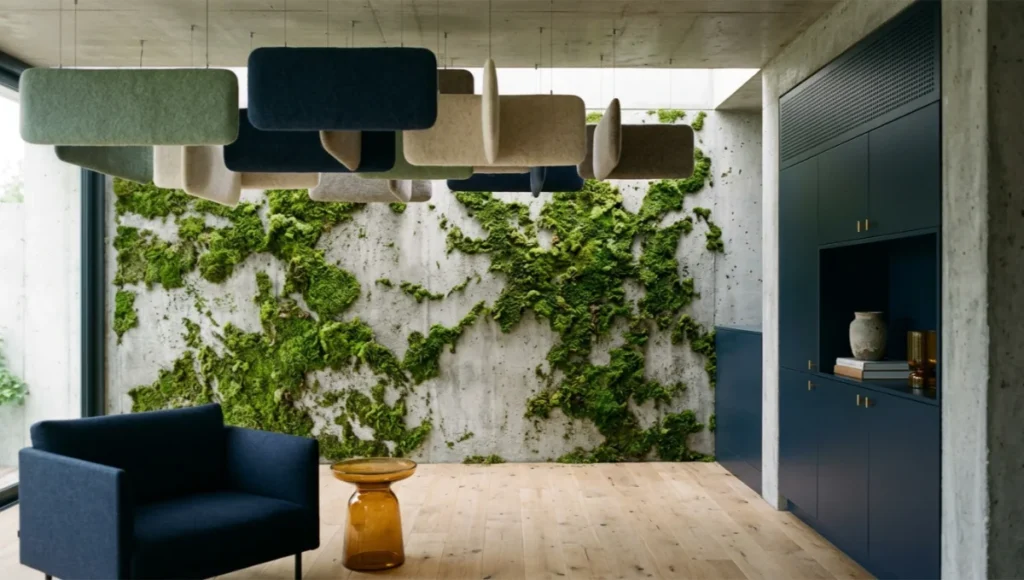
See the 5 sensory layers redefining calm, focus, and room identity. Get the data.
Table of Contents
You redesign the kitchen. You repaint the bedroom. You spend weeks sourcing the right sofa. And yet—every evening—your nervous system is still running at 78 decibels of ambient digital noise, mechanical hum, and the low-grade acoustic violence of a dwelling that was never asked to communicate in sound.
Soundscaping interior design is the 2026 sensory shift that exposes this gap: the fifth surface of every room has always been its acoustic identity, and designers are only now beginning to treat it with the same rigour they apply to light or material. The walls absorb. The floors reflect. The ceiling amplifies. But who decides what the room actually sounds like—and what that does to you biologically? That question is no longer rhetorical.
Nuvira Perspective
At Nuvira Space, we do not design rooms. We engineer biological environments. The next era of domestic life is defined not by how a home looks to the eye but by how deeply it synchronises with the body’s circadian architecture—its hormonal rhythms, its attentional bandwidth, its capacity for autonomic recovery. Modular adaptability is only half the equation. The other half is sensory calibration: the deliberate orchestration of what a home sounds like at 7 a.m., at noon, and at 10 p.m., tuned to match the body’s biological state at each of those moments.
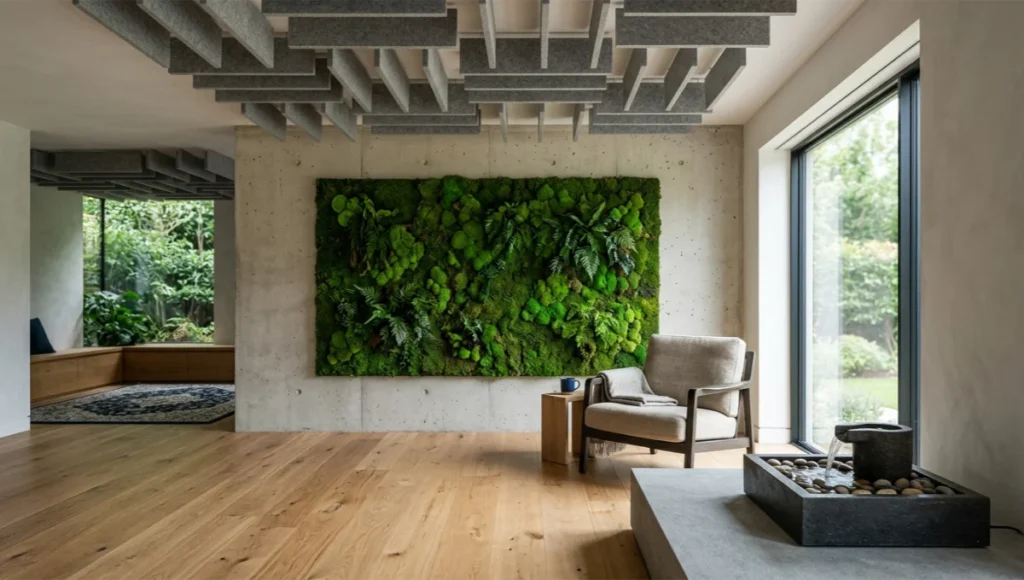
The home is evolving into a health machine—not a metaphor, but a functional claim. A health machine regulates its internal environment in response to the physiological state of its occupant. Circadian synchronisation through light is now well documented; circadian synchronisation through sound is the next frontier. At Nuvira, this is not speculative. It is the design brief.
Technical Deep Dive: The Acoustic Architecture of the Human Nervous System
How the Brain Processes Domestic Sound
Sound reaches the auditory cortex in approximately 8–10 milliseconds. Before conscious processing begins, the amygdala has already tagged the signal as safe, ambiguous, or threatening. This pre-cognitive response is the biological reason soundscaping interior design matters: the room is already communicating with your stress axis before you are aware of it.
Chronic exposure to anthropogenic indoor noise—HVAC systems at 45–55 dB(A), refrigerator compressors at 40–50 dB(A), traffic ingress through single-glazed windows at 55–70 dB(A)—drives sustained cortisol elevation. The AIA Framework for Design Excellence identifies acoustics as one of the most common complaints in the built environment, noting that poor acoustic performance reduces productivity, raises blood pressure, and directly impairs sleep. A 2024 systematic review published in Stress confirmed statistically significant differences in heart rate, blood pressure, and respiratory rate between subjects exposed to natural sounds versus ambient indoor silence.
The 5 Acoustic Layers of a Soundscaped Interior
Each layer below operates independently but compounds when combined—a principle Nuvira applies across all residential briefs, including sensory room design where acoustic precision is a clinical requirement, not an aesthetic preference.
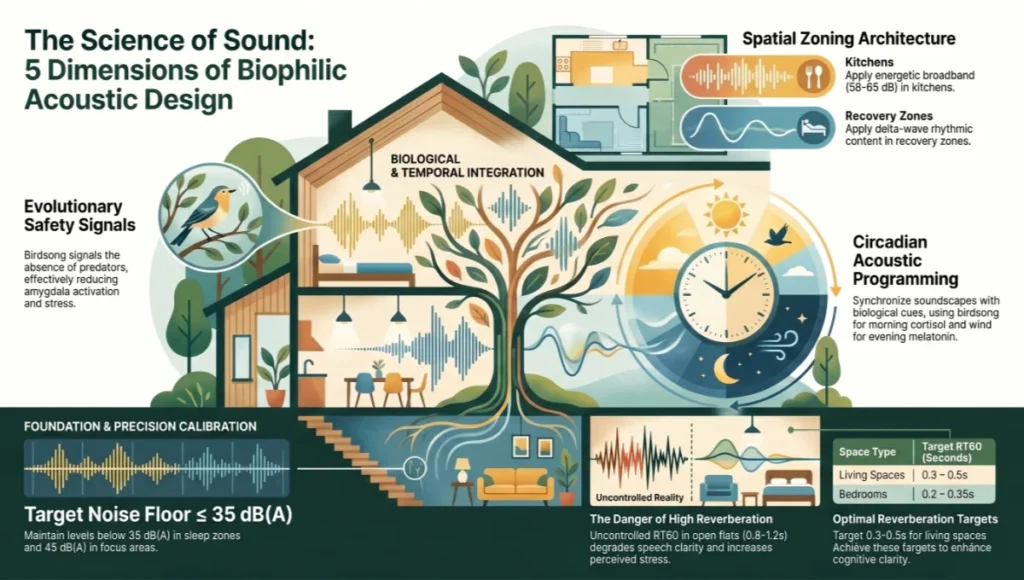
5 Dimensions of Biophilic
Acoustic Design
- Layer 1: Spectral Density Management
- Target frequency range: 250 Hz–2 kHz (speech-masking and cognitive clarity band)
- Aim for ambient floor noise ≤ 35 dB(A) in sleep zones, ≤ 45 dB(A) in focus areas
- Biophilic content at 55–65 dB(A) actively masks competing anthropogenic noise
- Layer 2: Reverberation Time (RT60) Calibration
- Living spaces: RT60 target 0.3–0.5 seconds
- Bedrooms: RT60 target 0.2–0.35 seconds
- Uncontrolled RT60 in open-plan flats routinely reaches 0.8–1.2 seconds, degrading speech intelligibility and increasing perceived stress
- Layer 3: Biophilic Soundscape Content
- Flowing water: activates parasympathetic nervous system via predictable rhythmic pattern
- Birdsong: evolutionary safety signal—signals absence of predators, reduces amygdala activation
- Wind-through-foliage: broadband, non-repetitive masking at 45–55 dB(A)
- Layer 4: Spatial Zoning Architecture
- High-stimulation zones (kitchen, entry): energetic broadband content, 58–65 dB(A)
- Focus zones (home office, reading nook): low-frequency masking, 38–48 dB(A)
- Recovery zones (bedroom, bathroom): delta-wave-aligned rhythmic content, ≤ 40 dB(A)
Layer 5 — Circadian Acoustic Programming — mirrors the logic of circadian lighting systems: both are time-of-day interventions that communicate biological cues to the body through environmental stimulus rather than pharmacology.
- Layer 5: Circadian Acoustic Programming
- Morning (06:00–09:00): birdsong and high-frequency natural content to support cortisol awakening response
- Afternoon (12:00–16:00): flowing water at moderate SPL to sustain focus without fatigue
- Evening (20:00–23:00): sub-40 dB(A) wind or rain content aligned with melatonin onset window
Material Acoustics: The Surface Equation
Every material in a room is a sound modifier. Most interior specification processes treat acoustics as an afterthought—a problem to solve after aesthetic decisions are made. Soundscaping interior design reframes this: acoustic behaviour is a primary material criterion.
- Plaster / gypsum board (NRC 0.05): high reflectivity, increases RT60—use on one primary surface only to maintain liveliness
- Wool textile / acoustic felt panel (NRC 0.80–0.95): primary absorption medium—ideal for ceiling baffles and feature walls
- Mass timber (NRC 0.10–0.15): low absorption but warm tonal colouration—suitable for floors where controlled reflectivity is desired
- Perforated metal / micro-perf panels (NRC 0.55–0.80): diffusion with partial absorption—ideal for open-plan partitioning
- Dense moss walls / living plant panels (NRC 0.40–0.60): biophilic and acoustic dual-function; effectiveness varies with water content
| NUVIRA ACOUSTIC SPECIFICATION NOTE Room acoustic design should target an average NRC of 0.35–0.50 across all surface materials in living spaces. This range sustains conversational warmth while preventing the echo-chamber dynamics common in minimalist interiors with hard floors and bare walls. |
Comparative Analysis: Soundscaping Interior Design vs. Industry Standard
Where Conventional Interior Acoustics Falls Short
The industry standard response to residential acoustics is reactive and narrow: install a rug to dampen footfall, add a bookcase to break flutter echo, consider double glazing if the client complains about traffic. This approach treats sound as a problem to suppress rather than a resource to design. The result is acoustic environments that are quieter but not calmer—interiors that reduce peak noise without constructing any positive sensory identity.
The gap between suppression and design is precisely what the AIA’s Sonic Harmony: Where Architecture Meets Acoustics course addresses: applying biophilic design principles and evidence-based acoustic strategies for occupant well-being across residential and commercial settings. It is among the strongest professional case studies for integrating soundscaping into the design process from concept stage.
| Dimension | Soundscaping Interior Design | Industry Standard Acoustic Treatment |
| Philosophy | Curated sensory environment; biological calibration | Noise reduction; problem suppression |
| Scope | Full-room, multi-layer, circadian-linked | Surface-specific, static intervention |
| Biophilic content | Central design element; species-specific acoustic content | Absent; purely absorptive or masking |
| Circadian awareness | Programmed by time-of-day and physiological state | None; fixed installation |
| Measurable outcome | Cortisol, HRV, sleep latency, focus duration | dB(A) reduction at a single frequency |
| Cost range | €3,000–€18,000 full residential system | €500–€4,000 passive treatment materials |
| Reversibility | High; smart speaker arrays and acoustic panels are removable | Low; structural interventions are permanent |
The Copenhagen Reference
Copenhagen offers the clearest macro-evidence for what soundscaping interior design can achieve at city scale. Architecture practices in the Danish capital have pioneered acoustic simulation of public plazas before construction—testing how a space will sound, not just how it will look. Residential developers have adopted the same logic inward, commissioning acoustic identity briefs alongside visual ones. The outcome is measurable: residents in acoustically designed blocks report significantly lower perceived noise annoyance than those in conventionally treated equivalents, despite comparable external noise exposure. When cities treat sound as urban infrastructure, individual homes follow. Soundscaping interior design is the domestic expression of a principle Copenhagen proved at scale.
Concept Project Spotlight
Speculative / Internal Concept Study — Sensorium Flat by Nuvira Space
Project Overview: Location / Typology / Vision
- Location: Singapore — a high-density urban context where residential soundscapes are dominated by 40% traffic and 36% biophonic sources, making curated interior sound a critical wellness intervention
- Typology: 72 m² two-bedroom flat, open-plan living and kitchen, single south-facing aspect
- Vision: To engineer a domestic sound environment in which the occupant’s cortisol awakening response is shaped by acoustic content rather than alarm stimulus, and in which the evening wind-down is guided by the home’s acoustic personality rather than willpower alone
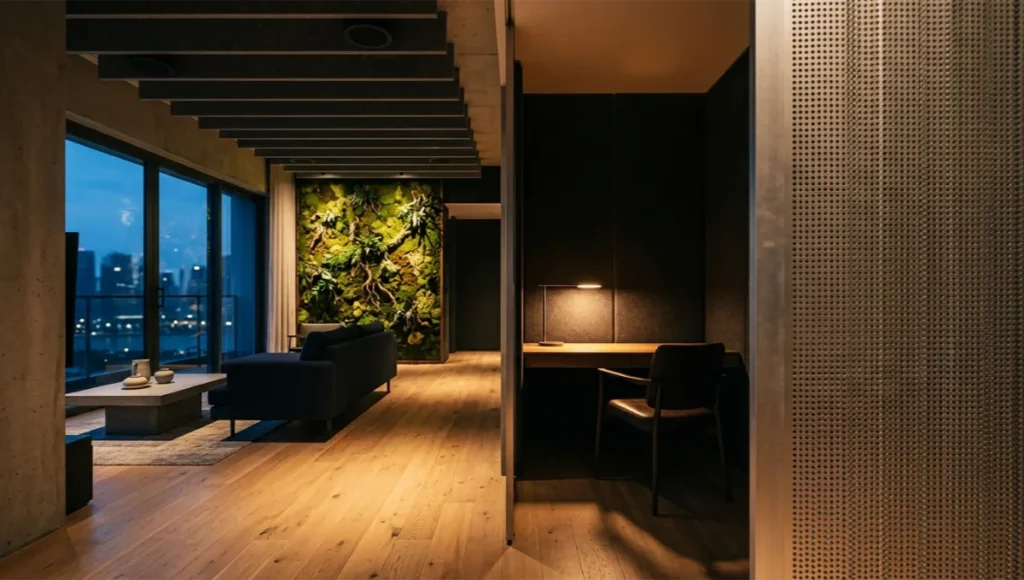
Design Levers Applied
Acoustic Surface Strategy
- Primary ceiling: 35% coverage in 50 mm wool acoustic baffles, spaced 400 mm apart (RT60 target: 0.38 seconds)
- Living wall: 6 m² Kokedama moss panel on eastern partition — NRC 0.48, biophilic visual anchor, humidity-stable formulation
- Floor: 18 mm engineered white oak over 5 mm acoustic underlayer — controlled reflectivity for warmth of tone
- Western glazing: triple-glaze unitised system, acoustic laminate interlayer — target: 42 dB(A) traffic attenuation
Biophilic Soundscape System
- Primary system: 8-channel distributed speaker array embedded in ceiling baffles, driven by generative soundscape engine (non-looping)
- Content library: Singapore-specific biophonic recordings — Sungei Buloh rainforest at dawn, Marina Bay tidal flow, Central Catchment birdsong
- Adaptive SPL: occupancy sensor modulates output 38–62 dB(A) based on room population and activity signature
- Circadian schedule: 06:30 birdsong ramp (cortisol curve support) → 13:00 water flow (post-lunch recovery) → 21:00 rain fade (melatonin alignment)
Spatial Acoustic Zoning
- Entry and kitchen: energetic broadband content 58–63 dB(A), morning activation mode
- Living zone: conversational clarity priority, RT60 0.38 s, biophilic masking at 45–52 dB(A)
- Primary bedroom: sub-40 dB(A) delta-aligned sound, blackout acoustic curtain adds 8 dB(A) traffic reduction overnight
- Study alcove: 4 m² acoustic refugia — three-surface wool panel installation, RT60 0.22 s, focus masking 40–46 dB(A)
Transferable Takeaway
You can apply the same logic at home by tuning evening lighting, building a refuge corner, and simplifying one primary sightline toward a natural anchor. In acoustic terms: replace a single hard-surface wall with a textile panel or moss feature; add a small water feature in the living zone; and set a timer that shifts any ambient speaker from daytime playlist to nature content at 20:30. Those three interventions alone shift your room’s acoustic identity and begin communicating safety to your nervous system rather than sustained low-grade alert.
Intellectual Honesty: Current Limitations
Soundscaping interior design is not yet a mainstream consumer category. It sits at the intersection of architectural acoustics, biophilic design, and circadian medicine—three disciplines with their own methodologies, jargons, and professional silos. Here is what the field cannot yet claim:
- No residential longitudinal RCTs: Most cortisol and HRV data on biophilic soundscaping comes from workplace or clinical environments. The translation to domestic settings is plausible but not yet formally confirmed at scale.
- Calibration complexity: Achieving target RT60 values in existing residential spaces without structural intervention is difficult. Tenant-grade solutions provide partial results.
- Listener habituation: Generative soundscape systems reduce novelty-based disengagement, but some occupants report reduced effectiveness after 3–6 months of continuous exposure.
- Cost barrier: A full residential soundscaping system currently ranges from €3,000 to €18,000 in Western markets. DIY approximations are possible but acoustically imprecise.
- Cultural specificity: Biophilic content is not universally calming. Sound that signals safety in one ecosystem may be neutral or ambiguous in another. Personalised content libraries are necessary but rare at residential scale.
2030 Future Projection
By 2030, soundscaping interior design will likely split into three market tiers:
- Passive tier: Acoustic material specification integrated into every residential build at planning stage. Standard-compliant RT60 targets written into building regulations in progressive markets—Scandinavia, Singapore, Netherlands expected to lead.
- Active tier: Generative sound engines—non-looping, biome-specific, occupancy-adaptive—embedded in HVAC and smart home platforms. Sound as a utility, not a luxury. Price point: €300–€800 as a smart home add-on.
- Precision tier: Biometric-linked soundscaping. Wearable data (HRV, sleep stage, cortisol proxy via skin conductance) feeds into real-time soundscape modulation. The room listens back. The home adjusts its acoustic identity not on a schedule but on a signal from your body.
The architectural precedent is already being set. Singapore is integrating sound into urban development analysis. Copenhagen is running acoustic simulations pre-construction. Rotterdam is deploying interactive urban sound installations that treat the acoustic environment as civic infrastructure. When cities think this way, homes follow within a decade.
Actionable Design Principles
You do not need a €15,000 system. You need a sequence. These principles are ordered by implementation effort, from immediate to structural:
- Audit before you act: Spend one week logging when you feel most alert, most calm, and most fatigued. Map those states to rooms and times of day. You are reverse-engineering your existing soundscape’s biological signature.
Target one recovery zone first: The bedroom is highest yield. Pair acoustic intervention with the broader wellness bedroom design principles Nuvira has documented—a single acoustic curtain (NRC 0.55–0.70) at the window, a countertop water feature at 40–45 dB(A), and the elimination of mechanical hum sources can reduce perceived noise annoyance in 48 hours.
- Add absorption before content: No soundscape content will perform well in a reflective room. One square metre of NRC 0.80+ material per 12 m² of room area is the minimum viable acoustic intervention.
- Choose non-looping content: Short-loop ambient tracks (under 10 minutes) trigger habituation within weeks. Use generative or long-form (8+ hours) nature recordings. The brain responds to imperceptible variation.
- Zone by function, not by room: An open-plan living and kitchen space can have two acoustic identities. A directional speaker array and a partition panel can create a focus zone within 2 m of a social zone without structural work.
- Schedule the shift: Set your soundscape to change at 21:00. Transitioning from daytime content to sub-40 dB(A) rain or wind communicates melatonin onset to your nervous system more reliably than any supplement.
Comprehensive Technical FAQ
Q: What is soundscaping interior design exactly?
A: It is the deliberate design of a room’s acoustic identity—what it sounds like, at what volume, at what time of day, using what spectral content—with the goal of producing measurable physiological and psychological outcomes. It combines architectural acoustics (RT60 control, NRC-specified materials), biophilic content (species-specific natural soundscapes), and circadian programming (time-linked SPL and frequency schedules).
Q: Is soundscaping the same as noise cancellation or acoustic treatment?
A: No. Acoustic treatment reduces unwanted noise through absorption or blocking. Soundscaping goes further: it constructs a positive acoustic identity. The analogy is lighting design versus blackout curtains. Blackout curtains remove light. Lighting design specifies what light you want, when, and at what colour temperature. Soundscaping is lighting design for your ears.
Q: What are the key technical specifications for a residential soundscape system?
- Ambient floor noise: ≤ 35 dB(A) in sleep zones, ≤ 45 dB(A) in living areas
- RT60 (reverberation time): 0.2–0.35 s bedroom; 0.3–0.5 s living room
- Biophilic content SPL: 40–65 dB(A) depending on zone and time
- Speaker coverage: 1 speaker per 8–12 m² for even distribution
- Content type: generative or 8+ hour non-looping recordings
- Material NRC target: average 0.35–0.50 across room surfaces
Q: Which materials give the best acoustic-biophilic dual return?
A: Living moss walls offer NRC 0.40–0.60 while functioning as visual biophilic anchors and mild humidity regulators. Wool acoustic panels reach NRC 0.80–0.95 with the highest pure absorption. Mass timber provides tonal warmth (NRC 0.10–0.15) with reflectivity that sustains conversational liveliness—useful in living zones where dead silence feels uncomfortable.
Q: How long before the nervous system responds to a new soundscape?
A: Acute parasympathetic activation from natural sound exposure occurs within 3–5 minutes (measurable via heart rate reduction). Sustained cortisol normalisation with consistent exposure typically shows within 2–4 weeks. Full habituation reset—where the brain stops registering the soundscape as novel—can take 3–6 months, which is why generative content is preferable to looping tracks.
Q: Can soundscaping interior design be retrofitted or is it only for new builds?
A: It can be retrofitted at multiple levels of investment:
- Low budget (€200–€800): acoustic curtains, countertop water feature, long-form nature content on existing speakers, strategic textile placement
- Mid budget (€1,500–€5,000): dedicated acoustic panels, ceiling baffles, distributed speaker array, smart home integration
- Full specification (€5,000–€18,000): custom speaker array, generative content engine, occupancy-adaptive SPL, biometric integration, structural acoustic treatment
Q: Is there evidence that soundscaping helps sleep specifically?
A: Yes, within limits. Scandinavian hospitals have trialled nature-based auditory masking in sleep wards with documented improvement in patient rest quality. Residential studies are directionally consistent but less rigorous. Sub-40 dB(A) broadband natural content—rain, wind—has been shown to reduce sleep onset latency by masking intermittent disruptive noise events, the primary sleep fragmentation driver in urban homes.
Your Room Is Already Talking to Your Nervous System
The question is not whether your home has an acoustic identity. It does. The question is whether you designed it or whether your building did it for you by accident—with HVAC noise, bare concrete, single glazing, and the 57 dB(A) hum of a city that never pauses. Soundscaping interior design in 2026 is not a luxury category. It is a design discipline whose absence is costing you sleep, focus, and recovery time every single night.
Start with the bedroom. Choose one surface. Add one content stream at the right time. Then listen to what your room becomes.
© Nuvira Space All rights reserved. | LIVING SPACES Series | All specifications cited are based on peer-reviewed acoustic research (Stress, 2024; PLOS ONE, 2024; JMIR Mental Health, 2025; Haworth Biophilic Soundscaping Study; ISO 12913 Soundscape Standards; AIA Framework for Design Excellence — Well-being; Topos Magazine Urban Soundscapes, 2025; UTS Soundscape Urban Design Research, 2025). The Sensorium Flat is a speculative internal concept study and does not represent a completed project.