

Table of Contents
The Space You Live In Is Already Shaping Your Nervous System
Most adults spend between 85 and 90 percent of their lives inside buildings. For neurodivergent adults — those living with autism spectrum conditions, ADHD, sensory processing disorder, or co-occurring profiles — that statistic carries a weight that neurotypical design guides rarely acknowledge. The home is not a neutral backdrop. It is an active neurological input, firing continuously into a nervous system that processes sensation differently, often more intensely, and with fewer automatic filters.
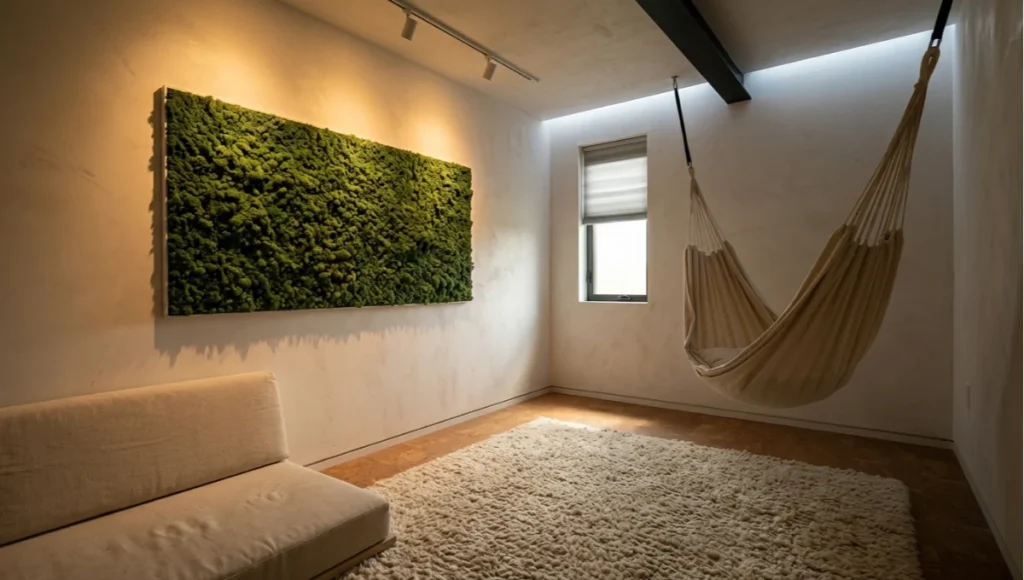
Residential sensory room neurodivergent adults design is not, as many home improvement resources suggest, about adding a calming corner with fairy lights and a beanbag. It is a discipline that sits at the intersection of environmental psychology, occupational science, and architectural theory. When applied with precision, it reduces the physiological cost of simply being at home. When ignored, it amplifies it.
This guide approaches that discipline seriously. It does not offer aesthetic trends. It offers a functional framework — grounded in spatial psychology, circadian biology, and real-world application — for designing a residential sensory room that performs as reliably as any therapeutic tool.
At Nuvira Space: The Home as a Health Machine
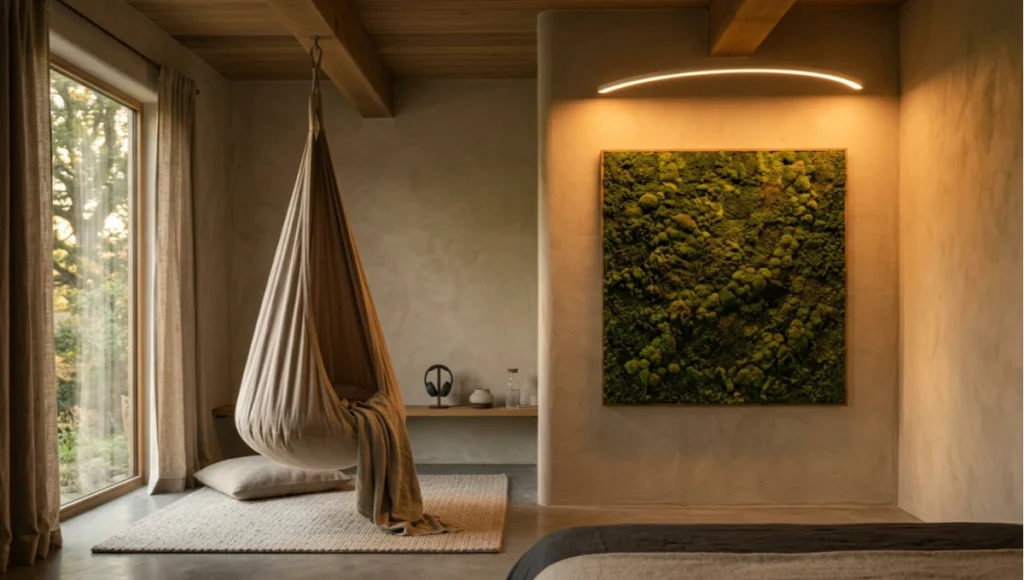
At Nuvira Space, we do not design rooms. We engineer sensory ecosystems. The premise driving our Living Spaces practice is straightforward: the domestic environment is the most underutilised health intervention available to any adult, neurodivergent or otherwise. What separates a well-designed residential sensory room from a conventional bedroom or lounge is not the presence of specific products — it is the deliberate calibration of every spatial variable to serve the user’s nervous system rather than a generic aesthetic.
We define this approach as human-machine synthesis: the integration of architectural intelligence — material selection, acoustic geometry, circadian lighting protocols — with the biological realities of the person occupying the space. In 2026, with a growing body of peer-reviewed evidence connecting built environment variables to autonomic regulation, stress biomarkers, and cognitive performance, this is no longer a fringe position. It is the logical next phase of residential design.
Our core thesis, across every Living Spaces project, is that modular adaptability and circadian synchronisation are not premium add-ons. They are the baseline requirements for any home that takes the health of its occupants seriously. For neurodivergent adults, those requirements become non-negotiable.
Technical Deep Dive: The Architecture of Sensory Regulation
A residential sensory room is defined by its capacity to shift the occupant’s autonomic state — from sympathetic activation (the stress response) toward parasympathetic dominance (rest and regulation). Achieving that shift reliably requires precise control over six environmental variables.
For a broader introduction to the topic, see Nuvira Space’s overview: Sensory Rooms Residential — Design Foundations.
3.1 Acoustic Architecture
Sound is the most pervasive and least-controlled sensory input in most homes. For neurodivergent adults, ambient noise — appliances, street traffic, HVAC systems — frequently exceeds the threshold at which regulation becomes difficult. The target acoustic environment for a residential sensory room is a background noise level at or below 35 dB(A), with reverberation time (RT60) under 0.4 seconds.
Specification Targets
- Wall insulation: minimum STC (Sound Transmission Class) rating of 45 — sufficient to attenuate most conversational and traffic noise
- Ceiling treatment: acoustic tiles or suspended panels with NRC (Noise Reduction Coefficient) ≥ 0.85
- Flooring: cork, thick wool carpet, or rubber underlayment — hard floors increase RT60 by 0.2–0.4 seconds
- Door sealing: solid-core doors with acoustic gaskets; hollow-core doors provide near-zero acoustic isolation
- HVAC: low-velocity systems at ≤ 25 dB(A) supply air noise — standard residential units often exceed 45 dB(A)
Related reading: Acoustic Insulation for Home Offices — Nuvira Space
3.2 Circadian Lighting
The human circadian clock is entrained primarily by light. Correlated colour temperature (CCT) and illuminance levels directly influence melatonin suppression, cortisol rhythms, and alertness. A residential sensory room requires a lighting system capable of spanning the full therapeutic range — from high-CCT, high-illuminance morning states to low-CCT, ultra-low-illuminance evening states — without the flicker and glare that many neurodivergent adults find acutely distressing.
For a full technical breakdown of home circadian systems, see: Circadian Lighting Systems — Nuvira Space.
Specification Targets
- Morning/daytime: 6,500K CCT at 300–500 lux (simulates overcast daylight); full-spectrum LED with CRI ≥ 90
- Afternoon: 4,000K CCT at 150–250 lux; supports focus without stimulating cortisol spike
- Evening: 2,700K CCT at 10–50 lux; promotes melatonin onset
- Night mode: ≤ 1 lux warm amber (< 2,200K) — eliminates blue-light melatonin suppression
- Flicker: all fixtures must measure < 1% flicker at 50/60 Hz to prevent visual discomfort and headache onset
- Control: dimmer-compatible smart LED system with scene automation; manual override always available
3.3 Tactile Environment
The tactile channel is frequently underweighted in residential design. Neurodivergent adults may be hypersensitive to texture (finding certain fabrics physically painful) or hyposensitive (requiring deep pressure or strong proprioceptive input for regulation). An effective sensory room addresses both ends of that spectrum simultaneously through layered material choices.
Specification Targets
- Primary seating: deep-compression options — a weighted blanket (8–12% body weight) or high-density foam seating with full-body wrap geometry
- Flooring: at minimum one zone of high-pile rug or EVA foam tiles for grounding barefoot contact
- Wall surfaces: at least one tactile panel — options include ribbed timber, soft fabric panels, or moss walls (real or preserved)
- Temperature: individual thermostatic control to ±1°C; many neurodivergent adults are highly thermoregulation-sensitive
3.4 Visual Field Management
Visual complexity directly correlates with cognitive load. Research from the Academy of Neuroscience for Architecture (ANFA) consistently demonstrates that high-pattern-density environments increase task-switching costs and reduce the capacity for voluntary attention regulation. A sensory room should engineer a low-complexity primary sightline — the first visual plane the eye settles on upon entering.
Specification Targets
- Primary wall: single material, muted palette (Munsell value 6–8; chroma 2–4) — soft sage, warm linen, or cool grey
- Storage: fully concealed — no open shelving in the sensory zone; visual clutter functions as ambient cognitive demand
- Window treatment: blackout capacity with diffuse option — the ability to shift between full blackout and soft natural diffusion within seconds
- Focal anchor: one deliberate biophilic element positioned at natural eye level — a living plant, stone feature, or moving water element
3.5 Olfactory Control
Olfactory hypersensitivity is among the most commonly reported sensory differences in autistic adults. Synthetic fragrances — from cleaning products, plug-in diffusers, or VOC off-gassing from synthetic materials — can trigger immediate stress responses. The sensory room must be a chemically simplified environment.
Specification Targets
- Materials: low-VOC paint (< 5 g/L VOC), natural timber or FSC-certified MDF — avoid composite boards with urea-formaldehyde binders
- Ventilation: mechanical ventilation with heat recovery (MVHR) rated at ≥ 0.5 air changes per hour, with HEPA + activated carbon filtration
- Optional aromatherapy: single-note, user-selected natural essential oil diffusion (lavender, vetiver, or cedarwood) — never layered synthetics
3.6 Proprioceptive and Vestibular Inputs
Movement-based regulation is scientifically well-supported. Deep-pressure input and rhythmic vestibular motion both activate the parasympathetic nervous system through the vagal pathway. In a residential sensory room, this means providing access to movement options that do not require leaving the space.
Specification Targets
- Ceiling mount: structural anchor point capable of supporting 120 kg for a hammock, pod swing, or sensory swing — requires joist or beam installation, not drywall anchoring
- Rocking option: curved-base chair or glider in the low-stimulation zone
- Compression input: body-wrap cushion or compression vest stored within arm’s reach
Comparative Analysis: Nuvira Approach vs. Industry Standard
The residential sensory room market in 2026 spans a broad spectrum — from occupational therapy-informed professional installations to generic ‘calming room’ product bundles marketed to parents of autistic children. The gap between those poles is significant, and neurodivergent adults are poorly served by most commercially available guidance.
4.1 Acoustic Treatment
Industry Standard: Most residential guides recommend soft furnishings — rugs, curtains, cushions — as acoustic treatment. These reduce RT60 marginally (typically from 0.7 to 0.55 seconds) but do not address airborne sound transmission. A street-facing room with double glazing and soft furnishings will still exceed 45 dB(A) under moderate traffic conditions.
Nuvira Approach: We specify acoustic treatment at the assembly level — wall, ceiling, and floor simultaneously — with measured targets rather than material suggestions. A correctly specified room achieves < 35 dB(A) and RT60 < 0.4 seconds, which occupational therapy research identifies as the threshold below which most autistic adults can sustain voluntary relaxation without active effort.
4.2 Lighting
Industry Standard: Dimmable warm-white LED strips and fairy lights appear in virtually every sensory room guide. These provide aesthetic warmth but rarely address CCT range, flicker rate, or circadian sequencing. A static 2,700K room is inadequate for daytime use and does nothing to support morning cortisol regulation.
Nuvira Approach: A full circadian arc — spanning 6,500K morning light to sub-2,200K night mode — delivered through a scene-programmable system. Lighting is treated as a time-of-day tool, not a mood accessory.
4.3 Material Selection
Industry Standard: Soft play mats, bean bags, and polyester fibre blankets dominate consumer sensory room product lines. Many of these off-gas VOCs during the first six to twelve months, and synthetic textures are frequently problematic for tactile-hypersensitive adults.
Nuvira Approach: Every material is specified against both sensory and chemical criteria. Natural fibres, low-VOC finishes, and real rather than simulated textures are non-negotiable specifications, not premium upgrades.
4.4 Flexibility
Industry Standard: Most sensory room installations are fixed configurations — a corner setup that cannot be reconfigured as the occupant’s sensory profile shifts across seasons, health states, or life circumstances.
Nuvira Approach: Modular adaptability is built in from the outset. Moveable acoustic panels, repositionable lighting tracks, removable swing fixtures, and furniture on castors allow the room to be reconfigured in under thirty minutes — a specification requirement, not an afterthought.
Concept Project Spotlight — Speculative / Internal Concept Study: The Vauxhall Refuge by Nuvira Space
Project Overview
Location: South London, United Kingdom — Vauxhall district
Typology: Third-floor converted Victorian terrace apartment; single dedicated sensory room, 14 m²
Occupant Profile: 35-year-old late-diagnosed autistic adult with co-occurring ADHD and auditory hypersensitivity; works remotely from home five days per week
Vision: A residential sensory room that functions as both a decompression refuge after high-demand workdays and a low-stimulation focus environment for deep-work sessions — without requiring the occupant to leave their home to access therapeutic-grade environmental control
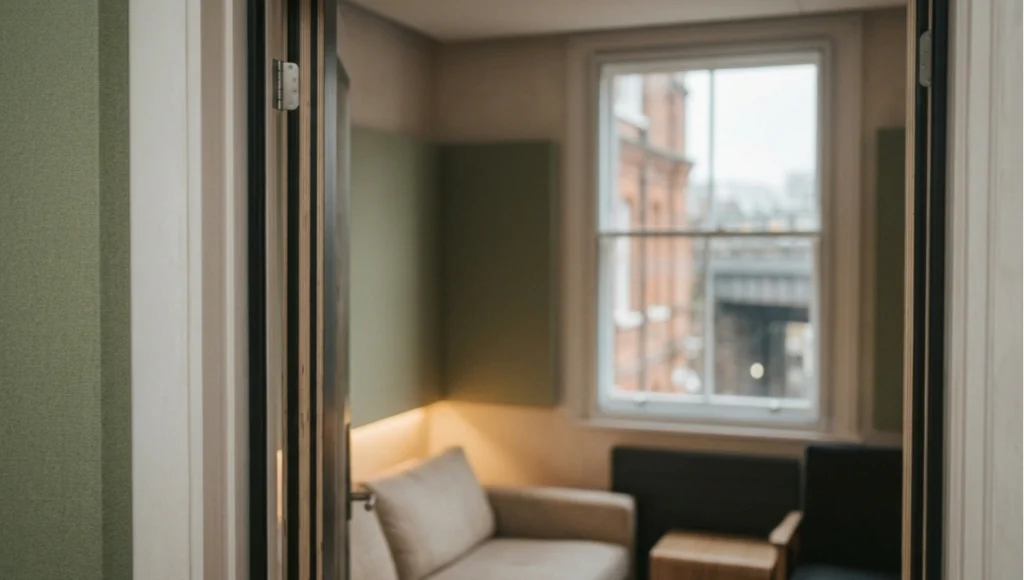
The Vauxhall district presents a specific acoustic challenge: the apartment sits 80 metres from an elevated railway line generating peak sound events of 78 dB(A) at 6-minute intervals during operating hours. Standard residential glazing in Victorian conversions achieves STC 25–28 — wholly inadequate for the target acoustic environment. The design challenge was to achieve a sub-35 dB(A) interior without structural modification to the listed building fabric.
Design Levers Applied
Acoustic Isolation — Decoupled Inner Leaf
- A decoupled stud wall (25 mm air gap, resilient channels, 2× 12.5 mm acoustic plasterboard) was installed on the railway-facing wall, adding STC 19 points without touching the original masonry — total assembly STC: 46
- Ceiling: independent suspended ceiling with resilient mounts, 100 mm mineral wool, achieving STC 44 overhead from upper flat
- Secondary glazing: 10 mm laminated glass at 100 mm offset from existing sash — acoustic insertion loss of 38 dB
- Door: solid ash-core with acoustic perimeter seal and drop seal — STC 42
- Measured result: 31 dB(A) interior during peak train events (acoustic engineer verified)
Circadian Lighting — Integrated Scene Architecture
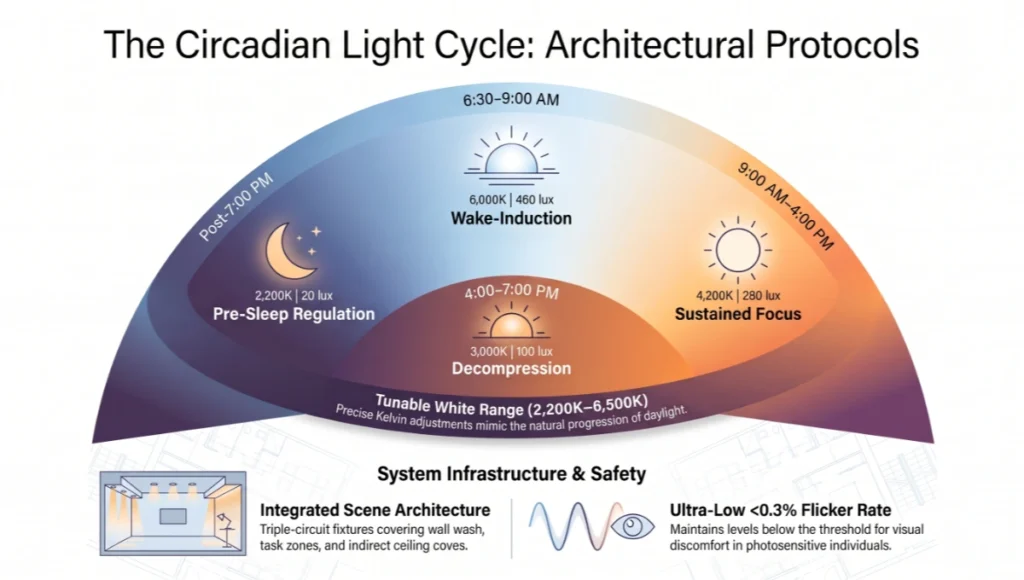
- Fixtures: Tunable white LED track (2,200K–6,500K) on three independent circuits — wall wash, task zone, and indirect ceiling cove
- 6:30–9:00 AM: 6,000K / 450 lux — wake-induction protocol
- 9:00 AM–4:00 PM: 4,200K / 280 lux — sustained focus state
- 4:00–7:00 PM: 3,000K / 100 lux — transition decompression
- Post-7:00 PM: 2,200K / 20 lux — pre-sleep regulation
- All fixtures: measured flicker rate < 0.3% — below the threshold for visual discomfort in photosensitive individuals
Material Specification
- Walls: limewash plaster in warm white (Munsell 8/1) — breathable, zero-VOC, soft matte finish with subtle organic texture variation
- Floor: cork tiles (6 mm) over acoustic underlay — thermal underfoot, high NRC, low-VOC adhesive
- Primary seating: custom low-profile platform with high-density 80 kg/m³ foam in organic cotton cover — no synthetic upholstery
- Swing: pod hammock chair on structural ceiling beam anchor (tested to 250 kg) in organic cotton canvas
- Focal anchor: 900 mm preserved moss panel on primary sightline wall — biophilic stimulus without irrigation requirements
Control System
- KNX-based automation with physical rocker switches (no touchscreen requirement — touchscreen interfaces add a cognitive load step at high-distress moments)
- 4 pre-set scenes accessible via single button: Morning / Focus / Decompress / Night
- Manual override: every variable independently adjustable from same panel
Transferable Takeaway
You can apply the same logic at home without a full architectural intervention. Begin by identifying your single most disruptive sensory input — for most neurodivergent adults it is either unpredictable sound or uncontrolled light. Address that one variable first with targeted treatment: secondary glazing for sound, blackout-plus-dimmable layering for light.
Then build your focal anchor — position one natural element at seated eye level and remove visual complexity from the same sightline. Finally, build a decompression corner: one piece of seating that provides compression or grounding, one source of warm low-CCT light on independent switch, one acoustic boundary (even a heavy curtain on a ceiling track improves the sense of enclosure meaningfully). These three moves — acoustic boundary, circadian lighting layer, and a compression seat with biophilic anchor — replicate the functional core of the Vauxhall Refuge at a fraction of the cost and without structural work.
Intellectual Honesty: Current Limitations
The evidence base for residential sensory room design in neurodivergent adults is growing but uneven. Several honest limitations are worth acknowledging.
The majority of sensory environment research has been conducted in institutional settings — schools, clinical facilities, and care homes — with children or adolescents as the primary population. Direct transfer to residential settings for adults requires careful interpretation. Adult sensory profiles are generally more differentiated and self-directed than paediatric ones, which is an advantage, but it means that population-level design recommendations carry less predictive power for any individual.
Circadian lighting protocols, while well-supported in sleep science literature, have less direct research evidence in neurodivergent adult populations specifically. The therapeutic mechanisms — melatonin suppression, cortisol rhythmicity — are physiologically consistent across neurotypes, but individual variation in light sensitivity means that a single protocol may require personalisation.
Cost remains a significant barrier. A full specification as described in this guide — decoupled acoustic walls, tunable lighting, natural material specification, structural swing anchor — represents an investment most renters cannot access. The concept project spotlight is a rented property with a cooperative landlord; that condition is not universally replicable.
Finally, sensory needs are not static. A residential sensory room designed for a specific profile in 2026 may require substantial reconfiguration within three to five years as the occupant’s sensory responses shift with age, health status, or medication. Modular adaptability is not simply a design preference — it is a functional necessity.
2030 Future Projection: Where Sensory Design Is Heading
Three trajectories are converging that will reshape residential sensory room design by 2030. Each carries specific implications for neurodivergent adults.
7.1 Biosensor-Integrated Environments
The integration of wearable biosensor data — heart rate variability, electrodermal activity, skin temperature — with environmental control systems is already technically feasible. By 2030, residential sensory rooms capable of reading autonomic state in real time and adjusting lighting, acoustic masking, and temperature automatically will be commercially available at mid-market price points. The first deployments of this technology are already appearing in corporate wellness facilities in Singapore and Amsterdam, where occupant-adaptive lighting systems have demonstrated measurable reductions in self-reported stress during high-demand cognitive tasks. The residential equivalent is a near-term projection, not a speculative one.
7.2 Acoustic Meta-Materials
Current acoustic treatment relies on mass and absorption — materials that work by being heavy or porous. Meta-material acoustics, which achieve sound attenuation through geometric structure rather than mass, are moving from laboratory to commercial application. By 2030, thin-panel acoustic solutions capable of achieving STC 45+ at thicknesses under 20 mm will significantly reduce the spatial cost of acoustic isolation — a critical development for small residential rooms where current solutions consume between 80 and 120 mm of wall depth per assembly.
7.3 Neurodivergent-Inclusive Building Codes
The United Kingdom’s Part M of the Building Regulations is under review for its 2027 revision, with neurodivergent inclusivity formally on the consultation agenda. Several cities in the Netherlands — including Rotterdam, which has been operating a neurodiversity-inclusive urban design framework since 2022 — have already introduced residential planning guidance that requires acoustic performance standards and lighting control specifications in new-build homes. If equivalent provisions reach UK national building regulations by 2028–2030, residential sensory room design principles will move from specialist intervention to baseline requirement.
Actionable Design Principles: Where to Start
Whether you are designing a dedicated room from scratch, adapting an existing space, or working within rented accommodation, these principles apply in order of impact.
Principle 1: Identify Your Primary Sensory Driver
Before specifying any material or product, identify the single sensory input causing the highest regulatory cost in your current home environment. This is your first design problem. For most neurodivergent adults it will be sound, uncontrolled light, or visual complexity. Solve that first.
Principle 2: Treat Acoustic and Light Control as Infrastructure
These are not decorative decisions. Acoustic isolation and circadian lighting control are the structural layer of sensory room design. Allocate the largest portion of any budget here. A quiet, well-lit room with basic furnishings outperforms a beautifully equipped room with uncontrolled sound and static lighting in every regulatory outcome measure.
Principle 3: Design for One Sightline
Identify the sightline you occupy most often when seated in the room — this is typically toward the primary wall or window. Simplify everything on that line: one material, one muted colour, one biophilic anchor. Remove everything else from that visual plane.
Principle 4: Build in Modular Change
Do not build a fixed configuration. Use furniture on castors, modular acoustic panels, and dimmer-controlled independent lighting circuits. Your sensory needs will change. Your room should be able to change within thirty minutes, not thirty days.
Principle 5: Control Access and Transition
The entry point to a sensory room is a regulatory threshold. A solid-core door with an acoustic seal is not an upgrade — it is the functional boundary between the regulated space and the uncontrolled environment beyond it. Design the transition deliberately: a door handle rather than a knob (lower motor demand at high-distress moments), a dedicated light switch at entry height, and no immediate visual complexity on the wall facing the door.
Principle 6: Layer Before You Commit
Test before permanent installation. Hang acoustic curtains before commissioning wall assemblies. Trial a tunable smart bulb before specifying a full lighting circuit. Spend two weeks with a weighted blanket before investing in a compression chair. Sensory needs are individual, and what the literature suggests may not match your specific profile.
For evidence-based design standards, the following external resources provide authoritative reference:
• Academy of Neuroscience for Architecture (ANFA) — Research & Publications — peer-reviewed studies on how the built environment affects autonomic and cognitive function.
• American Institute of Architects (AIA) — Design & Health Resources — AIA’s curated practice resources on inclusive and health-centred residential design.
Comprehensive Technical FAQ
Designing a shared family space for children or multi-generational use rather than adult clinical needs? Start from our residential sensory room design for families guide, which covers room sizing, cost ranges, co-occupant conflict, and bedroom conversions.
Acoustic & Sound
Q: What is the minimum acoustic standard for a residential sensory room?
A: A background noise level at or below 35 dB(A) with a reverberation time (RT60) under 0.4 seconds. These figures are derived from occupational therapy research identifying the thresholds below which most autistic adults can maintain voluntary relaxation without active effort. Below 30 dB(A) is achievable in well-specified rooms and provides additional regulatory benefit for those with severe auditory hypersensitivity.
Q: Can I achieve meaningful acoustic isolation in a rented property?
A: Yes, within limits. Decoupled secondary glazing (no fixings into the original frame) and heavy acoustic curtains (minimum 1,500 g/m² lined fabric) are reversible interventions that can reduce airborne sound transmission by 12–18 dB without structural modification. Acoustic door seals and drop seals add a further 6–10 dB and are removable. Combined, these measures can take a typical Victorian flat from 55 dB(A) to 38–42 dB(A) — below the threshold for most regulatory challenges.
Q: Do white noise machines help?
A: For auditory hypersensitivity driven by unpredictable transient sounds — footsteps, door slams, raised voices — broadband white or pink noise masking can reduce the startle and orienting response by raising the ambient noise floor above the threshold at which transient sounds register as distinct events. Target masking level: 5–10 dB above the peak transient you are masking. Pink noise is generally better tolerated than white noise for extended use. This is a compensatory strategy, not a replacement for source reduction.
Lighting & Circadian
Q: What is the minimum circadian lighting specification for a functional sensory room?
A: At minimum: two independently switchable circuits — one tunable white LED capable of reaching 5,000K+ at 300+ lux, one warm amber LED at 2,200K or below dimmable to under 20 lux. A single static warm-white dimmable lamp does not constitute a circadian lighting system. Scene automation is recommended but not strictly required if manual switching habits can be reliably maintained.
Q: How do I know if a light fixture has problematic flicker?
A: Flicker at or below 1% is the target; below 0.5% is preferable for photosensitive individuals. Most LED luminaire datasheets do not publish flicker rates — request the photometric report or use a flicker meter (available as smartphone apps using the front camera, though dedicated tools like the UPRTek MK550T provide reliable results). Cheaper LED drivers, particularly dimmer-compatible budget units, frequently exceed 10% flicker when dimmed below 50% — this is the most common source of lighting-related sensory distress in ostensibly ‘sensory-friendly’ rooms.
Materials & VOCs
Q: Which paint types are safest for VOC-sensitive individuals?
A: Natural mineral paints (limewash, silicate dispersion) are effectively zero-VOC and do not use synthetic binder compounds. Water-based latex paints labelled ‘low VOC’ typically contain < 5 g/L VOC — acceptable, but ensure ‘zero VOC’ tinting pigments are used, as standard tints add 5–15 g/L regardless of base paint specification. Allow 14 days of ventilation after any painting before occupying the room for extended periods, even with low-VOC products.
Q: Are synthetic foam products safe to use?
A: Standard polyurethane foam contains isocyanate-based compounds and may off-gas for 12–24 months. High-density natural latex foam (Dunlop process, 70+ kg/m³) is the preferred alternative — it off-gasses negligibly and provides superior compression characteristics for regulatory seating. Certified to OEKO-TEX Standard 100 is the minimum specification to request.
Budgeting & Prioritisation
Q: What is a realistic budget for a basic but effective residential sensory room?
A: A meaningful sensory environment — acoustic curtains, secondary glazing on one window, a tunable lighting system on two circuits, a compression seating option, and low-VOC material finishes — can be achieved in a 10–14 m² room for £3,500–£6,000 at 2026 UK material and labour costs. A full specification including decoupled acoustic wall assemblies, MVHR ventilation, and a structural swing anchor typically ranges from £12,000–£22,000 depending on room condition and regional labour costs.
Q: Which intervention delivers the highest regulatory return per pound spent?
A: Acoustic treatment on the highest-noise source (typically a single window or wall) and installation of a tunable circadian lighting circuit consistently deliver the greatest self-reported regulatory improvement per unit cost in occupational therapy literature. Prioritise these before any furniture, equipment, or decorative elements.
Your Next Step: Design the Environment Your Nervous System Deserves
The gap between a home that depletes you and one that regulates you is, in most cases, a matter of six variables applied with precision. Sound. Light. Texture. Visual complexity. Air quality. Movement access. These are not luxury considerations for neurodivergent adults — they are the conditions under which daily function either costs less or more than it needs to.
The residential sensory room is the most direct built-environment intervention available to you. It does not require a diagnosis, a prescription, or institutional access. It requires a room, a specification, and the willingness to treat your home as the primary health infrastructure it actually is.
At Nuvira Space, our Living Spaces practice exists for exactly this purpose. Whether you are beginning with a single acoustic curtain or commissioning a full specification from the ground up, the framework is the same: identify the highest-cost input, address it with a measurable target, and build modular adaptability into everything you do. The Vauxhall Refuge was a 14 m² Victorian room beside a railway line. It now measures 31 dB(A) at peak train events. The methodology is repeatable. The result is yours to claim.
© Nuvira Space All rights reserved. | LIVING SPACES Series | All specifications cited are based on peer-reviewed environmental psychology research, occupational therapy literature, acoustic engineering standards (BS EN ISO 717-1, ASHRAE 62.1), and circadian biology publications (Cajochen et al., Lockley & Foster). External references include ANFA (anfarch.org) and the American Institute of Architects (aia.org). The Vauxhall Refuge is a speculative internal concept study and does not represent a completed project.