

Table of Contents
Traditional construction is failing your biology. For decades, the industry has prioritized “decor”—the superficial layering of fabrics, pigments, and trends—over the neuro-spatial reality of how a built environment affects your endocrine system. We treat houses as static containers, yet your brain processes every corner, shadow, and ceiling height as a physiological signal. When we compare modular vs prefab homes, we aren’t just discussing assembly lines or construction speed; we are identifying the 1 faster way to elite design that functions as a sophisticated biological intervention.
Nuvira Perspective: The Home as a Health Machine
At Nuvira Space, we view the “human-machine synthesis” not as a cold, robotic future, but as the ultimate evolution of the domestic sanctuary. We believe the home must stop being a passive shelter and start becoming an active “health machine.” By leveraging modular adaptability and precision-engineered circadian synchronization, we are moving beyond architecture into the realm of externalized biology. Our homes are designed to “breathe” with your metabolism, using high-fidelity environmental sensors and adaptive geometries to ensure your living space is as dynamic as your own DNA. We don’t build rooms; we curate atmospheric states that prime the human nervous system for peak performance and deep recovery.
Technical Deep Dive: The Neuro-Architecture of Off-Site Builds
To understand why modular systems outperform traditional builds in “Elite Design,” we must look at the cognitive load of the environment. A home built in a controlled factory environment achieves a level of “Tectonic Precision” impossible in the mud and rain of a standard site.
The Physics of Precision
The transition from site-built to modular is the transition from “approximate” to “absolute.” When a house is framed in an open field, it is subject to moisture absorption, wood warping, and human error. In contrast, a modular unit is a product of aerospace-grade tolerances.
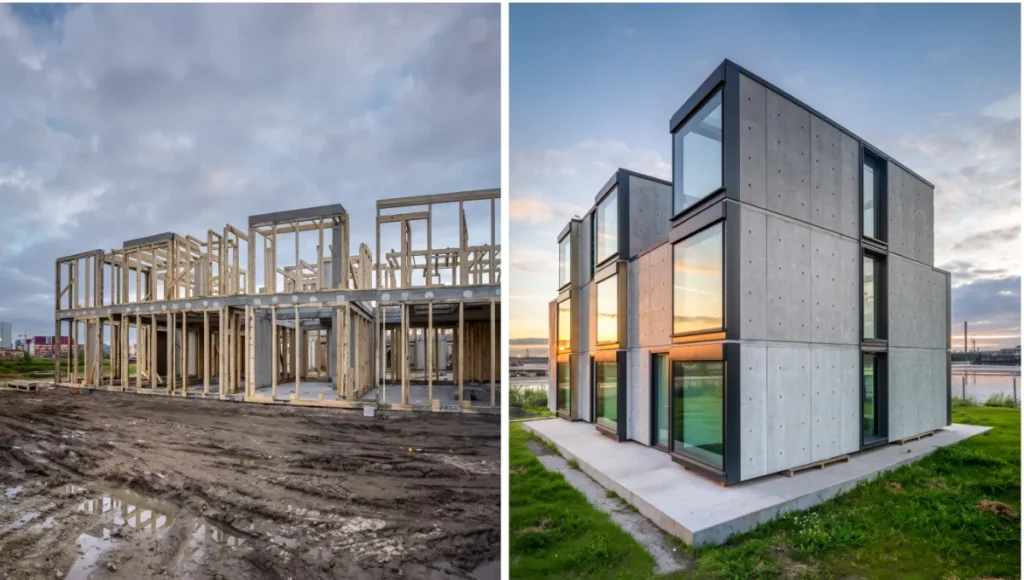
- Millimeter Accuracy: Factory-calibrated jigs ensure air-tight seals (0.6 ACH or lower), eliminating the “micro-stressors” of drafts and thermal bridging that trigger low-level cortisol spikes.
- Acoustic Decoupling: Modular units inherently possess double-walled construction at the joints (where modules meet), creating “quiet zones” with an STC (Sound Transmission Class) rating of 60+. This is essential for protecting the “deep-work” state from the intrusive frequencies of urban life.
- Material VOC Control: Off-site construction allows for the curing of adhesives and paints in isolated, ventilated environments long before the modules arrive at your land, delivering a “Zero-Day” air quality profile.
Circadian Engineering Specs
The speed of modular construction allows for the integration of “Smart Glass” and “Tuned Apertures” that a general contractor would struggle to align on-site. We treat light as a drug—dosed precisely to regulate your hypothalamic-pituitary-adrenal (HPA) axis.
- Spectral Tuning: Integration of LED arrays that mimic the 480nm blue-light peak of morning sun, transitioning to a 1800K amber glow as the sun sets.
- Dynamic Shading: Automated louvers that adjust based on real-time solar azimuth to prevent “visual glare fatigue,” a leading cause of afternoon cognitive decline.
- Atmospheric Stability: Redundant HVAC systems with HEPA-H14 filtration that cycle air every 15 minutes, ensuring CO2 levels never exceed 600ppm—the threshold where decision-making begins to degrade.
Comparative Analysis: Modular vs. Prefab Homes
While the market often uses these terms interchangeably, the distinction determines your long-term spatial health. “Prefab” is a broad umbrella; “Modular” is the specialized precision instrument.
The Solution vs. The Industry Standard
| Feature | Traditional Industry Standard | Nuvira Prefab (Panelized) | Nuvira Modular (Volumetric) |
| Build Velocity | 12–18 Months (High Stress) | 6–9 Months (Variable) | 3–4 Months (Predictable) |
| Spatial Logic | Rigid / High Material Waste | Flexible Shell | Adaptive Volumetric Units |
| Psychological Impact | Sensory Inconsistency | High Light Exposure | Total Sensory Control |
| Sustainability | 30% Material Waste | 10% Material Waste | <2% Material Waste |
| Seismic Rating | Standard Code | Enhanced Rigid Shell | Redundant Frame Resilience |
Why Volumetric Modular is the “Elite” Choice
“Prefab” can include anything from kit homes to panelized walls shipped in a flat-pack. While efficient, it lacks the 1 faster way to elite design found in volumetric modularity. Because modular units are completed up to 95% in-factory—including the integrated lighting, hidden storage, and neuro-responsive “refuge corners”—the transition from “site” to “home” is a seamless software-like deployment. You aren’t managing a construction site; you are witnessing a precision installation.
Concept Project Spotlight: “The Chronos Pod” by Nuvira Space
Speculative / Internal Concept Study: Chronos Pod v2.0
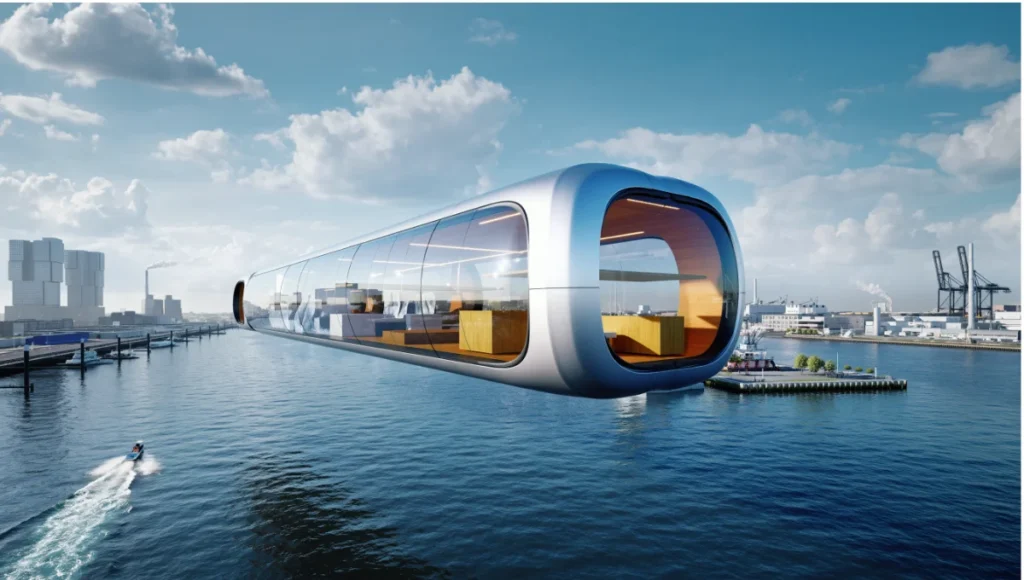
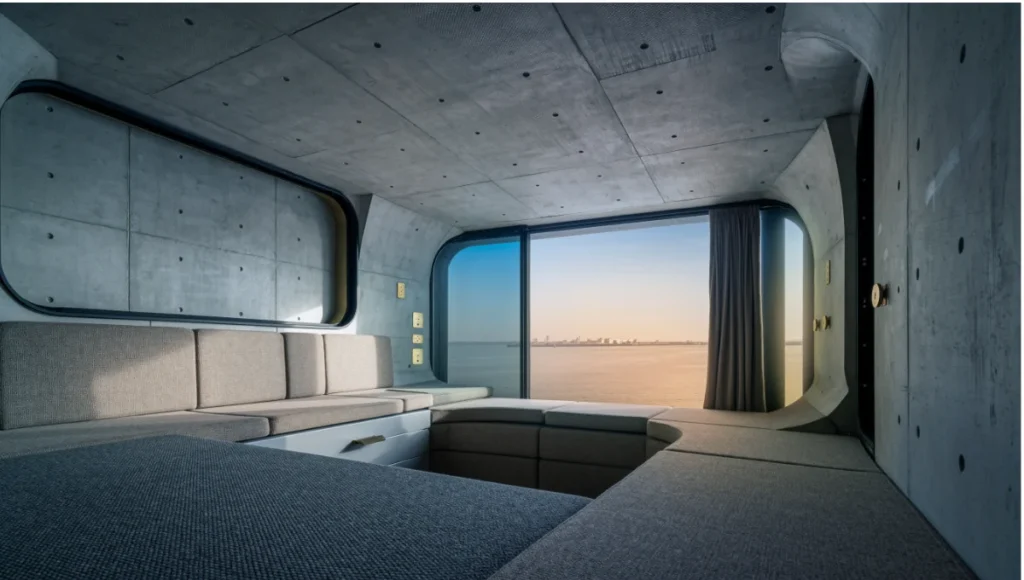
Project Overview: Rotterdam Harbor / Urban Refuge / Circadian Synthesis In the densifying urban fabric of Rotterdam, Netherlands, the “Chronos Pod” serves as our case study for high-velocity elite design. Rotterdam’s maritime heritage of “loading and stacking” provides the macro-environmental context for a vertical modular cluster designed to combat “Urban Burnout.” In a city defined by its gray skies and industrial grit, the Chronos Pod creates a hyper-natural interior reality.
Design Levers Applied
- The Saccadic Buffer: Entrance hallways are designed with soft, radiused corners rather than 90-degree angles. This reduces “saccadic” eye movements—the rapid, jerky movements the eye makes when scanning sharp edges—which has been shown to instantly lower the occupant’s heart rate upon entry.
- Biophilic Fractals: Window mullions and ceiling textures follow a Fibonacci-based fractal pattern. EEG studies confirm that viewing these specific ratios induces alpha-wave relaxation, moving the brain from “High Beta” (stress) to “Alpha” (calm) within 60 seconds of exposure. Learn more about implementing biophilic fractals and refuge-prospect in interiors → Biophilic Interior Design: 7 Iconic Ways to Reduce Stress
- Thermal Anchoring: Individual sleep modules utilize phase-change materials (PCM) in the walls to drop the ambient temperature by exactly 2.5 degrees Celsius at 10:00 PM, triggering the body’s natural core-temperature drop and subsequent melatonin production.
- The Olfactory Vent: A modular “scent port” that releases phytoncides (natural oils from trees) during the morning hours, mimicking the chemical composition of a Japanese forest to boost Natural Killer (NK) cell activity in the immune system.
Transferable Takeaway
You do not need to live in a Rotterdam Chronos Pod to begin this evolution. You can apply the same logic at home today:
- Tune your evening lighting: Swap bulbs to 1800K-2000K warm tones after 8:00 PM to protect your circadian rhythm.
- Build a “Refuge Corner”: Dedicate one space with high-back seating and acoustic dampening where your back is protected and your view is clear (the “Prospect-Refuge” theory).
- Simplify one primary sightline: Remove clutter from the first thing you see when you wake up, anchoring the view on a natural element like a single high-contrast plant or a window frame.
Intellectual Honesty: Current Limitations
We must be intellectually honest: the “Health Machine” is not without its hurdles. Despite the physiological benefits, modular architecture faces a “Logistical Bottleneck.” The very precision that makes it “Elite” also makes it sensitive to transport. The “Golden Ratio” of a room is often dictated by the width of a shipping lane or the height of a highway overpass in the destination city.
Furthermore, the “Health Machine” concept requires a high-bandwidth digital backbone. To truly synchronize a home’s lighting, air, and acoustics to a resident’s wearable health data, the home needs a localized battery storage system and an AI edge-processor that can function during grid outages. We are building the future, but the infrastructure of the past still occasionally tethers us.
2030 Future Projection: The Generative Dwelling
By 2030, we project the convergence of 3D-knitted textiles, carbon-negative modular frames, and generative AI design. Your home will not just be “built”; it will be “printed, plugged, and evolved.”
We envision a future where your modular home senses a change in your inflammatory markers via non-invasive sensors in the floor and automatically adjusts the humidity and phytoncide levels in the air to accelerate physical recovery. The home of 2030 will be a “living skin”—a soft-modular system that can expand or contract its volumes based on the number of occupants, ensuring that the “psychological density” of the space is always optimized for the task at hand.
Actionable Design Principles for the Modern Futurist
To achieve elite design through modular logic, you must adopt these three principles:
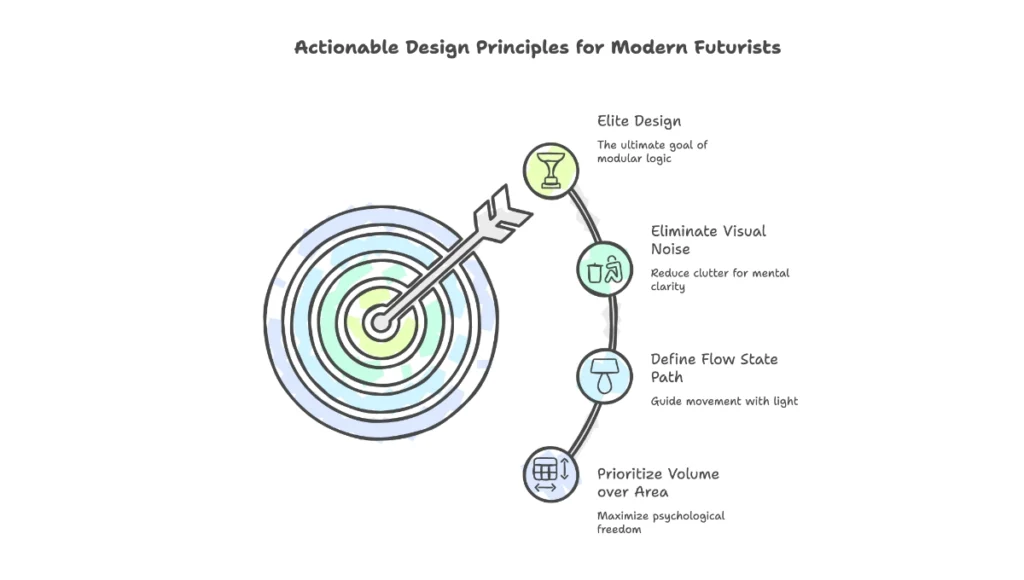
- Prioritize Volume over Area: Do not be fooled by square footage. A 12-foot ceiling in a small 800 sq. ft. modular unit provides more “cognitive breathing room” and better air stratification than a sprawling 2,500 sq. ft. traditional house with 8-foot ceilings. Volume equals psychological freedom.
- Define the “Flow State” Path: Design your modular layout so that your morning routine (bed to bath to kitchen) follows a linear sun-path. Light should guide your movement, pulling you from the “cave” (bedroom) to the “plateau” (living space).
- Eliminate Visual Noise: Use integrated “hidden cabinetry” to hide the clutter of daily life. Clutter triggers the brain’s “incomplete task” alert system, causing a constant, low-level drain on your mental energy.
Comprehensive Technical FAQ
Q: Does “Modular” mean I lose the ability to have a bespoke home?
A: On the contrary. Modular is the 1 faster way to elite design because it uses a “Bespoke Component” logic rather than a “Custom Labor” logic. Think of it as high-end watchmaking versus manual carpentry.
- Technical Specs: Our systems offer 1,000+ finish combinations, interchangeable floor-plate modules, and “add-on” sensory pods for specialized functions like cryotherapy or sound-proofed podcasting.
Q: Is a prefab home as durable as a traditional “brick and mortar” build?
A: It is significantly more durable. Modular homes must be engineered to withstand “G-forces” and seismic-level vibrations during highway transport.
- Technical Specs: Steel-reinforced frames (Grade 50), hurricane-rated glazing (Impact Level D), and vibration-dampening floor assemblies that reduce footfall noise by 40% compared to standard joists.
Q: How exactly does modular construction improve my sleep quality?
A: Through “Total Environmental Isolation.” By controlling the thermal and acoustic envelope in a factory, we eliminate the gaps that traditional builders leave behind.
- Technical Specs: Triple-pane argon-filled windows (U-value 0.15) and automated “blackout” tracks integrated directly into the ceiling module to ensure 0-lux darkness.
Q: Is this an environmentally responsible choice?
A: Yes. Modular construction is the most sustainable way to build elite design.
- Technical Specs: We achieve <2% material waste through digital cutting and recycling loops. Most site-builds send 30% of their materials straight to a landfill.
Upgrade Your Biological Footprint
The “Modular vs Prefab Homes” debate is over. The evidence points toward a future where speed, sustainability, and elite design are no longer at odds—they are synthesized into a single, high-performance product.
Your home is the most significant “wearable” you will ever own. It is the filter through which you experience reality, the vessel for your recovery, and the catalyst for your creativity. If you are ready to stop “decorating” a failing structure and start engineering a life of peak physiological alignment, the path is clear.
[Contact a Nuvira Space Architect Today to Begin Your Deployment]