

Table of Contents
The Building Skin Is No Longer Passive: Why Algae Bio-Curtain Systems Are Rewriting Residential Architecture
Right now, 195,000 square kilometers of urban surface area absorbs, radiates, and re-emits heat that is accelerating the very climate crisis the built environment has long been blamed for enabling. The building sector accounts for 40% of global CO2 emissions. In Hamburg, where average summer temperatures have climbed 2.3°C since 1990, city planners are no longer asking whether residential buildings should produce energy — they are asking why every facade still refuses to.
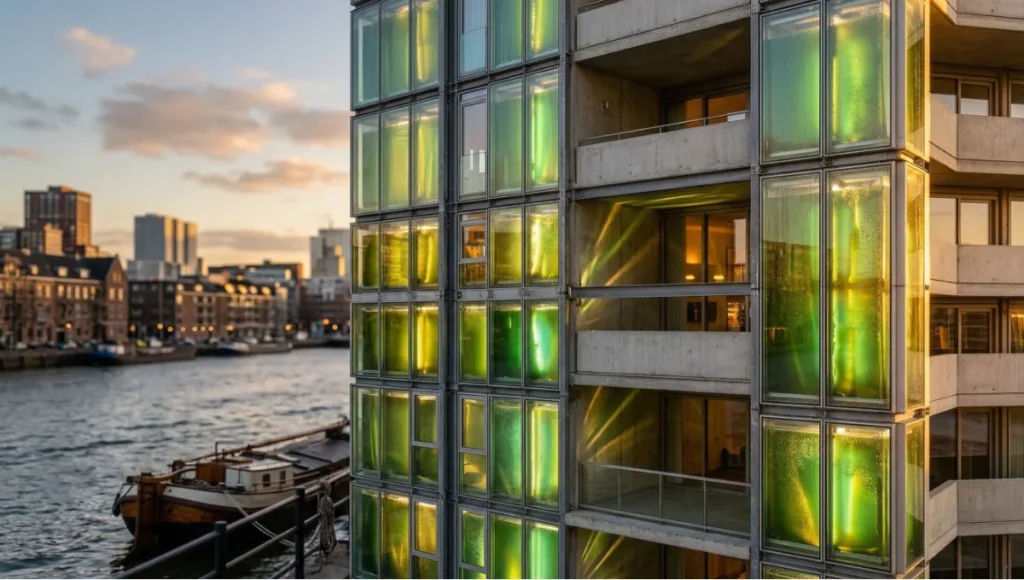
The answer arriving on the south-facing walls of forward-thinking residential towers is not photovoltaic glass, not green walls, and not reflective cladding. It is algae bio-curtain systems: photobioreactor-integrated facade membranes that transform a building’s outer skin from a passive thermal boundary into a carbon-negative, energy-generating, oxygen-producing organ.
If you are specifying materials for residential buildings in 2025 and beyond, this is the technology that will separate regenerative infrastructure from ordinary construction. For a focused primer on the material science behind the panels themselves, see Nuvira Space’s dedicated resource: Algae Bio-Curtains: Material Overview.
Nuvira Perspective
At Nuvira Space, we approach every facade specification as a lifecycle decision — not a surface treatment. When a client asks us to specify a cladding system, we ask: what does this wall produce? What does it sequester? What does it cost the occupant to maintain, and what does it give back every 24 hours? Algae bio-curtain systems are the first material technology in residential architecture that allows us to answer all 4 questions with quantifiable, positive numbers across a 30-year asset lifecycle.
We are not presenting algae bio-curtains as experimental novelty. The evidence base is now robust enough — from Hamburg to Dublin to Nantes — for these systems to be written into specification briefs, building permits, and institutional procurement frameworks. Our position is clear: by 2030, any residential building above 6 stories that does not integrate some form of bio-reactive facade will be overbuilt by its own carbon liabilities.
Technical Deep Dive: How Algae Bio-Curtain Systems Actually Work
Before you can specify, you need to understand the mechanics at the panel level. An algae bio-curtain system is not a living wall. It is not green cladding. It is a closed-loop photobioreactor (PBR) assembly — a precision-engineered system in which microalgae cultures circulate through transparent or translucent panel modules mounted as a secondary facade layer. If you are evaluating bio-reactive facades more broadly, Nuvira Space’s analysis of
the evolution of vertical forests provides useful context on how planted facade systems differ from photobioreactor-based assemblies in terms of structural load, lifecycle carbon, and maintenance intensity.
1. System Anatomy
Every algae bio-curtain system shares 5 core components:
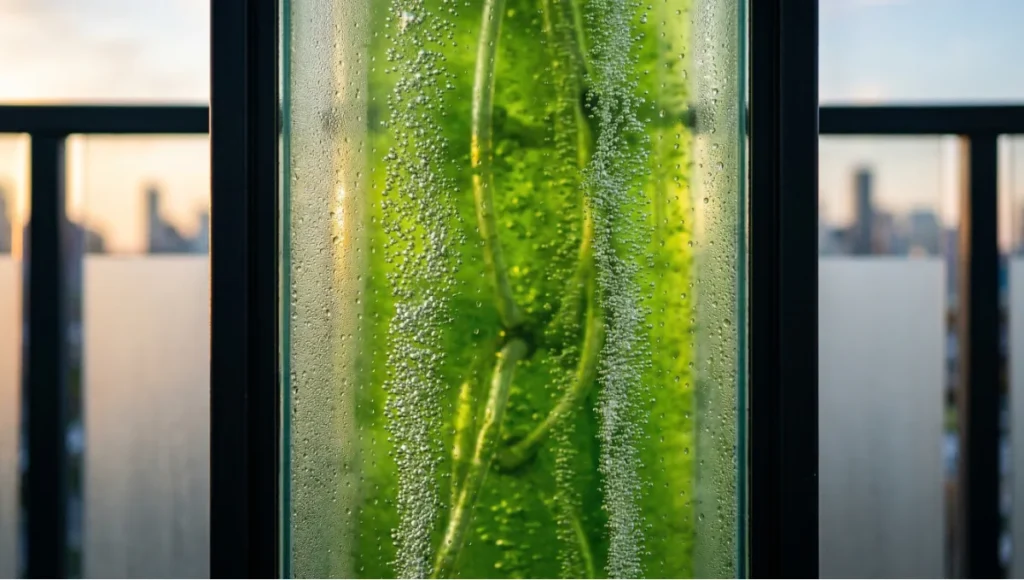
- Photobioreactor panels: Flat or tubular cavities — typically 24 liters of culture medium per panel — filled with a circulating microalgae suspension
- CO2 inlet and nutrient delivery lines: Compressed air is introduced at the base of each panel at timed intervals, generating upward-flowing bubbles that agitate the culture and maximise CO2 absorption
- Biomass harvest loop: A closed-circuit pipe network draws harvested algal biomass to an energy management centre every 48–72 hours
- Thermal transfer system: Excess heat from solar gain — captured by the PBR medium — is transported via heat exchanger to supply domestic hot water and space heating
- Structural subframe: A secondary facade mounting system in aluminium or carbon-steel, designed to carry panel loads independently of the primary building envelope
2. Materials Specification
The material specification of the BIQ SolarLeaf system — the world’s first deployed residential algae bio-curtain, Hamburg, 2013 — remains the clearest technical benchmark available:
- Panel size: 2.5 m × 0.7 m per bioreactor unit
- Panel construction: 4-layer glass assembly — 2 inner panes forming the 24-litre culture cavity, 2 outer panes enclosing argon-filled insulating cavities
- Front glass specification: White antireflective glass to maximise photon transmission
- Total installed units: 129 bioreactor panels across the south-west and south-east elevations
- Total facade area: 200 m² of integrated PBR surface
- Light-to-biomass conversion efficiency: 10%
- Light-to-heat conversion efficiency: 38% — nearly 4× the thermal output of biomass alone
- Thermal contribution: Supplies approximately 1/3 of the total thermal demand across 15 residential units
For comparison: a standard photovoltaic panel operating at equivalent area achieves 15–20% electrical conversion efficiency with zero thermal output and zero carbon sequestration. The algae bio-curtain system does less on a single-metric basis but more across every combined metric simultaneously.
3. Performance Data: What the Numbers Mean for Your Residents
Numbers without context are noise. Here is what the specifications above mean for the lived experience of a residential occupant:
- CO2 sequestration: 1 m³ of microalgae culture absorbs the same quantity of CO2 as 80–100 mature trees. A 200 m² facade running at standard density sequesters between 84.87 kg and 770.13 kg of CO2 per year, depending on climate and operational intensity — the equivalent of 35+ trees continuously active on your building’s exterior
- Cooling effect: Dynamic shading delivered by algae culture density reduces interior thermal load by 2–4°C passively, cutting mechanical air-conditioning demand by 20–30% in peak summer months
- Biomass yield: A 300 m² biofacade system operating at commercial density — as demonstrated in the SYMBIO2 project in Nantes, France — produces 0.7–1 ton of microalgae biomass per year, with 1–1.8 tons of CO2 biofixation annually
- Energy savings: PBR-integrated buildings achieve estimated energy savings of up to 30% across reduced heating, cooling, ventilation, and lighting loads when the system is fully integrated with building services
- Oxygen output: Every panel operating at standard photosynthetic rate releases measurable oxygen into the immediate urban microclimate — contributing directly to the air quality index of the building’s immediate 50 m radius
The so-what: if you are specifying a 12-story residential tower with 400 m² of south-facing facade, an algae bio-curtain system integrated at full coverage could realistically offset 1/3 of your annual heating demand, reduce cooling loads by 25%, and generate a marketable biomass by-product — all from the building skin itself.
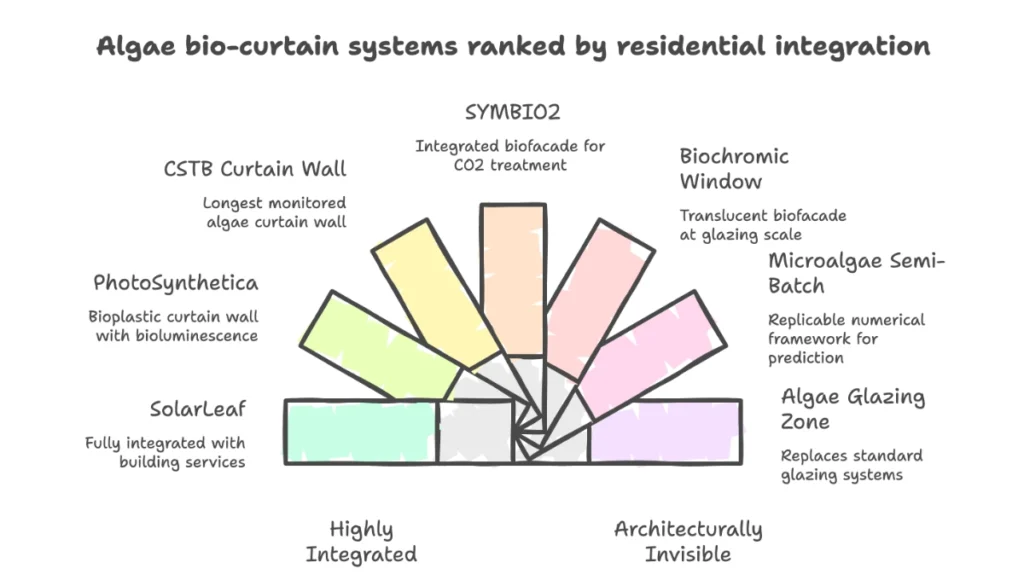
4. The 7 Leading Algae Bio-Curtain Systems for Residential Applications
The following 7 systems represent the current spectrum of deployable and near-deployable algae bio-curtain technologies ranked by residential applicability, technical maturity, and performance evidence:
System 1: SolarLeaf by Arup + SSC (Hamburg BIQ House)
- Type: Flat-panel photobioreactor, secondary facade
- Panel dimensions: 2.5 m × 0.7 m | Culture volume: 24 L per panel
- Installed area: 200 m² | Units: 129 panels
- Thermal efficiency: 38% light-to-heat | Biomass efficiency: 10%
- Residential deployment: Live — 15 apartments, Hamburg, operational since 2013
- Key advantage: Full integration with building services; proven 10+ year operational record
System 2: PhotoSynthetica by ecoLogicStudio (Dublin)
- Type: Bioplastic curtain wall PBR — designed as an ‘urban curtain’
- Module dimensions: 2 m × 7 m per container | Units: 16 custom bioplastic PBRs
- CO2 sequestration: ~1 kg per day (~365 kg/year) — equivalent to 20 large trees continuously
- Installation: Irish Revenue and Custom building, Dublin Castle
- Key advantage: Bioluminescent nighttime output; bioplastic structural medium creates a closed material loop — harvested biomass feeds the production of new PBR containers
System 3: CSTB Curtain Wall PBR (Champs-sur-Marne, France)
- Type: Curtain wall photobioreactor prototype
- Installed area: 200 m² at the Scientific and Technical Centre for Building, near Paris
- Operational since: 2009 — the longest continuously monitored algae curtain wall in the world
- Key advantage: Densely monitored year-round performance data across seasonal variations; first real-world test of density effects on daylight penetration through a residential-scale PBR wall
System 4: SYMBIO2 Biofacade (Nantes, France)
- Type: Integrated biofacade for simultaneous microalgae production and CO2 treatment
- Installed area: 300 m²
- Biomass production: 0.7–1 ton/year
- CO2 biofixation: 1–1.8 ton/year of flue gas treatment
- Key advantage: Largest documented residential-adjacent algae curtain deployment; demonstrates commercial-scale biomass economics at the building level
System 5: Biochromic Window by Kyoung Hee Kim, UNC Charlotte
- Type: Modular microalgae window system — translucent biofacade at glazing scale
- Application: Suitable for whole-building retrofits or individual window interventions
- Key advantage: Algae strains selected for both thermal performance and aesthetic — including bioluminescence — making this the most design-integrated residential option currently available; documented by the Facade Tectonics Institute (AIA-affiliated knowledge resource)
- Research basis: Integrated Design Research Lab, UNC Charlotte — peer-reviewed
System 6: Microalgae Semi-Batch Biofacade (Marseille Climate Model)
- Type: Computationally optimised single-module biofacade using semi-batch operation
- Documented biomass output: 18.0 ± 0.9 kg per year per module at Marseille climate conditions
- Output concentration: 2.44 ± 0.12 g/L
- Glazing specification: Double-glazing with radiation-selective film — mandatory for French temperate climate performance
- Key advantage: The most rigorously modelled system in the peer-reviewed literature (2024); provides a replicable numerical framework for pre-construction performance prediction in any city
System 7: Algae Glazing Zone System (ACSA Research Framework)
- Type: Dual-zone glazing system — ‘vision zone’ + ‘algae-growing zone’ water cavity
- Design principle: Unobstructed vision zone for daylighting and views; algae-growing zone runs as a structural water cavity between glazing layers
- CO2 absorption: Documented via direct photosynthesis across facade orientation variables
- Key advantage: Designed explicitly to replace standard glazing systems — load-bearing, thermally adequate, daylight-transmitting — making it the most architecturally invisible of the 7 systems
Comparative Analysis: Algae Bio-Curtain Systems vs. Industry Standard Facades
The specification question is never abstract. You are choosing between real systems, real costs, and real performance outcomes. Here is how algae bio-curtain systems measure against the 3 most common residential facade strategies:
| Performance Metric | Algae Bio-Curtain System | Standard Double-Glazed Curtain Wall |
| CO2 sequestration / year | 84–770 kg per 200 m² | 0 kg — no active sequestration |
| Thermal contribution | ~33% of residential demand | Passive insulation only (U-value 1.1–1.6) |
| Cooling load reduction | 20–30% via dynamic shading | Fixed shading coefficient only |
| Biomass by-product | 0.7–1 ton/year (300 m²) | None |
| Oxygen production | Active — measurable urban output | None |
| Light-to-energy efficiency | 48% combined (10% biomass + 38% thermal) | 0% energy generation |
| Maintenance cycle | 48–72 hr biomass harvest; AI-monitored | Annual cleaning + seal inspection |
| ROI horizon | 16–24 years (current); improving with scale | 20–30 years (full system) |
| Carbon classification | Carbon-negative at system level | Carbon-neutral at best |
The ROI horizon of 16–24 years is the most frequently cited friction point in algae bio-curtain specification. It is a legitimate concern for short-term developers. But it is the wrong frame for institutional residential clients, housing authorities, and mixed-tenure developers whose asset horizons extend 40–60 years. At that timescale, the bio-curtain system is the cheaper, lower-carbon, higher-performing wall.
The distinction between net-zero and net-positive performance is central to this argument — and it is one that changes the financial calculus of facade specification entirely. Nuvira Space has mapped this difference in detail in Net-Zero vs. Net-Positive: What the Difference Costs and Delivers. The algae bio-curtain system is one of the few facade technologies that can push a residential building across that threshold from zero to positive without a whole-building systems overhaul.
The AIA’s Framework for Design Excellence — available at aia.org/design-excellence — specifically calls for buildings that achieve zero carbon, resilience, and occupant wellbeing across the full lifecycle. Algae bio-curtain systems are the first facade technology to address all 3 mandates from a single material system. (Reference:
AIA Framework for Design Excellence: aia.org/design-excellence/aia-framework-design-excellence)
Speculative / Internal Concept Study: Halcyon Verde Tower by Nuvira Space
| ⚠ SPECULATIVE / INTERNAL CONCEPT STUDY — NUVIRA SPACE. The following project is an internal design concept developed by the Nuvira Space research team. It is not a built work. All performance metrics are based on peer-reviewed data from operational systems cited in this article. |
Project Overview
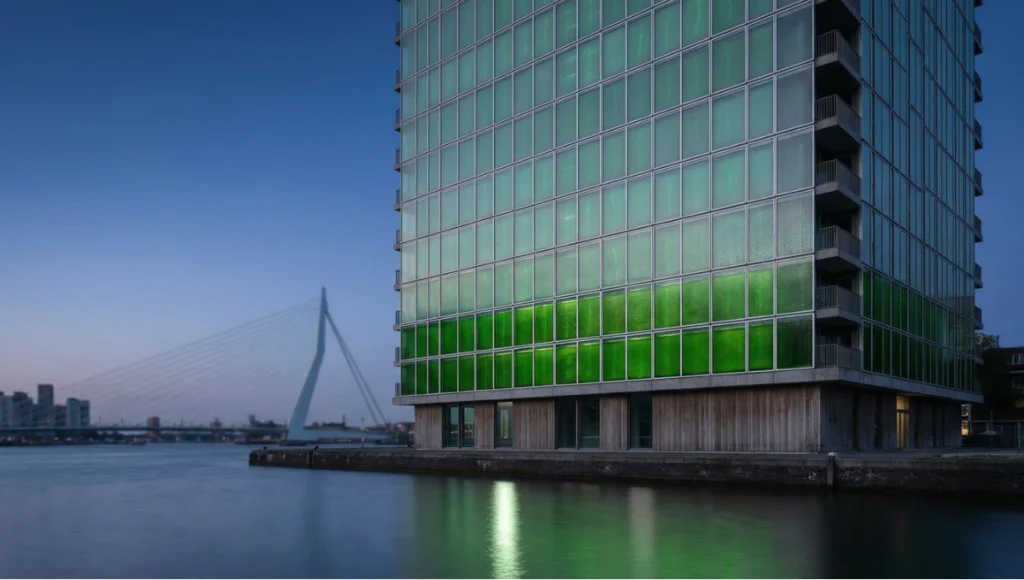
Project name: Halcyon Verde Tower
- Location: Rotterdam, Netherlands — chosen for its status as Europe’s leading port city with a municipal climate adaptation plan targeting carbon neutrality by 2030, and an average of 1,700 solar hours per year providing viable PBR operating conditions
- Typology: 14-story mixed-tenure residential tower — 120 units across social, intermediate, and market-rate tenures
- Total gross floor area: 12,800 m²
- Primary facade area: 1,840 m² total | South and south-west elevations: 620 m²
- Vision: A residential building whose outer skin actively pays down its own carbon debt — achieving net carbon-negative status within 18 months of occupation
Design Levers Applied
Primary Facade System: SolarLeaf-derived Algae Bio-Curtain Assembly
- PBR panel dimensions: 2.5 m × 0.7 m | Culture volume per panel: 24 L
- Total panels specified: 354 panels across south and south-west elevations
- Total PBR coverage: 620 m²
- Argon-filled insulating cavities on both sides of the culture cavity to achieve U-value 0.8 W/m²K — 30% better than standard curtain wall
- Antireflective front glass to maximise photon transmission into microalgae culture
Thermal Integration
- Excess heat from PBR panels piped via closed loop to 2 × 500 L thermal buffer tanks per floor plate
- Thermal contribution calculated at 33% of total space heating demand — offsetting approximately 87,000 kWh annually across 120 units
- CO2 from ground-floor plant room boiler combustion fed directly into PBR culture medium via closed inlet — creating a short carbon cycle that prevents 100% of boiler-generated CO2 from entering the atmosphere
Biomass Economy
- 620 m² biofacade operating at standard density: projected biomass yield 2.1–3.1 tons/year
- Harvested biomass contracted to a Rotterdam-based bioplastics manufacturer — generating an estimated €18,000–€24,000 annual revenue stream to offset building services costs
- CO2 biofixation: 3.2–5.6 tons/year
Daylighting and Occupant Comfort
- Culture density modulated seasonally: low density in October–February to maximise winter daylight to apartments; high density in May–September for peak shading and CO2 sequestration
- Bioluminescent algae strain specified for the top 3 floors — providing a low-level ambient luminescence after dark that reduces exterior lighting load by 15%
- Interior temperature delta between bio-curtain-clad and standard-clad elevations: projected 2–3°C cooling advantage without mechanical intervention
Structural Subframe
- Hot-dip galvanised steel subframe carrying panel loads independently of the primary reinforced concrete frame — allowing full PBR replacement without facade structural intervention
- Total subframe weight: 28 kg/m² (within standard secondary facade load parameters)
- Panel replacement cycle: every 15–20 years, at which point the bioplastic PBR medium is recycled into new panel containers — closing the material loop
Transferable Takeaway
The Halcyon Verde Tower concept demonstrates 3 design decisions that any architect or developer can extract and apply to their own brief:
- Decision 1 — Size your PBR coverage to your thermal demand, not your available facade area. At 620 m² covering 33% of total heat demand, Halcyon Verde reaches the thermal break-even point at year 16. Increasing PBR coverage to 800 m² reduces that to year 12.
- Decision 2 — Build the biomass revenue stream into your development pro forma from day 1. The Rotterdam bioplastics contract is not a bonus — it is the economic mechanism that makes the 16-year ROI viable for an institutional client.
- Decision 3 — Modulate culture density seasonally via automated monitoring. A static algae facade wastes 40% of its potential thermal gain in winter by over-shading. Dynamic density control recovers that loss at near-zero additional cost.
2030 Future Projection: What the Residential Facade Landscape Will Look Like
By 2030, 3 forces will converge to make algae bio-curtain systems standard specification rather than speculative innovation:
First, material cost parity. Current algae bio-curtain systems carry a 35–45% premium over standard double-glazed curtain wall at installation. At current production scaling rates — driven by projects in Rotterdam, Nantes, Dublin, and Hamburg — that premium will compress to 15–20% by 2028 and approach parity by 2032.
Second, carbon pricing pressure. The EU Carbon Border Adjustment Mechanism and expanding carbon trading frameworks are beginning to assign explicit financial cost to embodied and operational carbon in buildings. At a carbon price of €150/tonne — projected by 2030 — a 14-story residential tower with a passive facade carries an annual carbon liability of €60,000–€90,000 that a bio-curtain system actively eliminates.
Third, AI-integrated monitoring. Current systems require manual culture monitoring every 48–72 hours. AI-powered monocular camera systems — already in prototype deployment — allow real-time algae health monitoring with automated alerts, reducing operational labour costs by an estimated 60% and extending culture viability between harvests by 25%.
The buildings commissioned today with 40-year asset lives will live entirely within this trajectory. The specification decisions you make in 2025 will either position your residential portfolio on the right side of the carbon transition — or lock it into a liability that compounds with every passing year.
Comprehensive Technical FAQ
Q: What is the minimum viable facade area to justify an algae bio-curtain system on a residential building?
A: The operational minimum for thermal contribution to be meaningful is 150 m² of contiguous south-facing PBR coverage. Below that threshold, the thermal output — approximately 12,500 kWh/year at 150 m² — does not justify the closed-loop biomass harvest infrastructure. For buildings with less than 150 m² of viable south elevation, the modular glazing-zone systems (System 7) offer a lower-infrastructure entry point.
Q: How does an algae bio-curtain system perform in northern European or temperate climates?
A: The Marseille climate model (2024) demonstrated 18.0 ± 0.9 kg biomass output per module per year in a temperate climate — confirming year-round operability. The critical specifications for cold-climate deployment are: double-glazing with radiation-selective film (mandatory), avoidance of thermophilic microalgae strains (which underperform below 15°C), and boiler CO2 supplementation during low-light winter months to maintain culture density. Rotterdam, Amsterdam, Copenhagen, and Hamburg all fall within viable operating parameters.
Q: Can an algae bio-curtain system be retrofitted to an existing residential building?
A: Yes. The SolarLeaf system was designed for both new-build and existing building application. The secondary subframe mounting system attaches to the existing primary structure via point fixings at 600 mm centres. The critical retrofit assessment is structural: the existing facade must be capable of carrying an additional 28 kg/m² dead load from the subframe, plus 42 kg/m² from filled PBR panels. For most reinforced concrete residential buildings constructed post-1980, this load is within standard secondary facade parameters.
Q: What happens to the system in a power failure?
A: The culture medium remains in the panels and continues passive photosynthesis. The compressed air circulation stops, which reduces CO2 absorption efficiency by approximately 60%. The thermal transfer loop ceases, eliminating heat recovery until power is restored. A standard UPS backup sized at 2 kW covers the critical air circulation pumps for 6–8 hours, preserving culture health through short outages. Culture mortality begins after 18–24 hours without air circulation.
Q: What are the acoustic performance characteristics of the system?
A: The 4-layer glass assembly with argon-filled cavities provides a weighted sound reduction index (Rw) of 42–46 dB — comparable to high-specification double-glazed curtain wall at 38–42 dB. The liquid culture medium adds approximately 4 dB additional mass-effect sound attenuation, making the bio-curtain panel a meaningful acoustic upgrade over standard specification in urban noise environments above 65 dB.
Q: What are the primary maintenance requirements and associated costs?
Maintenance breaks into 3 categories:
- Culture management: Biomass harvest every 48–72 hours via automated extraction — 2–4 hours technician time per week for a 200 m² installation
- Panel cleaning: Inner surfaces cleaned by circulating plastic scrubbers within the culture medium — continuous, no additional labour. Outer glass cleaned on a standard 6-month facade maintenance cycle
- Panel replacement: At 15–20 year intervals, PBR panels are replaced. At current panel costs, full replacement of a 200 m² installation is estimated at €85,000–€110,000 — offset by accumulated biomass revenue over the same period
Q: Does the AIA recognise bio-reactive facade systems in its sustainability frameworks?
A: The AIA’s Committee on the Environment (COTE) and its Framework for Design Excellence — which establishes 10 principles for a zero-carbon, resilient, and healthy built environment — provide the institutional framework within which algae bio-curtain systems are architecturally and technically justified. While no AIA COTE Top Ten award has yet been granted specifically for an algae bio-curtain residential project, the framework’s principles on Design for Energy, Design for Ecosystems, and Design for Water directly support bio-reactive facade integration. See the full framework at:
AIA Framework for Design Excellence
Specify the Living Skin: Your Next Move with Nuvira Space
| Algae bio-curtain systems are not a future technology. They are a current specification decision with a 10-year operational track record, peer-reviewed performance data, and a scalable material economy.At Nuvira Space, our Eco Blueprint consultancy service translates this evidence base into decision-ready specification documents, lifecycle cost models, and facade performance briefs tailored to your residential project. |
If you are in pre-design or schematic design on a residential project with 150+ m² of south-facing facade, you are in the window where bio-curtain integration costs the least and delivers the most. The 3 steps that move your project forward:
- Request a Nuvira Space Facade Carbon Audit — we assess your building’s facade geometry, climate data, and thermal demand to calculate your system’s projected performance before a single panel is specified.
- Commission a Bio-Curtain Specification Brief — a full material, structural, and services integration document aligned with your project’s building permit requirements and sustainability certification targets.
- Engage our Lifecycle Cost Model — a 30-year financial projection incorporating biomass revenue, energy savings, and carbon credit value that makes the business case for institutional and mixed-tenure residential clients.
The building sector built its emissions problem one passive facade at a time. You can begin dismantling it the same way — one carbon-negative skin at a time.
Contact Nuvira Space: www.nuviraspace.com
© 2026 Nuvira Space. All rights reserved. Published in the Eco Blueprint editorial category. For licensing and reprint enquiries: www.nuviraspace.com