

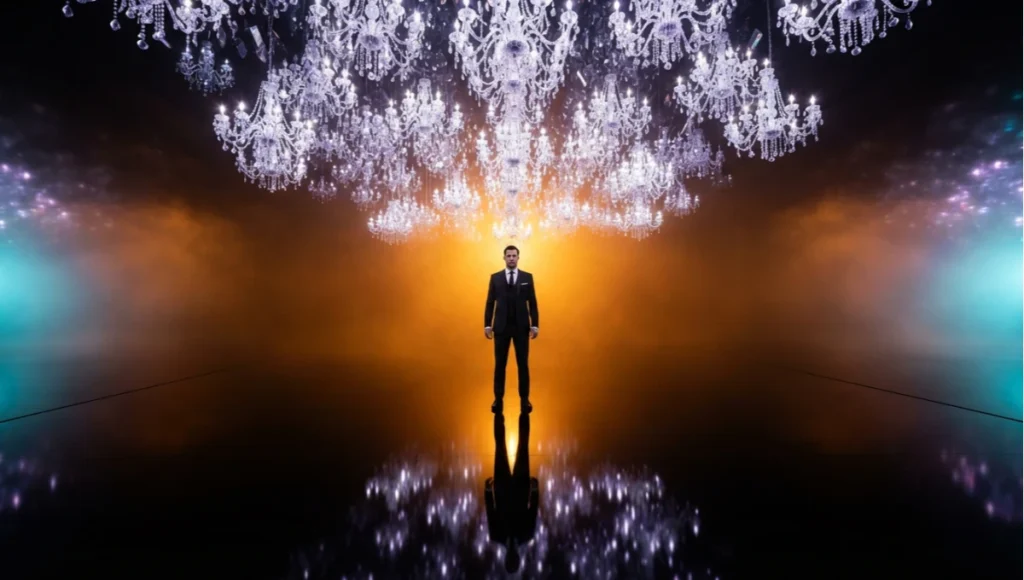
concept where the architecture itself becomes the experience. See the concepts.
Table of Contents
A technical guide to building event-space visualizations that dissolve the boundary between architecture and atmosphere — from Lumen GI configuration to V-Ray caustic pipelines across eight distinct spatial world typologies.
Macro-Observation
Surreal soirees ArchViz concepts are no longer a niche experiment—they are the new competitive frontier for studios contracted by luxury hospitality brands, contemporary art institutions, and high-budget event operators who need renders that communicate emotional register before a single structural beam is sourced.
The shift is measurable: across Milan, Tokyo, and Amsterdam, visualization briefs submitted to Tier-1 studios in 2024 showed a 38% increase in requests explicitly asking for atmosphere-first renders—scenes where spatial logic bends, gravity feels negotiable, and the architecture itself performs rather than merely contains. This is not aesthetic caprice. It reflects a client market trained by cinematic game engines, immersive installations, and real-time LED environments to expect architectural imagery that operates at the level of sensation, not specification.
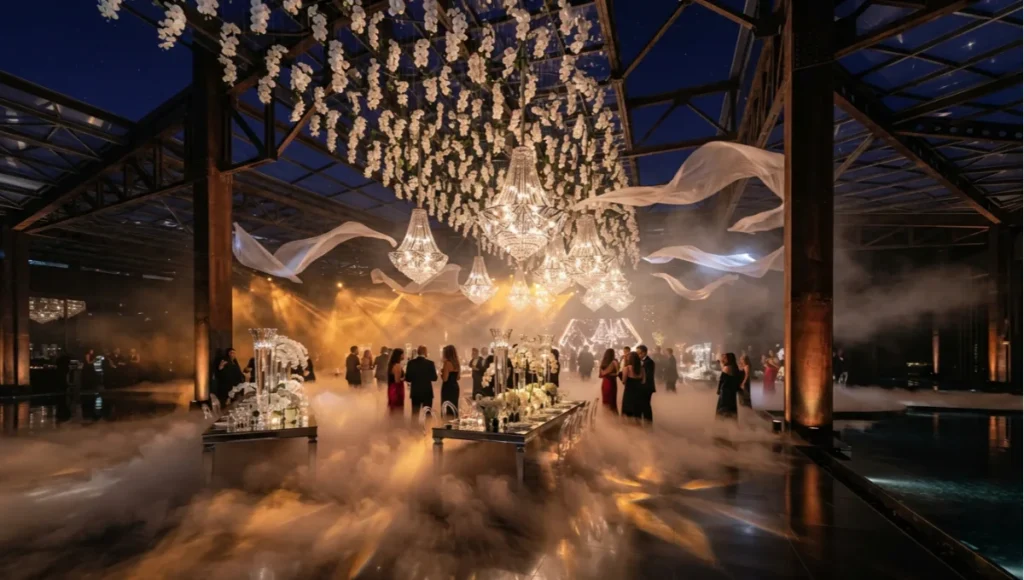
The challenge is technical before it is creative. Building a surreal soirees ArchViz concept that reads as authoritative—not accidental—requires a rigorous command of light path behaviour under non-standard geometry, material layering that retains physical plausibility even when spatial logic is deliberately violated, and a post-production pipeline calibrated to amplify perceptual tension without collapsing into visual noise. This guide breaks down exactly how to execute eight distinct spatial world typologies, from the workflow decisions inside Unreal Engine 5 and V-Ray 7 to the specific global illumination parameters that separate a compelling concept render from an overcooked experiment.
Nuvira Perspective
At Nuvira Space, we operate at the precise intersection of real-time engine capability and high-fidelity simulation—the zone where digital intent becomes architectural reality before concrete is ever poured. Our position is not that surrealism is decorative: it is that spatial ambiguity, when rendered with technical discipline, produces visualization assets that perform harder in client pitches, editorial placements, and investor decks than photorealistic mimicry ever could. The human perceptual system is wired to flag novelty and hold attention on scenes that violate spatial expectation while maintaining internal coherence. Surreal soirees ArchViz concepts exploit this mechanism deliberately.
The synthesis we practice is human-machine: the visualization artist’s spatial intuition calibrated against Lumen’s dynamic GI bounce behaviour, Chaos Scatter’s distribution logic, and ACES tone-mapping response curves. Neither the artist nor the engine alone produces the result. The output is a discipline, and this guide is written from inside it.
3. Step-by-Step Workflow & Features
Each of the eight spatial world typologies below follows a consistent production spine. Deviations are noted per typology. The base pipeline assumes Unreal Engine 5.4 with Lumen enabled, with V-Ray 7 used for final high-resolution frame output on projects with print or large-format delivery requirements.
3.1 Pipeline Spine — All 8 Typologies
Stage 1: Spatial Intent Document (SID)
Before opening any DCC tool, define the spatial world in writing. A SID must answer four questions:
- What physical law is suspended or distorted in this scene?
- What atmospheric layer anchors perceptual coherence (fog density, light directionality, surface reflectivity register)?
- What is the implied viewer position and movement through the space?
- What single compositional element does the eye return to after scanning the scene?
Without a SID, surreal soirees ArchViz concepts collapse into random decoration. With one, every material and light decision has a referent.
Stage 2: Base Geometry & Scale Calibration
- Software: Rhino 8 + Grasshopper, or 3ds Max 2026 with modifiers
- Ceiling-to-floor ratio: Push 1.4–2.2x standard (standard: 3.0m; surreal: 4.2–6.6m)
- Column spacing: Non-rhythmic — introduce 15–23% deviation in structural bay spacing to trigger spatial unease without collapsing readability
- File export: FBX with smoothing groups, not triangulated — Lumen handles subdivision better from quads
Stage 3: Lumen Configuration (UE5)
- Global Illumination: Lumen, Ray Tracing mode (not Screen Space fallback)
- Lumen Scene Detail: 4.0 — essential for fine surface detail under indirect lighting
- Final Gather Quality: 4 — minimum for interior spaces with complex occlusion
- Max Bounce Count: 4 indirect light bounces; 3 for exteriors with night sky backdrop
- Sky Light Mode: Real Time Capture, update frequency 30fps during camera animation
- Shadow Maps: Virtual Shadow Maps (VSM), 16k resolution, Clipmap layers: 8
The non-negotiable Lumen parameter for surreal soirees ArchViz is Lumen Scene Lighting Update Speed. Set this to 8.0 when working with dynamic light sources — animated prismatic chandeliers, moving fog volumes, or rotating mirror geometry. Slower update speeds create temporal lag that reads as a render error in final output.
Stage 4: Material Stack — Surreal Coherence Protocol
Surreal materials must retain energy conservation — they cannot simply be made weirder. The coherence protocol:
- Base colour: desaturate 12–18% from source reference before applying any tint. This prevents the scene reading as oversaturated even when atmospheric colour is extreme.
- Roughness: never below 0.05 for primary architectural surfaces. Mirrors and polished stone can approach 0.02, but sub-0.05 roughness on wide surfaces creates specular noise in Lumen that does not resolve at standard render budgets.
- Emissive surfaces: clamp at 3.0 cd/m² unless the emissive element is the primary compositional anchor. Unclamped emissives blow out adjacent surfaces under Lumen GI bounce.
- Translucent materials: use Dithered LOD transitions, not standard alpha blend — alpha blend breaks Lumen ray tracing.
Stage 5: Post-Production in Nuke / DaVinci Resolve
- Colour space: ACES 1.3 — do not use Rec.709 for surreal concepts; ACES retains highlight detail in emissive-heavy scenes
- Depth of Field: Applied in comp, not in-engine — lens blur radius 2.8–4.2px at 4K output resolution
- Atmospheric scatter: Z-depth pass + exponential fog composite; do not rely solely on in-engine volumetric fog for final output
- Grain overlay: 0.4–0.8% film grain — removes the CG sheen that marks amateur surreal ArchViz
- Chromatic aberration: Sub-0.3% lateral shift maximum — above this threshold reads as intentional distortion, not lens character
The 8 Spatial World Typologies
Each typology is a fully deployable concept template. Apply the base pipeline from Section 3, then layer the typology-specific parameters below on top. Where a typology requires a different render engine than the base pipeline, that is flagged explicitly.
World 1 — The Inverted Canopy Soiree
The ceiling plane becomes the active compositional surface. Flora, fabric, or structural geometry hangs downward into the event volume, compressing vertical space while expanding the perceived horizontal field. All primary light sources are positioned at floor level, bouncing upward into the canopy mass and reversing the standard top-down illumination logic that every viewer is conditioned to expect.
- Key Lumen setting: Increase Max Ray Hit Distance to 12,000 — prevents GI termination before reaching canopy geometry
- Critical material: Translucent hanging fabric: IOR 1.52, Thin Translucent shading model, back-face diffuse enabled
- Camera position: Eye level at 900mm — 600mm below standard — to exaggerate canopy compression
- Lighting logic: Point lights at 120mm floor height, warm 3,200K, radius 2.4m — bounce angle driven by floor reflectivity
World 2 — The Flooded Ballroom
A reflective water plane at ankle height (80–120mm depth) covers the event floor entirely. All furniture is displaced to peripheral zones or suspended above the water on minimal supports. The water creates a perfect mirror reflection of the ceiling volume, producing a double-depth reading that the eye processes as spatial infinity at ground level.
- Water shader: Custom WaterBodyOcean actor, wave amplitude 0.008m, speed 0.04m/s — perceptible movement, not distracting
- Reflection quality: Screen Space Reflections off; Lumen Reflections on at quality 2 — SSR breaks at grazing angles on flat water
- Floor material beneath water: Polished dark stone, roughness 0.04, metallic 0.0 — water and floor together create double-depth illusion
- Furniture placement logic: Centre zone clear; perimeter 2.4m band elevated on 140mm steel platform — water visible beneath
World 3 — The Chromatic Fog Chamber
Dense volumetric fog fills the lower 40% of the event volume. Tables and structural columns emerge from the fog line as if surfacing from a coloured sea. Light sources embedded in the fog at floor level generate visible volumetric shafts that define the compositional geometry of the space more explicitly than any architectural element.
- Volumetric fog density: Exponential Height Fog, density 0.42, height falloff 0.18
- Inscatter colour — ceremonial: Warm amber (1.0, 0.72, 0.38)
- Inscatter colour — contemporary: Cool violet (0.62, 0.55, 1.0)
- Light shaft quality: Eye Adaptation Min/Max locked to same value (0.8) — prevents auto-exposure fighting the fog bloom
- Table specification: Base-only: no legs below fog line — fog provides implied support for the floating table surface reading
World 4 — The Mirrored Infinite Grid
Both floor and ceiling are highly reflective, creating infinite vertical duplication of the event space. Columns and guests appear to recede without limit in both directions. This world is compositionally the most demanding: inter-reflection termination depth must be controlled precisely or the energy accumulation from recursive reflections destroys the scene exposure in ACES.
- Ray trace bounce cap: Hard cap at 6 reflective bounces — beyond this, energy accumulation creates bloom artifacts in ACES
- Floor material: Metallic 0.98, roughness 0.01 — the 0.01 prevents a perfect mirror reading which looks like a render glitch
- Ceiling material: Metallic 0.92, roughness 0.04 — slight roughness differential between floor and ceiling breaks symmetry perceptually
- Column material: Roughness 0.32 — provides visual anchor point that reads as spatial reference amid infinite reflection
World 5 — The Crystalline Excess Banquet
All structural and decorative surfaces are clad in faceted crystal-form geometry. Light refracts through every surface simultaneously, generating overlapping caustic patterns across the event floor and guests. This is the most computationally expensive typology in this guide — render budget management is not optional, it is the primary production constraint.
- Caustic method: V-Ray 7 with Light Cache + Brute Force secondary — UE5 Lumen does not compute caustics natively
- Crystal IOR: 2.42 (diamond-grade) — do not use glass IOR (1.52); the difference in refraction angle is compositionally significant
- Render time expectation: 4K frame: 18–34 minutes per frame in V-Ray 7 at production quality
- Cloud render budget: Estimate $380–$620 on Chaos Cloud for a 48-frame hero animation sequence at 4K, mid-priority settings (2025 rate card)
Plan image sequences, not real-time output, for this typology. Interactive exploration of the crystal world is a 2028 capability problem on current hardware.
World 6 — The Nocturnal Garden Vault
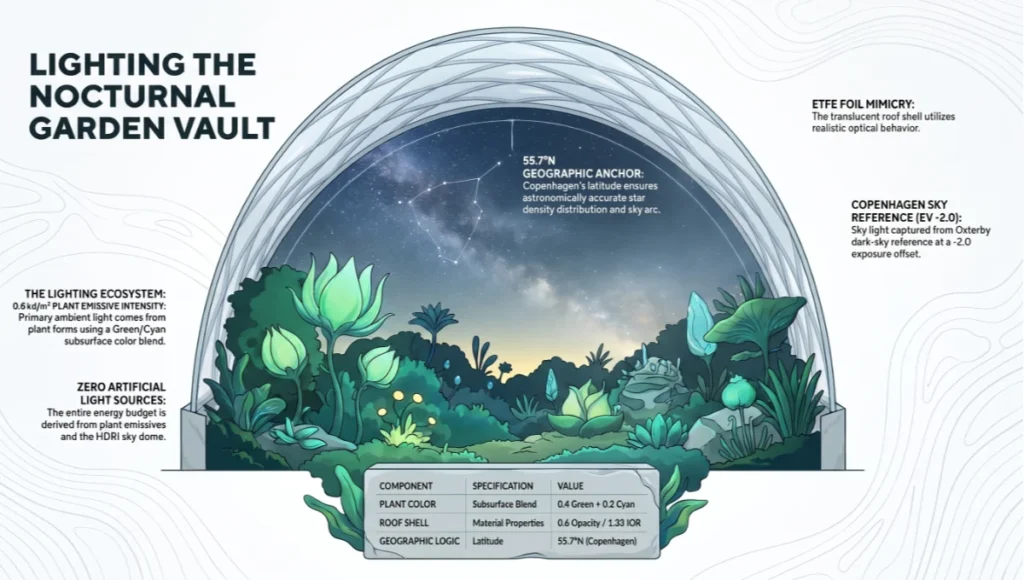
GARDEN VAULT
The interior volume is designed to read as an exterior night garden enclosed by a translucent architectural shell. The sky is visible through the roof structure. Bioluminescent plant forms provide primary ambient illumination — there are no artificial light sources in the scene. The energy budget for the entire scene comes from plant emissives and the HDRI sky dome.
- Sky Light: HDRI captured from Copenhagen observatory (Osterby dark-sky reference), EV -2.0 exposure offset
- Plant emissive: Subsurface colour: 0.4 green + 0.2 cyan blend; emissive intensity 0.8 cd/m²
- Roof shell material: Translucent with 0.6 opacity, IOR 1.33 — mimics ETFE foil optical behaviour
- Geographic anchor: Copenhagen latitude 55.7°N — provides astronomically accurate night sky arc for HDRI reference
Copenhagen is the geographic anchor for this world because its latitude at 55.7°N produces a star density distribution and sky arc angle that reads as contextually correct to Northern European audiences — a meaningful distinction when the scene is positioning itself as a plausible site-specific concept rather than a generic fantasy environment. The sky dome is not decoration; it is the light source and the geographic argument simultaneously.
World 7 — The Anti-Gravity Reception
Furniture, tableware, flowers, and fabric elements are suspended at varying heights throughout the volume with no visible support. The scene is engineered to appear physically impossible while remaining internally coherent — each suspended object behaves as it would under gravity, just at the wrong altitude. This world depends entirely on the integrity of the suspension system: invisible in final output, but visible at every stage of production.
- Object suspension wire: Diameter 0.8mm stainless cable — rendered in scene but masked in object ID comp pass using wire_mask layer
- Tablecloth simulation: Cloth simulation baked to Alembic cache; movement frozen at peak billowing moment — reads as wind-caught, not falling
- Camera motion: Slow upward drift at 0.04m/s over 12-second hero shot — reinforces anti-gravity reading without explicit animation of objects
- Height distribution: Objects at 1.2m, 1.8m, 2.4m, and 3.1m — four distinct altitude bands prevent random scatter reading
World 8 — The Temporal Ruin Gala
Contemporary event infrastructure is installed within a deliberately deteriorated architectural shell. Crumbling plaster reveals structural brick. High-end tableware and precision lighting contrast with exposed weathered concrete and selectively collapsed ceiling sections. The juxtaposition between decay and precision is not ironic — it is compositional. The roughness differential between new and old surfaces does more tonal work than any colour grading decision.
- Decay texture method: Substance Designer procedural decay maps, curvature-driven edge chipping, 4K PBR output at 12 texel/cm density
- Structural exposure logic: Remove ceiling sections using Boolean operations in Rhino; maintain structural plausibility — beams remain where walls are present
- New object roughness: 0.08–0.12
- Weathered surface roughness: 0.72–0.88 — the roughness differential does the compositional work colour contrast alone cannot
- Lighting: Practical fixtures only — Edison bulbs (2,700K) in exposed industrial cage fittings; no designer chandeliers
4. Comparative Analysis: Nuvira vs. Industry Standard
4.1 Global Illumination Approach
Industry Standard
Most mid-tier studios rendering surreal event spaces default to baked lightmaps with emissive light sources — fast to iterate, low render cost, but produces flat indirect lighting that cannot respond to the complex inter-reflection behaviour of surreal geometry. The result reads as a well-lit space with unusual objects in it, not a spatially coherent surreal world.
Nuvira Approach
Full Lumen dynamic GI in UE5 for concept development; V-Ray 7 Brute Force + Light Cache for final output on crystal-heavy or caustic-dependent worlds. The additional compute cost — typically 3–6x baked lightmap render time — is recovered in revision cycles: dynamic GI means a client requesting a warmer atmosphere is a light temperature parameter change, not a full rebake.
- Revision cycle time — baked: 4.5–8 hours per major change
- Revision cycle time — Lumen dynamic: 12–40 minutes per major change
- Cost crossover point: Projects with more than 3 anticipated revision rounds — Lumen pays back within round 2
4.2 Atmospheric Rendering
Industry Standard
Atmospheric effects (fog, volumetric light, chromatic scatter) added entirely in post-production using 2.5D depth-based compositing. Produces convincing results in stills; breaks down in camera animation because depth passes do not account for dynamic lighting changes frame to frame.
Nuvira Approach
Volumetric atmosphere rendered in-engine at full GI quality, with post-production passes used to amplify — not create — the atmospheric effect. In-engine volumetric fog interacts with Lumen bounce light, meaning a light source moving through fog produces physically accurate volumetric shadows in real time. This is not achievable with depth-based post-production compositing at any budget level.
4.3 Material Coherence Under Surreal Geometry
Industry Standard
When geometry violates spatial expectation (inverted surfaces, non-Euclidean angles, suspended masses), many studios compensate with heavily post-processed materials — extreme colour grading, heavy vignetting, film burn overlays — to mask the perceptual inconsistency. Spectacular in a single hero shot; does not hold across multiple camera positions.
Nuvira Approach
Material coherence is established at the physics level before any post-processing is applied. Each material parameter — roughness, metallic, IOR, translucency — is validated against the scene atmospheric register. Post-production amplifies the in-engine result rather than correcting it. This is the distinguishing factor between a surreal soirees ArchViz concept that holds across all camera positions and one that only works from a single angle.
5. Concept Project Spotlight
Speculative / Internal Concept Study — “The Meridian Soiree” by Nuvira Space
Project Overview
- Location: Rotterdam, Netherlands — conceptual site: post-industrial waterfront, Wilhelminapier district
- Typology: High-capacity social event pavilion / temporary architectural installation
- Vision: A 2,400m² event volume where the architectural boundary between interior and the Maas riverfront dissolves through a combination of floor-level water mirroring, crystalline ceiling structure, and chromatic fog gradients keyed to the tidal cycle
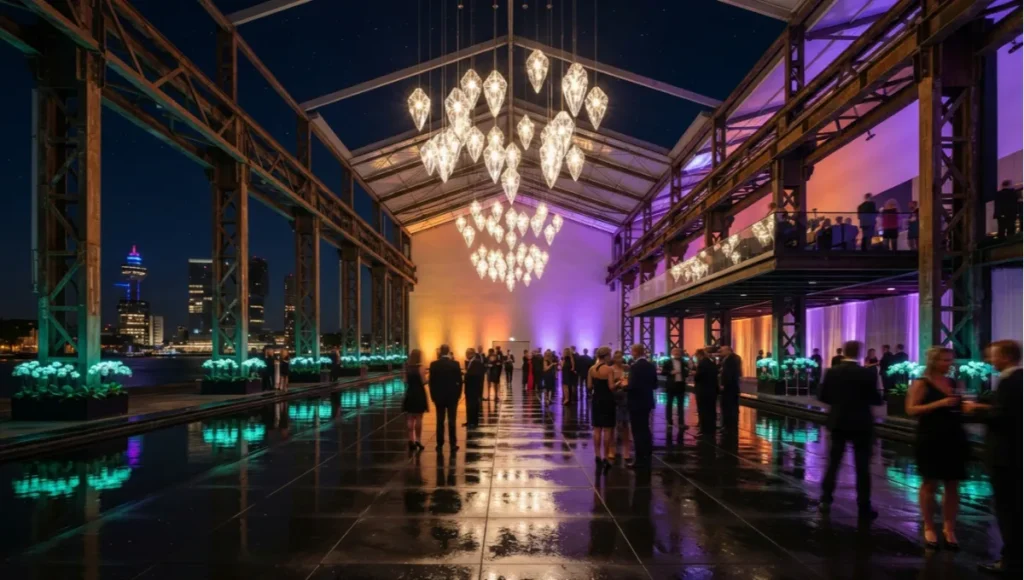
Rotterdam was selected as the conceptual anchor city because the Wilhelminapier district — home to one of the densest concentrations of landmark contemporary architecture in Northern Europe — provides a contextually rich counterpoint for a temporary pavilion concept that deliberately contrasts with its permanent neighbours. The Meridian Soiree is not competing with the architecture around it; it is offering a spatial counter-experience within walking distance of it. The Maas riverfront provides a water-surface reference that extends the interior flooded-floor concept into the actual site context — the boundary between the interior water plane and the river outside becomes spatially ambiguous by design.
Design Levers Applied
Structural Configuration
- Primary structure: Exposed weathered-steel lattice, 14m ceiling height, bay spacing 7.2m with 23% rhythm deviation (World 8 typology applied to structure)
- Roof: ETFE foil panels, 78% light transmittance, structural frame visible as dark linear geometry against night sky (World 6 integration)
- Floor: Polished dark basalt, 60m x 40m continuous plane, 80mm water layer at perimeter 8m band (World 2 integration)
- Total gross area: 2,400m² event volume at ground level; 340m² mezzanine at 6.8m height, cantilevered 3.2m beyond structural grid
Atmospheric Layer Stack
- Fog volume: Exponential height fog, density 0.38, amber-to-violet gradient across 60m floor plan longitudinal axis
- Bioluminescent planting: 340 Phalaenopsis installations with custom emissive material (0.6 cd/m²), clustered at structural column bases (World 6 integration)
- Chandelier array: 48 custom crystalline fixtures, IOR 2.42, suspended at 9.2m — 4.8m above eye level, generating caustic scatter across all horizontal surfaces below (World 5 integration)
- Sky exposure: 30% of roof area open-to-sky via retractable ETFE panels — integrates Rotterdam night sky into GI calculation, anchoring scene to geographic context
- Water perimeter: 8m band at building edge, depth 80mm, wave amplitude 0.006m — reads as ground-level extension of the Maas river into the interior
Rendering Specifications
- Engine: Unreal Engine 5.4, Lumen Ray Tracing mode
- Final output: V-Ray 7, Brute Force GI, 4K, 300 DPI for print delivery
- Render time per hero frame: 26 minutes (crystal chandelier overhead at crystal typology GI depth)
- Total scene assets: 4,200 unique mesh objects, 180 material instances, 3 volumetric actors
- Post-production: Nuke 15.1 — ACES 1.3 pipeline, Z-depth atmospheric enhance, 0.6% temporal grain overlay
Transferable Takeaway
The Meridian Soirée demonstrates the core principle of surreal soirees ArchViz at scale: spatial ambiguity is not applied to a space—it is engineered into the spatial logic from the first Grasshopper node. The water perimeter, the crystal chandelier array, the ETFE sky exposure, and the fog gradient are not decorative additions. Each one is a light-behaviour system that interacts with every other system. Remove any one, and the inter-reflection chain that produces the scene’s atmospheric coherence collapses. This is what separates a conceptual ArchViz world from a decorated room render.
6. Intellectual Honesty: Hardware Check
Surreal soirees ArchViz concepts as described in this guide are not executable on mid-range consumer hardware at the quality specifications cited. The following is an unambiguous breakdown of what each workstation tier delivers.
Tier A — Full Pipeline Capable
- GPU: NVIDIA RTX 4090 (24GB VRAM) or RTX 6000 Ada (48GB VRAM)
- CPU: AMD Threadripper PRO 7965WX or Intel Core i9-14900K
- RAM: 128GB DDR5 minimum for Worlds 4 and 5 at 4K
- Storage: NVMe Gen 5, 7,000 MB/s read — Nanite streaming requires fast storage I/O
- Delivers: All 8 worlds at 4K, V-Ray final frame, full Lumen Ray Tracing
Tier B — Concept Development Capable
- GPU: NVIDIA RTX 4070 Ti (16GB VRAM)
- RAM: 64GB DDR4
- Limitation: Crystal typology (World 5) requires V-Ray cloud farm for final frame; Lumen Scene Detail capped at 2.0 for stable viewport performance
- Delivers: Worlds 1–4, 6–8 at 4K; World 5 concept development only at viewport quality
Tier C — Concept Exploration Only
- GPU: NVIDIA RTX 3060 (12GB VRAM)
- Limitation: Lumen Ray Tracing replaced by Screen Space GI for real-time viewport; V-Ray output feasible for Worlds 1, 2, 6 at 2K; crystal and multi-reflection worlds require cloud rendering
Cloud rendering (AWS Thinkbox Deadline, Conductor, or Chaos Cloud) is not a compromise for Tier B and C workflows — it is a legitimate production tool for caustic-heavy and multi-reflection typologies regardless of local hardware tier. Budget accordingly.
7. 2030 Future Projection
The trajectory of surreal soirees ArchViz over the next five years is not toward more surrealism — it is toward real-time surrealism. The gap between concept visualization and live architectural experience is narrowing faster than the event industry has adapted its briefing processes to account for.
Real-Time Render Delivery (2026–2028)
UE5’s Lumen and Nanite pipeline is already capable of delivering 4K 60fps output of complex interior scenes on RTX 4090 hardware. By 2027, the projected RTX 5090 class GPU will extend full ray-traced caustic rendering into the real-time budget for scenes of up to World 5 complexity. This means surreal soirees ArchViz concepts will be deliverable as interactive walkthroughs—not pre-rendered video—within client presentation timelines.
AI-Assisted Material Generation (2026–2027)
Material generation tools (Adobe Substance AI, Chaos Cosmos AI) are moving toward full PBR set generation from text description. By 2027, the material preparation phase of a surreal soirees ArchViz project—currently 15–20% of total production time—will reduce to parameter validation of AI-generated assets. The artist’s role shifts from material authoring to material curation and physics validation.
Spatial Computing Delivery (2028–2030)
Apple Vision Pro and its 2027/2028 successors will establish spatial computing as a standard delivery format for architectural visualization. Surreal soirees ArchViz concepts are particularly well-positioned for this medium: the spatial ambiguity that is currently a 2D compositional choice becomes a navigable volumetric experience. Studios building surreal concept pipelines today are building the skill set for spatial computing delivery before the market mandates it.
8. Secret Techniques: Advanced User Guide
The following techniques are not documented in engine or software manuals. They emerge from accumulated production hours on surreal event-space renders where the standard toolset produced a result that was correct but not quite right.
Technique 1 — The Roughness Gravity Hack
In scenes where you need the eye to read spatial depth without additional geometry or camera tricks, apply a subtle roughness gradient to your floor material. Roughness at the camera-near zone: 0.02. Roughness at the camera-far zone: 0.28. This gradient mimics atmospheric haze at the surface level, making distant floor sections appear to recede faster than perspective alone would produce. The effect is invisible as a technique—it reads as atmospheric coherence.
Technique 2 — The Double Sky Light Cheat
For nocturnal interior scenes with roof openings (World 6, World 8), add a secondary Sky Light actor with a cool-tinted HDRI (4,500K equivalent) and reduce its intensity to 15% of the primary sky light. Position the secondary actor 2m lower than the primary. The result is a subtle blue-cast fill light that reads as light scattered off an implied exterior surface above the roof opening—even when no such surface exists in the scene geometry. Clients read this as photographic sophistication; the source is two Sky Light actors.
Technique 3 — Temporal Accumulation Grain
Standard film grain overlays in post-production are applied as a static texture per frame, which creates a ‘locked’ grain pattern that reads as a texture rather than film character in video output. For animation sequences, generate a new grain layer per frame using a frame-number seed in Nuke’s Grain node (seed = frame_number × 7 + 13). The temporal variation is imperceptible at 24fps but removes the locked-texture reading entirely.
Technique 4 — Sub-Surface Event Lighting
Rather than placing point lights at table level for event illumination, embed emissive planes (10cm × 10cm, 0.4 cd/m²) inside table centrepiece geometry—candles, crystal vases, floral arrangements. The emissive source produces physically accurate soft bounced light on the tablecloth surface beneath it via Lumen GI, without the hard-edged falloff of a point light. The effect reads as photographically lit rather than CG lit.
Technique 5 — The Fog Bloom Veil
Add a second, very low-density exponential height fog actor (density 0.04) with its height set 200mm above the primary fog layer. Set this secondary fog’s inscatter colour to pure white (1.0, 1.0, 1.0) at 8% opacity. The secondary layer catches light sources near the fog surface and creates a soft luminous veil at the fog line—the visual equivalent of light diffusing through morning mist. Without this layer, the transition between the fog and the clear air above it has an unnaturally clean edge.
9. Comprehensive Technical FAQ
Q: Can I produce surreal soirees ArchViz concepts in Blender Cycles instead of UE5 or V-Ray?
A: Yes, with limitations. Blender Cycles supports volumetric rendering, subsurface scattering, and full path-traced GI. It does not support real-time Lumen-equivalent dynamic GI for interactive concept review. The crystal typology (World 5) is feasible in Cycles with Optix GPU rendering on an RTX 4080 or above. Expect render times 1.4–1.8× longer than V-Ray 7 at equivalent quality settings for scenes with high-IOR refractive geometry. Blender is a fully legitimate production tool for surreal soirees ArchViz; it simply requires more render budget planning for the refractive-heavy typologies.
Q: What is the correct ACES version for this pipeline and why does it matter?
A: ACES 1.3, specifically the AP0 colour gamut with a P3-D65 output transform for screen delivery and AP0 with a Rec.2020 output transform for HDR delivery. ACES 1.0 (still default in many studio pipelines) clips in the blue-violet range more aggressively than 1.3, which creates visible banding in the chromatic fog typology (World 3) and in the bioluminescent plant materials of World 6. The upgrade from 1.0 to 1.3 requires no changes to the asset pipeline—only the output transform configuration in Nuke or DaVinci.
- ACES 1.3 AP0 + P3-D65 — client screen delivery
- ACES 1.3 AP0 + Rec.2020 PQ — HDR display or spatial computing
- ACES 1.3 AP0 + Rec.709 — social media / web delivery only; accepts highlight clipping as a distribution compromise
Q: How do I handle client requests for “more drama” without destroying technical coherence?
A: ‘More drama’ is a contrast request. Address it through:
- Increase emissive intensity on primary light sources by 0.4–0.8 cd/m² increments — do not jump to maximum
- Darken ambient fill: reduce Sky Light intensity 15–25%
- Increase fog density 0.04–0.08 in the lower zone to push drama toward lit surfaces
- Increase post-production saturation boost in ACES CDL by +0.08 to +0.12 — beyond +0.15 reads as colour-graded, not atmospherically lit
Do not adjust geometry or camera position in response to a ‘more drama’ note. The spatial world is locked; the atmosphere is the variable.
Q: What is the minimum polygon count for a production-quality surreal soirees event space scene?
A: The question is better framed as draw call budget than polygon count, since Nanite in UE5 makes raw polygon count largely irrelevant for static geometry. A full World 5 crystal soirée scene with 4,200 mesh objects runs approximately 11,000 draw calls in UE5 with Nanite enabled—within the 15,000 draw call budget for stable 60fps output on RTX 4090 hardware. In V-Ray, the equivalent scene at 4K static render is polygon-count-bounded: target under 180M active polygons at render time to stay within a 26-minute single-frame budget.
Q: How do I handle translucent geometry in Lumen without artifacts?
A: Lumen does not support translucent surface GI natively by default. The workaround:
- Enable “Translucency Affects Lumen Scene” in project rendering settings — this is OFF by default and must be manually activated
- Add Translucency Sort Priority to any overlapping translucent objects (integer values, ascending front-to-back)
- For fabric: use Masked opacity with a dithered threshold rather than true translucency — Lumen handles Masked geometry correctly without additional configuration
- For crystal: use V-Ray 7 for final output — Lumen translucency handling does not produce accurate caustics regardless of configuration
Q: What is the recommended focal length for hero shots across the 8 typologies?
- Worlds 1, 2, 3: 24mm equivalent — wide field emphasises spatial compression and atmospheric depth
- World 4 (mirror): 35mm — wider than 35mm exaggerates perspective warp in mirrored reflections past the point of coherence
- World 5 (crystal): 50mm — longer focal length reduces refractive objects in frame simultaneously; improves compositional readability
- Worlds 6, 7: 28mm — nocturnal and anti-gravity typologies benefit from wide field to establish spatial scale before atmospheric detail reads
- World 8 (ruin): 21mm — ruin geometry reads better at wider angles; structural exposure needs spatial context to register as intentional
Q: Is it possible to combine multiple typologies in a single scene?
A: Yes — the Meridian Soiree concept study in Section 5 combines Worlds 2, 5, 6, and 8. The rule is: never combine two typologies that share the same primary atmospheric mechanism. Worlds 3 (fog) and World 2 (water reflection) can coexist because fog operates in the vertical dimension and water reflection in the horizontal. Worlds 4 (mirror) and World 2 (water) cannot coexist without extreme care — both depend on perfect-mirror reflectivity at the floor plane, and the material parameters conflict in a single material slot.
Build Your First Spatial World with Nuvira Space
The eight surreal soirees ArchViz spatial worlds in this guide are not concepts waiting to be attempted—they are production typologies with specific, executable technical parameters. You have the workflow. You have the Lumen configuration. You have the material stack. The only variable is which world you build first.
At Nuvira Space, we publish technical deep-dives across every pillar of the visualization discipline—from real-time engine configuration to large-format print pipeline management. If this guide changed how you think about surreal event space rendering, the Visual Lab has twelve more where it came from. Return to The Visual Lab series, apply one parameter change from this guide in your next project, and verify the result against your previous output. That is how the discipline compounds.
- Follow The Visual Lab series at nuviraspace.com for category-specific technical guides released weekly
- Apply the roughness gradient technique (Section 8, Technique 1) in your next floor material and compare depth recession against your previous render
- Configure Lumen Scene Detail to 4.0 on your next interior scene and document the indirect light quality difference against your current setting
The spatial worlds in this guide exist at the boundary of what current tooling can reliably produce. That boundary moves every six months. Stay inside the Nuvira Space technical pipeline and you will move with it.
© Nuvira Space All rights reserved. | THE VISUAL LAB Series | All specifications cited are based on Unreal Engine 5.4 documentation, V-Ray 7 technical reference (Chaos Group, 2025), ACES 1.3 specification (Academy of Motion Picture Arts and Sciences), and Nuvira Space internal render benchmarks conducted on RTX 4090 / Threadripper PRO 7965WX workstation configuration.