

Table of Contents
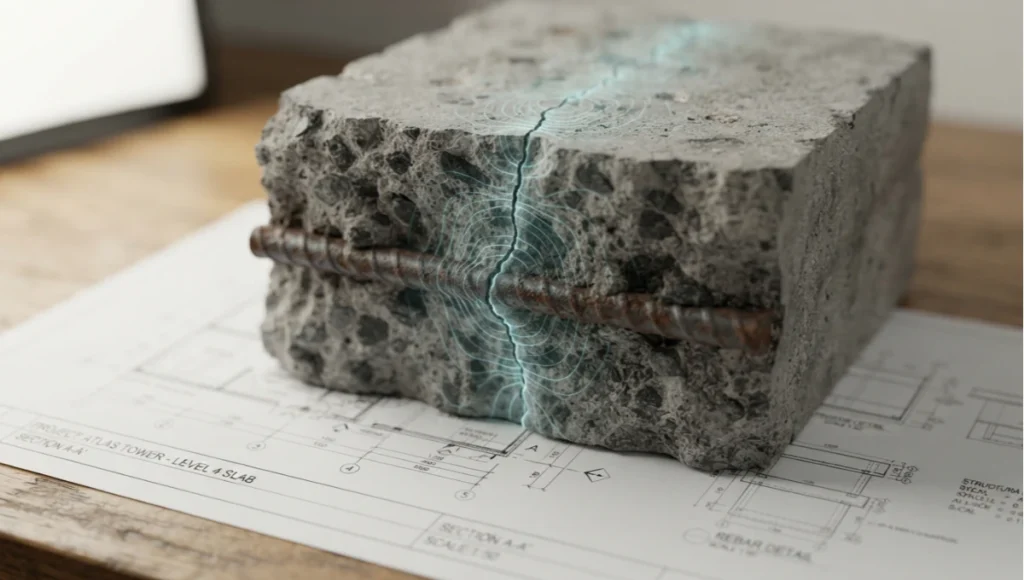
A building starts failing long before you see it. The concrete does not crack overnight; it accumulates 6 to 18 months of micro-fracture propagation before a hairline mark ever reaches a paintable surface. That gap between mechanical onset and human visibility is the single most expensive blind spot in the built environment, and it is the exact gap that quantum sensing structural health micro crack detection was built to close. You are not reading this as a curiosity.
You are reading it because the workflow you were trained on — walk the site, log the visible defects, schedule the next inspection in 12 to 24 months — was designed for a world where structural data arrived slower than structural decay. That world is closing.
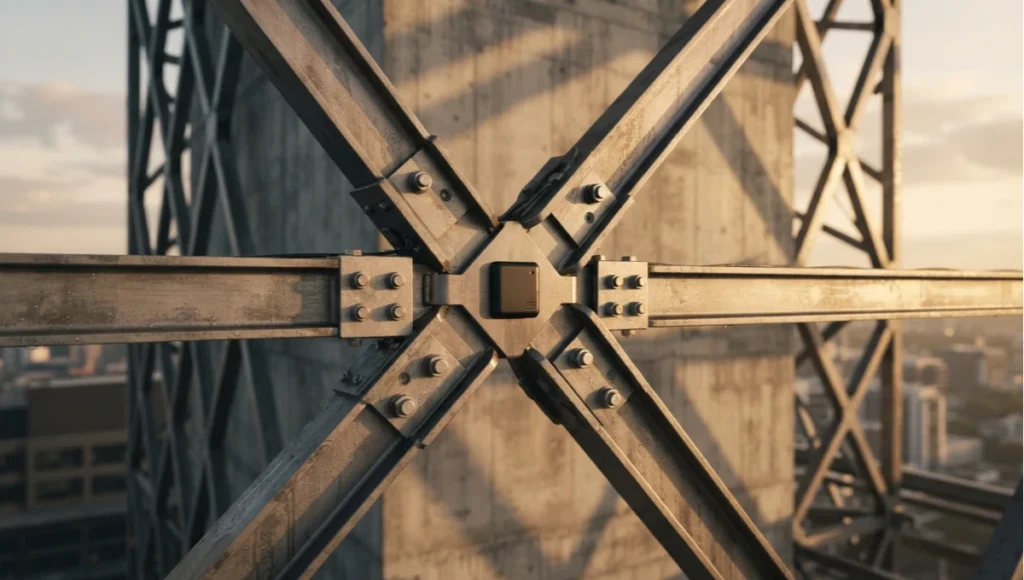
Think about the last punch-list you signed off. Every item on it was a symptom, not a cause: a hairline crack at a beam-column joint, a stain suggesting moisture ingress, a hollow sound under a tapped tile. Each of those symptoms had already been mechanically underway for months, sometimes years, invisible to every inspection cycle that came before it.
Quantum sensing structural health micro crack detection does not wait for the symptom. It reads the magnetic and strain signature of the underlying mechanism — dislocation movement in steel, micro-void coalescence in concrete — while it is still happening at the molecular scale, long before it produces anything a flashlight and a clipboard could catch.
Nuvira Perspective
At Nuvira Space, we treat a building as a live instrument, not a finished object. Human-machine synthesis is not a slogan for us — it is the operating premise behind every concept study we publish. A structure equipped with quantum-grade sensing does not wait for you to notice it is degrading; it reports its own condition, continuously, at a resolution below what any unaided inspector could register. That shift changes who the architect is accountable to. You are no longer designing for a static occupancy certificate issued once at handover. You are designing for a system that will keep grading your decisions in real time, for decades, in sub-nanotesla increments.
This is the parametric flux era: material behavior, fabrication tolerance, and long-term monitoring data are no longer three separate disciplines handled by three separate consultants. They are one continuous feedback loop, and the firms that fail to close that loop will keep specifying structures that behave like black boxes until the day they do not.
Our position is not that every project needs a quantum-grade sensing layer tomorrow. Our position is that you can no longer treat monitoring as an afterthought bolted onto a finished parametric model. When the sensing hardware is specified alongside the fabrication geometry — not after it — the building becomes something closer to an instrument with a facade than a facade with instruments attached. That is the synthesis we design toward: software that predicts, hardware that fabricates, and sensing that verifies, all three informing each other on the same timeline instead of three sequential handoffs.
This is also why we push back on the framing of quantum sensing as an exotic add-on reserved for flagship towers. The technology’s real utility shows up on unglamorous infrastructure — transit tunnels, water treatment structures, parking substructures below the water table — where a 6-to-18-month early warning has a direct line to avoided closures and avoided casualties, not just avoided repair invoices. A design practice serious about human-machine synthesis has to be willing to specify the sensing layer where it matters most, even when that project will never appear on an awards shortlist.
Technical Deep Dive
How Quantum Sensors See What Concrete Hides
Conventional structural health monitoring relies on strain gauges, accelerometers, and vibrating-wire sensors that register deformation only after it has already redistributed load through the structure. Quantum sensing instruments — the subject of our earlier quantum sensing structural monitoring deep dive — work at a different physical layer entirely.
Nitrogen-vacancy (NV) diamond magnetometers detect the magnetic-field distortions produced by micro-fracture propagation in reinforced steel, resolving fields down to the sub-nanotesla range. Superconducting quantum interference devices (SQUIDs) extend that sensitivity further, achieving spatial resolution between 0.1 mm and 0.5 mm when mapping galvanic current shifts across a reinforcement grid. Distributed fiber-optic sensing, using Brillouin optical time-domain analysis (BOTDA), complements the magnetometry layer by tracking strain continuously along a single fiber run rather than at discrete gauge points.
The Sensor Stack
- NV-diamond magnetometer arrays — sub-nanotesla field sensitivity, embedded at 1.2 m intervals along primary load paths
- SQUID gradiometers — 0.1–0.5 mm spatial resolution, cryogenically cooled, used for reinforcement-grid corrosion and micro-pit onset
- Distributed BOTDA fiber — continuous strain resolution to 1 microstrain across a single run, no discrete gauge gaps
- 8-axis robotic arms — used during retrofit installation to route sensor fiber through existing structural cavities with sub-millimeter placement accuracy
- Edge compute nodes (ARM Cortex-A class) — process up to 12 TB of raw magnetic and strain data per building, per month, before it reaches the cloud layer
The practical distinction that matters to you as a designer is spatial resolution versus temporal resolution. A vibrating-wire strain gauge gives you excellent temporal resolution at one fixed point — sampled 50 to 200 times per second — but tells you nothing about the meter of structure between that point and the next gauge. A distributed BOTDA fiber run inverts that trade-off: it gives you continuous spatial coverage along its entire 1 microstrain-resolution length, updated on a slower but still practical multi-minute cycle.
Quantum sensing structural health micro crack detection is valuable precisely because it stacks both resolutions — point-source magnetic sensitivity from the NV-diamond and SQUID layers, plus distributed strain coverage from the fiber layer — so a crack initiating between two conventional gauge points no longer goes unseen simply because it did not choose to happen under an instrument.
Installation sequencing matters more than most specifications acknowledge. NV-diamond nodes are placed at connection points during the same 8-axis robotic fabrication pass that mills the structural steel, because retrofitting them after cladding is closed up adds a labor cost that can exceed the sensor hardware cost itself. SQUID clusters, by contrast, are almost always installed below grade, close to the water table or soil interface where corrosion risk concentrates, and they require a dedicated cryogenic supply line run alongside standard MEP routing — a detail that has to be coordinated at the same stage as plumbing and electrical, not bolted on afterward.
Parametric Flux — Digital Fabrication Meets Live Data
The ‘so what’ is this: once a structure is instrumented at this resolution, the parametric model that generated its geometry does not have to stop working at handover. Fabrication tolerances that were locked at ±3 mm during 8-axis robotic milling can now be re-validated against real strain data collected in the first 90 days of occupancy, and the digital twin adjusts its predictive maintenance schedule accordingly.
A facade panel joint specified for a 2 mm thermal expansion gap either holds that tolerance under live load, or the sensing layer flags the deviation within hours, not the next scheduled inspection cycle 18 months out. That is the functional difference between a building that is designed once and a building that keeps being designed.
Consider what this does to daily functionality rather than just structural safety. A digital twin building management system fed by continuous quantum-layer data can reallocate HVAC load away from a bay showing early strain drift, close a floor’s elevator bank for inspection before a shaft misalignment becomes audible, or delay a scheduled facade wash if wind-load readings suggest the panel seals are already near tolerance. None of that is speculative software marketing — it is the direct operational consequence of moving from a 12-to-24-month manual inspection cadence to a sub-nanotesla continuous feed. The lived experience of the building changes because the building’s own maintenance decisions are now made on a data cycle measured in hours, not years.
Comparative Analysis
Solution vs. Industry Standard
The industry standard for structural health monitoring between 2024 and 2026 is a distributed wireless mesh of MEMS accelerometers and vibrating-wire strain gauges, sampled at 50–200 Hz, backed by manual inspection cycles every 12 to 24 months. Quantum sensing does not replace that mesh outright — it operates one layer beneath it.
- Detection lead time — quantum sensing: 6–18 months before visible surface cracking; MEMS mesh: 0–2 months, typically after threshold breach
- Hardware cost for a 200-node deployment — quantum sensing: $480,000–$960,000; MEMS mesh: $40,000–$160,000
- Sampling behavior — quantum sensing: continuous field-level monitoring at sub-nanotesla sensitivity; MEMS mesh: threshold-triggered sampling at 50–200 Hz
- Failure-cost offset — 1 avoided major structural incident carries an average direct cost of $18M–$340M, which the quantum sensing premium recovers many times over on critical infrastructure
You should not read this as quantum sensing ‘winning.’ On a low-risk residential podium, the MEMS mesh remains the correct specification. On a transit tunnel, a long-span bridge, or a hospital critical-care wing, the 6-to-18-month lead time is the entire value proposition, and the cost delta stops being a debate.
There is a second axis worth putting numbers on: maintenance labor. A MEMS mesh with 200 nodes typically needs battery or wired-power servicing across 15–20 site visits per year for a large asset. A quantum sensing layer, once the cryogenic supply for its SQUID clusters is commissioned, runs largely unattended between the 4-hour digital twin refresh cycles, with physical intervention required only when the edge compute layer flags a hardware fault rather than on a fixed calendar. That difference in labor overhead rarely appears in the initial capital cost comparison, but it compounds over a 60-year design life.
Where the Industry Standard Still Wins
The MEMS mesh is not obsolete technology waiting to be replaced — it is the correct tool for vibration-dominant failure modes. A 50–200 Hz sampling rate captures seismic response, wind-induced sway, and live-load oscillation far better than a magnetometer array tuned for slow, static field drift. Quantum sensing structural health micro crack detection is not built to catch a sudden overload event; it is built to catch the 6-to-18-month accumulation that precedes one.
The AIA’s own guidance on integrating building performance data into design practice makes a parallel case for simulation and monitoring data feeding decisions earlier, not just at handover. Specifying the two sensing layers together, rather than choosing between them, is the position we take on every Nuvira Space critical-infrastructure concept study.
Concept Project Spotlight — Speculative / Internal Concept Study: Meridian Skin, by Nuvira Space
Project Overview
Location: Rotterdam, Netherlands
Typology: 34-story mixed-use timber-hybrid tower
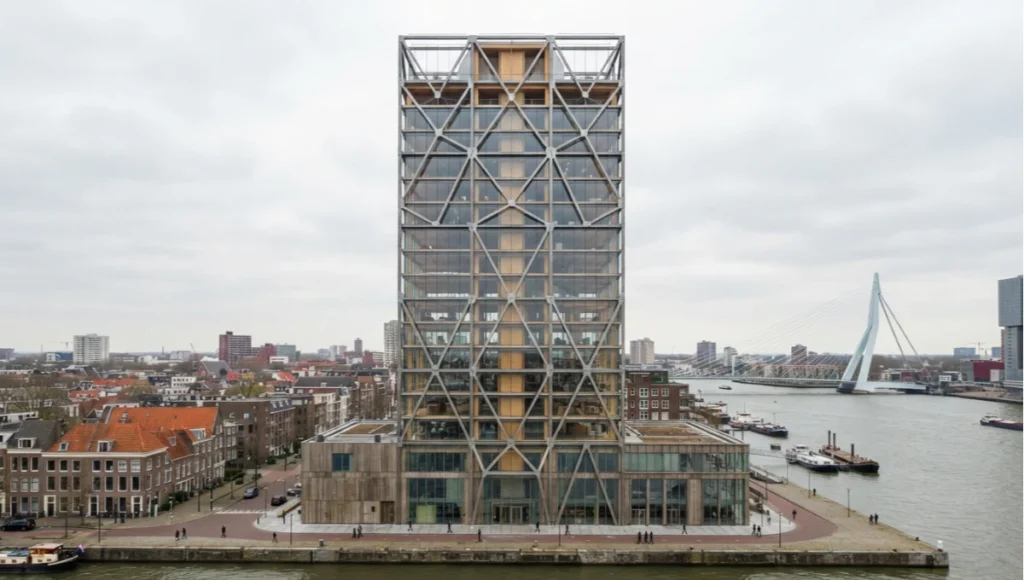
Vision: Meridian Skin explores a structural facade that reports its own fatigue state to the building management system in real time, using its exposed cross-laminated timber and steel diagrid as both architectural expression and sensing substrate.
Design Levers Applied
- 42 NV-diamond magnetometer nodes embedded within the steel diagrid at every second connection point
- A continuous BOTDA fiber run of 1.1 km threaded through the timber core during 8-axis robotic fabrication
- 6 SQUID gradiometer clusters positioned at the below-grade transition zone, where Rotterdam’s high water table accelerates corrosion risk
- A digital twin refresh cycle of 4 hours, reconciling live sensor data against the original parametric fabrication model
Meridian Skin’s diagrid was chosen specifically because its exposed steel nodes double as the ideal magnetometer housing points — no additional structural penetration was required to embed the 42 sensing nodes, since each one sits inside a connection detail that already existed in the base parametric model. The 1.1 km BOTDA fiber run was routed through 3 vertical service risers during the timber core’s 8-axis robotic fabrication pass, adding an estimated 11 hours to the total fabrication schedule of a typical floor-plate cycle — a cost the concept study treats as a rounding error against the monitoring value it buys across a 60-year design life.
Transferable Takeaway
The lesson exportable beyond Rotterdam is not the diagrid geometry — it is the decision to treat the sensing layer as a fabrication input rather than a post-occupancy add-on. Wherever a structure sits on reclaimed or high-water-table ground, the same 6-cluster SQUID configuration becomes a reusable design lever, independent of tower height or material palette.
Intellectual Honesty: Current Limitations
Quantum sensing structural monitoring is not deployment-ready across every building typology as of 2026, and you should specify it with that constraint in view. SQUID arrays require cryogenic cooling, which adds mechanical complexity and a maintenance burden that most facilities teams are not yet staffed to handle. The $480,000–$960,000 hardware premium for a 200-node deployment is real and non-trivial, and it is only actuarially justified on structures where failure cost sits in the tens or hundreds of millions.
Regulatory frameworks are still catching up. Singapore’s Building and Construction Authority issued a quantum sensing pilot guidance note in the third quarter of 2024, and it explicitly positions continuous quantum monitoring as a supplement to statutory inspection, not a replacement for it. The Netherlands’ RVO has a comparable exemption framework under review, targeted for 2026 publication. If you are specifying this technology on a live project, you obtain jurisdiction-specific legal opinion before you let quantum monitoring data defer or replace a statutory inspection cycle.
There is also a data-volume problem you should plan for, not discover mid-project. A single instrumented building can generate up to 12 TB of raw magnetic and strain data per month. Without an edge compute layer capable of denoising and dimensionally reducing that stream before it reaches the cloud, the monitoring system itself becomes the bottleneck it was meant to eliminate. Budget for the ARM Cortex-A class edge nodes as a line item, not an assumed inclusion in the sensor hardware quote.
Finally, treat the technology’s newness honestly. Most of the deployment data referenced in this piece comes from pilot programs active only since 2024–2025. As Nature’s research summary on structural health monitoring and damage detection notes, the wider field is still consolidating sensor fusion and AI-driven diagnostics into standardized practice — there is not yet a multi-decade track record showing how NV-diamond and SQUID hardware performs across a full 60-year structural design life, including component replacement cycles and long-term calibration drift. Specify it as a high-confidence early-warning layer, not as a proven substitute for the inspection regimes that codes already require.
2030 Future Projection
By 2030, expect the hardware premium to compress by roughly 60–70% as NV-diamond fabrication moves from lab-scale to wafer-scale production, following the same cost curve that miniaturized MEMS accelerometers a decade earlier. Expect an ISO working group — building on the UK National Infrastructure Commission’s active quantum sensing framework — to publish the first international standard for continuous quantum structural monitoring, giving insurers a common basis for premium adjustments on instrumented assets.
Expect cryogenic-free SQUID alternatives, currently in early lab trials, to remove the single biggest maintenance barrier to widespread deployment. The workflow you are training on today — parametric model, embedded sensing layer, live digital twin — will not be the disruptive exception in 2030. It will be the baseline specification for anything taller than 10 stories or spanning more than 40 m.
You should also expect insurance underwriting to move first, ahead of building codes. Once actuarial tables have 3 to 5 years of instrumented-building failure data to draw on, insurers will have a direct financial incentive to price continuous quantum monitoring into premiums the way telematics already reshaped auto insurance. That shift, not a code mandate, is likely to be the actual mechanism that pushes adoption past the current pilot-program stage in Singapore and the UK toward broader specification across Europe and North America by the early 2030s.
The Toolset: 5 Key Tools
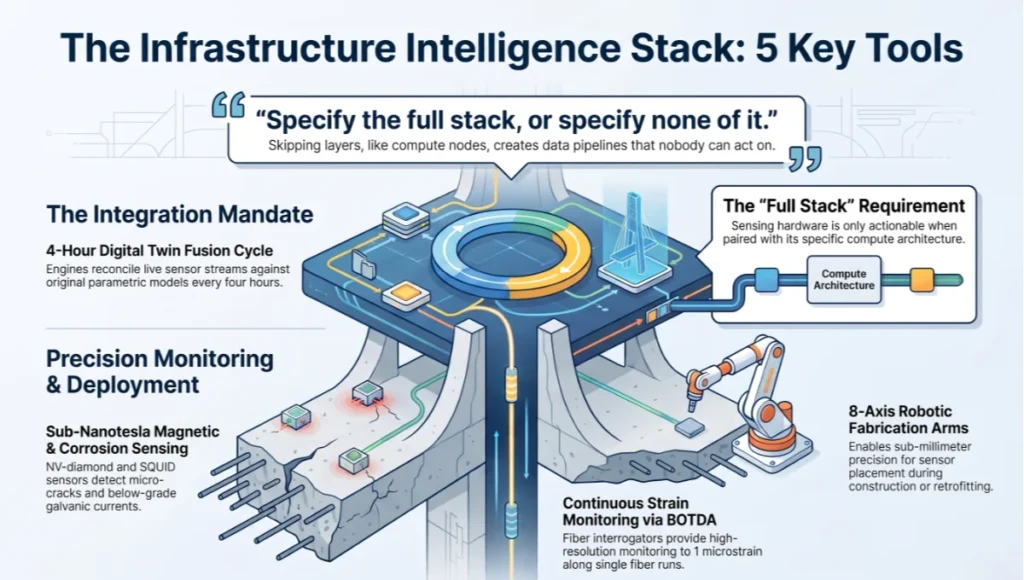
- NV-diamond magnetometer arrays — sub-nanotesla magnetic field sensing for embedded fatigue and micro-crack detection
- SQUID gradiometer clusters — 0.1–0.5 mm spatial resolution for corrosion and galvanic current mapping in below-grade zones
- Distributed BOTDA fiber interrogators — continuous strain monitoring to 1 microstrain resolution along a single fiber run
- 8-axis robotic fabrication arms — sub-millimeter sensor and fiber placement during construction or retrofit
- Digital twin fusion engines — reconcile live sensor streams against the original parametric fabrication model on a 4-hour refresh cycle
None of these 5 tools function as a standalone product. Each one is a layer in a stack, and skipping a layer — installing magnetometers without the edge compute nodes to process their output, for instance — produces a data pipeline that collects information nobody can act on. The same principle underpins our take on neuromorphic sensors for building management integration: the sensing hardware is only as useful as the compute architecture built to interpret it. Specify the full stack, or specify none of it.
Comprehensive Technical FAQ
Q: How much earlier does quantum sensing catch a micro-crack than a visual inspection?
A: Between 6 and 18 months earlier, depending on the load path and material. The lead time comes from detecting the magnetic-field signature of fatigue propagation before it reaches a visible surface fracture.
Q: Does quantum sensing replace strain gauges and accelerometers?
A: No. It operates as an additional, deeper-resolution layer beneath the existing MEMS mesh, which continues to handle vibration and threshold-based alerting.
Q: What does a 200-node deployment actually cost?
- Quantum sensing hardware: $480,000–$960,000
- Comparable MEMS mesh: $40,000–$160,000
- Break-even trigger: 1 avoided major structural incident, at an average direct cost of $18M–$340M
Q: Can quantum sensing data replace a statutory inspection?
A: Not currently, in any jurisdiction referenced in this piece. Singapore’s BCA and the Netherlands’ RVO both frame it as a supplement. Obtain jurisdiction-specific legal opinion before specifying it as a substitute.
Q: What is the maintenance burden of a SQUID-based system?
A: Cryogenic cooling infrastructure, which is the primary barrier to adoption on typologies without dedicated facilities staffing. Cryogenic-free alternatives are in early lab trials.
Q: How does the sensing layer connect to the original fabrication model?
A: Through a digital twin fusion engine that reconciles live strain and magnetic-field data against the parametric model on a 4-hour refresh cycle, flagging tolerance deviations as they occur rather than at the next inspection window.
Q: Is this only viable for new-build towers, or can it retrofit existing structures?
A: Both. The Meridian Skin concept study assumes new-build sequencing, but the same 8-axis robotic arms used for fabrication can route sensor fiber and magnetometer housings through existing structural cavities during a retrofit, at sub-millimeter placement accuracy, without requiring new structural penetrations in most steel-frame typologies.
Q: How much data-processing infrastructure does a project need to budget for?
A: Plan for an edge compute layer capable of handling up to 12 TB per building per month before that data reaches the cloud. Skipping this line item is the most common way project teams turn a monitoring upgrade into a data bottleneck.
Where This Leaves You
You do not need to retrofit every project with a 200-node quantum array next quarter. You need to stop specifying a monitoring strategy that reports damage after it has already redistributed load. Start with the highest-consequence structural elements on your next critical-infrastructure project — the transition zones, the high-water-table foundations, the long-span connections — and instrument those first. Talk to your structural engineer this week about where a 6-to-18-month lead time would change a maintenance decision, not a marketing deck.
If you are scoping a concept study of your own, bring the sensing layer into the room during schematic design, not value-engineering review. The 11-hour fabrication delta that Meridian Skin absorbed to route its BOTDA fiber run is trivial when planned into an 8-axis robotic sequence from the outset, and expensive when it has to be reverse-engineered into a structure that already has its cladding closed. That single scheduling decision is the difference between a building that monitors itself and one that only ever gets inspected.
© Nuvira Space. All rights reserved. | Future Tech Series | All specifications cited are based on publicly available quantum sensing structural health monitoring research, including Singapore BCA pilot guidance, UK National Infrastructure Commission framework materials, and peer-reviewed structural sensing literature (no external links included). Meridian Skin is a speculative internal concept study and does not represent a completed project.
This article is part of our smart building technology guide, the state-of-play synthesis across generative AI, robotics, and sensing layers.