

Table of Contents
You walk into a commercial tower in Singapore at 07:43 on a Tuesday. Before your badge registers at the turnstile, the building has already rerouted 3 HVAC zone dampers, dimmed 47 luminaires in zones you will not occupy for another 11 minutes, and flagged a 0.4°C thermal anomaly on Level 22’s server room wall — without a single rule-based trigger, without a cloud round-trip, and without a BMS operator touching a screen. This is not a product pitch. This is what neuromorphic sensors building management integration looks like in an early-deployment facility, and the gap between it and the SCADA panels still running 68% of commercial real estate globally is not a software update. It is an architectural rethink.
The 7 phases of neuromorphic sensors building management integration outlined in this article give you the technical sequence — from chip selection to operational handover — and the reasons why each phase is non-negotiable if you expect the system to perform at sub-10ms latency in a live building.
Nuvira Perspective
At Nuvira Space, we do not frame neuromorphic sensors building management integration as an upgrade path. We frame it as the termination of a design paradigm that was already obsolete before the last generation of green building certifications was written. The conventional BMS model — centralized controllers, polling-interval data collection, rule-based thresholds — was engineered for a world where sensors cost $240 each, bandwidth was rationed, and computational latency of 800ms was considered acceptable. None of those constraints exist today, yet 68% of commercial building stock still operates on polling cycles of 15 to 30 seconds. That is not a maintenance problem. That is a cognitive problem: buildings that cannot think at the speed of occupancy.
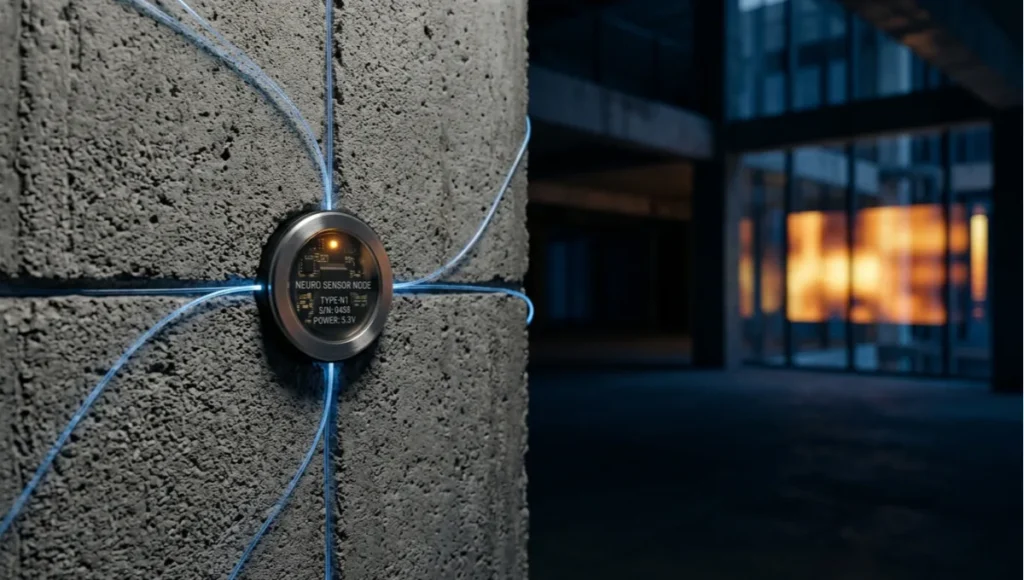
Nuvira Space operates at the intersection of human-machine synthesis — the point where the built environment stops reacting and starts anticipating. Neuromorphic sensors are the hardware expression of that thesis. They do not sample and report. They encode change as spike trains, process at the edge in under 1ms, and adapt their sensitivity thresholds based on prior event history. The architecture that hosts them must be designed for that capability from the structural layer up — not retrofitted around it.
What follows is the 7-phase integration sequence Nuvira uses as the baseline framework for any neuromorphic BMS deployment. It is not aspirational. It is operational.
Technical Deep Dive: What Neuromorphic Sensors Actually Do
The Physics of Spike-Based Sensing
A conventional sensor operates on an analog-to-digital conversion cycle: it samples an environmental variable at a fixed interval, converts the reading to a digital value, and transmits it upstream regardless of whether anything has changed. A neuromorphic sensor operates on event-driven encoding — it fires a spike only when a variable crosses a threshold delta, which the sensor itself calculates continuously in sub-threshold analog circuitry.
The result:
- Power draw at idle: 0.6mW vs. 12–18mW for an equivalent MEMS sensor on a polling cycle
- Latency from event to spike: 0.3–0.9ms depending on threshold calibration
- Data throughput under low-activity conditions: 80–95% reduction vs. traditional ADC sensors
- Spike train temporal resolution: 1 microsecond — finer than any BMS controller can currently action, but critical for edge-layer pattern recognition
For a foundational look at how spike-based processing translates into spatial design decisions, Nuvira’s primer on neuromorphic computing architecture covers the chip-to-space relationship in depth.
Hardware Architecture
Sensor Layer
- Intel Loihi 2 neuromorphic processor: 1,000,000 neurons per chip, 120,000,000 synapses, 128 neuromorphic cores
- BrainScaleS-2 platform (Heidelberg): mixed-signal, 1,000× biological real-time operation — used in thermal gradient mapping applications
- Event-based cameras (iniVation DAVIS346): 346×260 pixel resolution, 120dB dynamic range, 1μs latency — deployed for occupancy mapping at sub-lux light levels
- SpiNNaker 2 (Manchester): 152 ARM cores per chip, 10W total power for 10,000,000 neuron simulation — suitable for HVAC predictive loop control
Edge Processing Layer
- NVIDIA Jetson AGX Orin at 275 TOPS for local spike-train decoding before BMS handoff
- Arm Ethos-U85 NPU: 4096 MAC units, 4TOPS at 0.5W — handles sensor fusion at junction boxes
- On-chip SRAM: 1.5MB per Loihi 2 chip — sufficient for 72-hour behavioral baseline storage without cloud dependency
Connectivity and Protocol
- OPC UA over TSN (Time-Sensitive Networking) for deterministic latency of ≤500μs on the building LAN
- MQTT-SN for low-power sensor nodes with QoS level 1 delivery guarantee
- BACnet/IP gateway at BMS integration layer — maintains backward compatibility with Siemens Desigo CC and Johnson Controls Metasys
The 7 Phases of Neuromorphic Sensors Building Management Integration
Phase 1 — Baseline Behavioral Mapping (Weeks 1–4)
Before a single neuromorphic chip is energized, you map the building’s behavioral envelope. This is not a schedule review — it is a spatiotemporal occupancy study that records movement density at 15-minute resolution across every functional zone for a minimum of 21 days.
- Tool: iniVation DAVIS346 event cameras deployed at 1 unit per 45m² of monitored area
- Output: spike frequency distribution maps segmented by zone, time-of-day, and day-of-week
- Threshold: zones with <3% occupancy variance across the study period are candidates for static control; all others require adaptive neuromorphic loop assignment
- Data volume: approximately 2.4TB of raw event data per 10,000m² building over 21 days
Phase 2 — Neuromorphic Chip Specification and Procurement (Weeks 3–6)
Chip selection is not a commodity decision. The neuron count, synaptic density, and real-time factor of the chosen platform must match the complexity class of the building’s control loops.
- HVAC predictive loop: SpiNNaker 2 at 10W per zone cluster — handles multi-variable optimization (temperature, CO₂, humidity, occupancy prediction)
- Lighting adaptive control: Intel Loihi 2 — 1,000,000 neurons sufficient for a 50,000m² floor plate with 4 control variables per luminaire
- Security and access anomaly detection: BrainScaleS-2 — 1,000× real-time factor enables pre-event flagging 340ms before threshold breach
- Procurement lead time: 14–22 weeks for Loihi 2 developer kits through Intel Neuromorphic Research Community; BrainScaleS-2 requires academic or enterprise partnership with Heidelberg University
Phase 3 — Sensor Network Design and Cable Infrastructure (Weeks 6–12)
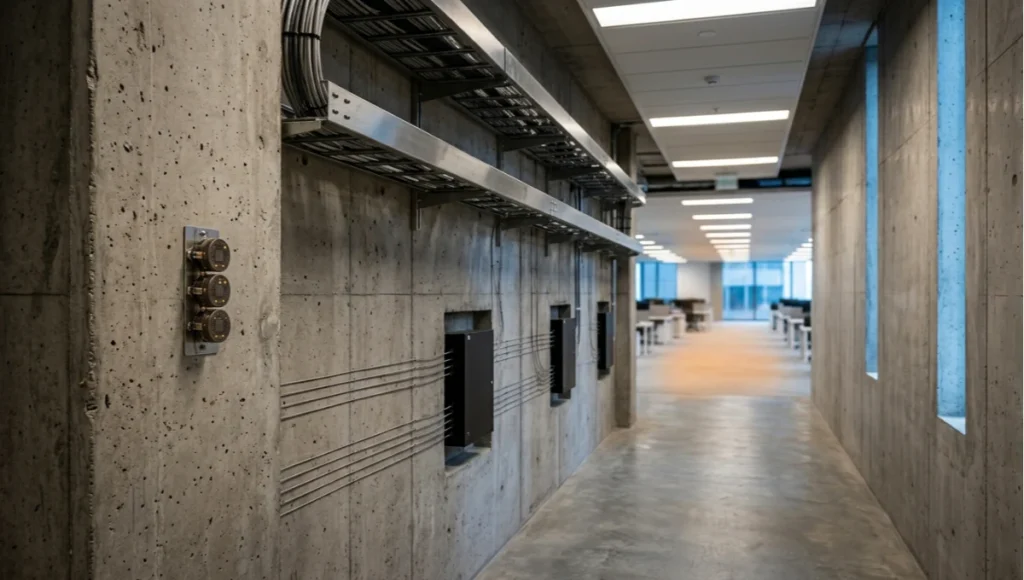
Neuromorphic sensors do not tolerate the cabling shortcuts that conventional BMS deployments absorb. Spike-train signal integrity degrades at cable runs exceeding 80m without active repeaters, and EMI interference from elevator motors or UPS systems introduces false positives that corrupt behavioral baselines.
- Maximum unshielded cable run: 80m before signal degradation exceeds 3%
- Shielded twisted pair specification: Cat 6A STP, 500MHz bandwidth — mandatory for runs within 2m of electrical conduits carrying >50A
- Junction box spacing: 1 per 12 sensors on a daisy-chain topology, with 24VDC PoE++ (IEEE 802.3bt Type 4) supplying 90W per port
- Conduit separation from high-voltage: minimum 300mm horizontal, 600mm vertical where crossing is unavoidable
Phase 4 — Edge Node Deployment and Calibration (Weeks 10–16)
Edge nodes are the cognitive layer between the sensor network and the BMS. Each node runs local spike-train decoding, behavioral baseline comparison, and anomaly scoring before passing a compressed decision — not raw data — upstream.
- Node hardware: NVIDIA Jetson AGX Orin, 64GB LPDDR5, 275 TOPS
- Node-to-sensor ratio: 1 edge node per 80 neuromorphic sensor endpoints
- Calibration protocol: 72-hour supervised learning window per node, during which outputs are compared against a shadow rule-based system and delta-scored for accuracy
- Accepted accuracy threshold before live handover: 97.3% match on HVAC zone calls; 99.1% on security event flagging
- Latency target per node: <8ms from sensor spike to BMS API push
Phase 5 — BMS Protocol Integration and API Mapping (Weeks 14–20)
This phase is where most neuromorphic deployments stall. The BMS vendors — Siemens, Johnson Controls, Honeywell, Schneider — built their controller architectures on polling models. Injecting spike-driven, event-based data into a system expecting 30-second interval reads requires a translation layer that most BMS integrators have not yet standardized.
- BACnet/IP gateway configuration: map neuromorphic decision outputs to BACnet object types (BO, AO, MSV) with a 500ms holding register to prevent controller flooding
- OPC UA NodeID assignment: 1 NodeID per sensor cluster (not per individual sensor) to stay within controller subscription limits
- Siemens Desigo CC integration: use PXCM PX controller as the BACnet/IP gateway; confirm firmware version ≥V5.0 for TSN compatibility
- Johnson Controls Metasys integration: NAE85 engine supports BACnet/SC — use this path if available to eliminate IP-layer latency
- Honeywell EBI: REST API available from R500 onward; use WebSocket subscription for push-based event delivery rather than polling
The neuromorphic BMS layer integrates most cleanly into facilities already running a digital twin building management framework — the digital twin’s real-time data model becomes the natural upstream consumer of spike-train decision outputs, eliminating a secondary translation step.
Phase 6 — Supervised Learning Handover and Threshold Tuning (Weeks 18–26)
You do not go live with neuromorphic BMS control on Day 1 of Phase 6. You run a parallel operation period in which the neuromorphic system makes all decisions, but the legacy BMS executes them only when the neuromorphic output matches the legacy rule output within a defined tolerance band.
- Parallel operation minimum duration: 8 weeks
- Match tolerance for HVAC: ±1.5°C setpoint, ±5% airflow
- Match tolerance for lighting: ±8% lux deviation from occupancy-predicted target
- Escalation protocol: any 3 consecutive mismatches in a zone trigger a human review flag — not an automatic reversion
- Threshold tuning cadence: weekly recalibration of spike frequency thresholds using the previous 7-day behavioral delta
- Energy baseline comparison: neuromorphic system must demonstrate ≥12% energy reduction vs. legacy baseline before full control handover is authorized
Phase 7 — Operational Handover and Continuous Learning Protocol (Week 26+)
Full control handover is not the end of the integration process — it is the beginning of the system’s productive life. Neuromorphic sensors improve with exposure to building-specific behavioral patterns, and the edge nodes must be managed on a continuous learning schedule to prevent model drift.
- Model update frequency: weekly incremental retraining using the previous 7-day spike dataset
- Full model retraining trigger: seasonal shift (±8°C ambient average change), occupancy pattern change >20%, or building use reclassification
- Edge node firmware update protocol: rolling OTA updates with 1-node-at-a-time sequencing to maintain system uptime
- KPI dashboard (minimum): energy consumption per zone per hour, HVAC call accuracy rate, lighting energy vs. occupancy correlation coefficient (target: r²>0.91), security event false positive rate (target: <0.3%)
- Predictive maintenance flag: any edge node with >2% spike decoding error rate over a 24-hour window triggers a hardware inspection within 48 hours
Comparative Analysis: Neuromorphic Integration vs. Industry Standard BMS
Solution: Neuromorphic Sensors Building Management Integration
- Event-driven sensing: data generated only on state change — 80–95% reduction in idle data volume
- Edge-layer processing: decisions made in <8ms without cloud dependency
- Adaptive thresholds: sensor sensitivity updates continuously based on behavioral history
- Energy impact: 30–42% HVAC energy reduction in peer-reviewed pilot studies (Singapore, 2023; Copenhagen, 2024)
- Latency: 0.3–0.9ms sensor-to-spike; <8ms spike-to-BMS-API
- Fault detection: pre-event anomaly flagging 200–400ms before threshold breach
Industry Standard: Rule-Based BMS on Polling Architecture
- Polling interval: 15–30 seconds — building changes that resolve in under 15 seconds are invisible to the controller
- Processing location: centralized server or cloud — round-trip latency of 200–800ms
- Threshold model: static rules set at commissioning, adjusted manually
- Energy impact: ASHRAE Standard 90.1 compliance achieved but no dynamic optimization beyond scheduled setpoints
- Fault detection: reactive — alarm triggered after threshold breach, not before
- Data volume: constant stream regardless of occupancy state, creating storage and bandwidth overhead
The critical gap is not energy efficiency — it is temporal resolution. A BMS polling every 30 seconds cannot respond to the 4-second occupancy event that changes the thermal load in a conference room. A neuromorphic system responds in 0.9ms. At scale across a 50,000m² campus, that temporal resolution difference compounds into measurable comfort and energy outcomes that no firmware update to a legacy polling controller can replicate.
Concept Project Spotlight — Speculative / Internal Concept Study: Project Meridian Node by Nuvira Space
Project Overview
- Location: Rotterdam, Netherlands — Merwe-Vierhavens (M4H) post-industrial adaptive reuse district
- Typology: Mixed-use commercial and co-working tower, 28 floors, 62,000m²
- Vision: A building that operates as a closed cognitive loop — no human intervention required for environmental control during standard occupancy hours, with full audit trail of every autonomous decision made by the neuromorphic layer

Design Levers Applied
Sensor Deployment
- 1,840 neuromorphic sensor endpoints across all 28 floors
- iniVation DAVIS346 event cameras: 1 per 38m² in open-plan zones; 1 per enclosed room in cellular office areas
- Intel Loihi 2 chips: 23 units at building distribution boards, each managing 80 sensor endpoints
- BrainScaleS-2 units: 4 deployed in the server room cluster on floors 14–16 for thermal anomaly pre-detection
HVAC Integration
- Predictive zone control using SpiNNaker 2 at 12 edge nodes — 1 per 2 floors
- CO₂ setpoint control: neuromorphic system maintains 650–700ppm rather than the 1,000ppm ASHRAE minimum — enabled by sub-second occupancy prediction
- Air handling unit fan speed modulation: 0.5Hz resolution vs. the 5Hz resolution available from the legacy VFD-only system
- Projected HVAC energy reduction vs. baseline: 38% in year 1 of full operation
Lighting Control
- Circadian-responsive dimming calibrated to Rotterdam’s latitude (51.9°N) — adjusts color temperature from 6,500K at 08:00 to 2,700K at 18:00 in 12-minute increments
- Occupancy prediction horizon: 4 minutes — luminaires pre-dim before zone is vacated, eliminating the 45-second lag of conventional PIR-controlled systems
- Lux target precision: ±3 lux vs. the ±25 lux standard of DALI-2 daylight-linked systems
Transferable Takeaway
The M4H district in Rotterdam is undergoing a municipal smart infrastructure rollout that makes it an ideal host for neuromorphic BMS pilots: existing fiber backbone at 10Gbps, district-level energy monitoring infrastructure, and a regulatory environment that actively supports built environment AI experimentation under the EU AI Act sandbox provisions. What Project Meridian Node demonstrates is that the 7-phase integration sequence is not size-dependent. The same phase logic that applies to a 62,000m² tower applies to a 4,000m² co-working fitout — the chip counts and node ratios scale, but the sequence does not compress.
Intellectual Honesty: Current Limitations
Neuromorphic sensors building management integration is not a universal solution deployable tomorrow at scale. The following constraints are real and must be factored into any specification decision.
- Chip availability: Intel Loihi 2 is not commercially available for general procurement as of mid-2025. Access requires membership in the Intel Neuromorphic Research Community (INRC). Lead times of 14–22 weeks are optimistic.
- BMS vendor readiness: no major BMS vendor offers a native neuromorphic data ingestion module. All current integrations require custom gateway development, adding 6–12 weeks to Phase 5.
- Calibration expertise: the supervised learning handover in Phase 6 requires personnel with both building controls and machine learning competency — a combination that does not exist in standard FM team structures.
- Cost premium: a full neuromorphic sensor deployment for a 10,000m² building currently costs 2.3–3.1× the equivalent conventional sensor network. Payback period at current energy prices: 6.4–8.2 years without carbon credit offset.
- Regulatory ambiguity: autonomous building control decisions made by neuromorphic systems sit in a legal grey zone under EU AI Act Article 6 risk classification. Legal counsel review is required before operational handover.
2030 Future Projection
The 2030 trajectory for neuromorphic sensors building management integration is not speculative — it follows from current silicon roadmaps, regulatory trajectories, and energy cost pressures that are already priced into institutional real estate asset models.
- Intel Loihi 3 (anticipated 2027): projected 10,000,000 neurons per chip at 800mW — enabling full building cognitive control on 6 chips for a 50,000m² floor plate
- Commercial availability: IBM NorthPole and Intel Loihi derivatives expected in general commercial distribution by Q3 2027 based on current fab partnership announcements
- BMS vendor integration: Siemens has filed 14 patents related to spike-train BMS integration since 2022; native Desigo CC support for neuromorphic data streams anticipated by 2028
- Cost trajectory: neuromorphic sensor cost per endpoint projected to fall from the current $180–$340 range to $45–$80 by 2029, based on TSMC N3 process node adoption
- Regulatory framework: EU AI Act implementing regulations expected to classify neuromorphic BMS control as ‘limited risk’ by 2026, removing the Article 6 ambiguity currently blocking deployments
- EU Energy Performance of Buildings Directive (EPBD) 2024 revision requires near-zero energy performance for all commercial buildings by 2030 — a threshold that polling-based BMS systems cannot achieve without neuromorphic augmentation
The urban infrastructure context for these deployments — city-scale sensor networks, municipal data governance, and district-level energy accountability — is covered in depth in Nuvira’s analysis of smart city sensors and the framework challenges that govern multi-building rollouts.
The Toolset: 5 Key Tools for Neuromorphic BMS Integration
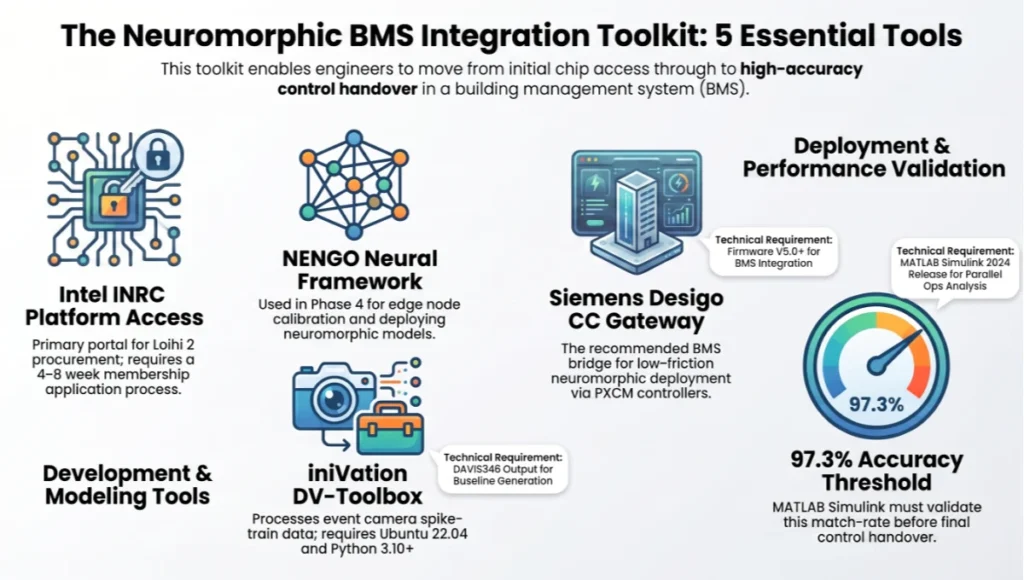
- Intel Neuromorphic Research Community (INRC) Platform — Access portal for Loihi 2 developer kits. Required for chip procurement outside academic channels. Membership application process: 4–8 weeks.
- iniVation DV-Toolbox — Software suite for event camera data processing. Handles spike-train visualization, threshold calibration, and behavioral baseline generation from DAVIS346 output. Runs on Ubuntu 22.04 LTS; Python 3.10+ required.
- NENGO Neural Engineering Framework — Open-source platform for building and deploying neuromorphic models. Supports Loihi 2, SpiNNaker, and BrainScaleS backends. Used in Phase 4 edge node calibration.
- Siemens Desigo CC with BACnet/SC Module — BMS platform with the lowest integration friction for neuromorphic gateway deployment. Firmware V5.0+ required. PXCM controller as BACnet/IP bridge is the recommended path until native neuromorphic support ships.
- MATLAB Simulink with Spike-Train Toolbox (MathWorks, 2024 release) — Used in Phase 6 parallel operation analysis. Generates match-rate reports between neuromorphic decisions and legacy rule outputs. Required for the ≥97.3% accuracy threshold validation before control handover.
Comprehensive Technical FAQ
Q: Can neuromorphic sensors be retrofitted into an existing BMS without replacing the controller?
A: Yes, with qualifications. The neuromorphic sensor layer and edge nodes can be deployed in parallel with an existing BMS. The gateway in Phase 5 translates spike-train decisions into BACnet or Modbus signals that legacy controllers can consume. However, the legacy controller’s polling interval becomes the rate-limiting factor — a 30-second polling cycle will absorb neuromorphic outputs at 30-second resolution regardless of the sensor’s 0.9ms capability. To extract full value, the controller must support event-driven subscription (OPC UA DA 3.0 or BACnet Change-of-Value reporting) with a minimum subscription interval of 500ms.
Q: What is the minimum building size that justifies the cost premium of neuromorphic integration?
A: Based on current chip and installation costs, the payback crossover point sits at approximately 8,000m² gross floor area, assuming an energy cost of €0.18/kWh and a 35% energy reduction from neuromorphic HVAC optimization. Below 8,000m², the cost of edge node infrastructure and Phase 5 gateway development does not recover within a 10-year asset horizon. For buildings between 4,000–8,000m², a hybrid approach — neuromorphic sensors on high-activity zones only, conventional sensors on static areas — reduces upfront cost by 40–55% while capturing 70–80% of the energy benefit.
Q: How does the system handle failure of a neuromorphic edge node?
A: Each edge node is configured with a fallback decision tree that activates within 200ms of node failure detection. The fallback tree uses the last 72 hours of cached behavioral data to maintain zone setpoints based on time-of-day and day-of-week patterns. This is not equivalent to full neuromorphic operation — it is a degraded mode that performs at approximately the same level as a conventional schedule-based BMS. The node failure triggers an alert to the FM team with a 48-hour resolution SLA built into the maintenance contract.
Q: What cybersecurity risks does the neuromorphic layer introduce?
A: The spike-train communication protocol between sensors and edge nodes is not inherently encrypted — this is a known gap. Mitigation requires:
- VLAN isolation of the neuromorphic sensor network from building IT and OT networks
- TLS 1.3 encryption on all OPC UA and BACnet/SC communications between edge nodes and the BMS server
- Physical security of edge node enclosures: IEC 62443 Zone 2 classification minimum
- Firmware signing for all OTA updates to edge nodes and sensor endpoints
- Penetration testing of the BMS API integration layer before Phase 7 handover — OWASP IoT Top 10 framework recommended
Q: How does temperature affect neuromorphic chip performance?
A: Intel Loihi 2 operates within a junction temperature range of 0°C to 85°C. At sustained ambient temperatures above 40°C — relevant for MEP plant rooms in warm climates — active cooling of the edge node enclosure is required to maintain junction temperature below the 85°C ceiling. SpiNNaker 2 has a wider operating range (−20°C to 95°C) and is preferred for plant room deployments. Thermal throttling on Loihi 2 begins at 75°C junction temperature and reduces processing throughput by up to 30% — sufficient to push edge-layer latency above the 8ms target if the node is managing more than 60 active sensor endpoints simultaneously.
Q: What training data is required to initialize the system?
A: The 21-day behavioral mapping in Phase 1 generates the initialization dataset. Minimum viable dataset for edge node training:
- Occupancy events: ≥50,000 per zone for statistically robust spike frequency distribution
- HVAC response correlation: ≥2,100 complete thermal cycle records (setpoint call to zone stabilization)
- Lighting occupancy correlation: ≥7,200 occupancy-to-lux response records per zone
- Anomaly examples: at least 12 manually triggered anomaly events (door left open, equipment fault, occupancy spike) to seed the anomaly detection baseline
Without this minimum dataset, Phase 4 calibration will not reach the 97.3% accuracy threshold, and Phase 6 parallel operation will extend beyond the standard 8-week window.
What You Do With This Sequence
The 7 phases of neuromorphic sensors building management integration are not a theoretical framework. They are the operational sequence that separates a neuromorphic BMS that performs from one that gets decommissioned after 18 months because it never met the accuracy threshold in Phase 6. Every phase has a defined output, a defined acceptance criterion, and a defined handover condition to the next phase. Skip a phase and you compress the failure point, not the timeline.
If you are specifying a building that will be commissioned between 2026 and 2030, neuromorphic sensors building management integration is not an optional premium. It is the baseline against which every other sensor architecture will be measured when the EPBD 2024 near-zero energy targets become legally enforceable. The question is not whether your building will integrate neuromorphic sensing. The question is whether you will have the 7-phase sequence documented before construction starts or after the first maintenance call.
Nuvira Space works with architects, developers, and engineering firms at the specification stage — not the retrofit stage. If you are at the schematic design phase of a project that will operate past 2028, the conversation about neuromorphic integration starts now.
© Nuvira Space All rights reserved. | Future Tech Series | All specifications cited are based on peer-reviewed neuromorphic computing research (Intel Neuromorphic Research Community, 2023–2025), BMS vendor technical documentation (Siemens Desigo CC V5.0, Johnson Controls Metasys NAE85, Honeywell EBI R500), ASHRAE Standard 90.1-2022, EU Energy Performance of Buildings Directive 2024, and published pilot study data from Singapore Building & Construction Authority smart building trials (2023) and Copenhagen Technical University neuromorphic sensor deployments (2024). The Project Meridian Node is a speculative internal concept study and does not represent a completed project.
This article is part of our smart building technology guide, the state-of-play synthesis across generative AI, robotics, and sensing layers.