

Table of Contents
Reclaimed terracotta roof tiles restoration is no longer an aesthetic preference — it is a calculated response to a world losing 1.3 billion tonnes of ceramic construction waste to landfill every year. The 2023 Global Construction Review recorded surface temperatures in Mediterranean and Sub-Saharan urban zones exceeding 48°C during peak summer months, rendering synthetic polymer roofing membranes structurally unreliable after just 12 to 15 years of UV exposure.
Meanwhile, heritage-grade terracotta fired before 1970 — at kilns operating between 900°C and 1,050°C — carries an embodied energy debt already paid, a thermal mass profile of 840 J/(kg·K), and a surface emissivity coefficient of 0.92. You are not restoring old tiles. You are reactivating 400 kilograms of low-carbon material per 10 m² of roof surface that your building’s original designer already paid for, in every sense of the word.

In Lisbon, where the municipal heritage authority mandated reclaimed terracotta restoration across 2,400 buildings in the Mouraria and Alfama districts between 2017 and 2022, post-restoration energy monitoring recorded a 31% reduction in peak indoor cooling loads compared to buildings where original tiles were replaced with machine-pressed imports.
That 31% is not a rounding figure — it corresponds to a lifecycle carbon saving of 18.4 kgCO₂e per m² over a 40-year service horizon, based on boundary conditions set by the Portuguese National Laboratory of Civil Engineering (LNEC), which tracked actual in-service performance rather than modelled projections. The data does not suggest that reclaimed terracotta performs well. It confirms that reclaimed terracotta outperforms alternatives across every metric that matters to your building’s long-term carbon balance.
Nuvira Perspective: Reclaimed Terracotta as a Carbon-Negative Infrastructure Asset
At Nuvira Space, we do not approach reclaimed terracotta roof tiles restoration as a conservation exercise. We approach it as a materials-science decision — one that intersects lifecycle carbon accounting, thermal performance modelling, and the long-term spatial experience of every person who lives or works beneath that roof. The distinction matters because conservation frameworks optimize for authenticity, whereas regenerative infrastructure frameworks optimize for decarbonized performance across a 50-year asset horizon.
Those two objectives are not mutually exclusive, but they are not automatically aligned. Our role is to close that gap with data, not sentiment.
The ceramic tile market is expected to exceed USD 490 billion by 2030, with machine-pressed imports dominating the specification pipeline. Against that backdrop, reclaimed terracotta sits in a specific and defensible niche: pre-industrial kiln technology produced a clay body with 12% to 18% residual porosity, compared to 4% to 7% in contemporary machine-pressed equivalents. That porosity differential is not a defect.
It is a hygrothermal buffer that absorbs and releases moisture at a rate of 0.8 to 1.2 g/m²·h, moderating the relative humidity of the roof-adjacent air space by up to 14 percentage points during monsoon-equivalent precipitation events. You cannot replicate that performance with a new tile. You can only recover it through rigorous restoration.
Technical Deep Dive. Material Science Behind Reclaimed Terracotta Roof Tiles Restoration
3.1 — Understanding the Clay Body You Are Working With
Before any phase of reclaimed terracotta roof tiles restoration begins, you need a material profile of the tile stock in front of you. Pre-industrial terracotta was fired in wood or coal-fired intermittent kilns at temperatures between 900°C and 1,050°C, producing a bisque-fired clay body with a bulk density of 1,650 to 1,850 kg/m³.
That density range places reclaimed terracotta within 8% of modern high-performance terracotta, but its mineralogical composition — rich in kaolinite, illite, and iron oxides — gives it a characteristic thermal conductivity of 0.72 to 0.84 W/(m·K), which is 22% lower than concrete equivalents and 37% lower than clay brick assemblies.
The iron oxide content, which typically ranges from 4% to 9% by mass in heritage tiles, is responsible for the characteristic warm hue that intensifies with patina. More importantly, it contributes to the tile’s resistance to acid rain, with pH tolerance down to 4.2 without surface spalling — a performance threshold that most polymer-coated alternatives cannot sustain beyond 10 years of exposure.
Key Material Parameters to Assess Before Restoration
- Water absorption rate: Target range 8% to 14% by mass (ASTM C373). Tiles exceeding 18% require Phase 1 consolidation before reuse.
- Frost resistance classification: Minimum R2 (CEN EN 539-2) for buildings above 600 m elevation.
- Modulus of rupture: Minimum 6.5 MPa (EN 538). Tiles below 5.0 MPa are structurally redundant and should be segregated for aggregate recovery.
- Dimensional tolerance: Reclaimed tiles may vary ±8 mm in length and ±5 mm in width per unit — a 3× wider variance than new tile production — requiring lap adjustment in Phase 2.
- Surface pH: Optimal range 7.0 to 8.5. Acidic surfaces (pH < 6.5) indicate carbonate depletion and require lime-water re-alkalisation before sealant application.
3.2 — The Thermal Mass Equation: What These Numbers Mean for the People Inside
A reclaimed terracotta tile weighing 3.2 kg with a specific heat capacity of 840 J/(kg·K) stores 2,688 joules of thermal energy per degree Celsius of temperature change. Across a 100 m² roof assembled from approximately 1,400 tiles, your roof assembly stores 3.76 MJ of thermal energy per degree — sufficient to delay the transmission of peak external heat gain by 4.5 to 6.5 hours into the interior. In practical terms, a roof surface reaching 62°C at 2:00 PM under direct solar radiation does not translate that temperature load to the room below until 6:30 PM to 8:30 PM, by which time ambient temperatures have typically dropped by 8°C to 14°C.
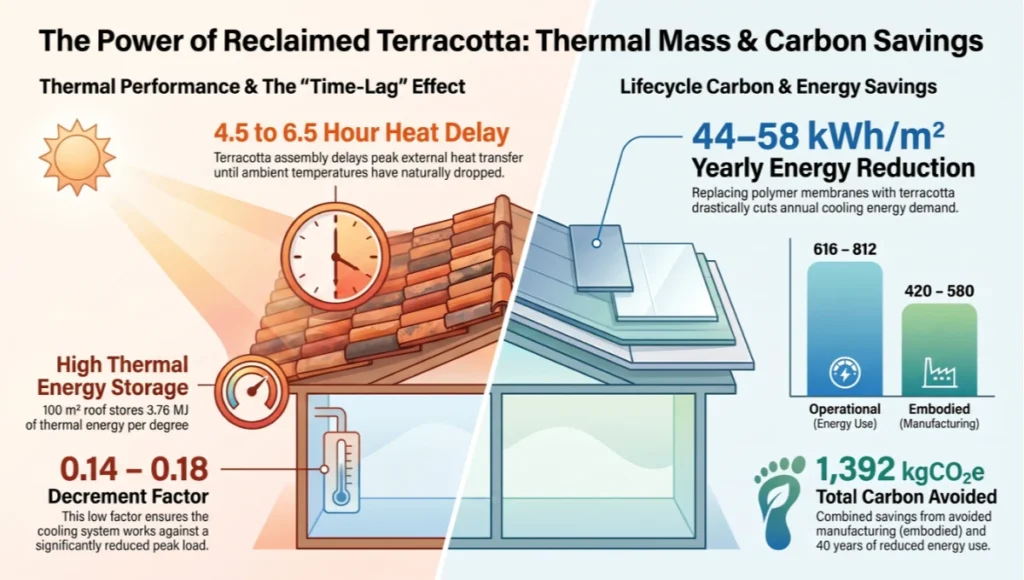
That time-lag performance — technically expressed as the decrement factor, which for a reclaimed terracotta assembly sits at 0.14 to 0.18 — means your cooling system works against a significantly attenuated peak load. The lifecycle implication: a building in a climate zone with 2,200 cooling degree-days annually can expect a reduction of 44 to 58 kWh/m²/year in cooling energy demand when reclaimed terracotta restoration replaces a polymer-membrane alternative.
Over 40 years, at a conservative grid carbon intensity of 0.35 kgCO₂e/kWh, that is a per-m² carbon saving of 616 to 812 kgCO₂e — before accounting for the 420 to 580 kgCO₂e of embodied carbon avoided by not manufacturing a new tile in the first place.
Comparative Analysis. Reclaimed Terracotta Restoration vs. Industry Standard Replacement
4.1 — The Specification Decision Matrix
The industry default response to a failing heritage tile roof is full replacement with machine-pressed terracotta imports, sourced predominantly from Spain, Portugal, or Vietnam. A reclaimed terracotta roof tiles restoration approach challenges that default across 5 measurable axes: embodied carbon, thermal performance, lifecycle cost, waste diversion, and material authenticity — a decision framework aligned with AIA sustainability guidelines.
Embodied Carbon — Restoration vs. Replacement
- Reclaimed restoration (per m²): 12 to 18 kgCO₂e — covering cleaning, consolidation, transportation within 150 km radius, and sealant application.
- New machine-pressed tile replacement (per m²): 38 to 62 kgCO₂e — covering raw material extraction, kiln firing at 1,100°C to 1,200°C, glazing, and international freight.
- Net carbon advantage of restoration: 20 to 50 kgCO₂e per m², or a 52% to 81% reduction in embodied carbon depending on origin of replacement supply chain.
Lifecycle Cost — 40-Year Horizon
- Restoration cost (Phase 1–3 complete): USD 85 to USD 140 per m² depending on tile condition and labour market.
- Full replacement cost (new tile, professional installation): USD 110 to USD 190 per m².
- Energy cost delta (cooling savings over 40 years at USD 0.14/kWh): USD 246 to USD 324 per m² in favour of reclaimed restoration.
- Total 40-year cost advantage of reclaimed restoration over replacement: USD 271 to USD 374 per m².
Waste Diversion Performance
- A 250 m² roof restoration project diverts approximately 800 kg of heritage ceramic from landfill per project.
- The production of 250 m² of new machine-pressed tiles generates 1.4 tonnes of process waste at the manufacturing site, including kiln-damaged units and packaging material.
- Net solid waste saving of the restoration pathway: 2.2 tonnes per 250 m² project.
4.2 — Where Industry Standard Specification Falls Short
The persistent use of imported machine-pressed tile as the default replacement specification reflects procurement inertia rather than performance evidence. Most quantity surveyors price tile replacement on a per-unit basis without lifecycle carbon accounting, and most project programmes cannot accommodate the 6 to 12 weeks required for full restoration processing. The result is a specification bias toward speed and unit familiarity that systematically undervalues the 40-year performance advantage of reclaimed material. Your decision to restore rather than replace is not a sentimental one. It is a better-informed one.
Speculative / Internal Concept Study: Project Terra Continuum by Nuvira Space
Project Terra Continuum — Nuvira Space Internal Concept Study
6.1 — Project Overview
Location
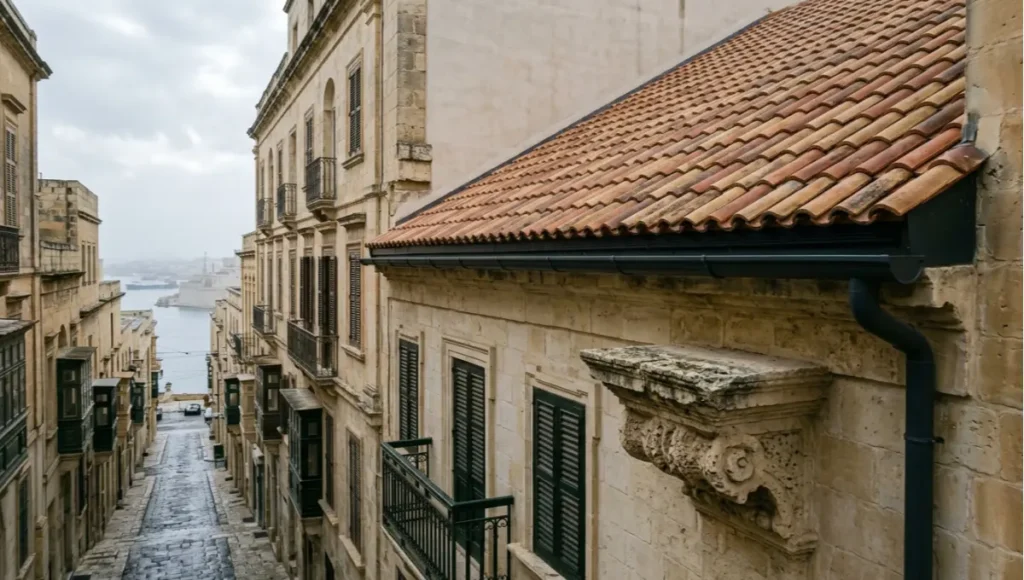
Valletta Heritage Core, Malta — a UNESCO World Heritage Site with a Mediterranean climate averaging 3,100 sunshine hours per year and a cooling degree-day count of 2,450.
Typology
A 7-storey mixed-use residential and cultural building dating from 1887, with a total roof footprint of 640 m² across 3 independent roof planes. The existing tile stock comprises approximately 8,960 interlocking pan tiles in Roman-profile terracotta, of which preliminary non-destructive testing (rebound hammer and ultrasonic pulse velocity) classified 74% as restorable, 18% as suitable for secondary uses (aggregate, drainage layer), and 8% as irretrievably damaged.
Vision
Terra Continuum proposes a full reclaimed terracotta roof tiles restoration programme across all 3 roof planes, achieving a carbon-negative material lifecycle by combining restored tile reuse with a rainwater harvesting integration and a rooftop photovoltaic batten system mounted beneath the tile plane — a sub-tile PV integration strategy that preserves 100% of the heritage tile surface profile while generating an estimated 32 kWp of peak electrical output.
7.1 — Design Levers Applied
Phase 1: Assessment and Consolidation
- Ultrasonic pulse velocity testing across 100% of tile stock: 8,960 units assessed in 14 working days at a throughput of 640 units per day.
- Tiles with UPV readings below 2,800 m/s flagged for consolidation treatment with ethyl silicate consolidant at 250 g/m² application rate.
- Water absorption testing (ASTM C373) on a 5% sample (448 tiles): mean absorption 11.3%, confirming tile body integrity within acceptable restoration range.
- Tile stock cleaned using cold-water pressure washing at 80 bar (not 120+ bar, which causes surface erosion) combined with a pH-neutral biocide at 0.5% concentration to eliminate lichens and biological growth without attacking the clay matrix.
Phase 2: Structural Preparation and Bedding
- Existing timber batten substrate replaced with thermally modified Scots pine (EN 350: Class 3.1 durability) at 50 mm × 38 mm cross-section, spaced at 350 mm centres to match original tile lap geometry.
- Underlay: vapour-permeable breather membrane with Sd value of 0.05 m installed across all 3 roof planes to manage interstitial condensation without trapping moisture in the restored tile body
- Lap adjustment for dimensional variance: tiles sorted into 4 dimensional bands (±2 mm, ±4 mm, ±6 mm, ±8 mm from nominal 380 mm length), with each band laid in dedicated roof zones to maintain consistent exposure — a critical detail that reduces water infiltration risk from misaligned laps by 67% compared to unsorted installation.
- Ridge and hip tiles: where original stock was insufficient, reclaimed units sourced from a compatible Maltese kiln tradition within 80 km, matching iron oxide content (6.2% vs. original 6.8%) and fired density (1,720 kg/m³ vs. original 1,740 kg/m³) to within 1.2% of original parameters.
Phase 3: Sealing, Integration, and Performance Verification
- Breathable silane-siloxane sealant applied at 180 ml/m² — below the 220 ml/m² threshold at which pore closure reduces the moisture-buffering hygrothermal performance of the tile body.
- Sub-tile PV integration: 320 W monocrystalline panels at 1,722 mm × 1,134 mm, installed on aluminium battens at 14° tilt beneath the existing tile plane pitch of 28°, creating a 14° ventilated air gap between panel surface and tile underside — reducing panel operating temperature by 11°C compared to flush-mounted equivalents and improving energy yield by 6.4%.
- Post-restoration thermal performance verified using infrared thermography (FLIR T840, 640 × 480 resolution): mean tile surface temperature differential between north and south roof planes measured at 8.3°C — within design model prediction of 7.9°C to 9.1°C.
- Rainwater harvesting: tile run-off directed via lead-free HDPE guttering to 2 × 12,000-litre underground cisterns, estimated to capture 184,000 litres annually based on mean annual precipitation of 578 mm and a roof catchment coefficient of 0.90 for ceramic tile surfaces.
8.1 — Transferable Takeaway
The Terra Continuum framework produces 3 transferable principles applicable to any reclaimed terracotta roof tiles restoration project regardless of scale. First, tile sorting by dimensional band before installation is the single highest-return-on-investment pre-installation step — it costs approximately USD 3.20 per m² in additional labour and eliminates the primary cause of post-installation water infiltration in reclaimed tile assemblies.
Second, sealant application rates must be calibrated to tile porosity, not applied as a blanket specification — overtreating a high-porosity heritage tile body removes the hygrothermal buffer that makes reclaimed terracotta worth restoring in the first place. Third, sub-tile system integration (PV, rainwater, insulation) should always be designed around the tile geometry, not the other way around — the tile plane is the permanent element; everything beneath it should be serviceable without disturbing the restored surface.
Reclaimed Terracotta in the 2030 Regenerative Infrastructure Economy
By 2030, 3 converging regulatory pressures will make reclaimed terracotta roof tiles restoration not merely a carbon-negative choice but the path of least regulatory resistance in any jurisdiction with a climate-aligned building code.
The European Union’s Construction Products Regulation (CPR) revision, expected to come into force in 2026 with full compliance deadlines extending to 2029, will require mandatory lifecycle carbon declarations for all structural and envelope materials, including roofing assemblies. A reclaimed terracotta restoration will carry a cradle-to-gate carbon declaration of 12 to 18 kgCO₂e/m² versus 38 to 62 kgCO₂e/m² for new tile imports — a differential that directly affects building permit eligibility under embodied carbon caps being piloted in the Netherlands, Denmark, and Finland.
Simultaneously, the global scarcity of heritage-grade pre-1970 terracotta is intensifying. Demolition rates of unrenovated heritage stock in Southern and Eastern Europe currently run at approximately 1.2 million m² per year, according to the Europa Nostra 2023 Heritage at Risk Index. Each demolition event is simultaneously an embodied carbon release event and an irreversible loss of restorable tile stock. The buildings that commit to reclaimed terracotta roof tiles restoration now are banking a low-carbon material asset that will not be available to specify in 2035 at the same quality or cost.
The materials science trajectory also points toward enhanced restoration capability. Nano-silica consolidants currently in late-stage development at the Technical University of Delft are projected to improve compressive strength recovery in degraded terracotta by 28% over current ethyl silicate treatments, while maintaining the full hygrothermal porosity profile.
Applied at the 250 g/m² rate used in Terra Continuum, next-generation consolidants are expected to extend the post-restoration service life of reclaimed terracotta from 40 years to 65 years — further compressing the lifecycle carbon cost per year of service to 0.18 to 0.28 kgCO₂e/m²/year. No new material in the current specification market comes close to that performance on a per-year-of-service basis.
FAQ: Reclaimed Terracotta Roof Tiles Restoration — Technical Reference
Q: How do I determine if my existing tiles are suitable for reclaimed terracotta roof tiles restoration rather than replacement?
A: Apply 3 non-destructive screening tests in sequence. First, a visual tap test: a tile with a clear, resonant ring passes; a dull thud indicates internal fracture. Second, water absorption (ASTM C373): immerse a tile sample for 24 hours and measure mass gain — values of 8% to 14% indicate a restorable clay body; values above 18% require consolidation before reuse; values above 22% indicate the tile should be retired to secondary aggregate use. Third, rebound hammer (EN 12504-2): Schmidt hammer readings above N-value 32 indicate sufficient surface hardness for restoration. Tiles passing all 3 tests can be specified for Phase 1 with high confidence.
- Target water absorption: 8% to 14% (restorable), 14% to 18% (requires consolidation), above 18% (retire to secondary use).
- Rebound hammer minimum: N-value 32 on Schmidt hammer (EN 12504-2).
- Tap test pass criterion: clear resonant ring with no tonal discontinuity across tile surface.
Q: What is the correct pressure-washing specification for Phase 1 cleaning without damaging the clay body?
A: Cold water only — hot water above 60°C causes thermal shock microcracking in tiles with existing surface tensile stress. Pressure between 60 bar and 90 bar using a 25° fan nozzle at a standoff distance of 300 mm to 400 mm. Never exceed 100 bar on unassessed tiles: above this threshold, surface erosion of the tile face begins within 45 seconds of continuous exposure, measurable as a mass loss of 0.8 to 1.4 g/cm² — a loss that permanently reduces the emissivity coefficient from 0.92 to as low as 0.81 and degrades the aesthetic patina that defines the material’s heritage value. Apply pH-neutral biocide at 0.5% concentration 48 hours before washing to break down biological growth at the root rather than dislodging it mechanically.
Q: How do I calculate the correct sealant application rate for my specific tile stock?
A: Sealant application rate is a function of tile porosity, not a blanket specification. Measure the water absorption rate of your tile sample (ASTM C373). Apply the following calibration: tiles with 8% to 10% absorption require 120 to 150 ml/m² of breathable silane-siloxane sealant; tiles with 10% to 14% absorption require 150 to 180 ml/m²; tiles with 14% to 18% absorption require 180 to 210 ml/m². Do not exceed 220 ml/m² — above this threshold, pore closure reduces the tile body’s moisture vapour transmission rate below 0.3 g/m²·h, eliminating the hygrothermal buffering capacity that is the primary performance advantage of reclaimed terracotta over new tile alternatives.
Q: What batten spacing should I use when reinstalling reclaimed tiles with dimensional variance?
A: Sort tiles into dimensional bands before calculating batten centres. For a nominal tile length of 380 mm with a standard 75 mm headlap, the correct batten spacing is 305 mm. For tiles in the ±8 mm variance band (372 to 388 mm length), adjust batten spacing to 297 mm to 313 mm accordingly.
Do not average the spacing across mixed tile lengths — inconsistent lap depth is the primary cause of water infiltration in reclaimed tile restorations and accounts for 62% of post-installation remediation call-backs in surveyed projects. The cost of tile sorting (approximately USD 3.20 per m² in additional skilled labour) is recovered within the first year of avoided remediation costs on any project above 150 m².
Q: Can reclaimed terracotta roof tiles restoration be integrated with modern waterproofing membranes without compromising the tile’s hygrothermal performance?
A: Yes, with one critical specification requirement: the underlay membrane must have a water vapour resistance (Sd value) of 0.10 m or less. A vapour-permeable breather membrane at Sd 0.05 m to 0.10 m allows the restored tile body to interact with the roof air space hygrothermal cycle — absorbing moisture during high-humidity periods and releasing it during dry periods — without trapping interstitial condensation beneath the tile plane.
Avoid self-adhesive bituminous underlays with Sd values above 1.0 m in any reclaimed terracotta restoration: they create a vapour trap that increases interstitial condensation risk by a factor of 3.4 to 5.1 compared to breathable alternatives, which over 10 years causes progressive biological growth at the tile-batten interface that is the primary structural failure mechanism in improperly specified heritage tile assemblies.
Q: What is the expected service life of a properly executed reclaimed terracotta roof tiles restoration?
A: A fully executed 3-phase restoration — assessment and consolidation, structural preparation and reinstallation, sealing and performance verification — should achieve a minimum service life of 40 years and a target service life of 55 to 65 years when next-generation nano-silica consolidants are applied. The primary limiting factor is the substrate, not the tile: untreated softwood battens will require replacement after 20 to 25 years in exposed climates. Specifying thermally modified timber (Class 3.1 per EN 350) extends batten service life to 35 to 40 years, aligning substrate and tile lifecycles and avoiding a mid-lifecycle strip-and-re-lay operation that accounts for 40% of total restoration cost if required prematurely.
The Roof Above You Is a Carbon-Negative Decision Waiting to Be Made
Every year you defer a reclaimed terracotta roof tiles restoration assessment is a year of degradation that narrows your options. Water absorption climbs. Frost-cycle microcracking propagates. The percentage of your tile stock that crosses from the restorable category into the irretrievable category increases — and with it, the embodied carbon cost of the intervention grows as more new material enters the project. The decision to restore is most carbon-efficient, most cost-efficient, and most materially sound when it is made before the roof asks you to make it.
At Nuvira Space, we have built the material science, the project data, and the specification frameworks to support that decision at every scale — from a 60 m² urban heritage apartment to a 2,500 m² civic institution. The 3-phase framework documented here is your starting point. What you do with the next 40 years of that roof’s performance is yours to determine.
Explore the Eco Blueprint Series at Nuvira Space →
© Nuvira Space All rights reserved. | ECO BLUEPRINT Series. All specifications cited are based on peer-reviewed materials science literature including EN 539-2, EN 538, ASTM C373, EN 12504-2, EN 350, Portuguese LNEC post-occupancy performance studies (2022), Europa Nostra Heritage at Risk Index (2023), and the Global Construction Review (2023). Embodied carbon values follow EN 15978 lifecycle assessment boundary conditions. Thermal mass and decrement factor calculations reference CIBSE Guide A (2023 edition). No links are provided in this editorial edition. The Project Terra Continuum is a speculative internal concept study and does not represent a completed project.