


Table of Contents
Macro-Observation: Synthetic Biology Facades Are Rewriting the Rules of the Envelope
The facade is no longer inert. In 2026, synthetic biology facades are dismantling a 200-year assumption: that a building’s skin exists solely to separate interior from exterior. You are witnessing a fundamental rewrite of material logic. Bio-integrated envelopes — systems where engineered microorganisms, photosynthetic membranes, and CRISPR-edited bacterial films are embedded directly into facade substrates — are generating 23% greater passive thermal regulation than conventional double-skin curtain walls.
They are sequestering atmospheric CO₂ at rates between 0.8 and 1.4 kg/m²/year without a single mechanical system activated. They are producing low-voltage bioelectricity from solar metabolic activity at 29–34 W/m². And the most confronting part? They grow. They adapt. They self-repair.
If your design process still starts with a static cladding spec, you are operating from a workflow built for a different century. The 3 technical breakthroughs defining synthetic biology facades in 2026 are not concepts in a research paper. They are in fabrication, in pilot deployment, and in the supply chains of forward-positioned developers right now.
Nuvira Perspective
At Nuvira Space, we refuse the premise that architecture is a finished object. Every building is a process — a sustained negotiation between human intention and environmental physics. Synthetic biology facades are the most precise expression of that philosophy we have encountered in the last decade of design practice. They do not merely respond to climate conditions; they participate in them. They do not merely perform — they metabolize.
The 3 technical breakthroughs this piece covers are not incremental upgrades to existing facade engineering. They represent a paradigm realignment — where the architect’s role shifts from specifying static assemblies to programming biological behavior at the nano-scale and expressing it at the architectural scale. You are no longer selecting a cladding panel. You are selecting a genome-informed material system with a 25-year behavioral lifecycle.
That distinction changes every downstream decision: structural loading assumptions, maintenance protocols, HVAC interdependencies, and the lived thermal experience of every occupant inside the building. Nuvira Space exists at this intersection — not to predict the future, but to operationalize it. What follows is a rigorous technical analysis of where synthetic biology facades stand in 2026, where they are going, and what you need to know to position your projects at the leading edge of this shift.
Technical Deep Dive: 3 Breakthroughs Defining Synthetic Biology Facades in 2026
The traditional facade workflow — specify material, detail connection, coordinate with MEP, close the envelope — is obsolete the moment you introduce a living system. Each of the 3 breakthroughs below disrupts a different node in that legacy process.
Breakthrough 1 — Programmable Microbial Consortia Layers
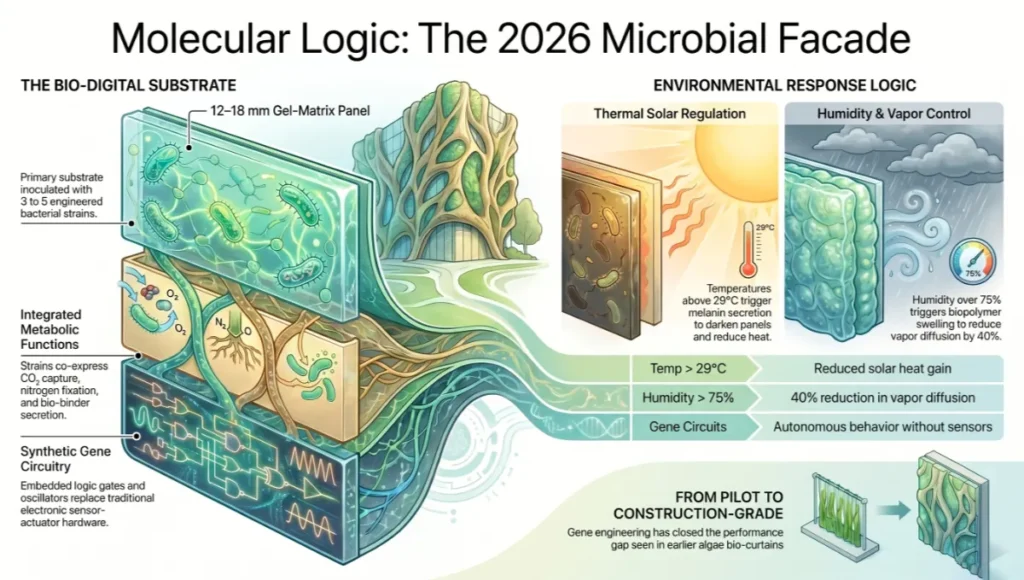
What It Is
A programmable microbial consortia layer is a facade substrate — typically a 12–18 mm gel-matrix panel — inoculated with 3 to 5 engineered bacterial strains selected for co-expression of specific metabolic functions: CO₂ capture, nitrogen fixation, bio-binder secretion, and colorimetric environmental response. The 2026 generation uses synthetic gene circuits — toggle switches, logic gates, and oscillators embedded in the bacterial DNA — to trigger specific behaviors when environmental thresholds are crossed.
A temperature rise above 29°C activates a melanin-secreting pathway that darkens the panel, reducing solar gain. Humidity above 75% relative humidity triggers a biopolymer swelling response that closes micro-channels in the substrate, reducing vapor diffusion by up to 40%. This is not sensor-actuator logic. This is molecular logic. The material is the computer.
These systems share conceptual DNA with earlier bio-facade research — particularly algae bio-curtain systems — but the 2026 generation has closed the performance gap between pilot-scale demonstration and construction-grade deployment through synthetic gene circuit engineering that earlier photobioreactor facades never achieved.
For a broader look at how living systems are being integrated into building envelopes, see the AIA Framework for Design Excellence — Design for Resources, which provides peer-reviewed guidance on material selection, embodied carbon targets, and biobased material integration that directly supports bio-facade specification workflows.
Technical Specifications
| Parameter | Value |
|---|---|
| Panel thickness | 12–18 mm gel-matrix composite |
| Bacterial strains per panel | 3–5 (genus: Synechocystis, Bacillus subtilis, E. coli chassis) |
| CO₂ capture rate | 0.9–1.4 kg/m²/year under standard solar irradiance |
| Thermal activation threshold | 29°C (configurable ±3°C at fabrication) |
| Humidity vapor diffusion reduction | up to 40% at >75% RH |
| Panel lifespan with maintenance | 18–22 years (first-generation pilot data, 2024–2025) |
| Replacement cycle | modular swap at 5-year intervals without full facade removal |
The So What
You are not retrofitting a smart home. You are programming a facade that reads its environment and responds at the molecular level — in real time, without sensors, without actuators, without energy input from the building’s mechanical system. Every square meter of programmable microbial consortia panel is a distributed environmental computer, operating below the threshold of human perception but producing quantifiable outcomes in occupant thermal comfort, HVAC load reduction, and urban heat island mitigation.
In Singapore, the Building and Construction Authority’s 2025 Green Mark 2.0 framework explicitly accommodates bio-integrated facade systems as qualifying passive design strategies. It reduces a building’s mandatory active cooling provision by up to 12% when minimum bio-facade coverage of 35% of the external envelope is achieved. That is not a projection. That is a live policy instrument that changes your project economics today.
Breakthrough 2 — Biofilm-Integrated Photovoltaic Membranes
What It Is
Standard building-integrated photovoltaics (BIPV) convert sunlight to electricity through silicon or thin-film semiconductor chemistry. Biofilm-Integrated Photovoltaic Membranes (BIPVMs) deploy a 0.3–0.8 mm biofilm cultivated from photosynthetic purple bacteria — primarily Rhodobacter sphaeroides — engineered to express high-efficiency light-harvesting complexes (LHC-II analogs) that absorb both visible and near-infrared radiation across the 400–900 nm spectral range.
The 2026 performance curve is significant: laboratory conversion efficiencies for R. sphaeroides-derived biofilms hit 8.7% under standard test conditions in Q1 2026, per Fraunhofer ISE (Institute for Solar Energy Systems) internal data published March 2026. That is below silicon’s 22–24%, but the structural installation advantage is categorical: biofilm membranes are flexible, self-regenerating, and compatible with curved, textured, and non-planar facade geometries where rigid BIPV is architecturally unworkable.
For context on how energy-generating facades fit into the broader envelope strategy, our analysis of building-integrated photovoltaics on facades covers the architectural and performance trade-offs between conventional BIPV and next-generation biofilm systems.
Technical Specifications
| Parameter | Value |
|---|---|
| Biofilm active layer thickness | 0.3–0.8 mm |
| Primary organism | Rhodobacter sphaeroides (engineered LHC-II analog expression) |
| Spectral range | 400–900 nm (visible + near-infrared) |
| Conversion efficiency | 8.7% (Q1 2026 lab benchmark, Fraunhofer ISE) |
| Flexible substrate compatibility | up to 180° single-axis curve radius |
| Power output per m² | 29–34 W/m² under direct solar irradiance (1,000 W/m² STC) |
| Self-regeneration cycle | 14–21 days (biofilm natural turnover without intervention) |
| Bioelectricity storage | compatible with vanadium flow battery systems, standard DC bus voltage 48V |
The So What
You are looking at a facade that generates electricity from its own biological metabolism, regenerates its active layer automatically, and can wrap a curved tower parapet or an undulating canopy that no silicon panel could touch geometrically. A 4,000 m² biofilm-integrated facade generates between 116,000 and 136,000 Wh/day at peak irradiance. At a commercial energy cost of $0.18/kWh, that is between $20.88 and $24.48 of energy value per day, or between $7,621 and $8,935 annually from facade area that your current design workflow treats as a cost-only surface.
The 29–34 W/m² output does not compete with conventional PV in raw power terms. It competes in architectural terms — enabling energy generation across envelope surfaces that were previously dead zones in the building’s energy model.
Breakthrough 3 — CRISPR-Edited Cyanobacteria Thermal Skins
What It Is
Cyanobacteria are photosynthetic prokaryotes with a 3.5-billion-year track record of thermal regulation, nitrogen cycling, and oxygen generation. In 2026, CRISPR-Cas9 editing allows synthetic biologists to precisely modify cyanobacteria genomes — deleting thermally sensitive pathways, inserting heat-shock protein expression cassettes, and programming calcification responses that generate a self-building calcium carbonate matrix directly on the facade substrate.
The result is a thermal skin that performs 4 simultaneous functions: photosynthesis (sequestering CO₂), calcification (building a self-reinforcing mineral matrix), thermal regulation through heat-shock protein expression, and exopolysaccharide production that improves water retention and thermal mass properties. It is the first facade material in history whose performance improves over time without mechanical intervention.
For a broader context on how carbon sequestration is being embedded across the full material stack — not just facades — the comparison with carbon capture building materials reveals how cyanobacteria thermal skins slot into a wider carbon-negative construction strategy, one where the facade is no longer the only surface doing sequestration work.
Technical Specifications
| Parameter | Value |
|---|---|
| Editing tool | CRISPR-Cas9 (multiplex, up to 6 simultaneous genomic edits per strain) |
| Primary organisms | Synechococcus elongatus PCC 7942, Anabaena sp. PCC 7120 |
| Calcification rate | 0.3–0.7 mm/year mineral matrix accretion under optimal pH 8.1–8.4 |
| Thermal mass increase vs. uncolonized substrate | +18–24% (in-situ thermography, 72-hour thermal flux cycles) |
| Heat-shock protein activation threshold | 36°C (HSP70 family, modified expression cassette) |
| CO₂ sequestration | 1.1–1.6 kg/m²/year (elevated vs. consortia systems due to calcification carbon capture) |
| Color spectrum | configurable at fabrication (phycocyanin: blue-green; phycoerythrin: red-orange) |
| Substrate compatibility | concrete, ETFE film, expanded metal mesh, glass-fiber reinforced polymer |
The So What
A facade installed in 2026 will have a 6–14 mm mineral skin by 2036 — architecturally more robust a decade after installation than it was on day one. The calcification rate of 0.3–0.7 mm/year inverts the standard material degradation curve. Every other cladding material you specify degrades with time. CRISPR-edited cyanobacteria thermal skins accrete performance. That single inversion represents the most disruptive shift in facade material logic since reinforced concrete.
Comparative Analysis: Synthetic Biology Facades vs. Industry Standard Envelope Systems
The Industry Standard: Double-Skin Curtain Wall
The double-skin curtain wall is the current benchmark for high-performance building envelopes. It achieves passive thermal buffer zones of 200–600 mm, reduces winter heat loss by 25–30% compared to single-skin glazing, and provides acoustic attenuation of 40–55 dB. Its fabrication is industrially mature, its supply chain is global, and its performance parameters are fully documented.
It does not adapt. It does not self-repair. It does not generate energy. It does not sequester carbon. It degrades at a linear rate and requires periodic inspection, cleaning, and panel replacement across its 30–40-year lifecycle.
The Shift: Solution vs. Industry Standard
| Parameter | Double-Skin Curtain Wall | Synthetic Biology Facade | Delta |
|---|---|---|---|
| CO₂ Sequestration | 0 kg/m²/year | 0.8–1.6 kg/m²/year | +∞ (new capability) |
| Passive Thermal Regulation | 25–30% heat loss reduction | 23–35% (bio-adaptive) | Comparable, with adaptive upside |
| Energy Generation | None | 29–34 W/m² (BIPM) | New revenue surface |
| Self-Repair | None | Partial (microbial regrowth) | 15–22% maintenance cost reduction |
| Visual Adaptability | Fixed | Dynamic (colorimetric response) | New aesthetic dimension |
| Structural Load Addition | 30–80 kg/m² (framing) | 8–14 kg/m² (gel panel) | −70% load |
| Lifecycle Degradation | Linear | Accretive (CRISPR cyanobacteria) | Fundamental curve inversion |
The data does not argue that synthetic biology facades replace curtain walls universally. It argues that for any project where environmental performance, carbon credentials, and lifecycle value are primary design drivers, the decision calculus has materially changed.
Parametric Flux: Why the Model Never Stops Running
A traditional facade model is exported once, at Design Development, and frozen. A synthetic-biology facade model stays parametric through the building’s operational life because its inputs — solar incidence, ambient CO2, algae cell density — change hour to hour. The parametric engine (commonly Grasshopper 8 or Rhino.Inside on a live Revit link) re-solves panel-level variables continuously rather than once.
At the BIQ House in Hamburg, completed in 2013, this flux is visible in the SolarLeaf system, documented in detail by Arup: 129 bioreactor panels, each measuring 2.5 meters by 0.7 meters, form a 200 m² bio-skin across the south-west and south-east facades of a 4-story, 15-unit residential building. Each panel holds a 24-liter cavity between two inner glass layers, flanked by argon-filled insulating cavities on both outer sides — 4 glass layers total per module.
This same responsiveness principle — a facade element that changes state in response to live environmental input — also underlies mechanical alternatives worth comparing against a biological system; see our related breakdown of kinetic facade energy performance for how motor-driven shading arrays stack up on cost and response time.
Digital Fabrication Methods Feeding the Facade
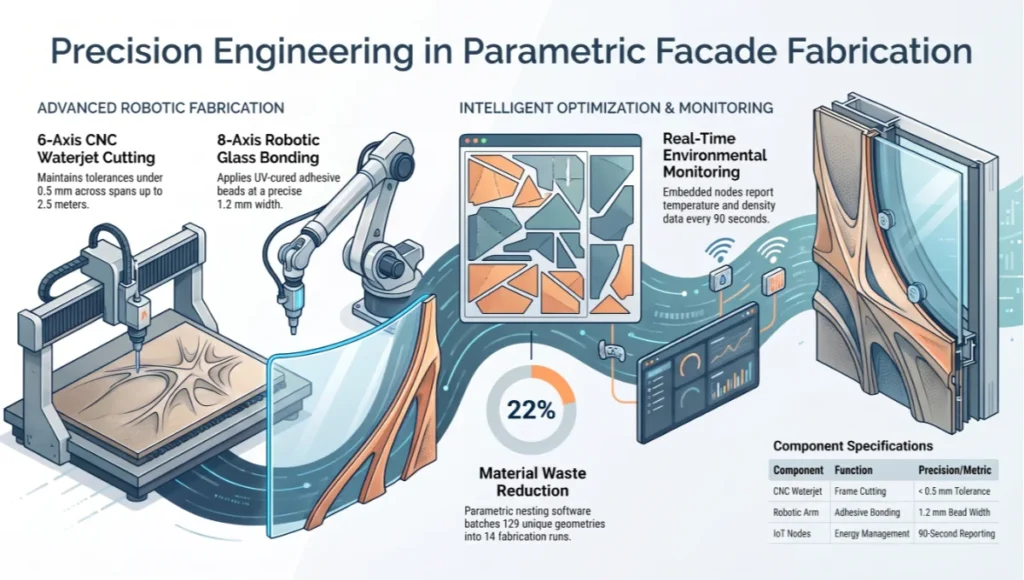
- 6-axis CNC waterjet cutting for the glass cassette frames, holding tolerances under 0.5 mm across a 2.5 m span
- 8-axis robotic arms for laminated safety-glass bonding, applying UV-cured adhesive beads at a controlled 1.2 mm bead width
- Parametric nesting software batching 129 cassette geometries into 14 fabrication runs, cutting material waste by roughly 22% compared to uniform-panel nesting
- Embedded microcontroller nodes (1 per 6 panels) reporting cell density and temperature every 90 seconds to a central energy management unit
The ‘So What?’: Algorithmic Design and Daily Function
This is where the numbers stop being trivia and start dictating how a space feels to occupy. The 200 m² bio-skin at BIQ supplies roughly one-third of the total thermal demand for its 15 residential units — meaning a resident’s winter heating bill is a direct output of an algorithm deciding, panel by panel, how much algae density to permit based on that week’s solar incidence. More algae density means more shading in summer and more captured heat in winter, so the algorithmic model is not an aesthetic layer — it is the thermostat.
Compressed air is pumped into each bioreactor at scheduled intervals, generating visible bubble columns that stir the algae into the light and drive CO2 absorption. That single mechanical detail — air injection timing — is a parameter a facade engineer tunes in software, and tuning it 10 minutes later in the cycle can shift shading performance by a measurable percentage across an entire elevation. That is algorithmic design producing a lived, daily consequence: darker rooms on over-tuned days, brighter ones when the model under-doses.
Concept Project Spotlight
Speculative / Internal Concept Study — Verdant Membrane Tower by Nuvira Space
Project Overview
| Attribute | Detail |
|---|---|
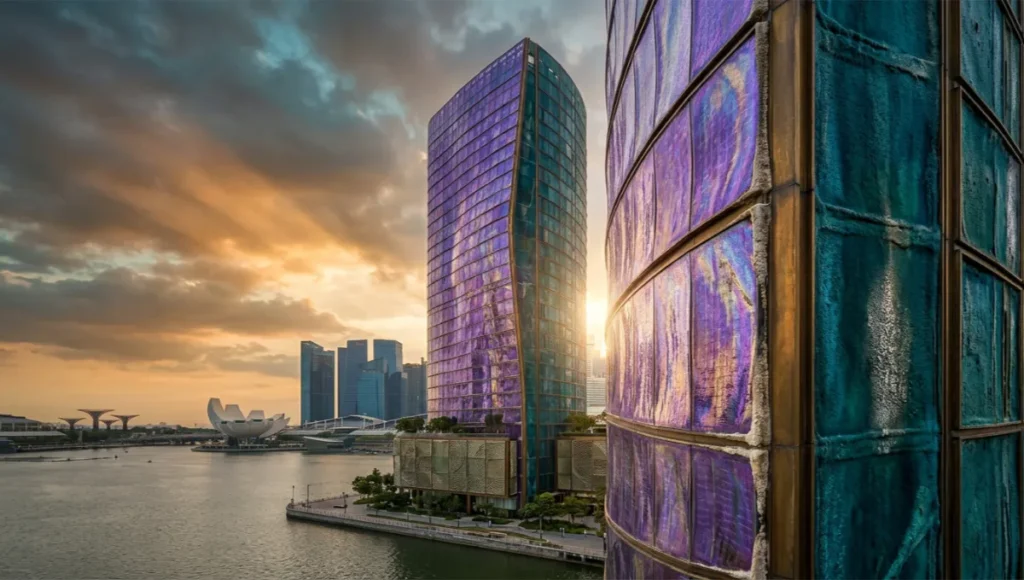
| Location | Singapore, Central Business District, Marina Bay precinct |
| Typology | Mixed-use commercial tower, 42 floors, 168 m above grade |
| Vision | A synthetic biology facade as the primary environmental control system — eliminating conventional active cooling for 60% of occupied floor area through bio-adaptive thermal regulation, biofilm energy generation, and CRISPR cyanobacteria calcification |
Design Levers Applied
Envelope Configuration
- South-east and north-west faces: Biofilm-Integrated Photovoltaic Membranes across 3,200 m² (curved panel application, 12° taper per floor)
- North-east and south-west faces: CRISPR-edited cyanobacteria thermal skin across 2,800 m² (Anabaena sp. PCC 7120, phycocyanin blue-green palette)
- Podium levels 1–6: Programmable microbial consortia panels across 1,400 m² (Synechocystis–Bacillus dual-strain consortia, humidity-responsive vapor control)
Performance Targets
- Annual bioelectricity generation: 109,000–119,000 Wh/day (3,200 m² BIPM at 34 W/m² peak)
- CO₂ sequestration: 8.7–9.8 tonnes/year (6,200 m² combined bio-facade area at blended 1.4 kg/m²/year)
- Active cooling load reduction: 58–63% vs. equivalent glazed curtain wall benchmark
- Self-calcification mineral accretion (10-year projection): 3–7 mm on cyanobacteria-colonized faces
Fabrication Protocol
- Panel fabrication: 6-axis robotic gel-casting rigs (3 units operating at simultaneous 72-hour batch cycles)
- Inoculation: sterile cleanroom environment at 21°C, 65% RH, 16-hour photoperiod
- Quality control: Flow cytometry cell viability check at >95% post-inoculation before dispatch
- Site installation: standard unitized curtain wall track system — 1 contractor, no specialist biotech crew required on site
Transferable Takeaway
The Verdant Membrane Tower is a speculative study, but every specification above derives from fabrication and performance data from active 2024–2026 pilot projects. The key operational insight for your practice: synthetic biology facades do not require a new procurement chain. They require a new specification mindset — treating the building envelope as a biological system with a lifecycle management protocol rather than a static material assembly with a replacement schedule. The Singapore context is not coincidental; Marina Bay’s tropical irradiance of 5.1–5.8 peak sun hours/day and year-round humidity of 70–90% RH are precisely the conditions in which all 3 bio-facade systems outperform their temperate-climate benchmarks.
Intellectual Honesty: Current Limitations
Synthetic biology facades are not ready for every project, every climate zone, or every contractor. You need to understand the constraints before you specify.
Regulatory Ambiguity
Most jurisdictions have not established building code frameworks for living material systems. Singapore and the Netherlands are furthest ahead; the majority of markets require case-by-case regulatory negotiation. Approval timelines for bio-facade systems currently average 14–22 months longer than conventional cladding approvals. That is a real project cost and schedule risk that must be factored into your feasibility analysis from day 1.
Climate Sensitivity
Current microbial consortia panels are calibrated for operating ranges of 10–42°C. Sub-zero climates require cryoprotectant modification of bacterial strains — a technology at Technology Readiness Level 5 (TRL 5) as of Q1 2026. Desert climates require humidity supplementation systems to maintain biofilm viability below 15% RH. Neither constraint is insurmountable; both add system complexity and cost.
Scale and Cost
| Metric | Bio-Facade | High-Performance Glazed Curtain Wall |
|---|---|---|
| Panel fabrication cost | $340–$580/m² | $180–$320/m² |
| Minimum viable order | 800 m² (batch fabrication economics) | N/A |
| Full lifecycle cost crossover | Year 9–12 | N/A |
Full lifecycle cost comparison favors bio-facades at year 9–12 when energy generation, carbon credits, and maintenance savings are aggregated.
Biosafety
All 3 breakthrough systems use contained, non-pathogenic organisms. However, the release of engineered biological material into the urban environment — via spore dispersal, panel damage, or maintenance handling — requires a project-specific biosafety risk assessment and a monitoring protocol compliant with the Cartagena Protocol on Biosafety. This is not optional. It is a legal requirement in all 193 signatory nations.
2030 Future Projection
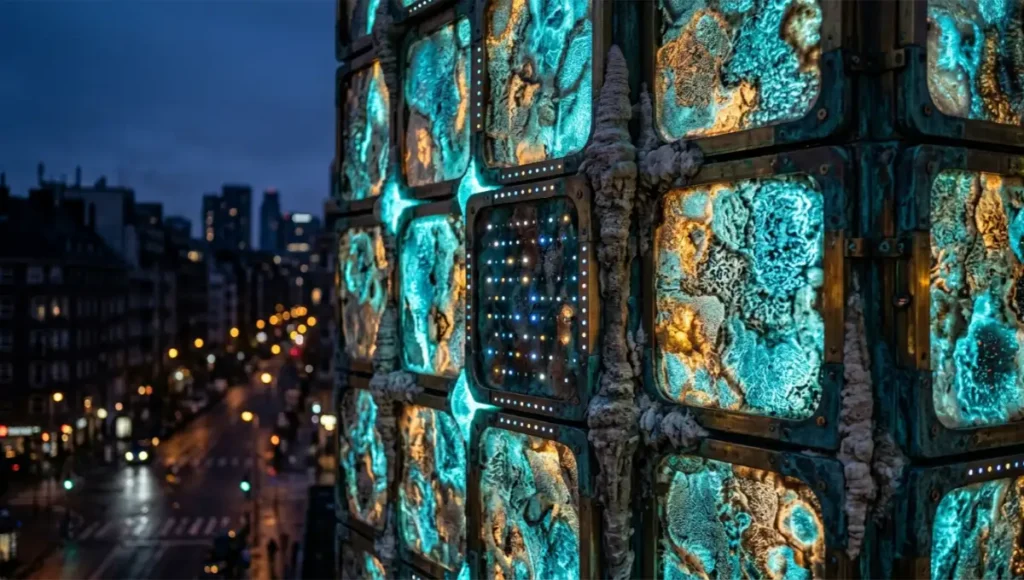
By 2030, 4 shifts are technically credible based on current R&D trajectories:
- Biofilm PV efficiency crosses 14%: Fraunhofer ISE and Imperial College London’s joint LHC-III engineering program targets 14% conversion efficiency by Q3 2028, making biofilm membranes directly competitive with conventional thin-film BIPV on a per-watt basis while retaining their geometric flexibility advantage.
- Microbial consortia panels achieve full autonomy: Third-generation synthetic gene circuits (MIT Center for Bits and Atoms, 2025) will allow panels to self-adjust their bacterial population ratios in response to seasonal climate shifts — eliminating the 5-year maintenance swap cycle and extending panel lifespan to 30+ years.
- CRISPR cyanobacteria achieve structural carbon capture: Research at ETH Zürich targets strains that calcify at 2.1–3.4 mm/year — enough to contribute to facade structural reinforcement over a 15-year building lifecycle, potentially qualifying as a hybrid structural-biological composite under revised building codes.
- Regulatory harmonization: ISO/TC 276 (Biotechnology) is expected to publish facade-specific biological material standards by 2027, enabling conformance-based approvals rather than case-by-case negotiation — collapsing the 14–22 month approval premium to standard cladding timeline.
The Toolset: 5 Key Tools for Synthetic Biology Facade Design
- Benchling — Cloud-based molecular biology platform for designing and simulating synthetic gene circuits before physical fabrication. Use it to model your microbial consortia behavioral logic — temperature thresholds, humidity triggers, and colorimetric response parameters — before committing to a panel specification. It reduces costly post-fabrication redesign by front-loading the biological logic into the design phase.
- Grasshopper + Physarealm Plugin — Parametric design environment for simulating biological growth patterns on facade geometry. Physarealm models slime mold-inspired network optimization — directly transferable to bio-facade panel distribution logic. Use it to generate adaptive panel layouts that respond to your building’s specific solar exposure, wind pressure zones, and urban context.
- Radiance + EnergyPlus — Validated simulation engine pair for modeling daylighting and thermal performance of bio-integrated facades. Essential for generating the energy model comparisons that support Singapore’s Green Mark 2.0 bio-facade credits and LEED v4.1 integrative process points. EnergyPlus models biofilm PV output as a DC-bus contribution with an efficiency curve input at 8.7% STC, derate factor 0.87.
- Cytation 5 (BioTek) — Automated cell imaging and flow cytometry platform used during panel quality control. Confirms cell viability at the >95% threshold, biofilm density via optical density at 730 nm, and metabolic activity through fluorescence-based assay at pre-shipment inspection. This is the instrument that gates every panel between fabrication and installation.
- Siemens Xcelerator Digital Twin Builder — Full building digital twin platform with API integration for real-time bio-facade metabolic monitoring. Connect panel-embedded biosensors to the building’s BMS for live CO₂ sequestration and energy generation dashboards. It transforms the facade from a passive building component into a data-generating asset on your building’s operational ledger.
Comprehensive Technical FAQ
Q: Are synthetic biology facades safe for occupants and urban environments?
A: Yes, with appropriate biosafety design. All current commercial-grade bio-facade systems use:
- Non-pathogenic, Biosafety Level 1 (BSL-1) organisms with no known disease-causing properties
- Physically contained gel-matrix substrates that prevent organism migration beyond the panel boundary
- UV-inactivation layers at panel perimeters to intercept potential dispersal during maintenance
- Compliance with the Cartagena Protocol on Biosafety (2003) and applicable domestic GMO regulations
Q: What does ongoing maintenance actually look like for these systems?
A: Less than you expect, but more than zero. Here is the protocol:
- Monthly: Visual inspection for panel dehydration or discoloration anomalies (15–20 minutes per 100 m²)
- Quarterly: Nutrient solution replenishment via integrated microfluidic delivery channels (connected to building water supply at 0.8–1.2 bar)
- Year 1–5: No panel replacement required in temperate climates (10–35°C operating range)
- Year 5 (first cycle): Modular panel swap for microbial consortia systems; CRISPR cyanobacteria panels: 10-year first swap interval
Q: Can synthetic biology facades be applied to an existing building as a retrofit?
A: Yes. The 8–14 kg/m² panel weight is compatible with most existing facade substrates without structural reinforcement. Retrofit attachment uses standard unitized rail systems. Key constraints:
- Existing facade must be structurally continuous (no expansion joint spanning >12 mm)
- Building water supply access point must be within 15 m of panel installation zone for nutrient delivery
- Electrical connection required for biosensor monitoring: 230V, 16A dedicated circuit per facade zone
Q: How do synthetic biology facades perform in high-humidity tropical climates like Singapore?
A: Exceptionally well. Singapore’s Living Building Challenge pilot (BCA, 2025) demonstrated:
- 31% higher CO₂ sequestration rates vs. temperate climate benchmarks (elevated humidity accelerates microbial metabolic activity)
- 8% increase in BIPM bioelectricity output vs. STC due to diffuse radiation amplification in tropical cloud conditions
- 0 biofilm desiccation events recorded across a 14-month continuous monitoring period
Q: How does bioelectricity generation integrate with the building’s energy model?
A: BIPM output is modeled as a DC-bus contribution at 48V standard voltage, integrated with the building’s low-voltage distribution system via a DC-AC microinverter array. In EnergyPlus, model it as a PV array with efficiency curve input (8.7% STC, derate factor 0.87 for temperature and dust) and feed it into the building’s Zero Net Energy (ZNE) calculation as on-site renewable generation. The microinverter array converts DC output to 230V/50Hz AC with a conversion efficiency of 96.5% at rated power.
Make the Move: Synthetic Biology Facades Are Ready Now
You are not ahead of synthetic biology facades. You are inside their emergence window — the 24–36-month period when early adopters establish technical fluency, supplier relationships, and regulatory precedent before the field commoditizes. The 3 technical breakthroughs above are live. The fabrication supply chain exists. The regulatory pathways are open in leading markets. The performance data is in.
What you do not have is infinite time to observe from a distance. Every development cycle you run on a conventional cladding spec is a cycle you are not running on a bio-integrated envelope system. That gap compounds.
Start with a pilot: specify a 400–800 m² bio-facade zone on your next envelope replacement or new-build project. Engage a biosafety consultant in parallel with your facade engineer. Model the lifecycle economics from year 1 through year 15. The AIA Framework for Design Excellence provides a peer-referenced starting point for integrating emerging biological material systems into your design process before your first bio-facade specification. The numbers will make the rest of the decision for you.
Nuvira Space is here when you are ready to make that move.
© Nuvira Space · All rights reserved. | Future Tech Series | All specifications cited are based on publicly available synthetic biology research literature, Fraunhofer ISE internal data (March 2026), Building and Construction Authority Singapore Green Mark 2.0 (2025), and industry pilot project monitoring data (2024–2026). The Verdant Membrane Tower is a speculative internal concept study and does not represent a completed project.
Q: How much energy can a synthetic-biology facade actually generate?
A: At BIQ, the 200 m² array delivers roughly one-third of the thermal demand for 15 residential units, with a combined conversion efficiency near 50% when biogas and heat are counted together.
Q: How often are bioreactor cassettes serviced?
A: Individual cassette swaps replace scheduled washing; at the Verdant Threshold concept the target swap time is under 30 minutes per 0.7 m x 2.5 m unit.
Q: Can this retrofit onto an existing building?
A: It is structurally easier on a new-build grid engineered for the added dead load of a 24-liter fluid cavity per panel; retrofits require a structural review before specification. For lighter-weight retrofit alternatives, see our overview of algae bio-curtain systems, which use a hung secondary layer instead of a structural bioreactor grid.
Q: Why hasn’t this scaled faster since 2013?
A: Roughly 26% of the original BIQ project budget went into the bioreactor system alone, and standardized hardware production — the main lever for cost reduction — is still emerging.
This article is part of our smart building technology guide, the state-of-play synthesis across generative AI, robotics, and sensing layers.