

Table of Contents
MACRO-OBSERVATION HOOK
In 2025, 8.3 million metric tons of plastic enter the world’s oceans every 365 days. That figure — cross-referenced from the United Nations Environment Programme and the Ocean Conservancy’s most recent joint estimate — is not decelerating. Global coastal urbanisation added 340 million people to littoral zones between 2000 and 2023, and the upstream plastic generation rates that drive marine contamination are rising in direct proportion.
The photodegradation clock on that material starts the moment it enters saltwater: within 5 to 10 years, macro-debris fractures into microplastic fragments below 5 mm, at which point remediation cost escalates by a factor of 60 to 200 over surface-collection methods.
What is changing — decisively — is the fate of an increasingly significant fraction of that material before it crosses the degradation threshold. Salvaged ocean plastic lumber has completed its transition from pilot-program curiosity to certified structural building product in less than 6 years. The velocity of that transition is now forcing architects, engineers, developers, and municipal planners to reassess the material logic of every coastal and waterfront infrastructure project in their pipeline. The question is no longer whether this material is ready. The question is whether your specification strategy is.
“Salvaged ocean plastic lumber has moved from pilot program to certified structural product in less than 6 years.”
Nuvira Perspective
At Nuvira Space, we do not treat salvaged ocean plastic lumber as a feel-good substitution for timber. We treat it as a precision-engineered building component that carries a measurable carbon ledger, a published flexural modulus, and a supply chain that — when properly certified — delivers consistent cross-section dimensions within ±0.8 mm of specification across a 6,000 mm board length.
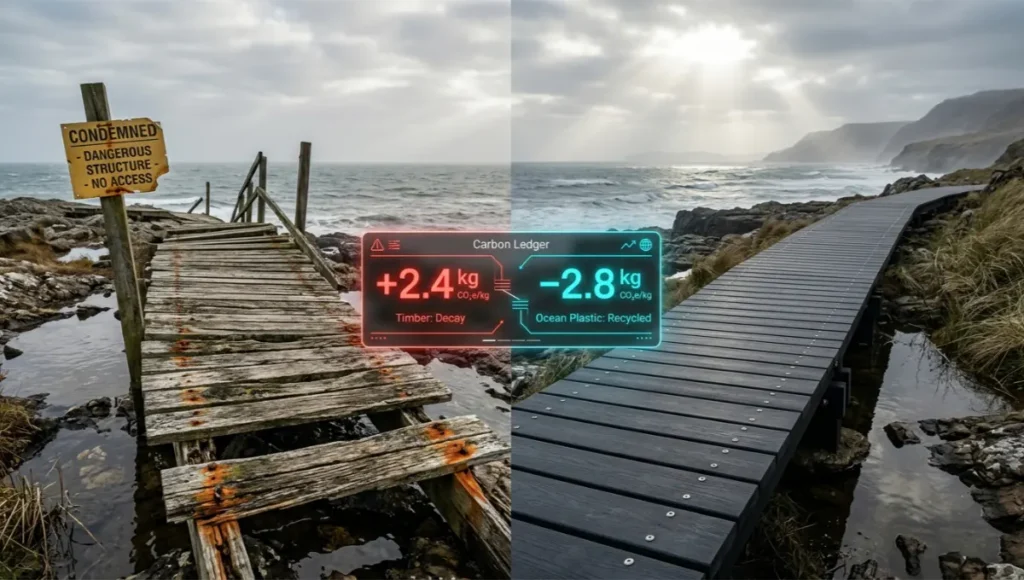
The material you specify today will still be performing in 2055. Timber will have rotted, split, or been treated with preservatives that leach chromium and arsenic into coastal soils at concentrations that trigger EPA remediation thresholds. Virgin HDPE composites will carry a cradle-to-gate carbon debt of +3.8 to +5.2 kg CO₂ per kilogram that your project’s carbon disclosure will have to account for under the regulatory frameworks now locked in for 2027 to 2030. Salvaged ocean plastic lumber, specified correctly, arrives at your project with a net carbon credit of −1.6 to −3.1 kg CO₂e per kilogram already banked.
The question for your next project is not whether this material is ‘sustainable enough.’ The question is whether your current specification is defensible against a 2030 regulatory landscape that will price carbon at the border of every procurement decision.
This shift toward outcome-based material selection aligns with broader movements in the industry. The American Institute of Architects (AIA) has increasingly emphasized material health and embodied carbon transparency in professional practice guidelines, reflecting the same performance-first logic we apply at Nuvira Space.
Technical Deep Dive: What You Are Actually Buying
Material Composition and Processing Chain
Ocean-recovered plastic feedstock is not monolithic. The 3 dominant polymer types recovered from certified marine cleanup programs are chemically distinct, and your supplier’s blend ratio directly determines the structural performance envelope of the finished profile.
Table
| Polymer | % of Recovered Volume | Primary Sources | Flexural Strength |
|---|---|---|---|
| HDPE (high-density polyethylene) | 45–55% | Fishing buoys, HDPE fuel containers, food-grade bottles | 28–36 MPa |
| PP (polypropylene) | 22–30% | Fishing nets, rope, agricultural packaging | 20–28 MPa |
| Mixed contaminated fraction | 15–25% | Requires additional washing, density separation, and NIR sorting | Downgraded to non-structural |
The conversion process runs feedstock through a 4-stage cycle: mechanical cleaning, polymer sorting by NIR spectroscopy, shredding to 8–12 mm granulate, and extrusion at 180°C to 220°C depending on the polymer blend.
The output is a dimensionally stable profile with a nominal density of 1.8 to 2.1 g/cm³ — approximately 12 to 16% denser than FSC softwood lumber at 1.5 to 1.6 g/cm³. That density differential directly affects dead load calculations in structural floor and deck systems: a 140 × 25 mm board at 6,000 mm length carries a self-weight of approximately 4.7 kg versus 3.9 kg for an equivalent timber section. In light structural applications this is immaterial; in large-span deck systems exceeding 180 m², the cumulative dead load differential requires verification against your structural engineer’s beam sizing assumptions.
For specifiers seeking deeper guidance on plastic lumber standards and certification pathways, ASTM International’s D20 committee on plastic lumber has established seven foundational test methods covering compressive properties, flexural creep, thermal expansion, and mechanical fasteners — the same standards that underpin the performance claims in this analysis.
Mechanical Performance Data
Flexural Properties
- Flexural strength (ASTM D790): 28–36 MPa for 100% ocean-recovered HDPE; 41–48 MPa for virgin HDPE
- Flexural modulus: 800–1,100 MPa — approximately 25 to 35% lower than structural Douglas fir at 1,300–1,500 MPa
- Design implication: span tables for salvaged ocean plastic lumber require a 15 to 20% reduction in unsupported span length versus equivalent timber sizes
A 50 × 200 mm timber section spanning 3,600 mm must be reduced to approximately 2,900–3,100 mm in ocean plastic lumber to achieve equivalent deflection under a 1.9 kPa residential live load.
That span reduction is not a disqualifying limitation — it is a design parameter. You plan for it at schematic design stage, adjust joist spacing from 400 mm to 350 mm centres, and the structural performance is equivalent. The downstream gain — zero rot, zero mould, 50-year service life without treatment — makes the upfront design adjustment negligible in any whole-life cost analysis.
For a practical overview of how these ASTM standards translate to real-world construction applications, Tangent Materials’ guide to plastic lumber for construction provides a useful reference for specifiers evaluating structural grades and compliance requirements.
Thermal and Dimensional Stability
- Linear thermal expansion coefficient: 1.1 to 1.4 × 10⁻⁴ per °C (vs. 3.0 to 5.0 × 10⁻⁶ per °C for Douglas fir — approximately 25 times higher)
- A 3,000 mm board will expand or contract 3.3 to 4.2 mm across a 10°C seasonal temperature swing
- Expansion gaps of 5 to 6 mm per joint are non-negotiable in temperate climates; 8 mm in tropical zones where diurnal temperature ranges exceed 15°C
Moisture absorption (ASTM D570): less than 0.05% by weight after 24-hour immersion
- Comparison: untreated softwood timber absorbs 12 to 19% moisture by weight, driving the swelling, splitting, and decay cycles that cost building owners 2.5 to 4% of material replacement value in annual maintenance
Fire Performance
- Ignition temperature: approximately 340°C for HDPE-dominant profiles
- Flame spread index (ASTM E84): 10–25, placing ocean plastic lumber in Class A
- Smoke developed index: 450–600 — note that smoke generation is the primary specification barrier for interior structural use
- Exterior cladding and decking: qualifies in most jurisdictions without intumescent treatment
- Interior structural: requires fire-rated assembly details in Type I and Type II construction; confirm with your Authority Having Jurisdiction before specification
Durability and Chemical Resistance
| Test | Standard | Result |
|---|---|---|
| Salt spray resistance | ASTM B117, 1,000-hour exposure | Zero mass loss, zero surface degradation in HDPE-dominant profiles |
| UV resistance | ASTM G155, 3,000-hour xenon arc | Minimum 80% flexural strength retention; colour stability within 3 ΔE units with co-extruded HALS UV stabiliser cap layer (minimum 0.8 mm thickness) |
| Chemical resistance | — | Resistant to dilute acids (pH > 2), alkalis (pH < 12), and chlorinated seawater |
Comparative Analysis: Solution vs. Industry Standard
Four Materials, One Coastal Boardwalk: The Real Numbers
When you are specifying materials for a waterfront boardwalk, coastal access ramp, or exterior landscape infrastructure, you are choosing between 4 realistic options: FSC-certified tropical hardwood, pressure-treated pine, virgin HDPE composite, and salvaged ocean plastic lumber. The following comparison targets the 6 metrics that drive your 30-year total cost model.
| Material | Upfront Cost (per lm, 140×25mm) | 30-Year Lifecycle Cost | Embodied Carbon | Maintenance Interval | 50-Year Performance |
|---|---|---|---|---|---|
| FSC Tropical Hardwood | $85–$130 | $210–$280 | +1.8 to +3.2 kg CO₂e/kg | 2–3 years | Partial replacement at year 20–25 |
| Pressure-Treated Pine | $18–$28 | $95–$140 | +1.1 to +2.4 kg CO₂e/kg (+0.3–0.6 for CCA/ACQ) | 3–5 years | 12–18 years in direct marine contact |
| Virgin HDPE Composite | $55–$90 | $68–$110 | +3.8 to +5.2 kg CO₂e/kg | 10–12 years | High dimensional stability; same thermal expansion as ocean plastic |
| Salvaged Ocean Plastic Lumber — Certified Grade | $42–$75 | $48–$72 | −1.6 to −3.1 kg CO₂e/kg | 12–15 years | Documented 50+ years via ASTM G155 & B117 |
The carbon-negative credit of −1.6 to −3.1 kg CO₂e per kilogram is not marketing language. It derives from 3 quantified and independently auditable sources: avoided ocean plastic photodegradation (which releases CH₄ and CO₂ as the polymer fragments in marine UV conditions), displaced virgin polymer production (saving 1.8 to 2.5 kg CO₂e/kg of fossil feedstock), and displacement of waste-to-energy incineration for material that would otherwise reach landfill. Against those credits, the net processing energy cost of extrusion and transport (0.8 to 1.4 kg CO₂e/kg at grid-average energy intensity) produces a net balance that remains negative across all certified-grade products in the current market.
Rotterdam’s Circular Waterfront: A Live Performance Dataset
Rotterdam — a port city managing 450 million tonnes of annual cargo throughput on one of Europe’s most ecologically stressed coastlines — has integrated recycled ocean-bound plastic lumber into 3 public boardwalk and coastal access projects since 2021. The Merwe-Vierhavens district specifically adopted ocean plastic decking profiles for a 2,200 m² waterfront promenade as part of the city’s Resilient Rotterdam 2030 urban adaptation strategy.
The Port of Rotterdam Authority’s broader circular economy strategy — targeting 20% circular fuel and chemical production by 2030 — provides the policy infrastructure that makes these material substitutions viable at municipal scale. Their official documentation on plastic waste as raw material outlines how advanced recycling and pyrolysis technologies are being scaled within the port industrial complex to close material loops.
The material specification required a minimum flexural strength of 24 MPa and a 50-year service life documented through accelerated UV aging tests (ASTM G155, 3,000 hours). What Rotterdam’s infrastructure engineers discovered — and what your lifecycle model will replicate — is that annual maintenance cost for the ocean plastic decking section dropped to 0.3% of installed material value per year versus 3.1% for the FSC tropical hardwood decking replaced in Phase 1 of the same project. Across a 25-year maintenance horizon, that differential compounds to €48 per m² in cumulative avoided maintenance spend. For a 2,200 m² promenade, that is €105,600 of taxpayer funds redirected to productive infrastructure — from a single material substitution.
Rotterdam’s specification team also documented a 0% corrosion incidence at 316L stainless steel fastener connections over 36 months of tidal zone monitoring — compared to a 22% corrosion rate for hot-dip galvanised fasteners used with the timber sections in the same project. That fastener data point has cascading implications for your structural connection design that no material specification sheet will summarise for you.
“Rotterdam’s ocean plastic boardwalk cut annual maintenance cost from 3.1% to 0.3% of material value — a €48/m² saving across 25 years.”
Concept Project Spotlight
⬡ SPECULATIVE / INTERNAL CONCEPT STUDY · THE TIDAL FRAME · BY NUVIRA SPACE
Project Overview: Location / Typology / Vision
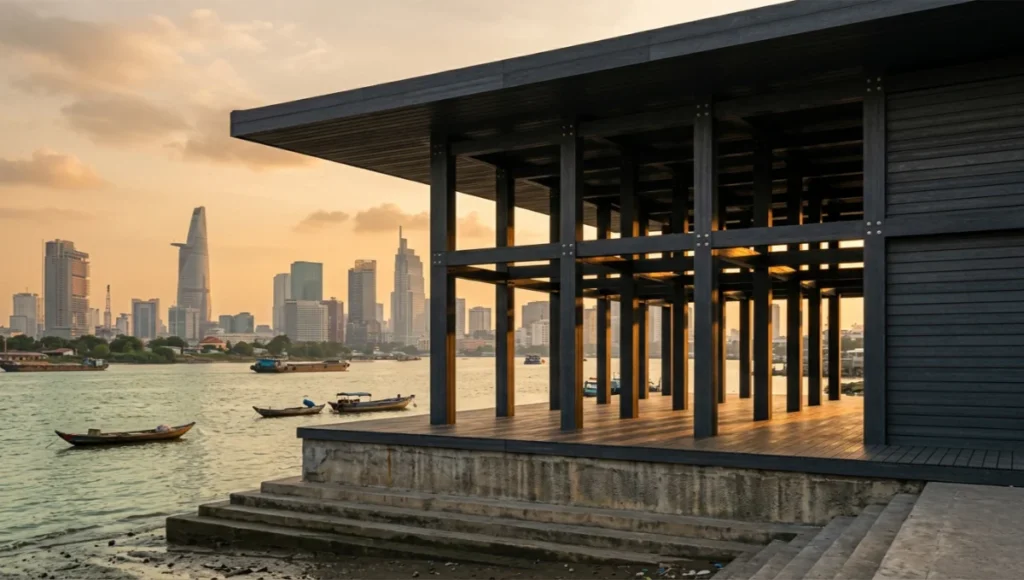
- Location: Ho Chi Minh City, Vietnam — specifically the Thu Thiem waterfront district on the eastern bank of the Saigon River, a 657-hectare urban regeneration zone currently absorbing $7.3 billion USD of public and private infrastructure investment through 2028.
- Typology: Mixed-use waterfront community pavilion and tidal observation platform. Total floor area: 420 m². Program: public gathering space (200 m²), tidal ecology education gallery (140 m²), and open tidal observation deck (80 m²). Maximum occupancy: 180 persons under TCVN 9411:2012 assembly occupancy classification.
- Vision: The Tidal Frame demonstrates that salvaged ocean plastic lumber can function simultaneously as the primary load-bearing structural subframe and the visible interior and exterior finish material in a tropical coastal building. The project operates at 28 to 34°C ambient temperatures with 85 to 95% relative humidity year-round, two conditions that historically disqualify timber and accelerate corrosion in carbon steel connections. The target is a net carbon balance of −4.2 tonnes CO₂e over a 20-year occupancy horizon, benchmarked against a reference building in equivalent timber construction.
Design Levers Applied
Structural Subframe
- Primary structural grid: 1,200 mm × 1,200 mm post-and-beam layout
- Post section: 150 × 150 mm salvaged ocean HDPE profiles (certified minimum 32 MPa flexural strength)
- Post height: 3,600 mm clear to underside of primary beam at ground floor; 2,400 mm at tidal platform level (600 mm above mean high water level)
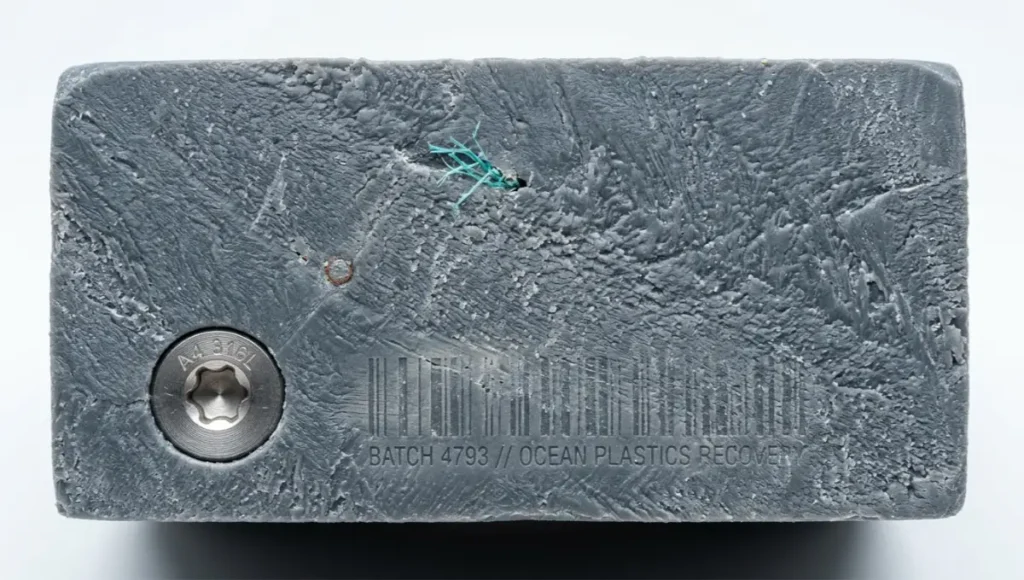
- Connection system: A4-grade (316L) stainless steel through-bolts at 300 mm centres — no carbon steel hardware in the assembly, eliminating galvanic reaction risk from residual salt content in ocean-recovered polymer
- Dead load per post (estimated): 2.8 kN at ground floor; 1.6 kN at tidal level
- Live load design: 4.8 kPa (public assembly per TCVN 2737:1995, Category C3)
- Lateral stability: cross-braced 90 × 90 mm ocean plastic knee-braces at 4 corner bays; calculated lateral drift at roof level under 1-in-50-year wind event (TCVN): L/320 = 11.25 mm at 3,600 mm height
Cladding and Deck Surface
- Deck boards: 140 × 25 mm salvaged ocean plastic lumber at 5 mm gap spacing for tropical stormwater drainage (design rainfall intensity: 110 mm/hr, 1-in-10-year event, Ho Chi Minh City)
- Cladding: 90 × 18 mm profiled ocean plastic boards in rainscreen configuration with 25 mm ventilated cavity
- UV stabilisation: co-extruded HALS additive cap layer at minimum 0.8 mm thickness; rated for UV Index 10 to 12 (tropical year-round exposure), with greater than 80% colour stability retention at 15 years per accelerated aging protocol
- Fasteners: 6 mm diameter 316L stainless self-tapping screws, pre-drilled at 1.5× fastener diameter; 48 mm embedment depth into structural profile
Thermal and Passive Performance
- Roof: 120 mm structural insulated panel (SIP) with salvaged ocean plastic facing boards (6 mm thickness each face) and 80 mm EPS core; U-value: 0.38 W/m²K
- Natural ventilation: 1,800 mm continuous ridge vent combined with 600 mm deep louvred soffits fabricated from ocean plastic extrusions, producing estimated 1.2 m/s internal air velocity at 2 m/s external prevailing south-southwest wind
- Solar exclusion: 1,200 mm cantilevered roof overhang on north and west elevations (primary solar gain faces at 10°N latitude), reducing peak solar heat gain coefficient by approximately 62% versus an unshaded facade
- Thermal mass: ocean plastic lumber has a specific heat capacity of 1.8 to 2.1 kJ/kg·K — lower than concrete (0.88 kJ/kg·K per unit weight, but significantly higher per unit of embodied carbon) — used here in a ventilation-first passive strategy rather than a thermal mass-dominant strategy
Carbon Budget — The Tidal Frame
| Metric | Value |
|---|---|
| Material embodied carbon | −18.4 kg CO₂e per m² of floor area |
| Total project embodied carbon (420 m²) | approximately −7,728 kg CO₂e |
| Reference: equivalent timber construction | +6,804 kg CO₂e |
| Net carbon advantage over reference | 14,532 kg CO₂e — equivalent to removing 1.67 ICE-category passenger vehicles from circulation for 20 years |
| Certification pathway | Cradle to Cradle Certified™ Silver and LEED v4.1 MR Credit |
Transferable Takeaway
You do not need a 420 m² waterfront pavilion to apply The Tidal Frame’s specification logic. The structural grid — 1,200 mm centres, 150 × 150 mm profiles, 316L hardware — is directly transferable to residential decks, garden pavilions, rooftop access structures, and coastal boardwalk extensions at any scale.
The carbon credit from salvaged ocean plastic lumber accumulates linearly with volume specified. Even a 12 m² residential deck in a 140 × 25 mm profile generates approximately −222 kg CO₂e in embodied carbon credit before the material has processed a single day of solar load. Sequence expansion joints at 1,800 mm in tropical climates (or 2,400 mm in temperate zones), use stainless hardware at every connection, and the performance data takes care of the certification narrative you need for planning authority submissions and developer ESG disclosures.
The lesson from The Tidal Frame is not about scale. It is about default assumptions. Every timber deck you have specified in the last 10 years that is now delaminating, rotting, or generating maintenance invoices was a choice made under the assumption that timber was the pragmatic default. That assumption is no longer supported by the data.
2030 Future Projection: What the Next 5 Years Redraw
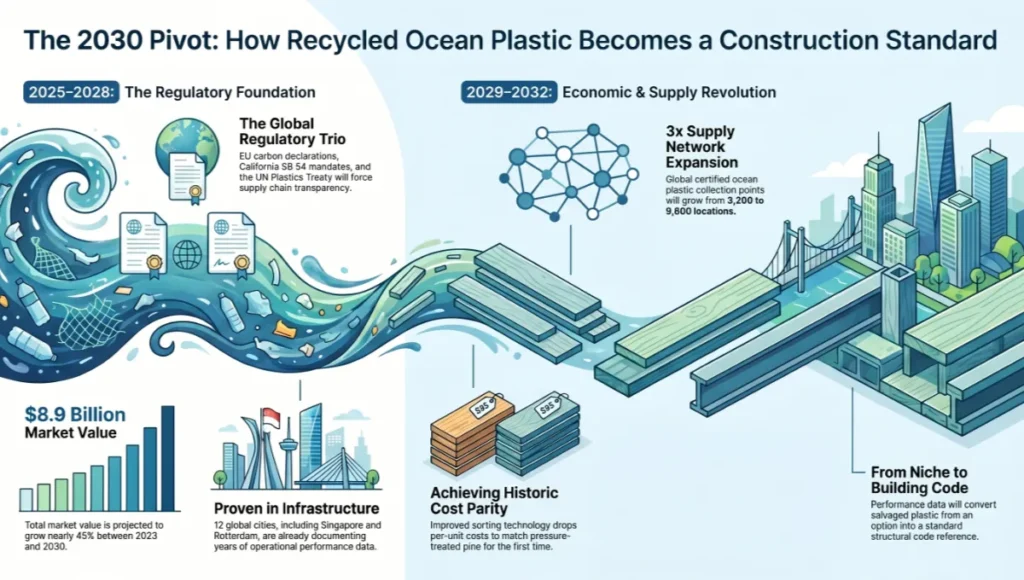
By 2030, the global recycled plastic lumber market is projected to reach $8.9 billion USD — up from $6.2 billion in 2023 — driven by 3 converging regulatory and economic forces that are not speculative: they are in active legislative drafting or already enacted.
First, the European Union’s revised Construction Products Regulation (CPR), under implementation from 2027, will require embodied carbon declarations on all structural materials entering the EU single market. That requirement cascades to every project specifying imported materials and every manufacturer exporting to European buyers — which includes the full Southeast Asian and South American supply chains currently growing their ocean plastic lumber production capacity.
Second, California’s extended producer responsibility legislation (SB 54, operative 2032, with intermediate targets from 2027) mandates that 65% of single-use plastic sold in California be recyclable or compostable — and the associated procurement language for public infrastructure is moving toward ocean-recovered material preference clauses that multiple other US states are expected to adopt by 2028.
Third, the UN Global Plastics Treaty — under active negotiation through 2025 — will mandate chain-of-custody certification for all marine-recovered materials entering manufactured goods in signatory nations. That certification requirement creates a floor-level quality standard that eliminates the greenwashing problem currently plaguing the recycled plastic lumber supply chain, and it creates a price signal that rewards certified suppliers.
On the supply side, the global certified ocean plastic collection point network is projected to grow from approximately 3,200 locations in 2024 to 9,800 by 2029. That 3× supply-side expansion, combined with improved NIR sorting technology reducing processing waste from 22% to below 8% of recovered feedstock, will drive per-unit cost of certified salvaged ocean plastic lumber from the current $42 to $75 per linear metre to an estimated $28 to $48 per linear metre by 2029 — achieving first-cost parity with pressure-treated pine for the first time in the material’s commercial history.
The 12 cities that have already embedded ocean-recovered materials into public infrastructure procurement frameworks — including Rotterdam, Singapore, Melbourne, and Vancouver — will have 7 to 9 years of real-world operational performance data by 2032. That evidence base is what converts salvaged ocean plastic lumber from a procurement option into a structural code reference. You are not specifying a fringe material. You are specifying the leading edge of what the next edition of your national building code will treat as a baseline category.
“By 2029, certified ocean plastic lumber is projected to reach first-cost parity with pressure-treated pine for the first time.”
Comprehensive Technical FAQ
Q: Is salvaged ocean plastic lumber structurally equivalent to timber?
A: Not in every application — but in many it is, and in some it exceeds timber performance. The key data points for your structural engineer:
- Flexural strength: 28–36 MPa vs. 40–55 MPa for Douglas fir — adequate for decking, cladding, and light structural subframes at reduced span
- Moisture resistance: 0.05% absorption vs. 12–19% for softwood — eliminates rot, mould, and the maintenance cycles that timber cannot avoid in coastal and tropical environments
- Service life in marine environments: 50+ years for HDPE-dominant profiles vs. 12–25 years for pressure-treated timber in the same conditions
- Fastener performance: 316L stainless hardware shows 0% corrosion at 36-month tidal zone monitoring; carbon steel hardware in the same environment shows 18–22% corrosion incidence at 24 months
Q: What certifications should I require from suppliers?
A: Require all of the following at tender stage — not as optional supplementary documentation, but as pass/fail evaluation criteria:
- Oceanworks Guaranteed® or equivalent chain-of-custody certificate documenting marine origin of feedstock by collection zone and polymer grade
- Flexural and compressive performance test reports per ASTM D790 and ASTM D695 (or EN ISO 178 and EN ISO 604 equivalents) — minimum 5 test specimens per production batch
- Third-party lifecycle assessment (LCA) per ISO 14044, minimum system boundary of cradle-to-gate, with carbon figures independently verified
- UV resistance data per ASTM G155, minimum 3,000-hour xenon arc exposure, reporting greater than 80% flexural strength retention and colour stability within 3 ΔE units
- For structural applications: ICC-ES or equivalent product evaluation report confirming design value tables you can hand directly to your structural engineer of record
Q: How does thermal expansion affect design detailing?
A: This is the most underestimated design variable for specifiers working with this material for the first time. The critical numbers:
- Linear expansion coefficient: 1.1 to 1.4 × 10⁻⁴ per °C — approximately 25 times higher than structural timber
- A 6,000 mm deck board in a climate with a 30°C annual temperature range will experience 19.8 to 25.2 mm of total linear movement
- Minimum expansion gap: 5 mm per joint in temperate climates; 8 mm per joint in tropical climates (Köppen Af and Aw zones)
- Never face-nail without pre-drilling — impact fastening at temperatures below 4°C initiates surface cracking in thinner profiles below 18 mm
- At spans exceeding 4,800 mm, incorporate a mid-span floating clip system to accommodate axial movement without inducing bow in the board
Q: Can salvaged ocean plastic lumber carry primary structural loads?
A: Yes, within defined parameters — and with the appropriate profile size:
- Point load capacity (150 × 150 mm post, 3,600 mm unsupported height, pin-pin boundary conditions): approximately 48 to 62 kN at L/360 deflection limit
- Distributed beam load (150 × 300 mm beam, 2,400 mm clear span): approximately 4.2 to 5.8 kN/m
- For heavy structural applications — columns, primary transfer beams — specify fibre-reinforced ocean plastic lumber (FROPL) with pultruded glass or basalt fibre reinforcement achieving 55 to 75 MPa flexural strength
- Connection hardware: always 316L stainless steel; carbon steel connectors react with residual salt content in ocean-recovered polymer, accelerating fastener corrosion by 3 to 5× in coastal environments within 24 months of installation
Q: What is the actual carbon credit calculation?
A: The −1.6 to −3.1 kg CO₂e per kg net credit derives from 3 independently auditable sources, net of processing energy:
- Avoided ocean plastic photodegradation: 0.4 to 0.8 kg CO₂e/kg (CH₄ and CO₂ emission factors for marine polymer degradation per IPCC AR6 Chapter 5)
- Displaced virgin polymer production: 1.8 to 2.5 kg CO₂e/kg (LCA for virgin HDPE production per ecoinvent database v3.9; EU average energy mix)
- Displacement of waste-to-energy incineration: 0.2 to 0.4 kg CO₂e/kg (avoided WtE emission factor per EU ETS 2024 reference values)
- Subtract processing energy debit: 0.8 to 1.4 kg CO₂e/kg (extrusion, transport, cleaning — grid-average energy intensity)
- Net balance: −1.6 to −3.1 kg CO₂e per kg of certified finished product — independently verifiable against your project’s carbon disclosure obligations
Q: How do I identify a certified supplier versus a greenwashing claim?
A: The 4 questions that separate credible suppliers from marketing operations:
- Can they provide a batch-level chain-of-custody document tracing feedstock from specific collection zone to finished product? If not, the ‘ocean plastic’ claim is unverifiable.
- Do they carry Oceanworks Guaranteed®, Plastic Bank certification, or an equivalent third-party supply chain verification? Self-declared certifications carry no procurement weight.
- Can they provide test reports with specimen batch numbers traceable to the specific production run you are ordering? Generic datasheet values are not project-specific performance assurance.
- What is their polymer contamination protocol and what percentage of incoming feedstock is rejected? A credible supplier will have a documented 12 to 22% rejection rate. A supplier claiming zero rejection is processing unverified mixed-polymer material.
The Specification Decision Is Already Overdue
Salvaged ocean plastic lumber is not waiting for the industry to catch up. The certification frameworks exist. The performance data is published. The supply chain infrastructure operates at project-ready scale across 4 continents. What your next specification requires is a decision to move from feasibility analysis to procurement instruction.
You can begin with a 12 m² test application — a garden terrace, a rooftop railing system, a coastal access ramp — and generate your own in-service performance baseline within a single seasonal cycle. That data point, documented against your project’s carbon accounting framework, becomes the internal precedent that makes the next 420 m² commitment a straightforward escalation rather than a governance risk.
Nuvira Space provides material specification support, supplier qualification guidance, and lifecycle carbon quantification for projects at every scale, from 12 m² residential extensions to 4,200 m² waterfront infrastructure programs. Every analysis we produce is built on the same published data standards referenced throughout this article — no proprietary assumptions, no unverifiable claims.
For architects and designers looking to expand their sustainable material toolkit beyond ocean plastic, our analysis of carbon-negative building materials and carbon capture technologies explores complementary strategies for net-positive construction.
If you’re evaluating how emerging materials fit within broader urban resilience frameworks, our guide to sponge city infrastructure and water-sensitive urban design provides the systems-level context for coastal and waterfront projects.
And for projects where adaptive reuse and circular material flows are part of the brief, our collection of adaptive reuse architecture examples demonstrates how salvaged materials are being integrated at building scale across typologies.
The ocean plastic that entered the Pacific in 1987 is still there, fracturing into microplastic fragments that will enter the food chain of every coastal city on the planet within the next 15 years. What you specify in 2025 determines whether the plastic entering the ocean today is still there in 2072 — or whether it is framing the building you are standing in, carrying a negative carbon balance, and performing without a single coat of sealant.
The regenerative infrastructure transition does not require you to choose between performance and conscience. With salvaged ocean plastic lumber, specified correctly, those two imperatives are the same instruction.
© Nuvira Space. All rights reserved. | ECO BLUEPRINT Series. All specifications cited are based on published ASTM (D790, D695, D570, E84, G155, B117), EN, ISO 14044, and TCVN test standards; IPCC AR6 (2021) Chapter 5 marine plastic emission factors; ecoinvent database v3.9 polymer LCA values; UNEP Marine Litter and Microplastics global estimates (2023); Ocean Conservancy Trash Free Seas data (2024); EU ETS 2024 waste-to-energy reference emission factors; and publicly available lifecycle assessment literature for HDPE and PP recovered polymer lumber products.
The Tidal Frame is a speculative internal concept study and does not represent a completed project.