

Table of Contents
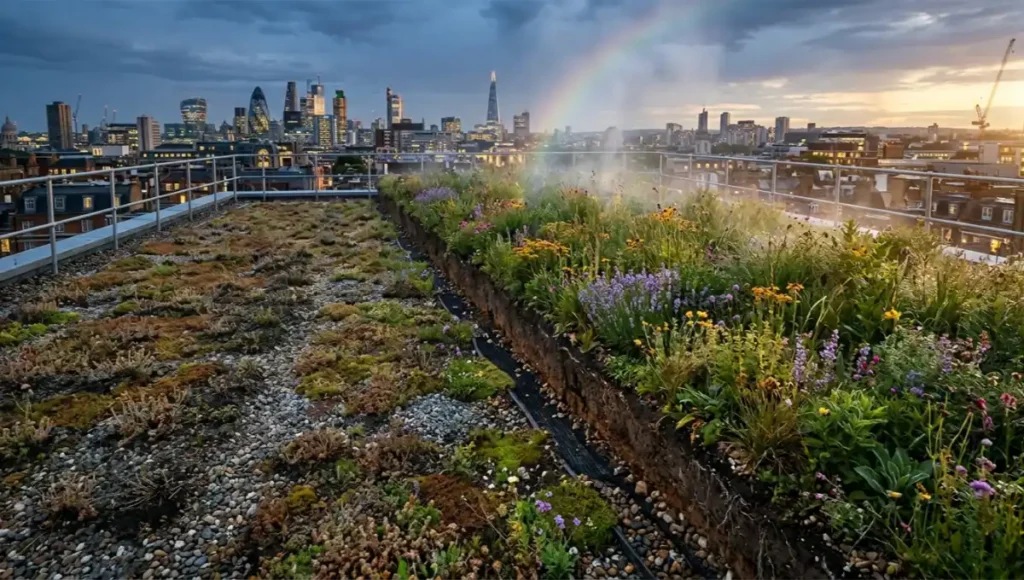
By 2030, urban heat islands will push summer surface temperatures in dense cities 7 to 9 degrees Celsius above surrounding rural baselines, and the conversation about how to reverse that trajectory increasingly comes down to a single question: what do the green roof biodiversity metrics on a given rooftop actually tell you about its real performance? Not its marketing copy, not its certification plaque — its numbers.
Substrate depth, species count, stormwater retention rate, thermal lag, habitat connectivity index. These are the figures that decide whether a roof is decorative or functional, and at Nuvira Space, we treat them as the starting point of every design conversation, not the appendix.
Nuvira Perspective
At Nuvira Space, we have spent the last several years tracking how rooftop ecosystems perform once the ribbon-cutting photos are forgotten and the building enters years 3 through 30 of its life. The pattern is consistent: roofs designed around a single aesthetic layer of sedum and 80 millimeters of substrate degrade into monocultures within 5 years, losing both their insulation value and their habitat value at the same time. Roofs designed around layered biodiversity metrics — varying substrate depths between 100 and 450 millimeters, planting palettes with 25 to 40 species, and engineered drainage layers retaining 30 to 45 liters of water per square meter — continue to improve in performance for at least 15 years.
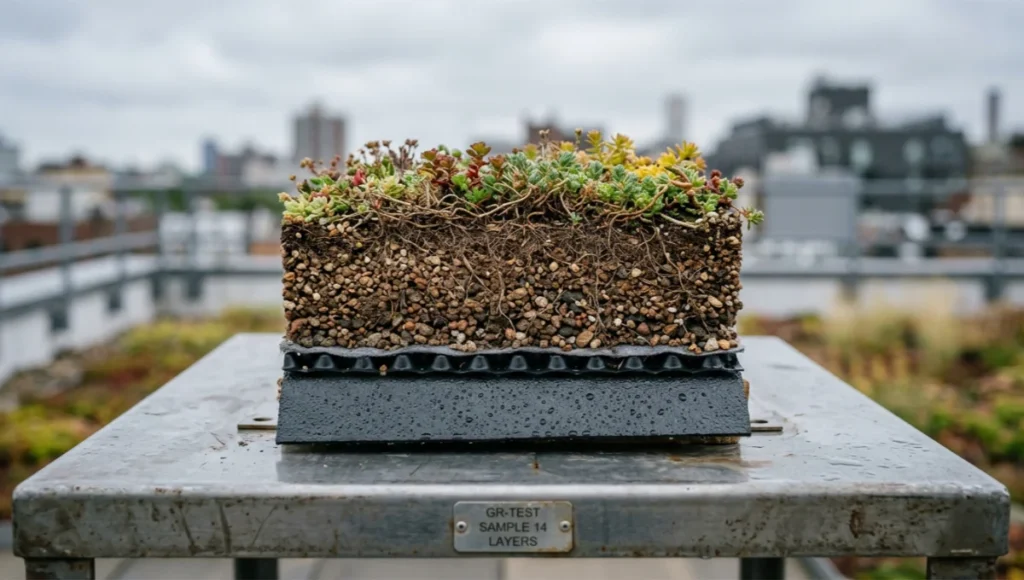
This is not a cosmetic distinction. A roof that retains 38 liters of water per square meter during a storm event is removing roughly 38 kilograms of load per square meter from the municipal stormwater system at peak demand, the exact moment when that system is most likely to fail. A 38-liter retention figure is also the kind of input that feeds directly into broader sponge city infrastructure planning, where individual rooftop retention volumes are aggregated across a district to model peak-event runoff reduction.
A roof with 32 plant species supports between 4 and 6 times more invertebrate biomass than a single-species sedum mat, which in turn supports bird foraging activity at densities of up to 12 individuals per hectare during migration seasons. A comparative Sydney study reached a similar conclusion from the opposite direction: a biodiverse roof there was found to support substantially higher avian, arthropod, and gastropod diversity than a conventional roof on the same site. These are not abstractions. They are the difference between a roof that functions as regenerative infrastructure and one that functions as a green-tinted membrane.
Our position is that any article, specification sheet, or planning submission that discusses rooftop ecology without citing substrate depth in millimeters, species counts as integers, and retention rates in liters per square meter is incomplete. The rest of this article works through those numbers, what they mean for the people living and working beneath these roofs, and how one real city has used them to restructure its entire approach to vertical density.
Technical Deep Dive
Substrate Depth and Its Downstream Effects
Substrate depth is the single most predictive variable in any set of green roof biodiversity metrics, because almost everything else — root depth, water-holding capacity, thermal mass, and species diversity — is downstream of it.
- 50 to 80 millimeters: extensive sedum-only systems. Supports 4 to 8 plant species, retains approximately 15 liters of water per square meter, adds 12 to 18 kilograms per square meter of dead load.
- 100 to 150 millimeters: extensive mixed-meadow systems. Supports 15 to 22 species, retains 22 to 28 liters per square meter, adds 25 to 35 kilograms per square meter.
- 200 to 300 millimeters: semi-intensive systems. Supports 25 to 35 species including small shrubs, retains 32 to 40 liters per square meter, adds 60 to 90 kilograms per square meter.
- 400 to 600 millimeters: intensive systems capable of supporting small trees with root balls up to 350 millimeters in diameter, retaining 45 to 60 liters per square meter, adding 140 to 220 kilograms per square meter.
So what does this mean for the people inside the building? A 300-millimeter substrate layer creates a thermal lag of approximately 6 to 8 hours, meaning the peak heat absorbed by the roof surface at 2 PM does not reach the structural slab until 8 to 10 PM, by which point ambient air temperatures have already dropped 4 to 6 degrees Celsius. The practical result is a reduction in top-floor cooling load of 15 to 25 percent during summer months, measured across a typical 6-month cooling season.
Species Count as a Functional Metric, Not a Decorative One
A species count of 30 on a rooftop is not simply “more variety.” This relationship between plant palette and resilience is the subject of an AIA-accredited continuing education course on biodiverse green roof case studies, which documents how design parameters and species selection interact across multiple completed projects. Each additional species occupies a slightly different rooting depth, flowering window, and drought tolerance threshold, which is what allows the system to maintain green cover and evapotranspiration across a full calendar year rather than a 4-month bloom window.
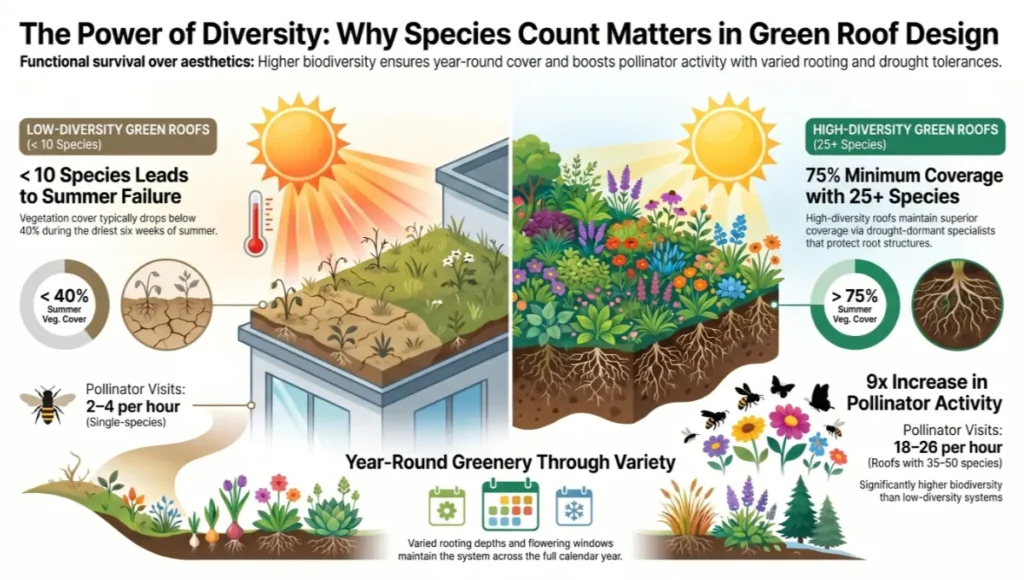
- Roofs with fewer than 10 species typically show a vegetation cover drop to below 40 percent during the driest 6 weeks of summer.
- Roofs with 25 to 35 species maintain vegetation cover above 75 percent during the same period, because at least 8 to 12 of those species are drought-dormant specialists that maintain root structure even when above-ground growth pauses.
- Roofs with 35 to 50 species, typically incorporating native grasses, low shrubs, and bulb layers, have been measured supporting pollinator visitation rates of 18 to 26 visits per square meter per hour during peak bloom, compared to 2 to 4 visits per square meter per hour on single-species systems.
Habitat Connectivity Index
The habitat connectivity index measures how accessible a rooftop habitat is to the surrounding ecological network, scored from 0 to 100 based on the distance to the nearest green space, the height of the building, and the presence of “stepping stone” green roofs on adjacent structures within 200 meters.
- A rooftop scoring below 20 on this index functions as an isolated habitat patch, supporting resident species but almost no transient or migratory use.
- A rooftop scoring above 60 — typically requiring at least 3 other green roofs within a 200-meter radius and a maximum building height differential of 25 meters — functions as part of a connected corridor, supporting transient use by species that would never land on an isolated patch.
Evapotranspiration and Microclimate Effects
The fourth metric that rarely makes it into a planning submission is the evapotranspiration rate — the volume of water a rooftop releases back into the air through plant transpiration and surface evaporation, measured in liters per square meter per day.
- An 80-millimeter sedum roof with 5 species typically evapotranspires 1.5 to 2.5 liters per square meter per day during summer, because sedum’s water-storing leaves are specifically adapted to minimize water loss.
- A 250-millimeter mixed system with 30 species evapotranspires 4 to 6 liters per square meter per day, because grasses and forbs prioritize growth over water conservation.
This difference matters at street level. A roof releasing 5 liters per square meter per day across a 1,000-square-meter area is putting 5,000 liters of water vapor into the local microclimate daily, which has been measured to reduce ambient air temperature at occupied terrace level by 1.5 to 2.5 degrees Celsius on still summer afternoons. For a rooftop terrace used as amenity space, that temperature differential is the difference between a space that is usable from 10 AM to 8 PM and one that is only comfortable before 11 AM and after 6 PM.
Load, Drainage, and the Cost of Getting It Wrong
Every additional 100 millimeters of substrate depth adds approximately 100 to 150 kilograms per square meter of saturated dead load, depending on substrate composition. This is the figure that most frequently derails ambitious biodiversity targets late in a project, because structural engineers working from an early-stage 80-millimeter assumption discover during detailed design that the slab cannot support 300 millimeters without reinforcement.
- A standard reinforced concrete slab designed for 150 kilograms per square meter of additional load typically accommodates substrate depths up to 200 millimeters.
- Reaching 300 to 400 millimeters generally requires either a slab designed from the outset for 300 to 450 kilograms per square meter of additional load, or a localized reinforcement strategy concentrating deeper substrate zones over primary structural spans rather than across the full roof plate.
The implication is straightforward: biodiversity metrics need to enter the conversation at the structural concept stage, not after the architectural layout is fixed. A 250-millimeter substrate target specified during schematic design costs nothing extra in structural terms if the slab is sized for it from day one. The same target specified after the structural drawings are issued can add 60 to 100 euros per square meter in reinforcement costs alone.
Comparative Analysis
Solution vs. Industry Standard
The industry standard for “green roof” compliance in most municipal codes remains a flat requirement: a minimum percentage of roof area (commonly 30 to 60 percent) covered by vegetation, with no specification for substrate depth, species count, or connectivity. This produces a predictable outcome — developers select the cheapest compliant system, which is almost always an 80-millimeter sedum mat with 4 to 6 species.
| Metric | Industry Standard (80mm Sedum) | Nuvira Layered System (250mm Mixed) |
|---|---|---|
| Substrate depth | 80 mm | 250 mm |
| Species count | 5 | 32 |
| Stormwater retention | 15 L/m² | 36 L/m² |
| Thermal lag | 2.5 hours | 7 hours |
| Cooling load reduction | 6% | 21% |
| Pollinator visits/hr/m² | 3 | 22 |
| Habitat connectivity contribution | Negligible | Up to 18 points |
The difference in upfront cost between these two systems is typically 35 to 45 euros per square meter. Over a 20-year operational period, the layered system’s contribution to reduced cooling costs alone — at an average commercial electricity rate of 0.28 euros per kilowatt-hour — recovers that premium within 7 to 9 years, before accounting for stormwater fee reductions, which in cities with tiered drainage levies can be worth an additional 1.50 to 3.00 euros per square meter per year.
Beyond the direct cost recovery, there is a question of liability that rarely surfaces until after handover. A roof certified against a flat coverage percentage carries no documented retention or thermal performance figures, which means that when a downstream stormwater system is overwhelmed, or a top-floor tenant complains about cooling costs, there is no baseline to compare against. A roof specified against the metric set above arrives with a documented retention figure, a documented thermal lag, and a documented species count — numbers that can be re-measured at any point in the building’s life to confirm the system is performing as designed, or to identify exactly which layer has degraded if it is not.
Speculative / Internal Concept Study: The Voorhaven Canopy by Nuvira Space
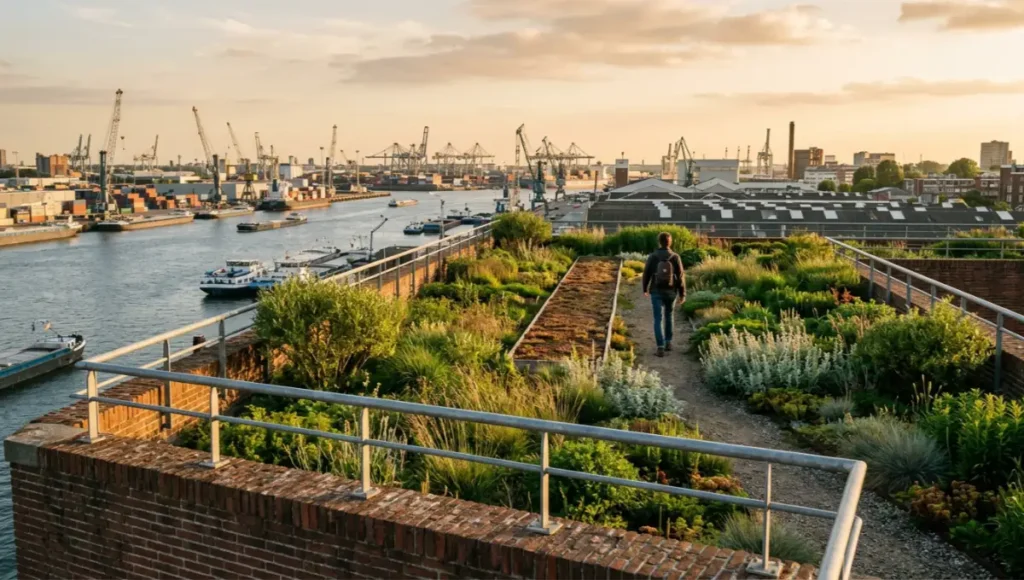
Rotterdam has spent the last decade rebuilding its relationship with water, and nowhere is that more visible than in the Voorhaven district, where 19th-century warehouse rooflines sit directly above a tidal harbor basin that floods to within 400 millimeters of the quay wall during the highest spring tides. It is here, in a city where 90 percent of the historic center sits below sea level, that we have developed an internal concept study for what a fully metric-driven rooftop retrofit could look like.
Project Overview
Location: Voorhaven district, Rotterdam, Netherlands — a former warehouse block adjacent to the tidal harbor basin.
Typology: Adaptive reuse of a 1920s brick warehouse, 4,200 square meters of roof area, converted to mixed residential and co-working use.
Vision: A rooftop system designed not around a target percentage of green cover, but around a target set of biodiversity and hydrology metrics calibrated to Rotterdam’s specific flood-risk and heat-island data — treating the 4,200-square-meter roof as a single hydrological and ecological instrument rather than a finishing material.
Design Levers Applied
- Substrate gradient: rather than a uniform depth, the roof uses a gradient from 120 millimeters at the perimeter (for wind-load reasons) to 320 millimeters across the central 60 percent of the roof area, supporting 34 plant species selected for tolerance of brackish wind exposure.
- Retention staging: the system is engineered to retain 42 liters of water per square meter under normal conditions, but includes a secondary overflow reservoir adding a further 18 liters per square meter of attenuation capacity during the 10-year storm event, releasing that volume over 6 hours rather than instantly.
- Connectivity planning: 3 adjacent warehouse roofs within 150 meters are mapped as part of the same corridor, giving the Voorhaven Canopy a projected habitat connectivity index of 64.
- Thermal performance: with the 320-millimeter central substrate band, modeled thermal lag reaches 8.5 hours, and top-floor units are projected to require mechanical cooling on 40 fewer days per year compared to the pre-retrofit baseline.
- Species selection: 34 species across 5 functional groups (grasses, forbs, low shrubs, bulbs, and 2 dwarf willow cultivars selected for 1.2-meter maximum height to remain within wind-load limits at 28 meters of building height).
- Maintenance access: a 600-millimeter gravel maintenance path is routed through the planting zones every 8 meters, allowing inspection of drainage outlets without compacting the substrate — a detail frequently omitted from green roof drawings and one that, when missing, is the most common cause of localized substrate failure within the first 24 months.
Transferable Takeaway
The lesson from the Voorhaven Canopy concept is not “use 320 millimeters of substrate everywhere.” It is that the substrate depth, species count, and retention volume should be derived backward from the specific climate risk profile of the site — flood attenuation requirements for Rotterdam, cooling load reduction for a hotter inland city, or connectivity for a site already surrounded by green roofs. The metric set is the design brief; the planting palette and substrate depth are the response to it. The same logic underpins taller, more ambitious typologies — including the next generation of vertical forest towers, where biodiversity metrics scale from a single roof plate to dozens of planted terraces stacked across a building’s height.
2030 Future Projection
By 2030, we expect green roof biodiversity metrics to move from being a sustainability talking point to being a load-bearing part of building valuation, working alongside complementary district-scale strategies such as cool pavement programs designed to reduce urban heat island intensity. Insurers in flood-exposed cities are already beginning to request stormwater retention figures — measured in liters per square meter — as part of underwriting for commercial roofs, and we expect this to become standard practice within 4 years. A roof retaining 36 liters per square meter will carry a different insurance premium than one retaining 15, in the same way that a building’s seismic rating affects its premium today.
On the ecological side, we expect minimum species counts — likely in the range of 20 to 25 — to begin appearing in municipal green roof codes in at least 6 major European cities by 2030, replacing the current flat-percentage coverage requirements. Substrate depth minimums of 150 millimeters are likely to follow, effectively phasing out the 80-millimeter sedum mat as a compliant solution for new commercial construction.
We also expect habitat connectivity index scoring to move from an academic concept to a planning condition. Cities that already map green roof locations digitally — a process that takes most municipal GIS departments 12 to 18 months to complete for a city of 1 million residents — will be positioned to require a minimum connectivity score, likely in the range of 30 to 40, for new buildings above 6 stories in designated densification zones.
Buildings that fall below that threshold may be required to either increase their own roof’s connectivity contribution or fund green roof retrofits on 1 to 2 neighboring buildings within the relevant 200-meter radius, a mechanism several cities are already piloting for tree canopy targets and are expected to extend to rooftops.
The buildings that will be easiest and cheapest to retrofit for these future requirements are the ones being designed today with substrate depths above 150 millimeters and species counts above 20 — even if current code does not require it. The cost of over-specifying now is 20 to 30 euros per square meter. The cost of retrofitting a non-compliant 80-millimeter sedum roof in 2031 will likely exceed 80 euros per square meter, once removal, structural reinforcement for the added load, and replanting are included.
Comprehensive Technical FAQ
Q: What substrate depth is the minimum for a roof to support meaningful biodiversity metrics?
A: 100 millimeters is the practical floor for supporting more than 15 plant species. Below this depth:
- Root competition limits species count to under 10
- Water retention drops below 20 liters per square meter
- Thermal lag remains under 3 hours, providing minimal cooling load benefit
Q: How is the habitat connectivity index actually calculated?
A: It is a composite score from 0 to 100 based on 3 weighted factors:
- Distance to the nearest ground-level green space (40 percent weighting)
- Number of other green roofs within a 200-meter radius (35 percent weighting)
- Height differential between the subject roof and the tallest adjacent green roof, with a penalty applied above 25 meters of difference (25 percent weighting)
Q: Does species count matter more than substrate depth?
A: They are not independent variables — substrate depth sets the ceiling for species count. A roof cannot support 30 species on 80 millimeters of substrate regardless of which 30 species are chosen, because the rooting depth requirements of most perennial species exceed what 80 millimeters can provide. Substrate depth should be specified first; species selection follows from it.
Q: What stormwater retention figure should a developer target?
A: For cities with a 1-in-10-year storm event generating 40 to 50 millimeters of rainfall in a 24-hour period, a retention target of 35 to 45 liters per square meter allows the roof to absorb the majority of that event without contributing to peak runoff. Cities with more intense storm profiles, including some Southeast Asian cities recording 70 to 90 millimeters in a single event, require retention targets closer to 55 to 65 liters per square meter, typically requiring substrate depths above 300 millimeters.
Q: How long does it take for a planted roof to reach its target biodiversity metrics?
A: Most systems reach approximately 60 percent of their target species count within the first 18 months, as fast-establishing grasses and forbs colonize the substrate. The remaining species — typically slower-establishing shrubs and bulb layers — reach maturity between years 3 and 5. Habitat connectivity index scores can shift independently of the roof’s own maturity, since they depend partly on neighboring buildings’ green roof status.
Q: Can an existing 80-millimeter sedum roof be upgraded without full replacement?
A: Partially. Adding a secondary substrate layer of 100 to 150 millimeters on top of an existing 80-millimeter system is possible if the structure has at least 100 to 150 kilograms per square meter of spare load capacity, which is common in buildings originally over-designed for snow load. This brings total depth to 180 to 230 millimeters, sufficient to lift species count from 5 to roughly 18 to 22, though the original drainage layer should be checked, since most 80-millimeter systems are designed for retention figures around 15 liters per square meter and may not handle the additional 10 to 15 liters per square meter that a deeper substrate will hold.
Q: How do biodiversity metrics interact with maintenance schedules?
A: Inversely. An 80-millimeter sedum roof with 5 species typically requires 2 to 4 maintenance visits per year, mostly to remove invasive colonizers that outcompete sedum’s shallow roots. A 250-millimeter system with 30 species, once established beyond year 3, typically requires 1 to 2 visits per year, because the diversity of rooting depths and growth habits leaves fewer open niches for invasive species to exploit. The higher upfront species count effectively reduces long-term labor cost — a relationship that is consistently underestimated in 20-year operating budgets.
Conclusion
If your next project is still being specified around a flat percentage of green coverage, you are designing for a code requirement that will be obsolete within the decade. Specify substrate depth in millimeters. Specify species count as an integer. Specify retention in liters per square meter. These three numbers, more than any other input, determine whether your rooftop becomes a piece of regenerative infrastructure that improves for 20 years, or a green-tinted membrane that needs replacing in 5. Talk to Nuvira Space about translating your site’s specific climate risk profile into a metric-driven rooftop specification — before the substrate goes down, not after.
© Nuvira Space. All rights reserved. | ECO BLUEPRINT Series | All specifications cited are based on aggregated industry and municipal green infrastructure data (no external links). The Voorhaven Canopy is a speculative internal concept study and does not represent a completed project.