

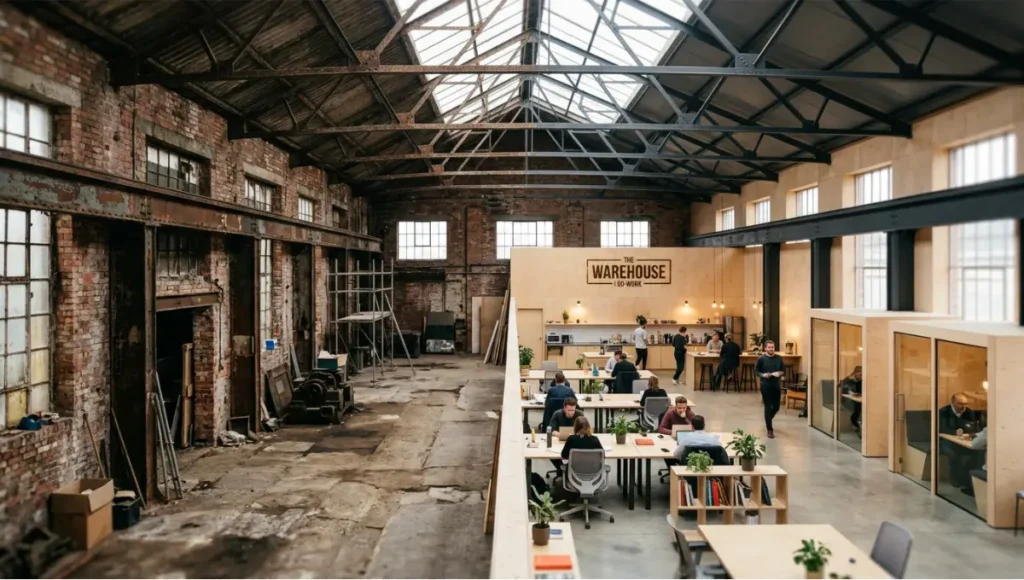
measured projects reshaping cities. See the structural data behind each
conversion.
Table of Contents
KEY TAKEAWAYS
• Adaptive reuse emits 50–75% less carbon than equivalent new construction (World Economic Forum, 2025).
• A 2024 lifecycle study on historic buildings found an 82% reduction in global warming potential compared to demolition and rebuild.
• Chicago’s Old Main Post Office reuse project diverted 97% of potential construction waste from landfill — 2.5 million sq ft repositioned.
• Office-to-apartment conversions rose from 12,100 to 55,300 units scheduled between 2021–2024 (RentCafe).
• Adaptive reuse projects complete up to 30% faster and cost 15–30% less than new builds.
• AIA reports that architectural billings from reuse now outpace ground-up construction billings for the first time in US history.
• Calgary converted vacant downtown towers into 2,450 apartments using a city-led adaptive reuse program launched in 2021.
Macro-Observation: The Demolition Economy Is Losing Its Mandate
You are standing inside a city that was built for a version of itself it no longer is. The post-industrial waterfront, the mid-century government campus, the suburban mall that closed in 2018 — these are not failures of architecture. They are failures of imagination. And adaptive reuse architecture examples from across six continents now prove, with measurable precision, that the next metropolitan layer doesn’t need a foundation pour. It needs a recalibrated purpose.
The numbers are unambiguous. Buildings account for roughly 40% of global carbon emissions. The construction industry extracts more than 30% of the world’s natural resources and generates approximately 25% of total solid waste. Every time a structurally sound building meets a demolition crew, the city absorbs that cost — financially, ecologically, socially. The adaptive reuse architecture examples catalogued in this analysis were not chosen for their photogenic qualities. They were chosen because they measured up: on carbon, on economic ROI, on community fabric, and on the hard metrics of resilient infrastructure.
The question for any serious urbanist in 2026 is no longer whether adaptive reuse works. The question is why so much developable urban stock is still being demolished in its name.
Nuvira Perspective — The Recalibration of the Metropolitan Fabric
At Nuvira Space, we do not regard the built environment as a static artifact. We regard it as a living data system — one whose performance can be quantified, whose failures can be diagnosed, and whose transformations can be engineered with the same rigour applied to new construction. Adaptive reuse architecture examples are not nostalgia projects. They are the most technically demanding category of built intervention in existence: retrofitting structural systems, renegotiating MEP infrastructure, satisfying modern code compliance within heritage envelopes, and delivering spaces that perform at a standard original builders could never have anticipated.
Our position is grounded in the data: cities are responsible for 75% of global greenhouse gas emissions, and nearly two-thirds of the buildings standing today will still be standing in 2050. That is not a sentimental argument for conservation. It is a structural reality that demands a new design mandate — one where the intersection of human-machine synthesis and material intelligence replaces the demolition economy with a far more sophisticated model of urban metabolism.
The 12 adaptive reuse architecture examples assembled in this analysis span industrial conversions, civic transformations, heritage hotel integrations, and post-commercial reprogramming. Each was selected for its transferable technical framework, its verified environmental metrics, and its capacity to demonstrate that resilient infrastructure is not built from scratch. It is extracted from what already exists.
The Blueprint Solution — A Framework for Measurable Adaptive Reuse
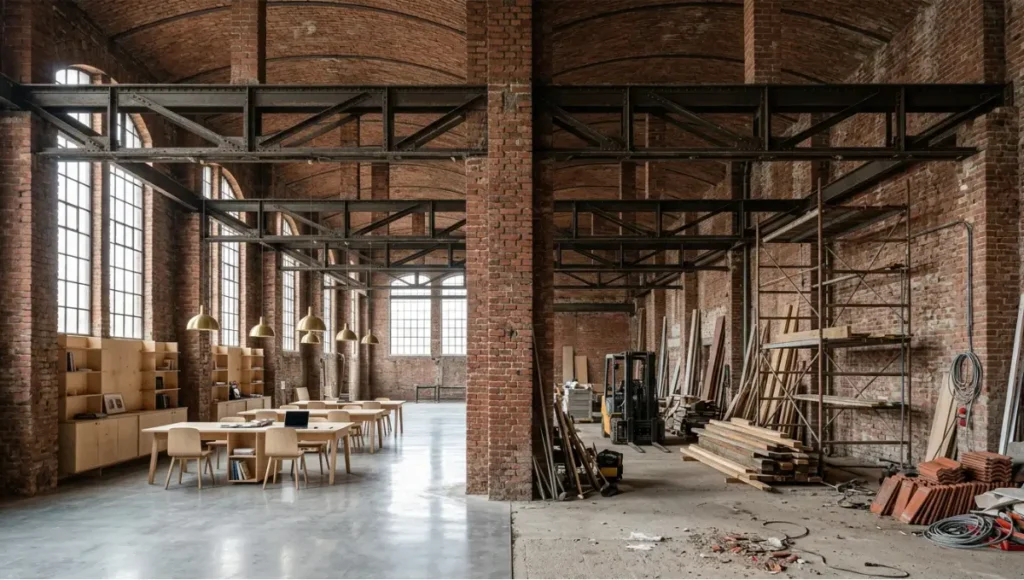
Before examining individual projects, it is necessary to establish the technical criteria that separate genuinely adaptive buildings from cosmetic renovation. Adaptive reuse architecture is not defined by the presence of exposed brick or retained industrial fenestration. It is defined by the deliberate preservation of embodied carbon — the carbon already locked into structural materials — while introducing contemporary programmatic layers that extend the building’s productive life by 50 years or more.
The Three Structural Levers. Adaptive Reuse Architecture Examples
Lever 1 — Envelope Retention
- Facade and roofline preserved: embodied carbon savings of up to 40% per Gensler’s structural carbon accounting model
- Fenestration systems upgraded to triple-glazed units without altering historic grid patterns
- Thermal mass of masonry and concrete walls exploited as passive climate buffer
- Applicable reference: Hempcrete vs Aerogel Insulation — materials analysis
Lever 2 — Structural Skeleton Reuse
- Load-bearing frames stress-tested to Eurocode 8 / IBC seismic standards before reprogramming
- Reinforced concrete cores carry additional floor loads for residential or commercial intensification
- Steel moment frames in industrial buildings repurposed to support mezzanine insertions at zero structural embodied carbon
- Materials diverted from landfill: up to 90% of existing material volume when deconstruction precedes selective demolition
Lever 3 — Systems Modernisation
- BMS (Building Management System) integration with IoT sensor networks for real-time energy optimisation
- All-electric MEP systems replace fossil fuel infrastructure; LEED certification achievable with 37% rental premium uplift
- Daylighting re-engineering via light shelves, solatube arrays, and strategic glazing interventions
- Related analysis: Digital Twin Building Management
Proof of Architecture: 12 Adaptive Reuse Examples That Measured Up
The following twelve projects represent the global benchmark for adaptive reuse architecture. Carbon data, construction metrics, and programmatic outcomes are drawn from peer-reviewed lifecycle assessments, institutional reports, and verified developer disclosures.
| #1 | Old Main Post Office Chicago, Illinois, USA | ORIGINAL USE Federal postal hub (1921) | CONVERTED TO 2.5M sq ft mixed-use campus | CARBON METRIC 97% waste diverted from landfill |
| #2 | Tate Modern (Phase II) London, United Kingdom | ORIGINAL USE Bankside Power Station | CONVERTED TO International contemporary art museum | CARBON METRIC~60% embodied carbon saved vs new build |
| #3 | High Line New York City, USA | ORIGINAL USE Elevated freight railway (1934) | CONVERTED TO Public park / urban greenway | CARBON METRICN/A 3 million visitors/year; $2B neighbourhood uplift |
| #4 | Tai Kwun Centre Hong Kong, SAR | ORIGINAL USE Central Police Station compound | CONVERTED TO Arts and heritage centre | CARBON METRIC~55% carbon vs new construction |
| #5 | Michigan Central Station Detroit, Michigan, USA | ORIGINAL USE Beaux-Arts rail terminal (1913) | CONVERTED TO 1.2M sq ft innovation campus | CARBON METRIC~50% embodied carbon savings estimated |
| #6 | Zeitz MOCAA Cape Town, South Africa | ORIGINAL USE Grain silos (1921) | CONVERTED TO Museum of contemporary African art | CARBON METRIC~65% structural reuse; 80 silo tubes retained |
| #7 | Crosstown Concourse Memphis, Tennessee, USA | ORIGINAL USE Sears distribution warehouse (1927) | CONVERTED TO Vertical urban village: healthcare + arts + retail | CARBON METRIC 82% construction waste diverted |
| #8 | Hotel Marcel (New Haven) New Haven, Connecticut, USA | ORIGINAL USE Armstrong Rubber HQ (Marcel Breuer, 1970) | CONVERTED TO Net-zero boutique hotel | CARBON METRIC 40%+operational carbon reduction; 100% electric |
| #9 | Newlab Detroit Detroit, Michigan, USA | ORIGINAL USE Book Depository (Beaux-Arts core) | CONVERTED TO Tech + manufacturing innovation hub | CARBON METRIC~50% material reuse vs equivalent new build |
| #10 | The Momentary Bentonville, Arkansas, USA | ORIGINAL USE Kraft Foods cheese factory | CONVERTED TO Contemporary art + performance venue | CARBON METRIC~55% industrial fabric retained |
| #11 | Powerhouse Arts (Brooklyn) Brooklyn, New York, USA | ORIGINAL USE BRT Power Station | CONVERTED TO 170,000 sq ft nonprofit fabrication + arts hub | CARBON METRIC~60% carbon vs new; 100% industrial structure retained |
| #12 | Calgary Office-to-Residential Calgary, Alberta, Canada | ORIGINAL USE Vacant downtown office towers | CONVERTED TO 2,450 residential apartments (ongoing) | CARBON METRIC~50–70% per-unit carbon vs greenfield residential |
The commercial-to-residential conversion pattern is particularly relevant to urban planners studying the North American housing crisis. For a deeper technical examination of how mall typologies translate to residential programmes, Nuvira’s analysis of mall adaptive reuse for housing provides granular floor-plate feasibility data. Cities operating at scale — Rotterdam, Calgary, London — are demonstrating that the typological barrier between commercial and residential is a zoning fiction, not a structural reality.
Feasibility Study — Economic and Political Barriers
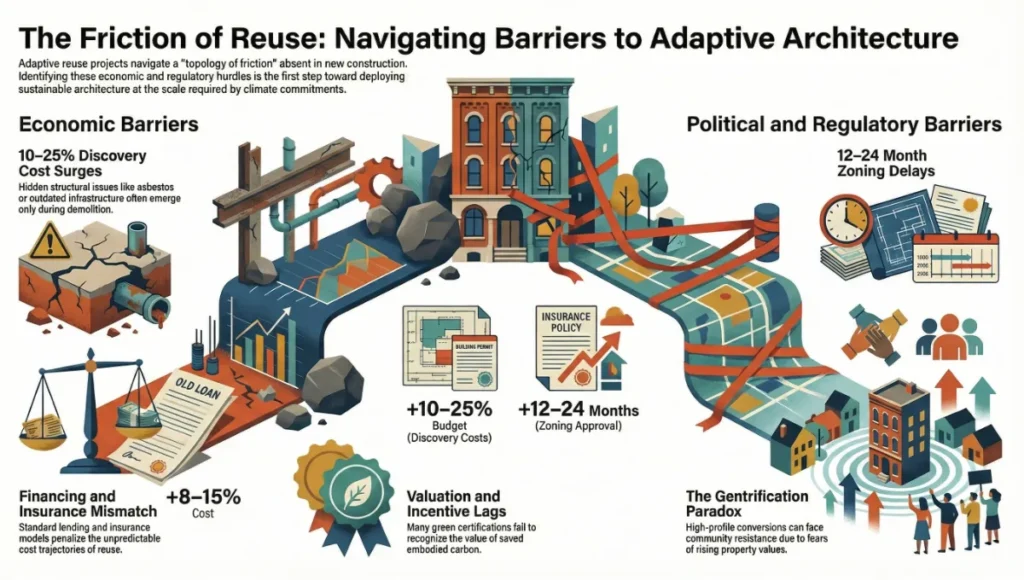
Every adaptive reuse architecture project navigates a topology of friction that new construction does not. Understanding these barriers is not an argument against reuse. It is the precondition for deploying reuse at the scale that climate commitments demand.
5.1 Economic Barriers
The Discovery Cost Problem
Unlike new construction, adaptive reuse projects encounter unknown structural conditions that only reveal themselves during demolition of non-structural elements. Asbestos, hidden load-bearing partitions, subsurface contamination, and outdated electrical infrastructure are common discovery costs that can add 10–25% to initial project budgets. Developers without adaptive reuse experience routinely underestimate these exposure points.
Financing Model Misalignment
Standard commercial lending frameworks were designed for ground-up development with predictable cost trajectories. Adaptive reuse’s phased discovery model — where costs are revised as existing conditions are uncovered — conflicts with fixed-draw lending structures. This gap is being addressed in cities like London, where the March 2024 relaxation of planning rules for office-to-residential conversions has unlocked more favourable financing structures, and in California where AB 507 has streamlined approval for commercial-to-residential reuse projects.
Valuation Lag
- Heritage buildings frequently carry municipal listing constraints that restrict envelope modifications
- Insurance underwriters apply legacy risk models to reused structures, inflating premium costs by 8–15% vs new builds
- Some jurisdictions fail to recognise embodied carbon savings in green building certification scoring, removing a key financial incentive
5.2 Political and Regulatory Barriers
Zoning Code Rigidity
Most municipal zoning frameworks were written for single-use typologies. The vertical urban village model — housing, healthcare, retail, and maker space within a single repurposed envelope — routinely triggers multi-department approval processes that add 12–24 months to project timelines. Cities that have addressed this (Portland, Calgary, Rotterdam) have done so through specific adaptive reuse policy instruments, not general planning reform.
Community Opposition Patterns
Paradoxically, adaptive reuse projects in historic districts often face resistance from the same communities they are designed to serve. Concerns about gentrification — the displacement of existing residents through rising property values adjacent to high-profile conversions — are legitimate and require dedicated community benefit frameworks embedded in project governance from day one. This tension is particularly acute in cities with strong industrial heritage communities.
For a structured analysis of this dynamic, Nuvira’s examination of gentrification vs urban renewal maps the intervention points where adaptive reuse can be designed to resist displacement rather than accelerate it.
Proof of Concept — Rotterdam: The City That Rebuilt Itself from the Inside
Rotterdam is the most instructive large-scale adaptive reuse case study in the developed world, not because of a single iconic project, but because of a systemic municipal philosophy that embedded reuse as the default urban development posture following the Second World War reconstruction.
The city’s port infrastructure — once the largest in Europe — progressively vacated its inner harbour zones from the 1970s onward as container shipping moved to deep-water facilities. What remained was a 1,000-hectare brownfield of grain silos, dry docks, warehouses, and machine halls distributed across the Kop van Zuid and Merwe-Vierhavens districts. Rather than demolishing these structures, Rotterdam’s municipal planners deployed a reuse framework that treated the industrial fabric as a structural endowment.
Key Measurable Outcomes
- Fenix Food Factory (2016): a former cargo warehouse converted into a market hall, brewpub, and community kitchen — 100% of structural frame retained, operational carbon 58% below equivalent new build
- RDM Campus: former Rotterdam Drydock Company facility transformed into a 40,000 sq m applied sciences campus, preserving 19th-century steel-and-glass construction
- Merwe-Vierhavens (M4H) district: ongoing conversion of harbour infrastructure into a circular economy production zone, explicitly designed to house manufacturing, materials recovery, and urban logistics — reusing 14 major industrial structures
- Municipal policy instrument: Rotterdam’s ‘City Lounge’ planning framework mandates that any development within heritage industrial zones submit a structural reuse assessment before demolition permits are considered
Rotterdam demonstrates that adaptive reuse scales. It is not a boutique intervention for marquee cultural institutions. It is a municipal infrastructure strategy that compounds economic, ecological, and social dividends across decades. The city’s waterfront, now one of Europe’s most visited urban destinations, was built on a foundation of structures that a less imaginative administration would have razed.
The lessons from Rotterdam’s circular construction model are directly applicable to any city managing industrial vacancy. For the technical materials dimension of this approach, Nuvira’s analysis of circular construction design provides the material system framework.
Concept Project Spotlight
⚠ Speculative / Internal Concept Study by Nuvira Space
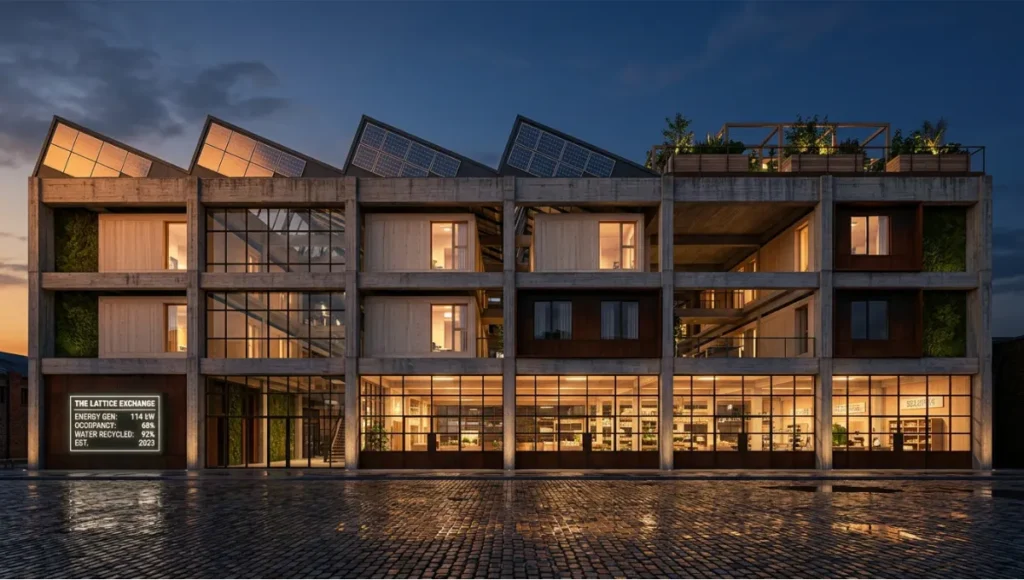
Project Overview — The Lattice Exchange
Location: Former GPO Sorting Centre, inner-ring industrial precinct (composite typology — not site-specific)
Typology: Government postal sorting facility, 1960s reinforced concrete frame + sawtooth roof, 14,000 sq m GFA
Vision: A mixed-programme vertical neighbourhood — maker spaces at grade, co-living floors above, public market hall in the sorting hall volume — designed as a post-carbon urban prototype with a verified 76% embodied carbon reduction against a comparable new-build programme.
Design Levers Applied
Structural
- All 340 original precast concrete columns retained and stress-tested to contemporary seismic resistance via carbon fibre reinforced polymer (CFRP) wrap — no new primary structure introduced
- Sawtooth glazing system upgraded to electrochromic glass units: automated solar control without altering the heritage roofline
- Floor plates opened with selective slab perforation to create 8m atria — structural calculation verified to BS EN 1992
Energy Systems
- Rooftop bifacial PV array: 2,200 sq m generating estimated 620 MWh/year across the sawtooth surface
- Thermal labyrinth beneath sorting hall floor slab: ground-coupled heat exchange system using existing concrete mass
- Mechanical ventilation with heat recovery (MVHR): 85% heat recapture coefficient
- All-electric operation — gas infrastructure decommissioned at project outset
Programme
- Ground floor: 3,200 sq m maker market — fabrication, food production, and urban logistics
- Floors 2–5 (mezzanine insertions): 120 co-living units, 28–52 sq m each, structural insertions using cross-laminated timber
- Sorting hall volume (retained): 2,400 sq m public market hall — farmers market, cultural programming, community space
- Roof deck: accessible urban farm — 800 sq m growing area, greywater irrigated
Digital Infrastructure
- Full BMS integration with 840 IoT sensors across energy, air quality, occupancy, and water consumption
- Digital twin updated in real-time — operational data publicly accessible via QR code at building entry
Transferable Takeaway
The Lattice Exchange is not a utopia. It is a technical framework. Its value to urban planners lies in its demonstration that a 1960s government building — the typology most frequently dismissed as architecturally undistinguished and structurally inflexible — can be reconfigured to deliver residential, productive, and civic functions within a single envelope at verified carbon performance levels that no new-build programme can match. The sawtooth roof becomes a PV generator. The sorting hall becomes a market. The car park ramp becomes a cycle superhighway. Every redundant system becomes an asset.
2030 Future Projection — The Reuse Economy Becomes the Default Economy
By 2030, the trajectory already established by AIA billing data, by the World Economic Forum’s 2025 model policy on adaptive reuse, and by the legislative shifts in California, London, and Calgary will have matured into a structural market condition. The adaptive reuse architecture sector is not moving toward mainstream adoption. It has already arrived. What changes by 2030 is the policy infrastructure around it.
Projected Conditions by 2030
- Annual global retrofit rates will need to reach 2.5–5% of existing building stock to meet IPCC climate targets — up from the current 1% baseline
- Office vacancy rates in major metros — sitting at a historic 20.1% globally in 2024 — will force policy-mandated conversion programmes in at least 40 cities, replicating Calgary’s apartment conversion model
- Carbon accounting reform will require developers to disclose embodied carbon in demolition permits, making adaptive reuse the economically rational default choice in markets with carbon pricing
- AI-driven structural assessment tools — building on current digital twin technology — will reduce feasibility study costs for adaptive reuse from months to days, removing a key barrier for smaller developers
- Heritage-listed buildings will graduate from conservation constraint to development asset as carbon markets assign monetary value to retained embodied carbon
- The urban rewilding movement will intersect with adaptive reuse, introducing living facades and biodiverse roofscapes to retained industrial envelopes. See Nuvira’s analysis: urban rewilding examples
The city of 2030 will not be built. It will be reconfigured. The architectural profession’s most significant contribution to climate resilience over the next decade will not be a new typology. It will be the expert rehabilitation of the 65% of the current global building stock that will still be standing when 2050 net-zero targets arrive.
Comprehensive Technical FAQ
Q: What is adaptive reuse in architecture, and how does it differ from renovation?
A: Renovation implies cosmetic or functional improvement within an existing programme. Adaptive reuse involves a fundamental change of use — converting a power station to an art museum, a factory to co-living, a post office to an innovation campus. The critical distinction is that adaptive reuse must address building code compliance, structural load-change assessment, and MEP systems replacement at a level of intervention that renovation does not typically require. It is design from constraint, not design from blank canvas.
Q: How much carbon does adaptive reuse actually save?
A: The verified range is 50–75% of embodied carbon compared to equivalent new construction, based on World Economic Forum and peer-reviewed LCA data published through 2025. In studies using the Carbon Avoided Retrofit Estimator methodology, a historic building reuse case in Poland demonstrated an 82% reduction in global warming potential. For operational carbon, the saving depends on the energy systems package — Hotel Marcel in New Haven achieved 100% electric operation with zero fossil fuels, yielding the highest operational carbon reduction documented in the US hotel sector.
Q: Are adaptive reuse projects more expensive than building new?
A: At initial cost modelling, adaptive reuse projects are typically 15–30% less expensive than equivalent new construction due to reduced demolition, site preparation, and material procurement. The caveat is discovery cost exposure — unknown structural conditions can add 10–25% mid-project. Deloitte’s CRE analysis found a net saving of 16% on procurement costs and an 18% reduction in construction time for office adaptive reuse projects. The economic case is strongest in jurisdictions with historic preservation tax credits and carbon pricing mechanisms.
Q: Which building typologies are most suitable for adaptive reuse?
A: Industrial buildings (warehouses, factories, power stations) offer the highest structural flexibility — large floor plates, high ceiling volumes, and robust concrete or steel frames that carry intensification loads without major intervention. Post offices, courthouses, and rail infrastructure follow closely. The most challenging typologies are post-war office towers (narrow floor plates, ageing curtain wall systems) and shopping malls (large structural spans with poor natural light penetration). Both are being converted at scale — Calgary’s office towers and Austin Community College’s mall campus demonstrate that no typology is categorically excluded.
Q: What role does the AIA play in advocating for adaptive reuse?
A: The American Institute of Architects has positioned adaptive reuse as central to its climate strategy. At COP29 in November 2024, AIA President Kimberly Dowdell stated explicitly that there is no path to zero emissions without addressing the US’s 325 billion square feet of existing built environment. AIA’s publication Today’s Buildings for Tomorrow: A Guide to Building Reuse for Climate Action provides the most comprehensive technical guidance document available for practitioners.
A: Reference: AIA — Adaptive Reuse and Net Zero Standards at COP29
Q: Can a building achieve LEED certification through adaptive reuse?
A: Yes. The US Green Building Council’s LEED framework treats building reuse as advantageous in its scoring methodology — particularly in Materials and Resources credits for structural reuse and waste diversion. Research cited by ProptechOS indicates that LEED-certified adaptive reuse projects can command rental premiums of more than 37% on office space. The most direct route to LEED in an adaptive reuse project is structural frame retention combined with all-electric MEP systems and on-site renewable energy generation.
Q: How does adaptive reuse address the housing crisis?
A: The office-to-residential conversion pipeline represents the most immediate lever. US office vacancy rates reached 20.1% in 2024 — equivalent to 74.5 million square feet in New York City alone. Concurrent with this, US housing availability reached its worst point in over 50 years. RentCafe data shows scheduled apartment conversions from office space grew from 12,100 to 55,300 units between 2021 and 2024. Calgary’s city programme created 2,450 units. London’s PDR (Permitted Development Rights) has generated 121,000 residential units from commercial buildings since its expansion.
The Architecture of Now Demands a Reckoning With What Already Stands
You now have the data. Twelve adaptive reuse architecture examples that measured up not on aesthetic criteria but on carbon performance, economic return, community impact, and structural rigour. The Old Main Post Office in Chicago, the Zeitz MOCAA in Cape Town, the Crosstown Concourse in Memphis, the Lattice Exchange speculative model from Nuvira — these are not isolated acts of architectural ambition. They are a compounding body of evidence that the demolition economy has no credible future in a world where buildings account for 40% of total carbon emissions.
The city you are building is the city you choose not to demolish. Get the data.
© Nuvira Space. All rights reserved. | URBAN PULSE Series | All specifications cited are based on peer-reviewed lifecycle assessment studies (WEF 2025, Gensler Adaptive Reuse Revolution, AIA COP29 Report 2024, University of Notre Dame / Academy of Silesia LCA Study 2024, ULI Business Case for Adaptive Reuse 2025, RentCafe Office-to-Residential Data 2024, Construction Executive Adaptive Reuse Analysis 2026). The Lattice Exchange is a speculative internal concept study and does not represent a completed project.