

Table of Contents
Urban air quality has reached a structural crisis point. The World Health Organization now classifies indoor air pollution as one of the top 5 global environmental risks to human health — and the problem is not outside. It is in the materials you seal inside your walls, embedded in the foam of your furniture, suspended in the air your HVAC system recirculates every 20 minutes.
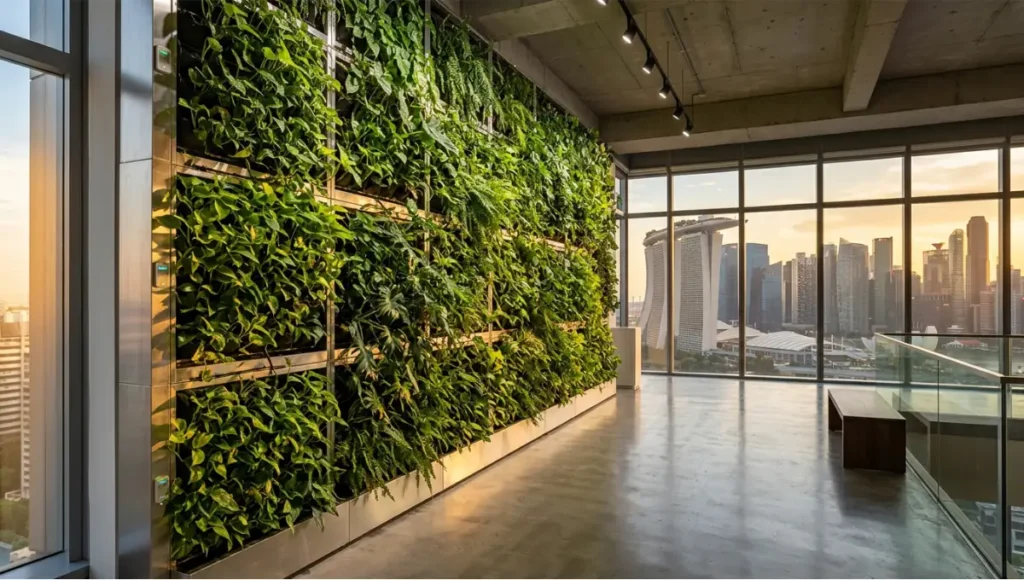
In Singapore, where airtight high-rise construction has become the dominant residential typology, measured indoor formaldehyde concentrations in new-build apartments consistently exceed outdoor air levels by 3 to 8 times. Benzene, toluene, and trichloroethylene — chemical byproducts of furniture lacquers, synthetic adhesives, and dry-cleaning residue — accumulate in the absence of direct counter-intervention. Living walls indoor air purification has moved from a design aesthetic to a measurable technical strategy, and the data separating effective systems from decorative ones is now rigorous enough to inform specification.
Nuvira Perspective
At Nuvira Space, we do not treat living walls as an interior landscaping decision. We treat them as building infrastructure — systems that either meet a performance threshold or don’t. The research gap between passive plant installations and active biofilter walls is not a matter of degree; it is a categorical difference in mechanism, and confusing the two costs clients money, certifications, and the air quality outcomes they were promised. This editorial maps the 7 documented performance results that define what a living wall can actually achieve, the species data behind those results, and the architectural specifications required to replicate them.
Technical Deep Dive: How Living Walls Purify Air
The Mechanism: Leaf Surface vs Root Zone
The most consequential misunderstanding in living wall specification is attributing air purification to the leaf surface. The original 1989 NASA Clean Air Study, conducted by Dr. Bill Wolverton in sealed test chambers, measured VOC removal rates for 19 common species under controlled conditions with no competing air movement. Results — 70–90% benzene removal in 24-hour closed-chamber tests for Spathiphyllum wallisii and Dracaena marginata — were real. The test conditions were not.
A 2019 meta-analysis published in the Journal of Exposure Science & Environmental Epidemiology standardized 12 chamber studies into Clean Air Delivery Rates (CADR). The median single-plant CADR: 0.023 m³/hour. A standard 50 m² apartment ventilates at approximately 120 m³/hour. The arithmetic requires 5,217 plants to match natural ventilation — the American Lung Association’s translation: 680 plants per 1,500 sq ft.
This is a passive limitation, not a categorical failure. The solution is mechanical air-to-root-zone contact.
Active Biofilter Walls: The Specification Threshold
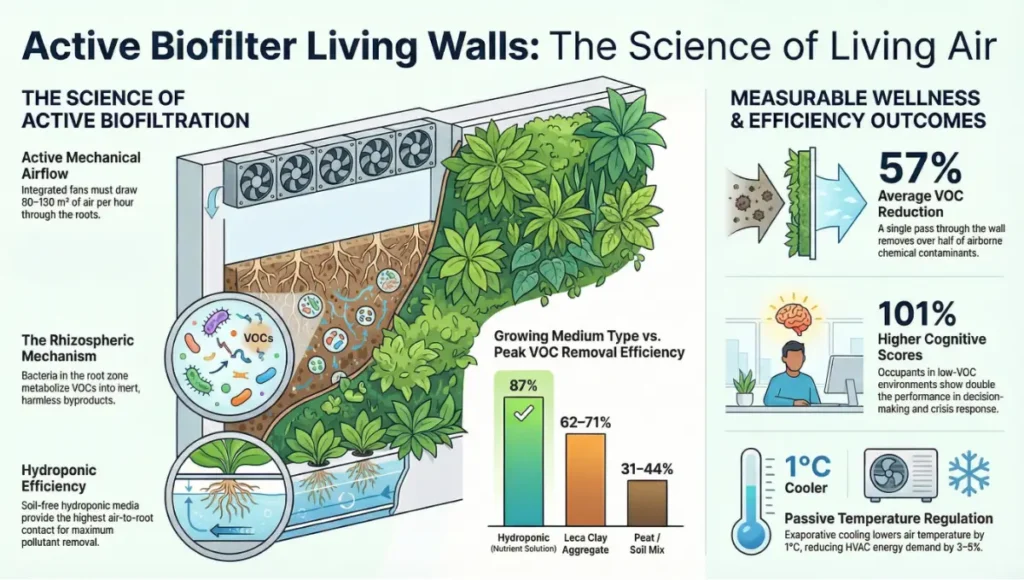
THE SCIENCE OF
ACTIVE BIOFILTRATION
Active Mechanical
Airflow
Integrated fans must draw 80-130 m’ of air per hour through the roots.
Active biofilter living walls (ALWs) draw air mechanically through the root zone and growing medium via integrated fans or direct HVAC integration. The rhizospheric microbiome — bacteria inhabiting the root zone — metabolizes VOCs including formaldehyde, benzene, toluene, and xylene into inert byproducts. This is the mechanism that converts a plant installation into a measurable air treatment system.
Minimum specification criteria for active classification:
- Mechanical airflow directed through — not past — the root zone
- Defined flow rate: minimum 80 m³/hour per panel for residential; 150 m³/hour per panel for commercial
- Growing medium: hydroponic (nutrient solution, no soil) for maximum rhizospheric air contact
- Root zone depth: minimum 120 mm to sustain adequate microbial biofilm surface area
- Integrated humidity sensor with ±2% RH accuracy for closed-loop irrigation control
Result 1: 57% Average VOC Reduction Per Single Pass
BRE (Building Research Establishment, UK) and VTT Technical Research Centre of Finland independently tested active biofilter living walls using single-pass methodology — measuring VOC concentration entering versus exiting the wall over 8-hour test periods.
- BRE results across 3 runs: 56.5%, 55.1%, 58.5% — mean 57% removal of methyl ethyl ketone (MEK)
- VTT results across compounds including toluene, MEK, 2-ethylhexanol, decane, benzene: up to 65% single-pass removal
- Compounded at realistic recirculation rates (3 passes/hour): residual VOC load drops to 15.7% of baseline within 60 minutes
Result 2: 87% VOC Removal via Rhizosphere Microbes (NRC)
Canada’s National Research Council isolated rhizospheric microbial populations in controlled conditions, optimizing airflow contact time. Peak VOC removal efficiency: 87%. The critical variable: growing medium.
Growing medium performance comparison:
- Hydroponic (nutrient solution): 87% peak removal, unobstructed air-to-root contact
- Leca clay aggregate: 62–71% removal, moderate restriction
- Peat/soil mix: 31–44% removal, high restriction, inconsistent microbial activity
- Foam substrate: 55–68% removal, dependent on foam pore structure
The Harvard Smith Campus Center Green Wall study (Shen et al., cited Journal of Environmental Engineering, 2025) validated the rhizosphere-primary-mechanism finding in a real-world institutional setting — the first large-scale non-laboratory confirmation. Medium composition was the principal variable explaining performance variation across 6 tested wall sections.
Result 3: Particulate Matter Reduction + 0.3–1.0°C Temperature Drop
Research at United Arab Emirates University monitored air quality in offices with and without active living walls across an 8-week autumn period:
- Particulate matter (PM2.5): measurably reduced versus control rooms
- VOC concentrations: lower across entire monitoring period in walled rooms
- Temperature differential: 0.3°C to 1.0°C cooler via evaporative cooling from plant transpiration
- At 1.0°C operative temperature reduction, HVAC cooling demand decreases approximately 3–8% depending on envelope type and system efficiency
A parallel UK study (2021) on a pre-1970s building retrofit recorded a 31% reduction in heat loss through exterior living wall sections — a thermal envelope benefit that compounds the internal cooling effect.
Explore carbon-negative passive cooling design strategies
Result 4: Humidity Regulation — 40–60% RH Without Mechanical Input
Target indoor relative humidity for respiratory health: 40–60% RH. Below 40% RH, mucous membrane drying increases pathogen susceptibility. Above 60% RH, mold proliferation risk rises markedly.
Active living walls with integrated hydroponic irrigation systems have demonstrated the ability to maintain 40–60% RH target ranges in winter heating conditions where indoor humidity commonly drops to 20–30% RH — eliminating the need for separate mechanical humidification in moderately sized spaces up to approximately 80 m².
WELL Building Standard credit applicability:
- Enhanced Indoor Air Quality Strategies (EQ credit): VOC threshold compliance
- Moisture Management feature: demonstrated humidity regulation
- Biophilic Design Opportunities: green space integration credit
Result 5: Cognitive Performance — Up to 101% Higher Decision-Making Scores
Harvard T.H. Chan School of Public Health (Allen et al.) exposed participants to controlled air quality conditions varying CO₂ concentration and VOC load. Participants in low-CO₂, low-VOC conditions — the output conditions of a functioning active living wall — scored:
- 101% higher on decision-making assessments
- 288% higher on crisis response tasks
- Reported fewer headaches, reduced afternoon fatigue, and improved sustained attention
The mechanism applies to any system reducing indoor VOC load. The living wall advantage: no filter replacement cost, no HEPA noise load, passive humidification built-in.
Comparative Analysis: Active Biofilter vs Industry Standard
Solution: Living Walls Indoor Air Purification vs Mechanical HEPA/Carbon Purifier
| Parameter | Active Biofilter Wall | HEPA + Carbon Purifier |
|---|---|---|
| VOC single-pass removal | 57–87% | 85–95% (carbon stage) |
| PM2.5 removal | Moderate | High (HEPA: 99.97% at 0.3 μm) |
| Humidity effect | +8–15% RH | −2–5% RH (drying effect) |
| Noise output | 28–35 dB | 40–65 dB |
| Maintenance cycle | Irrigation + quarterly trim | Filter replacement every 6–12 months |
| Operational energy | 15–40W per panel | 30–80W continuous |
| LEED/WELL credits | Multiple (EQ, biophilic, moisture) | Limited (EQ only) |
| Cognitive/biophilic benefit | Documented | None |
Verdict: Mechanical purifiers outperform on PM2.5 and peak VOC removal. Active biofilter walls outperform on humidity regulation, noise, biophilic benefit, and multi-credit certification value. A combined approach — active wall for VOC and humidity, HEPA for particulate — is optimal for healthcare, education, and high-occupancy office environments.
Understand the full evolution of regenerative infrastructure in vertical green systems
Concept Project Spotlight
Speculative / Internal Concept Study — The Vertical Lung by Nuvira Space
Project Overview
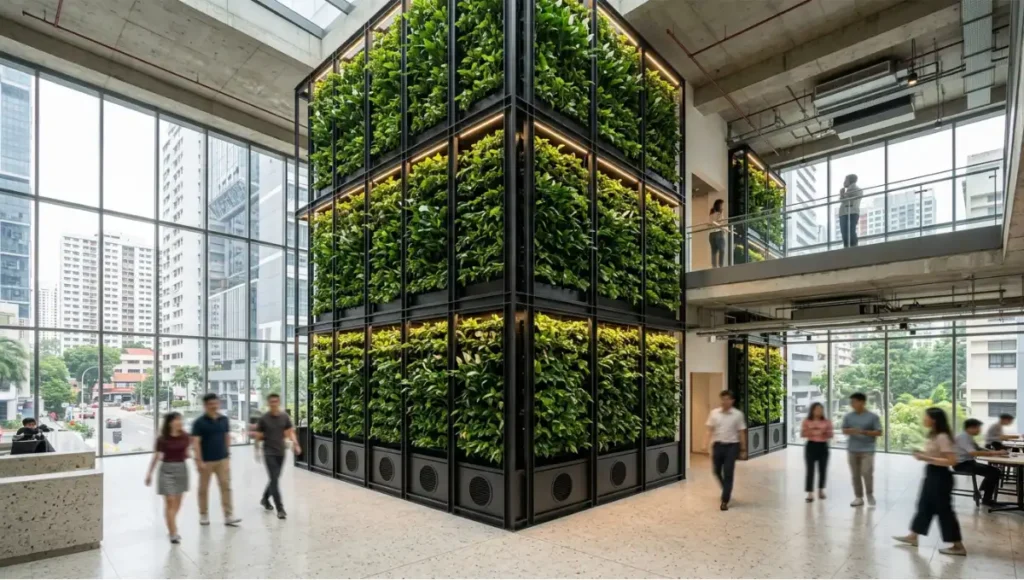
Location: Dense mixed-use urban block, Singapore typology (modeled on Tanjong Pagar district constraints) Typology: 2,400 m² commercial office floors, 3 levels Vision: Invert the standard air quality hierarchy — active biofilter living wall as primary air treatment infrastructure, mechanical HVAC as backup and precision humidity control only
Design Levers Applied
Wall specification:
- 14 linear meters of active biofilter wall distributed across 3 floors
- Panel dimensions: 2,400 mm H × 600 mm W × 180 mm D per module
- Growing medium: closed-loop hydroponic nutrient solution, 140 mm root zone depth
- Primary species: Epipremnum aureum (high root mass, VOC-generalist) + Spathiphyllum wallisii (benzene/formaldehyde specialist)
- Integrated centrifugal fans: 150 m³/hour airflow per panel, 35 dB at 1 m
- Moisture sensors: ±1.5% RH accuracy, linked to irrigation controller (target: 47–53% RH)
Projected performance (based on VTT 65% single-pass efficiency, modeled at 3 recirculations/hour):
- Formaldehyde reduction: from 0.08 mg/m³ baseline (new-fit-out) to below WHO 0.1 mg/m³ guideline within 45 minutes of occupancy
- Benzene: below ASHRAE 62.1 threshold maintained continuously during occupied hours
- Temperature: −0.6°C operative reduction via evapotranspiration, reducing HVAC cooling load by approximately 4.8%
HVAC integration:
- ASHRAE 62.1 IAQP compliance pathway: documented in-space treatment allows outside air reduction of approximately 18%
- HVAC system downsizing: 12% reduction in primary air handling unit capacity versus conventional ventilation-only design
- Estimated payback period on wall installation cost vs HVAC capital saving + energy reduction: 4.2 years
Transferable Takeaway
The Vertical Lung demonstrates that the HVAC integration dividend — not the aesthetic — is the strongest financial argument for active biofilter living walls in commercial projects. An 18% reduction in outside air intake, a 12% HVAC system downsize, and a 4.2-year payback period reframe the living wall from an interior design line item into a mechanical engineering decision. The specification logic transfers to any commercial or institutional project above approximately 1,000 m² with meaningful occupant density.
2030 Future Projection
By 2030, the International WELL Building Institute projects that over 40% of new commercial construction will target WELL Gold certification or above. Active biofilter living walls will transition from a premium add-on to a baseline specification tool in that context — not because they became more fashionable, but because ASHRAE’s evolving ventilation standards and tightening WHO indoor air quality guidelines will make passive HVAC-only approaches increasingly non-compliant in densely occupied spaces.
3 converging developments will define the next 5 years:
1. Smart rhizosphere monitoring. Embedded soil-sensor arrays (pH, nitrogen cycle, VOC load) will enable real-time adjustment of irrigation and airflow rates, closing the performance gap between laboratory-tested and real-world biofilter efficiency. Expect commercial systems delivering consistent 75–80% single-pass efficiency by 2027.
2. Species genomics. Research currently underway at Wageningen University is identifying root-zone bacterial strains with documented VOC-specific metabolic pathways. Purpose-inoculated living wall systems — tuned to the specific pollutant profile of a building’s finish materials — are a 5-year commercialization horizon.
3. Carbon accounting integration. As embodied carbon reporting becomes mandatory in major markets (UK, EU, Singapore by 2027), living walls will gain formal recognition in lifecycle carbon assessments as carbon-sequestering building elements. A 14 linear-meter installation at The Vertical Lung’s specification sequesters approximately 420 kg CO₂e per year through combined biomass growth and soil carbon processes — a quantifiable offset against the building’s operational carbon budget.
Learn how biophilic interior design drives measurable environmental and wellbeing outcomes
Comprehensive Technical FAQ
Q: Do living walls actually purify indoor air?
A: Active biofilter living walls — systems that mechanically draw air through the plant root zone at a minimum of 80 m³/hour — have demonstrated 57–87% single-pass VOC removal efficiency in BRE and NRC third-party tests. Passive living walls (no forced airflow) achieve negligible VOC reduction at realistic plant densities and should not be specified for air quality purposes.
Q: How many plants does a living wall need to clean a room’s air?
A: For passive plants with no mechanical airflow: approximately 680 plants per 1,500 sq ft, per American Lung Association analysis of the NASA CADR data. Active biofilter systems resolve this by concentrating airflow through a dense root zone — a 600 mm × 2,400 mm panel processing 150 m³/hour treats equivalent air volume to several hundred passive plants.
Q: What are the best plants for a living wall air purifier?
A:
- Spathiphyllum wallisii — benzene, formaldehyde, trichloroethylene; high root mass in hydroponic media
- Epipremnum aureum — formaldehyde, benzene; fast-growing root system, VOC-generalist
- Dracaena marginata — benzene, trichloroethylene, xylene; high leaf-surface transpiration
- Chlorophytum comosum — formaldehyde, carbon monoxide; resilient in variable humidity
- Sansevieria trifasciata — CAM metabolism, night oxygen production; complements daytime systems
For active systems: prioritize large-root-mass species (Epipremnum, Spathiphyllum) to maximize rhizospheric surface area.
Q: Can a living wall replace an air purifier?
A: For VOC removal and humidity regulation: yes, with equivalent or superior performance on most metrics. For PM2.5 removal below 0.3 μm: no — a HEPA mechanical stage is required. For comprehensive air quality management in healthcare or high-occupancy environments, a combined approach (active biofilter wall + HEPA for particulate) is the technical best practice endorsed by the AIA’s Framework for Design Excellence, which addresses measurable indoor environmental quality as a core design performance criterion.
Q: What does ASHRAE 62.1 have to do with living walls?
A: ASHRAE 62.1 offers 2 compliance pathways: the prescriptive Ventilation Rate Procedure and the Indoor Air Quality Procedure (IAQP). Buildings with documented in-space air treatment — including active biofilter walls with certified performance data — can apply for IAQP compliance, allowing reduced outside air supply rates. This translates to direct HVAC energy and capital cost savings:
- Outside air reduction: 10–20% depending on occupant density and building type
- HVAC equipment downsizing: estimated 10–15% for commercial applications
- Payback period: 3–7 years depending on project scale and regional energy costs
Q: Does a living wall affect humidity?
A: Yes. Active living walls with hydroponic irrigation systems release consistent moisture through transpiration. In winter heating conditions where indoor humidity frequently drops to 20–30% RH, tested systems maintain 40–60% RH target ranges — the optimal band for respiratory health and mold prevention — without supplementary mechanical humidification in spaces up to approximately 80 m².
Specify Regenerative Infrastructure. Measure What It Does.
The living wall that purifies air is not a trend, a biophilic statement, or a LEED checkbox. It is a building system with a defined mechanism, a measurable performance threshold, and a growing body of institutional research that now spans NASA, NRC Canada, BRE, VTT, and UAEU. The AIA’s Framework for Design Excellence explicitly positions indoor environmental quality as a core performance criterion — not a finish-material decision.
If you are specifying a living wall for a project, demand BRE- or VTT-equivalent third-party single-pass VOC removal data from the manufacturer. Require hydroponic growing medium disclosure. Model the ASHRAE 62.1 IAQP pathway before finalizing your mechanical system. And measure the result after installation.
The 0.08 mg/m³ of formaldehyde in the air of your next project is not invisible. It has a name, a mechanism, and now a documented architectural counter-measure.
© Nuvira Space — All rights reserved. | ECO BLUEPRINT Series | All specifications cited are based on: BRE Independent Test Report (Naava, 2019); VTT Technical Research Centre of Finland (2018–2020); National Research Council Canada Living Wall Biofilter Study (2017–2021); UAE University Indoor Air Quality Monitoring Study (2022); Harvard T.H. Chan School of Public Health — Allen et al. Cognitive Performance Study (2016); Journal of Exposure Science & Environmental Epidemiology — Cummings & Waring Meta-Analysis (2019); Journal of Environmental Engineering — Shen et al. Harvard Smith Campus Green Wall Study (2025); AIA Framework for Design Excellence (2023 edition). The Vertical Lung is a speculative internal concept study and does not represent a completed project.