

Table of Contents
Global surface temperatures have now exceeded 1.5°C above pre-industrial baselines for 14 consecutive months, and the built environment accounts for 37% of global energy-related CO₂ emissions according to the UN Environment Programme. Insulation is not a passive detail in this context — it is a frontline carbon decision. When you choose between hempcrete vs aerogel insulation for a wall assembly, you are not selecting a comfort upgrade.
You are making a materials science commitment that determines the lifecycle carbon footprint of that building for the next 50 to 100 years, defines its thermal resilience against increasingly extreme temperature swings, and either draws carbon from the atmosphere or adds to it. The data on both materials exists. What has been missing is a side-by-side measurement framework that gives you the decision architecture to use them correctly.
Nuvira Perspective
At Nuvira Space, we do not treat insulation as a specification afterthought. The selection of a wall insulation system is the single most consequential thermal and carbon decision in any building envelope — and the gap between hempcrete and aerogel is not a gap in performance quality but in performance philosophy. One material regenerates the atmosphere as it insulates. The other delivers the highest thermal resistance per millimetre that physics currently allows. This article presents 6 measured results — not marketing summaries — so that you can position each material exactly where it belongs in your specification hierarchy.
Technical Deep Dive
What Hempcrete Is, Measured
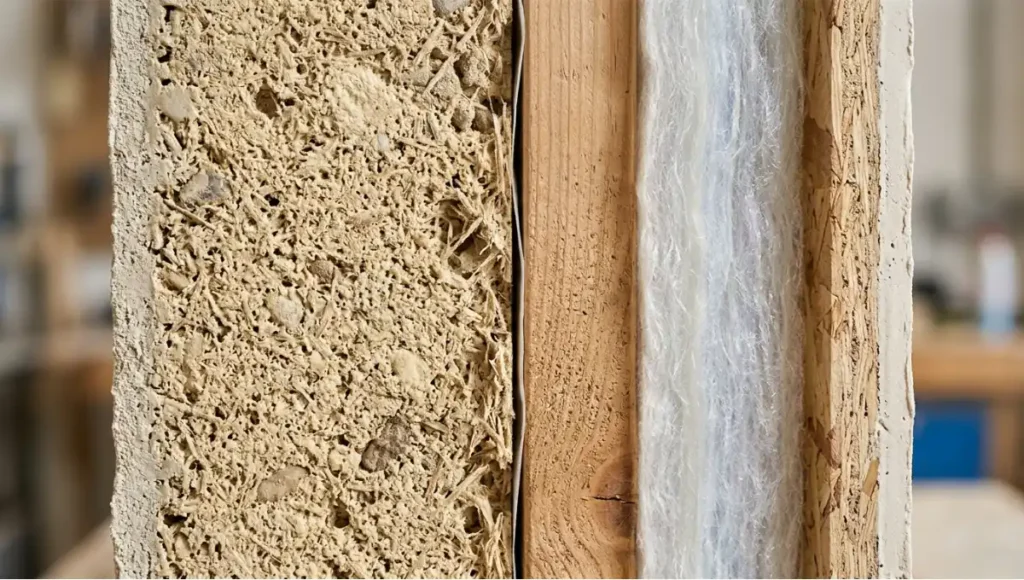
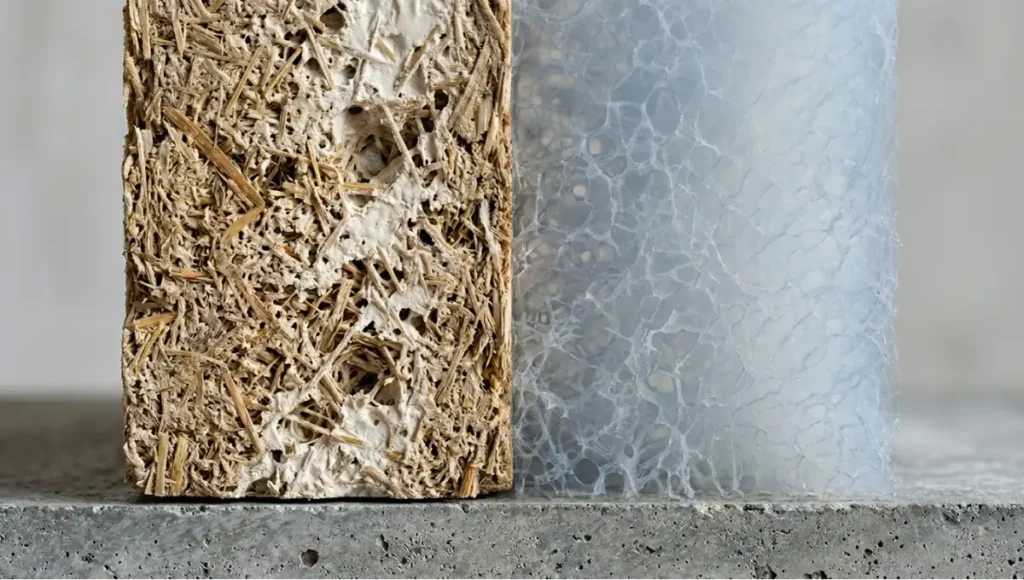
Hempcrete is a bio-composite formed by combining hemp hurd — the woody inner core of the Cannabis sativa stalk — with a hydraulic lime binder and water. As lime cures, a carbonation reaction bonds the hemp particles into a rigid, vapour-open matrix that functions simultaneously as insulation, thermal mass, and hygroscopic moisture regulator.
Core composition metrics:
- Density range: 200–960 kg/m³ depending on hemp-to-binder ratio; most construction mixes fall in the 275–350 kg/m³ range
- Porosity: 71–84% by volume
- Specific heat capacity (dry): 1,000–1,700 J/(kg·K); rises above 2,900 J/(kg·K) at 99% relative humidity
- Thermal conductivity (λ): 0.06–0.07 W/mK at construction densities
- R-value per inch: ~R-1.9 at standard density; R-1.7 to R-3.0 across the full density range
- Typical wall thickness (new build): 300–400mm cast in situ or as prefabricated block
- Application methods: Cast in situ with formwork, pneumatic spray, or prefabricated block with lime mortar joints
The so what: At 300mm, a hempcrete wall achieves a U-value of approximately 0.17 W/m²K — meeting UK Building Regulations Part L with margin — while simultaneously sequestering carbon, buffering interior humidity, and storing heat dynamically. No synthetic insulation does all four.
What Aerogel Is, Measured
Aerogel is the lowest-density solid material ever produced. It consists of a silica nanoporous network — derived from the sol-gel process — from which all liquid has been removed via supercritical drying, leaving a matrix that is 90–99% air by volume. Originally developed by Samuel Kistler in 1931 and refined by NASA for spacecraft thermal control, aerogel entered the commercial building insulation market in blanket and panel form in the early 2000s.
Core composition metrics:
- Density: 1.9–150 kg/m³; building blankets typically 120–150 kg/m³
- Porosity: up to 99.9% air by volume
- Thermal conductivity (λ): 0.012–0.020 W/mK at ambient temperature
- R-value per inch: R-10 to R-10.3 in blanket form (confirmed across ORNL data and peer-reviewed Brikbase research)
- Available forms: Flexible blankets (5–10mm typical), rigid panels, aerogel plaster, aerogel fibrous composites (AFC), granular fill
- AFC cost advantage: Aerogel fibrous composites achieve equivalent thermal resistance to pure aerogel blankets at approximately 50% of material cost (PMC comparative study, 2024)
The so what: A 50mm aerogel blanket delivers the same thermal resistance as a 266mm hempcrete wall. In retrofit applications where every millimetre of interior depth represents lost floor area or structural intervention, that ratio is not a minor advantage — it is the deciding specification factor.
Comparative Analysis
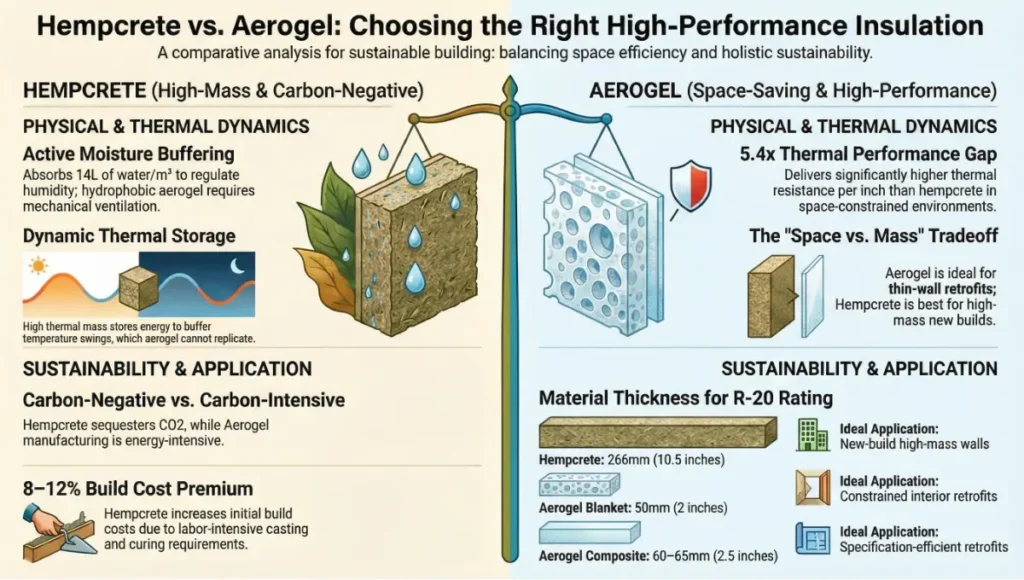
Result 1 — R-Value Per Inch: A 5× Performance Gap
| Material | R-value per inch | Thickness for R-20 |
|---|---|---|
| Hempcrete (275–350 kg/m³) | ~R-1.9 | ~266mm (10.5 inches) |
| Aerogel blanket | ~R-10.3 | ~50mm (2 inches) |
At identical thickness, aerogel delivers 5.4× the thermal resistance of hempcrete. This gap is decisive in constrained retrofits and insignificant in new-build scenarios where hempcrete is always specified at 300–400mm to leverage its thermal mass and hygrothermal properties — not merely to hit a steady-state R-value.
For your retrofit projects, this ratio defines whether aerogel is a luxury or a necessity: in a solid-wall Victorian terrace where adding 270mm to interior walls eliminates 12–18m² of floor area per floor, aerogel at 50mm is the only viable carbon-negative upgrade path.
Result 2 — Thermal Conductivity: The Physics Behind the Numbers
- Hempcrete λ: 0.06–0.07 W/mK at construction density; rises with moisture content but moisture is actively managed by the material’s hygroscopic structure
- Aerogel λ: 0.012–0.020 W/mK — 3 to 5× lower than hempcrete across all comparable densities
A 2025 PMC study using Transient Plane Source (TPS) measurement on loose hemp-fibre and hurd mixtures confirmed conductivities of 0.055–0.065 W/mK for optimised mix ratios, consistent with standard hempcrete at construction densities.
The so what: Hempcrete’s conductivity is not a static number — it responds to ambient humidity, and at high moisture loads its specific heat capacity increases to above 2,900 J/(kg·K), meaning the material stores more energy precisely when your building needs thermal buffering most. Aerogel’s conductivity remains stable regardless of ambient conditions but provides no dynamic thermal storage.
Result 3 — Moisture Performance: The Metric Aerogel Cannot Replicate
Hempcrete’s total porosity of 68–84% by volume — combined with hemp hurd’s open micropore structure — gives it a moisture buffering value (MBV) classified as EXCELLENT in peer-reviewed testing (Journal of Building Engineering). 1m² of hempcrete wall can absorb up to 14 litres of water and re-release it as ambient conditions change, regulating indoor relative humidity passively.
Aerogel is hydrophobic. It repels liquid water and provides zero moisture buffering. In highly airtight assemblies where aerogel is the primary insulator, mechanical ventilation with heat recovery (MVHR) becomes a mandatory system cost — adding complexity, embodied carbon, and maintenance that hempcrete walls eliminate by functioning as the humidity management system themselves.
For you: In climates with significant seasonal humidity variation — Northern Europe, Southeast Asia, the eastern United States, coastal Australia — specifying aerogel without supplementary ventilation strategy introduces an indoor air quality liability that hempcrete avoids by design.
Result 4 — Embodied Carbon: Carbon-Negative vs Carbon-Intensive
This is where the two materials diverge most sharply — and where your whole-life carbon calculations cannot afford to treat them as equivalent.
Hempcrete embodied carbon:
- Hemp absorbs CO₂ during growth; the hurd retains 325 kg of CO₂ per tonne of dried hemp permanently once cast
- Lime carbonation continues absorbing CO₂ for decades post-installation
- Net embodied carbon: -35 to -80 kg CO₂eq/m³ (carbon-negative across lifecycle)
- Classified alongside cork and cellulose as carbon-negative in a ScienceDirect comparative study of 21 insulation materials
For projects with whole-life carbon reporting requirements under LEED, BREEAM, or emerging UK and EU embodied carbon regulations, hempcrete does not consume your carbon budget — it extends it. Your carbon-negative home design strategy should treat hempcrete as the baseline wall system against which all other materials are measured.
Aerogel embodied carbon:
- Supercritical drying manufacturing process is energy-intensive: pressurised CO₂ cycling, silica processing, high-temperature calcination
- Net embodied carbon: approximately +100 to +185 kg CO₂eq/m³ in blanket form
- Ranked alongside PIR board as highest embodied carbon insulation in the ScienceDirect 21-material comparison
The gap in practical terms: Specifying 50mm of aerogel blanket instead of 300mm of hempcrete on a 200m² wall area shifts your embodied carbon figure by approximately 2,700 to 5,900 kg CO₂eq — a material decision, not a rounding error.
Result 5 — Cost Per Square Metre: Premium in Different Directions
Neither material competes on cost with fiberglass or mineral wool. Both are premium specification tools, but they are expensive for different reasons.
Hempcrete cost:
- Adds approximately 8–12% to overall build cost when used as a primary wall system (Natural Building Alliance data)
- Labour-intensive: in-situ casting requires formwork and 2–8 weeks curing time before finishes can be applied
- Prefabricated hempcrete blocks reduce on-site time but introduce mortar joint thermal bridging and add material cost
- Import dependence (particularly in the US market) elevates hemp hurd cost above European benchmarks
Aerogel cost:
- Blanket aerogel: approximately $2 USD per square foot at R-10.3 performance
- Aerogel fibrous composites (AFC): approximately 50% of blanket aerogel cost at equivalent thermal resistance — the most specification-efficient aerogel format for wall applications
- Cost-competitiveness emerges at high R-value targets: Brikbase research found aerogel retrofit methods achieved 25% cost savings versus conventional interior insulation at R-4 targets, and 18–23% savings at R-12 targets — because the wall depth reduction eliminates spatial and structural costs that accumulate in thin-wall retrofits
Result 6 — Wall Thickness for R-20: The Build Reality
R-20 is a standard residential wall performance target across cold climate zones (ASHRAE zones 5–7).
| Material | R-value/inch | Thickness for R-20 | Practical spec |
|---|---|---|---|
| Hempcrete | R-1.9 | 266mm (10.5 inches) | 300–400mm new build |
| Aerogel blanket | R-10.3 | 50mm (2 inches) | 50–75mm retrofit blanket |
| Aerogel AFC | R-8–9 | 60–65mm (2.4–2.6 inches) | 65mm retrofit composite |
The thermal mass correction: A 350mm hempcrete wall consistently out-performs its steady-state R-value prediction in monitored buildings because thermal mass performance emerges in dynamic real-world conditions. Peak heating and cooling loads are reduced by heat storage and time-lag effects that no R-value calculation captures. The lived experience of a hempcrete building — stable interior temperatures, absence of cold-wall radiant discomfort, naturally regulated humidity — reflects performance dimensions that the table above cannot quantify.
Concept Project Spotlight
Speculative / Internal Concept Study — “The Carbonite Wall” by Nuvira Space
Project Overview
Location / Typology / Vision
- Location: Amsterdam, Netherlands — a city where 65% of the pre-1945 housing stock is solid brick construction with no cavity insulation, and where the municipality has committed to carbon-neutral renovation of 17,000 homes per year by 2030
- Typology: Deep retrofit of a 1920s canal-facing terraced dwelling, 4-storey, solid brick party-wall construction, no structural modification permitted
- Vision: Achieve a carbon-negative whole-life embodied carbon figure while hitting Passive House-adjacent thermal performance (U-value ≤ 0.15 W/m²K), preserving 95% of existing interior floor area, and eliminating MVHR dependency through passive hygrothermal management
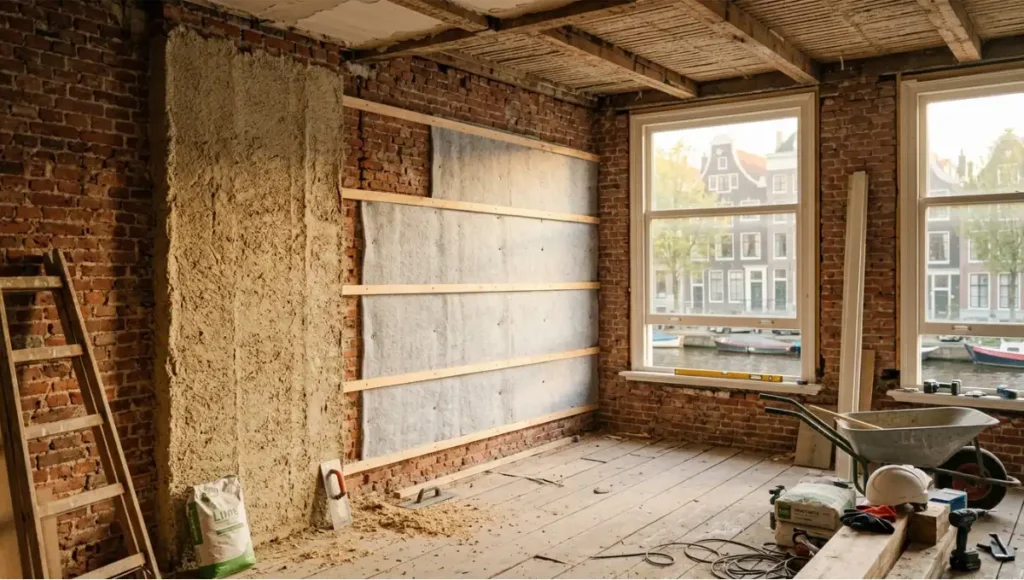
Amsterdam is a precise test case because its retrofit constraints are real and severe: listed facades cannot be insulated externally, floor plates cannot be structurally altered, and the dense urban grain makes significant wall buildup spatially untenable. The city’s 2030 retrofit targets require a material solution that performs at aerogel’s thermal level while delivering hempcrete’s carbon profile.
Design Levers Applied
The Hybrid Wall Assembly
Layer 1 — Interior Hempcrete Layer (150mm)
- Applied to interior face of existing solid brick via pneumatic spray hempcrete
- Target density: 300 kg/m³; thermal conductivity: 0.065 W/mK; R-contribution: ~R-8.7
- Carbon sequestration: ~42–52 kg CO₂eq/m³ net negative at 150mm
- Hygroscopic function: handles all moisture buffering for interior air quality — MVHR dependency eliminated
- Lime finish direct to hempcrete surface: no additional wall depth consumed
Layer 2 — Aerogel Fibrous Composite (AFC) (35mm)
- Applied on service batten zone between hempcrete and final plaster line
- AFC thermal conductivity: ~0.016 W/mK; R-contribution at 35mm: ~R-7.7
- Hydrophobic face prevents internal surface condensation on cold bridges at masonry ties
- Total wall buildup interior addition: 185mm (hempcrete 150 + AFC 35)
- Floor area reduction: ~3.7m² on a 20m² floor plate — within the 5% threshold
Combined Assembly Performance
- Projected U-value: ~0.13 W/m²K (below Passive House EnerPHit retrofit target of 0.15 W/m²K)
- Whole-life embodied carbon: net negative — hempcrete sequestration (~50 kg CO₂eq/m³ negative) more than offsets AFC embodied carbon (~110 kg CO₂eq/m³ positive) at this thickness ratio
- Moisture management: fully passive; no MVHR required
- Structural impact: zero — no load-bearing elements altered, no floor plates touched
Transferable Takeaway
When to Apply the Carbonite Hybrid
You can apply this assembly logic in any pre-1945 solid-wall building where external insulation is prohibited or spatially impossible. The principle is consistent: hempcrete handles moisture, carbon sequestration, and thermal mass on the structural side of the assembly; the AFC layer handles the thermal resistance uplift in the minimum possible depth on the interior service side. The combined system hits targets that neither material achieves alone — carbon-negative lifecycle AND Passive House-adjacent U-values — without mechanical ventilation dependency.
Where floor area loss tolerance is below 3%, reduce the hempcrete layer to 100mm and increase the AFC to 50mm: projected U-value rises to ~0.14 W/m²K, still within EnerPHit compliance, whole-life carbon remains net negative.
2030 Future Projection
The trajectory for both materials by 2030 is driven by three converging forces: embodied carbon legislation, material innovation, and supply chain maturation.
Hempcrete at 2030: Industrial hemp cultivation is expanding across the EU, UK, Canada, and the US following regulatory normalization. The UK Hempcrete sector projects a 40% reduction in material cost as domestic hemp hurd supply chains reach scale. The introduction of carbon-negative embodied carbon credits under anticipated UK and EU whole-building carbon regulations will make hempcrete’s sequestration value a direct financial asset — not just an environmental metric. By 2030, hempcrete prefabrication technology is projected to reduce installation time by 60%, eliminating the extended on-site curing time that currently adds to contractor cost and project programme.
Aerogel at 2030: Ambient pressure drying (APD) manufacturing processes — already in commercial testing — are projected to reduce aerogel production energy by 35–50% versus supercritical drying, materially reducing embodied carbon and cost. Bio-silica aerogels derived from agricultural waste (rice husk silica) are in advanced research phase at multiple European universities, with the potential to produce carbon-neutral aerogel within a decade. AFC composites are expected to achieve cost parity with premium mineral wool by 2028–2030 as production scales.
The convergence: By 2030, the specification choice between hempcrete and aerogel will be less about performance compromise and more about optimised material layering — the hybrid assembly model piloted in the Carbonite Wall concept will likely represent standard practice for deep retrofit in constrained urban typologies across Northern Europe and beyond.
Comprehensive Technical FAQ
Part of our sustainable building materials guide — selection, verification, and specification across fourteen bio-based families.
Q: What is the R-value of hempcrete vs aerogel insulation?
A:
- Hempcrete: ~R-1.9 per inch at standard construction density (275–350 kg/m³); range of R-1.7 to R-3.0 across the full density spectrum
- Aerogel blanket: R-10 to R-10.3 per inch — approximately 5.4× higher per unit thickness
- Aerogel fibrous composite (AFC): R-8 to R-9 per inch at approximately 50% of blanket cost
Q: Is hempcrete better than aerogel for carbon-negative construction?
A: Yes — unambiguously. Hempcrete has a net negative embodied carbon footprint of -35 to -80 kg CO₂eq/m³ across its lifecycle due to hemp sequestration and lime carbonation. Aerogel’s embodied carbon is +100 to +185 kg CO₂eq/m³ due to energy-intensive supercritical drying manufacturing. For any project with whole-life carbon reporting requirements or net-zero targets, hempcrete reduces your carbon budget while aerogel consumes it.
Q: Can you use hempcrete and aerogel in the same wall assembly?
A: Yes — and this is often the optimal specification for deep retrofit in constrained buildings. The logic:
- Hempcrete on the structural side: carbon sequestration, thermal mass, hygrothermal regulation
- Aerogel AFC on the interior service side: thermal resistance uplift at minimum depth, hydrophobic cold-bridge protection
- Combined result: carbon-negative lifecycle + Passive House-adjacent U-value + no MVHR dependency
Q: What thickness of hempcrete is needed to meet UK Building Regulations Part L?
A: A 300mm hempcrete wall at standard density (300 kg/m³) achieves a U-value of approximately 0.17 W/m²K, meeting Part L requirements. A 350mm wall provides additional thermal mass margin and is the standard new-build specification recommended by UK Hempcrete for cold climate applications.
Q: Is aerogel insulation environmentally friendly?
A: Not in the same category as hempcrete or natural insulants. Aerogel’s manufacturing process — supercritical drying with pressurised CO₂ and high energy inputs — gives it one of the highest embodied carbon footprints of any insulation material, comparable to PIR board. It is not carbon-negative and should not be classified as a regenerative infrastructure material in its current production form. Bio-silica and ambient-pressure-dried aerogel variants in development by 2030 may change this classification.
Q: What is aerogel fibrous composite (AFC) and why does it matter for cost?
A:
- What it is: Aerogel integrated into a mineral fibre (typically glass or silica fibre) matrix, producing a flexible blanket with aerogel’s nanoporous structure distributed through a fibrous carrier
- Thermal performance: Equivalent to pure aerogel blanket at equivalent thickness (R-8 to R-9 per inch)
- Cost advantage: Approximately 50% lower material cost than pure aerogel blanket at equivalent R-value (PMC 2024 study)
- Why it matters: AFC makes aerogel-class thermal performance accessible at specification budgets that previously required conventional insulation thickness — collapsing the cost barrier that has restricted aerogel to high-end retrofit and heritage applications
Q: How does hempcrete perform in high-humidity climates?
A:
- Hempcrete’s hygroscopic capacity — 14 litres of water absorption per m² — is a direct asset in high-humidity climates
- Moisture buffering value classified as EXCELLENT (Journal of Building Engineering)
- At 99% RH, specific heat capacity exceeds 2,900 J/(kg·K), increasing thermal storage precisely during peak humidity events
- Vapour-open lime finish allows continuous hygrothermal cycling without moisture entrapment
- Contrast with aerogel: Aerogel is hydrophobic — it provides zero moisture regulation and requires mechanical ventilation systems to manage indoor air quality in airtight assemblies
Ready to Specify Smarter?
The data above is not a theoretical exercise. Amsterdam’s 17,000-home-per-year retrofit programme, the UK’s embodied carbon regulation trajectory, and the EU’s Renovation Wave directive are all creating a mandatory specification context in which the hempcrete vs aerogel insulation decision carries regulatory, financial, and carbon consequences that dwarf the material cost difference.
You now have the 6 measured results — R-value, conductivity, moisture, carbon, cost, and build thickness — to make that decision with precision. The specification tables above consolidate the full technical data, and consult the AIA Framework for Design Excellence (aia.org) for whole-building carbon integration guidance applicable to both material systems. The choice between these two materials is no longer a preference. It is an engineering position — and now you have the numbers to defend it.
© Nuvira Space. All rights reserved. | ECO BLUEPRINT Series | All specifications cited are based on peer-reviewed research from ScienceDirect, PMC (PubMed Central), ORNL insulation data, UK Hempcrete technical documentation, Brikbase thermal performance studies, and the Natural Building Alliance material cost database. The Carbonite Wall is a speculative internal concept study and does not represent a completed project.
Q: What is the fire rating for a standard 300mm hempcrete wall?
A: Hempcrete is classified as non-flammable — each hemp shiv is coated in lime, which prevents combustion. A standard 300mm wall typically achieves a 120-minute fire rating (REI 120), with zero toxic off-gassing during fire exposure (unlike EPS, which releases toxic gases when burned).
Q: Can hempcrete be used for load-bearing structures in high-rise applications?
A: No — hempcrete must be used as an infill (compressive strength 0.2 to 0.5 MPa). Standard practice pairs it with a primary structural frame of timber, steel, or carbon-negative concrete.
Q: What is the drying time for cast-in-situ hempcrete?
A: A 300mm cast-in-situ wall requires 6 to 10 weeks to fully cure depending on ambient conditions; pre-cast blocks bypass the wait entirely.
8 thoughts on “Hempcrete vs Aerogel Insulation: 6 Measured Results”