

Table of Contents
The apartment you occupy right now is performing a biological operation on your nervous system. Whether you are conscious of it or not, every sightline, every surface temperature, every lumen of light hitting your retina is feeding data into your body’s stress-regulatory architecture. Most interiors are poorly calibrated machines. The emerging framework of
japandi interior design small space thinking offers something more precise: a methodology for tuning the domestic environment to align with your cortisol rhythms, your circadian biology, and your need for cognitive restoration. This is not aesthetics. This is applied spatial neuroscience.
Nuvira Perspective: The Home as a Health Machine
At Nuvira Space, we do not design rooms. We engineer environments. The traditional discourse around interior decoration—centered on style, colour palettes, and trending aesthetics—fundamentally misunderstands what a home is: a biological apparatus that either supports or undermines the organisms living inside it. When you live in a space, you are not passively inhabiting it. You are in constant physiological dialogue with it.
The synthesis we pursue sits at the intersection of neuroarchitecture, circadian chronobiology, and modular adaptability. We are interested in how your apartment can shift from passive shelter to an active health-delivery mechanism—adjusting light spectra at dusk to suppress cortisol, reconfiguring spatial boundaries through modular furniture to prevent the territorial compression that small-space living imposes, and embedding natural anchors that trigger the parasympathetic restoration your overworked prefrontal cortex requires.
The japandi interior design small space discipline is not merely a design trend. It is a measurable, evidence-based protocol. It draws on Japanese’s Wabi-Sabi principle of accepting impermanence and Scandinavia’s Hygge-rooted emphasis on physical comfort. Combined, they generate a spatial vocabulary that is, by neurological coincidence or cultural wisdom, perfectly aligned with what contemporary cognitive science tells us the human brain needs from its domestic environment. What follows is Nuvira’s analytical breakdown of the five principles that constitute this protocol—and why they work at a biological level.
Technical Deep Dive: The Neuroscience of Japandi Spatial Logic
Designing for the Brain
Principle 1 — Negative Space as Cognitive Decompression
The average urban apartment accumulates a “visual noise index” that functions as chronic low-grade stressor. Every object within your field of vision that does not serve an immediate function requires a micro-decision from your prefrontal cortex: acknowledge and categorise, or suppress. Across hundreds of objects per hour, this compounding cognitive load depletes executive function in a process psychologists call decision fatigue.
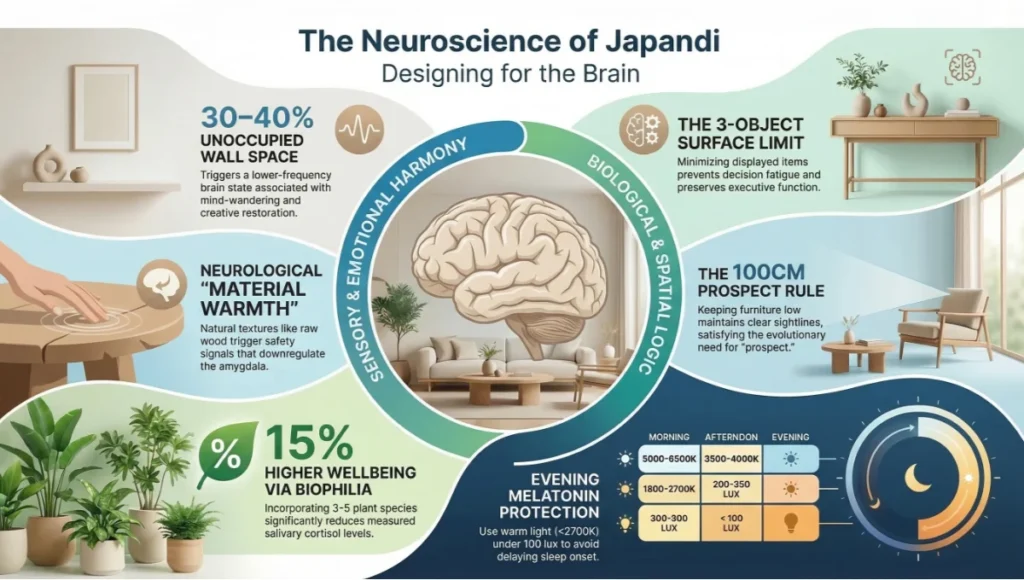
Japandi addresses this not through minimalism as an aesthetic preference but through negative space as a deliberate neurological intervention. When 30–40% of a wall surface remains unoccupied, your visual cortex enters a lower-frequency processing state associated with mind-wandering and creative restoration. This is measurable in EEG studies of attention restoration theory (ART), pioneered by Rachel and Stephen Kaplan.
Key specifications for implementing negative space in apartments under 55 m²:
- Limit displayed objects to a maximum of 3 per horizontal surface
- Maintain at least 60 cm of uninterrupted wall length between visual anchors
- Floor clearance beneath furniture: minimum 18 cm to preserve the perception of spatial depth
- Primary sightline from habitual seating position must terminate at a natural element or bare wall—not a door, screen, or storage unit
Principle 2 — Material Warmth as Thermal Emotional Regulation
Your brain processes visual texture through the same neural circuits that process tactile sensation. This is not metaphor—it is mirror neuron activity. When you see the grain of unfinished oak or the matte irregularity of hand-thrown stoneware, your somatosensory cortex partially activates as if your hand were touching the surface. This phenomenon, documented in haptic perception research at the Max Planck Institute, explains why material selection in small spaces has a disproportionate impact on emotional comfort.
Japandi’s material vocabulary—raw linen, rattan, plaster, stone, and FSC-certified timber—is not curated for Instagram credibility. It is curated for neurological warmth. Cold, high-gloss synthetic surfaces trigger vigilance responses. Warm, matte, slightly irregular surfaces trigger safety signals that downregulate the amygdala’s threat-detection activity.
Material specification targets for a Japandi small apartment:
- Timber surfaces: visible grain, natural oil finish (not polyurethane), colour temperature 2700–3000K under artificial light
- Textiles: natural fibre content minimum 70% (linen, wool, cotton); texture variation coefficient of at least 3 surface changes per room
- Ceramics and stoneware: matte or satin glaze only; visible tool marks or asymmetry preferred
- Wall surfaces: mineral plaster or limewash; reflectance value (LRV) between 55–70 for primary walls
Principle 3 — Circadian Light Calibration
Most small apartments are chronobiologically hostile environments. Fixed overhead lighting at uniform colour temperatures destroys your body’s melatonin-cortisol cycle, which operates on a 24-hour circadian clock directly influenced by light exposure. In a study published in the Journal of Biological Rhythms, evening exposure to light above 4000K (cool white) suppressed melatonin production by up to 85% in participants, delaying sleep onset by an average of 47 minutes. Understanding circadian lighting systems is therefore central to any serious Japandi small-space intervention.
Japandi’s traditional preference for warm, layered, low-positioned light sources is not a stylistic affectation inherited from Japanese paper lanterns or Nordic candlelit winters. It is a chronobiologically coherent system. Low-angle light below eye level, filtered through natural materials, mimics the spectral qualities of late-afternoon sunlight—which your hypothalamus uses as a cue to begin melatonin production.
Circadian lighting specification for Japandi small spaces:
- Morning: 5000–6500K at 300–500 lux (simulate sunrise, support cortisol awakening curve)
- Afternoon work: 3500–4000K at 200–350 lux (task clarity without melatonin suppression)
- Evening: 1800–2700K at under 100 lux; warm-spectrum floor and table lamps at seated eye level or below
- No overhead lighting after 20:00 unless using deep-red spectrum (< 1800K)
Principle 4 — Biophilic Micro-Interventions and Stress Biomarkers
The therapeutic value of biophilic interior design—the introduction of natural elements into built environments—has been quantified. A landmark meta-analysis by the Human Spaces report (2015), drawing on 7,600 office workers across 16 countries, found that workers in environments with natural light and living plants reported a 15% higher wellbeing score and a 6% gain in productivity. In residential contexts, studies correlate even minimal plant presence (3–5 species) with statistically significant reductions in measured salivary cortisol levels.
In japandi interior design for small spaces, biophilic intervention follows a precision micro-dosing model rather than a maximalist green-wall approach. The constraint of limited square footage makes this philosophically coherent: a single Japanese bonsai on a windowsill, placed at the terminus of the primary sightline, delivers the neurological stimulus of natural presence without consuming the negative space your cognitive system requires.
Biophilic micro-intervention specifications:
- Minimum 3 plant species; at least one with visible soil (bare earth visible = grounding cue)
- Place primary plant at the terminal point of the longest uninterrupted sightline
- Incorporate one water element (even a 15 cm ceramic bowl with still water) to introduce auditory and visual flow
- Natural fibre flooring (jute, sisal, or cork) to engage haptic grounding cues through barefoot contact
Principle 5 — Spatial Compression and the Refuge-Prospect Framework
Evolutionary psychology offers a framework called Refuge-Prospect Theory, developed by geographer Jay Appleton, which proposes that humans are neurologically calibrated to prefer spaces offering both wide visual prospect (the ability to see far without obstruction) and intimate refuge (a sheltered, bounded area suggesting protection). Modern apartments routinely fail both parameters: open-plan layouts offer prospect but no refuge; divided micro-rooms offer neither.
Japandi’s spatial philosophy instinctively honours this binary. The use of shoji-inspired room dividers, low furniture that does not interrupt sightlines, and designated “nest” zones—a low-seated reading corner bounded on two sides by a wall and a bookshelf—creates the psychological architecture of the refuge-prospect gradient within a single apartment room.
Refuge-Prospect implementation specs:
- Furniture maximum height: 100 cm for primary seating-zone pieces (to preserve prospect sightlines)
- Refuge corner: bounded on minimum 2 sides; ceiling or canopy element optional but impactful
- Prospect axis: minimum 3.5 m unobstructed sightline from the primary seating position
- Room dividers: translucent or slatted (40–60% visual permeability) to maintain light flow
Comparative Analysis: Japandi vs. Industry Standard Small-Space Design
The Problem with Conventional Small-Space Solutions
The standard industry response to small-space living centres on storage maximisation, multifunctionality, and the visual trick of “making a space feel larger.” This approach is physiologically counterproductive. High-density storage—floor-to-ceiling shelving systems, under-bed drawers, over-door hangers—increases the visual noise index. It solves the logistical problem of square footage while worsening the neurological experience of the space.
The “mirrors make rooms feel larger” convention deserves particular scrutiny. Reflective surfaces create perceptual spatial expansion, but they simultaneously increase ambient light uniformity (reducing the contrast that creates depth perception) and introduce movement at the periphery of vision (a vigilance trigger inherited from our predator-detection neurology). For inhabitants with elevated baseline anxiety—disproportionately prevalent among urban apartment dwellers—mirror-heavy interiors can measurably increase sympathetic nervous system activation.
The Japandi Alternative: Quality of Spatial Experience Over Quantity of Storage
Comparative specification table:
- INDUSTRY STANDARD: Maximise storage with built-in floor-to-ceiling units | JAPANDI: Curate possessions; display maximum 20% of what you own; conceal the rest in 2 or fewer furniture-integrated storage solutions
- INDUSTRY STANDARD: Use mirrors to create illusion of space | JAPANDI: Use depth perception through layered furniture placement and warm-cool colour contrast on opposite walls
- INDUSTRY STANDARD: Uniform overhead LED lighting throughout | JAPANDI: Layered warm-spectrum task and ambient lighting adjusted across the circadian arc
- INDUSTRY STANDARD: Multipurpose furniture as a space-saving fix | JAPANDI: Modular furniture with clean lines; functionality is singular per piece to reduce cognitive clutter
- INDUSTRY STANDARD: Pale neutrals throughout to ‘open up’ the space | JAPANDI: Warm earth tones anchored by one or two deeper tones that create visual boundaries and spatial identity
Speculative / Internal Concept Study: The Kinjo Apartment by Nuvira Space
Project Overview
Location: Copenhagen, Denmark (Nørrebro district)
Typology: 42 m² single-occupancy apartment, third floor, north-facing primary aspect
Vision: To demonstrate that a sub-50 m² northern European apartment can function as a measurably restorative health environment—with quantified improvements in occupant sleep latency, cortisol recovery rate, and self-reported cognitive clarity—through the application of all five Japandi neuro-spatial principles.
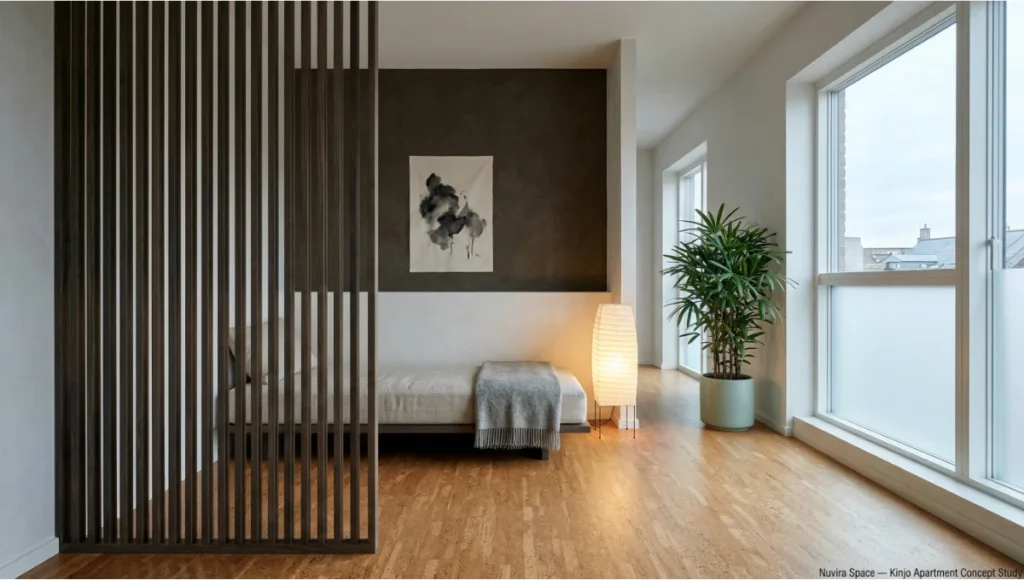
Copenhagen was selected deliberately. As a city that experiences fewer than 7 hours of daylight in December, it presents the most demanding chronobiological challenge for residential design in Northern Europe. If the Japandi circadian calibration protocol functions here, it functions anywhere.
Design Levers Applied
Lever 1 — Negative Space Protocol
- 70% of wall surface area intentionally left unoccupied
- Furniture count limited to 9 pieces across the entire 42 m² plan
- All electrical cables routed through internal channels or concealed conduits
- One primary artwork: 60 cm × 80 cm sumi-e ink wash on raw cotton; positioned at the terminus of the living room sightline
Lever 2 — Circadian Light System
- Tunable LED system across 1800K–6000K spectrum; automated via astronomical clock synced to Copenhagen’s latitude (55.7°N)
- Dawn simulation: 05:30 ramp from 1800K to 5000K over 45 minutes
- Evening protocol: automatic shift to 2200K at 19:00; all overhead circuits disabled at 21:00
- Light sources: 4 floor-positioned Japanese washi-paper floor lamps supplemented by 2 recessed warm-spectrum wall washers
Lever 3 — Material Palette
- Primary floor: 18 mm cork with linseed oil finish (LRV 42, acoustic damping coefficient 0.55)
- Primary walls: Tadelakt lime plaster in warm white (LRV 68)
- Accent wall: Limewash in deep umbra (LRV 18) to create spatial boundary and visual depth
- Furniture: solid smoked ash (FSC-certified, Danish supplier); joinery exposed with hand-finished edges
- Textiles: 100% undyed Belgian linen; structural woollen throw sourced from Faroe Islands cooperative
Lever 4 — Biophilic Strategy
- 3 plant species selected for low-light tolerance (Aspidistra elatior, Sansevieria ehrenbergii, Rhapis excelsa)
- Primary plant positioned at 3.8 m sightline terminus from the reading refuge corner
- Ceramic water bowl (22 cm diameter, handmade) on kitchen windowsill: auditory and visual natural anchor
- Jute area rug (160 cm × 240 cm) defining the living zone: barefoot haptic grounding element
Lever 5 — Refuge-Prospect Configuration
- Reading refuge: 90 cm deep alcove created with two low bookshelves (82 cm h) and a linen-upholstered platform daybed (38 cm seat height)
- Prospect axis: 4.1 m clear sightline from refuge to north window with frosted lower pane and clear upper pane (maintains sky view while controlling glare)
- Room divider: slatted ash screen (180 cm × 120 cm) at 50% visual permeability separating sleeping zone from living zone
Transferable Takeaway
You do not need a 42 m² Copenhagen apartment, a tunable LED system, or an artisan ceramics collection to apply the Kinjo logic. You can apply the same spatial reasoning at home by making three targeted interventions: tune your evening lighting to a warm-spectrum lamp below seated eye level and switch off overhead lights after dinner; designate one corner as your refuge by positioning a chair with its back to a wall and placing your primary plant within the forward sightline; and clear one complete sightline—from your habitual seating position to the furthest wall—of every object that does not actively contribute to calm.
Intellectual Honesty: Current Limitations
The evidence base for neuroarchitectural design interventions is growing but not yet at the level of clinical standardisation. Most studies on biophilic design and circadian lighting effects are conducted in workplace or hospital settings, where variables are more controllable than in domestic environments. The extrapolation of findings to small residential apartments involves assumptions that rigorous researchers would flag.
Modular lighting systems with full circadian spectrum control remain financially prohibitive for many renters—the systems referenced in the Kinjo study would represent a capital investment of approximately 2,400–4,800 EUR for a full apartment installation. DIY smart-bulb approximations (Philips Hue, Govee RGBWW systems) deliver partial circadian control at a fraction of the cost but with reduced spectral precision.
Material authenticity is a particular concern in the japandi interior design small space conversation. The market is saturated with mass-produced “Japandi-aesthetic” products—synthetic-veneer furniture, polyester “linen-look’ textiles, injection-moulded ‘ceramic-finish’ planters—that deliver the visual reference without the haptic neurological value. A limewash wall and a vinyl-wrap-on-MDF cabinet may look identical in a photograph. To your somatosensory cortex, they are entirely different objects.
The American Institute of Architects (AIA) has published guidance on evidence-based design through its Academy on Architecture for Health. For practitioners seeking peer-reviewed frameworks on spatial wellbeing, the AIA’s resources provide a rigorous starting point: AIA Academy on Architecture for Health.
2030 Future Projection: Where Japandi Neuro-Design Is Heading
By 2030, the japandi interior design small space methodology will have bifurcated into two distinct streams. The first is the mass-market aesthetic stream: Japandi as a visual language will continue to penetrate mainstream furniture retail, losing its neurological precision while gaining cultural ubiquity. The second stream—and the one Nuvira Space operates within—is the evidence-based spatial health stream, which will converge with smart-home biometric integration.
Imagine an apartment that reads your cortisol levels through a wearable and autonomously adjusts lighting spectrum, temperature, and even acoustic damping (through motorised textile panels) in real time. The hardware for this exists in prototype form. The design language most compatible with its integration—pared-back, material-warm, spatially uncrowded, circadian-calibrated—is precisely the Japandi framework.
Singapore’s Housing Development Board (HDB) has already begun piloting biophilic and circadian design integration in public housing blocks in the Tengah eco-town development—a satellite town designed from inception around active mobility, green corridors, and reduced car dependency. Tengah’s “forest town” planning principles represent a macro-scale articulation of the same logic that Japandi applies at the apartment level: reduce environmental stressors, increase natural cues, trust the biology of the occupant to do the rest.
By 2030, expect the following to become standard specification in premium small-space residential development:
- Embedded circadian lighting (tunable 1800–6500K) as a standard fixture, not an upgrade
- Acoustic performance ratings for apartment interiors (currently used only in commercial fit-outs)
- Material wellbeing certifications analogous to LEED, assessing haptic quality, VOC emission, and biophilic compatibility of interior finishes
- AI-assisted spatial configuration tools that model refuge-prospect ratios before furniture placement
Actionable Design Principles: Your 5-Step Implementation Protocol
Based on the analysis above, here is a sequenced implementation protocol you can apply to any small apartment without professional intervention:
Step 1: Audit Your Visual Noise Index
Stand at your primary seating position and count every discrete object within your field of vision. If the count exceeds 40 objects, you are operating in a chronically overstimulating environment. Begin by removing or concealing 50% of visible objects before making any purchases.
Step 2: Remap Your Lighting by Time-of-Day
Purchase a minimum of two warm-spectrum floor or table lamps (2700K or below). Establish a personal rule: no overhead lighting after 20:00. Track sleep onset time before and after this single intervention for two weeks. The delta will be instructive.
Step 3: Audit Your Materials
Identify the three largest surface areas in your apartment (floor, primary wall, dominant furniture piece). Assess their haptic quality: are they warm or cold to the touch? Matte or reflective? Natural or synthetic? Prioritise replacing the highest-tactility surfaces—the one you touch most often—with natural materials first.
Step 4: Establish One Biophilic Anchor
Place a single plant at the terminal point of your longest unobstructed sightline. Do not scatter plants decoratively. One well-placed, healthy plant at sightline terminus delivers more neurological value than six plants positioned randomly.
Step 5: Build Your Refuge Corner
Identify the most ‘enclosed’ corner of your apartment—where two walls meet, ideally away from the main circulation path. Position a chair or low seat with its back to the corner, facing the room’s longest prospect axis. This is your cognitive recovery station. Keep it free of screens.
Comprehensive Technical FAQ
Q: Does Japandi interior design small space work for apartments under 30 m²?
A: The neurological principles apply more urgently in sub-30 m² spaces, not less. Spatial compression increases the physiological cost of environmental stressors. The priority sequence for micro-apartments is: lighting calibration first, visual noise reduction second, biophilic anchoring third. Furniture selection is almost secondary to these interventions.
Q: Can I implement Japandi principles in a rented apartment I cannot modify structurally?
A: Yes. The highest-impact Japandi interventions are entirely reversible: lighting (lamp repositioning, bulb colour temperature), object curation (removal, not addition), textile layering (floor rugs, linen throws), and plant placement. The only structural element—wall treatment—can be approximated with removable limewash-effect wallpaper, though haptic fidelity is reduced.
Renter-friendly intervention priority list:
- Replace all bulbs with tunable warm-spectrum smart bulbs (Philips Hue White Ambiance or equivalent)
- Remove 50% of displayed objects; store in opaque containers under bed or in wardrobe
- Add one large natural-fibre rug to define spatial zones
- Position one plant at sightline terminus
- Use a standing paper floor lamp to create low-position warm-light anchor in the living zone
Q: How do I balance Japandi minimalism with practical storage needs?
A: The Japandi approach to storage follows the principle of concealed abundance. You own what you own. The neurological argument is not for radical ownership reduction (though this helps) but for visual concealment. Furniture with flush-door storage, closed baskets in natural materials, and internal wardrobe organisation systems allow you to maintain functional storage capacity while reducing the visual noise that the open display of objects generates.
Q: What is the minimum budget for a meaningful Japandi neuro-design intervention?
A: The highest-return interventions are low-cost:
- 2 warm-spectrum floor lamps: 60–120 EUR
- 3 smart bulbs for circadian control: 45–80 EUR
- 1 large natural-fibre rug: 80–200 EUR
- 2–3 low-light plants with ceramic pots: 40–90 EUR
- Object curation (removing clutter): 0 EUR
A total investment of 225–490 EUR can produce a measurably different neurological environment. The law of diminishing returns applies above 2,000 EUR unless structural modifications (wall treatments, built-in furniture) are included.
Q: How does Japandi perform acoustically in small apartments with hard floors?
A: This is an underaddressed dimension of Japandi design. Hard floors (timber, cork, stone) and sparse furnishing reduce the acoustic absorption coefficient of a room, increasing reverberation time (RT60). In small apartments, this can create a paradox where visual calm is accompanied by acoustic stress. The counter-strategy: layer natural textiles generously. A large jute rug, heavy linen curtains, and a woollen throw collectively contribute significant mid-frequency acoustic absorption. Cork flooring has an inherent acoustic damping coefficient of approximately 0.55, making it the preferred Japandi flooring choice for both haptic quality and acoustic performance.
Ready to Redesign Your Apartment as a Health Machine?
The five principles outlined in this article are a diagnostic framework, not a decoration checklist. Your apartment is already performing a neurological function. The question is whether it is performing the right one.
At Nuvira Space, we conduct Spatial Health Audits for small apartments—a structured assessment of your existing environment against the five Japandi neuro-design parameters, delivered as a prioritised action plan with specifications tailored to your floor plan, light conditions, and lifestyle rhythms. No full renovation required. No aesthetic prescription imposed. Just a calibrated, evidence-based pathway to an apartment that actively supports your biology.
If you are ready to stop tolerating your space and start designing it with intent, begin with the audit. Your nervous system will register the difference before you can consciously articulate it.
Contact Nuvira Space at www.nuviraspace.com to schedule your Spatial Health Audit.
© Nuvira Space. All rights reserved. | LIVING SPACES Series | All specifications cited are based on peer-reviewed research in neuroarchitecture, chronobiology, and biophilic design, including: Kaplan & Kaplan’s Attention Restoration Theory (1989); Journal of Biological Rhythms (circadian lighting suppression data); Human Spaces Global Report on Biophilic Design (2015); Jay Appleton’s Refuge-Prospect Theory (1975); Max Planck Institute haptic perception studies; and AIA Academy on Architecture for Health evidence-based design guidance (aia.org). The Kinjo Apartment is a speculative internal concept study and does not represent a completed project.