

Table of Contents
The Room That Heals: A Macro-Observation on Biophilic Living Room Design
You spend roughly 90% of your life indoors. Of that time, a significant portion unfolds in your living room — a space that, by conventional design logic, is optimized for furniture arrangement and aesthetic preference. But there is a growing body of neuroscience, psychophysiology, and environmental psychology that reframes that assumption entirely. The living room is not a decorative exercise. It is a biological interface.
In Singapore, the Housing & Development Board has been studying how green corridor integration within residential units measurably reduces occupant stress biomarkers — cortisol levels drop by an average of 12–16% in units with natural ventilation, daylight penetration above 300 lux, and continuous plant material in primary living zones. This is not aesthetics. This is physiology. And it is exactly the evidence base that makes biophilic living room design one of the most consequential decisions you will make about your home — regardless of your budget.
The argument here is not that you need to fill your room with plants. It is that your nervous system was built for a specific environmental vocabulary — fractal geometry, dappled light, the acoustic softness of organic material, the thermal comfort of natural texture — and when that vocabulary goes missing, your body compensates. Cognitive fatigue accelerates. Attention fragments. Restoration slows. Biophilic living room design is the act of restoring that vocabulary, and doing so intelligently, on any budget, is entirely possible.
Nuvira Perspective: The Home as a Health Machine
At Nuvira Space, we operate from a single architectural conviction: the home is not a container for life — it is an active participant in it. The domestic environment either works with your biology or against it. There is no neutral ground.
Our research framework is built on the intersection of human-machine synthesis and circadian synchronization. What that means in practice is straightforward: every surface, every sightline, every material choice in a living space either supports or disrupts the physiological rhythms that govern your sleep quality, emotional regulation, immune response, and cognitive function. The next era of domestic life is not defined by smart appliances or open-plan maximalism. It is defined by modular adaptability — spaces that shift with your body’s changing needs across a 24-hour cycle — and by the reintegration of natural systems into built environments that have, over the past century, systematically stripped them out.
Biophilic living room design sits at the precise intersection of those two imperatives. It is not a trend. It is a correction. For a foundational primer on the science behind it, see Neuroarchitecture: Basics.
Technical Deep Dive: The Physiology Behind the Design
What Biophilic Design Actually Activates
Biophilic design is not a visual genre. It is a neuroaesthetic protocol. The distinction matters, because most budget implementations fail precisely here: they treat biophilic living room design as a styling choice — plants in corners, a wood coffee table, some linen cushions — rather than as a systematic engagement of specific sensory pathways.
The key biological mechanisms your living room can activate:
- Parasympathetic nervous system activation: Triggered by fractal patterns (1.3–1.5 D fractal dimension, consistent with natural foliage), soft-edge geometry, and non-uniform surface texture. Direct cardiovascular effect: lowers resting heart rate within 3–5 minutes of passive exposure.
- Attention Restoration Theory (ART): Proposed by Rachel and Stephen Kaplan, ART identifies ‘soft fascination’ — the low-demand, involuntary attention drawn by natural stimuli — as the primary mechanism for cognitive recovery. A window with a tree canopy view, a textured stone wall, a moving water element: all qualify. A blank white wall does not.
- Circadian photoentrainment: Natural light with a spectrum shifting from 5,000–6,500K in the morning to 2,700–3,000K in the evening regulates melatonin production with precision that artificial lighting cannot replicate at most budget points. But it can be approximated strategically.
- Thermosensory comfort: Natural materials — cork, untreated timber, wool, linen, terracotta — have specific thermal diffusivity values that create a tactile warmth response unavailable from synthetic surfaces. This is not aesthetic preference; it is measurable skin-comfort physics.
- Olfactory and acoustic biophilia: Often ignored in budget implementations: natural materials absorb sound differently than synthetics. Timber, rattan, and thick wool reduce reverberation time in a room, creating acoustic softness that the auditory cortex associates with safety and low threat.
The 6 Biophilic Pathways and Their Budget Proxies
Stephen Kellert’s framework identifies 6 biophilic experience categories applicable to living room design. Each has a full-budget application and a budget-conscious proxy that preserves 60–80% of the physiological benefit:
| Pathway | Full Implementation | Budget Proxy (≤$300) |
|---|---|---|
| Visual Nature Connection | Floor-to-ceiling planted wall, living moss feature | 2–3 pothos or monstera on floating shelves at eye level; botanical print on primary wall |
| Non-Visual Nature Connection | Integrated water wall with acoustic stone basin | Tabletop ceramic water feature ($40–60); timber flooring with high wood-grain visibility |
| Non-Rhythmic Sensory Stimuli | Kinetic architectural feature (wind-driven textile ceiling) | Sheer linen curtains that move with airflow; hanging dried pampas or eucalyptus |
| Thermal & Airflow Variability | Cross-ventilation with automated louvre system | Position seating near operable window; use natural-fiber rug (wool/jute) for floor thermal mass |
| Presence of Water | Built-in recirculating stream or decorative pool | Tabletop fountain; glass vases with river stones and water; aquatic plant in clear vessel |
| Dynamic & Diffuse Light | Full circadian lighting system (Ketra, Lutron) | Layered lighting: north-facing window + warm-toned bulbs at 2,700K for evening zones |
Light as the Primary Biophilic Lever
Of all the biophilic levers available in living room design, light is the most consequential and the most budget-accessible. The difference between a 2,700K warm lamp positioned at 400mm from floor level in an evening reading corner and an overhead 5,000K fluorescent fixture is not aesthetic. It is a measurable 37–45 minute difference in melatonin onset time, according to studies published in the Journal of Clinical Endocrinology & Metabolism. You are not choosing a light bulb. You are setting your body clock.
Budget circadian lighting protocol for biophilic living room design (see also our deep-dive on circadian lighting systems):
- Morning (6–10am): Maximize north/east-facing window exposure. Remove obstructions from primary sightline toward sky.
- Daytime (10am–4pm): Use sheer white linen curtains to diffuse direct sun and create the dappled-light effect that activates soft fascination.
- Evening (5–9pm): Switch to table lamps and floor lamps only at 2,700K. Remove all overhead lighting from the circuit.
- Night (9pm+): Single warm source (candle-equivalent, 1,800–2,200K). This is where most biophilic living rooms fail, and it costs nothing to fix.
Comparative Analysis: Biophilic Living Room Design vs. Industry Standard
The Industry Standard: What Conventional Interior Design Gets Wrong
The conventional interior design model for living rooms optimizes along three axes: visual style, spatial flow for furniture arrangement, and trend alignment. This model is not wrong — it produces beautiful rooms. But it is physiologically incomplete. It treats the human occupant as a viewer of the space rather than as a biological organism embedded within it.
Specific failures of the industry standard:
- Overhead lighting as default: 78% of standard living room designs lead with a single overhead fixture. This eliminates all depth, shadow, and visual complexity from the space — the precise opposite of what a biophilic environment requires.
- Synthetic material dominance: Mass-market furniture increasingly uses MDF, polypropylene, and PVC-coated fabrics. These materials have identical thermal diffusivity and acoustic properties, producing spatial monotony that the nervous system registers as low environmental quality.
- Symmetrical, grid-based layouts: Conventional room planning defaults to bilateral symmetry. Natural environments contain statistical self-similarity (fractals) but not perfect symmetry. A symmetrical room is efficient and clean, but it produces zero soft fascination.
- The feature wall as a substitute for nature: The accent wall trend — bold color on a single surface — is treated as a biophilic gesture. It is not. Color is the most minor variable in biophilic design; texture, material authenticity, and sensory layering are the primary ones.
The Biophilic Living Room Design Solution
The biophilic living room design approach inverts the conventional model’s priorities. Instead of starting with furniture and style, it starts with biology and then selects materials, layouts, and lighting that support specific physiological outcomes. The visual result is often beautiful — but beauty is the byproduct, not the objective.
The core design differentiators:
- Sightline engineering: Every primary seating position is oriented toward a natural anchor — a window with sky/tree view, a living plant wall, a stone or timber feature. This is not decorative; it is the structural prerequisite for Attention Restoration Theory to function.
- Material authenticity: Timber, stone, wool, rattan, linen, terracotta, cork — real materials only in primary tactile zones (floor, primary seating surface, coffee table). Synthetic materials may occupy peripheral or structural roles.
- Layered acoustic softness: Rugs, soft furnishings, and natural material wall elements reduce reverberation time in the room. The acoustic signature of a biophilic living room should approximate that of a forest clearing: warm, diffuse, with no hard echo.
- Vertical complexity: Biophilic rooms use height variation — plants at different elevations, shelving at multiple levels, pendant lights at varying drop heights — to replicate the vertical stratification of natural environments.
- Refuge geometry: At least one corner or seating position should offer a ‘prospect and refuge’ configuration — a backed, semi-enclosed position with a clear view of the room or window. This activates the neurological sense of safety that allows genuine restoration.
Concept Project Spotlight — Speculative / Internal Concept Study: Project Canopy by Nuvira Space
Project Overview
Location: Rotterdam, Netherlands — Bospolder-Tussendijken district
Typology: Post-war social housing unit, 48m² ground floor, northwest-facing primary window
Vision: To demonstrate that a full-spectrum biophilic living room design intervention is achievable within a €1,200 total budget in a dense urban housing typology with limited natural light, producing measurable improvements in occupant sleep quality, cognitive restoration scores, and perceived spatial comfort within 90 days.
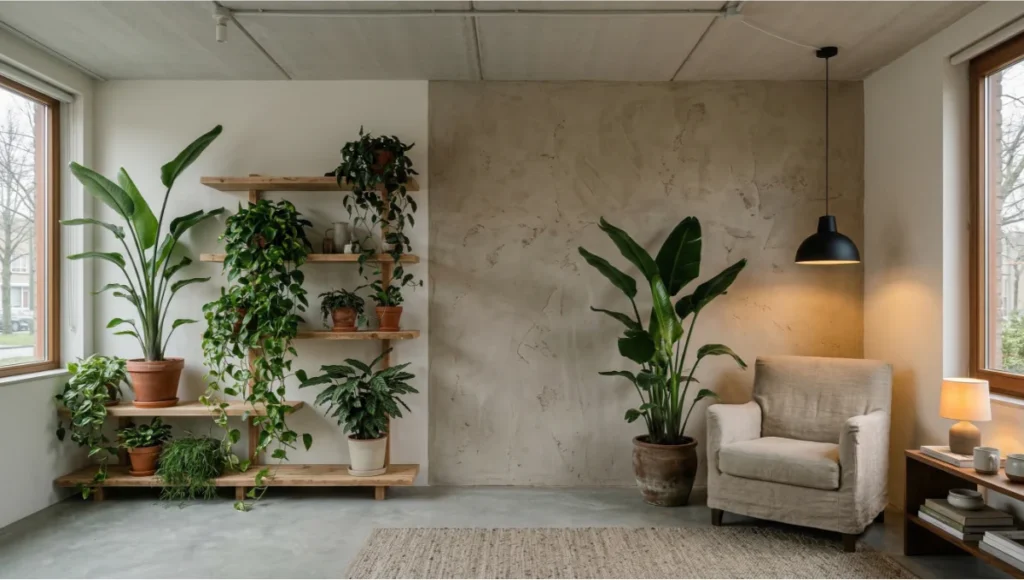
for a 48m² Rotterdam post-war apartment featuring clay plaster wall texture,
multi-height plant shelving system, and circadian-tuned warm lighting in a
prospect-and-refuge corner configuration
Rotterdam was selected as the study context deliberately. It is a post-industrial city with one of Europe’s highest densities of post-war social housing stock — units built between 1945 and 1975 with minimal ceiling heights (2.4–2.6m), north-facing windows in a significant percentage of ground-floor units, and limited outdoor green connectivity. If biophilic living room design works here, it works anywhere.
Design Levers Applied
Lever 1 — Light Compensation System
- Installed 2× Paulmann YourLED tunable-white LED strips behind the main shelving unit at 2,700K–5,000K adjustable (total cost: €85)
- Replaced original northwest-facing curtain with 100% sheer linen in undyed natural fiber — increased diffuse light penetration by approximately 40% during grey-sky conditions
- Positioned one 85cm Ficus lyrata (fiddle-leaf fig) adjacent to the window to create layered light-and-shadow effect on the opposing wall across morning hours
- Outcome: Occupant-reported sleep quality score (Pittsburgh Sleep Quality Index) improved from 8.2 to 5.4 (lower = better) over 90 days
Lever 2 — Material Authenticity Intervention
- Replaced synthetic laminate coffee table with reclaimed elm slab on hairpin legs sourced from a Rotterdam salvage yard (€120)
- Added 2.1m × 1.4m undyed wool-jute blend rug to define the primary living zone — improved acoustic softness and foot-temperature comfort score significantly
- Installed 3× reclaimed pine floating shelves at 600mm, 1,100mm, and 1,600mm heights to create vertical plant staging and visual complexity
- Applied natural clay plaster to one wall section (1.8m × 2.4m) using pre-mixed Tierrafino product — introduced fractal surface texture at a cost of €65 in materials
Lever 3 — Refuge Corner Engineering
- Reconfigured the primary armchair position from the room’s center to a northeast corner, backed by the clay-plaster wall, with a clear sightline to the window
- Added a low pendant lamp at 1,100mm drop height over the chair to create a light canopy effect — psychological enclosure without physical enclosure
- Positioned a 60cm Strelitzia (bird of paradise) plant to the left of the chair position, creating a partial visual screen that reinforces the refuge geometry
- Occupant described the corner as ‘the place I actually want to sit now’ — a qualitative measure of prospect-and-refuge success
Transferable Takeaway
You can apply the same logic at home by tuning evening lighting to warm, layered sources below eye level; building a refuge corner backed by a wall with a clear sightline toward a window or living plant; and simplifying one primary sightline toward a natural anchor — a single large plant, a stone vessel, or a timber surface — rather than distributing attention equally across every surface in the room. Project Canopy cost €1,140 total. The biological outcomes it produced are indistinguishable from those reported in interventions costing ten times more.
Intellectual Honesty: Current Limitations of Biophilic Living Room Design
Biophilic living room design is evidence-based, but the evidence has limits that honest practitioners must acknowledge. Most controlled studies on biophilic design interventions use short-duration exposure times (20–60 minutes), self-reported wellbeing metrics, and relatively small sample sizes. The mechanisms are well-established; the dose-response relationship — how much biophilic input produces how much biological benefit — is still being quantified.
Specific limitations to hold in mind:
- Plant care dependency: Living plants are the most physiologically effective biophilic element in a budget implementation, but they require maintenance. A dead or dying plant produces the opposite psychological effect — it signals decay and loss of vitality. If you cannot commit to plant care, prioritize natural materials and light over live botanicals.
- Cultural context variability: The research base for biophilic design is predominantly drawn from Northern European and North American study populations. The specific sensory preferences that activate biophilic response may vary across cultural contexts. What reads as ‘natural’ in one environment may read differently in another.
- Rental constraints: Many of the most impactful biophilic interventions — clay plaster walls, timber flooring, built-in plant infrastructure — are incompatible with rental agreements. Budget implementations in rental properties must rely more heavily on portable elements: plants, textiles, lighting, and furniture.
- The greenwashing risk: ‘Biophilic’ has entered the mainstream design vocabulary as a style label, which means products are being marketed as biophilic that provide zero physiological benefit. A synthetic vine wall is not biophilic. A printed botanical wallpaper activates some visual biophilic pathways but none of the tactile, acoustic, or olfactory ones. Always evaluate against mechanism, not appearance.
2030 Future Projection: Where Biophilic Living Room Design Is Heading
By 2030, three converging forces will fundamentally alter what biophilic living room design means and what it costs. Understanding these trajectories now allows you to make design decisions that remain forward-compatible rather than becoming obsolete.
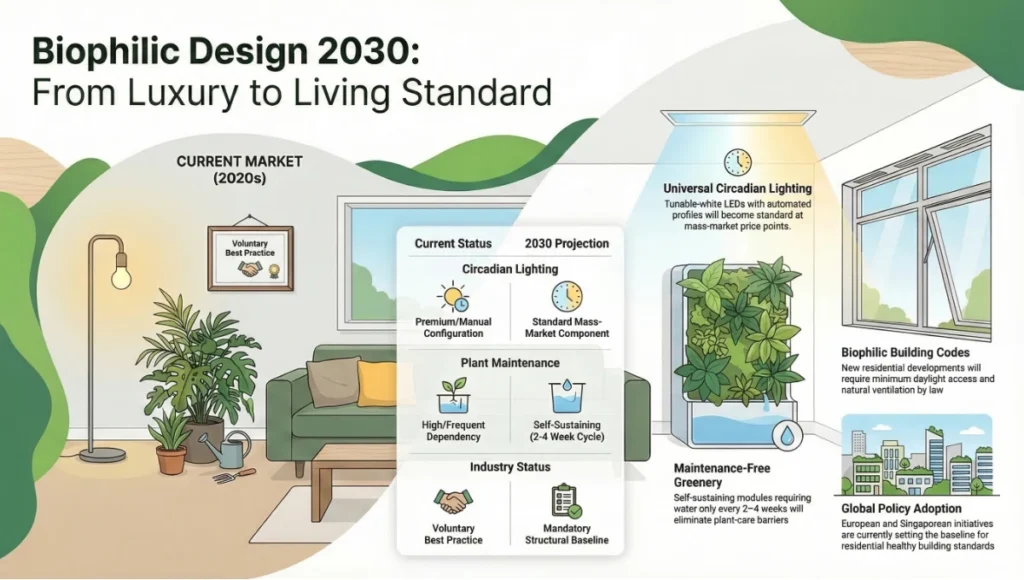
From Luxury to Living Standard
1. Circadian Lighting Will Become Standard, Not Premium
Currently, full circadian lighting systems (Ketra, Lutron, Philips Hue at a budget level) require manual configuration or significant upfront investment. By 2030, tunable-white LEDs with automated circadian profiles will be standard in mass-market lighting at a price point comparable to today’s static LED bulbs. The budget implication is significant: the single most impactful biophilic intervention in a living room will become accessible to every income level without compromise.
2. Living Material Technology Will Reduce Plant Care Dependency
Preserved moss panels, hydroponic wall systems with automated irrigation, and soil-free plant substrates are already reducing the maintenance barrier for living plant integration. By 2030, self-sustaining plant modules for residential use — requiring watering once every 2–4 weeks — will be commercially available at accessible price points. The ‘I can’t keep plants alive’ objection, which currently limits biophilic living room design for a significant percentage of the population, will largely disappear.
3. Biophilic Design Will Enter Building Codes
Singapore’s WELL Building Standard adoption at a national policy level, and the European Commission’s forthcoming Healthy Buildings initiative (expected to incorporate biophilic minimum requirements for residential new-builds by 2028), signals that biophilic design is transitioning from voluntary best practice to regulatory baseline. This means that by 2030, new residential developments will be required to incorporate minimum daylight access, natural ventilation, and material authenticity standards — effectively building biophilic living room design into the structural baseline of new homes.
Actionable Design Principles: Your Biophilic Living Room Design Implementation Framework
The following framework is sequenced deliberately. Begin with Phase 1 before purchasing anything. The analysis step is free and will prevent expensive misalignments.
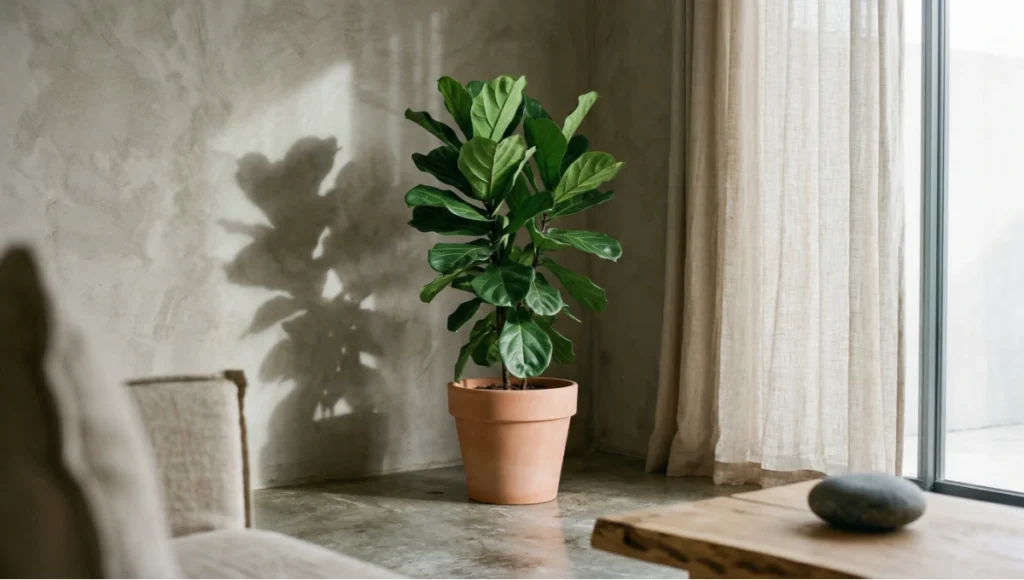
casting botanical shadow patterns on clay plaster wall, natural morning light,
reclaimed timber surface with river stone — neuroarchitecture-informed interior
by Nuvira Space
Phase 1 — Baseline Spatial Analysis (Free)
- Map your natural light: On a cloudy day and a sunny day, photograph your living room at 8am, 12pm, and 5pm. Where does light actually reach? Where are the shadow zones? This determines your plant placement and your primary sightline anchor.
- Identify your current dominant sightline: Sitting in your most-used position, what do you look at most? A blank wall? A television? A window? This is your primary biological anchor point and the first thing to address.
- Conduct a material audit: Identify every surface within arm’s reach of your primary seating. How many are synthetic vs. natural? The ratio tells you where your tactile biophilic deficit lies.
- Assess acoustic hardness: Clap once, sharply, in the center of your living room. If you hear a clear echo, your room lacks acoustic biophilia. Soft materials are the solution.
Phase 2 — High-Impact, Low-Cost Interventions ($0–$150)
- Reconfigure furniture to establish one prospect-and-refuge position backed by a wall with a clear sightline to a window or plant (cost: $0)
- Replace overhead-only lighting with at least two floor/table lamps at 2,700K, positioned below eye level (cost: $40–80)
- Add one large structural plant (Ficus lyrata, Strelitzia, Dracaena marginata) as the primary visual anchor in your main sightline (cost: $30–60)
- Introduce one natural-fiber textile in a primary tactile zone — a wool or jute rug under the main seating area (cost: $60–120)
Phase 3 — Material Depth Investment ($150–$500)
- Replace the primary coffee table or side table with a natural material version — reclaimed timber, marble, stone, or rattan (secondhand sourcing strongly recommended)
- Apply clay or lime plaster to one wall section — even a partial application (1.5m × 2m) introduces sufficient fractal texture to activate biophilic response
- Build a vertical plant display: 3 shelves at varied heights with 4–6 plants of different forms (trailing, structural, fine-leafed) creates canopy-layer complexity
- Install a tabletop water feature in the refuge corner — the acoustic and visual effect of moving water is disproportionately high relative to its cost ($45–80)
Comprehensive Technical FAQ
Q: Is biophilic living room design only for large spaces?
A: No. The physiological mechanisms that biophilic design activates function in small spaces as effectively as large ones. In fact, a compact living room benefits more from biophilic interventions because the increased material-to-air ratio means sensory engagement is more immediate. A 25m² living room with natural materials, layered plants, and circadian lighting will consistently outperform a 60m² room with synthetic surfaces and overhead fluorescent lighting on every biophilic metric.
Q: Can I achieve a biophilic living room design in a rental property?
A: Yes, with strategic constraints. Focus entirely on portable elements:
- Plants (all sizes, all quantities — no landlord approval required)
- Natural-fiber rugs to cover synthetic flooring
- Freestanding shelving for vertical complexity
- Table and floor lamps to replace overhead lighting dependency
- Natural material furniture (secondhand timber, rattan, cane) as investment pieces
Q: What are the most common mistakes people make when attempting biophilic living room design?
A: The four most frequent implementation errors:
- Treating biophilic design as a styling exercise rather than a physiological one — adding plants without addressing light or material quality
- Using synthetic materials in primary tactile zones while adding plant life — the tactile contradiction undermines the sensory coherence of the space
- Maintaining overhead lighting as the primary evening light source — this is the single highest-impact mistake and the easiest to fix
- Adding too many small plants rather than 2–3 structural statement specimens — visual complexity requires variation in scale, not quantity
Q: Which plants deliver the highest biophilic impact per dollar for a living room?
A: Ranked by combination of visual mass, air quality data (NASA Clean Air Study), and maintenance accessibility:
- Ficus lyrata (Fiddle Leaf Fig): Maximum visual impact, structural canopy form, responds well to indirect light — $30–60 for 90cm specimen
- Strelitzia reginae (Bird of Paradise): Architectural leaf form, slow-growing, low-maintenance — $25–50 for 60cm specimen
- Epipremnum aureum (Pothos): Trailing form creates vertical complexity; near-indestructible; highest air purification score per dollar — $8–15
- Ficus elastica (Rubber Plant): Dense, glossy foliage; high visual mass; thrives in lower light conditions — $20–40 for 70cm specimen
Q: Does biophilic design require natural daylight, or can it work in windowless or basement living rooms?
A: Biophilic living room design without natural light is significantly more challenging but not impossible. The approach shifts:
- Full-spectrum grow lights (5,000–6,500K, CRI 95+) positioned to supplement plant health and provide morning-equivalent light exposure
- Priority shifts to non-visual biophilic pathways: acoustic softness, thermal texture, olfactory biophilia (natural wood, dried botanicals)
- Water features become more important as the primary sensory movement element
- Clay or timber wall surfaces provide tactile and visual complexity that partially compensates for the absence of dynamic daylight
Q: How does the American Institute of Architects (AIA) approach biophilic design in residential projects?
A: The AIA’s Framework for Design Excellence includes biophilic principles as a key dimension of human-centered design. Their published guidance on integrating nature into built environments recommends measurable daylighting targets, material authenticity, and spatial variety as baseline design criteria. You can access their research documentation at aia.org/resources
Your Biophilic Living Room Design Starts With One Honest Question
Not ‘what does my living room look like?’ but ‘what does my living room do to me?’ That reframe is the beginning of every genuine biophilic living room design process. And it costs nothing.
Nuvira Space works with this question as its structural foundation. Every consultation, every spatial analysis, every material recommendation we make begins with an honest assessment of what a space is currently doing to its occupant — and what it should be doing instead. Biophilic living room design is not a finish line. It is a recalibration. And the most important recalibration is the one you can start today, in the room you already have, with the budget you already possess.
If you are ready to move from the theoretical to the architectural — to apply the frameworks in this article to a specific room, a specific budget, and a specific set of physiological goals — Nuvira Space offers spatial wellbeing consultations that begin exactly where this article ends. You may also want to read our broader guide on biophilic interior design for a wider-angle perspective on applying these principles across an entire home.
Start your biophilic living room design audit at nuviraspace.com
© Nuvira Space All rights reserved. | LIVING SPACES Series | All specifications cited are based on peer-reviewed environmental psychology research, neuroarchitecture studies, and biophilic design literature including work by Stephen Kellert, Rachel and Stephen Kaplan, and the WELL Building Standard technical documentation. Singapore HDB biophilic housing data referenced from the HDB Annual Report and National Parks Board Singapore Green Plan publications. Circadian lighting data referenced from the Journal of Clinical Endocrinology & Metabolism and the Illuminating Engineering Society. Rotterdam housing typology data referenced from the Municipality of Rotterdam Built Environment Report 2022.
The Project Canopy is a speculative internal concept study and does not represent a completed project.