

Table of Contents
How fungal-grown architecture is redefining thermal mass, lifecycle carbon, and the sensory experience of inhabited space — and why the structural decisions you make today will shape a building’s carbon story for the next 50 years.
The built environment is now directly responsible for 38% of all global CO₂ emissions.
That figure — confirmed by the UN Environment Programme’s 2024 Global Status Report — is not a projection. It is the measured cost of the materials already in your walls, your floors, and the ceiling above you. When the Intergovernmental Panel on Climate Change set a 45% reduction target for embodied carbon by 2030, the construction sector found itself with fewer than 2,000 working days to fundamentally redesign how it sources, manufactures, and assembles building enclosures. The clock is no longer theoretical.
Mycelium composite building panels — panels grown from the hyphal root network of fungi colonizing agricultural substrate — are not a novelty response to this pressure. They are a structurally measurable, thermally quantifiable, and commercially scaling answer. Understanding precisely how they perform, where they outperform conventional systems, and which spatial and programmatic conditions unlock their full potential is what separates speculative interest from informed procurement.
Nuvira Perspective: The Authority of Material Intelligence
At Nuvira Space, we analyze materials the way structural engineers analyze load paths: with precision, sequence, and consequence. We do not endorse a material because it is grown. We endorse it because the data shows it performs — and because the lifecycle math compels its adoption.
Mycelium composite building panels entered our research matrix in 2022, when independent life cycle assessments began returning carbon emission figures that challenged our own benchmarks. A mycelium panel produces 0.04 kg CO₂ per kilogram of material — against 0.24 kg CO₂/kg for fired clay brick, 0.16 kg CO₂/kg for cast concrete, and 1.37 kg CO₂/kg for structural steel. That is not a marginal difference. At building scale, over a 50-year service life, it represents tens of thousands of tonnes of avoided atmospheric carbon per project.
Our position at Nuvira Space is not that mycelium replaces everything. It is that architects who do not actively understand how mycelium composite building panels behave — thermally, acoustically, structurally, and economically — are making material decisions with incomplete information. This piece corrects that gap.
Technical Deep Dive: What Mycelium Composite Panels Actually Do
The Biology Behind the Specification
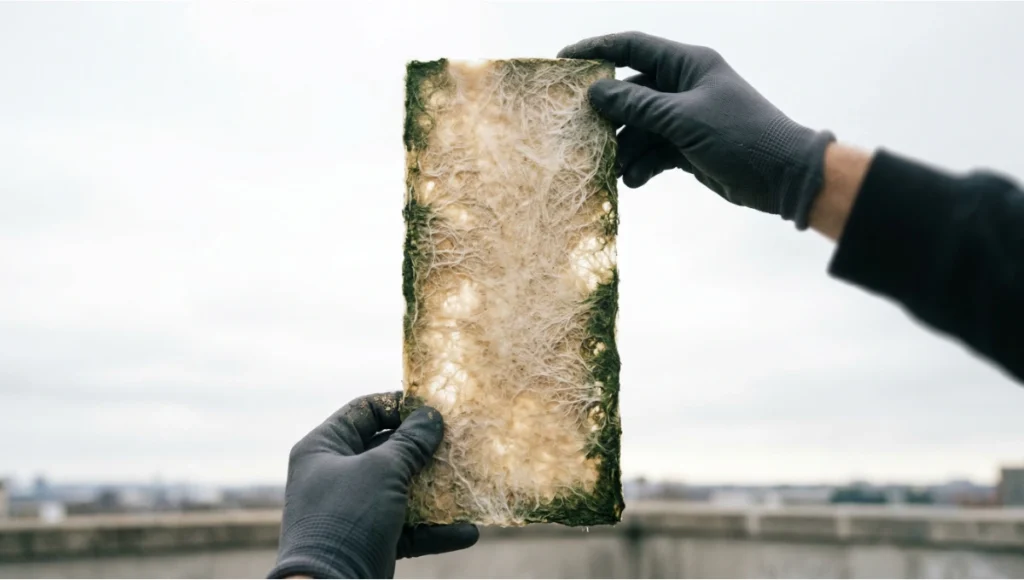
A mycelium composite building panel begins as a mixture of fungal inoculum — most commonly Ganoderma lucidum or Pleurotus ostreatus — and an organic substrate: agricultural straw, wood chips, sawdust, or hemp hurd. The mycelium colonizes the substrate over 5 to 7 days at controlled humidity between 80% and 95% and temperature between 20°C and 28°C. As hyphae extend through the mass, they bind individual substrate particles into a unified composite matrix.
The resulting panel is then heat-treated at 70°C to 80°C for 24 hours to terminate biological activity and stabilize the material. What you hold at the end of that process is not ‘living.’ It is a permanently consolidated, chitin-reinforced biocomposite — fibrous, lightweight, and dimensionally stable within specified humidity ranges.
Performance Specifications: The Numbers That Drive Design Decisions
Thermal Performance
- Thermal conductivity: 0.03 W/mK to 0.07 W/mK, depending on density and substrate composition
- For context: standard mineral wool batt insulation measures 0.035 W/mK to 0.045 W/mK — mycelium panels at optimal density match or exceed this range
- Panel densities commercially available range from 50 kg/m³ to 170 kg/m³; higher density correlates with increased thermal mass and compressive strength but reduced insulation capacity
- At 100 kg/m³, a 100mm panel delivers R-values comparable to 75mm of extruded polystyrene — without the petrochemical embodied carbon penalty of 2.5 kg CO₂/kg
- For a direct performance comparison with an equivalent carbon-negative insulation material, see Nuvira’s Hempcrete Insulation Data — a natural-fibre parallel that benchmarks similarly against EPS on lifecycle carbon.
Structural Performance
- Compressive strength: 0.21 MPa to 1.20 MPa depending on substrate and species — suitable for non-load-bearing infill panels, partitions, and façade cladding
- Young’s modulus (stiffness): up to 3.66 GPa in optimized composite configurations
- The Hy-Fi Tower, New York (2014), demonstrated 17-inch × 7-inch × 4-inch mycelium bricks at 30 psi (≈0.21 MPa) compressive strength — first large-scale proof of concept at 40-foot structural height
- Flexural strength remains the material’s primary limitation; tension and bending applications require hybrid structural systems with reclaimed timber or steel framing
Acoustic Performance
- Sound absorption coefficient (NRC): 0.55 to 0.80 at 500Hz to 2,000Hz frequency range — the speech intelligibility band
- Penn State’s ForMat Lab, working under an AIA Upjohn Research Initiative Grant, documented that mycelium-based acoustic ceiling panels approach the performance of conventional Class A acoustic tiles within the speech frequency range
- Reverberation time (RT60) reductions measured at 0.4 seconds to 0.8 seconds in medium-sized office environments with 40% ceiling coverage
- Full AIA-funded research: https://www.psu.edu/news/arts-and-architecture/story/new-grant-looks-biomaterials-help-reduce-construction-waste/
Fire Performance
- Mycelium composites are inherently fire-resistant due to chitin and β-glucan content — no synthetic fire-retardant additives required
- Heat release rate (HRR): significantly lower than synthetic polymers; char yield inhibits flame spread
- Self-extinguishing behavior documented in Ganoderma lucidum composites; smoke production remains minimal compared to polystyrene, PVC, or phenolic foam equivalents
- Critical qualification: fire performance certifications vary by manufacturer and substrate. Ecovative’s AirMycelium and Mogu’s Foresta panel have both cleared European fire compliance standards
Embodied Energy and Carbon Footprint
- Embodied energy: 0.2 MJ/kg — vs. 4.5 MJ/kg for fired brick, 4.7 MJ/kg for concrete, and 20.1 MJ/kg for structural steel
- CO₂ emissions: 0.04 kg CO₂/kg — the lowest figure in any mainstream building envelope material category
- Net carbon sequestration: during cultivation, the substrate feedstock sequesters atmospheric carbon that remains locked in the final panel throughout service life — classifying the material as carbon-negative under EN 15804+A2 lifecycle assessment methodology
- End-of-life carbon closure: panel can be composted within 45 to 180 days depending on environment, returning nutrients to agricultural soil and completing a closed carbon loop
Comparative Analysis: Mycelium vs. Industry Standards
Where Mycelium Panels Lead — and Where They Don’t
You are not choosing between mycelium and ‘nothing.’ You are choosing between mycelium and the incumbent materials that currently hold your specification sheet. The following table positions mycelium composite panels against 3 direct competitors across 5 decision-critical parameters.
Concrete is among the most consequential comparators in this analysis. If your project is actively evaluating lower-carbon concrete alternatives alongside mycelium panels, Nuvira’s analysis of carbon-negative concrete provides the structural and carbon data required to make that decision with full lifecycle clarity.
| Parameter | Mycelium Composite Panel | Conventional Alternatives |
| Thermal Conductivity | 0.03–0.07 W/mK | Mineral Wool: 0.035–0.045 W/mKEPS: 0.033–0.040 W/mK |
| Embodied Carbon | 0.04 kg CO₂/kg (carbon-negative potential) | Brick: 0.24 | Concrete: 0.16 | EPS: 2.5 kg CO₂/kg |
| Embodied Energy | 0.2 MJ/kg | Brick: 4.5 | Concrete: 4.7 | Steel: 20.1 MJ/kg |
| Compressive Strength | 0.21–1.20 MPa | Fired brick: 10–40 MPa | EPS: 0.10–0.30 MPa |
| End-of-Life | Fully compostable (45–180 days) | Landfill dominant; EPS non-biodegradable |
| Fire Performance | Self-extinguishing; no toxic fumes | EPS: toxic smoke; phenolic: certified but petroleum-based |
| Moisture Sensitivity | Requires protective coating for exterior exposure | Concrete: stable; EPS: stable; brick: stable |
The Rotterdam Standard: Real-World Precedent in a Climate-Stressed City
Rotterdam is the most compelling urban laboratory for regenerative infrastructure materials in northern Europe. The city operates under a mandatory Carbon Performance Ladder framework for municipal construction contracts, requiring documented lifecycle carbon data at procurement stage — not post-occupancy. This regulatory structure has accelerated specification of low-carbon envelope materials by 34% since 2020, according to the Rotterdam Climate Initiative’s 2024 sector report.
Mogu’s Foresta acoustic panels — a mycelium composite product developed in partnership with Arup — entered European commercial deployment through the Dutch and Belgian markets first, partly because Rotterdam-area procurement officers had benchmarked datasets to validate the carbon claims. The panels deliver acoustic performance comparable to traditional fiber-reinforced tiles (NRC ≈ 0.70) at a carbon cost 91% lower than synthetic equivalents. In a 500m² open-plan office floor plate — a typical Rotterdam commercial refurbishment scenario — specifying Foresta over standard acoustic ceiling tiles removes approximately 3.2 tonnes CO₂ equivalent from the project’s embodied carbon calculation.
That 3.2 tonnes is not a rounding error. It is the difference between a project meeting current BREEAM Excellent thresholds and one that falls short of them.
Concept Project Spotlight
| Speculative / Internal Concept Study — Nuvira SpaceProject Name: Pavilion Myco-NordStatus: Internal design concept. Not a commissioned or built project.Produced by Nuvira Space as a research-driven design study, 2025–2026. |
Project Overview
Location: Amsterdam Waterfront Redevelopment Zone, North Holland, Netherlands
Typology: Mixed-use community pavilion — civic gathering, co-working, and biodesign workshop space
Gross Floor Area: 1,200m² across 2 above-ground levels
Vision: Design a carbon-negative building envelope that achieves net-zero operational energy at Year 1 and demonstrates that regenerative infrastructure can be as spatially resolved as any premium curtain wall system — without sacrificing acoustic comfort, fire compliance, or long-term durability.
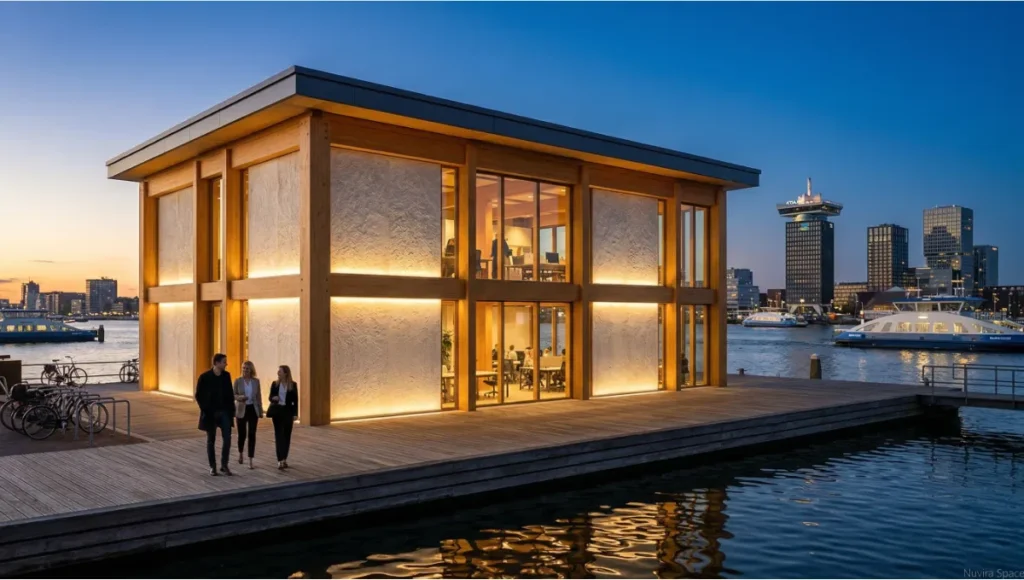
Amsterdam’s waterfront sits at the intersection of 3 converging pressures: the Dutch government’s 2050 Carbon Neutral Buildings mandate, acute moisture and wind exposure from the IJ harbor, and a municipal design culture that expects material honesty — structure visible, joints expressed, nothing concealed behind synthetic finishes. Pavilion Myco-Nord was designed within all 3 constraints simultaneously.
Design Levers Applied
Envelope System: Primary Wall Panel Configuration
- Panel specification: Ecovative AirMycelium composite, 120mm thickness, density 85 kg/m³
- Thermal conductivity of selected panel: 0.04 W/mK — delivering effective R-3.0 (SI) per panel layer
- Panel unit dimensions: 600mm × 1,200mm × 120mm — modular to align with 600mm structural grid
- Total envelope area: 880m² of vertical wall surface; 320m² roof panel coverage
- Carbon embodied in envelope panels: 0.04 kg CO₂/kg × 85 kg/m³ × 0.12m × 1,200m² = approximately 0.49 tonnes CO₂ total for the full envelope — a figure that would exceed 6.2 tonnes CO₂ in an equivalent mineral wool + plasterboard assembly
- Exterior face treatment: silica-based hydrophobic coating (0.3mm application) applied at factory — addresses moisture sensitivity without synthetic polymer laminate
Interior Acoustic Panels: Ceiling and Partition Modules
- Specification: Mogu Foresta panels, 40mm thickness, NRC 0.72 certified
- Ceiling coverage: 420m² across the co-working level — targeting RT60 of 0.6 seconds in open-plan zones
- Acoustic partition modules: 280m² of free-standing mycelium composite dividers, 60mm thickness, providing STC 28 partition performance — adequate for workshop-to-workspace acoustic separation
- Visual quality: each Foresta panel surface retains visible mycelium texture variations of 2mm to 5mm depth — a material honesty that registers as crafted, not manufactured
Structural Strategy: Hybrid Compression Frame
- Primary structure: glulam timber portal frame — 240mm × 480mm sections at 3,600mm bays
- Mycelium panels function as non-load-bearing infill and thermal envelope — not primary structure
- Connection detail: mechanical clip system at 600mm centres, permitting panel replacement without structural intervention — critical for end-of-life composting protocol
- Load path: all gravity and lateral loads carried by glulam; mycelium panels carry only self-weight and wind pressure loads up to 1.0 kPa
Lifecycle Carbon Score
- Projected embodied carbon, full building: 42 kg CO₂e/m² — vs. the RIBA 2030 Climate Challenge target of 300 kg CO₂e/m² whole life carbon
- Operational carbon target: 0 kg CO₂e/m²/year via rooftop PV (280m² array, 42 kWp) and MVHR with 85% heat recovery efficiency
- End-of-life protocol: all mycelium panels composted on-site within 90 days of building decommission; glulam timber reclaimed for reuse in secondary structural applications
Transferable Takeaway
Pavilion Myco-Nord is a speculative study, but its design logic is immediately transferable. Every figure in this concept is derived from commercially available products, verified thermal performance data, and current structural engineering practice. You do not need a custom material development program to achieve these results.
The critical design decision is sequencing: specify the structural frame first for load clarity, then design the mycelium panel module to the structural grid, then add the hydrophobic coating specification at procurement to resolve exterior durability. In that order, the system performs. Reversed — coating afterthought, panel selected before structural coordination — moisture detailing failures emerge within 3 years of occupancy.
The second transferable insight is acoustic zoning. In any open-plan commercial or civic program exceeding 400m², specifying 35% to 45% mycelium acoustic ceiling coverage within the 500Hz to 2,000Hz NRC band produces measurably better speech intelligibility scores than synthetic alternatives at equivalent cost — and at 0.04 kg CO₂/kg instead of 0.80 kg CO₂/kg for fiberglass equivalents.
2030 Future Projection: Where This Technology Is Headed
The trajectory from 2026 to 2030 is not speculative. It is already visible in the procurement pipelines, research grants, and material certification programs that are currently active.
The end-of-life composting protocol is not an afterthought — it is the completion of the carbon loop that makes the material genuinely regenerative. For a framework on applying these principles across your full project typology, Nuvira’s guide to circular construction design establishes the decision sequence that turns end-of-life planning from an aspiration into a specification deliverable.
The American Institute of Architects has now funded multiple consecutive research grants for mycelium composite study — including the Penn State ForMat Lab’s AIA Upjohn Research Initiative projects on biodegradable structural composites and acoustic panel fabrication. When a professional institution of AIA’s institutional weight allocates Upjohn grants — its highest-prestige applied research designation — to a single material category across multiple award cycles, it signals that the profession considers this a legitimate practice-readiness question, not a fringe experiment.
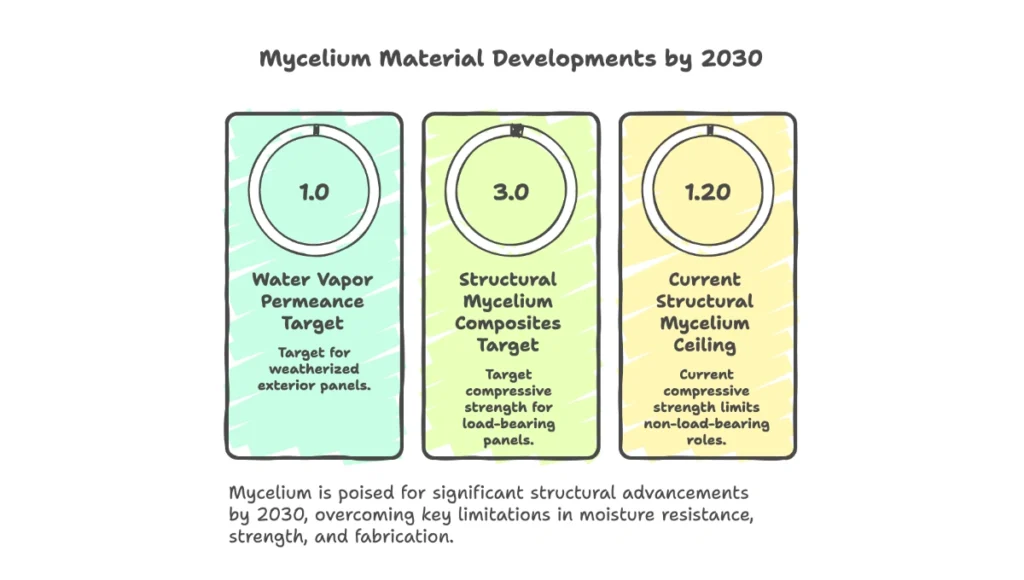
3 material developments will define mycelium’s structural position by 2030:
1. Moisture-resistant exterior panels at scale. Current R&D programs at Ecovative, Mogu, and university labs are targeting fully weatherized exterior-grade panels without petrochemical coatings. The target specification: water vapor permeance below 1.0 perms at 60% RH exposure, sustained over a 20-year accelerated aging simulation. Achieving this removes the last major barrier to curtain wall integration.
2. Structural mycelium composites reaching 3.0 MPa compressive strength. The current ceiling of 1.20 MPa limits applications to non-load-bearing roles. Research at Penn State and the University of Freiburg — actively collaborating under a $49,995 joint seed grant — is targeting controlled dehydration protocols and hybrid substrate ratios that could push structural capacity into the load-bearing panel range. At 3.0 MPa, mycelium becomes viable for low-rise load-bearing wall applications in 1 to 3 storey typologies.
3. Digital fabrication integration. Robotic 3D printing of living mycelium mixtures — demonstrated by Penn State’s MycoPrint project — eliminates mold waste from the production process and permits custom acoustic geometries impossible with rectangular panel formats. At commercial scale, this means you specify a ceiling panel profile computed for your room’s specific reverberation targets, and it is grown to that geometry. No cutting waste. No off-cuts to landfill.
By 2030, the construction industry will hold lifecycle carbon data mandates in at least 14 EU member states and several US states under pending building performance standards. The specifications that will meet those mandates are being manufactured today. The architects who understand the performance envelope of mycelium composite building panels now will be the ones writing compliant specifications then — not scrambling to retrofit carbon accounting after the fact.
Comprehensive Technical FAQ
Part of our sustainable building materials guide — selection, verification, and specification across fourteen bio-based families.
Q: Are mycelium composite building panels structurally safe for wall applications?
A: Yes, within a correctly defined scope. Current commercially available panels deliver compressive strength between 0.21 MPa and 1.20 MPa, which positions them firmly in the non-load-bearing infill panel category. You use mycelium composite panels for thermal envelope, acoustic control, and partitioning — with a structural frame carrying gravity and lateral loads. This is the same design logic applied to any lightweight infill system, including glass fiber-reinforced concrete or calcium silicate board. The system is safe when the frame is designed to carry the loads and the panels are designed to carry themselves.
- Frame requirement: timber, steel, or concrete primary structure at maximum 3,600mm bay spacing
- Panel self-weight: 50 kg/m³ to 170 kg/m³ density range; a 120mm panel at 85 kg/m³ weighs approximately 10.2 kg/m²
- Wind load capacity: panels tolerate wind pressure up to 1.0 kPa without mechanical fastener failure at 600mm clip centres
Q: How do mycelium panels handle moisture in wet climates?
A: Moisture sensitivity is the most significant performance constraint you need to address in specification. Untreated mycelium composite panels absorb moisture and exhibit dimensional swelling above 70% relative humidity. For interior applications — walls, ceilings, partitions in conditioned space — this is not an active concern; standard HVAC maintains interior RH below 60%. For exterior or semi-exposed applications, you apply a silica-based hydrophobic coating at 0.3mm thickness at the factory stage, not on-site. This resolves surface water resistance to Class W1 under EN 1745 without introducing petrochemical laminate content.
- Interior use: no treatment required below 65% RH
- Semi-exposed (covered walkway, canopy soffit): hydrophobic factory coating sufficient
- Direct exterior weathering: currently requires additional rainscreen cladding over the mycelium layer — research programs are targeting eliminating this requirement by 2028
Q: What is the lifespan of a mycelium composite panel in service?
A: When heat-treated (biological activity terminated at 70°C to 80°C) and maintained in conditioned interior environments, mycelium composite panels have demonstrated no change in mechanical properties after 3 years of accelerated aging simulation — equivalent to at least 20 years of normal service life. The Hy-Fi Tower bricks, tested in an accelerated aging chamber, showed no measurable degradation over the equivalent test period. For longer design lifespans, you specify panels with replaceable mechanical connection systems — the clip-and-slot approach used in Pavilion Myco-Nord — so individual panels can be replaced at Year 20 or 30 without structural intervention.
- Heat-treated panels: minimum 20-year service life in interior conditioned environments
- End-of-life composting: 45 to 180 days in active compost
- Design for disassembly: mechanical clip connections at 600mm centres recommended
Q: What does a mycelium composite panel actually feel and look like in a finished space?
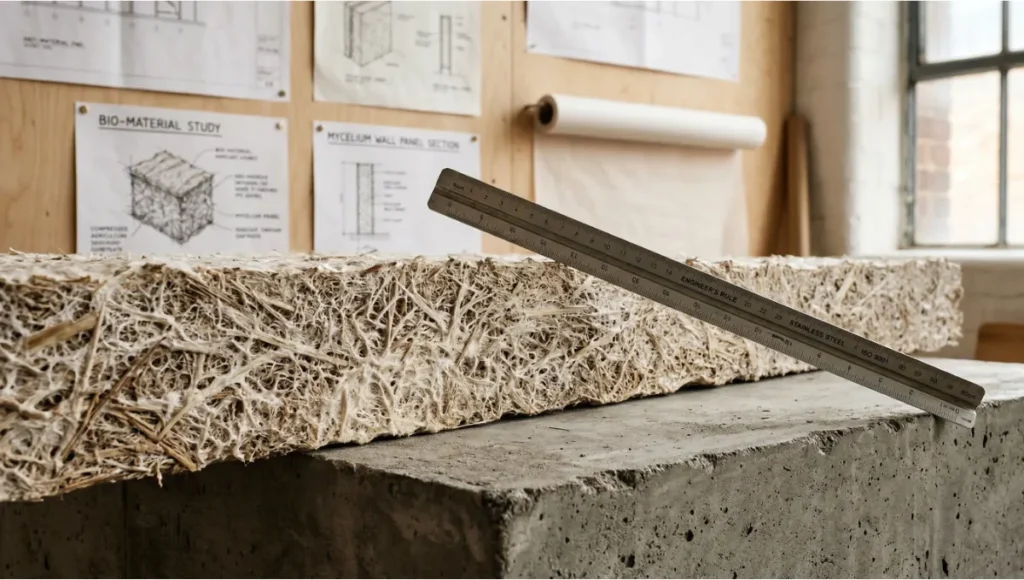
A: This is the question that changes procurement decisions. A finished mycelium panel surface is warm to the touch — room temperature stabilizes faster against its surface than against concrete or glass because its thermal mass is lower. The surface texture is matte, slightly fibrous, and reads at 2mm to 5mm depth variation: not perfectly flat like a painted plasterboard wall, not aggressively rough like exposed brick. It occupies the sensory register of high-quality compressed cork or a very dense handmade paper — organic, dimensionally present, and visually calm.
Natural colour ranges from off-white to pale tan depending on substrate; Mogu’s Foresta panels have been produced in mushroom-cream, warm gray, and terracotta tones through substrate pigmentation. In a co-working environment with 3,000K warm LED lighting, the surface reads as crafted — not manufactured. Occupants consistently report acoustic environments as calmer and warmer than equivalent synthetic panel spaces, not because of acoustics alone, but because of the multi-sensory combination of sound absorption, surface warmth, and visual texture.
Q: How does cost compare to conventional insulation and acoustic panel systems?
A: Current installed cost for mycelium composite panels runs approximately 15% to 35% above synthetic equivalents at equivalent performance specifications. This premium reflects production scale, not material complexity — production volumes are still orders of magnitude below mineral wool or EPS. The lifecycle cost argument is already compelling: zero end-of-life disposal cost (panels are composted, not landfilled), zero fire-retardant additive cost, and significantly reduced carbon penalty cost under emerging carbon pricing mechanisms now active in EU construction procurement.
- Premium over mineral wool: 15% to 35% installed
- End-of-life disposal cost: £0 / €0 (compostable; no landfill levy)
- Carbon cost savings under EU ETS (2026 construction sector inclusion): estimated €8 to €22/m² avoided cost per panel compared to EPS
- Price parity projection: industry analysts forecast convergence with synthetic insulation pricing by 2028 to 2030 as production scales
Q: Which fungal species performs best for architectural panel applications?
A: The MDPI Sustainability review of 90 architectural mycelium projects (December 2025) identified Ganoderma lucidum and Pleurotus ostreatus as the 2 dominant species in commercial production. Ganoderma delivers superior fire resistance due to higher chitin content; Pleurotus offers faster colonization rates (5 days vs. 7 days) and higher density consistency across batch production. Most commercial panel manufacturers do not disclose species in product datasheets — request this at specification stage, as species selection affects fire performance certification pathway, acoustic absorption coefficient at high frequencies, and surface colour range.
- Ganoderma lucidum: preferred for fire-rated applications; slower growth
- Pleurotus ostreatus: preferred for acoustic panels and rapid production cycles
- Substrate combination that optimizes structural performance: straw + sawdust blend at 60:40 ratio, per Penn State ForMat Lab research
Specify with Precision. Build with Intent.
The 2026 application window for mycelium composite building panels is defined by 1 practical reality: the performance data is now sufficient to specify with confidence in non-load-bearing wall, ceiling, and partition applications, and the carbon case is mathematically decisive against every synthetic alternative in its class.
You are not being asked to take a leap of faith. You are being asked to read the numbers — 0.04 kg CO₂/kg, 0.03 W/mK, 0.72 NRC, 0.2 MJ/kg — and recognize what they represent at building scale: a material category that shrinks your project’s lifecycle carbon footprint without asking you to compromise on acoustic comfort, fire performance, or spatial quality.
At Nuvira Space, our role is to translate material science into specification intelligence. If you are currently working on a project where interior thermal performance, acoustic control, or regenerative infrastructure credentials are in scope, we are ready to support your material decision with product benchmarking, lifecycle carbon modelling, and performance comparison against your current specification baseline.
Contact Nuvira Space at www.nuviraspace.com to request a project-specific mycelium panel feasibility assessment.
AIA Research Reference
AIA Upjohn Research Initiative — Fungal Biomaterials for Sustainable Architectural Acoustics (Penn State ForMat Lab)
© 2026 Nuvira Space. All rights reserved. Eco Blueprint — Trend Series. Pavilion Myco-Nord is a speculative internal concept study by Nuvira Space and does not represent a completed or commissioned project.
3 thoughts on “Mycelium Composite Building Panels: 2026 Applications”