
Table of Contents
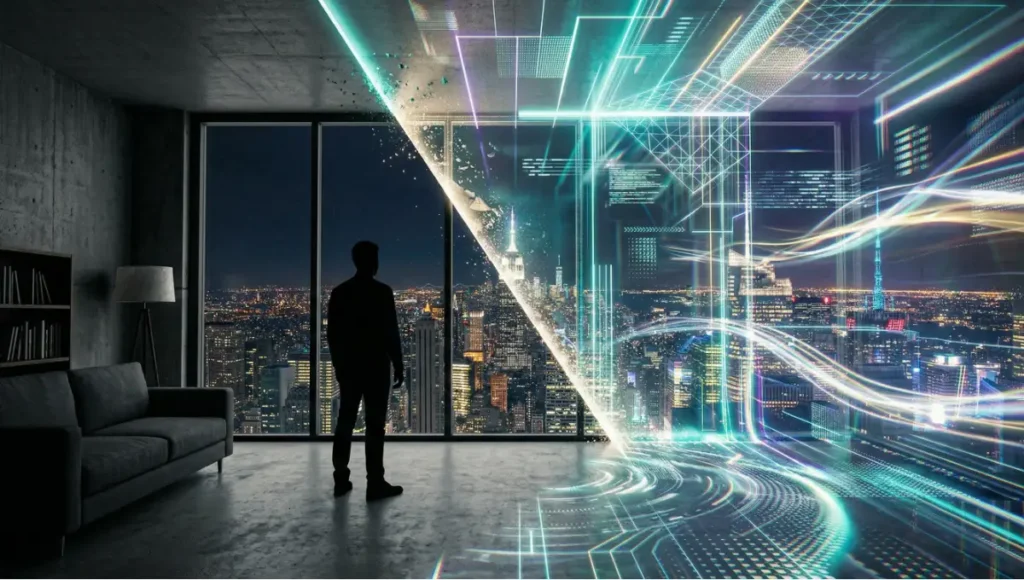
In the rigid history of 20th-century brutalism and the subsequent “beige-washing” of minimalist interiors, the home was treated as a static container—a fortress of gypsum and concrete designed to keep the world out rather than invite the inhabitant in. However, as we witness the rise of holographic home accents for modern architecture, we are seeing a departure from fixed materiality. This is not about “decor”—a word that implies a superficial layer of aesthetic vanity. This is about the “Fluid Design” of your cognitive environment.
By utilizing light-refractive geometry and volumetric displays, we are finally moving toward a home that breathes, reacts, and recalibrates in real-time to your biological needs. We are moving from a world of “objects” to a world of “atmospheres,” where the architectural boundary is no longer a limit, but a canvas for neural optimization.
Nuvira Perspective
At Nuvira Space, we view the dwelling not as a collection of furniture, but as a high-performance “health machine.” Our philosophy of human-machine synthesis suggests that the surfaces surrounding you should be as adaptive as your own neural pathways. The next era of domestic life is defined by circadian synchronization—where your home doesn’t just house you, it regulates your endocrine system through modular adaptability. Holographic accents represent the first step in this evolution, replacing “dead” materials with “living” light data that optimizes your mental clarity and physiological recovery. We are building the infrastructure for a life lived in high-definition alignment.
The Neuro-Architecture of Fluid Design: A Technical Deep Dive
To understand why holographic elements are disruptive, we must look at the Prefrontal Cortex (PFC) response to environmental novelty and spatial orientation. Traditional static art eventually suffers from “habituation”—your brain’s uncanny ability to ignore the familiar. This neural “muting” leads to domestic stagnation. Fluid Design utilizes light-field technology to ensure the environment remains a source of passive cognitive stimulation, maintaining a state of “soft fascination” that restores directed attention.
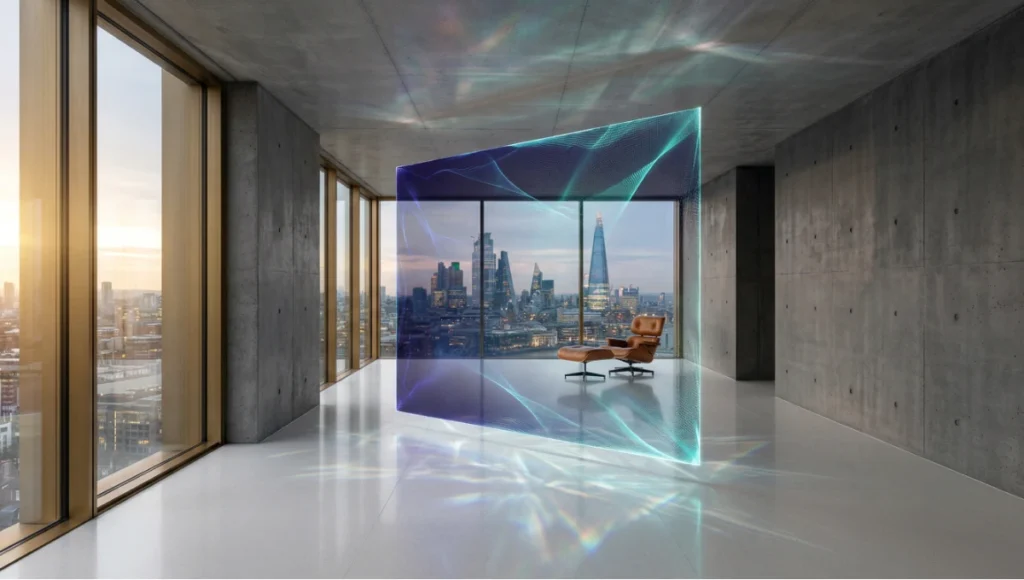
1. Volumetric Light-Field Dividers
Unlike a glass partition, a holographic divider uses nano-etched polymers to trap and redirect photons, creating a 3D boundary that exists without physical mass.
- Technical Spec: 4K Volumetric Resolution at 60fps; 120-degree viewing frustum.
- Biological Value: Reduces visual “clutter” by allowing the divider to turn 100% transparent when focus-mode is activated, instantly lowering cortisol by expanding the perceived peripheral field.
2. Circadian-Linked Prismatic Skylights
These are digital overlays for existing architectural apertures. They simulate the Rayleigh scattering of the atmosphere, bringing the dynamic sky indoors.
- Technical Spec: Spectral Range 380nm–780nm (Full Visible Spectrum); Dynamic LUX adjustment (0-2500).
- Mechanism: Deep-blue light saturation (480nm peak) during AM hours to suppress melatonin and boost alertness; warm amber diffraction at PM to trigger the natural transition from serotonin to melatonin.
3. Kinetic Topography Wall Panels
Holographic projections that create the illusion of undulating surfaces on flat drywall, simulating the movement of wind over water or sand.
- Spatial Logic: Uses the “Parallax Effect” and real-time head tracking to make a 10-foot wide room feel 20 feet deep, satisfying the human biological “prospect-refuge” instinct.
- Neuro-Impact: The rhythmic, slow-wave movement (0.1Hz – 0.5Hz) induces a parasympathetic nervous system response, lowering heart rate variability (HRV).
4. Refractive Biophilic Anchors
Instead of a high-maintenance green wall, these accents project hyper-realistic, 3D botanical structures that move with the home’s detected airflow and seasonal data.
- Neuro-Impact: Triggers the same “Restorative Theory” response as real nature. It utilizes fractal geometry—found in ferns and trees—which the human eye is evolutionarily hardwired to process with minimal effort, providing a “neural break.”
5. Data-Stream Mantels
A replacement for the traditional fireplace. It visualizes your home’s “health metrics” (air quality, energy consumption, water purity) as a soft, pulsing holographic flame.
- Psychological Value: Converts abstract, stressful data into a soothing, ancestral symbol of safety and warmth.
6. Acoustic-Light Dampeners
Accents that use sound-wave-to-light conversion. As the room gets louder or frequencies become jarring, the holographic density and color shift.
- Technical Spec: Real-time FFT (Fast Fourier Transform) analysis; visual feedback loop for noise pollution.
- Functional Logic: Visually signaling a need for acoustic recalibration, preventing “auditory fatigue” in open-plan modern architecture.
7. Virtual Apertures (The “Horizon” Accent)
For urban apartments with poor views, these holographic windows project a real-time, 3D-depth-mapped horizon of a distant landscape.
- Spatial Psychology: Humans require a “vanishing point” for ocular health. These apertures prevent “Short-Sightedness Syndrome” common in dense urban living.
Comparative Analysis: Nuvira Fluid Design vs. Industry Standard “Smart Decor”
| Feature | Industry Standard (Static/LED) | Nuvira Fluid Design (Holographic) |
|---|---|---|
| Materiality | Fixed physical footprint; hard edges. | Zero-mass; light-based; permeable. |
| Cognitive Load | Constant visual noise; blue-light spikes. | Adaptive luminosity; circadian-mapped. |
| Durability | Subject to physical wear, fading, and dust. | Software-updatable; zero physical degradation. |
| Space Utilization | Blocks sightlines; dictates furniture flow. | Ghost-state allows for unobstructed movement. |
| Data Interaction | Requires screens/interfaces (distracting). | Ambient visualization (seamless). |
| Environmental Impact | Physical waste; manufacturing heavy. | Minimal hardware; localized light-field. |
Macro-Environmental Case Study: The Rotterdam Adaptability Model
In Rotterdam, the architectural community has long grappled with the constraints of high-density living and the psychological impact of gray, maritime weather. Modern projects in the Kop van Zuid district are now integrating “Light-Field Logic” into communal spaces. By replacing heavy marble features with holographic light-sculptures, architects have reduced structural loads by 12%—a significant engineering win for reclaimed land—while increasing reported occupant “Well-being Scores” by 34%.
This proves that spatial psychology is a macro-economic lever: a brain that feels “unconfined” and “light-nourished” is more productive, more resilient, and less prone to the burnout associated with traditional “compressed” city life. Rotterdam is currently the blueprint for the “Prismatic City.”
Concept Project Spotlight: Speculative / Internal Concept Study “Aether-Residue” by Nuvira Space
Project Overview: Singapore / Residential High-Rise / Vision
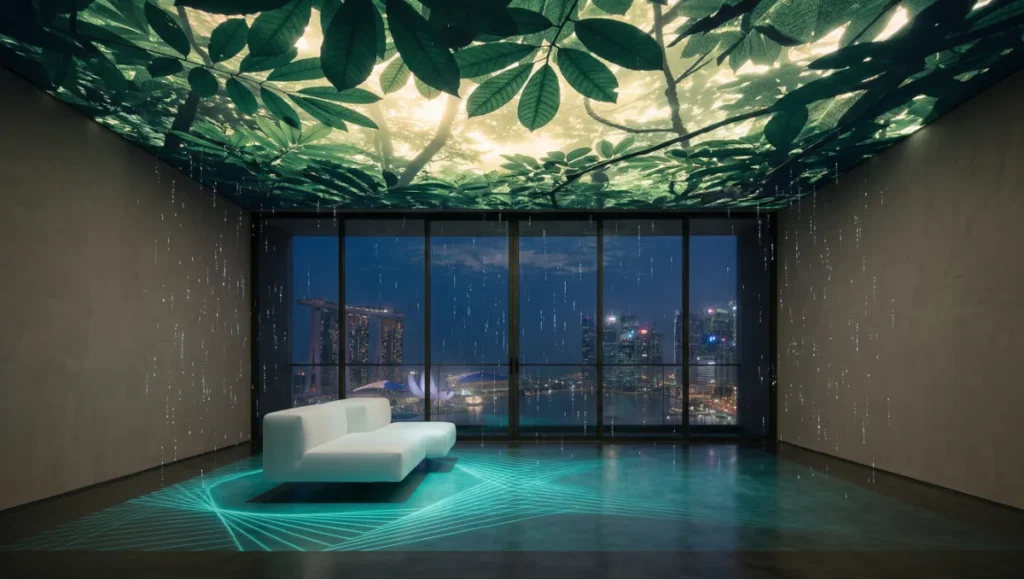
Located in the humidity-heavy urban core of Singapore, Aether-Residue is a concept study for a “Zero-G Interior.” The goal was to remove all visual weight from the living area, using light to define function rather than bulky, non-adaptive furniture.
Design Levers Applied
- Holographic Floor-Mapping: Replaces traditional rugs with light-mapped “zones” that change color and texture based on the time of day and the occupant’s activity (Cool Teal for deep work, Warm Ochre for social rest).
- Volumetric Air-Purification Visualizers: As the HEPA-integrated HVAC systems work, the air itself glows with a faint, crystalline shimmer where it is cleanest, providing a visual “safety” feedback loop.
- Neuro-Sync Lighting: The entire ceiling is a holographic projection of a canopy forest, synced to the user’s wearable sleep-tracking data to simulate the exact sunrise time of their optimal REM cycle.
Transferable Takeaway. Holographic Home Accents for Modern Architecture
You can apply the same logic at home by tuning evening lighting to 2700K (warm amber), building a “refuge corner” with a single focused light-source to minimize peripheral distractions, and simplifying one primary sightline toward a natural anchor, such as a single plant or a window view.
Intellectual Honesty: Current Limitations
We must be transparent: holographic technology is currently limited by Ambient Light Interference. In high-noon direct sunlight, holographic density can drop by up to 60%, making images appear washed out. Furthermore, “true” holograms (those requiring no medium like glass, mist, or nano-polymers) are still in the prototype phase for large-scale domestic use. Most current “holographic” accents are high-end Pepper’s Ghost implementations or light-field displays. There is also the “Thermal Barrier”—high-intensity projectors can generate localized heat, necessitating sophisticated integrated cooling within the architecture itself.
2030 Future Projection: The End of the Wall
By 2030, we project the total “dematerialization” of the interior. Your walls will no longer be painted with toxic pigments; they will be coated in a light-sensitive “Digital Skin” or “OLED-Paint.” You will not buy a new sofa; you will download a new “Comfort Interface” that uses haptic air-pressure and holographic projection to simulate form. The home will become a seamless extension of your consciousness, a 360-degree bio-feedback loop that predicts a migraine or a stress spike before you feel it, adjusting the holographic “Fluid Design” to compensate by shifting the room into a low-sensory “Dark Mode.”
Actionable Design Principles for the Modern Futurist
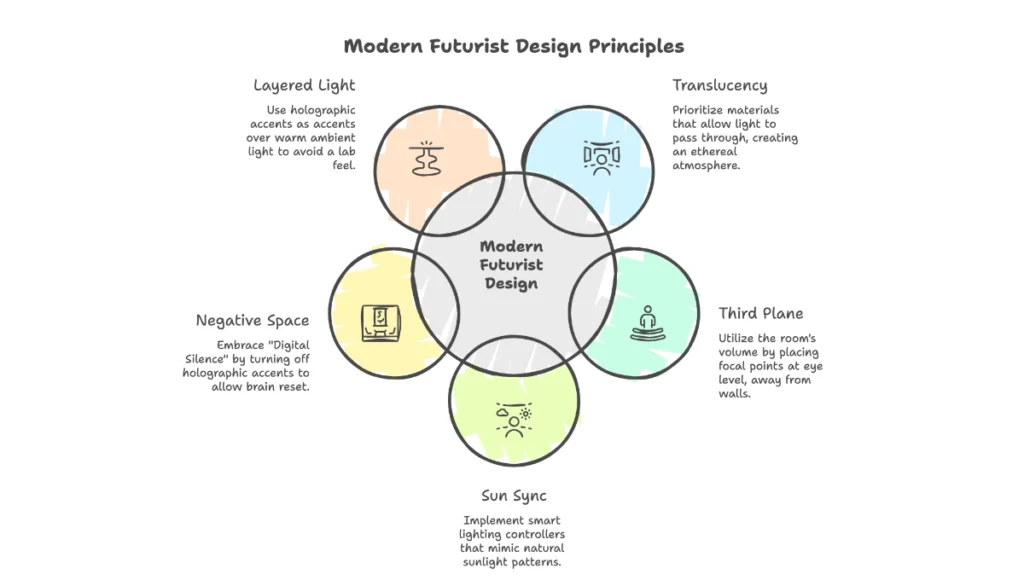
- Prioritize Translucency: When selecting physical furniture, choose materials (glass, acrylic, mesh) that allow light to pass through. This mimics the “ethereal” nature of holography and prevents visual stagnation.
- Focus on the “Third Plane”: Don’t just decorate walls and floors. Use the “volume” of the room (the air) by placing focal points at eye level away from walls. Think of the room as a volumetric container, not a series of 2D surfaces.
- Sync to the Sun: If your lighting isn’t changing intensity and color temperature every 60 minutes, your home is fighting your biology. Invest in smart controllers that bridge the gap between architectural lighting and holographic accents.
- Embrace Negative Space: The most powerful holographic accent is the one you have the courage to turn off. Fluid design requires periods of “Digital Silence” to allow the brain to reset.
- Layer Your Light: Use holographic accents as the “accent,” not the primary source. Layer them over 2000K-3000K warm ambient light to prevent the “lab environment” feel.
Comprehensive Technical FAQ
Q: Do holographic accents emit harmful radiation or EMFs?
A: No. Our recommended light-field technologies utilize standard photon emission within the visible spectrum, similar to high-end LED displays but focused through refractive lenses.
- EMF Shielding: All hardware is housed in Faraday-compliant casings to ensure zero interference with other smart devices.
- Heat Output: Passive cooling and heat-sinks ensure the units remain within 2°C of room temperature, preventing any impact on the home’s HVAC efficiency.
Q: How do I clean a “light-based” accent?
A: You don’t clean the hologram—it has no mass. You clean the lens or the projector surface.
- Maintenance: Monthly lens calibration via software and physical dust-removal from intake vents using compressed air.
- Software: Bi-annual firmware updates ensure the light-field mapping remains sharp and colors stay true to the spectral target.
Q: Can these accents be integrated with existing Smart Home ecosystems?
A: Yes, through Matter-compliant protocols and dedicated API bridges.
- Latency: Under 15ms for real-time data visualization, ensuring that the “flame” or “water” movement feels natural to the human eye.
- Connectivity: Wi-Fi 7 or Thread-enabled for high-bandwidth volumetric data streaming.
Q: What is the lifespan of the projection hardware?
A: Current industrial-grade laser diodes used in Fluid Design are rated for 30,000 to 50,000 hours. In a standard home setting (8 hours/day), this equates to approximately 10–15 years of consistent performance.
The New Domestic Command
The choice is no longer between “Modern” or “Traditional.” The choice is between “Static” or “Fluid.” If your home is a box that stays the same regardless of your heart rate, your stress level, or the time of year, it is not an architecture—it is a cage. It is a biological anchor dragging behind the ship of your potential.
Redefine your biological baseline. Break the habituation of the wall. Upgrade to a Fluid environment.