

Table of Contents
Sponge cities explanation: To understand the future of urban resilience, one must first confront the absolute failure of the “Hard City.” As the climate shifts, the traditional architectural paradigm of shunting water away through concrete pipes has become a liability. We must pivot toward a systemic porosity where the metropolitan fabric itself acts as a living filter.
Key Takeaways
- Systemic Porosity: Moving beyond “drainage” to “absorption” as a primary urban defense mechanism.
- Decentralized Infrastructure: Distributing water storage across the metropolitan fabric rather than relying on singular, failing mega-structures.
- Social Permeability: Using resilient water infrastructure to create high-value, multi-functional public spaces.
- Biophilic Synthesis: Integrating natural hydrological cycles into the data-driven “Smart City” stack.
- Economic Resilience: Transitioning from reactive flood damage costs to proactive asset appreciation through blue-green design.
At Nuvira Space
At Nuvira Space, we view the city not as a static collection of concrete assets, but as a living, breathing metabolic system. We operate at the intersection of human-machine synthesis, where data-driven design recalibrates the metropolitan fabric to withstand the volatile climate shifts of the Anthropocene. Our authority is rooted in the belief that the “smart city” is a failed concept if it remains dehydrated; true intelligence lies in a city’s ability to mimic the hydrological wisdom of the earth itself.
The Macro-Observation: Dystopia by Design
You are walking through a graveyard of mid-century hubris. Every asphalt street, every non-porous sidewalk, and every concrete embankment in your current city is a design flaw waiting to be exploited by a single heavy rainfall. This is the dystopian reality of the “Hard City”—a rigid, brittle shell that treats water as an enemy to be exiled rather than a resource to be integrated.
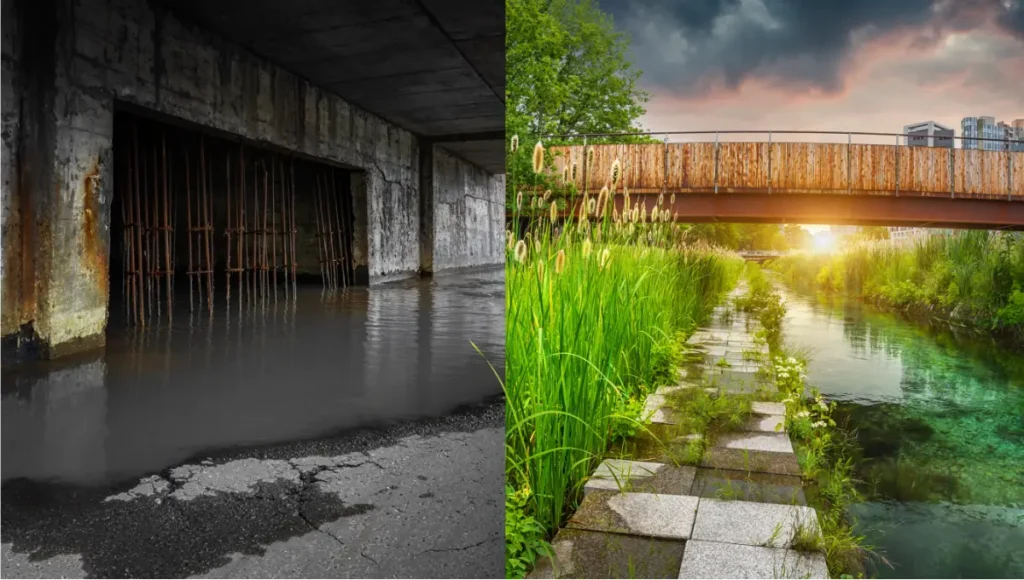
A Sponge Cities explanation is not merely a technical manual for better sewers; it is a sociological indictment of how we have paved over our future. By sealing the earth, we have severed the city’s relationship with its own site. To achieve resilience, you must embrace the disruptive potential of porosity. The American Institute of Architects (AIA) has increasingly advocated for this shift, noting in their Resilience Design Toolkit that the “standard of care” for modern architects must now include passive survivability and hydrological integration. We are seeing a move away from “defensive” architecture toward “absorptive” urbanism.
The Blueprint: 5 Resilient Urban Designs
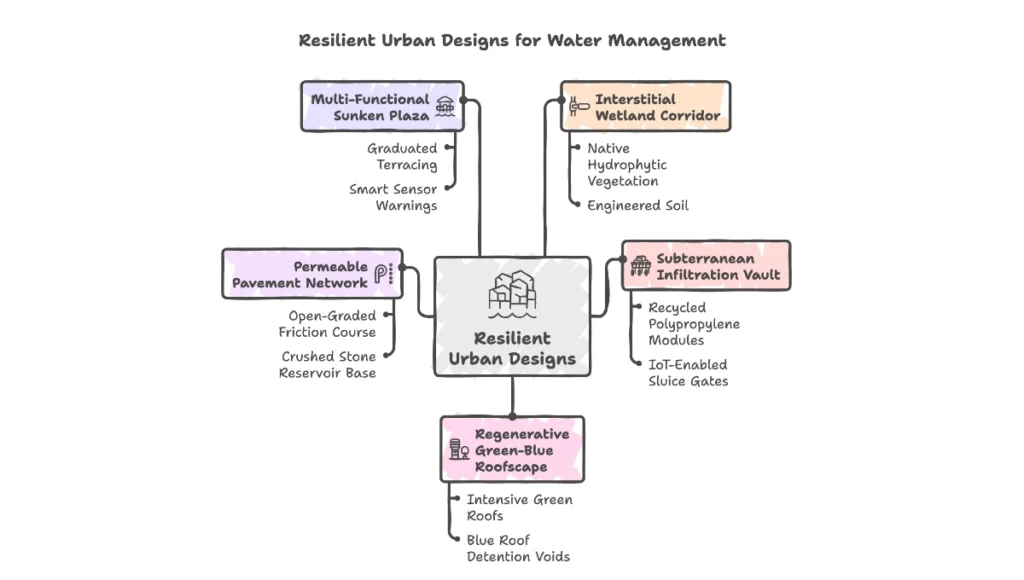
1. The Interstitial Wetland Corridor
Traditional transit-oriented development (TOD) focuses on the movement of people. A resilient recalibration demands the movement of water alongside them. By replacing concrete highway medians with bio-retention swales, you create a dual-purpose transit spine. This approach aligns with the principles of pedestrian-first city design, where the streetscape is reclaimed for both human movement and ecological performance. These swales act as the city’s “kidneys,” filtering toxins before they reach the water table.
- Technical Spec: Native hydrophytic vegetation (e.g., Typha, Phragmites).
- Substrate: Multi-layered engineered soil with a 40% void ratio for immediate storage.
- Outcome: 60% reduction in peak runoff velocity and enhanced local biodiversity.
2. The Subterranean Infiltration Vault
Where surface space is a premium, resilience hides beneath the pavement. We propose modular, honeycomb-structured cisterns located under parking lots and public plazas. These systems represent a critical component of digital twins for smart cities, allowing planners to simulate and manage underground water volumes in real-time. This is not just storage; it is active groundwater recharge.
- Material: High-density recycled polypropylene modules with structural load-bearing capacity for heavy vehicle traffic.
- Intelligence: IoT-enabled sluice gates that release water into the deep aquifer based on real-time soil saturation data.
- Capacity: Scalable from 500 to 50,000 cubic meters.
3. The Regenerative Green-Blue Roofscape
The “Fifth Elevation” of the city—the roof—is currently a wasted thermal mass. A sponge city transforms this into a decentralized reservoir system. This is a vital evolution for high-density environments, much like the concepts explored in urban farming skyscrapers, where vertical surfaces become productive ecological filters. By coupling detention layers with vegetation, we address both flood risk and the Urban Heat Island (UHI) effect.
- Design Lever: Intensive green roofs (min. 300mm substrate) coupled with “Blue Roof” detention voids.
- Thermal Impact: 4°C reduction in local ambient temperature via evapotranspiration.
- Efficiency: Capture and reuse of 90% of incident rainfall for greywater systems.
4. The Permeable Pavement Network
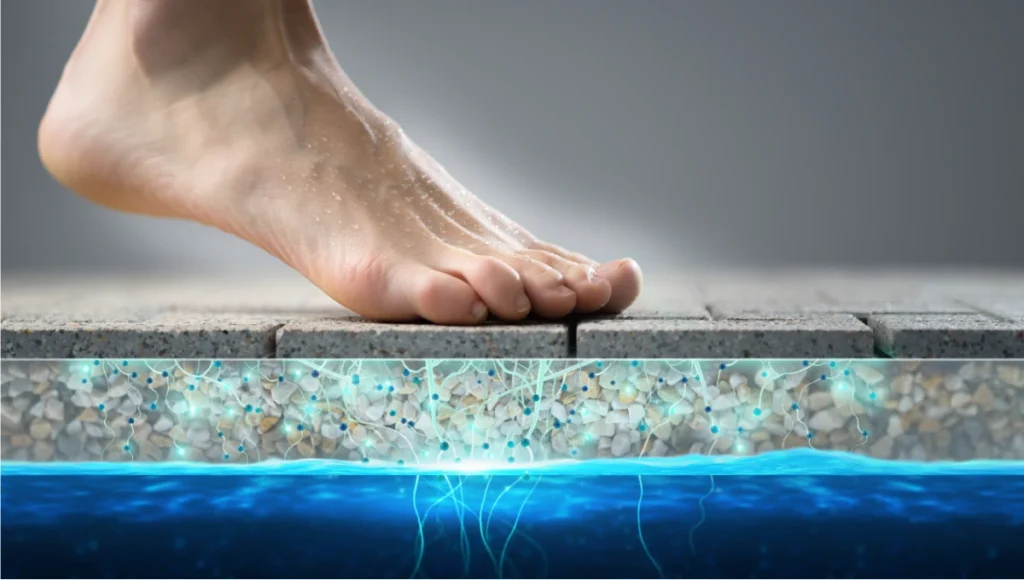
The road is no longer a barrier; it is a filter. By utilizing porous asphalt and interlocking permeable pavers, the very ground you drive on becomes the first line of defense. This disruptive material shift allows the city to “breathe” water directly into the sub-base, preventing the catastrophic “sheet flow” that characterizes modern urban flooding.
- Composition: Open-graded friction course (OGFC) over a crushed stone reservoir base.
- Filtration: Natural removal of heavy metals, hydrocarbons, and microplastics before they reach groundwater.
- Maintenance: Periodic vacuum sweeping to maintain 98% infiltration efficiency over a 20-year lifecycle.
5. The Multi-Functional Sunken Plaza
Resilience must be habitable. During dry months, these are amphitheaters, skate parks, or markets. During monsoons, they become temporary detention ponds. This aligns with the AIA’s “Framework for Design Excellence,” which emphasizes that resilient design must serve the community’s social health as much as its physical safety. We must design for the “floodable” state as an aesthetic opportunity, not a disaster.
- Capacity: Engineered to hold up to 10,000 cubic meters of overflow per hectare.
- Safety: Graduated terracing and smart sensor warnings to allow safe water accumulation without flash-flood risks.
- Typology: Sunken sports courts, “Water Squares,” and stepped urban parks.
Feasibility Study: The Walls of Inertia
The barriers to this recalibration are rarely engineering-based; they are political and economic. Current municipal budgeting is siloed—flood management belongs to public works, while park design belongs to recreation. To bridge this gap, we must adopt the AIA’s holistic approach to lifecycle cost analysis.
- The CAPEX Fallacy: Short-sighted planners view porous infrastructure as a “premium” cost. However, a Benefit-Cost Analysis (BCA) often reveals that nature-based solutions are 50% more cost-effective than traditional “grey” infrastructure when accounting for avoided flood damage and increased land value.
- The Maintenance Myth: There is a critical misunderstanding that green infrastructure requires more upkeep than decaying concrete. In reality, biological systems self-repair and improve with age; concrete only erodes and cracks.
- Regulatory Rigidity: Existing building codes often penalize “ponding” on site. We need disruptive policy changes that mandate on-site retention for all new developments.
Proof of Concept: The Singapore and Rotterdam Models
Look to Singapore. Through its “Active, Beautiful, Clean Waters” (ABC Waters) program, the city-state has moved beyond the “Garden City” to the “City in a Garden.” By naturalizing concrete canals—such as the Bishan-Ang Mo Kio Park—they have turned a drainage ditch into a 62-hectare floodable parkland. This transformation increased the capacity of the Kallang River by 40% while providing a massive social asset.
In Europe, Rotterdam serves as the vanguard of the “Cloudburst” strategy. Their “Water Squares” (like Benthemplein) function as sunken sports courts that can hold nearly 2 million liters of water during peak storms. These real-world applications prove that a sponge cities explanation is not academic—it is a functional reality. Rotterdam’s success is built on the “Room for the River” philosophy, acknowledging that we cannot fight the water; we must give it space to exist.
Project Spotlight: “The Aquifer Pulse”
Speculative / Internal Concept Study: Project Hydra by Nuvira Space
Location: Neo-London Docklands / Typology: Post-Industrial Sponge Retrofit Vision: To replace 40% of the non-porous industrial footprint with a “Liquid Commons” that serves as both a carbon sink and a flood buffer.
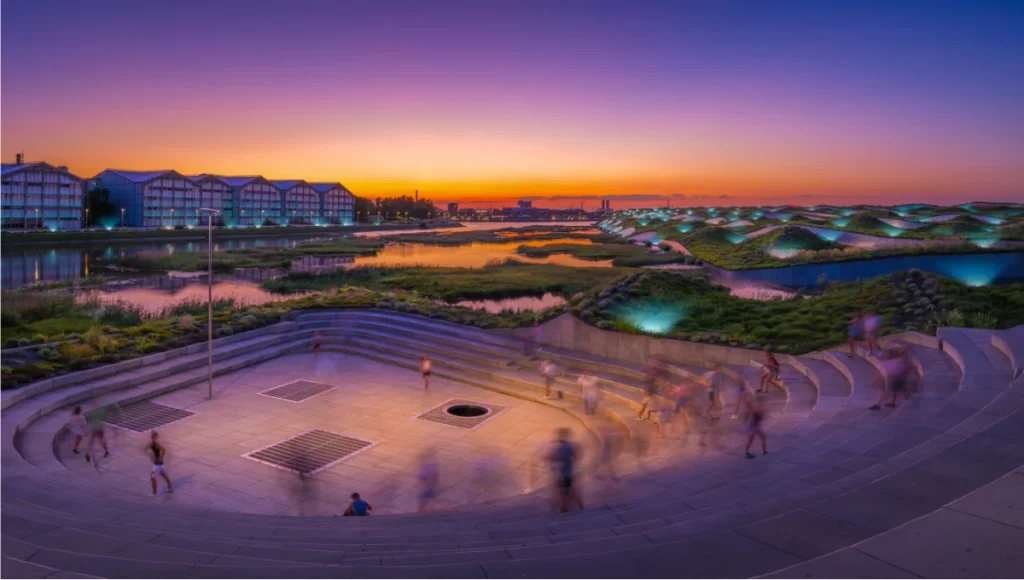
hydro-turbine grates in the foreground, intensive green-blue roofscapes on repurposed industrial warehouses in the midground, and a bioluminescent mycelium-filtered wetland waterfront edge at background, demonstrating data-driven urban resilience design, blue-green infrastructure, and
post-industrial architectural transformation.
Design Levers Applied:
- Pneumatic Soil Aeration: Using automated drones to prevent soil compaction in public parks, maintaining maximum infiltration rates even under heavy foot traffic.
- Kinetic Energy Capture: Hydro-turbines embedded in gravity-fed overflow pipes to generate local micro-grid power during rain events, turning the storm into an energy source.
- Digital Twin Hydro-Modeling: A real-time virtual replica of the district that predicts flood paths 15 minutes before they occur, triggering automated flood-gate deployment and rerouting traffic through smart street signage.
- Mycelium-Based Filtration Blocks: Underground barriers grown from fungal networks that trap and digest chemical pollutants from urban runoff.
Transferable Takeaway: Resilience is not a fixed state; it is a performance. By integrating sensors into the landscape, the “Aquifer Pulse” demonstrates that a city can respond to a storm with the same agility as a human nervous system. This is the ultimate synthesis of the biological and the digital.
2030 Future Projection: The Infiltration Index
By 2030, the “Hard City” will be an architectural relic. We predict a mandatory “Porosity Quota” for all new developments. Cities will no longer be measured by their GDP alone, but by their Infiltration Index. You will live in neighborhoods where the sound of running water is not a sign of a broken pipe, but the sound of a city functioning at peak physiological health.
This future relies on the widespread adoption of circular economy principles. As noted in our study on circular construction design, water must be treated as a closed-loop asset, never leaving the site in a polluted or wasted state. We will see the rise of “Hydrological Districts” where tax incentives are tied to the volume of water a building captures and filters.
Comprehensive Technical FAQ
Q: How does a sponge city handle extreme pollution in runoff?
A: Through Bio-Remediation and multi-stage filtration.
- Mechanisms: Microbes in the root zones of rain gardens break down hydrocarbons and heavy metals.
- Stages: Sedimentation (trapping dirt), Filtration (through sand/gravel), and Biological Uptake (plants eating nitrogen/phosphorus).
- Efficiency: Studies show up to 90% removal of suspended solids and 70% removal of heavy metals in properly designed swales.
Q: Is this feasible in cold climates where water freezes?
A: Yes, with climate-specific engineering.
- Adaptation: Using salt-tolerant plant species and ensuring sub-base depths are below the frost line to prevent heaving.
- Void Ratio: Maintaining high air-void percentages in permeable pavements allows for ice expansion without cracking the surface.
- Salt Management: Specifying non-corrosive de-icing agents to protect the biological filters.
Q: What is the ROI for a private developer?
A:
- Space Optimization: Eliminates the need for unsightly, single-use retention ponds, freeing up land for additional units or premium amenities like biophilic interior design.
- Property Value: Research shows a 15-20% increase in property value for developments integrated with high-quality green-blue infrastructure.
- Risk Mitigation: Drastic reduction in flood insurance premiums and future-proofing against stricter climate regulations.
Recalibrate or Submerge
The era of concrete dominance is over. You have two choices: continue to build walls that will eventually be overtopped, or join Nuvira Space in the radical reconstruction of the urban landscape. We are seeking partners—architects, city planners, and bold investors—who are ready to replace Dystopia with Porosity. The AIA’s Resilience Design Toolkit is our starting point, but the execution requires a disruptive, data-driven mindset.
The future is permeable. Will you be?