

Table of Contents
Architecture becomes most disciplined when space is limited. At 506 FT² of total heated area, every wall, opening, and structural decision must justify its existence. This SIMPLE HOUSE DESIGN PLAN does exactly that. It does not inflate space. It refines it.
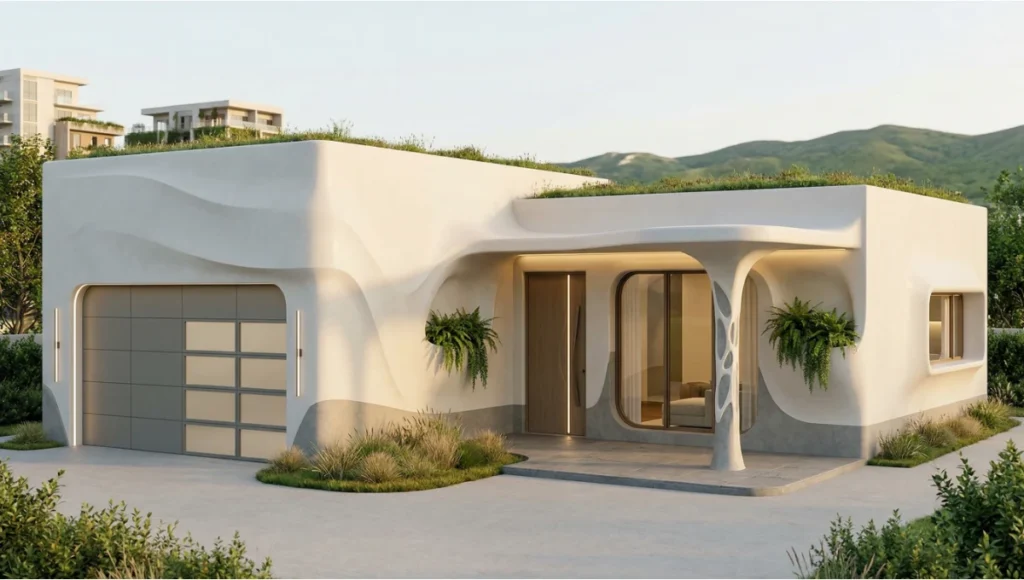
With 1 bedroom, 1 bathroom, 1 story, and a 2-car front-entry garage, this compact dwelling balances efficiency with real-world functionality. Its footprint measures 46′ 0″ in width and 28′ 0″ in depth, making it suited for a narrow lot while still presenting strong street presence. Behind its modest size is a carefully calibrated system of proportions, structure, and spatial flow.
This is not a small house that feels compromised. It is a compact house that feels complete.
The Discipline of 506 FT²
When you design within 506 FT², waste becomes visible. Long corridors are unacceptable. Redundant circulation cannot hide. Every transition must serve purpose.
In this plan, movement is immediate and direct. From the covered front porch, you enter into the great room — not a hallway, not a vestibule, but a usable living zone. The open floor plan ensures that visual depth extends across the interior, making the home feel larger than its measured area.
This efficiency mirrors principles seen in well-executed micro living layouts, where compression in footprint is offset by expansion in perception. Here, that balance is achieved through openness, ceiling height, and proportional control.
You are not navigating rooms. You are inhabiting volume.
Proportion and Site Fit: 46′ 0″ by 28′ 0″
The house measures 46′ 0″ wide and 28′ 0″ deep. Those dimensions are not arbitrary.
The 46′ 0″ width establishes presence across the street frontage. It allows the 2-car garage and covered front porch to coexist without crowding each other. The 28′ 0″ depth prevents unnecessary extension into the lot, preserving backyard space and reducing structural span complexity.
Because the design is suited for a narrow lot, this balanced geometry becomes critical. Excessive depth would create dark interior zones. Excessive width would demand larger setbacks. This footprint resolves both constraints.
The result is a dwelling that sits confidently without overwhelming its site.
One Story, 9′ 0″ Ceilings, 17′ 1″ Overall Height
This is a 1-story home. That choice immediately simplifies your daily routine. No stairs. No vertical fragmentation. Everything essential exists on a single plane.
Yet compact homes risk feeling compressed if ceiling heights are reduced. That is why the main floor ceiling is set at 9′ 0″. In 506 FT², vertical space becomes psychological relief. It allows light to distribute evenly across the great room and kitchen. It prevents the interior from feeling constrained.
The overall structure reaches 17′ 1″ in height, accommodating the roof system while maintaining balanced exterior proportions. The home reads as grounded and residential, not exaggerated or flattened.
Vertical proportion supports horizontal restraint.
The Open Floor Plan: Eliminating the Unnecessary
The open floor plan is not stylistic here. It is strategic.
Instead of dividing the interior into rigid compartments, the great room and kitchen operate as a unified core. There are no excess partitions interrupting flow. Sightlines extend across the full depth of 28′ 0″, reinforcing spaciousness.
In daily life, this means:
- Cooking while remaining connected to the living area.
- Flexible furniture arrangements.
- Clear circulation without wasted square footage.
This adaptability reflects core ideas behind flexible home design, where rooms evolve with your needs rather than forcing static behavior. In a 506 FT² home, that flexibility is essential. You may use part of the great room as a workspace one year and reconfigure it the next.
The architecture supports change without structural modification.
Kitchen with Pantry: Efficiency Without Visual Clutter
A compact kitchen must prioritize storage discipline. The inclusion of a pantry ensures that bulk items remain concealed, reducing upper cabinet overload and maintaining visual clarity across the open plan.
Because the kitchen is integrated into the great room, its organization affects the entire spatial experience. A cluttered kitchen would visually shrink the house. The pantry prevents that.
The adjacency between kitchen and living space enhances social interaction. You remain engaged while preparing meals. There is no isolation, no separation between activity and relaxation.
In 506 FT², connection matters more than segmentation.
Primary Bedroom on the Main Floor
With 1 bedroom and 1 story, placement becomes a matter of privacy and flow. The primary bedroom is positioned to maintain separation from the central living zone while remaining easily accessible.
This balance allows you to retreat without feeling removed from the home’s core. Nighttime circulation to the 1 bathroom remains short and direct. There are no unnecessary turns or secondary hallways.
The bedroom dimensions are disciplined. They accommodate essential furniture without consuming disproportionate area. Oversizing the bedroom would weaken the great room. This plan avoids that imbalance.
Comfort here is measured by usability, not excess.
1 Bathroom: Compact Precision
A 1 bathroom layout demands efficiency in plumbing and layout. Fixtures are positioned to minimize pipe runs and simplify maintenance. The bathroom supports both the primary bedroom and living zone without occupying excessive floor area.
In a single dwelling configuration, simplicity becomes an asset. Fewer wet walls, fewer vertical stacks, and reduced mechanical complexity contribute to long-term reliability.
This is architecture that respects both daily use and future upkeep.
Laundry on the 1st Floor
The inclusion of laundry on the 1st floor reinforces the logic of the 1-story design. There is no vertical hauling of loads. There is no secondary mechanical room consuming space.
In compact homes, operational tasks must integrate seamlessly into the plan. Laundry access is direct and efficient, supporting everyday convenience without visual disruption.
Small homes succeed when routine actions are simplified.
The 2-Car Front-Entry Garage: Functional Expansion
While the heated living area totals 506 FT², the property includes an additional 506 FT² of unheated living space in the 2-car garage. This effectively doubles the functional footprint of the structure.
The garage location is at the front, with a front-entry configuration. This decision aligns with the 46′ 0″ width and supports driveway efficiency on narrow lots. Side-entry options would demand additional lot width that may not be available.
The garage provides:
- Secure vehicle storage.
- Flexible workspace potential.
- Seasonal storage capacity.
- Buffer space between exterior and interior.
Rather than being oversized, the garage serves as infrastructure. It absorbs storage pressure that would otherwise crowd the 506 FT² heated interior.
Structural Strategy: 2×6 Framing and Truss Roof System
Behind the simplicity lies structural clarity.
The walls use 2×6 framing. Increased wall depth allows for improved insulation potential and structural strength. In compact homes, envelope performance has an amplified effect on comfort.
The roof is framed with a truss system, distributing loads efficiently and simplifying construction. The primary roof pitch is 9/12, creating strong visual character while enhancing water shedding performance.
This combination of 2×6 framing and truss roof construction provides durability without unnecessary structural complexity.
When paired with compact geometry and controlled envelope design, these elements support environmental performance strategies commonly associated with passive cooling techniques. The 28′ 0″ depth and single-story form improve airflow potential and reduce mechanical dependency.
Performance here is built into form.
Covered Front Porch: Human-Scaled Transition
The covered front porch is more than aesthetic detail. It moderates sunlight, protects the entry, and establishes a threshold between public and private space.
On a 46′ 0″ wide façade that includes a 2-car garage, the porch provides balance. It softens the garage’s visual weight and introduces pedestrian scale.
In daily use, it offers:
- Shelter during weather transitions.
- Informal seating opportunity.
- Defined entry identity.
Even compact homes deserve dignified arrival sequences.
Designed for a Narrow Lot
Being suited for a narrow lot is a strategic advantage. The 46′ 0″ width ensures adequate frontage, while the 28′ 0″ depth preserves rear outdoor space.
Foundation costs remain controlled. Structural spans remain efficient under the truss system. The compact footprint reduces site disturbance and construction complexity.
This is not a house that fights its site. It cooperates with it.
The Integrated Specification
This simple house design plan integrates:
- 506 FT² total heated space
- 506 FT² unheated garage space
- 1 bedroom
- 1 bathroom
- 1 story
- 2-car front-entry garage
- 46′ 0″ width
- 28′ 0″ depth
- 17′ 1″ overall height
- 9′ 0″ main floor ceiling
- 2×6 wall framing
- Truss roof framing
- 9/12 primary roof pitch
- Covered front porch
- Pantry
- Great room
- Laundry on the 1st floor
Every number supports a spatial decision. None are decorative statistics.
Why This Concept Works
The brilliance of this design lies in restraint. It does not attempt to compete with larger homes. It focuses on proportion, flow, and performance.
You gain:
- Accessibility through 1-story living.
- Visual openness through 9′ 0″ ceilings.
- Storage flexibility through a 2-car garage.
- Structural durability through 2×6 framing and trusses.
- Environmental potential through compact geometry.
It is a house engineered to function efficiently for decades.
Final Reflection
A SIMPLE HOUSE DESIGN PLAN is not about minimizing ambition. It is about refining it.
This 506 FT² residence demonstrates that disciplined dimensions — 46′ 0″ by 28′ 0″ — can produce comfort, efficiency, and architectural clarity. The 1-bedroom, 1-bath layout avoids redundancy. The open floor plan enhances livability. The structural system reinforces longevity.
Before you pursue additional square footage, evaluate whether better proportion might serve you more effectively.
If you are ready to build with intention rather than excess, consider how this concept aligns with your site, your routine, and your priorities. Thoughtful architecture does not begin with expansion. It begins with precision.
Now the next step is yours.
If the download link does not function properly, subscribe to Nuvira Space and we will send the full blueprint file directly to your inbox.