

Table of Contents
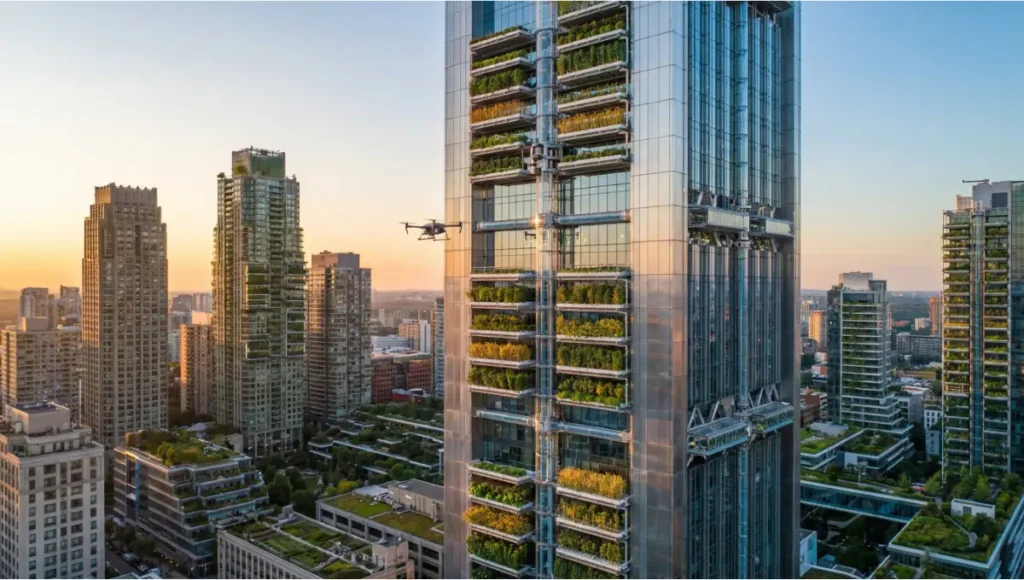
Urban Farming Skyscrapers represent the definitive architectural response to the fragility of global food supply chains. By integrating high-density caloric production into the vertical urban core, we are not merely designing buildings; we are engineering metropolitan survival.
Key Takeaways
- Metropolitan Resilience: Vertical farming decouples food production from climate-vulnerable rural zones, moving ‘the field’ to the consumer’s threshold.
- Tectonic Shift: Structural steel enables the high-load capacities required for hydroponic irrigation and automated harvesting systems.
- Societal Value: Beyond food, these towers act as thermal regulators and social hubs, transforming transit-oriented developments into productive ecosystems.
- AIA Resilience Framework: Alignment with the American Institute of Architects’ focus on hazard mitigation and social equity through “shocks and stresses” planning.
- Case Study: Singapore’s “30 by 30” (and revised 2035) strategy serves as the global benchmark for evidence-based vertical agriculture policy.
Nuvira Perspective
At Nuvira Space, we view the city not as a collection of static assets, but as a living, breathing machine in constant need of synchronization. Our philosophy of human-machine synthesis demands that we look beyond the aesthetic of the glass curtain wall. We advocate for the recalibration of the metropolitan fabric through data-driven design, where every structural beam is an opportunity for caloric output. For us, Architecture’s Steel Urban Farming Skyscrapers are not an option; they are the logical conclusion of a society seeking to bridge the gap between digital efficiency and biological necessity. By leveraging digital twins in smart cities, we can now simulate the metabolic rate of an entire skyscraper before the first steel beam is even cast.
The “Blueprint” Solution: Tectonic Sovereignty
The current dystopian reality of city planning relies on a fragile, long-distance supply chain that treats food as a commodity rather than an infrastructure. To disrupt this, we propose a “Blueprint” that treats the skyscraper as a specialized machine for growth—a vertical field that is resilient, automated, and hyper-local.
High-Tensile Skeletal Systems
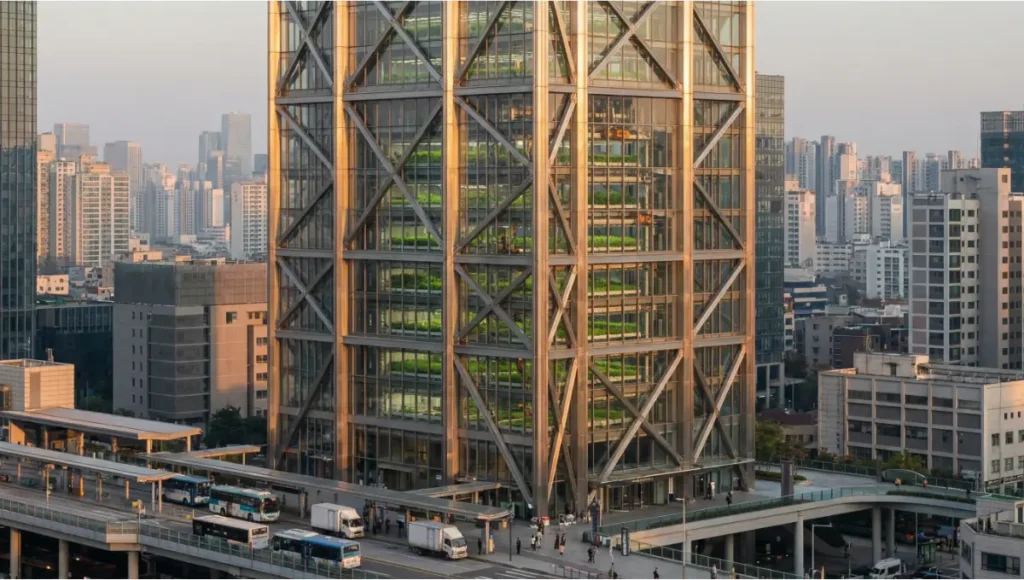
The structural demands of an urban farm skyscraper far exceed those of a traditional commercial office. While recent trends discuss mass timber vs. steel, the unique hydromass loads of vertical agriculture necessitate the high-tensile reliability of advanced steel alloys.
1. The Load Profile
- Static vs. Dynamic Load: Standard offices are designed for 2.4 to 4.8 kPa. An urban farm requires a structural system capable of 15+ kPa to support water-saturated growing media and nutrient reservoirs.
- Column-Free Vistas: Steel allows for expansive, column-free spans (up to 20 meters) to maximize sunlight penetration and accommodate automated robotic gantries.
2. Material Durability in High-Humidity Envelopes
Modern aeroponic and hydroponic systems operate at humidity levels often exceeding 90%. Architecture’s Steel Urban Farming Skyscrapers utilize:
- Duplex Stainless Steel: Superior resistance to localized corrosion in nutrient-rich micro-climates.
- Thermal Breaks: Precision-engineered steel connections that prevent condensation and thermal bridging in the building envelope.
4D Data-Driven Integration
The “4D” aspect refers to time as the fourth dimension—the lifecycle of the crop integrated with the lifecycle of the building.
- Heliotropic Orientation: Using generative algorithms, we determine the building’s optimal torque. This ensures that the steel structure doesn’t shade its own internal crops, providing 360-degree solar exposure.
- Closed-Loop Metabolism: We integrate greywater recycling systems that harvest humidity from the air to feed the irrigation loops. This transforms the skyscraper into a self-watering organism.
Feasibility Study: The Politics of Verticality
Transitioning from a concrete jungle to a productive one is met with significant friction, much of it rooted in outdated 20th-century zoning laws.
Economic Hurdles and Value-Driven ROI
The capital expenditure (CAPEX) of a steel-integrated farmscraper is roughly 40% higher than a traditional tower. However, a traditional ROI analysis fails to account for the “Externalities of Distance.”
- Logistics Savings: These structures reduce food-mile costs by 90%.
- Health Equity: Providing fresh produce in “food deserts” reduces long-term healthcare burdens on the municipality.
- Real Estate Premium: Mixed-use towers with integrated greenery command 15-20% higher rents due to the biophilic “wellness” factor.
The AIA Resilience Imperative
The American Institute of Architects (AIA) has pioneered the “Disaster Resilience Program,” emphasizing that architecture must be a proactive defense against climate shocks. In the AIA’s report on The Architect’s Guide to Business Continuity, resilience is defined by the ability to maintain critical functions during an event. There is no more critical function than nutrition.
By integrating farming into the urban core, architects fulfill the AIA’s mandate for “hazard mitigation.” If a flood or storm severs rural supply lines, a city with Steel Urban Farming Skyscrapers maintains its own caloric autonomy.
Proof of Concept: Singapore and Beyond
No city exemplifies this shift better than Singapore. Facing a 90% food import dependency, the city-state has transformed into a living laboratory. Through initiatives like the “30 by 30” plan, they have accelerated the deployment of towers that utilize A-frame steel rotating systems.
These structures utilize gravity-driven water pulleys to rotate crops, ensuring uniform sunlight. This is not speculative; it is a macro-environmental necessity for a nation-state with zero room for horizontal expansion. We see similar movements in Rotterdam, where floating farms are acting as the precursor to full-scale skyscraper integration.
The Rise of Automated Construction
The complexity of these structures requires a shift in how we build. Traditional construction methods are too imprecise for the tight tolerances of automated farming systems. We are now seeing the integration of robotic fabrication in architecture, where steel components are 3D-milled and assembled by autonomous systems to ensure every nutrient line and sensor port is perfectly aligned.
Concept Project Spotlight: Speculative / Internal Concept Study “The Verdant Spire” by Nuvira Space
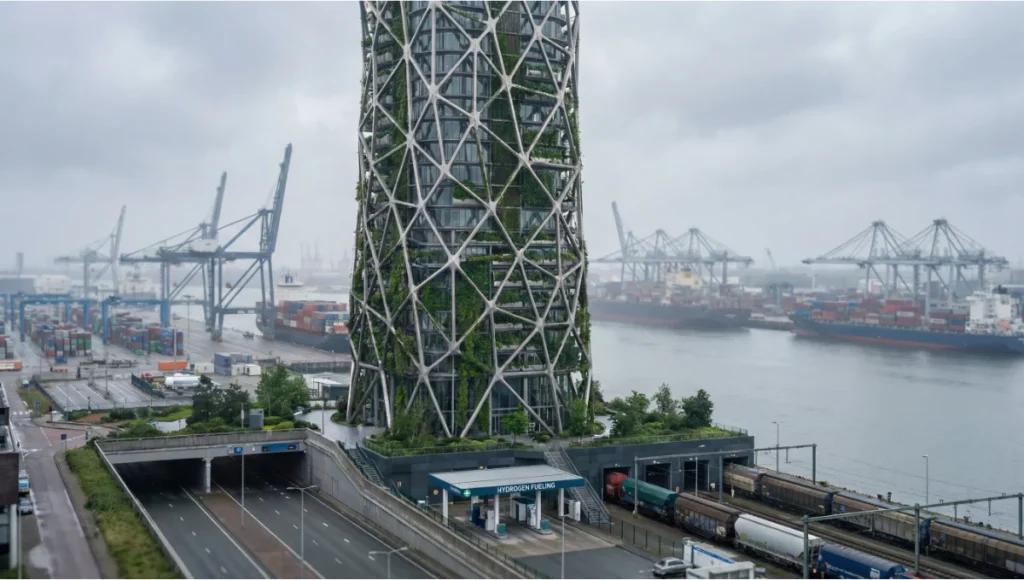
Project Overview: The Verdant Spire
- Location: Rotterdam, Netherlands (Port-side Industrial Zone)
- Typology: Mixed-Use Agri-Transit Hub
- Vision: A 300-meter steel lattice that serves as a hydrogen refueling station at its base and a 40-story vertical orchard at its peak.
Design Levers Applied
- Exoskeleton Frame: A Voronoi-patterned steel shell that provides structural rigidity while allowing 85% light transparency. This exoskeleton mimics the organic structure of bone, placing material only where stress requires it.
- Automated “Pod” Harvest: Modular crop pods that can be detached and lowered directly into the transit tunnels for same-hour distribution. This is “Transit-Oriented Agriculture” (TOA).
- Piezoceramic Sensors: Thousands of sensors embedded in the steel joints to monitor stress levels caused by the weight of the harvest in real-time.
Transferable Takeaway
The “Verdant Spire” proves that infrastructure can be multi-modal. A building is no longer just a shell for humans; it is a processor for energy, water, and nutrition. This represents a total departure from the “Dormitory City” model.
2030 Future Projection: The Sovereign Skyline
By 2030, we project that the “Central Business District” (CBD) will be rebranded as the “Central Bio-District” (CBD). Steel towers will no longer be empty monuments to finance but dense batteries of life.
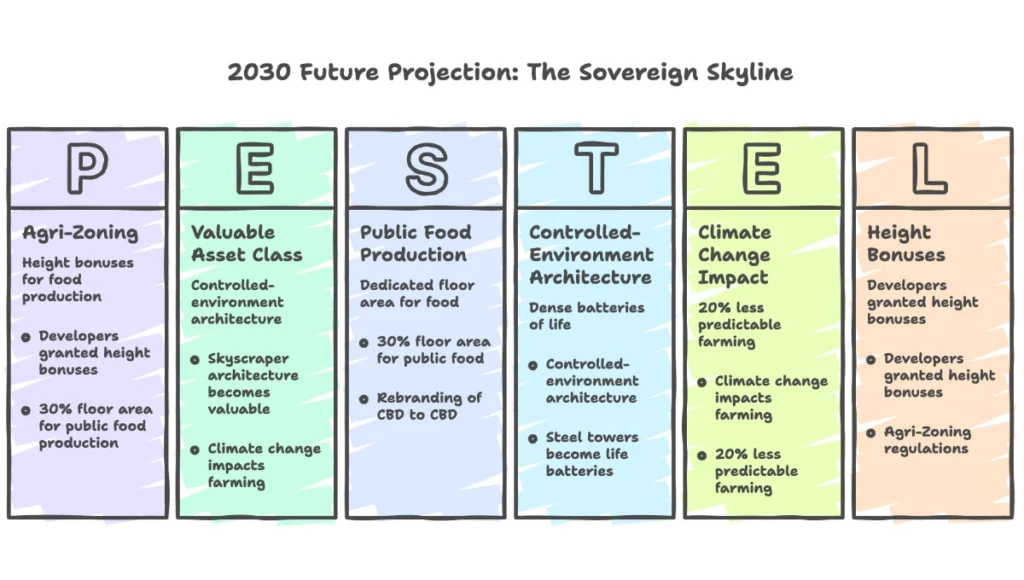
As climate change renders traditional soil-based farming 20% less predictable, the controlled-environment architecture of the skyscraper will become the world’s most valuable asset class. We anticipate the rise of “Agri-Zoning,” where developers are granted height bonuses in exchange for dedicating 30% of their floor area to public food production.
Comprehensive Technical FAQ
Q: Why is steel preferred over timber or concrete for these towers?
A: While timber is excellent for sequestering carbon, steel offers the highest strength-to-weight ratio and is uniquely suited for the “plug-and-play” modularity required in vertical farming.
- Modularity: Steel components can be replaced or upgraded as farming technology (like sensors or LED panels) evolves.
- Seismic Stability: The ductility of steel handles the sloshing effect of massive liquid nutrient reservoirs during wind or seismic events.
Q: How do you solve the energy-intensity of LED lighting?
A: Through Hybrid-Fiber Optics. We utilize rooftop solar collectors that funnel natural sunlight through fiber-optic cables directly to the internal plant beds, reducing the reliance on artificial LEDs by 60% during daylight hours. This is supplemented by high-efficiency transparent solar glass on the building’s south-facing facade.
Q: Is the food actually “safe” in an urban environment?
A: Yes. In fact, it is safer than traditional crops. Because these are controlled-environment architectures (CEA):
- Zero Pesticides: The sealed steel envelope prevents pest ingress, eliminating the need for chemicals.
- Air Filtration: HEPA-filtered HVAC systems ensure the crops are cleaner than those grown in open-air fields near highways.
- Water Control: Unlike field-grown crops, our water is recycled in a closed-loop system, free from heavy metal runoff or industrial contamination.
Q: How does this align with the AIA’s Framework for Design Excellence?
A: It specifically addresses the “Design for Resources” and “Design for Integration” categories. By treating the building as a resource generator, we move architecture from a passive consumer to an active producer in the urban ecosystem.
Join the Recalibration
The dystopian future of empty office parks and hungry cities is a choice. We choose the Steel Skyline. The transition requires a radical alliance between architects, structural engineers, and agronomists. We must stop viewing “nature” as something that exists only outside the city limits and start seeing our skyscrapers as the new forests.
If you are an architect, planner, or investor ready to move beyond the status quo, contact Nuvira Space today. Let us design a resilient future, one floor at a time. The sky is no longer the limit; it is the garden.