

Table of Contents
Key Takeaways
- Decoupling from the Engine: Transitioning from “throughput-based” metrics to “dwell-time” social indicators.
- The Superblock Methodology: Utilizing Barcelona’s Superilles as a template for localized ecological and acoustic restoration.
- Infrastructure as Interface: Viewing the street not as a void between buildings, but as a high-functioning organ of the city.
- Hyper-Proxemic Planning: The “15-minute city” is not a luxury, but a biological requirement for urban resilience.
- Data-Informed Permeability: Using AI to map pedestrian desire lines and heat-maps to optimize spatial flow.
- Health as Infrastructure: Aligning with AIA “Design for Health” principles to reduce chronic urban stressors.
Nuvira Perspective
At Nuvira Space, we view the current state of the metropolis not as a finished product, but as a legacy system in desperate need of a kernel update. Pedestrian-first city design is the essential patch. Our philosophy centers on a human-machine synthesis where data-driven design serves to liberate the physical body from the oppressive mechanics of 20th-century transit. We are not merely designing walkways; we are recalibrating the metropolitan fabric to prioritize biological rhythm over mechanical convenience. By leveraging Digital Twins in smart city planning, we simulate the lived experience before a single stone is laid.
The Macro-Observation: The Death of the Car-Centric Dystopia
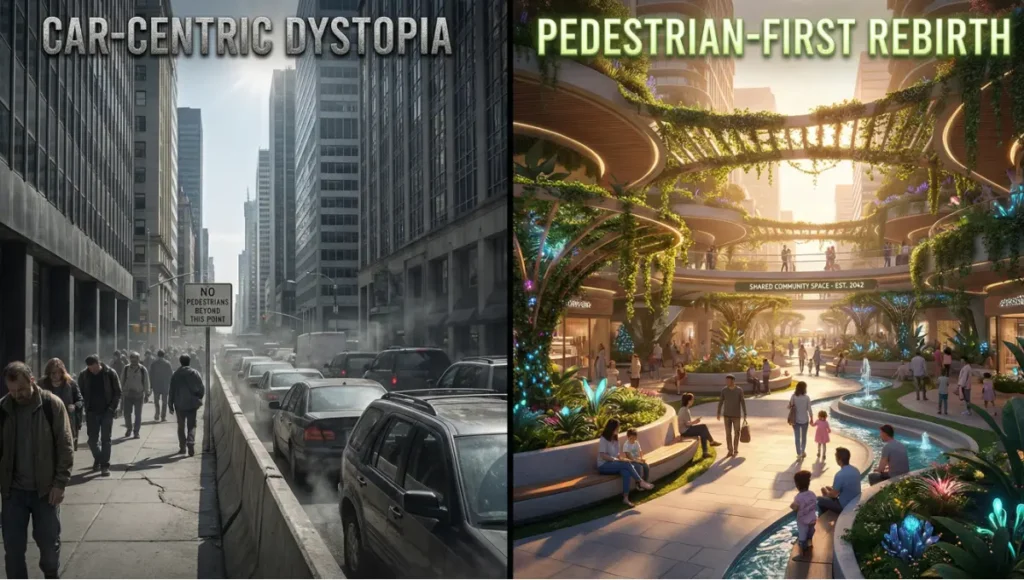
You walk through the canyons of the modern city and find yourself an alien in your own habitat. The “Dystopia of the Dashboard” has relegated the human experience to a narrow, three-foot strip of concrete, while 70% of the public realm is sacrificed to the storage and movement of two-ton steel boxes. This is the failure of the modern grid. To achieve a pedestrian-first city design, we must treat this imbalance as a sociological crisis.
The American Institute of Architects (AIA) has long advocated for the “Design for Health” framework, noting that the built environment is a primary determinant of public wellbeing. When we prioritize the vehicle, we prioritize sedentary isolation, respiratory degradation, and cognitive fatigue. A resilient city is one that acknowledges the street as the primary site of democratic exchange.
The “Blueprint” Solution: 7 Resilient Lessons
1. The Superblock: Reclaiming the Interior Grid
Borrowing from Barcelona’s radical Superilles, you must look at the city as a series of 400×400 meter cells. By diverting heavy transit to the perimeter, you transform internal streets into “citizen spaces.” This is not just a traffic plan; it is an ontological shift in how we define “The Street.”
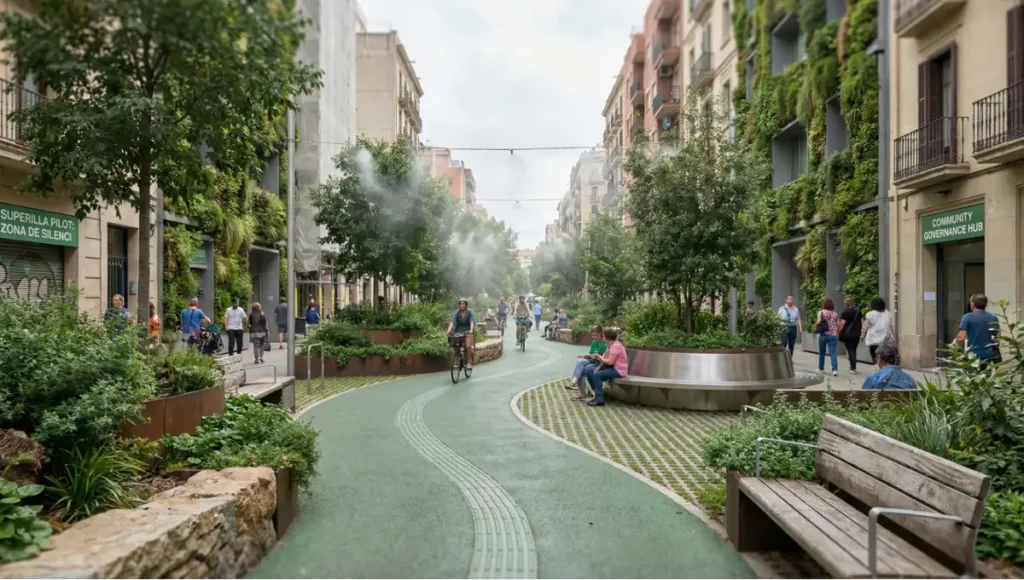
- Technical Spec: Target 60% reduction in local noise pollution (dB).
- Technical Spec: Implementation of permeable “green” asphalt to mitigate the urban heat island effect.
- Sociological Impact: Creation of “pockets of silence” that allow for decentralized community governance.
2. Frictionless Intermodality
The pedestrian experience fails at the “transfer point.” Your design must treat the transition from rail to sidewalk as a frictionless interface. The “last mile” should not be a gauntlet of exhaust and fractured pavement.
- Design Lever: Subterranean logistics hubs for last-mile delivery to remove heavy vans from the surface.
- Structural Spec: Integrated tactile paving and universal design gradients exceeding ADA minimums to ensure multi-generational accessibility.
3. Kinetic Permeability and Desire Lines
Rigid grids stifle movement. Resilient cities utilize “desire lines”—the paths humans naturally take—to dictate the placement of infrastructure. We must move beyond the “Right Angle” obsession of the 20th century. By studying Neuroarchitecture basics, you understand that the human brain craves visual complexity and organic curvature over the monotony of the industrial grid.
- Spec: AI-monitored pedestrian flow analysis to adjust signal timings in real-time.
- Spec: Paving patterns that subconsciously guide movement toward safety nodes.
4. The Acoustic Buffer as Aesthetic
Sound is a spatial material. In the current city, noise is an act of aggression. By utilizing tiered vegetation, vertical forests, and textured building envelopes, you can neutralize the “acoustic violence” of the remaining transit corridors.
- Tactical Spec: Use of “Living Walls” with sound-dampening substrate to absorb high-frequency tire noise.
- Observation: Silence is the new luxury in urban planning; providing it to the public is an act of equity.
5. Micro-Climatic Conditioning
A city is only walkable if it is survivable. In the face of rising global temperatures, the street must become a cooling organ. We must replace the “Heat-Trap” with the “Breathable Corridor.”
- Spec: Integration of high-albedo materials and automated misting systems powered by gray-water recycling.
- Technical Spec: Strategic canyon-ventilation analysis to harness natural wind-tunnels for passive cooling.
6. Socio-Economic Agnosticism
Pedestrian-first design is the ultimate democratizer. When the street is a park, the “cost of entry” to the city is eliminated. You are challenging the privatization of the public realm. The sidewalk becomes the “Great Room” of the metropolis, where the billionaire and the barista occupy the same physical and social plane.
7. The 15-Minute Proximity Mandate
True resilience is found in the “neighborhood unit.” If a citizen cannot access healthcare, fresh produce, and labor within a 15-minute walk, the city has failed its primary function. However, the implementation of this model requires deep analytical scrutiny. We invite you to analyze our latest 15-minute city feasibility study to understand the logistical hurdles of converting high-density districts.
Feasibility Study: The Barriers to Human-Centricity
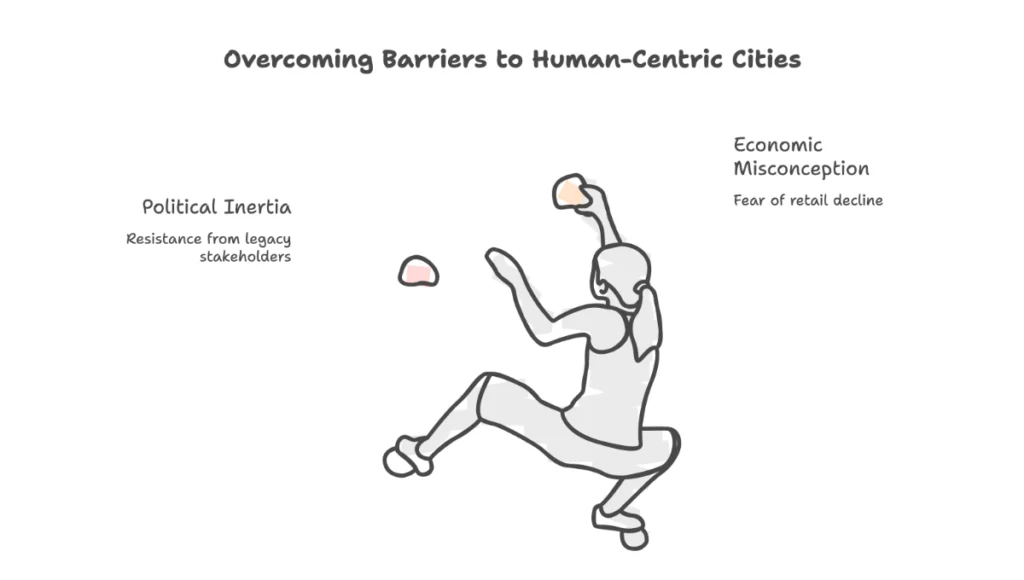
The Political Inertia
The primary obstacle is not engineering; it is the “Right to the Road” entitlement. You will face resistance from legacy stakeholders who equate vehicular speed with economic health. This is a cognitive bias left over from the Fordist era. To counter this, urbanists must frame pedestrianization not as “anti-car,” but as “pro-human.”
The Economic Misconception
Critics argue that removing cars kills retail. Data from Copenhagen and London proves the otherwise: pedestrianized zones see a 30%–40% increase in foot traffic and consumer spending. Merchants often overestimate the percentage of customers arriving by car by a factor of three. We must pivot from “Parking-per-Square-Foot” to “Experiences-per-Square-Meter.”
Proof of Concept: The Rotterdam Recalibration
Look to Rotterdam. Following the devastation of WWII, the city initially embraced car-centricity as a symbol of progress. However, their recent “Coolsingel” transformation is a masterclass in urban surgery. They didn’t just add a bike lane; they narrowed a primary arterial road by 50% to create a massive, high-quality public space that prioritizes the “stroller and the cyclist” over the commuter.
This project aligns with the AIA Framework for Design Excellence, specifically the principle of “Design for Integration,” where the project provides a sense of place and supports the local community while addressing larger environmental issues. Rotterdam’s success lies in its willingness to treat the street as a “Living Laboratory.”
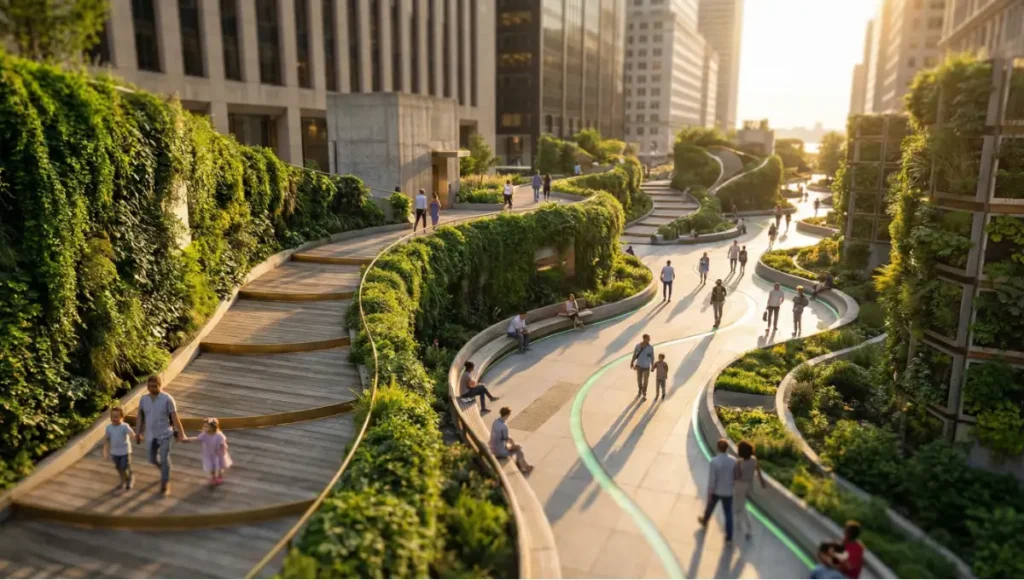
Concept Project Spotlight: Speculative / Internal Concept Study: The Neural Arterial by Nuvira Space
Project Overview
- Location: Lower Manhattan / Dense Coastal Typology
- Vision: A 12-block “Deep Pedestrianization” pilot that utilizes bio-digital integration to replace traditional asphalt.
Design Levers Applied
- Bio-Luminescent Wayfinding: Algae-based lighting that responds to human presence, reducing energy waste and light pollution.
- Modular Streetscapes: Prefabricated “plug-and-play” sidewalk modules containing integrated fiber-optics, gray-water filtration, and high-speed data nodes.
- Pneumatic Waste Capture: Eliminating the need for trash trucks within the pedestrian zone, thereby removing 40 tons of noise and emissions daily.
Transferable Takeaway
Urban resilience is achieved through the invisible automation of logistics, allowing the visible world to remain purely human. By moving the “guts” of the city beneath the surface, we liberate the “skin” of the city for social vitality.
The Sociological Imperative: Recalibrating Agency
When you design for the pedestrian, you are designing for agency. The driver is a passenger to the road; the pedestrian is a participant in the city. This shift reduces the “Urban Stress Response” and fosters what sociologists call “Thin Trust”—the ability to exist comfortably alongside strangers. This is the bedrock of a resilient democracy.
According to the AIA’s research on healthy communities, walkability is directly correlated with a reduction in respiratory illness and a marked increase in mental health resilience. By removing the “Mechanical Wall” of cars, we allow the city to function as a neuro-stimulant rather than a neuro-depressant.
2030 Future Projection
By 2030, the “Smart City” will no longer be defined by how many sensors it has, but by how many cars it has removed. We anticipate a global “Great Reclamation” where the asphalt of the 20th century is harvested for the materials of the 21st. The city will breathe again, functioning as a lush, quiet, and high-frequency social processor.
The “Neural Arterial” will not be a specialty project; it will be the default. Cities that fail to adapt will face the “Economic Desertification” of their cores as talent migrates to “Human-First” metropolises.
Comprehensive Technical FAQ
Understanding the Shift
Q: Does pedestrian-first design increase congestion on the perimeters?
A: Counter-intuitively, no. Through “Braess’s Paradox,” removing certain roads can actually improve overall flow by encouraging “mode-shift”—people choosing transit or micro-mobility over private cars.
- Stat: Documented 15% reduction in total city-wide vehicle miles traveled (VMT) in cities that implement high-density pedestrian networks.
Q: How does this affect emergency service response times?
A: By utilizing “Filtered Permeability,” we create emergency-only gates and retractable bollards. This allows ambulances to bypass the gridlock that usually traps them in car-heavy environments.
- Fact: Response times in pedestrianized London zones have remained stable or improved due to the reduction of private-vehicle congestion.
Q: Is this model applicable to existing suburban sprawls?
A: Yes, through “Infill Pedestrianization.” We focus on creating “Walkable Islands” within the sprawl and connecting them via high-frequency transit spines.
The Mandate for Change
The era of the “City as a Machine” is over. We are entering the era of the “City as an Organism.” You have the data. You have the architectural precedent of the AIA and the successful case studies of Europe and Asia. The only thing missing is the courage to tear up the asphalt.
Contact Nuvira Space to begin your metropolitan recalibration.
1 thought on “7 Resilient Pedestrian-First City Design Lessons”