
Table of Contents
Key Takeaways
- Core Objective: Establishing floating cities viability is the singular mechanism for preventing total metropolitan collapse in the face of hydraulic erosion.
- Spatial Decentralization: Floating urbanism represents the final decoupling of civic identity from terrestrial constraints.
- Modular Resilience: Advanced hexagonal infrastructure allows for organic growth and hurricane-tier stability.
- Resource Autonomy: Integrated bioreactors and desalination loops shift cities from “consumers” to “producers.”
- Geopolitical Shift: The emergence of maritime sovereignty challenges traditional land-based governance.
- Economic Viability: Initial high CAPEX is offset by long-term mitigation of land reclamation and flood damage costs.
Nuvira Perspective
At Nuvira Space, we view the current trajectory of terrestrial urbanism not as a series of fixable errors, but as a terminal misalignment between biology and the built environment. We are the architects of the recalibration. Our authority on human-machine synthesis compels us to look toward the horizon—not as a boundary, but as a canvas for the next phase of human habitation. We do not simply design buildings; we architect the data-driven systems that allow the metropolitan fabric to breathe, adapt, and sustain life in a state of perpetual flux. The floating city is the ultimate manifestation of this synthesis: a living, breathing node in a global network of resilient nodes.
Macro-Observation Hook
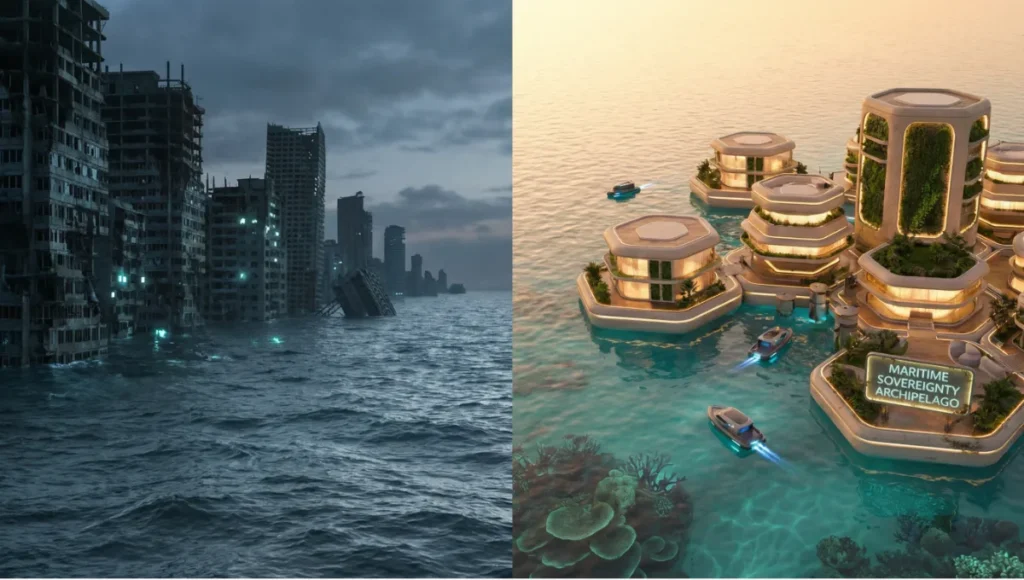
As you witness the slow, hydraulic erosion of our coastal capitals, you are actually observing the sunset of 20th-century city planning; the only path forward requires a cold, clinical assessment of floating cities viability as the singular mechanism for preventing total metropolitan collapse.
The “Blueprint” Solution: 12 Advanced Designs
To solve the climate-induced housing crisis, you must look beyond the “houseboat” and toward the “archipelago.” Here are the twelve structural pillars of advanced maritime design:
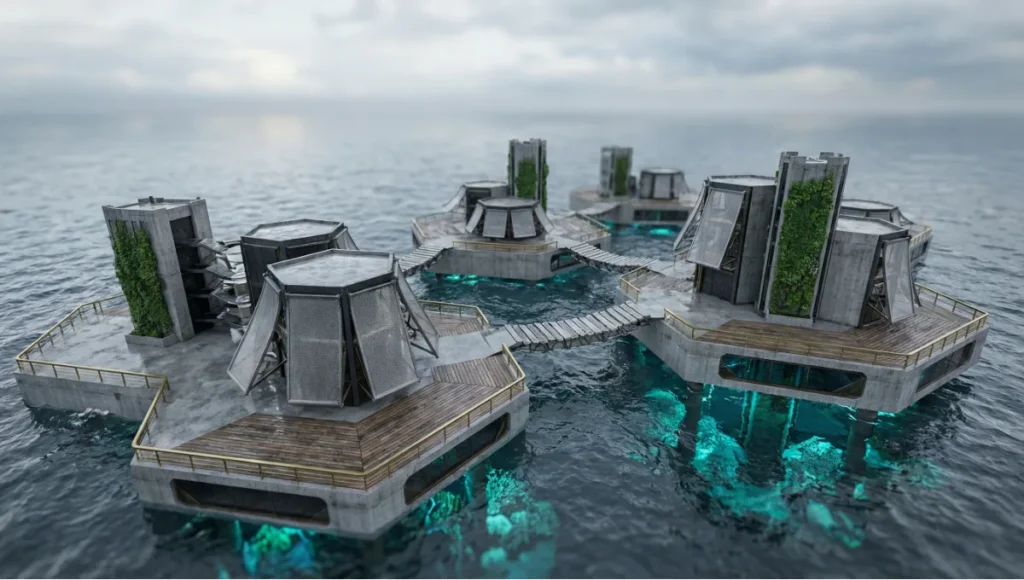
1. The Hexagonal Honeycomb Core
Standardized modularity is the only way to achieve scalability. This is not merely a geometric choice but a survival imperative.
- Structure: Reinforced concrete pontoons with 75-year lifespans, treated with hydrophobic nano-sealants.
- Physics: Center of gravity maintained through a 60/40 submerged ratio, ensuring that even under extreme loading, the platform remains level.
- Connectivity: Magnetic docking latches for real-time reconfiguration, allowing the city to shed or add modules like a biological organism.
2. Integrated Biophilic Lung Systems
You cannot build on the water without respecting the ecology beneath it. The maritime city must function as an artificial reef, not an industrial barge.
- Spec: Submerged biorock scaffolds that use low-voltage currents to accelerate coral growth.
- Function: Waste-to-nutrient pipelines that feed local mariculture, turning urban runoff into fish stock and seaweed forests.
3. Passive Kinetic Energy Harvesting
The motion of the sea is no longer a threat; it is your primary battery. By utilizing kinetic architecture facades, these structures translate environmental stress into storable energy.
- Device: Linear induction generators embedded in bridge hinges and outer-rim hull segments.
- Yield: Continuous base-load power harvested from the persistent swell of the deep ocean, unaffected by cloud cover or wind lulls.
4. Atmospheric Water Generation (AWG) Skinnings
Fresh water is the currency of the maritime city. The facade is no longer a barrier; it is a harvester.
- Material: Hydrophobic mesh facades that harvest humidity directly from the salt-heavy maritime air.
- Tech: Integrated solar-thermal distillation loops that purify greywater using concentrated sunlight.
5. Transit-Oriented Aquatic Flux
Eliminate the car to reclaim the streetscape for the citizen. In a floating environment, the “street” is a waterway, and the “sidewalk” is a modular pier.
- System: Autonomous electric ferries and pneumatic tube freight delivery systems that operate beneath the pedestrian level.
- Density: A strict 15-minute “walkability” radius across modular villages to ensure social cohesion.
6. Zero-Waste Closed-Loop Metabolism
Every ounce of matter within the city must be accounted for. Organic waste is diverted to anaerobic digesters, while inorganic materials are sorted for on-site additive manufacturing.
7. Vertical Aero-Hydroponic Columns
The floating city cannot rely on mainland supply chains for nutrition. You must integrate high-density vertical farming that utilizes nutrient-rich seawater (after desalination) to produce caloric requirements within the civic footprint.
8. Dynamic Mooring and Tension Leg Platforms
Borrowing from deep-sea oil rig technology, these platforms are anchored by suction piles and smart cables that adjust their tension based on tidal forecasts and wave height sensors.
9. Thermal Exchange Cooling (Ocean Thermal Energy Conversion)
The ocean is a massive heat sink. By leveraging the temperature differential between the surface and the deep, you can provide 24/7 climate control without the carbon footprint of traditional HVAC systems.
10. Multi-Modal “Flood-to-Flow” Bridges
Bridges are the nervous system of the archipelago. These structures must be flexible, telescopic, and capable of maintaining connections during 5-meter tidal shifts.
11. Distributed Ledger Civic Governance (Smart Contracts)
Identity and property in a mobile city require a decentralized framework. By implementing blockchain in architecture, you can manage energy credits, modular ownership, and voting rights without a centralized terrestrial bureaucracy.
12. Carbon-Negative Mineral Accretion Architecture
The city should grow its own foundations. Using electrolysis to pull minerals from seawater, the submerged hulls can thicken over time, becoming stronger and more integrated with the marine environment.
Feasibility Study: Economic and Political Barriers
The transition to maritime urbanism is hindered not by physics, but by the inertia of terrestrial law and the legacy of 20th-century financial instruments.
The CAPEX Paradox
The upfront cost of a 10,000-person maritime village is roughly 2.5x that of a traditional land development. However, the American Institute of Architects (AIA) has increasingly highlighted the necessity of “Resilient Design” as a financial hedge. According to AIA frameworks on disaster mitigation, every $1 spent on resilient infrastructure saves $6 in recovery costs. When you factor in the “Inertia Tax”—the trillions lost annually to flood insurance, land reclamation, and infrastructure decay in cities like New York or Jakarta—the floating cities viability becomes an economic inevitability rather than a luxury.
Legal Limbo: The Sea as No-Man’s-Land
Who owns the water beneath a floating city? Current international maritime law does not recognize permanent floating residences as “territory.” This creates a vacuum in policing, taxation, and diplomatic representation. To achieve viability, we must draft a “New Charter of the Seas” that treats maritime clusters as autonomous special economic zones, distinct from the jurisdictions of the nearest coastline.
Proof of Concept: The Rotterdam Precedent
You need look no further than Rotterdam to find the spiritual home of this movement. The city’s “Floating Office Rotterdam” (FOR) and the “Floating Farm” are not mere novelties; they are clinical trials for the end of dry-land dependence. Rotterdam has moved past the “protection” phase—building higher dikes—and entered the “negotiation” phase, where the city learns to rise with the water.
By utilizing the Rijnhaven as a laboratory, they have proven that transit-oriented development can thrive on a fluctuating surface. These projects serve as a baseline for the use of digital twins in smart cities, where every vibration, tidal shift, and structural stress point is monitored in a virtual environment before being addressed in the physical world.
The Sociological Recalibration: Beyond the Shore
As a city planner, you must recognize that moving to the water is not just a change in location; it is a change in the human psyche. Terrestrial life is based on the illusion of permanence—the “foundation.” Maritime life is based on the reality of flux—the “buoyancy.”
This shift requires a new form of “Neuroarchitecture,” where the sounds of the water and the gentle kinetic movement of the city are harnessed to reduce the chronic stress of high-density urban living. We are not just building platforms; we are building a new state of mind.
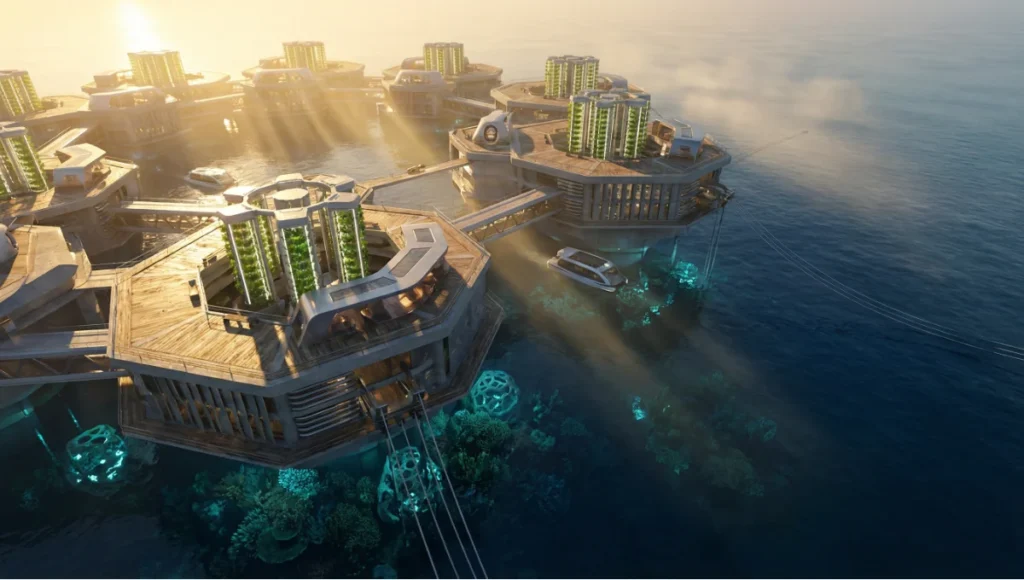
Speculative / Internal Concept Study: NEXUS-01 by Nuvira Space
Project Overview
- Location: The Celebes Sea / Equator (International Waters)
- Typology: Self-Sovereign Research & Manufacturing Hub
- Vision: A zero-latency, high-performance habitat where the boundaries between digital labor and physical existence dissolve.
Design Levers Applied
- Data-Driven Stability: AI-managed ballast tanks that counteract 15-meter swells in real-time.
- Human-Machine Synthesis: Neural-link integrated workspaces where environmental lighting and acoustics respond to cognitive load.
- Synthesized Atmosphere: HEPA-filtration arrays that maintain 99.9% purity regardless of external maritime conditions.
Transferable Takeaway
NEXUS-01 demonstrates that the “city” is no longer a place you live in, but a system you live with. The mobility of the city allows for seasonal migration to optimal climate zones, effectively eliminating the concept of “disaster zones.” If a storm approaches, the city simply moves.
2030 Future Projection
By 2030, you will see the first “Climate Refugee Sovereign Hubs.” These won’t be tents in a field; they will be high-tech modular archipelagos deployed by private-public partnerships. The focus keyword, floating cities viability, will no longer be a question of if, but a metric of efficiency.
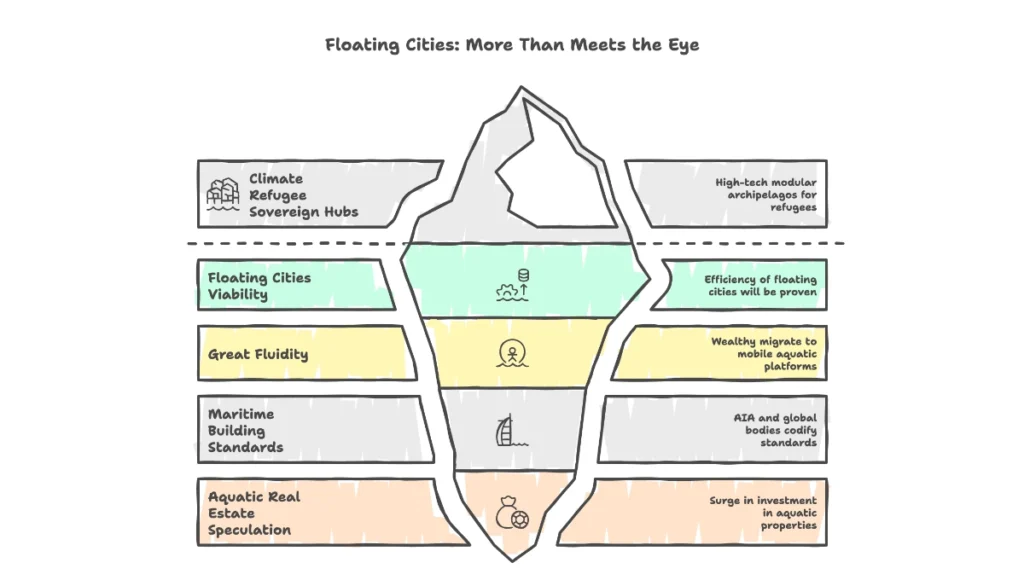
You will witness the “Great Fluidity,” where the wealthy and the resilient migrate to mobile aquatic platforms, leaving the crumbling concrete of the coast to those who refused to adapt. We expect the AIA and other global bodies to codify maritime building standards by 2028, leading to a surge in aquatic real estate speculation.
Comprehensive Technical FAQ
Q: How does a floating city survive a Category 5 hurricane?
A: Resilience is achieved through “pitting” rather than “resistance.”
- Dampening: Semi-submersible platforms sit below the wave-action zone, where water is naturally calmer.
- Geometry: Hexagonal clusters break up wave energy and disperse wind shear, preventing the “sail effect” seen in traditional skyscrapers.
- Mooring: Smart-tension cables that allow the city to sway within a 10-meter radius without drifting.
Q: Is the environmental impact on marine life negative?
A: On the contrary, advanced designs act as “artificial reefs.”
- Shadowing: Controlled light-leakage designs prevent “dead zones” beneath the platforms.
- Scaffolding: Biorock technology encourages shellfish and coral colonization, increasing local biodiversity by up to 300%.
Q: How is sewage and waste handled?
A: Through a decentralized anaerobic digestion system.
- Process: Human waste is converted into biogas for cooking and energy.
- Solid Output: Sterilized compost for the city’s vertical farms, ensuring zero discharge into the surrounding ocean.
Q: What about sea sickness for residents?
A: Modern stability systems utilize liquid mass dampers and gyro-stabilized foundations. For most residents, the motion is no more perceptible than the vibration of a standard high-rise elevator.
The Command to Recalibrate
The era of the “static city” is over. You are standing at the edge of the Anthropocene, and the ground beneath you is literally disappearing. You have two choices: cling to the sinking concrete of the past, or join the vanguard of the maritime future. Nuvira Space is already there, architecting the systems that will keep humanity buoyant.
Choose the horizon. Choose resilience. Recalibrate your future with Nuvira Space.