

Table of Contents
The most common mistake with smart glass is treating the five families as alternatives. They are not. One changes how much heat the glazing admits, another changes whether you can see through it, another changes whether anyone can see in, and two of them cannot be controlled at all. Specifying the wrong one is not a performance shortfall — it is a different product doing a different job, and the resulting conversation with a client usually happens after installation.
For a century the industry has worked on a static-specification model: choose a glazing type for a single worst-case orientation, then size the mechanical plant to deal with everything the glass cannot. Smart glass technology breaks that compromise by letting the glazing change its behaviour over the day, which means the plant can be sized for a range rather than an extreme. The pages below set out what each family actually does, what it cannot do, and how to tell them apart before a specification is written.
Nuvira Perspective
At Nuvira Space, we view the building envelope not as a static barrier but as an interface — the part of the building that negotiates light, heat and privacy on the occupant’s behalf. We are deliberate about which of those three we are solving, because most specification failures in this field come from choosing a product that solves a different one. A pane that changes from clear to milky is a privacy device; a pane that changes from clear to dark is a solar-control device; a pane that changes with temperature controls nothing at all, because nobody can override it. Our position is that dynamic glazing earns its cost where it replaces mechanical plant or a moving shading system — and that where it is added on top of both, the building has simply bought a third system to maintain. What follows separates the five families by what they do, not by which is newest.
Technical deep dive: the five families
These five are established, documented technologies rather than concepts. They are worth reading in the order below, because the first three are electrically controlled and differ mainly in what they change, while the last two give up control entirely — one by design, one as a consequence.
1. Electrochromic glazing (active, controllable)
The most controllable of the family, and the one most often meant when a specification says “smart glass”. A thin-film stack — tungsten oxide is the classic material — changes its optical state when a small voltage is applied across it.
- The mechanism: an applied voltage drives ions into the electrochromic layer, darkening it; reversing the current clears it. The state is held without continuous power, so the glazing consumes energy to change rather than to stay.
- What it is actually for: solar control with a controllable range. Because the tint can be set to intermediate levels rather than only on or off, it can be tuned to admit daylight while cutting glare — which is the version of the problem most facades actually have.
- The honest limitation: electrochromic glazing switches slowly, and the time is related to panel size. That is a genuine user-experience constraint, not a technical footnote, and it has to be communicated to a client who expects a window to respond like a light switch.
- Design consequence: the slowness means the control strategy should be predictive rather than reactive — tinting ahead of the sun rather than in response to it — which is a controls design problem, not a glazing one.
- Where it pays: large or awkward facades where a moving shading system would be difficult to service, and elevations where glare rather than heat is the dominant problem.
2. Thermochromic glazing (passive, uncontrolled)
The family that requires no wiring and no control system, because the trigger is heat. A thermochromic interlayer or coating changes its optical state as the glass itself warms up.
- The mechanism: the material changes state at a temperature threshold, so the glazing responds to the heat it has already absorbed rather than to a forecast or an instruction.
- What it is actually for: retrofits and simple facades, where running low-voltage wiring to every pane would be disproportionate to the benefit. It is also the only family that adds no control system to maintain.
- The honest limitation: nobody can override it. It cannot be tinted before the heat arrives, cannot be cleared when the heat is welcome, and its trigger correlates with the load it manages only in some climates. In a cool climate with strong winter sun, a thermochromic facade will tint when a building most wants the solar gain.
- What it redefines: it makes the facade a passive environmental filter rather than a controllable device, which suits passive cooling techniques and the logistics of retrofitting existing buildings where the cable route is the obstacle.
- Where it pays: small buildings, heritage contexts and retrofits where the alternative is a manual blind that nobody adjusts.
3. Suspended particle device glazing (active, fast)
The fast member of the family, and the clearest example of the field’s most common confusion. A film containing suspended rod-shaped particles aligns when a current is applied, darkening the pane; the change happens quickly rather than over minutes.
- The mechanism: with power, the particles align and the glazing clears; without it, they settle into a random arrangement and it darkens. The speed is the point — this is the family that can respond while conditions are changing.
- What it is actually for: solar control where the response has to be immediate — elevations where cloud cover or a moving reflection changes the glare environment within seconds, which is where a slow-response glazing fails.
- The distinction to hold: SPD is a tinting technology, not a privacy technology. It darkens rather than obscuring, and a client expecting to be screened from view will be disappointed by it — that job belongs to the family below.
- Where it pays: single large apertures and high installations where the sun’s angle changes quickly across a very visible surface.
4. Polymer dispersed liquid crystal glazing (active, privacy)
The family that is routinely sold as smart glass and does a job the others cannot: it goes from clear to a milky, light-diffusing state, so it obscures what is behind it while still admitting light.
- The mechanism: liquid crystal droplets dispersed in a polymer film scatter light when there is no power and align to let it pass when there is, which is the inverse of the solar-control families — the primitive state is opaque rather than clear.
- What it is actually for: privacy on demand — a glass partition or a glazed wall that converts from open to screened without a blind, a curtain or a moving part. The mechanism does not tint and does not meaningfully cut solar gain.
- The honest limitation: the milky state diffuses light rather than blocking it, so the pane becomes a bright diffusing surface. Used on an exterior face, that is a strong visual effect that changes the building’s appearance rather than merely closing it down.
- The maintenance argument: it replaces curtains, blinds and the cleaning and replacement cycles they require, which is where the case is made — not on energy.
- Where it pays: interiors, particularly meeting rooms and residential partitions, where privacy is intermittent and a fixed screen would waste daylight.
5. Transparent photovoltaic glazing (energy harvesting)
The family that does not control anything. Transparent photovoltaic glazing generates electricity from the light passing through it, which makes it an energy measure rather than an environmental control.
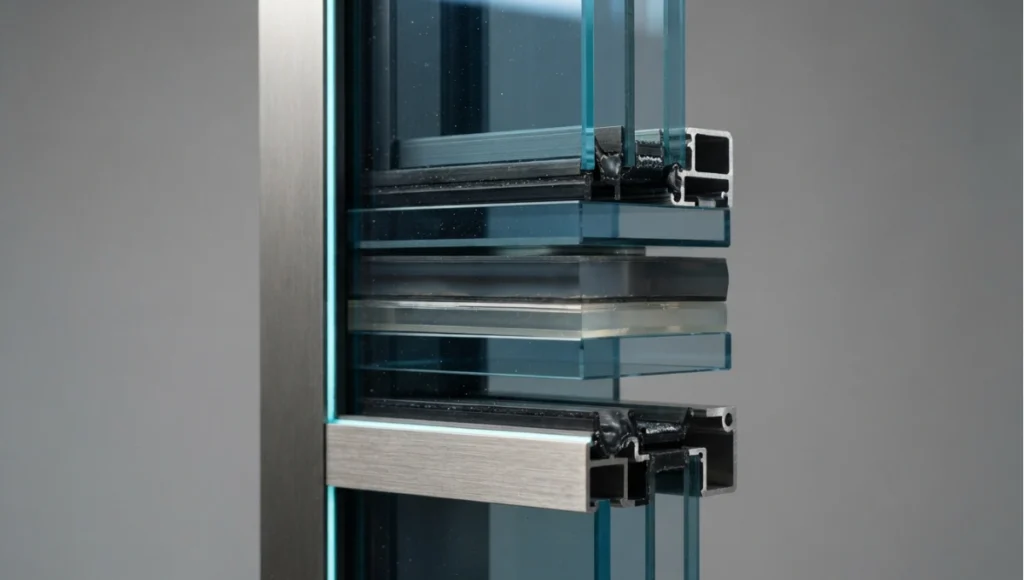
- The mechanism: photovoltaic material is integrated into the glazing or its interlayer, so the pane both admits light and produces a modest amount of power. There is a direct trade between how much light it transmits and how much it generates, and that trade is the design decision.
- What it is actually for: contributing to a building’s generation, particularly where the glazing is extensive and the alternatives for on-site generation are limited. The output is small relative to the facade area it requires.
- The honest limitation: a transparent photovoltaic pane is a compromise on both sides of the trade. Clarity decreases as generation increases, and the electricity produced is a fraction of what an opaque photovoltaic surface of the same area would deliver — which is why these are usually considered alongside opaque options rather than instead of them.
- Where it pays: where the added generation is worth the loss of transparency, or where a facade is already going to be highly tinted.
What actually separates the five
The industry literature distinguishes these families on two axes, and getting those right prevents most specification errors.
- What does it change? Electrochromic and SPD change how much solar energy and visible light pass through; PDLC changes whether the view is clear or diffused; thermochromic changes transmission passively; transparent photovoltaic changes nothing optically except by the transparency it sacrifices to generate.
- Who controls it? Electrochromic, SPD and PDLC are electrically controllable, so they need power, drivers, controls and a commissioning process. Thermochromic is uncontrolled by design. Transparent photovoltaic is not a control device at all.
- The direct answer to the title’s question: electrochromic and thermochromic are not competing versions of the same product, they are the controllable and uncontrollable ends of the same problem. Electrochromic can be tinted when you choose and takes minutes to change; thermochromic changes itself when the glass gets hot and cannot be told to do anything else. In a climate where the sun is unwelcome in summer and welcome in winter, that difference decides which one belongs on the building — and neither is a substitute for the other.
Comparative analysis: dynamic glazing versus a static specification
The comparison below sets a dynamic facade against a conventional static specification. The delta column states the direction of difference; no figure is asserted for either column, because the honest comparison is between strategies rather than between products.
| Capability | Traditional Workflow | Future Tech Stack | Delta |
|---|---|---|---|
| Glazing selection | One specification chosen for the worst-case orientation, applied everywhere | A range of states available across the day, and in principle per zone or per pane | Direction: performance tracks conditions rather than being sized for the extreme |
| Mechanical plant | Sized to meet the load the glass cannot manage, with margin added on top | Sized for a reduced and less volatile load where the glazing is actually doing the work | Direction: plant shrinks, but only if the glazing behaviour is included in the load calculation |
| Control layer | None: the glazing is a material with fixed properties | Drivers, controls and a commissioning process, integrated with the building management system | Direction: a material becomes a system, with the maintenance and version-management that implies |
| User experience | Occupants adjust blinds manually, or live with the result | Occupants may override, or may not be able to, depending on the family chosen | Direction: the control philosophy becomes a design decision that has to be made explicitly |
| Failure mode | Weathering and seal failure over decades | A pane or a driver that stops responding, leaving one element in the wrong state | Direction: failure becomes visible and discrete, and must be reportable |
| Retrofit suitability | Conventional reglazing | Only viable where a power and control route can reach the glazing, which excludes the passive family’s advantage | Direction: retrofit favours the uncontrolled family, new-build can use either |
| Justification | Compliance and a specified solar factor | Replacing a mechanical shading system or reducing plant, or delivering controllability | Direction: the case is strongest where it removes another system rather than adding to one |
The pattern is the same one that runs through every dynamic-envelope technology: the glass becomes capable and the building becomes more complex. The trade is worth taking where the glazing replaces a moving shading system or a portion of the plant, and rarely worth taking where it is added on top of both.
Nuvira Space · Future Tech
Dynamic glazing family selector
Dynamic glazing solves one of three different jobs: heat, privacy, or generation. Choosing a family that solves a different job is the most common specification error in the field. State the job and who must control it, then check what the specification has to say.
Selector result
Control solar gain · building management system — the tinting families, controllable either way
0 of 6 specification items in place.
Controlling solar gain is the job the tinting families were built for. Electrochromic glazing sets a tint and holds it, which suits a strategy that changes a few times a day; the fast family responds within the moment, which suits elevations where conditions change quickly. Both need power, drivers and controls.
Family fit: With a building management system controlling the glazing, every controllable family is viable and the choice comes down to range and speed. The BMS integration is itself the work: the tint schedules, the zone logic and the fault reporting all have to be authored and commissioned, and the interface between the glazing supplier and the controls integrator is where projects most often stall.
Watch for: an uncontrolled family specified where the trigger does not match the load. A heat-driven glazing tints when the glass is already hot, which is the wrong behaviour on an elevation with strong low winter sun. (Not yet specified: default state defined; duty cycle estimated; driver access designed; control logic owner named; switching speed expectation set; stated against what it replaces.)
Orientation aid only. This selector describes which dynamic glazing family suits a task and what a specification has to state; it does not certify a product, approve a facade assembly, or replace daylight, thermal, structural and code review by the responsible designers. Specifications cited are based on publicly available data as of 2026. © Nuvira Space. All rights reserved. | FUTURE TECH Series.
Variable porosity: where the control actually happens
The second shift behind dynamic glazing is not which technology is chosen but how finely it is controlled. A facade specified as a single state across a whole elevation is not really using a dynamic material — it is using a static building with an expensive one.
The useful version is zonal or per-pane control: one area tinting to cut glare while an adjacent area stays clear to keep the view and the daylight. That granularity matters most where occupants sit close to the glass, because a uniformly tinted facade solves the average and satisfies nobody, and it is the basis on which these technologies support the consistent non-glare daylight that biophilic interior design depends on. Where the granularity is available, the control logic that decides per-pane states becomes the design artefact — and it is a controls problem rather than a glazing one.
Intellectual honesty: current limitations
Four constraints matter, and the first is a user-experience problem rather than an engineering one.
- Switching speed is a perception problem. The controllable families do not respond instantly, and the slower ones take minutes on large panes. Occupants experience that as a window that is “wrong” for a while, so the control strategy has to anticipate conditions rather than react to them — and the expectation has to be managed in the brief. A technology that works as specified can still read as broken if nobody explained it (this is a usability question more than a technical one, and it is the kind of occupant-behaviour issue our neuroarchitecture basics coverage deals with).
- First cost is materially higher than high-performance static glazing, and the payback depends on what the glazing replaces. Where it replaces a moving shading system, the comparison is against that system’s capital and maintenance cost; where it replaces only some of the plant, the case is thinner and takes longer. Both are real, and they should be presented as separate lines rather than blended into one payback figure.
- It is a system, not a material. Dynamic glazing needs drivers, power, a control interface, network integration and commissioning, which means the skills required sit between glazing and building services rather than in either one. Whoever commissions it has to understand both, and that person should be named before the facade is ordered.
- The passive family cannot be overridden, and that cuts both ways. An uncontrolled facade requires no power, no controls and no commissioning, which is genuinely attractive on a retrofit — and it will tint when the material gets hot whether or not that is what the building wants. On an elevation with strong low winter sun, that is the wrong behaviour at the wrong time of year.
The toolset: 5 key tools
These five cover the workflow from solar analysis to the delivered installation. Cost tiers are expressed as tiers rather than figures because licensing moves faster than this page; verify current versions at implementation.
| Tool | What it does | Who it is for | Cost tier | 2026 maturity | 2030+ trajectory |
|---|---|---|---|---|---|
| Ladybug & Honeybee | Environmental and daylight analysis inside Rhino/Grasshopper, used to establish what each area of glass actually needs to do | Environmental designers, facade engineers | Free and open source | Mature and widely used | Dynamic glazing behaviour simulated as a controlled variable rather than a fixed property |
| Kangaroo Physics | Physics-based simulation of form and material behaviour within the same parametric environment | Computational designers, facade engineers | Free plugin, licence for host software | Established in computational design practice | Coupled simulation of coatings, curvature and movement becomes routine |
| Speckle | Open data exchange so the facade model, the analysis and the fabricator work from the same version | Computational designers, facade contractors | Open source, with hosted options | Mature in advanced practice | Version-matched data exchange becomes an expectation rather than an achievement |
| Unreal Engine 5 | Real-time visualisation of tint transitions so a client can experience the behaviour before panels are ordered | Design teams, clients | Free or subscription tiers plus hardware | Established; common in design review | Behaviour review moves from rendering into interactive design decision-making |
| Building management system with glazing driver integration | The layer that actually schedules the tint states and reports faults, connecting the glazing to the building’s controls | Controls integrators, facade contractors, operators | Commercial licence, project-based | Mature for conventional BMS, less so for glazing integration | Glazing control consolidates onto standard building platforms rather than bespoke interfaces |
One note on the live page’s toolset: it listed a proprietary Nuvira-branded integration layer, which is not a product the practice supplies and has been replaced with the technology class it described. The seam between the analysis tools and the building management system is where a facade’s intended behaviour and its delivered behaviour diverge, and it is the handoff worth watching.
Speculative / Internal Concept Study — Neural-Shell — by Nuvira Space
Everything in this section is a speculative internal concept study. It is not a built project, it has no client, and every quantity below is a modelled concept target used to make the reasoning concrete — never a measured result.
Project overview
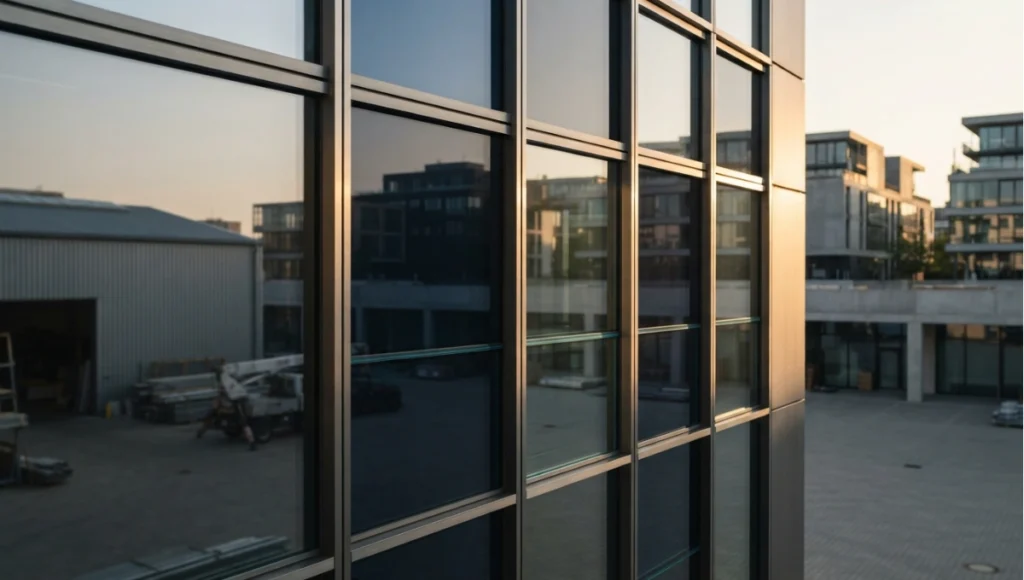
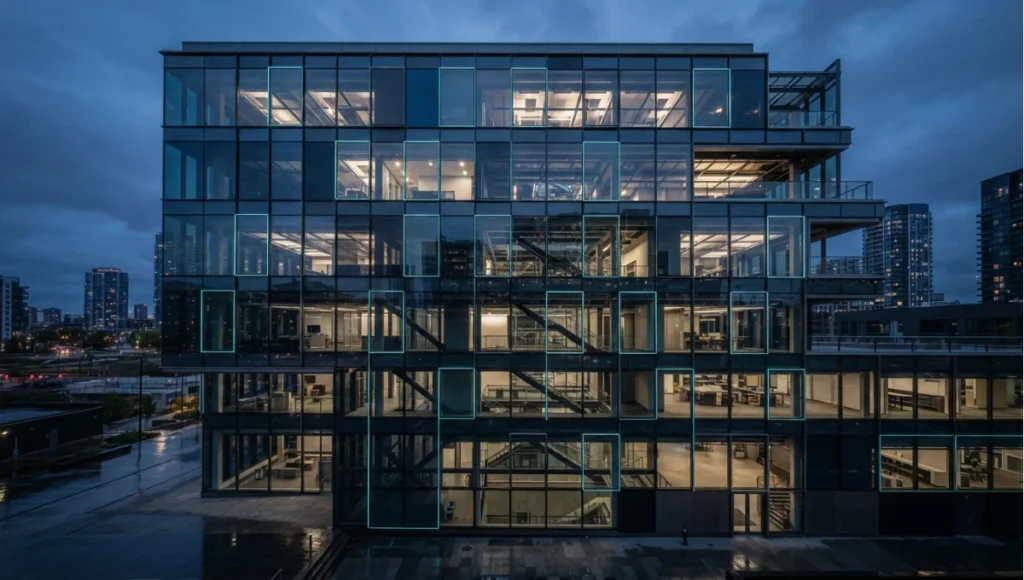
Neural-Shell is a speculative vertical research tower in Singapore, conceived to test how far per-pane control can be pushed on a tropical elevation where both heat and glare are continuous problems rather than seasonal ones. The proposal is not a client project and no site is secured; its purpose is to make the control and servicing consequences explicit at the outset rather than after the panels are ordered. Completion horizon is 2030+.
Design levers applied
- Per-zone rather than per-facade control: glazing states are set by exposure zone, so elevation areas with different sun angles can behave differently at the same moment rather than being averaged into one state (concept target, not a measured result).
- A family chosen per exposure condition: the control range is specified where controllability is needed, and the passive family is kept for areas where no override would ever be used (concept target, not a measured result).
- Predictive rather than reactive tinting: the control sequence anticipates the sun’s angle instead of responding to measured glare, which is the only way a slow-switching glazing can stay ahead of the condition it manages (concept target, not a measured result).
- Privacy separated from solar control: anything requiring visual screening is handled by a diffusing technology, with solar control handled separately, so neither system is asked to do the other’s job (concept target, not a measured result).
- Driver access designed in: the drivers and their access route are designed with the facade rather than added to a riser afterwards, because a control system that cannot be reached cannot be maintained (concept target, not a measured result).
- Generation treated as an optional layer: any photovoltaic glazing is assessed on what it contributes after the transparency it costs, and is not counted as a substitute for the facade’s environmental performance (concept target, not a measured result).
- A stated default state: every zone has a defined state it falls into if control is lost, chosen so an unresponsive facade still performs acceptably (concept target, not a measured result).
Transferable takeaway
Match the family to the job and state the default. Solar control, privacy and generation are three different problems, and only one family solves each; where a project needs more than one, it needs more than one product rather than one clever pane. Then define what every zone does when control is lost, because a dynamic facade that fails into an unknown state is worse than a static one — and write down who owns the control logic after handover, since that question is the one most often left unanswered.
2030 and beyond
Three directions, each a projection rather than a forecast.
- Control granularity increasing. The plausible near-term shift is from whole-elevation states to per-pane control, which matters more than any change in the glazing itself — a facade whose individual panes can be tuned separately behaves like a lighting system rather than a wall.
- The families converging into assemblies. Rather than choosing one technology per project, the direction is assemblies that combine a tinting layer, a diffusing layer and a generating layer, with each doing its own job. The complexity is in the interfaces and the control logic, not in the chemistry.
- Servicing becoming the differentiator. The change that would most affect adoption is a service model for the control layer — replacement drivers, defined response times, and diagnostics that report a pane in the wrong state. Once a building can tell you which panel has stopped responding, a dynamic facade becomes maintainable at scale rather than only at flagship scale.
Frequently asked questions
This article is part of our smart building technology guide, the state-of-play synthesis across generative AI, robotics, and sensing layers.
Q: Does smart glass technology require constant power to stay tinted?
**A:**For the electrically controlled families, no — they consume energy to change state rather than to hold it. Once a tint is set it is maintained without continuous draw, which is why the running energy of the control layer is small relative to the building’s loads. The energy question that matters is not the glazing’s own consumption but whether the glazing reduces the plant load enough to justify its capital cost.
Q: Can I install this in a residential setting?
**A:**Yes, and the case is often clearest there — particularly for skylights and high glazing where a manual blind is impractical to reach and a motorised one is another mechanism to maintain. The main constraint is that residential projects rarely have a building management system, so the control interface has to be something an occupant can actually operate.
Q: What is the lifespan of the tinting layer?
**A:**The switching layer is rated in cycles rather than years, and translating one into the other requires knowing how often the glazing will actually change state in your building — which depends on the control strategy, not just the material. A pane tinting twice a day has a very different duty cycle from one adjusting continuously. Ask for the cycle rating and then calculate your own duty cycle, rather than accepting a service-life figure quoted for a different pattern of use.
Q: Does it block UV light?
**A:**Dynamic glazing generally reduces ultraviolet transmission substantially in both states, which is one of its genuine side benefits for interiors — less fading of furnishings, and less exposure at the glass. The specific reduction varies by product and by state, so it should be taken from the manufacturer’s data for the specified build-up rather than from a category claim.
Q: How does smart glass handle extreme weather?
**A:**Through the same laminated construction as any other high-performance glazing, and the resilience case belongs to that construction rather than to the smart layer. A laminated assembly with tempered plies has a tested impact and load performance that can be specified; the dynamic coating sits inside an assembly whose structural behaviour is already covered by those tests, and it is the assembly that should be specified for the wind, snow and impact loads the site requires.
Q: Which family should be specified for a project that needs both solar control and privacy?
**A:**More than one product. No family does both well: the solar-control families tint rather than obscure, and the diffusing family scatters light rather than controlling solar gain. Where a project needs both, the workable answer is a diffusing layer for privacy and a solar-control layer for the facade, each specified for its own job, in an assembly the facade engineer has designed.
Step into the Future Tech archive
Step into the Future Tech archive → future-tech
© Nuvira Space All rights reserved.| FUTURE TECH Series | All tools and specifications cited are based on publicly available data as of 2026. Neural-Shell is a speculative internal concept study and does not represent a completed project.
1 thought on “5 Premier Smart Glass Technologies: Electrochromic vs Thermochromic”