

Table of Contents
The Global Shift Toward Atmospheric Resilience
The accelerating volatility of our planetary climate has rendered traditional urban planning obsolete; as cities face a 4.0 degree Celsius rise in localized heat island effects, the vertical forests evolution has transitioned from a localized aesthetic trend into a critical survival mechanism for the 21st-century metropolis. We are moving past the era of static glass-and-steel boxes toward dynamic, biological interfaces that treat the building envelope not as a barrier, but as a lung. This shift is not merely stylistic but aligns with the American Institute of Architects (AIA) Framework for Design Excellence, which emphasizes the “Design for Ecosystems” as a core pillar of modern architectural practice.
Nuvira Perspective: Defining the Regenerative Standard
At Nuvira Space, we view the integration of complex arboreal systems into high-density structures as more than a design choice; it is a fundamental reconfiguration of our urban metabolism. We move beyond the “cosmetic green” to engineer regenerative infrastructure that functions as a high-performance carbon sink. Our methodology prioritizes the lifecycle carbon footprint of every substrate, ensuring that the transition to a carbon-negative future is documented through rigorous material science and measurable ecological gain.
The Technical Evolution: 5 Iconic Design Milestones
To understand where you are going, you must analyze the radical shifts in engineering and biological integration that have defined this typology. The evolution of these structures mirrors the broader movement toward urban rewilding examples where the goal is to repair fragmented ecosystems within the city grid. In recent years, this has been accelerated by generative AI architecture tools that allow engineers to simulate complex wind-load interactions on organic facades with 99.0% accuracy before a single seed is planted.
1. The Prototype: Bosco Verticale, Milan (2014)
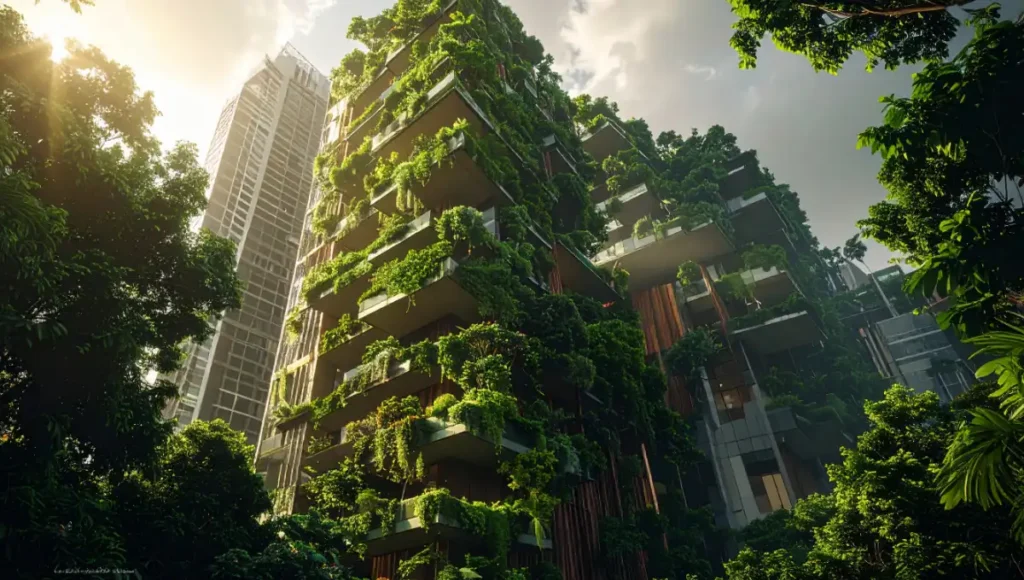
The genesis of the vertical forest movement proved that you could support 800 trees and 15,000 perennials on just 1,500 square meters of footprint. Designed by Stefano Boeri Architetti, this project set the precedent for how a building can provide a habitat for more than just humans.
- The Technical “So What?”: By concentrating the equivalent of 20,000 square meters of forest onto two towers, the project achieves a 30.0 kilo reduction in CO2 per year, per tower.
- Thermal Impact: The 0.25 meter to 0.50 meter thick vegetation layer creates a microclimate that reduces interior cooling loads by 7.5% in peak summer.
- Biological Logic: The species selection was not random; 90 different species were tested in wind tunnels to ensure they could withstand the vortexes created at heights of 110.0 meters. This rigorous testing phase is now a standard requirement for AIA-cited biophilic projects.
2. The Scaling Factor: Nanjing Green Towers, China (2018)
As the first of its kind in Asia, this project scaled the logic of the Milan prototype to an industrial level, designed to provide 25.0 tons of CO2 absorption annually. In a region where PM2.5 levels often exceed safe limits, these towers serve as localized air filtration hubs.
- Data Density: 1,100 trees from 23 local species were utilized to ensure regional biodiversity and resistance to local pests.
- Structural Load: The cantilevered balconies were engineered to support soil depths of 1.0 meter, factoring in the saturated weight of the root ball during monsoon cycles. This necessitated a shift toward carbon-negative concrete formulations to offset the immense structural weight required.
- Maintenance Innovation: The project introduced “Flying Gardeners,” a team of specialized arborists who abseil down the building, treating the facade like a mountain face rather than a garden.
3. The Social Pivot: Trudo Vertical Forest, Eindhoven (2021)
This milestone proved that regenerative infrastructure is not a luxury. By applying vertical forestry to social housing, the project utilized 125 units over 19 floors. This project is often cited in AIA case studies for its excellence in equitable design.
- Cost Efficiency: By utilizing pre-fabricated concrete components and standardized planters, the project maintained affordable rental rates while providing each resident with 1 tree and 20 shrubs.
- The “So What?”: This democratization of biophilic design ensures that low-income populations are not disproportionately affected by urban heat, providing 100% natural shading to every living room.
- Unit Density: Each apartment is only 50.0 square meters, but the floor-to-ceiling glass and 4.0-meter-deep balconies expand the perceived living area, showcasing how micro-living layouts can remain desirable through high-quality outdoor access.
4. The Timber Synthesis: La Forêt Blanche, Paris (2022)
A 54.0-meter-high tower constructed primarily of mass timber, representing the fusion of carbon-sequestering structure with carbon-sequestering facade. It challenges the dominance of concrete in high-rise construction.
- Carbon Metrics: The use of Cross-Laminated Timber (CLT) reduces the embodied carbon by 40% compared to traditional concrete frames.
- Lived Experience: You feel the structural warmth of wood coupled with the 2,000 plants on the facade, creating a dual-layered carbon-negative envelope.
- Interior Harmony: The design philosophy here emphasizes biophilic interior design, where the transition between the structural timber and the external canopy is blurred to maximize the psychological benefits of nature-immersion.
5. The Tropical Standard: CapitaSpring, Singapore (2021)
In the high-humidity context of Singapore, this 280.0-meter-tall skyscraper integrates a “Green Oasis” across 4 contiguous levels. This project represents the zenith of the “City in a Garden” philosophy.
- Vertical Density: With a total leaf area index (LAI) exceeding 10.0, the building acts as a vertical park for the 100,000 workers in the CBD.
- Micro-Environmental Hook: In Singapore, where humidity often exceeds 80%, the evapotranspiration from the 80,000 plants reduces the “felt temperature” on public terraces by up to 2.0 degrees Celsius.
- Smart Irrigation: Sensors embedded in the 1.5-meter soil pits monitor nitrogen levels and soil moisture, ensuring that the tropical species do not suffer from nutrient lockout in a closed-loop system.
Comparative Analysis: Regenerative Infrastructure vs. Industry Standard
| Metric | Traditional High-Rise | Nuvira-Grade Regenerative Infrastructure |
|---|---|---|
| Facade Life Cycle | 25-30 years (Degrades) | 50+ years (Bio-active, Evolves) |
| Albedo Effect | High (Contributes to Heat Island) | Low (Absorbs solar radiation via photosynthesis) |
| Carbon Status | Carbon-Positive (High embodied debt) | Carbon-Negative (Sequesters during operation) |
| Acoustic Mitigation | 2.0 dB – 5.0 dB reduction | 10.0 dB – 15.0 dB reduction via foliage density |
| Water Management | Stormwater Runoff (100%) | Stormwater Retention (65% to 85%) |
Concept Project Spotlight: Speculative / Internal Concept Study “AERIS-X” by Nuvira Space
Project Overview: Rotterdam / Hyper-Dense Residential / Carbon-Neutral Hub
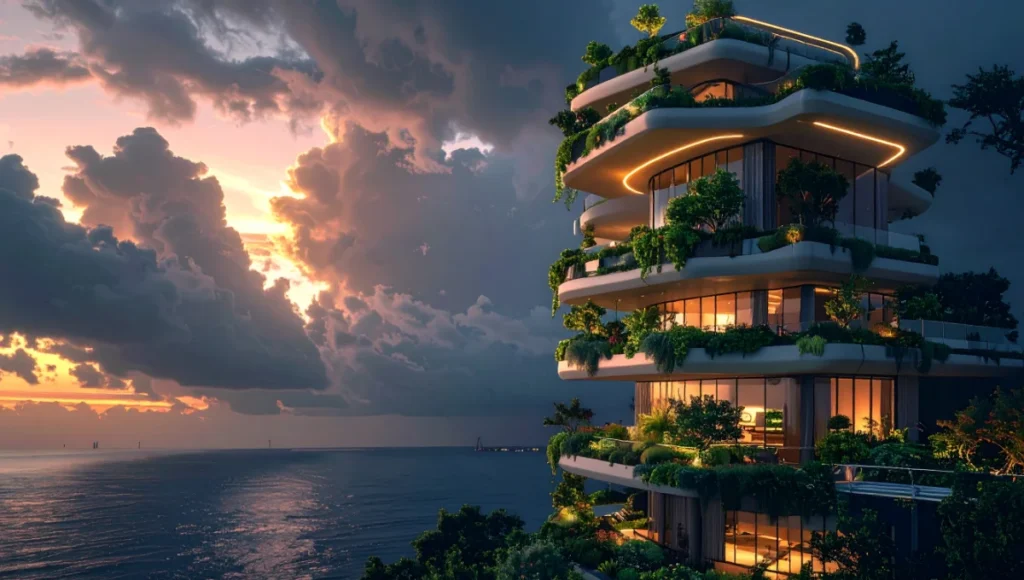
Designed for the maritime climate of Rotterdam, AERIS-X is a 180.0-meter residential spire that utilizes the North Sea winds to power its own internal irrigation systems. Rotterdam was selected for its leadership in water-adaptive architecture and its commitment to becoming a climate-resilient port city by 2030.
Design Levers Applied
- Automated Nutrient Delivery: A closed-loop hydroponic system that reduces water consumption by 85% compared to traditional soil-based planters. This is supplemented by high-efficiency greywater recycling from the residential units.
- Bio-Polymer Substrates: Instead of heavy soil, AERIS-X uses a 0.15-meter layer of recycled bio-polymer that is 60% lighter, allowing for 300% more plant density without increasing structural steel requirements.
- Phytoremediation Zones: Specific floors are dedicated to air purification, utilizing 12 specific species known to filter heavy metals from urban air. This data is tracked in real-time and displayed to residents via their building dashboard.
Transferable Takeaway
The key lesson from AERIS-X is structural weight optimization. When you reduce the “dead load” of the biological layer using advanced materials, you unlock the ability to retrofit existing 20th-century concrete buildings with vertical forests. This aligns with the AIA’s push for adaptive reuse as the most sustainable form of construction.
2030 Future Projection: The Bio-Digital Skyline
By 2030, we predict that the vertical forests evolution will reach a state of “self-regulation.” We will see buildings that are not just covered in plants, but are biologically engineered to react to environmental stressors. Advanced AI-driven sensors will monitor the sap flow of every tree in a building’s facade, adjusting irrigation in real-time based on trans-evaporation rates.
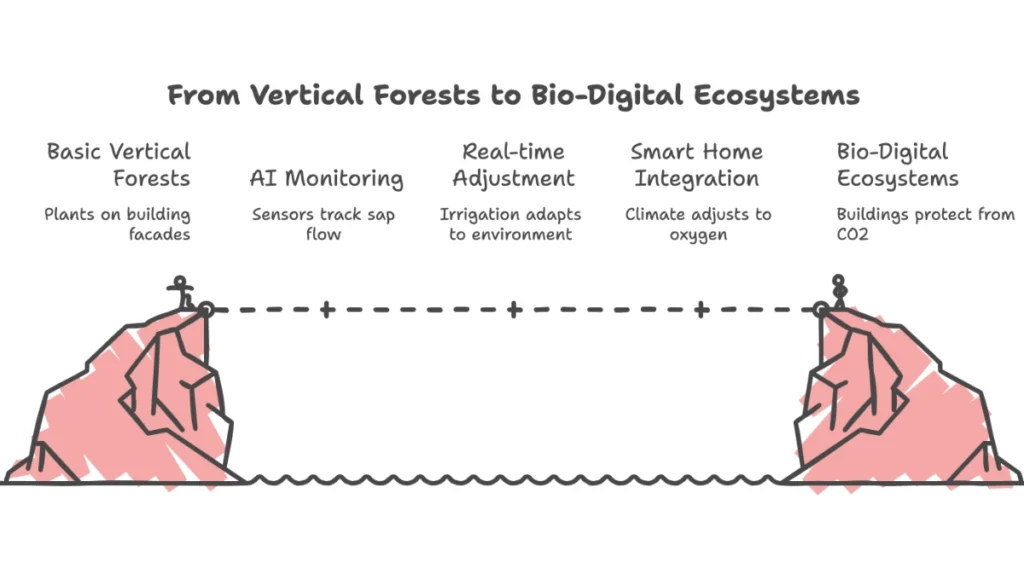
These external biological systems will integrate seamlessly with interior smart home ecosystems, allowing for automated climate adjustments based on the oxygen production levels of the facade at any given hour. We are moving toward a reality where your apartment doesn’t just house you; it protects you from the 450.0 ppm of CO2 in the atmosphere by creating a localized “Clean Air Zone” of 350.0 ppm.
Comprehensive Technical FAQ
Q: How does the weight of a forest affect the structural integrity of a skyscraper?
A: It is a matter of static vs. dynamic loading. Standard soil weighs approximately 1,600 kg per cubic meter when saturated. We mitigate this through:
- Utilizing lightweight volcanic pumice or expanded clay aggregates to replace 70% of the soil mass.
- Limiting saturated soil depth to 0.8 meters for large trees and 0.3 meters for shrubs.
- Reinforcing cantilevered balcony edges to handle 15.0 kN/m2 of vertical pressure, utilizing high-tensile steel reinforcements.
Q: Is the maintenance cost of these buildings sustainable?
A: While initial OpEx is 10% to 15% higher than glass towers, the long-term ROI is found in:
- Energy Savings: 25% reduction in HVAC costs due to natural shading and evaporative cooling.
- Property Value: A 15% to 20% premium on resale value due to the “biophilic advantage” and improved air quality.
- Asset Longevity: The vegetation protects the concrete from thermal expansion (which can cause micro-cracking) and UV degradation.
Q: How do you prevent root systems from damaging the building structure?
A: This is solved through a multi-layered waterproofing and root-barrier system:
- Primary Membrane: A 2.0 mm thick hot-applied rubberized asphalt.
- Root Barrier: A high-density polyethylene (HDPE) sheet that is chemically resistant to root penetration.
- Drainage Layer: A 20.0 mm dimpled geocomposite that allows water to move freely toward the drains while preventing root rot.
The Mandate for a Carbon-Negative Future
You are standing at the threshold of a fundamental architectural pivot. The data from the vertical forests evolution confirms that we no longer need to choose between urban density and ecological health. These five milestones demonstrate that when we apply rigorous material science to biophilic goals, the building becomes an active participant in the restoration of our planet.
By adopting regenerative infrastructure today, you are investing in the thermal mass and atmospheric resilience required for tomorrow. The transition is inevitable; the only question is whether your portfolio will be part of the solution or a relic of the carbon-positive past.
Join Nuvira Space in re-engineering the skyline. Secure your position in the carbon-negative future.