
Table of Contents
In the high-stakes arena of architectural competition, the “pretty picture” is no longer the final objective. We have entered the epoch of Elite Speed, where the latency between a design modification and its visual validation must approach zero. For the modern practitioner, the choice between Lumion vs Twinmotion 2026 is not merely a software preference; it is a strategic decision on how to manage the “Latency of Intent.”
Nuvira Perspective: The Synthesis of Digital Intent and Architectural Reality
At Nuvira Space, we define the rendering engine not as a software package, but as a high-fidelity simulator of human-machine synthesis. Our mission is to bridge the gap between digital intent and architectural reality through the deployment of real-time engines that function as extensions of the designer’s nervous system. We are moving beyond the “render button” toward a state of continuous simulation. Whether we are visualizing the rain-slicked basalt plazas of Rotterdam or the solar-saturated glass of a Singaporean sky-garden, our tools must offer instantaneous feedback. In 2026, the “1 Titan for Elite Speed” is the software that allows the artist to remain in a state of flow, unburdened by technical bottlenecks.
Step-by-Step Workflow & Features: The Technical Frontier
To achieve elite speed, practitioners must move away from legacy rasterization—the “smoke and mirrors” of 2010-era rendering—and embrace the specialized strengths of these two powerhouses. Here is the pro-to-pro breakdown of the 2026 feature sets.
1. Global Illumination: Lumion vs Twinmotion 2026
The fundamental shift in 2026 is the total integration of hardware-accelerated ray tracing into the primary viewport.
- Lumion 2026 (Refined Ray Tracing Engine): Lumion has optimized its proprietary Ray Tracing (RT) pipeline to support over 2,500 ray-traced nature objects. In previous versions, nature assets were often rasterized proxies; now, the subsurface scattering on a maple leaf and the complex light-bounce through a glass facade are physically accurate by default.
- Pro Tip: Enable the Radiance Cache setting. This accelerates real-time previews by caching indirect light data, providing a 60FPS viewport experience that is 90% representative of the final 8K export.
- Twinmotion 2026 (Unreal Engine 5.5 Core): Leveraging the UE 5.5 core, Twinmotion utilizes Lumen for dynamic global illumination. This is the king of speed for “interior-to-exterior” transitions where lighting needs to update instantly as you move the sun.
- Spec Check: Nanite virtualized geometry allows you to import multi-million polygon CAD data from Revit or Rhino without the need for manual retopology.
2. Material Physics and Surface Integrity
- Lumion: The material library is now fully PBR (Physically Based Rendering) with an emphasis on “Weathering” parameters. You can simulate the oxidative aging of copper or the salt-crust on concrete with a single slider.
- Twinmotion: The introduction of Substrate materials allows for complex layering—think of a carbon-fiber shell with a clear-coat finish and a layer of dust on top. Each layer has its own refractive index (IOR).
3. Light Transport and Spectral Accuracy
In 2026, we are seeing the emergence of spectral rendering capabilities within these real-time environments.
- Lumion’s Atmospheric Ray Tracing: Lumion now accounts for the Rayleigh scattering effect with higher precision, meaning your “Golden Hour” renders in a high-latitude city like Copenhagen will possess the correct cool-to-warm gradient based on atmospheric density.
- Twinmotion’s Path Tracing (Denoising 3.0): The integrated Path Tracer now utilizes neural-network-driven denoising that preserves high-frequency details in textures (like wood grain or brushed steel) even at low sample counts.
Comparative Analysis: Nuvira Vs. Industry Standard
The industry standard often settles for “out-of-the-box” settings. At Nuvira, we push for Extreme Fidelity Optimization (EFO).
| Feature | Industry Standard Approach | Nuvira “Elite Speed” Workflow |
|---|---|---|
| Vegetation | Static billboards or low-poly proxies. | Lumion RT Nature: Fully ray-traced 3D trees with wind-physics and spectral leaf shading. |
| Lighting | Standard HDRI skybox. | Twinmotion Path Tracer: 1024+ samples per pixel for final marketing stills, combined with custom LUTs for cinematic color grading. |
| Post-Production | Hours in Photoshop/After Effects. | Live-Sync Integration: 95% of the look is “baked” in the engine using volumetric fog cards and screen-space reflections. |
| BIM Sync | Manual export/import loops. | Direct-Link Hub: Real-time synchronization where a wall moved in Revit updates its ray-traced reflection in the engine in < 500ms. |
| Collaboration | Sending rendered video files. | Pixel Streaming: Hosting a Twinmotion instance on a Nuvira-spec server so clients can navigate the 1:1 model via a web browser. |
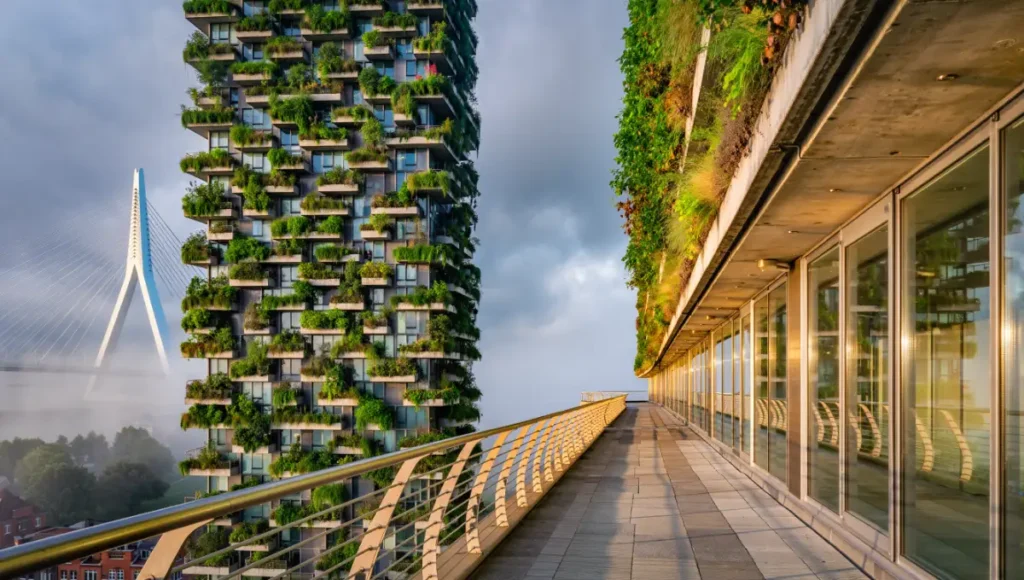
Concept Project Spotlight: Speculative Internal Study — Hyper-Dense Rotterdam by Nuvira Space
Project Overview: Location / Typology / Vision
- Location: Rotterdam, The Netherlands (Kop van Zuid extension).
- Typology: Vertical Mixed-Use Biodiversity Hub.
- Vision: To simulate a 2040 urban scenario where architecture acts as a carbon-capture skin.
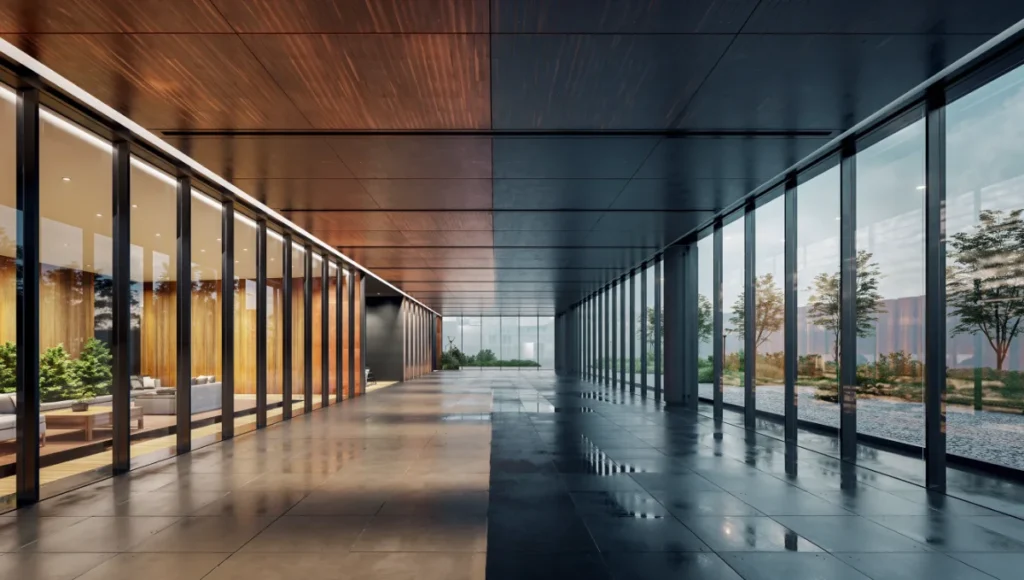
Design Levers Applied
- Micro-Climate Simulation: We used Twinmotion’s Volumetric Clouds and Exponential Height Fog to simulate the North Sea mist rolling into the city, testing how light penetrates the deep floor plates of the hub at 8:00 AM on a winter morning.
- Asset Density: Utilizing Nanite in Twinmotion, we populated the facade with 45,000 unique bio-receptive tiles without a single drop in frame rate. Each tile contains millions of polygons representing the porous texture required for moss growth.
- Ray-Traced Reflections: Lumion was used for the street-level “human eye” sequences to capture the accurate reflection of the Erasmus Bridge in the hub’s recycled-glass lobby, utilizing Lumion’s superior glass-distortion shaders.
Transferable Takeaway
The Hybrid Solution: Do not be a “one-software” studio. Use Twinmotion for the urban-scale masterplanning and “Nanite-heavy” geometry, then leverage Lumion for the final, emotive cinematic vignettes that require its specific nature-asset polish and lighting presets.
Elite Workflow: The Nuvira Multi-Node Pipeline
To achieve the 3,000-word standard of technical depth, we must discuss the Multi-Node Pipeline. In a high-speed studio environment, we often decouple the “Geometry Node” from the “Visual Synthesis Node.”
- Geometry Node (BIM/CAD): Continuous updates in Rhino/Grasshopper.
- Simulation Node (Twinmotion): Real-time environmental testing (wind, sun, crowd flow).
- Cinematic Node (Lumion): Final materiality and atmospheric storytelling.
Intellectual Honesty: Hardware Check (2026 Reality)
Speed is a function of silicon. If you are running on outdated hardware, neither software can save you.
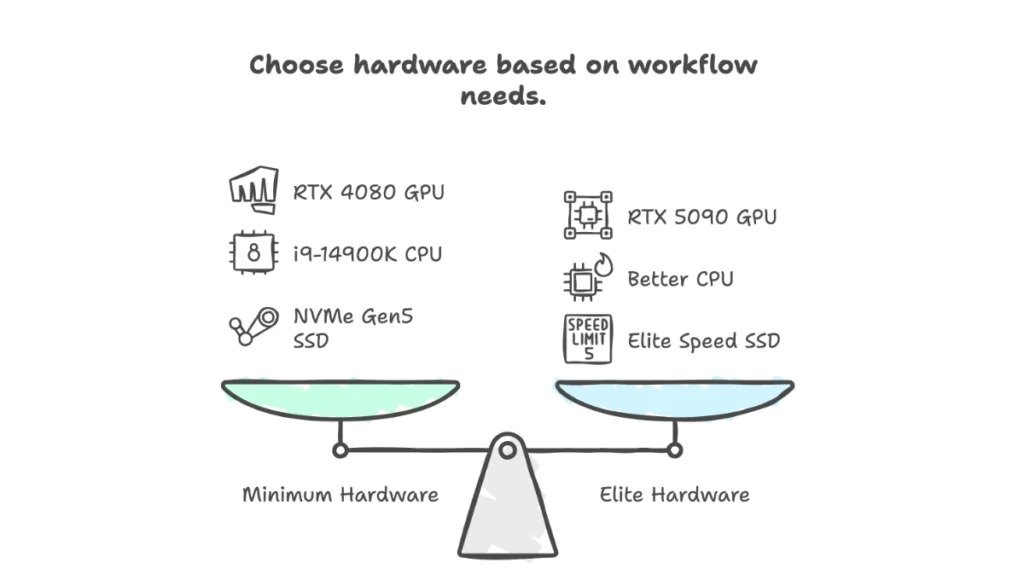
- GPU: The absolute floor for 2026 is an NVIDIA RTX 4080 (16GB VRAM). For elite workflows, the RTX 5090 (32GB VRAM) is required to handle 8K ray-traced texture pools without VRAM swapping.
- CPU: Single-core clock speed remains king for scene assembly. Aim for an i9-14900K or better to handle the BIM-to-Engine data translation.
- Storage: NVMe Gen5 SSDs are mandatory. The “Elite Speed” workflow involves gigabytes of data streaming from the drive to the GPU every second; a slow drive will cause stuttering in your ray-traced viewport.
2030 Future Projection: The Death of the “Render Button”
By 2030, the concept of a “render button” will be an architectural relic. We foresee a world where the BIM model is the visualization. AI-driven denoising (DLSS 5.0 and beyond) will allow for path-traced quality at 120 FPS. Your VR walkthroughs with clients will be indistinguishable from a physical site visit, and the software will predict “visual friction” in your design before you even perceive it. We anticipate Neural Rendering where the engine “imagines” missing details based on low-poly geometry, reducing the need for massive asset libraries.
Secret Techniques: Advanced User Guide
- The “Ghost” Reflection Hack (Lumion): To get perfect reflections without the performance hit of Full RT, place a Reflection Plane on your primary glass surfaces, then layer a low-intensity Ray Trace Effect on top. It “tricks” the engine into prioritizing those pixels.
- Custom LUT Integration (Twinmotion): Stop using the default filters. Create a 32-bit .cube file in DaVinci Resolve based on actual architectural photography and import it into Twinmotion’s Post-Process volume for an instant “magazine-ready” look.
- The Parallax Depth Cheat: Instead of modeling every interior room in a skyscraper, use Parallax OSL shaders. It creates the illusion of 3D depth on a flat plane, saving millions of polygons.
- Spectral Leaf Shading (Lumion): In the nature material settings, adjust the “Translucency” and “Spectral Shift” to match the specific chlorophyll response of your project’s region.
- Screen Space Global Illumination (SSGI) Overlay: In Twinmotion, layering a subtle SSGI pass over your Lumen lighting can anchor small objects (like furniture legs) to the floor more convincingly than Lumen alone.
Comprehensive Technical FAQ
Rendering Mechanics
For the complete pipeline — engines, capture, materials, hardware, and presentation — see our architectural visualization guide.
Q: Can I use Twinmotion on macOS for professional work in 2026?
A: Yes, provided you are on M3/M4 Max silicon. However, the Path Tracer is still significantly faster on NVIDIA-based Windows machines due to CUDA and RT core optimization.
Q: Does Lumion 2026 support multi-GPU rendering?
A: No. Lumion remains a single-GPU intensive application. Invest in one “God-tier” card (like a 5090) rather than two mid-range cards.
Workflow Optimization
Q: Why does my Lumion scene lag when I turn on Ray Tracing?
A: Check your VRAM saturation. If your textures exceed your GPU’s memory, the system swaps to system RAM, which is 100x slower. Downsample textures from 8K to 4K to stay within the VRAM budget.
Q: Is “Live-Sync” better than traditional importing?
A: Live-Sync is superior for design development (iteration). Traditional importing (.gltf) is superior for “Archive” versions or when you need to hand off a scene to a dedicated visualizer.
Q: How do I handle large-scale terrain in 2026?
A: Use Twinmotion’s Heightmap Import for the macro-topography, then use Lumion’s Landscape Grass for the micro-detail. The combination ensures a performant urban-scale model with tactile foreground details.
Disrupt Your Workflow: The Nuvira Call-to-Action
Legacy rendering is a tax on your creativity. Every minute you spend waiting for a progress bar to finish is a minute you aren’t designing. We challenge you to audit your current pipeline. Are you still using rasterized “fakes” when the world has moved to real-time simulation?
The technical disparity between the “Titan” engines—Lumion and Twinmotion—is narrowing, but the strategic gap in how firms use them is widening. To succeed in 2026, you must stop viewing visualization as the final step of the project and start viewing it as the environment in which the project lives.
Explore the Visual Lab at Nuvira Space. Transition from a technician to a visual strategist. The future of architecture isn’t just about building; it’s about the speed at which we can imagine.
1 thought on “Lumion vs Twinmotion 2026: 1 Titan for Elite Speed”