

Table of Contents
Key Takeaways
- The Proximity Mandate: 15-minute city feasibility is not merely a logistical goal but a sociological imperative to reclaim human time from the entropy of sprawl.
- Surgical Urbanism: Implementation requires the “cellular” restructuring of existing metropolitan zones into self-sustaining nodes rather than a total demolition of legacy infrastructure.
- Economic Friction: The primary barriers to feasibility are not engineering-based but rooted in legacy zoning laws and the “CBD-dependency” of global real estate markets.
- Resilient Infrastructure: Success hinges on the integration of “Active Pores”—permeable streetscapes that facilitate micro-mobility over heavy-vehicle reliance.
- Human-Machine Synthesis: Advanced spatial modeling and real-time data flows are essential to balance the metabolic demands of high-density living with psychological well-being.
15-minute city feasibility: The Macro-Observation of a Spatial Glitch
You are currently existing within a spatial glitch. For over a century, your movement has been dictated by the “Euclidean Error”—the rigid, industrial-era separation of living, working, and leisure zones that has turned the simple act of survival into a high-octane logistical nightmare. To assess 15-minute city feasibility is to perform a bold urban critique on the very morality of distance. We are moving past the era of the “Mega-Center,” that centralized altar of commerce that demands hours of your cognitive load in exchange for a desk and a paycheck.
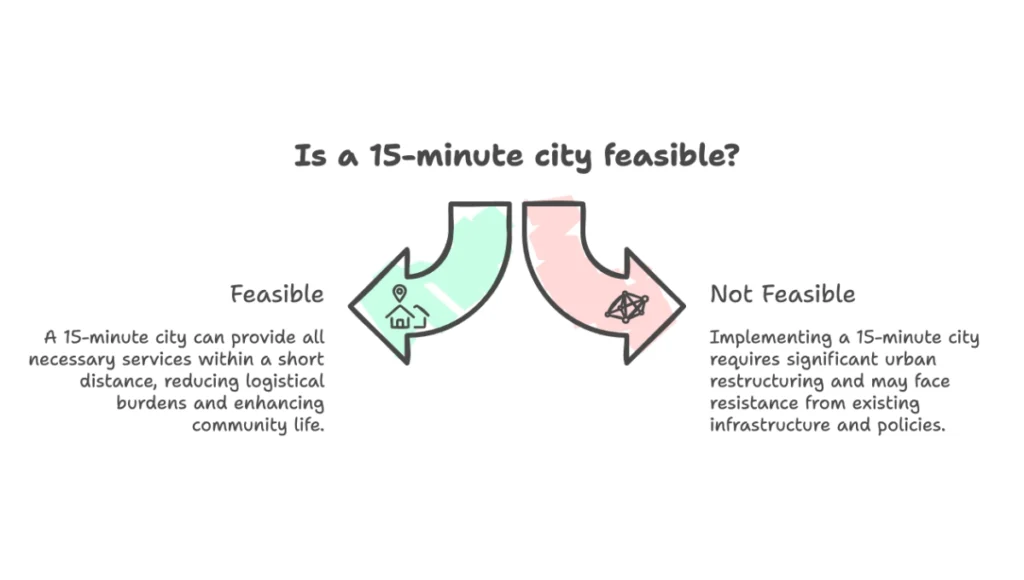
The future demands a fragmented, hyper-localized reality where the neighborhood is the primary unit of global existence. If a city cannot serve your needs within a 1,000-meter radius, it is not a city; it is a warehouse for human capital. This fragmentation is not a sign of decay, but of cellular maturation. Just as a biological organism scales by replicating its core functional units, the metropolis must scale by replicating self-sustaining “Urban Cells.” The feasibility of this transition is the defining challenge for the 21st-century architect.
Nuvira Perspective
At Nuvira Space, we operate at the bleeding edge of human-machine synthesis. We do not view the city as a static collection of concrete and steel, but as a living, breathing computational organ that requires constant recalibration. Our authority is built upon the synthesis of predictive data and sentient design; we see the 15-minute city not as a utopian dream, but as a necessary technical update to a failing metropolitan OS.
By leveraging high-fidelity spatial analytics, we are redefining the metropolitan fabric to serve the biological rhythms of the inhabitant rather than the mechanical needs of the automobile. We specialize in the “soft-warping” of urban space—using data to identify where the current fabric is tearing and applying architectural sutures that restore local sovereignty. Our role is to bridge the gap between the algorithmic efficiency of the machine and the messy, vibrant biological needs of the human species, creating a urban interface that is as intuitive as it is efficient.
The “Blueprint” Solution: Decentralized Sovereignty
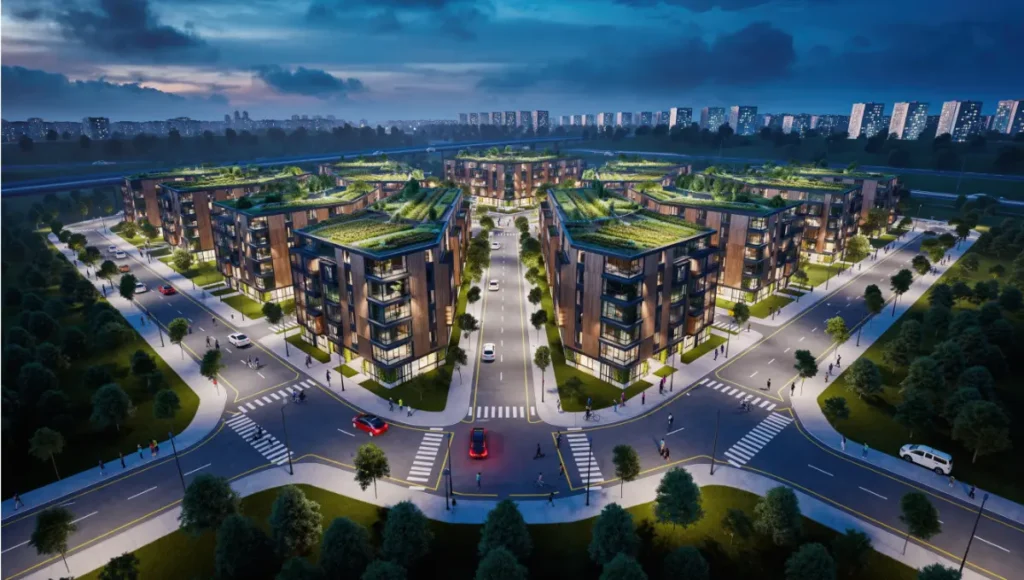
To achieve true feasibility, you must deploy a “cellular” architectural strategy. This is the decentralization of sovereignty—where every district possesses the metabolic capacity to sustain its population without external dependency. This is not about building walls; it is about building “capacitance”—the ability of a neighborhood to store and provide for the needs of its inhabitants.
Structural Specs for the Hyper-Local Node
The 5-Minute Core (The Civic Brain)
A centralized “Civic Anchor” within a 400-meter walk of all residents. This is a multi-layered hub housing essential healthcare diagnostics, automated grocery fulfillment, and primary education. It serves as the data-node for the neighborhood’s energy and waste management.
- Inhabitant Density: Minimum 125 units per hectare to support anchor viability.
- Vertical Integration: Civic services located on the first three floors, residential above.
- Redundancy: Dual-source power (Solar/Kinetic) to maintain core functions during grid failures.
Adaptive Infill Strategy (The Metabolic Layer)
Converting stagnant parking structures and abandoned retail “big boxes” into vertical farms, maker-spaces, and modular laboratories. This generates local caloric and economic value, reducing the “Supply Chain Shadow.”
- Materiality: Cross-laminated timber (CLT) retrofits for existing concrete shells.
- Thermal Logic: Passive heating and cooling through atrium-driven stack effects.
Active Pores (The Circulatory System)
Replacing secondary and tertiary asphalt roads with 4-meter wide “Green Veins.” These are not just paths; they are high-speed micro-mobility arteries and carbon-sequestering bioswales that facilitate pedestrian kinesis while managing local stormwater.
- Permeability: 80% non-sealed surfaces to prevent heat-island effects.
- Kinetic Capture: Foot-traffic surfaces that generate low-voltage power for local lighting.
The Third-Space Overlay
Integrating “un-programmed” spaces—plazas, rooftop commons, and semi-public atriums—that allow for the spontaneous social friction necessary for cultural innovation.
- Access Mandate: 24/7 public accessibility to at least 15% of total floor area in private developments.
The Metabolism of the Block: Temporal Density
Your design must prioritize “Temporal Density.” This means the same square footage serves different functions across a 24-hour cycle. In a Nuvira-recalibrated block, a school by day becomes a community digital hub by night; a restaurant serves as a co-working space in the morning; and a logistics bay for drone delivery doubles as an open-air art gallery on weekends. This ensures no space remains “dark” or unproductive, maximizing the ROI of every cubic meter of the urban fabric. By layering time onto space, we effectively double the capacity of the city without adding a single brick.
Feasibility Study: Economic and Political Barriers
The critique of 15-minute city feasibility often founders on the rocks of political inertia and the entrenched interests of the “status quo sprawl.” You are fighting the “Asphalt Lobby,” the automotive industrial complex, and a deep-seated cultural mythology that equates the private vehicle with individual liberty.
The Economic Paradox of Centralization
Global capital is currently tethered to the Central Business District (CBD). Transitioning to a polycentric model—where wealth and activity are distributed across dozens of local nodes—threatens the underlying asset value of the high-rise office towers that dominate city skylines. To make the 15-minute city feasible, you must propose a radical “Fiscal Pivot.” This involves:
- Reallocating Transit Subsidies: Shifting billions from highway expansion and maintenance toward “Hyper-Local Credits” that incentivize small-scale commercial density in residential deserts.
- Land Value Recapture: Implementing taxes on under-utilized land (like surface parking) to fund the “Green Veins” and civic anchors.
- The Decentralized Tax Base: Allowing local nodes to retain a portion of their economic output to reinvest in their specific metabolic needs.
- Stranded Asset Conversion: Creating tax shelters for developers who convert “zombie” office space into residential/mixed-use neighborhood cells.
Political Resistance and the “NIMBY” Filter
In sprawling metropolises, the introduction of density is often met with the visceral fear of “urbanization” or the loss of “character.” You must frame feasibility not as the loss of private space, but as the gain of private time. The political battle is won through “Granular Transparency.” Using Nuvira’s high-fidelity VR simulations, we show citizens the exact reduction in cognitive load and stress levels when their 45-minute stop-and-go commute is replaced by a 10-minute stroll through a climate-controlled, sensorially enriched green corridor. We are not selling density; we are selling the reclamation of the human lifespan.
Proof of Concept: Rotterdam and the “Cloud-Based” Urban Fabric
Rotterdam stands as a beacon of 15-minute city feasibility, not through sheer luck, but through its radical “Water Square” and “Integrated Neighborhood” initiatives. The city faced a macro-environmental crisis—subsidence and rising sea levels—and chose to solve it through design density rather than retreat.
In the Kop van Zuid district, you see the evidence-based reality of “Vertical Urbanism.” By treating the city as a series of resilient basins, Rotterdam has successfully integrated flood protection with high-density social spaces. The synthesis of high-speed transit and multi-layered residential/commercial blocks ensures that a resident can access a world-class cultural institution, a workspace, and a grocery hub within a 12-minute walk.
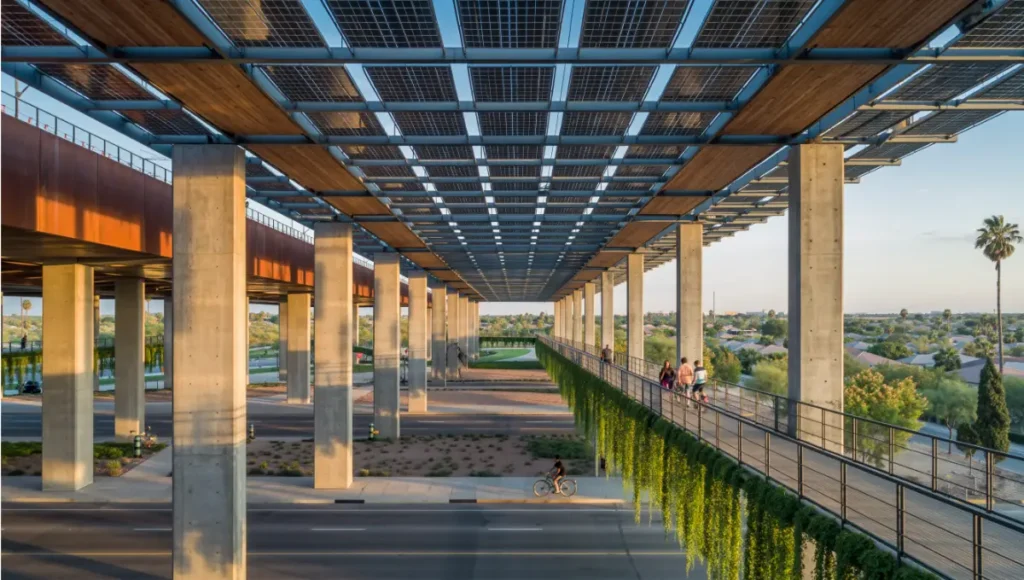
Rotterdam proves that the most daunting environmental challenges can be the catalyst for the very density that makes the 15-minute city viable. Their “Zomerhofkwartier” (ZOHO) district further illustrates this by transforming an industrial zone into a climate-adaptive “test-bed” for hyper-local life, proving that you can “hack” the existing city to achieve proximity without erasing its history.
Concept Project Spotlight: Speculative / Internal Concept Study – Project SYNAPSE by Nuvira Space
Project Overview
- Location: Generic Suburban Sunbelt (e.g., Phoenix / Houston Profile)
- Typology: Retrofitted Multi-Level Interchange / Industrial Infill
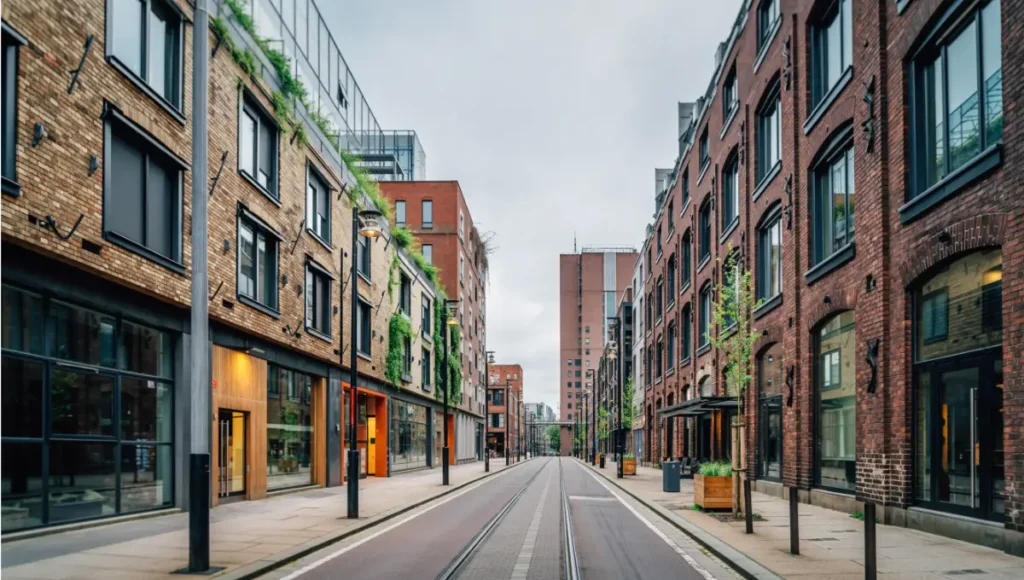
- Vision: To convert a high-traffic highway interchange—the literal heart of the sprawl—into a carbon-neutral “Synapse” that bridges previously severed neighborhoods.
Design Levers Applied
- Modular “Living Pods”: Timber-hybrid residential units suspended via a tensile grid over reclaimed transit lanes. These pods are 3D-printed on-site using recycled polymers, creating high-density living without the need for new land clearing.
- The “Market Mesh”: A ground-level, permeable bazaar that replaces the traditional “big box” store. This mesh uses Nuvira-spec automated micro-retailers that stock goods based on real-time neighborhood consumption data.
- Energy Harvest Skins: All architectural surfaces, including the “living pods” and the market roof, are coated in a third-generation thin-film photovoltaic skin. This makes the neighborhood a net-exporter of energy, powering the surrounding “Active Pores.”
- The Atmospheric Scrub: Integration of “Artificial Trees”—mechanical CO2 scrubbers—that purify the air at the site of the former highway, turning a pollution hotspot into an oxygen-rich lung for the city.
- Hydrological Loop: Capturing greywater from pods and recycling it through the “Market Mesh” for local cooling and vertical farming irrigation.
Transferable Takeaway
Project SYNAPSE demonstrates that the most “dystopian” elements of our current sprawl—the highway interchange and the surface parking lot—are actually the most valuable “land banks” for the 15-minute city transition. We do not need new land; we need to reclaim the land we have wasted on the machine. Any legacy infrastructure can be “hacked” if the architectural intent is bold enough.
2030 Future Projection: The Death of the Commute
By 2030, the term “commute” will be an archaism, a linguistic fossil used to describe the grotesque inefficiencies of the pre-recalibration era. As 15-minute city feasibility is realized globally, we will see the rise of the Cerebral Metropolis.
In this projection, your physical location will no longer be a barrier to your professional or social potential. The “City” will exist as a mesh of high-intensity nodes, connected by invisible data streams and high-velocity subterranean transit for long-distance travel, while the surface is returned to the pedestrian, the cyclist, and the forest.
The concept of “Prime Real Estate” will shift from proximity to a central business district to proximity to “Biodiversity Hubs.” You will live in a world where the air is silent, the streets are social, and the 15-minute radius provides a richer, more diverse experience than the entire 50-mile sprawl of the past. The “Home” will become a high-performance node of production, rest, and connection, powered by the synthesis of localized resources and global intelligence.
Comprehensive Technical FAQ
Q: Is 15-minute city feasibility possible in cities with legacy “Single-Family” zoning?
A: Yes, but it requires a strategy of “Stealth Density” and the “Suburban Hack.”
- Strategy: Legalizing Accessory Dwelling Units (ADUs), converting corner lots into “Micro-Services Hubs,” and allowing for “Gentle Density” like duplexes and triplexes.
- Technical Spec: To sustain a local grocery node and a primary healthcare clinic without external subsidies, a minimum density of 45 residents per hectare (approx. 18 per acre) is required. Most US suburbs sit at 10-12; the “gap” is bridged through modular infill on existing residential lots.
Q: How does the 15-minute city handle industrial and heavy-logistics needs?
A: Via “Peripheral Buffering” and “Last-Mile Automation.”
- Mechanism: Heavy industry and regional distribution centers remain on the city periphery (The Industrial Ring). Goods are then transported into the 15-minute cells via “The Sub-Surface Mesh”—automated, subterranean cargo-conveyors or small-scale electric drones. This eliminates heavy truck traffic from the human-scale streetscape, reducing noise pollution and infrastructure wear.
Q: Will this lead to “Social Silos” or isolation?
A: On the contrary. The current car-centric model is the greatest driver of social isolation in human history.
- Data Point: Studies in polycentric cities like Copenhagen show a 35% increase in “weak-tie” social connections—the casual interactions with neighbors and shopkeepers that build community resilience—when residents walk their daily routes rather than drive. The 15-minute city is the ultimate antidote to the “loneliness epidemic.”
Q: What about the “Digital Divide”? Can technology-driven feasibility be inclusive?
A: Only if the “Civic Anchor” includes a “Digital Commons.”
- Requirement: Every 15-minute node must provide free, high-speed mesh Wi-Fi and public access to high-end computational tools. Feasibility is not just about physical distance; it’s about “Access-Equity.”
Q: How does Nuvira Space manage the psychological impact of increased density?
A: Through “Biophilic Synthesis.”
- Approach: We use fractal geometry in our architectural skins and ensure every “Living Pod” has a direct line of sight to living greenery. We also use sound-dampening “Sonic Buffers”—active noise cancellation at the architectural scale—to ensure the 15-minute city is a place of restorative quiet, not urban clamor.
Recalibrate Your Urban Strategy
The 15-minute city is not a design trend; it is the final frontier of urban survival in a resource-constrained century. The entropy of the sprawl is a luxury we can no longer afford. Nuvira Space is ready to lead the transition from sprawling chaos to data-driven harmony. Whether you are a developer looking to maximize “Yield-per-Human-Hour,” a municipal leader seeking to future-proof your infrastructure against the next climate or economic shock, or an inhabitant tired of losing your life to the asphalt—the time to critique is over. The time to build is now.
Contact Nuvira Space today for a comprehensive Spatial Audit. Let us deploy our predictive analytics to map your neighborhood’s 15-minute potential and begin the recalibration of your metropolitan fabric.