

Table of Contents
Key Takeaways
- Infrastructure Inversion: Obsolete transit corridors are being repurposed as “ecological lungs,” shifting city value from throughput speed to atmospheric health.
- Resilience as Utility: Rewilding is not aesthetic; it is a critical engineering response to the Urban Heat Island (UHI) effect and catastrophic flooding.
- Sociological Recalibration: The transition from concrete car-culture to biophilic corridors restores human-scale interaction to the metropolitan core. This aligns with our vision for the 15-minute city model — read more on feasibility and implementation.
- Data-Driven Ecology: Successful rewilding utilizes IoT and sensor arrays to monitor biodiversity gain and carbon sequestration in real-time.
- Metabolic Sustainability: The shift from “static” architecture to “living” systems marks the next evolution in professional urban planning and civil engineering.
Macro-Observation: The Death of the Concrete Arterial
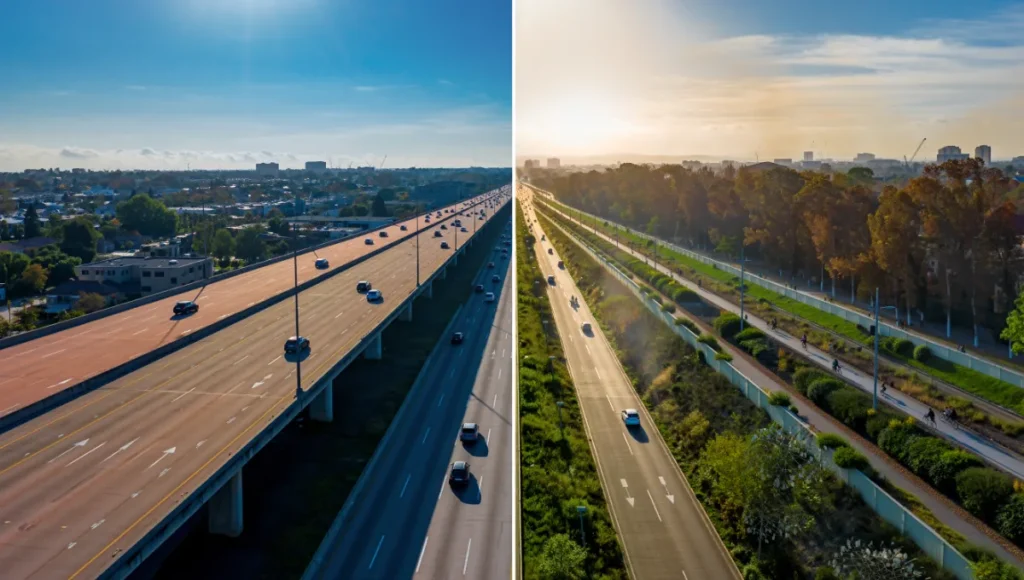
You are witnessing the terminal phase of the 20th-century city. For decades, you lived within a dystopian layout where grey infrastructure—massive, brutalist highway systems—severed the organic growth of neighborhoods. These “urban rewilding examples” are no longer fringe landscape experiments; they are the fundamental rejection of the car-centric grid. By reclaiming the highway, we are not merely planting trees; we are performing a radical surgery on the city’s circulatory system.
The post-war obsession with speed and separation created “non-places”—liminal zones of noise and exhaust that prioritized the machine over the inhabitant. Today, the economic and social cost of these concrete scars has become untenable. We are shifting toward an era of infrastructural inversion, where the very paths that once carried carbon-emitting vehicles now serve as the primary carbon-capturing sinks of the modern metropolis.
Nuvira Perspective: The Recalibration of the Metropolitan Fabric
At Nuvira Space, we view the city as a living, breathing machine—a synthesis of human intent and biological imperative. We do not design “parks”; we engineer high-performance ecological interfaces. Our authority stems from a commitment to data-driven design, where every sapling is a node and every wetland is a filtration system. We believe the future of city planning lies in the “human-machine-nature” triad, where technology facilitates the return of the wild to the core of our most dense civilizations.
We reject the notion that urban development and ecological restoration are at odds. Through the lens of Human-Machine Synthesis, we utilize generative design algorithms to simulate the growth of forest canopies and the flow of air through reclaimed transit corridors. Our goal is to recalibrate the metropolitan fabric, ensuring that the cities of tomorrow are not just “sustainable,” but inherently regenerative.
The “Blueprint” Solution: Engineering Urban Rewilding Examples
To successfully reclaim a highway, you must look beyond the surface. The transition from asphalt to ecosystem is a complex feat of civil engineering that requires a multi-layered technical approach:
1. Structural Load Re-engineering and Weight Mitigation
The primary challenge of rewilding elevated structures is the massive weight of soil and saturated biomass.
- Sub-grade Reinforcement: Utilizing lightweight recycled aggregates (such as expanded clay or glass) to manage soil weight without compromising the existing structural integrity of the viaduct.
- Seismic Dampening: Integrating green mass—trees and dense shrubbery—to act as a natural vibration absorber. This dampens the resonance caused by subterranean transit lines or adjacent heavy rail, protecting the longevity of the structure.
- Structural Monitoring: Embedding fiber-optic sensors within the concrete to provide real-time data on load distribution and tension as the ecosystem matures.
2. Hydrological Autonomy and Stormwater Engineering
Urban rewilding must function as a city-scale sponge.
- Bioswale Filtration: Replacing traditional drainage with tiered vegetation and engineered soils. These systems scrub heavy metals (lead, zinc, copper) from urban runoff through phytoremediation before the water enters the city’s water table.
- Atmospheric Cooling via Evapotranspiration: Strategic placement of high-transpiration species (such as Salix or Populus) to create microclimates. In high-density zones, these corridors can lower local ambient temperatures by up to 5°C, drastically reducing the energy load for surrounding buildings’ HVAC systems.
- Greywater Integration: Designing systems that capture runoff from adjacent rooftops to irrigate the rewilded corridor, creating a closed-loop hydrological circuit.
3. Biotic Connectivity and “Wild” Corridors
We are designing for more than just humans. We are creating “Habitat Stepping Stones.”
- Avian Pathways: Designing specific canopy heights and nesting densities to facilitate the movement of migratory birds through the urban core.
- Pollinator Highways: Integrating native wildflower “strips” that link isolated city parks, allowing for the genetic exchange of local insect populations.
- Micro-Ecology: Prioritizing the soil microbiome. By introducing mycorrhizal fungi into the engineered soil, we ensure that the “urban forest” can communicate and share nutrients, mimicking the resilience of an ancient woodland.
Feasibility Study: The Friction of Progress
Economic Barriers to Urban Rewilding Examples
The primary obstacle you face is the “Sunk Cost Fallacy” of infrastructure. Governments hesitate to decommission billion-dollar assets that have not yet reached their theoretical end-of-life. However, the Nuvira analysis suggests that the long-term maintenance costs of aging elevated highways far exceed the initial capital expenditure of a linear park.
- Value Capture and the “High Line Effect”: Real estate adjacent to rewilded corridors typically sees a 15-25% appreciation in valuation. This creates a “tax increment financing” opportunity where the project pays for itself through increased property tax revenue.
- Healthcare ROI: Air pollution in highway-adjacent neighborhoods is a leading cause of asthma and cardiovascular disease. Reductions in these ailments through biophilic filtration provide a direct, measurable ROI for municipal health budgets, often amounting to millions of dollars in saved productivity and treatment costs.
- Energy Mitigation: The “Cool Island” effect reduces the need for mechanical cooling in neighboring skyscrapers, providing a direct private-sector incentive for rewilding.
Political Inertia and the “Right to the Road”
The “Right to the Road” remains a potent sociological myth in many Western cultures. Overcoming this requires a shift in the narrative. We are not “taking away lanes”; we are “granting life.”
The political challenge lies in navigating the transition period. During the construction of rewilding projects, traffic congestion may temporarily increase. To mitigate this, planners must integrate Transit-Oriented Development (TOD), ensuring that as highway capacity is reduced, high-speed rail or autonomous transit lanes are integrated into the new green corridor.
Proof of Concept: Global Benchmarks of Success
To ground our analysis, we must look at the pioneers who have successfully navigated the friction of rewilding.
1. Singapore’s Green Heart: The Gold Standard
Look at Singapore. The city-state has transcended the “urban” label to become a “City in Nature.” Through the Park Connector Network (PCN), they have transformed canal edges and transit corridors into lush, biophilic highways.
- The Technical Edge: Singapore utilizes a proprietary “Digital Twin” of its urban forest, using sensors to monitor soil moisture, nutrient levels, and carbon sequestration rates. This ensures that the machine of nature operates at peak efficiency. It serves as the ultimate evidence that high-density living and wild biodiversity are not mutually exclusive.
2. Seoul’s Cheonggyecheon Stream: The Blue-Green Rebirth
In 2003, Seoul took the radical step of tearing down a major elevated highway to “daylight” an ancient stream buried beneath the concrete.
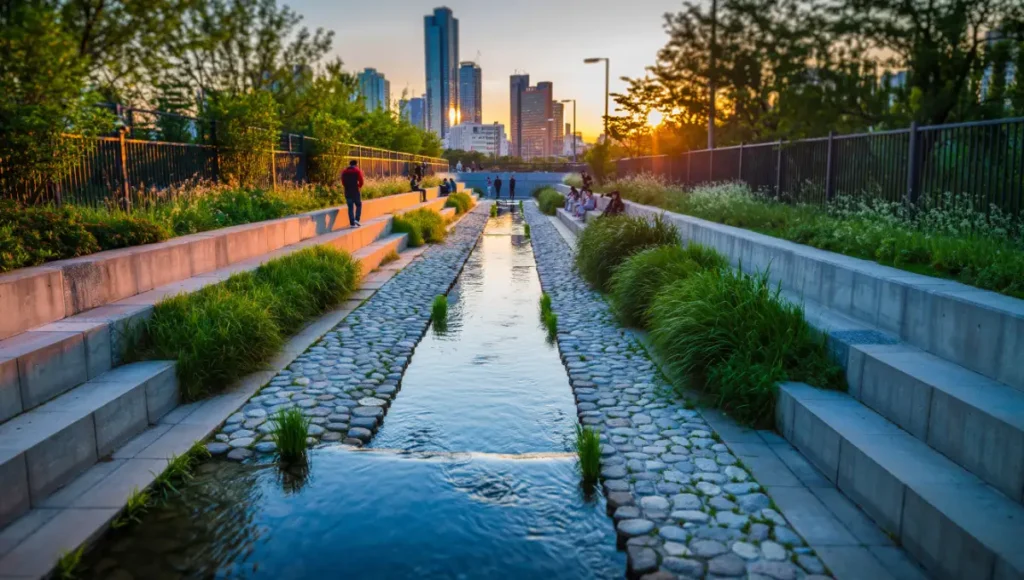
- Impact: The project didn’t just create a park; it lowered the temperature of the surrounding area by 3.6°C and triggered a massive revitalization of the downtown core. It proved that the “loss” of a road is an immense “gain” for the city’s soul.
3. Rotterdam’s Hofbogen: The Productive Viaduct
In Rotterdam, the Hofpleinline—a 1.9km elevated railway—is being transformed into a biodiverse roof park.
- Sociological Value: Unlike traditional parks, the Hofbogen integrates “productive” landscapes, including urban farming and beehives, fostering a new type of “citizen-steward” who participates in the city’s metabolism.
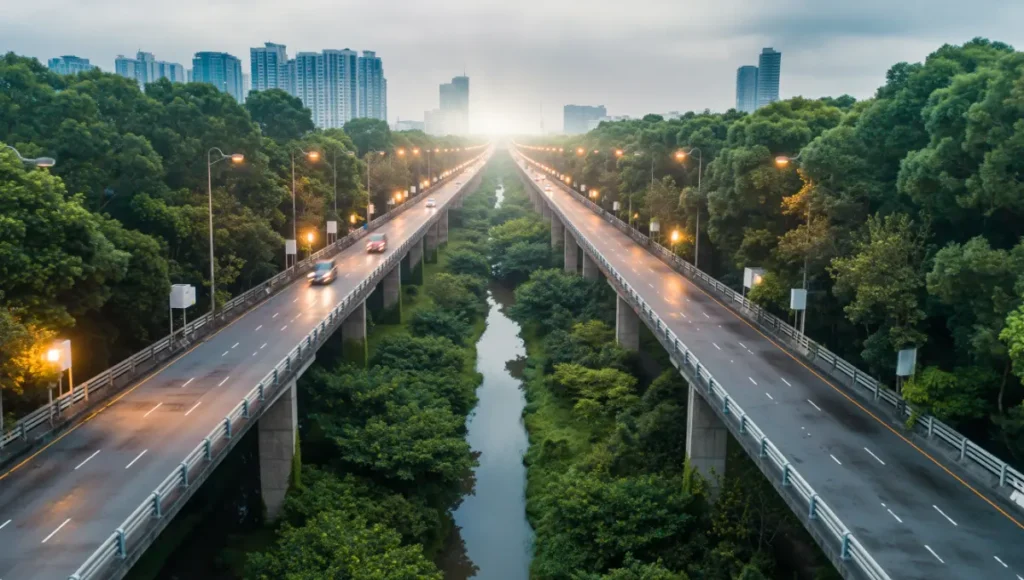
Speculative / Internal Concept Study: THE PULSE CORRIDOR by Nuvira Space
Project Overview
- Location: Abandoned Elevated Expressway Segment (Generic Global Metropolis)
- Typology: Adaptive Reuse / Multi-Species Transit Hub / Carbon Sink
- Vision: A 3-mile “Synthetic Forest” that generates its own microclimate while facilitating zero-emission micro-mobility.
Design Levers Applied
- Aero-Kinetic Harvesting: Small-scale, silent vertical turbines integrated into the “tree” structures to power the park’s sensor grid and lighting.
- Mycelium Remediation: Using fungal networks within the soil beds to break down legacy toxins (petrochemicals) from decades of leaded fuel exhaust. This is “Biochemical Infrastructure.”
- Tactile Navigation & AI Synthesis: Haptic paving for the visually impaired, synchronized with local biodiversity “sounds-capes” via an AR interface that identifies bird calls and plant species in real-time.
- Modular Carbon Scrubbers: Synthetic “leaves” integrated into the canopy that use carbon-capture technology to supplement the natural sequestration of the trees.
Transferable Takeaway
The “Pulse Corridor” proves that infrastructure can be multi-modal. A space can simultaneously be a forest, a power plant, a transit line, and a community hearth. It represents the end of the “single-use” asset in urban planning.
2030 Future Projection: The Ecotone City
By 2030, you will no longer recognize the “suburb” or the “downtown.” The city will become an ecotone—a transitional zone between the wild and the built. We predict the total removal of at least 30% of inner-city elevated highways in the G20 nations.
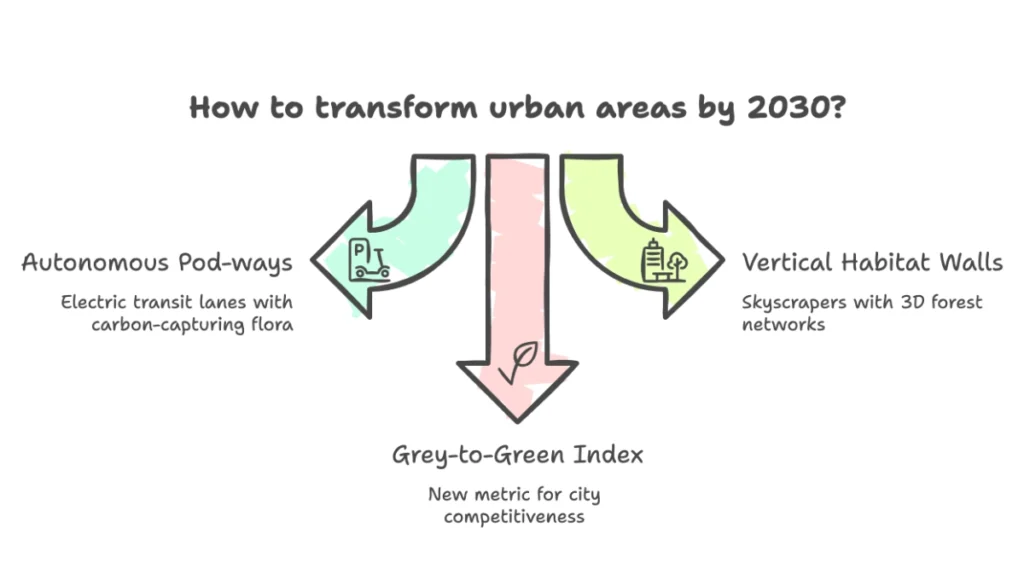
These spaces will be replaced by:
- Autonomous Pod-ways: Narrow, electric transit lanes shrouded in dense, carbon-capturing flora.
- Vertical Habitat Walls: The sides of skyscrapers will become extensions of the highway-parks, creating a 3D forest network.
- The “Grey-to-Green” Index: This will replace GDP as the primary metric for a city’s global competitiveness and inhabitant well-being.
Comprehensive Technical FAQ
Q: How does urban rewilding impact existing transit times for the working class?
A: Counter-intuitively, rewilding often triggers Braess’s Paradox, where removing a road can actually improve traffic flow by encouraging a shift to higher-capacity transit modes (Light Rail, BRT) and reducing “induced demand.” Furthermore, by integrating affordable housing within the “rewilding zones,” we reduce the need for long-distance commuting.
Q: What are the specific technical requirements for soil depth on bridges?
A: Modern rewilding uses “Intensive Green Roof” specs to ensure tree stability and health:
- Ground Cover (Grasses/Moss): 150mm–300mm
- Shrubs and Hedgerows: 450mm–600mm
- Small to Medium Trees: 800mm–1200mm (This requires specific structural reinforcement over the piers of the highway to handle point loads).
Q: Can rewilding mitigate the Urban Heat Island (UHI) effect significantly?
A: Yes. UHI is caused by asphalt and concrete absorbing and re-radiating heat. By replacing these “thermal masses” with vegetation, rewilded corridors create “cool islands” that extend up to 200 meters into the surrounding urban fabric, lowering the energy demand for the entire district.
Q: How do you handle the maintenance of “wild” spaces in an urban setting?
A: We use Precision Ecology. Robotic mowers, IoT soil sensors, and drone-based health monitoring allow us to manage vast green corridors with minimal human labor, ensuring that the “wild” remains safe and accessible without becoming overgrown or hazardous.
Reclaim Your Horizon
The era of the asphalt wasteland is over. The dystopian cities of the 20th century were built on the premise of separation and exploitation. The 21st-century city will be built on the premise of integration and restoration.
As an architect, developer, or city official, you have the power to demand a city that breathes. Nuvira Space is ready to partner with visionary planners to turn these speculative blueprints into physical realities.
Don’t just build the future. Grow it.