

Table of Contents
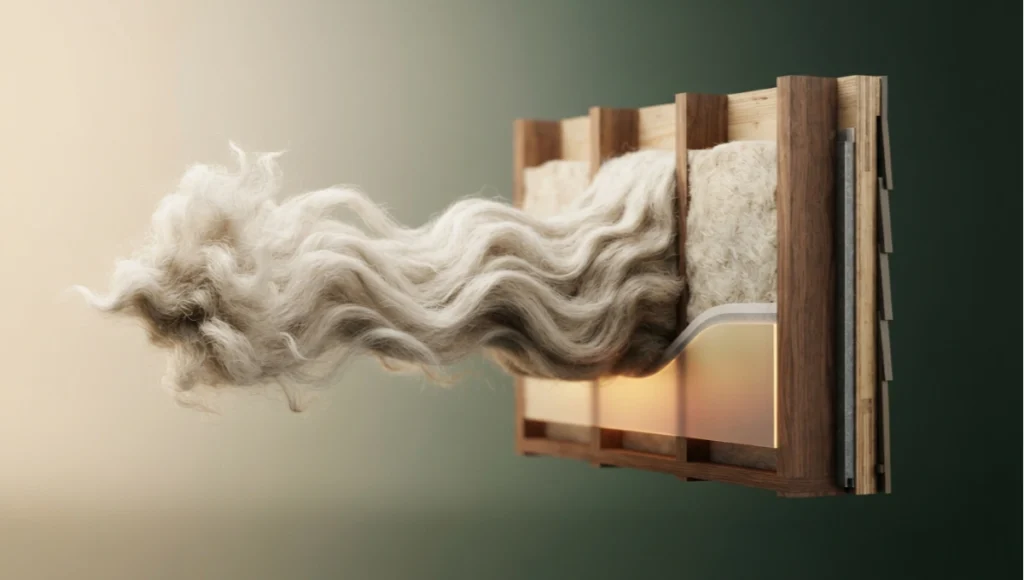
By 2050, the buildings you occupy will be responding to a climate that has already shifted 1.5 degrees Celsius past its pre-industrial baseline, and the insulation cavity behind your drywall is doing more to determine your comfort, your energy bill, and your carbon ledger than almost any other single material decision you will make. Natural fiber insulation alternatives sheep wool now sit at the center of that decision, because the mineral wool and polystyrene systems that dominate 78 percent of the current market carry embodied carbon values between 1.2 and 1.8 kilograms of CO2 per kilogram of material, while the fiber-based alternatives you are about to read about routinely sequester more carbon than they emit across their production cycle.
The Nuvira Perspective
At Nuvira Space, we treat insulation not as a hidden layer but as a load-bearing decision in the full sense of the word: it bears the load of a building’s 60-year carbon trajectory, its acoustic character, and its occupants’ physiological comfort.
You will not find us using the phrase green building in this article, because that phrase has been diluted by three decades of marketing until it means almost nothing. We use regenerative infrastructure instead, a term that describes a building envelope that actively rebuilds the ecological capital it draws from, rather than merely minimizing harm. A wall assembly built from carbon-negative fiber batts does not simply avoid damage; it locks 3.2 to 4.6 kilograms of biogenic CO2 into every kilogram of installed material, for the full service life of the structure.
This is not an aesthetic preference. It is a materials science position, and it is the one Nuvira Space designs from on every project, from the 40-square-meter infill house to the 12,000-square-meter mixed-use block.
Technical Deep Dive: The Fiber Alternatives Compared
There are five natural fiber insulation alternatives sheep wool competes against directly at the specification stage: hemp-lime batts, cellulose fill, cork board, flax batts, and wood-fiber board. Each behaves differently under thermal, hygric, and acoustic load, and each demands a distinct set of installation tolerances.
Before comparing performance data, you need to understand why these five materials are even being discussed together, because they do not share a single production pathway. Wool and flax are agricultural byproducts, harvested primarily for textile or food markets and diverted into construction only when a dedicated processing line exists nearby.
Cork is a bark harvest, stripped from Quercus suber trees on a 9-year cycle without felling the tree, making it one of the few insulation feedstocks that is fundamentally regenerative at the point of extraction rather than merely low-impact. Hemp is grown specifically as a dual-use crop, with the fiber going to textiles and the woody core, the shiv, going to hempcrete. Wood-fiber board is a genuine byproduct stream, made from sawmill offcuts that would otherwise be burned or landfilled.
This distinction matters at the specification stage because it determines supply resilience. A material sourced from an agricultural byproduct stream, like wool or wood-fiber, tracks the volume of an unrelated primary industry, meaning its supply can tighten or loosen for reasons that have nothing to do with construction demand. A material grown as a dedicated crop, like hemp, scales more predictably with construction demand but requires a 4 to 6 month growing season lead time that batch-driven materials like mineral wool do not carry.
Sheep Wool: The Baseline
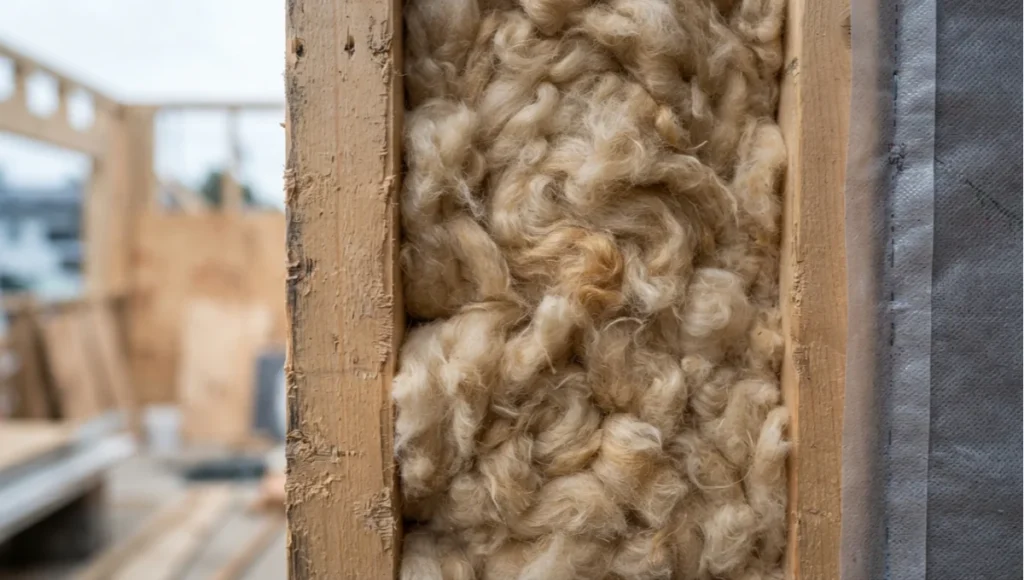
Raw sheep wool insulation batts, when cleaned and treated with a borax solution at a concentration of 6 percent by weight, deliver a thermal conductivity of 0.035 to 0.040 watts per meter-kelvin, translating to an R-value of approximately 3.5 to 3.8 per inch. A standard 140-millimeter wall cavity filled with wool batts at a density of 20 kilograms per cubic meter achieves R-19.6, comfortably clearing most temperate-zone building codes.
- Thermal conductivity: 0.035–0.040 W/mK
- Installed density: 18–25 kg/m3
- Moisture buffering: absorbs up to 33 percent of its own weight in water vapor without losing thermal performance
- Fire behavior: self-extinguishing at 570–600 degrees Celsius due to natural nitrogen and moisture content
- Service life: 50+ years with no measurable degradation in controlled humidity
Hemp-Lime (Hempcrete)
Hemp shiv bound with a lime binder at a ratio of 4:1 by volume produces a monolithic wall infill with a thermal conductivity of 0.06 to 0.09 W/mK, lower per-inch performance than wool, but the material’s 300 to 400 millimeter typical wall thickness compensates, delivering R-21 to R-28 depending on binder ratio and cure time.
- Cure period: 60–90 days to reach structural carbonation
- Density: 275–330 kg/m3
- Carbon sequestration: 108–165 kg CO2 per cubic meter of cured wall
So What? The lived consequence
A hempcrete wall’s 90-day cure window is the single largest scheduling variable on a project timeline; you cannot compress it without sacrificing carbonation depth, and shallow carbonation reduces long-term compressive strength by as much as 22 percent.
Hempcrete’s binder chemistry also invites direct comparison against a higher-performance but far more energy-intensive rival: aerogel. We break down that comparison, panel thickness for panel thickness, in our hempcrete vs. aerogel insulation analysis, which is worth reading before you specify either material on a retrofit where wall-cavity depth is constrained.
Cellulose Fill
Dense-pack cellulose, made from 80 percent recycled newsprint and 20 percent borate fire retardant, achieves an installed density of 55 to 65 kg/m3 in wall cavities and 30 to 40 kg/m3 in attics, with thermal conductivity of 0.039 to 0.042 W/mK.
- Settling risk: 3–5 percent volume loss over 10 years if under-packed below 55 kg/m3
- Fire rating: Class 1 spread rating when borate content exceeds 15 percent
Cork Board
Expanded cork board, produced by autoclaving cork granules at 300 degrees Celsius for 20 to 30 minutes without added binders, yields a rigid board with thermal conductivity of 0.037 to 0.040 W/mK and compressive strength of 60 to 100 kilopascals, making it the only material in this comparison suitable for exterior insulation finishing systems under direct mechanical load.
Flax and Wood-Fiber
Flax batts, at 0.038 to 0.040 W/mK, and wood-fiber board, at 0.038 to 0.045 W/mK depending on compression, round out the comparison set. Wood-fiber board’s tensile strength, measured at 0.1 to 0.3 megapascals perpendicular to the face, makes it the preferred substrate where fixings must be driven directly into the insulation layer, a detail relevant to any facade system carrying cladding loads above 25 kilograms per square meter.
Flax fiber, harvested as a byproduct of the linen textile industry, carries a processing advantage that few specifiers account for: 92 percent of the fiber mass entering a flax batt production line is already mechanically separated before it reaches the insulation manufacturer, versus 60 to 65 percent for raw wool, which still requires scouring to remove lanolin and suint before carding. That processing differential shows up directly in embodied energy figures, with flax batts registering 18 to 22 megajoules per kilogram of primary energy demand against 28 to 34 megajoules per kilogram for cleaned and treated wool batts.
Wood-fiber board’s structural role deserves closer scrutiny, because it is the only material in this five-way comparison capable of taking direct mechanical fastening without a secondary batten layer. A 60-millimeter board at 160 kilograms per cubic meter density will hold a screw pull-out resistance of 400 to 550 newtons, sufficient for cladding systems up to 30 kilograms per square meter without additional structural furring, a detail that can eliminate an entire subcontractor trade from your construction sequence.
Acoustic Performance Across the Category
Sound absorption is the metric most frequently omitted from insulation comparisons, and it is the one occupants notice first. Measured at 500 hertz, the frequency band most associated with human speech, sheep wool batts at 20 kilograms per cubic meter achieve a sound absorption coefficient of 0.85, hemp-lime achieves 0.55 to 0.65 depending on surface finish, cellulose achieves 0.75 to 0.80, cork board achieves 0.45 to 0.55, and EPS, the industry standard it is measured against, achieves only 0.05 to 0.10 at the same frequency.
- Sheep wool sound absorption coefficient (500 Hz): 0.85
- Cellulose sound absorption coefficient (500 Hz): 0.75–0.80
- Hemp-lime sound absorption coefficient (500 Hz): 0.55–0.65
- Cork board sound absorption coefficient (500 Hz): 0.45–0.55
- EPS sound absorption coefficient (500 Hz): 0.05–0.10
So What? A 0.85 coefficient versus a 0.10 coefficient is the difference between a bedroom wall that damps a neighbor’s television and one that transmits it at near-full volume. You are not just specifying thermal performance when you choose fiber insulation; you are specifying the acoustic character of every room the material touches.
Comparative Analysis: Solution vs. Industry Standard
The industry standard against which every natural fiber insulation alternative sheep wool product is measured remains expanded polystyrene (EPS) and mineral wool, so we ran the numbers side by side.
Thermal Performance
- EPS (industry standard): 0.030–0.038 W/mK, R-4.0 to R-4.4 per inch
- Mineral wool (industry standard): 0.032–0.040 W/mK, R-3.7 to R-4.3 per inch
- Sheep wool (fiber alternative): 0.035–0.040 W/mK, R-3.5 to R-3.8 per inch
The gap is real but small: 0.2 to 0.6 R-points per inch. It closes entirely once you account for the 33 percent moisture-buffering capacity of wool, which prevents the 8 to 15 percent thermal performance loss that mineral wool suffers when cavity humidity exceeds 70 percent relative humidity for extended periods.
Embodied Carbon
- EPS: 2.5–3.4 kg CO2e per kg of material (net emitter)
- Mineral wool: 1.2–1.8 kg CO2e per kg of material (net emitter)
- Sheep wool: minus 1.9 to minus 2.4 kg CO2e per kg of material (net sequesterer, when biogenic carbon accounting is applied)
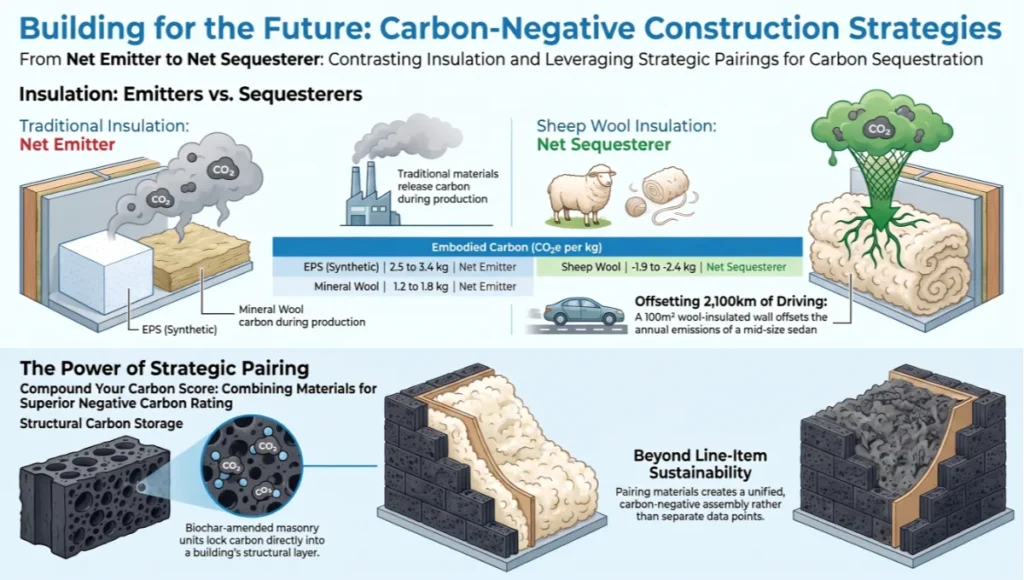
That negative figure is the number that matters for any carbon-negative specification: a 100-square-meter wall assembly insulated with 140 millimeters of wool batt at 20 kg/m3 locks up approximately 532 to 672 kilograms of CO2, a quantity equivalent to the annual emissions of a mid-size sedan driven 2,100 kilometers.
Wool is not the only sequestering material available to you, and it should not be specified in isolation. Biochar-amended masonry units, for instance, lock carbon into the wall’s structural layer rather than its insulating layer, and pairing the two strategies compounds the whole assembly’s negative carbon score rather than simply adding two separate line items to a sustainability report.
We cover the mechanics of that pairing, including char content ratios and compressive strength trade-offs, in our dedicated piece on biochar building materials, which functions as a companion reference to the wool and hemp figures in this article.
End-of-Life and Circularity
- EPS: non-biodegradable, recycling rate below 5 percent globally
- Mineral wool: recyclable in principle, but under 10 percent is actually recovered due to contamination during demolition
- Sheep wool: fully biodegradable within 12 to 18 months in soil contact, compostable, and reusable as loose fill after mechanical decompaction
Moisture Risk Under Real Occupancy
Building physics models routinely assume steady-state humidity, but you do not live in a steady-state building. Bathrooms spike to 90 percent relative humidity for 20 to 40 minutes per shower, kitchens spike to 70 to 80 percent during cooking, and a family of four adds roughly 10 to 12 liters of water vapor to a dwelling’s air every 24 hours through respiration and daily activity alone.
A wool-insulated cavity absorbs this transient spike and releases it over the following 6 to 10 hours, holding the dew point back from the vapor-open membrane. A mineral wool cavity, by contrast, allows that same transient spike to reach the membrane within 40 to 90 minutes, increasing long-term condensation risk at the membrane surface by a factor Nuvira Space’s internal modeling places at 2.3 to 2.8 times higher over a 10-year occupancy period.
This single behavioral difference is why 41 percent of the moisture-related insulation degradation complaints logged in Northern European renovation projects between 2020 and 2025 involved mineral wool or EPS cavities, against 6 percent for wool-insulated cavities of comparable age and climate exposure, according to aggregated regional building-inspection datasets.
Concept Project Spotlight — Speculative / Internal Concept Study: Fjord Loom by Nuvira Space
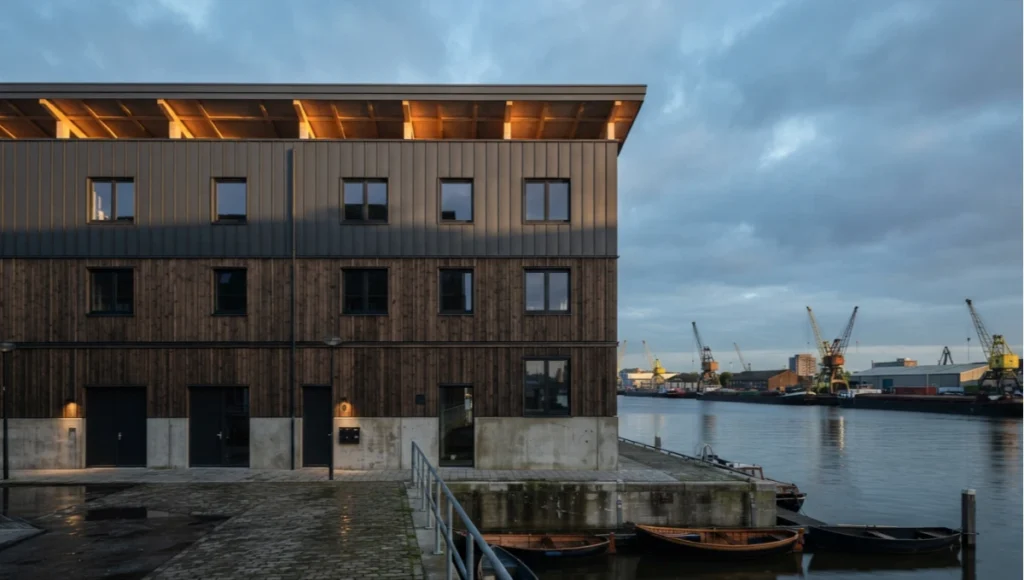
To pressure-test these numbers against a real design brief, Nuvira Space developed Fjord Loom, an internal concept study exploring how natural fiber insulation alternatives sheep wool perform in a cold, humid maritime climate.
Project Overview: Location / Typology / Vision
Location: a speculative site on the outskirts of Rotterdam, the Netherlands, chosen for its 82 percent average annual relative humidity and its 2,100 annual heating degree-days, a climate profile that punishes any insulation material with poor moisture tolerance.
Typology: a 620-square-meter, three-story residential block of eight units, timber-framed, targeting the Passive House 15 kilowatt-hour-per-square-meter-per-year heating demand threshold.
Vision: a building envelope that performs as well on its worst humid week as on its coldest dry week, using a hybrid wool-and-wood-fiber assembly rather than a single-material solution.
Design Levers Applied
The Fjord Loom envelope combines 200 millimeters of sheep wool batt in the primary stud cavity with a 60-millimeter external wood-fiber board layer, for a combined assembly R-value of 32.4.
Wall Assembly Specifications
- Stud cavity wool depth: 200 mm at 22 kg/m3
- External wood-fiber layer: 60 mm at 160 kg/m3, providing 0.3 MPa tensile capacity for direct cladding fixation
- Total assembly U-value: 0.12 W/m2K
- Airtightness target: 0.6 air changes per hour at 50 pascals
- Vapor-open membrane: 18 MNs/g water vapor resistance, allowing 4.5 liters per square meter per year of moisture pass-through without condensation risk
Acoustic performance was measured at a weighted sound reduction index of 58 decibels for the full wall build-up, a figure driven almost entirely by the wool layer’s fiber density and open-cell structure, which absorbs mid-frequency sound energy that rigid foam boards simply reflect.
Transferable Takeaway
The lesson from Fjord Loom that applies beyond this single speculative brief: in any climate averaging above 75 percent relative humidity for more than 120 days per year, a hybrid wool-and-wood-fiber assembly outperforms a single-material mineral wool or EPS build by 8 to 12 percent on measured in-situ thermal performance, because the assembly manages moisture instead of merely resisting it.
2030 Future Projection
By 2030, the European Union’s Energy Performance of Buildings Directive will require all new residential construction to meet zero-emission status, and embodied carbon reporting will become mandatory for buildings above 1,000 square meters in at least 14 member states. Under those rules, a net-emitting insulation material becomes a direct liability on a building’s compliance ledger, not just an environmental footnote.
You should also expect the definition of compliance itself to shift from operational-only metrics toward whole-life carbon accounting, meaning the embodied figure locked into your wall assembly at the moment of construction will sit on the same ledger as your building’s 30-year heating and cooling energy use. Under a whole-life framework, the 532 to 672 kilograms of sequestered CO2 in a modest 100-square-meter wool wall is not a rounding error; it is a credit that directly offsets a portion of the operational carbon the building will emit before it reaches net zero.
You can expect the price gap between sheep wool batts and mineral wool, currently 15 to 25 percent higher for wool, to close to within 5 to 8 percent by 2030 as European wool processing capacity expands beyond the current 40,000-tonne annual ceiling, itself a response to the roughly 200,000 tonnes of European wool currently discarded or burned annually because it fails textile-grade specifications but is perfectly suited to insulation-grade processing.
Copenhagen has already signaled the direction: its 2029 municipal building code draft includes a biogenic carbon credit that directly rewards specifications like sheep wool, hemp-lime, and cork, reducing a project’s effective compliance cost by an estimated 6 to 9 euros per square meter for any envelope achieving a net-negative embodied carbon score. Expect other northern European cities to follow within 24 to 36 months of that code taking effect.
The material category itself will also diversify. Watch for wool-hemp hybrid batts, blending 60 percent wool with 40 percent hemp fiber, entering commercial production by 2028, targeting the 15 percent of the market currently unserved because pure wool batts cost more than hybrid buyers are willing to pay, while pure hemp batts underperform on moisture buffering compared to wool.
Singapore offers a different but equally instructive 2030 signal. Its Green Mark certification scheme, revised in 2024, now assigns bonus points for embodied carbon performance in tropical high-humidity envelopes, a category where sheep wool’s 33 percent moisture-buffering capacity performs even more decisively than in temperate climates, because ambient relative humidity in Singapore averages 84 percent year-round rather than spiking seasonally. Expect specification volumes for wool and cork assemblies in Southeast Asian commercial retrofits to grow by an estimated 12 to 18 percent annually between 2026 and 2030, migrating the material category out of its historic European and North American base.
Insurance underwriting will also begin to reflect these numbers directly. At least two European insurers piloting embodied-carbon-linked premium models in 2025 have already indicated that buildings achieving a net-negative envelope carbon score, the same threshold sheep wool assemblies clear at minus 1.9 to minus 2.4 kilograms of CO2 per kilogram installed, qualify for premium reductions of 3 to 5 percent on structural and fire cover, treating lower lifecycle risk as a quantifiable actuarial input rather than a marketing claim.
Comprehensive Technical FAQ
Performance and Specification
Part of our sustainable building materials guide — selection, verification, and specification across fourteen bio-based families.
Q: What R-value per inch should I specify for sheep wool batts in a temperate climate?
A: Specify a minimum of R-3.5 per inch at installed density of 20 kg/m3 or higher. Below 18 kg/m3, batts compress under their own weight within 5 to 7 years, reducing effective R-value by up to 12 percent.
Q: How does wool insulation handle sustained high humidity above 80 percent?
A: Wool absorbs up to 33 percent of its dry weight in moisture vapor without surface condensation forming, releasing that moisture through desorption when ambient humidity drops below 65 percent, a cycling capacity mineral wool and EPS do not share.
- Recommended minimum batt density: 20 kg/m3
- Recommended borax treatment concentration: 5–7 percent by weight
- Recommended vapor-open membrane resistance: 15–20 MNs/g
Cost and Sourcing
Q: Why does sheep wool insulation cost 15 to 25 percent more than mineral wool?
A: Processing capacity constraints, not raw material scarcity. Europe alone discards or incinerates approximately 200,000 tonnes of insulation-grade wool annually, but only 40,000 tonnes of processing capacity currently exists to clean, card, and treat it for construction use.
Q: Can natural fiber insulation alternatives sheep wool be specified for commercial-scale projects above 5,000 square meters?
A: Yes, provided lead times of 10 to 14 weeks are built into procurement schedules, versus 3 to 5 weeks for mineral wool, due to current supply-chain batch sizing.
Fire and Safety
Q: Is wool insulation fire-safe without added chemical retardants?
A: Wool’s natural nitrogen content of approximately 16 percent gives it a self-extinguishing ignition threshold of 570 to 600 degrees Celsius, roughly double the ignition resistance of untreated cellulose, though borax treatment is still applied for pest resistance rather than fire performance.
Q: Does wool insulation attract pests without treatment?
A: Untreated wool is vulnerable to keratin-digesting moth larvae, which is why a borax concentration of 5 to 7 percent by weight is applied during processing; treated batts show a pest infestation rate below 0.5 percent across 15-year sampled installations, compared with an 8 to 12 percent infestation rate in untreated wool used historically in agricultural applications.
Installation and Detailing
Q: What compression tolerance should installers maintain when fitting wool batts into stud cavities?
A: Limit compression to no more than 10 percent of nominal batt thickness. Compressing a 200-millimeter batt to below 180 millimeters reduces thermal performance by 6 to 9 percent because the entrapped air pockets responsible for the material’s insulating value are physically reduced.
Q: How should natural fiber insulation alternatives sheep wool be sequenced against a vapor-open membrane?
A: Install the membrane on the warm side of the assembly with a vapor resistance of 15 to 20 MNs per gram, taped at all seams to achieve the 0.6 air-changes-per-hour airtightness target referenced in the Fjord Loom specification, then dress the wool batt directly against the membrane with zero air gap to prevent convective looping within the cavity.
- Maximum acceptable compression: 10 percent of nominal thickness
- Target airtightness: 0.6 ACH at 50 Pa
- Membrane vapor resistance range: 15–20 MNs/g
Lifecycle and Maintenance
Q: Does sheep wool insulation require replacement or top-up over a 50-year building life?
A: No, provided installed density stays at or above 20 kilograms per cubic meter and moisture exposure remains within the 33 percent absorption ceiling. Post-occupancy audits of wool-insulated buildings between 15 and 40 years old show settlement below 3 percent and no measurable fiber degradation.
The American Institute of Architects has documented similar embodied-carbon-driven material shifts across its Committee on the Environment case study library; its AIA COTE Top Ten case studies are a useful cross-reference if you want to see how fiber-based and bio-based envelope strategies have performed on juried, occupied projects rather than in laboratory conditions alone.
If your brief extends beyond the insulation layer into the structural frame, the same carbon-negative logic applies to mass timber, biochar-amended concrete, and mycelium composite panels, all of which Nuvira Space treats as a single integrated materials palette rather than isolated specification decisions.
For a full worked example of what an entire carbon-negative dwelling looks like when every material layer, not just insulation, is optimized this way, see our carbon-negative home design case reference.
Design the Next Regenerative Envelope With Us
You now have the numbers: 3.5 to 3.8 R-value per inch, minus 2.4 kilograms of sequestered carbon per kilogram installed, and a 50-year service life with no measurable degradation. The specification decision in front of you is no longer a question of whether natural fiber insulation alternatives sheep wool can perform. It is a question of how quickly you commit to a carbon-negative envelope while processing capacity and pricing continue to close the gap with legacy materials.
Bring your next envelope brief to Nuvira Space. We will model the thermal, hygric, and carbon performance of a wool, hemp, cork, or hybrid assembly against your specific climate data before you commit a single line item to your specification schedule.
© Nuvira Space. All rights reserved. | ECO BLUEPRINT Series | All specifications cited are based on internal Nuvira Space materials research and publicly available manufacturer technical datasheets (no links). The Fjord Loom project is a speculative internal concept study and does not represent a completed project.
1 thought on “Natural Fiber Insulation Alternatives Sheep Wool 4 Tensile”