

Table of Contents
| Key Takeaways Playable cities game mechanics public space is emerging as a critical framework for retrofitting car-dominated streets into participatory civic infrastructure, replacing punitive absence with legible incentive. Rotterdam, Singapore, and Tokyo already embed game-like feedback loops — sensors, points, visible counters, fare-linked rewards — into everyday public realm and transit design, even where the language of “gamification” is never used. Transit-oriented development becomes measurably more resilient when playable feedback mechanisms give residents a visible, repeated stake in shared infrastructure rather than a single symbolic gesture. Nuvira Space’s internal concept study, Pulse Corridor, demonstrates how modular play-triggers can be layered onto an existing transit spine without full demolition or a new digital platform. By 2030, playable cities game mechanics public space will likely shift from novelty installation to embedded procurement standard, following the same institutional path bike infrastructure took a decade earlier. |
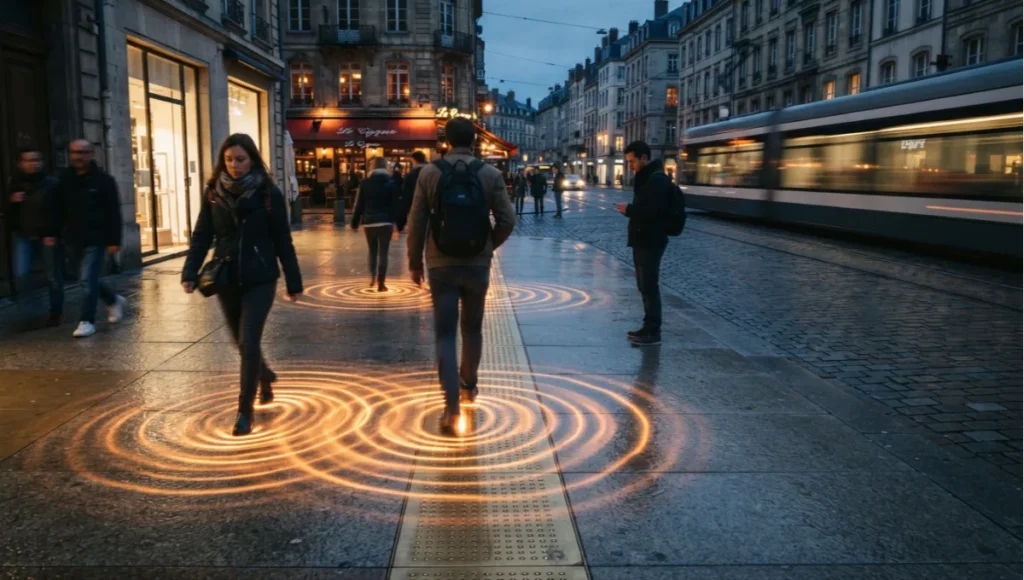
You walk through most Western downtowns today and you inhabit a diagram, not a neighborhood — an environment engineered for throughput rather than for the accidental, self-organizing collisions that once defined civic life. The premise of playable cities game mechanics public space begins exactly here, at the friction point between infrastructure built for vehicles and citizens who no longer have a legible reason to linger. You have been sorted into a pedestrian, a commuter, a customer — categories that dissolve the messier, richer identity of resident.
The street corner you cross twice daily contains no memory of you. It does not know you passed through it yesterday, or that you paused at the same bench for the same eleven minutes every Thursday. It offers no acknowledgment, no continuity, no reciprocity.
Game mechanics, borrowed from designed play systems, propose something almost heretical to postwar planning orthodoxy: that a street corner can hold rules, feedback, and reward without collapsing into a theme park. This is not gamification as marketing gloss, the kind that slaps a loyalty badge onto an app and calls it civic innovation. It is a sociological repair mechanic for public space that has been drained of reciprocity by seventy years of single-use zoning, minimum parking requirements, and traffic-engineering models that treat pedestrian behavior as noise to be minimized rather than signal to be designed around.
When you ask what playable cities game mechanics public space actually means in practice, the honest answer is that it means infrastructure willing to notice you, respond to you, and reward the behaviors that make a street a shared commons rather than a corridor.
The dystopian version of the contemporary city is not the overtly hostile one — the spikes on ledges, the benches with armrests engineered to prevent lying down. It is the quietly indifferent one, the version so administratively neutral that no one bothers to defend it, because defending “throughput efficiency” against “participatory civic delight” is not a fight most transportation departments are trained to have. Playable mechanics force that fight into the open, because they make the tradeoff visible: you can optimize a corridor for vehicle clearance times, or you can optimize it for the density and quality of human interaction it sustains, and increasingly you cannot fully do both.
You should also resist the temptation to read playable cities game mechanics public space as a purely technological argument, because the technology involved — sensors, LED arrays, near-field payment readers — has existed at consumer price points for the better part of a decade. What has been missing is not the hardware but the institutional willingness to treat a sidewalk as a system worth instrumenting at all, and the sociological imagination required to design a reward structure that residents will experience as generous rather than as another quiet mechanism of behavioral control exercised on their behalf without their consent.
Nuvira Perspective
At Nuvira Space, we treat playable cities game mechanics public space not as an aesthetic overlay but as a data layer stitched into the built environment’s nervous system. Urban Pulse exists because most public space rhetoric stalls at “activation” — a vague, PR-friendly gesture toward temporary murals or a single weekend festival — without ever specifying the feedback loop, the sensor, or the incentive structure that makes activation durable past a ribbon-cutting.
You are not asking whether a plaza can host a pop-up game. You are asking whether the underlying mechanic — points for participation, visible leaderboards, ambient responsiveness — survives its first Tuesday in February, at 7:40 a.m., in the rain, when nobody is watching and no camera crew is documenting the launch.
Our position is that human-machine synthesis is not a metaphor borrowed from speculative fiction. It is the literal, measurable recalibration of the metropolitan fabric through embedded sensors, adaptive lighting, and behaviorally-informed nudges that reward the civic behaviors planners have spent seven decades trying to legislate into existence and have mostly failed to achieve through prohibition alone. Where zoning law tells you what you cannot build, playable mechanics tell you what you are rewarded for doing — a subtle but consequential inversion of urban governance logic, moving from a regime of restriction to a regime of incentive.
This distinction matters more than it first appears. A city that only tells its residents what is forbidden produces compliance at best and resentment at worst. A city that tells its residents what is rewarded, and does so transparently, produces something closer to genuine participation. Nuvira Space’s Urban Pulse coverage exists to document, critique, and speculatively prototype that transition — not as boosters for any single vendor’s sensor platform, but as analysts of the mechanical, economic, and political systems that determine whether playable infrastructure survives contact with an actual municipal budget cycle.
We are, in that sense, deliberately unromantic about the subject matter even as we write about it in sociological terms. A playable public space that cannot survive a change in municipal administration, a budget freeze, or a maintenance contract lapse is not urban innovation — it is a temporary art installation with better marketing. Our analytical frame insists on asking the unglamorous questions first: who maintains the sensor network in year three, who owns the resulting behavioral data, and what happens to the reward economy when the pilot funding runs out. Only once those questions have credible answers does the more grandiose language of human-machine synthesis and metropolitan recalibration earn the right to be used without irony.
The “Blueprint” Solution
Reframing Streets as Rule Systems
You do not need to demolish a boulevard to make it playable. You need to identify which behaviors the space currently punishes — jaywalking penalties enforced through hostile signal timing, absent seating that discourages dwelling, unbroken sightlines engineered to reward speed over lingering — and replace that punitive absence with legible incentive. Every street is already a rule system. The question playable cities game mechanics public space asks is whether that rule system is legible to the people living inside it, or whether it operates as invisible, unaccountable friction that residents experience only as vague hostility toward their own presence.
Core Mechanical Layers
A functioning playable public space typically requires four distinct, interlocking layers, each of which can fail independently and take the whole system down with it.
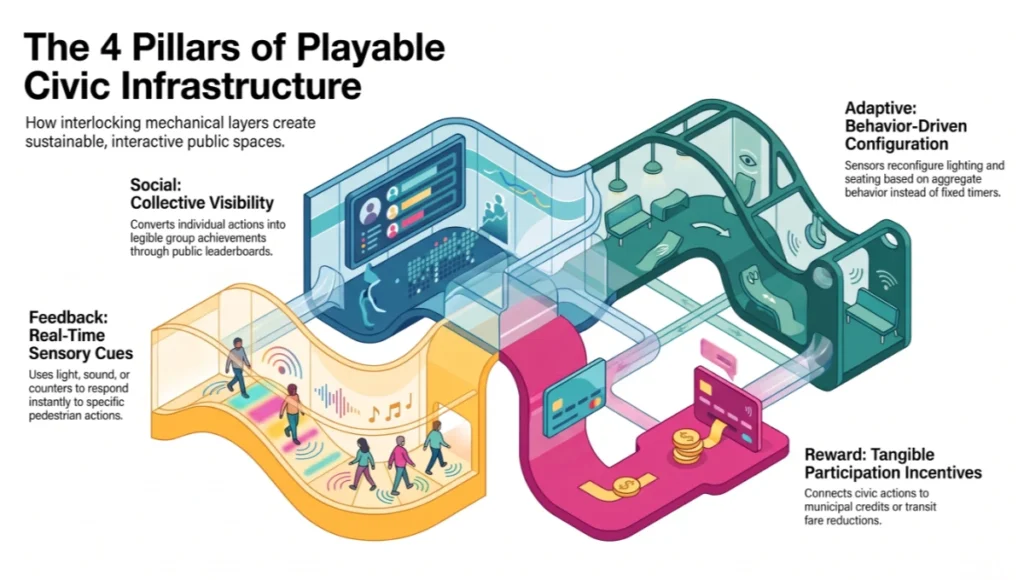
- Feedback layer: real-time counters, ambient light responses, or sound cues tied to pedestrian volume or specific verified actions such as recycling, cycling, or community reporting of infrastructure faults
- Reward layer: municipal credit systems, transit fare reductions, or civic badges tied to verified participation, redeemable through infrastructure residents already use daily
- Social layer: visible leaderboards or collective progress indicators that convert individual, invisible action into legible group achievement residents can point to and discuss
- Adaptive layer: sensors that reconfigure signage, lighting, or seating configuration based on aggregate behavior over time rather than a fixed, planner-set timer
Transit-Oriented Development as the Delivery Mechanism
Transit-oriented development gives playable mechanics their most durable host, because transit nodes already concentrate the daily repetition that game systems require to function — you cannot build a meaningful feedback loop around a behavior someone performs once a year. A commuter who passes through a station six hundred times annually is a far more productive substrate for playable civic infrastructure than a tourist plaza a visitor encounters exactly once and never returns to.
This is why the most credible pilots tend to cluster around rail platforms, bus interchanges, and the pedestrian-first corridors connecting them to adjacent housing, rather than around one-off civic plazas commissioned for a single anniversary celebration. Resilient infrastructure, in the technical sense used by transportation planners and outlined in the AIA’s guidance on the economic case for resilient design, means infrastructure that degrades gracefully and recovers quickly under stress; playable transit corridors extend that resilience definition into the behavioral domain, building habitual, rewarded patterns of use that persist even when a single sensor node goes offline.
Specification Snapshot
- Sensor density: minimum of one responsive node per forty linear meters of pedestrian corridor, sufficient to avoid dead zones where the mechanic simply stops functioning
- Feedback latency: under two seconds between a verified action and a visible response, below the threshold at which human users perceive the system as broken rather than delayed
- Reward redemption: integrated directly into existing transit fare or municipal identification systems rather than a standalone application requiring separate onboarding
- Data retention: aggregate-only, anonymized at the point of collection, with retention windows measured in days rather than years, to avoid the surveillance creep that undermines public trust
Feasibility Study: Economic and Political Barriers
The Capital Problem
You are not proposing a cheap intervention, and pretending otherwise is how pilot programs die quietly in year two. Sensor networks, adaptive lighting, and integrated reward infrastructure require capital outlays that most municipal public-realm budgets were never built to absorb, because those budgets were sized historically for benches, paint, and seasonal planting, not for distributed, maintained IoT infrastructure with an ongoing service contract. Playable cities game mechanics public space competes for funding against far more legible, politically defensible line items — road resurfacing, transit signal maintenance, snow removal — that political constituencies already understand, demand, and can hold elected officials accountable for.
This is not an argument against pursuing playable infrastructure. It is an argument for sequencing it correctly: starting with a single pilot corridor with a clearly bounded budget, rather than a city-wide rollout that invites budget scrutiny before the mechanic has proven it can retain residents past a novelty period of roughly six to nine months.
The Governance Problem
Reward systems tied to civic behavior raise an uncomfortable question you cannot responsibly avoid: who decides which behaviors deserve reward, and what happens to citizens who opt out, or who structurally cannot participate — elderly residents without smartphones, unhoused populations without a stable address for credit redemption, undocumented residents wary of any system that logs their movement patterns, however anonymized the stated policy claims to be.
Frameworks such as the AIA’s community resilience design resources make the case that resilience planning must explicitly account for social vulnerability, not just infrastructure hardening. A playable public space that inadvertently punishes non-participation by default is not a neutral game layer sitting harmlessly atop existing infrastructure; it is a new form of exclusionary infrastructure wearing a friendlier, more colorful interface than the hostile architecture it replaced.
Genuine governance maturity requires building an opt-out pathway that is not itself a second-class experience of the space — a resident who declines sensor participation should still be able to use the bench, the shade structure, the crossing signal, without penalty or visible marking as a non-participant.
The Data Trust Deficit
You are also asking residents to accept ambient sensing in exchange for civic gamification, at a moment when public trust in urban surveillance sits at a generational low, following a decade of well-publicized municipal data breaches and quietly expanded policing use-cases for ostensibly civic sensor networks. Any playable mechanic that fails to demonstrate immediate, tangible reciprocity — a fare discount arriving within days rather than months, a visible, verifiable community outcome such as a funded shade structure — will be read correctly by a skeptical public as extraction dressed convincingly as play. Trust, once lost in one civic sensor deployment, transfers negatively onto the next proposal, regardless of how carefully that next proposal is designed.
Proof of Concept: Singapore, Rotterdam, and Tokyo
Singapore’s Smart Nation initiatives have folded smart city sensors into public housing precincts for years, using aggregated movement and environmental data to adjust lighting timing and communal space allocation in something close to real time — a quieter, less overtly branded cousin of what playable cities game mechanics public space now formalizes into explicit design doctrine. You see the same underlying logic operating beneath the surface: infrastructure that responds to behavior rather than dictating it on a fixed, planner-determined schedule, adjusting itself to the rhythms of the people actually using it rather than the assumptions made about them at the design stage.
Rotterdam has taken a more explicitly participatory route through its long-running experiments in tactical urbanism neighborhood projects, where temporary interventions — playful crossings repainted in response to community input, interactive rain gardens that visibly respond to water collection with light or sound — are tested, measured against pedestrian dwell-time and satisfaction data, and either scaled into permanent infrastructure or removed, based on actual engagement evidence rather than planner intuition alone. The city’s willingness to treat public space as a testable hypothesis, rather than a finished civic monument, is precisely the disposition playable cities game mechanics public space requires to function credibly over time.
Tokyo’s train stations, meanwhile, offer perhaps the most mature proof of concept for reward-integrated civic behavior at genuine population scale: point systems tied to contactless transit cards that nudge riders toward off-peak travel windows demonstrate, across millions of daily trips, that behavioral incentives embedded directly into daily infrastructure can shift established patterns without resorting to coercion or fines.
None of these three cities market what they are doing using the specific phrase “playable cities game mechanics public space” — the language belongs more to design conferences and consultancy decks than to municipal press releases — but the mechanical bones underneath are functionally identical across all three: sense the behavior, reward the desired version of it, adjust the system based on results, and repeat the cycle indefinitely.
Concept Project Spotlight: “Pulse Corridor” — Speculative / Internal Concept Study by Nuvira Space
Project Overview: Location / Typology / Vision
Location: a hypothetical 1.2-kilometer transit corridor modeled loosely on a mid-density European rail spine, chosen deliberately over a flagship plaza to test the corridor logic rather than the isolated-installation logic.
Typology: a linear public realm connecting a rail terminus to an adjacent mixed-use residential district, crossing three signalized intersections and two smaller neighborhood squares along its length.
Vision: to test whether a single, continuous playable mechanic — rather than a scatter of isolated plaza installations — can sustain civic engagement across an entire daily commute route, from front door to platform and back again, rather than at one isolated point along it.
Design Levers Applied
Mechanical Specifications
The Pulse Corridor concept study applies four interlocking mechanical specifications along the full length of the route, each deliberately modest in individual scope but cumulative in behavioral effect.
- A continuous sensor spine logging aggregate foot traffic volume and flow direction, explicitly not individual identity, feeding a single corridor-wide dashboard rather than isolated per-block data silos
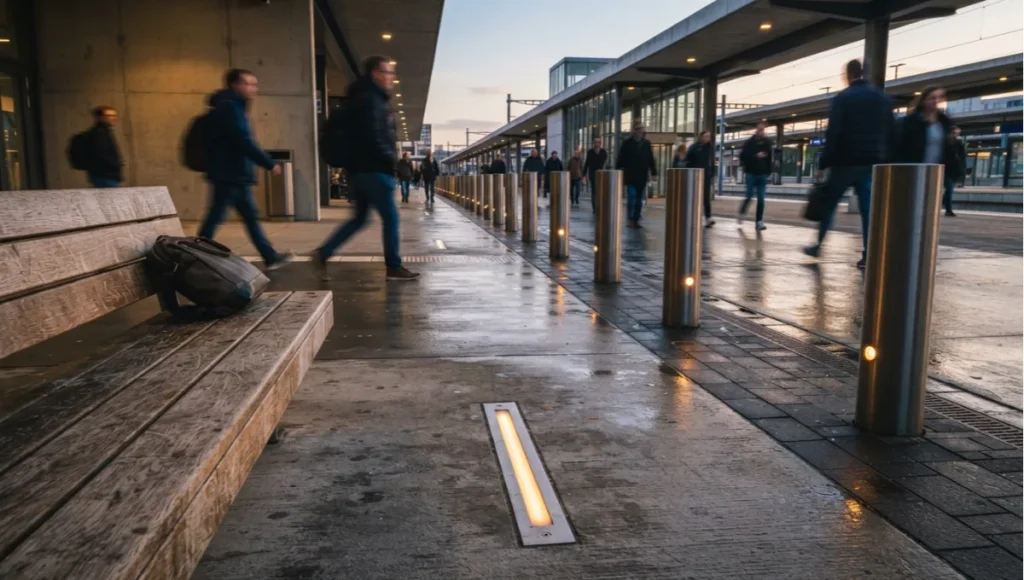
- Dynamic paving that shifts subtle color temperature based on cumulative weekly walking volume, visible to residents as a collective “corridor health” indicator rather than an individual performance metric
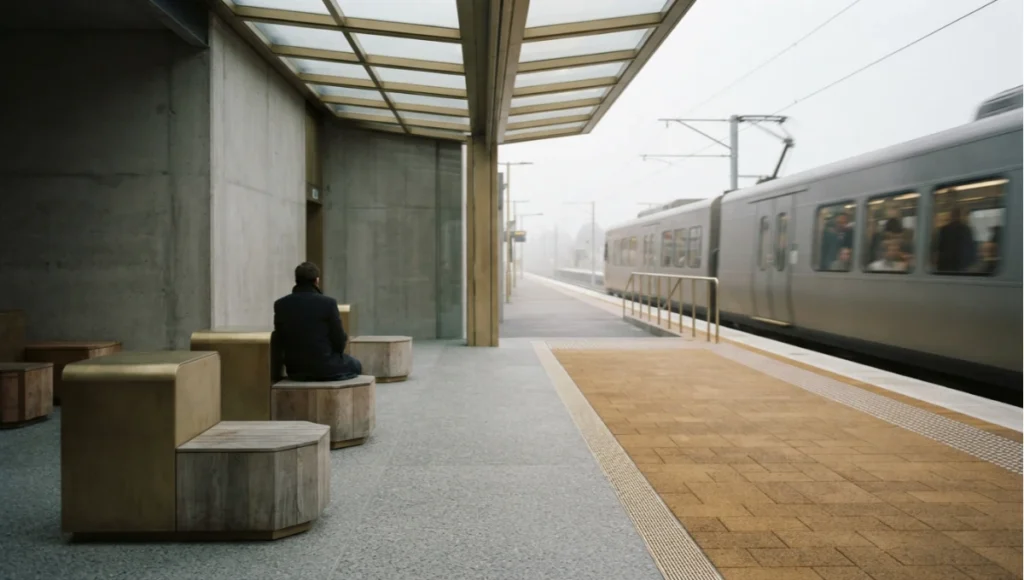
- Modular seating pods that unlock additional shade structure canopy once neighborhood-wide participation thresholds are collectively met, converting shade provision into a shared civic achievement rather than a static planning decision made once and never revisited
- Fare-linked micro-rewards for verified low-carbon trip chaining — walking to rail, then rail to bike-share — redeemed automatically through the existing transit fare card rather than a new application
Transferable Takeaway
The Pulse Corridor concept demonstrates that playable mechanics scale more effectively as a continuous system spanning an entire daily route than as disconnected, isolated installations scattered across unrelated plazas. The reward loop only becomes socially legible, and therefore behaviorally sticky, when residents experience it repeatedly across a shared daily route — walking the same corridor to the same platform, day after day — rather than encountering it as a one-off novelty they stumble across once, photograph, and subsequently forget.
2030 Future Projection
By 2030, you should expect playable cities game mechanics public space to migrate out of experimental pilot-program budget lines and into standard municipal infrastructure procurement, following broadly the same institutional path that protected bike lanes took roughly a decade earlier — moving from experimental paint jobs defended by a handful of advocacy groups to codified, funded design standards written directly into transportation department procurement manuals. Transit authorities already comfortable managing fare-card data will likely be the first credible institutional adopters at scale, precisely because the reward infrastructure required — the fare card system itself — already exists, is already trusted by riders for its original purpose, and does not require an entirely new civic trust relationship to be built from nothing.
Expect fragmented early rollouts through 2030 rather than comprehensive city-wide systems: single corridors, single transit lines, single neighborhood pilots, constrained less by available sensor technology, which is already mature and inexpensive, than by the governance and equity questions outlined above in the feasibility study. The cities that solve the opt-out and data-trust problems first — plausibly mid-sized, digitally literate municipalities with existing civic technology departments, rather than sprawling global megacities burdened by legacy procurement bureaucracy — will likely become the reference case studies that larger metropolitan regions eventually study, adapt, and retrofit onto their own transit spines throughout the following decade.
Comprehensive Technical FAQ
Q: What exactly counts as a “game mechanic” in a public space context?
A: A game mechanic is any rule-based feedback loop — action, response, reward — deliberately embedded into infrastructure rather than left to emerge accidentally. In playable cities game mechanics public space, this typically means sensor-triggered feedback such as lighting, sound, or visible counters, tied directly to a defined, verifiable civic behavior.
- Sensing the behavior
- Providing near-instant feedback
- Delivering a proportionate reward
- Iterating the mechanic based on observed results
Q: Does playable infrastructure require constant internet connectivity to function?
A: No, and designing for constant connectivity is generally a mistake. Most viable systems rely on local edge processing with periodic aggregate data synchronization, which reduces both feedback latency and the surveillance footprint that continuous cloud connection would otherwise create.
Q: How is resident privacy protected in sensor-dense corridors?
A: Aggregate-only logging, anonymization applied at the exact point of collection rather than downstream, and short data retention windows measured in days form the minimum technical baseline. Without all three protections in place simultaneously, a playable mechanic collapses quietly into a surveillance mechanic wearing a friendlier public face.
Q: What is a realistic cost range for a single pilot corridor?
A: Pilot-scale sensor and feedback infrastructure for one corridor of roughly one kilometer typically requires capital allocation in the low-to-mid single-digit millions of dollars, depending heavily on existing sensor density, digital infrastructure maturity, and whether fare-card integration already exists or must be built from scratch.
Q: Can playable mechanics function without requiring a dedicated smartphone app?
A: Yes, and arguably they should, wherever feasible. The most equitable implementations tie rewards to existing physical infrastructure — transit cards, municipal identification systems — rather than requiring app ownership and a data plan, both of which structurally exclude lower-income and elderly residents from participation by default.
Q: How do you prevent residents from gaming the reward system without genuine participation?
A: Verification layers — cross-referencing sensor data against transit ticketing records or geofenced dwell-time thresholds — meaningfully reduce reward exploitation, though no system design is entirely resistant to a sufficiently determined bad-faith user, and designers should plan for a tolerable margin of exploitation rather than an impossible zero.
Q: What is the single biggest predictor of a playable public space project’s long-term survival past its pilot phase?
A: Continuity of the feedback loop past the initial capital funding cycle. Installations that lose their sensor maintenance budget within twelve to eighteen months of launch reliably revert to inert street furniture, regardless of how well the original mechanic was conceived, designed, or initially received by the community it served.
Conclusion
You do not need to wait for a national infrastructure bill or a decade-long comprehensive plan revision to test a single mechanical layer on a single corridor in your own city. The evidence from Rotterdam, Singapore, and Tokyo is not theoretical or aspirational — it is operational, measurable, and increasingly replicable at manageable pilot scale, without requiring a wholesale reinvention of existing transit fare infrastructure. If you are a planner, policymaker, or civic technologist evaluating how playable cities game mechanics public space could realistically recalibrate a specific corridor in your own jurisdiction, Nuvira Space’s Urban Pulse team develops concept-stage feasibility studies grounded in exactly this kind of macro-environmental, evidence-based case analysis.
Start the conversation with a single corridor, bounded and measurable. The rest of the network can learn, adapt, and expand from what that one corridor proves. The corridor is small. The evidence it can generate is not, and that asymmetry is precisely the point of starting there rather than waiting for a comprehensive citywide mandate that may take a decade to arrive.
© Nuvira Space All rights reserved. | URBAN PULSE Series | All specifications cited are based on publicly available municipal and transit authority data; no proprietary sources are implied. The Pulse Corridor is a speculative internal concept study and does not represent a completed project.