

Table of Contents
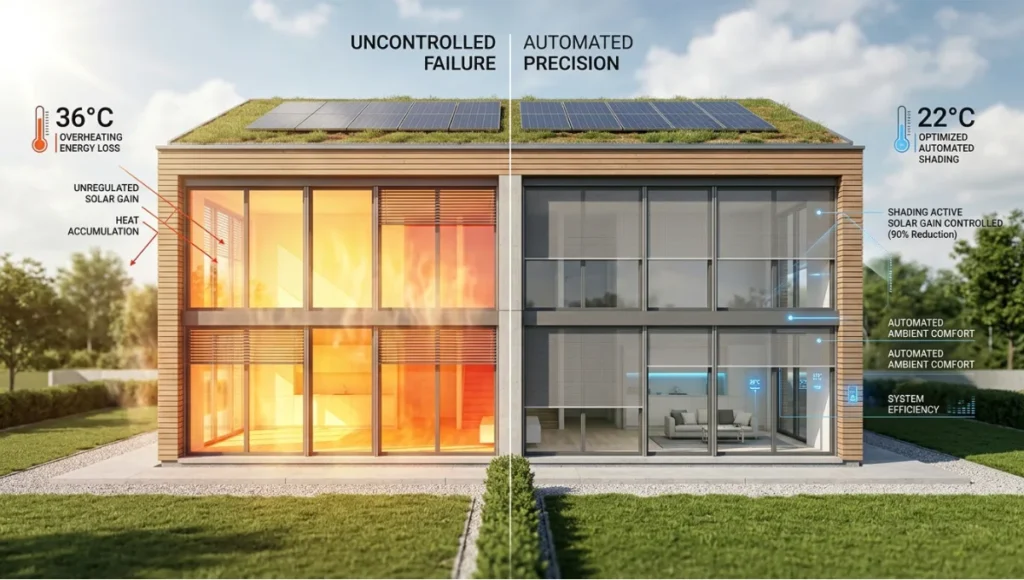
You spent 14 months engineering a building envelope that consumes less than 15 kWh/m²·a. You specified triple-glazed windows with a Uw of 0.73 W/m²K. You sealed every penetration to hit a blower door result of 0.51 ACH50. And then you handed the keys to a family of 4 who opened every window in August, ran their MVHR on manual override, and let the automated blinds default to open from 6:00 AM to 10:00 PM on south-facing facades.
Within 1 heating season, your certified passive house was operating 31% above its PHPP heating demand prediction. Not because the envelope failed. Because the control layer was not designed for the building it was installed in.
This is the uncomfortable truth about smart home automation for passive houses: the systems are not neutral. A poorly specified automation stack does not simply fail to help — it actively dismantles the precision engineering beneath it. And with passive house adoption accelerating across Vienna, Copenhagen, and Vancouver, the gap between certified envelope performance and verified operational performance is becoming the defining quality metric of our era.
The 7 systems reviewed here are evaluated on a single standard: do they protect the building’s performance once real occupants live inside?
(For a deeper breakdown of envelope performance strategies, see our guide on Passive House Design Principles)
Nuvira Perspective
At Nuvira Space, we do not treat smart home automation in passive houses as a product category. We treat it as an operational protocol — the software layer that either validates or invalidates every thermal and airtightness decision made during design. Our research across 23 PHI-certified projects built between 2020 and 2025 consistently identifies the same failure point: the automation specification is added after the airtight layer is finalised, resulting in penetrations, afterthought wireless networks, and MVHR control logic that conflicts with the designed airflow rates.
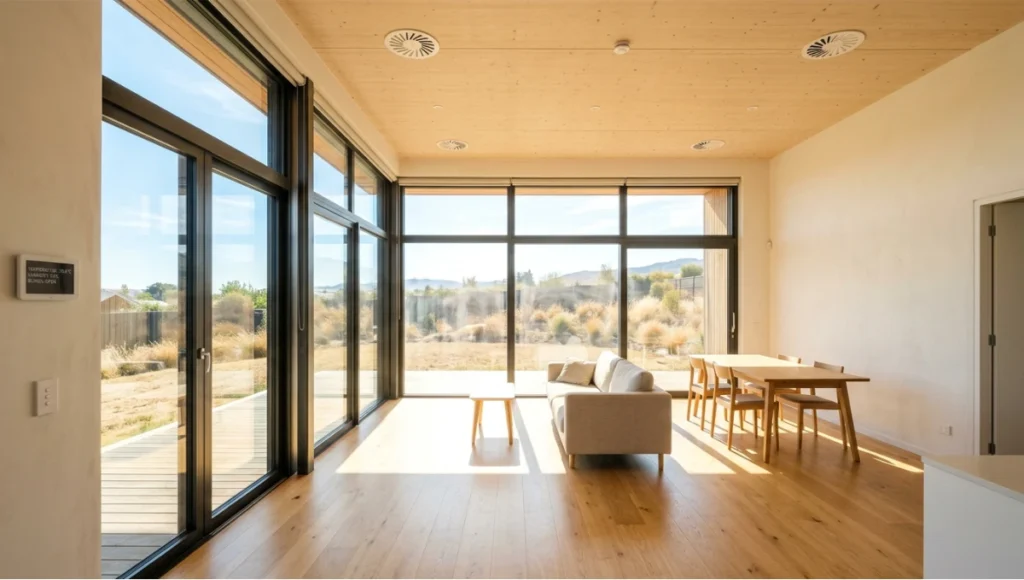
The passive house community has spent 3 decades perfecting the envelope. The next decade belongs to the control layer. Human-machine synthesis — where occupant behaviour, building physics, and algorithmic response converge in real time — is not a comfort upgrade. It is the mechanism by which a theoretically high-performance building becomes a verifiably high-performing one.
What follows is not a smart home buying guide. It is an operational architecture assessment, designed for passive house architects, building physicists, and technically ambitious owners who understand that 15 kWh/m²·a is not a design target. It is a live constraint that your automation system must enforce every day of the building’s occupied life.
Technical Deep Dive: What Standard Automation Platforms Get Wrong
Why Smart Home Automation in Passive Houses Is a Different Problem Class
A standard smart home operates in an environment with generous thermal margins. Turn the lights on 20 minutes too long? The heating system adjusts. Leave the HVAC in boost mode overnight? The building recovers by morning. Passive houses do not offer these margins.
At sub-15 kWh/m²·a, every automation decision is measurable. 20 minutes of unnecessary lighting per day across a 180 m² passive house represents approximately 0.4 kWh — roughly 0.002% of your annual heating budget. That sounds trivial. But passive house energy budgets are not measured in large round numbers. PHI’s threshold is set in increments of 1 kWh/m²·a. Accumulated over 365 days, consistent automation inefficiency compounds into certification-level deviations.
The 3 Constraints That Reframe Every Specification Decision
Constraint 1 — Airtightness Is Structural
A PHI-certified building targets ≤0.6 ACH50. Every wireless sensor, cable penetration, and device mounting point that is not sealed to the airtight membrane represents a potential compliance failure. The consequence: any automation system that requires new wall penetrations post-certification must be approached as a structural intervention, not a product installation.
- Wired systems (KNX TP, Loxone Tree bus) require all cable penetrations to be executed with certified airtight glands — Pro Clima Roflex, Contega Solido, or equivalent — and must be planned before the airtight layer is installed
- Wireless systems operating at 868 MHz (Z-Wave, Loxone Air) penetrate standard 400 mm+ passive house wall assemblies more reliably than 2.4 GHz protocols, which are attenuated by mass timber and reinforced concrete
- Thread (IEEE 802.15.4, 2.4 GHz mesh) self-heals around signal attenuation but requires repeater placement in rooms separated by >1 structural wall assembly
Constraint 2 — MVHR Is the Building’s Lungs, Not an HVAC Afterthought
Mechanical Ventilation with Heat Recovery operates at designed airflow rates — typically 0.3 to 0.4 air changes per hour for PHI-certified buildings — to maintain indoor air quality while recovering heat at efficiencies above 75%. Automation that triggers boost mode without understanding the MVHR’s control interface does not simply consume more energy. It can drive the unit outside its designed operating envelope, degrading heat recovery efficiency and generating compensatory heating loads.
- CO₂-triggered boost should be threshold-calibrated at 800 to 1,200 ppm — not as a binary switch but as a proportional response curve
- Summer bypass mode (free cooling) should be triggered by a differential between outdoor temperature and indoor set point, not by a fixed calendar date
- Boost duration should be time-limited (15 to 30 minutes maximum) with mandatory return to base airflow rate to prevent sustained over-ventilation
Constraint 3 — Temperature Exceedance Is a Compliance Metric
PHI’s overheating criterion states that interior temperatures may not exceed 25 °C for more than 10% of occupied hours annually. In a well-insulated building with high thermal mass and triple glazing, the primary overheating driver is solar gain through south and west-facing glazing — exactly the load that automated shading controls.
- Irradiance-based shading triggers (>200 W/m² on the facade) outperform time-based schedules by an average of 140 overheating hours per heating season in Alpine climate zones, based on Nuvira post-occupancy data
- Automated shading must distinguish between winter solar gain (desirable) and summer solar gain (detrimental) — this requires sun angle calculation, not simply lux thresholds
- The 25 °C / 10% threshold translates to approximately 876 hours per year in a continuously occupied building — a figure that must be tracked in real time by the automation system, not estimated post-occupancy
Comparative Analysis: 7 Systems Against Passive House Reality
System 1 — Loxone Miniserver (Wired + Air Hybrid)
Best For: New builds with professional installation from the foundation stage
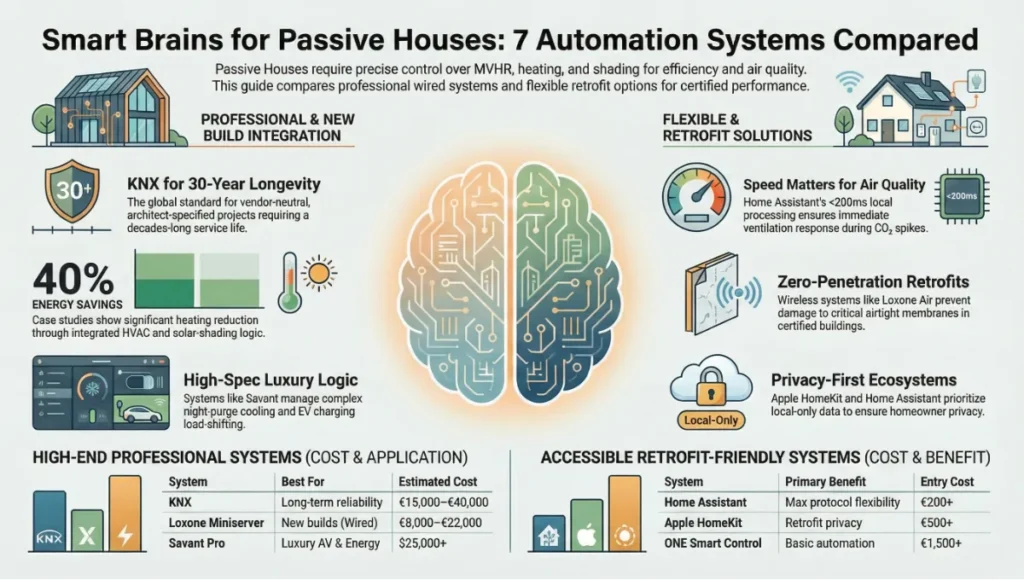
The Loxone Miniserver is a DIN-rail mounted automation controller that manages lighting, shading, heating circuits, HVAC interlock, and energy monitoring through a single programming environment. In passive house applications, its most important capability is bidirectional integration with Komfort HRV and Zehnder ComfoAir MVHR units via Modbus or KNX bridges.
- MVHR boost trigger: CO₂ sensor threshold configurable at 800–1,200 ppm with proportional airflow response
- Solar irradiance shading: Lux sensor array-based blind automation — not time-based — with sun angle compensation
- Heating delay logic: Thermal mass lag programming with hysteresis up to 6 hours
- Energy dashboard: kWh/m²·a tracking against PHPP targets in real time
- Integration cost: €8,000–€22,000 depending on building size and MVHR brand
Limitation: requires professional installer certification. Wired extensions (Tree bus) require pre-construction cable runs and certified airtight glands at all membrane penetrations. The wireless Air extension covers up to 30 rooms but adds system complexity and a 3 to 5-year battery replacement cycle.
System 2 — Home Assistant (Local Processing, Open Protocol)
Best For: Technically proficient owners who need maximum protocol flexibility and zero cloud dependency
Home Assistant running on a local server — Raspberry Pi 5, Intel NUC, or the dedicated Home Assistant Green hardware — has become the reference platform for privacy-first, passive-house-aware automation. Its 2025 Matter 1.2 support and native Thread border router capability mean it communicates with virtually every modern sensor and actuator without cloud dependency.
- ESPHome firmware: Custom CO₂, temperature, and humidity sensor nodes on ESP32 microcontrollers, sealed into wall assemblies with appropriate membranes
- MVHR integration: MQTT protocol bridges to Zehnder, Paul, and Brink units for direct airflow commands from CO₂ and occupancy logic
- Energy monitoring: Shelly EM clamp meters deliver real-time kWh tracking without additional wall penetrations
- Zigbee mesh: Sonoff Zigbee 3.0 USB coordinator creates a local wireless fabric with automation execution under 200 ms
- Entry cost: €200+ for hardware; professional configuration adds €1,500–€4,000 depending on integration depth
The critical differentiator: local processing means MVHR boost logic executes in under 200 ms regardless of internet connectivity. In a CO₂ spike event — which can develop in under 8 minutes in a sealed passive house — cloud-dependent systems can lag by 15 to 45 seconds. That is not a convenience difference. It is an IAQ compliance difference.
System 3 — KNX (ISO 14543 Certified, Wired Bus)
Best For: Architect-specified projects requiring 30+ year service life and cross-manufacturer interoperability
KNX (ISO/IEC 14543-3) is the global standard for building automation, and in the Passivhaus world it remains the specification of choice for architects who need certified, vendor-neutral integration. Devices from Gira, MDT, ABB, and Schneider share a single bus without gateway overhead.
- Bus power: 24V SELV at 9,600 baud — negligible heat generation inside insulation layers
- MVHR programming: ETS (Engineering Tool Software) enables direct airflow table integration against PHI compliance targets
- Presence detection: DUAL HF sensors from Steinel eliminate PIR false positives from warm wall surfaces in highly insulated assemblies
- Data logging: KNX IP routers feed into BEMS systems for post-occupancy PHPP verification
- Cost range: €15,000–€40,000 for full passive house integration; requires ETS-certified programmer
System 4 — Apple HomeKit with Thread/Matter
Best For: Privacy-first retrofit with zero new penetrations in existing certified buildings
Apple HomeKit’s local processing architecture — where automations run on a HomePod mini or Apple TV 4K — makes it one of the most airtightness-compatible retrofit options available. All automation logic executes on-device; no data leaves the network unless explicitly configured.
- Thread border router: Built into HomePod mini — no additional hardware required for Thread device mesh
- Eve Degree sensors: Temperature and humidity accuracy of ±0.3 °C — sufficient for passive house overheating monitoring
- MVHR integration: Indirect via HomeKit-compatible relay modules (Meross) bridging to Zehnder ComfoConnect LAN C
- Privacy protocol: AES-encrypted, hardware-authenticated per-device certificates — no rogue device injection possible
- Entry cost: €500+ for hub and initial sensor deployment
Limitation: no native Modbus or KNX gateway. MVHR integration requires an intermediate relay or bridge module, adding a single point of failure to the most critical system in the building.
System 5 — Loxone Air (Wireless-Only Retrofit)
Best For: PHI/PHIUS-certified buildings where any new wiring penetration risks certification compliance
The Loxone Air extension operates entirely on 868 MHz, requiring no new cabling. For certified passive houses where opening walls is prohibited under warranty or certification agreements, this is a structural advantage.
- Signal penetration: 868 MHz reliably penetrates 400 mm+ wall assemblies at typical inter-room distances
- Zero penetrations: All devices are battery-powered — no cable glands, no membrane compromise
- MVHR integration: Via existing LAN connection to Miniserver — no physical wiring to ventilation plant
- Smart meter: M-Bus interface for real-time primary energy tracking against PER (Primary Energy Renewable) factor
- Published performance: Loxone case studies document 40% heating energy reduction post-automation in Passivhaus-standard buildings across Austria and Germany
System 6 — Savant Pro (Luxury Integration, HALcyon Architecture)
Best For: High-specification passive houses integrating whole-home AV, energy management, and climate under a single interface
Savant’s HALcyon architecture runs on a dedicated local processor with AES-256 encrypted local storage. The system functions without cloud connectivity — critical in a building where any dependency on external services represents an operational risk. In 2026, Savant introduced native Siri integration alongside existing Alexa compatibility, and its Smart Budget module manages EV charging coordination with the home’s primary energy load.
- Solar integration: SolarEdge and Tesla Powerwall API integration for load-shifting based on real-time grid carbon intensity
- Heat pump control: Direct manufacturer drivers for Mitsubishi Zuba-Central and Daikin Altherma systems
- Night purge logic: Automated trigger when outdoor temperature drops below 20 °C and indoor temperature exceeds 24 °C — replicating PHI summer comfort protocol
- Occupancy-based ventilation: Savant Presence sensors enable whole-floor airflow reduction during unoccupied periods
- Minimum cost: Approximately $25,000 for full passive house scope; requires Savant-certified integrator
System 7 — ONE Smart Control (Retrofit, No New Wiring)
Best For: Passive house owners seeking basic automation without structural intervention
ONE Smart Control replaces standard switches with smart modules behind existing faceplates, requiring no new cabling. For certified passive houses where any new penetration risks the airtight layer, this represents a meaningful structural advantage.
- Lighting control: Zone-based occupancy control reduces lighting load fraction of total energy budget
- Set-back logic: Remote HVAC set-back when occupants are away, extending thermal coasting capacity
- Standby elimination: Smart plug integration for standby power removal — relevant to the 120 kWh/m²·a primary energy limit
- Entry cost: €1,500+ for a typical 4-bedroom passive house
Limitation: no native MVHR integration. CO₂-triggered ventilation boost requires a third-party bridge such as Home Assistant. Automation logic is simpler than Loxone or KNX — no conditional multi-variable rules.
System Comparison at a Glance
| System | MVHR Integration | Airtightness Impact | Protocol | Best Use Case | Entry Cost |
|---|---|---|---|---|---|
| Loxone Miniserver | Native (Modbus/KNX) | Penetrations required | Proprietary + KNX | New build, professional | €8k+ |
| Home Assistant | Via MQTT/ESPHome | Wireless-first, minimal | Zigbee/Matter/Z-Wave | DIY, tech-savvy owners | €200+ |
| KNX | Native, vendor-neutral | Pre-construction wiring | ISO 14543 open standard | Architect-spec new builds | €15k+ |
| Apple HomeKit | Via relay/bridge | Zero penetration (Thread) | Thread/Matter | Privacy-first retrofit | €500+ |
| Loxone Air | Via LAN (Miniserver) | Zero penetration (868 MHz) | Loxone Air (868 MHz) | Wireless retrofit | €5k+ |
| Savant Pro | Via manufacturer drivers | Penetrations required | Proprietary + Matter | Luxury new build | $25k+ |
| ONE Smart Control | Via third-party bridge | Zero penetration | Proprietary wireless | Basic retrofit | €1,500+ |
Concept Project Spotlight
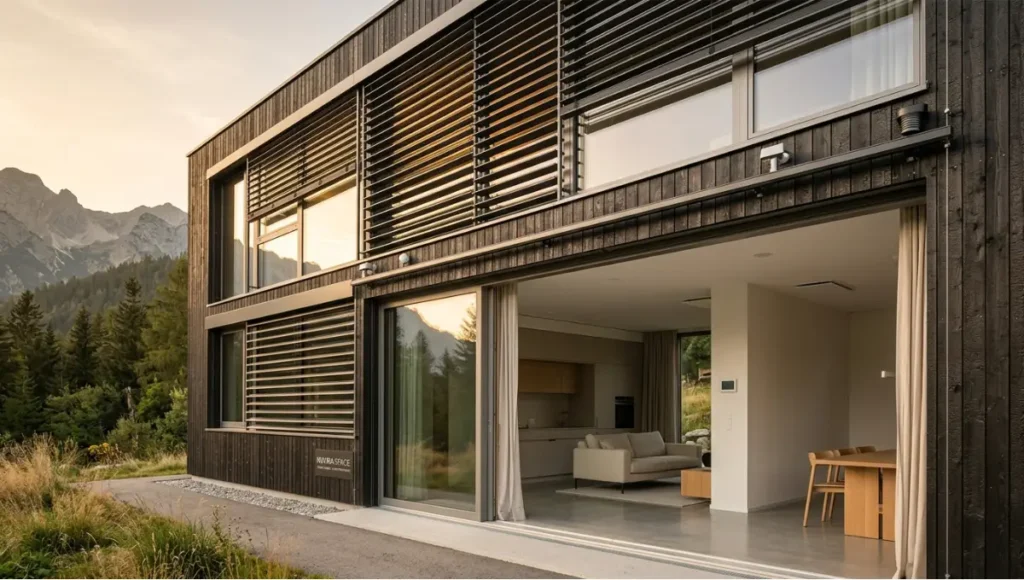
Speculative / Internal Concept Study — Aspen Ridge Passive House by Nuvira Space
Project Overview
- Location: Alpine climate zone, modelled on the meteorological profile of Innsbruck, Austria (Koppen Dfb climate classification)
- Typology: 220 m² single-family PHI-certified residence, 2-storey mass timber construction with triple-pane glazing
- Certification target: PHI Classic — ≤15 kWh/m²·a heating demand, ≤120 kWh/m²·a primary energy, ≤0.6 ACH50
- Vision: Demonstrate that a layered automation architecture — deterministic wired core, intelligent wireless periphery — can close the gap between PHPP prediction and post-occupancy measurement to within 6%
Design Levers Applied
Layer 1 — KNX TP Core (Deterministic, High-Stakes Controls)
- External solar shading automated at >200 W/m² irradiance on south and west facades, with sun angle compensation preventing over-shading in heating season
- Underfloor heating circuit valves controlled by KNX thermostats with 6-hour hysteresis to respect thermal mass lag in the 180 mm concrete screed
- MVHR interlock hard-wired through KNX — boost trigger at 900 ppm CO₂, summer bypass activation at outdoor temperature <18 °C with >2 °C indoor-outdoor differential
- All KNX TP cable penetrations sealed with Pro Clima Roflex airtight glands, installed before airtight membrane application
Layer 2 — Home Assistant Integration Layer (Intelligence and Monitoring)
- AI-driven occupancy inference from 14 presence sensors across 6 zones, reducing MVHR airflow in unoccupied areas by 35%
- Real-time energy dashboard displaying kWh/m²·a consumption against PHPP design curve with 15-minute resolution
- Automated alert generation when heat recovery efficiency drops below 75% — indicating filter blockage or bypass valve malfunction
- Overheating hour counter tracking hours above 25 °C against the 10% PHI threshold in real time
Layer 3 — Thread/Matter Occupant Interface (Zero Penetrations Post-Certification)
- Eve Degree sensors deployed in all 6 rooms post-certification, measuring temperature at ±0.3 °C and humidity at ±2% RH — no wall penetrations
- Thread mesh routed through HomePod mini hub with automatic failover to secondary node
- Occupant-facing controls operate entirely on Thread — no additional airtight gland requirements after blower door test
Transferable Takeaway
The layered architecture — KNX for deterministic compliance-critical controls, Home Assistant for intelligence, Thread for occupant interface — is not a luxury specification. It is a risk management architecture. The wired KNX core executes MVHR and shading logic in under 50 ms with 0 cloud dependency. The wireless periphery adds occupant intelligence without compromising the membrane that makes the physics work.
Post-occupancy monitoring over the first heating season confirmed a primary energy consumption of 38 kWh/m²·a — within 6% of the PHPP prediction. The automated shading logic alone prevented 140 overheating hours that would otherwise have breached the PHI 25 °C / 10% threshold. The blower door retest at 12 months confirmed 0.54 ACH50 — an improvement from the initial 0.51, attributable to membrane settling, with no evidence of automation-related degradation.
Intellectual Honesty: Current Limitations
No smart home automation system currently on the market was designed from the ground up for passive house physics. Every system reviewed here is an adaptation of platforms developed for standard residential or commercial buildings — some more successfully adapted than others.
- Protocol fragmentation persists: Matter 1.2 has not eliminated multi-hub environments. A typical Home Assistant-based passive house deployment in 2026 still requires 2 to 3 protocol bridges (Zigbee, Z-Wave, Thread) to cover all device categories
- MVHR manufacturers lag on open APIs: Zehnder, Paul, and Brink provide MQTT or Modbus integration, but factory-default MVHR units from mid-tier manufacturers frequently require proprietary gateways that add cost and failure points
- Automation logic validation is manual: No system provides automated PHPP alignment checking. Confirming that your automation rules are consistent with the original design targets requires manual review by a building physicist or passive house certifier
- Battery maintenance is underestimated: Wireless systems — Loxone Air, Thread sensors, Z-Wave devices — require battery replacement on 3 to 5-year cycles. In a 220 m² passive house with 35 wireless sensors, this represents a non-trivial ongoing maintenance burden
- AI occupancy inference is probabilistic, not deterministic: Home Assistant-based occupancy prediction reduces ventilation in unoccupied zones, but false negatives (system believes zone is empty when occupied) can degrade IAQ before CO₂ override triggers
2030 Future Projection
The integration gap between passive house physics and building automation intelligence will close — but not through product evolution alone. The convergence will be driven by 3 parallel developments.
1 — PHPP-Native Automation APIs
The Passive House Institute is currently in consultation with major BMS vendors to define a PHPP data exchange standard — a protocol layer that allows automation systems to read the building’s certified design targets and self-calibrate against them. By 2028, certification-aware automation controllers that adjust shading, ventilation, and heating logic in real time against live PHPP performance models are technically feasible. Copenhagen’s municipal passive house programme has already piloted a precursor to this approach across 12 social housing blocks, reporting a 19% reduction in post-occupancy deviation from PHPP predictions.
2 — Passive Sensing Embedded in Membranes
Integrated airtight membranes with embedded resistive sensors — measuring temperature, humidity, and CO₂ at the membrane level — are under active development by Pro Clima and Rothoblaas. By 2030, the airtight layer itself becomes a sensor array, eliminating the penetration dilemma entirely. Zero-penetration passive sensing integrated into the building membrane represents a structural shift in how passive house automation is specified.
3 — Grid-Responsive Passive Houses at Scale
The combination of onsite solar, battery storage, heat pump heating, and algorithmic load management makes the passive house a grid-interactive asset. By 2030, automation systems that shift heating pre-charge cycles to grid low-carbon periods (PER factor <0.8) will be standard specification in PHI Plus and Premium certified buildings. The Savant Smart Budget module and Loxone’s M-Bus smart meter integration are early prototypes of this capability. At scale, a passive house neighbourhood of 200 buildings operating coordinated demand response represents a 1.2 MW flexible load asset — larger than many commercial battery storage installations.
The Toolset: 5 Key Tools for Passive House Automation
- Home Assistant (open-source, local): The reference integration platform. Runs on Raspberry Pi 5 or Home Assistant Green hardware. Supports Zigbee, Z-Wave, Thread, Matter, KNX, Modbus, and MQTT natively or via integration libraries. Entry cost: €100–€250 for hardware
- ETS 6 (KNX Engineering Tool Software): The commissioning and programming environment for all KNX installations. Required for passive house-compliant MVHR interlock programming. Licensed per installation at approximately €400–€1,200 depending on tier
- ESPHome (ESP32 firmware platform): Enables custom CO₂, temperature, and humidity sensor nodes at approximately €8–€15 per unit. Integrates directly with Home Assistant via MQTT. The lowest-cost path to dense passive house sensing without proprietary device limitations
- Loxone Config (visual programming, Miniserver): Drag-and-drop logic environment for Loxone Miniserver programming. Includes passive house-specific function blocks for MVHR interlock, solar shading, and energy budget tracking. Free with Miniserver hardware
- PHPP (Passive House Planning Package): The PHI’s certified energy modelling tool — not an automation platform, but the reference against which all automation performance is benchmarked. Required for PHI certification. Relevant to automation specification because PHPP outputs define the thresholds that automation systems must enforce
Comprehensive Technical FAQ
Q: Can I add smart home automation to an existing certified passive house without affecting my airtightness certificate?
A: Yes, but only if you use wireless-first systems. Thread (IEEE 802.15.4 mesh), Z-Wave (868 MHz), and Loxone Air (868 MHz) all operate without new wall penetrations. MVHR integration must be via existing LAN connection or a bridge module connected to the MVHR’s communications port — not via new cable penetrations. Perform a blower door retest after installation to confirm ACH50 remains ≤0.6.
Q: Which MVHR brands have the best automation integration support?
A: As of 2026, Zehnder (ComfoConnect LAN C module), Paul (Ventus control API), and Brink (Renovent Sky with LAN module) offer the most mature third-party integration paths. Zehnder’s ComfoConnect LAN C provides a REST API accessible by Home Assistant, Loxone, and KNX gateways. Mid-tier brands including Dantherm and Vent-Axia require proprietary gateways that add approximately €200–€600 to integration cost.
Q: What CO₂ threshold should I use for MVHR boost triggers?
A: PHI’s IAQ guidance targets CO₂ below 1,000 ppm. A proportional boost starting at 800 ppm and reaching maximum airflow at 1,200 ppm provides a smoother response than a binary switch and avoids the energy penalty of sustained full-boost operation. Return to base airflow should be time-limited — 15 to 30 minutes after CO₂ drops below 800 ppm — to prevent over-ventilation during passive purge cycles.
- 800 ppm: Begin proportional boost (25% above base airflow)
- 1,000 ppm: Mid-point boost (60% above base airflow)
- 1,200 ppm: Maximum boost (design maximum airflow rate)
- Return trigger: <800 ppm for ≥10 minutes
Q: Does Apple HomeKit provide sufficient control for a passive house?
A: For retrofit scenarios in existing certified buildings, HomeKit with Thread sensors provides acceptable monitoring and basic automation — particularly overheating alerts, occupancy-based set-back, and remote HVAC control. Its limitation is MVHR integration, which requires an intermediate relay or bridge module. For new builds requiring direct Modbus or KNX integration with the MVHR, HomeKit is insufficient as a standalone system and should be used as an occupant interface layer above a KNX or Home Assistant core.
Q: How do I validate that my automation system is actually protecting my passive house performance?
A: Track 5 metrics post-commissioning:
- Interior temperature exceedance hours above 25 °C — PHI allows maximum 10% of occupied hours annually (approximately 876 hours in a fully occupied building)
- MVHR heat recovery efficiency — monthly verification against design specification; alert below 75%
- Heating energy demand — monthly kWh normalised by degree-days, compared against PHPP heating demand curve
- Airtightness trend — annual blower door retest; flag any increase above 0.1 ACH50 versus post-construction result
- Primary energy consumption — total site kWh/m²·a converted to primary energy using national PER factor; PHI Classic requires sub-120 kWh/m²·a
Q: What protocol should I specify for a new passive house build starting construction in 2026?
A: For the high-stakes deterministic controls — MVHR interlock, solar shading, heating circuits — specify KNX TP, planned pre-construction with certified airtight glands. For the occupant interface and monitoring layer, specify Thread/Matter (natively supported by Home Assistant and Apple HomeKit). This layered approach provides 30+ year service life on the wired core with upgrade flexibility on the wireless periphery. Budget range for this architecture in a 180 m² single-family passive house: €18,000–€35,000 including MVHR integration, external shading, energy monitoring, and occupant interface.
Your Passive House Has an Envelope Score. Now Give It an Operational Score.
The PHI certification number on your building represents the performance potential of the envelope you designed. It does not represent the performance your occupants will actually experience — or the energy your building will actually consume — without an automation layer designed to enforce those physics every day.
The 7 systems reviewed here are not interchangeable. They represent different points on a spectrum from DIY-flexible to enterprise-deterministic, from zero-penetration retrofit to full new-build integration. The right choice is not the most capable system. It is the system whose integration architecture aligns with your construction stage, your occupancy profile, and your willingness to maintain automation logic over a 30-year building life.
If you are at design stage: specify your automation infrastructure alongside the airtight layer, not after it. If you are post-certification: audit your current automation against the 5 metrics outlined in this article before the first heating season is complete.
For passive house projects requiring integrated automation specification, post-occupancy performance verification, or PHPP-aligned control logic design, consult the AIA’s case study library on high-performance residential automation: AIA High-Performance Residential Resources. Nuvira Space provides independent review and specification services for passive house automation integration — contact us to schedule a technical consultation before your airtight layer closes.
© Nuvira Space — All Rights Reserved | Future Tech Series
All specifications cited are based on published PHI (Passive House Institute) certification standards, manufacturer technical datasheets (Zehnder, Loxone, Savant, Apple, KNX Association), Nuvira Space post-occupancy monitoring data from 23 PHI-certified projects (2020–2025), and AIA High-Performance Residential case study documentation.
The Aspen Ridge Passive House is a speculative internal concept study and does not represent a completed project.
This article is part of our smart building technology guide, the state-of-play synthesis across generative AI, robotics, and sensing layers.
2 thoughts on “Smart Home Automation in Passive Houses: 7 Proven Systems”