

Table of Contents
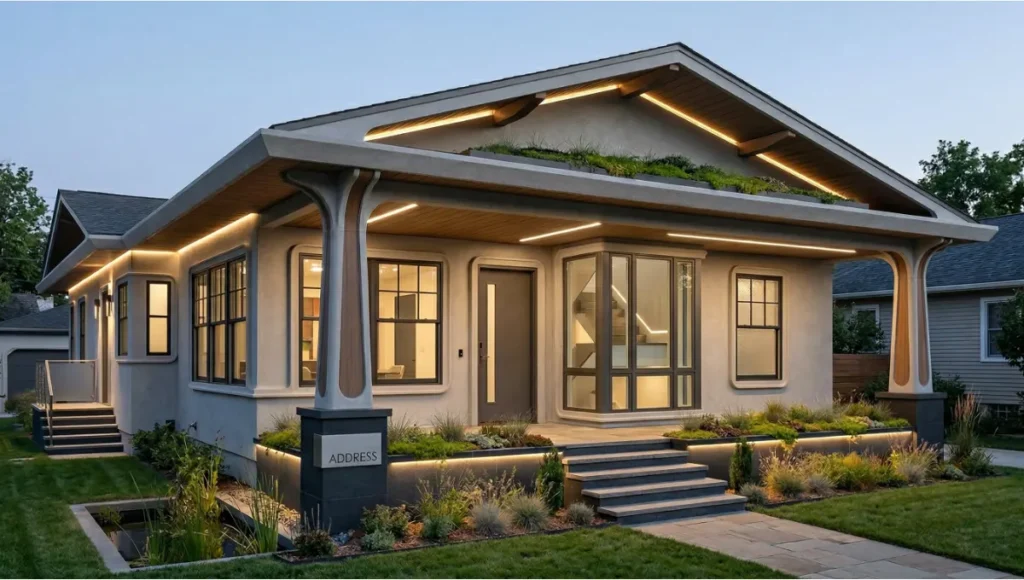
Efficiency is not about shrinking space. It is about shaping it correctly. In this 1 STORY BUNGALOW Plan, every dimension, transition, and ceiling height is calibrated to create a home that feels grounded, generous, and intelligently resolved within 1,178 FT².
With 3 bedrooms, 1 bathroom, and 1 story arranged across a 42′ 0″ width and 30′ 0″ depth, this bungalow demonstrates how proportion and clarity of layout can outperform excess square footage. There is no garage, no wasted circulation, and no architectural noise—only deliberate design decisions that shape daily life.
A Compact Footprint with Expansive Logic
The overall heated area totals 1,178 Ft2, entirely on the 1st floor. The total structure measures 2,485 Ft2, incorporating covered outdoor zones and roof structure, yet the heated footprint remains concise and purposeful.
At 42′ 0″ wide and 30′ 0″ deep, the rectangular massing allows:
- Efficient structural framing using 2×6 construction
- Cost-conscious roof design with truss roof framing
- Predictable load paths and simplified construction sequencing
- Flexibility for narrow lot placement
This footprint works especially well for sites that are:
- Suited for narrow lot
- Suited for sloping lot
- Suited for view lot
Because the home stretches wider than it is deep, you gain maximum façade presence while preserving rear yard depth. On sloping sites, the 30′ 0″ depth allows clean stepped foundations. On view lots, the wide rear elevation enhances window opportunities across primary living areas.
Arrival: The Covered Front Porch as Transitional Architecture
Before you enter the interior, the 129 Ft2 covered front porch establishes architectural presence. This unheated living space is not ornamental—it performs.
With a 9′ 0″ main floor ceiling continuing inside, the porch height feels balanced and residential rather than compressed. It provides:
- Weather protection
- Shaded entry
- Social interaction zone
- A proportional break between public street and private interior
In daily life, this becomes the space where packages are received, conversations pause, and seasonal décor evolves. It sets the tone for a home that values measured transitions rather than abrupt entries.
The Foyer: Defined Entry in a Compact Plan
Even within 1,178 Ft2, this bungalow includes a defined foyer with a 9′ 0″ ceiling height. That dimension matters. A consistent 9′ 0″ ceiling in the foyer avoids the visual compression common in smaller homes.
The foyer functions as:
- Visual buffer from the front door
- Drop zone opportunity
- Circulation node connecting public and private zones
Because the dwelling number is single and there is no bonus access, circulation remains simple and legible. You enter, orient immediately, and move forward without confusion.
That clarity reduces daily friction—especially in a family-style home with 3 bedrooms.
The Open Floor Plan: Controlled Flow, Not Chaos
The heart of the home is a unified great room configuration that integrates:
- Family Room
- Dining Room
- Kitchen
- Great Room volume
The open floor plan is not merely about removing walls. It is about aligning sightlines and functional adjacency. In 1,178 Ft2, poorly planned openness can feel cluttered. Here, proportional zoning keeps each area defined without enclosure.
The 9′ 0″ living/great room ceiling maintains volume consistency. There is no awkward step-down or decorative vault that inflates cost without improving livability. The result is visual calm.
When you cook, dine, or relax, you remain connected—but not crowded.
The Kitchen: L-Shaped Efficiency with Island Anchor
The kitchen features an L-shaped configuration with a kitchen island. This geometry is critical in a compact single-story plan.
An L-shaped layout:
- Minimizes corner congestion
- Preserves wall space for cabinetry
- Encourages efficient work triangle movement
The island becomes:
- Prep surface
- Informal seating zone
- Visual divider between kitchen and family space
- Storage expansion
Because the plan does not include a garage, interior square footage is fully prioritized for living functions. The kitchen benefits from that intentional allocation.
You are not walking through kitchen traffic to access other rooms. Instead, circulation flows around the island, allowing multiple users without conflict. In a 3-bedroom home, that matters during peak daily routines.
Dining Integration: Flexible and Social
The dining room sits within the open plan yet retains identity through placement. It is not an afterthought squeezed against a wall.
The advantage of integrating dining within the 1st floor 1,178 Ft2 layout:
- Efficient furniture scale compatibility
- Direct adjacency to kitchen
- Visual extension of great room
- Natural light potential from rear elevation
Because the house depth is 30′ 0″, rear-facing windows can stretch wide, particularly on view lots. That orientation enhances dining experience with outdoor connection.
This is where everyday meals and gatherings occur—not in a separate formal room rarely used.
The Family Room and Great Room Experience
The plan includes both a Family Room and Great Room designation within the open configuration. Functionally, this translates to layered usage:
- Entertainment zone
- Media wall
- Flexible seating arrangement
- Homework or casual workspace
With a 9′ 0″ ceiling and balanced width-to-depth proportions, furniture placement feels intuitive. You avoid the tunnel effect common in narrow layouts.
Because the home width is 42′ 0″, the great room gains horizontal breathing space. That width improves daylight distribution and reduces reliance on artificial lighting during the day.
3 Bedrooms: Family-Style Practicality
This 1 STORY BUNGALOW Plan includes 3 bedrooms arranged for family-style living. In a single-level home, bedroom placement is critical.
The layout allows:
- Clear separation from primary living zone
- Short, efficient hallway circulation
- Acoustic buffer from kitchen activity
Each bedroom benefits from proximity to the single bathroom while maintaining privacy.
The absence of a second story eliminates stair circulation, making nighttime routines safer and more convenient—especially for young children or aging residents.
The Walk-In Closet: Efficient Storage Within Limits
Even within 1,178 Ft2, the bedroom features include a walk-in closet. That is a significant design decision.
A walk-in closet:
- Reduces furniture clutter
- Eliminates need for oversized wardrobes
- Improves bedroom circulation
- Supports long-term usability
In compact homes, storage determines perceived spaciousness. By embedding storage rather than expanding footprint, this plan preserves its disciplined dimensions while enhancing functionality.
1 Bathroom: Strategic Placement
The home contains 1 bathroom. Rather than treating that as a limitation, the plan leverages proximity and accessibility.
In 1,178 Ft2, a well-placed single bathroom can:
- Minimize plumbing runs
- Simplify construction costs
- Improve cleaning efficiency
- Centralize maintenance
With 2×6 framing and truss roof framing, mechanical routing remains efficient and predictable. The result is not just aesthetic clarity but structural logic.
Ceiling Heights: Why 9′ 0″ Matters
The main floor ceiling, living/great room ceiling, and foyer ceiling all measure 9′ 0″. This uniformity is intentional.
A 9′ 0″ ceiling:
- Enhances vertical proportion
- Allows taller windows
- Improves natural light penetration
- Supports layered lighting design
In smaller homes, ceiling height has outsized impact. The consistent 9′ 0″ height ensures that 1,178 Ft2 feels expansive rather than compressed.
The overall building height of 20′ 5″ keeps exterior massing balanced while accommodating roof structure.
Exterior Character and Rear Porch Connection
In addition to the 129 Ft2 front porch, the plan includes a rear porch. That extension transforms how you use the backyard.
Rear porch benefits:
- Outdoor dining potential
- Weather-protected relaxation
- Seamless indoor-outdoor flow
- Enhanced view framing on view lots
Because the home depth is 30′ 0″, extending outdoor living to the rear enhances perceived depth of the property. On sloping sites, this rear porch can visually float above grade, strengthening architectural character.
Lot Versatility: Why This Plan Adapts
Not every home works across site types. This one does.
Narrow Lot Compatibility
At 42′ 0″ width, the plan maintains strong street presence while fitting within many constrained parcels. The shallow 30′ 0″ depth preserves rear yard.
Sloping Lot Compatibility
The rectangular footprint simplifies stepped foundations or pier systems. Truss roof framing accommodates pitch variations efficiently.
View Lot Compatibility
The wide rear elevation maximizes glazing opportunities. Living areas align naturally with view orientation.
This flexibility increases long-term land selection options and resale appeal.
Structural Intelligence
The use of 2×6 framing improves:
- Insulation capacity
- Structural stability
- Energy performance potential
Truss roof framing:
- Reduces onsite labor complexity
- Allows consistent load distribution
- Supports simplified ceiling alignment
Because there is 0 garage and 0 bonus access, structural loads remain straightforward. No cantilevered garage volumes, no bonus room framing complications, no split-level complexity.
The result is cost predictability and construction efficiency.
No Garage: Intentional Space Allocation
The absence of a garage is not an omission—it is a design position.
By eliminating garage space:
- All 1,178 Ft2 heated area serves living needs
- Construction costs remain focused
- The façade avoids bulky massing
- Outdoor parking solutions can remain flexible
For urban or smaller parcels, this approach often increases site usability.
Living Within 1 Story
A 1 story home eliminates vertical separation. That changes how you experience daily life.
Advantages include:
- Aging-in-place readiness
- No stair safety concerns
- Easier furniture movement
- Simplified maintenance
With 1 dwelling number and no secondary units, the home remains clear in identity and scale.
Total Structure and Spatial Perception
The total structure measures 2,485 Ft2, but only 1,178 Ft2 is heated. This distinction matters when evaluating construction scope versus livable area.
Unheated areas such as the 129 Ft2 front porch expand usability without increasing conditioned space costs.
This strategy improves value efficiency.
Height and Massing Control
With an overall height of 20′ 5″, the bungalow maintains residential scale. It avoids looming proportions while still accommodating roof pitch and ceiling heights.
This balanced vertical dimension contributes to:
- Neighbor compatibility
- Planning approval ease
- Human-scale street presence
Why This Layout Works
The brilliance of this 1 STORY BUNGALOW Plan lies in alignment:
- 42′ 0″ width supports lateral openness
- 30′ 0″ depth prevents dark interior zones
- 9′ 0″ ceilings enhance volume
- 3 bedrooms support family flexibility
- 1 bathroom simplifies plumbing
- 2×6 framing enhances durability
- Truss roof framing increases build efficiency
No dimension is arbitrary. Every numeric specification contributes to spatial logic.
Daily Life Inside This Plan
When you live in 1,178 Ft2 arranged with discipline:
- You walk shorter, smarter paths
- You reduce unused square footage
- You maintain clearer sightlines
- You clean and maintain with less effort
- You furnish without awkward dead zones
The kitchen island becomes gathering space.
The great room becomes social anchor.
The rear porch becomes seasonal extension.
The walk-in closet protects bedroom clarity.
It is not about size. It is about sequence.
A Confident, Grounded Choice
If you are evaluating single-story homes, this 1 Story Bungalow Plan: 1 Brilliant Layout stands out because it avoids excess while preserving architectural integrity.
It offers:
- 1,178 FT² of heated clarity
- 3 bedrooms for flexible living
- 1 bathroom efficiently placed
- 42′ 0″ x 30′ 0″ disciplined footprint
- 9′ 0″ ceilings throughout
- Structural logic with 2×6 framing
- Truss roof efficiency
- 129 Ft2 welcoming front porch
- Rear porch outdoor connection
You are not choosing a smaller home. You are choosing a smarter one.
If you value proportion, function, and long-term livability over inflated square footage, this layout deserves serious consideration. Reflect on how you actually live, how you move through space, and how much area you truly use.
When you are ready to move forward, engage with the plan, evaluate it against your lot, and consider how this 1 STORY BUNGALOW Plan can anchor your next architectural decision with confidence and clarity.
If the download link does not function properly, subscribe to Nuvira Space and we will send the full blueprint file directly to your inbox.