


Table of Contents
Key Takeaways
- Sensory Recalibration: Smart city sensors are shifting from “surveillance tools” to “biological extensions” of the metropolitan fabric.
- Aesthetic Integration: The “Elegant” design mandate ensures technology is ambient and invisible, preserving architectural integrity.
- Resilient Infrastructure: Real-time data synthesis is the only viable path toward achieving carbon neutrality in high-density transit-oriented developments.
- Societal Value: Data-driven design facilitates “Sensitive Cities,” where infrastructure responds to human pulse rather than just machine efficiency.
- Professional Standards: Integration follows the AIA Code of Ethics (Canon VI) regarding obligations to the environment through precise performance simulation.
Nuvira Perspective
At Nuvira Space, we view the city not as a static collection of concrete and glass, but as a living, breathing organism in a state of constant flux. The integration of smart city sensors represents more than a technological upgrade; it is a fundamental recalibration of the metropolitan fabric. We advocate for a human-machine synthesis where data is treated as a primary building material—as essential as steel or timber—to forge a symbiotic relationship between the occupant and the environment.
By leveraging these invisible nervous systems, we empower architects and city planners to transition from reactive maintenance to proactive, predictive urbanism. Our vision is to bridge the gap between architectural aesthetics and the cold precision of digital twins in smart cities.
The Macro-Observation: The Pulse of Smart City Sensors
The contemporary metropolis is suffering from a sensory void. We have built towering monuments to industry while remaining blind to the invisible toxins and kinetic gridlocks that erode the quality of urban life. The implementation of smart city sensors is the disruptive antidote to this structural ignorance. We are moving beyond the dystopian “panopticon” model of the early 2000s and toward a sophisticated, evidence-based analysis of how space is actually consumed.
This evolution is echoed in the American Institute of Architects (AIA) Architect’s Guide to Building Performance, which posits that simulation and real-time analysis are no longer optional “add-ons” but ethical imperatives for the modern practitioner. To design without data is to design in the dark.
The Blueprint: 10 Elegant Sensors for the Resilient Metropolis
To master the urban environment, you must first perceive it. Below are the ten critical sensory nodes required to synthesize a truly sustainable metropolitan design.
1. Hyper-Local Air Quality Arrays (HAQA)
The traditional method of placing one monitoring station every ten kilometers is an architectural failure.
- Technical Spec: Electrochemical Gas Sensors (NO2, O3, CO) with Laser Particle Counters (PM2.5/PM10).
- Architectural Value: Embedded into façade cladding to create “breathing” building envelopes that adjust HVAC intake based on external toxicity. This represents the next stage of kinetic architecture facades, where the building physically responds to air quality shifts.
2. Acoustic Ecology Microphones
Noise is the “silent” pollutant of the transit-oriented development.
- Technical Spec: MEMS microphone arrays with edge-AI sound classification.
- Societal Value: Distinguishes between construction, sirens, and human speech to trigger automated noise-dampening acoustic baffles in public plazas.
3. Kinetic Flow LiDAR
Standard cameras are invasive and lack spatial depth. LiDAR provides anonymous, 3D volumetric data.
- Technical Spec: 905nm Solid-State LiDAR; 200m range.
- Design Lever: Real-time recalibration of pedestrian crossings to prioritize human movement over vehicular throughput.
4. Sub-Surface Hydrological Probes
Resilient infrastructure requires a deep understanding of the water table.
- Technical Spec: TDR (Time Domain Reflectometry) soil moisture sensors.
- Utility: Prevents urban “heat island” effects by managing automated irrigation for “Sponge City” rooftop gardens.
5. Structural Health Piezos
Monitoring the internal stress of a skyscraper or bridge as if it were a skeletal system.
- Technical Spec: Fiber Bragg Grating (FBG) optical sensors.
- Value: Extends the lifecycle of the built environment by detecting micro-fissures before they reach critical failure. This is essential for maintaining the safety of robotic fabrication in architecture, where precision is paramount.
6. Thermal Envelope Thermopiles
- Technical Spec: Long-Wave Infrared (LWIR) focal plane arrays.
- Impact: Identifies thermal leaks in aging metropolitan fabric, guiding retrofitting priorities.
7. Dynamic Occupancy IR Sensors
- Technical Spec: Passive Infrared (PIR) + CO2 logic gates.
- Efficiency: Eliminates “Ghost Lighting” in commercial districts, reducing energy waste by up to 40%.
8. Multi-Spectral Solar Irradiance Meters
- Technical Spec: Pyranometers with 180-degree FOV.
- Design: Optimizes the tilt and translucency of kinetic photovoltaic facades in real-time.
9. Waste Stream Ultrasonic Volumetrics
- Technical Spec: 40kHz Ultrasonic transducers.
- Sustainability: Drastically reduces the carbon footprint of sanitation fleets by optimizing pickup routes based on actual fill levels.
10. Biometric Pedestrian Sentiment Nodes
- Technical Spec: Anonymized gait and posture analysis (non-facial).
- Human Factor: Measures the “stress level” of a public space, allowing planners to introduce greenery or lighting changes to improve well-being.
Feasibility Study: The Economic and Political Friction
The transition to a sensor-rich environment is not merely a design challenge; it is a battle against legacy governance.
Economic Barriers
The “CapEx vs. OpEx” paradox continues to stall development. While the initial investment in high-fidelity smart city sensors is substantial, the long-term ROI is found in the avoidance of “Dead Infrastructure.” We must shift from viewing sensors as an “added cost” to viewing them as “insurance against obsolescence.”
The AIA highlights that 21st-century relevance for architecture firms depends on their ability to apply analysis and metrics. As the industry shifts, firms that fail to integrate sensory data will find themselves marginalized by clients demanding “Smart-Ready” certifications.
The Political Privacy Deadlock
You cannot discuss urban data without addressing the specter of surveillance. The solution is Edge Computing. By processing data locally on the sensor—sending only the “insight” (e.g., “The street is at 80% capacity”) rather than the “raw footage”—we decouple the benefits of the smart city from the risks of the surveillance state.
Proof of Concept: The Rotterdam Nexus and AIA Directives
In Rotterdam, the “Digital Twin” project serves as a macro-environmental case study for the world. By integrating sub-surface water sensors with real-time weather data, the city has mastered the art of “Water Squares”—public plazas that act as recreational spaces during dry spells and flood-mitigation reservoirs during storms.
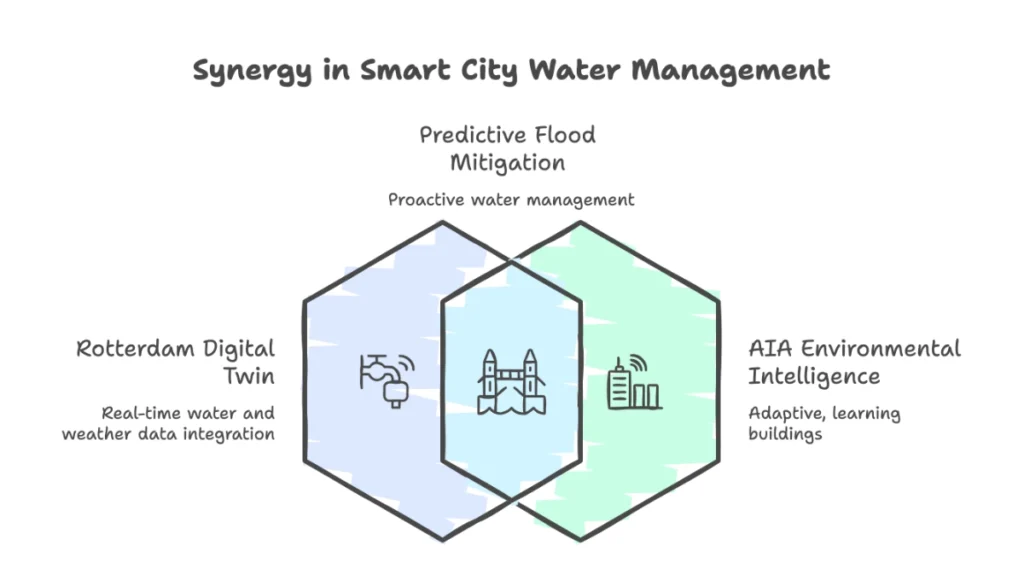
This aligns perfectly with the AIA’s framework for “Environmental Intelligence.” The AIA advocates for buildings that are “continuously learning” about occupant behavior and environmental performance. In Rotterdam, the sensors don’t just record; they inform a predictive model that allows the city to simulate flood scenarios before a single drop of rain falls.
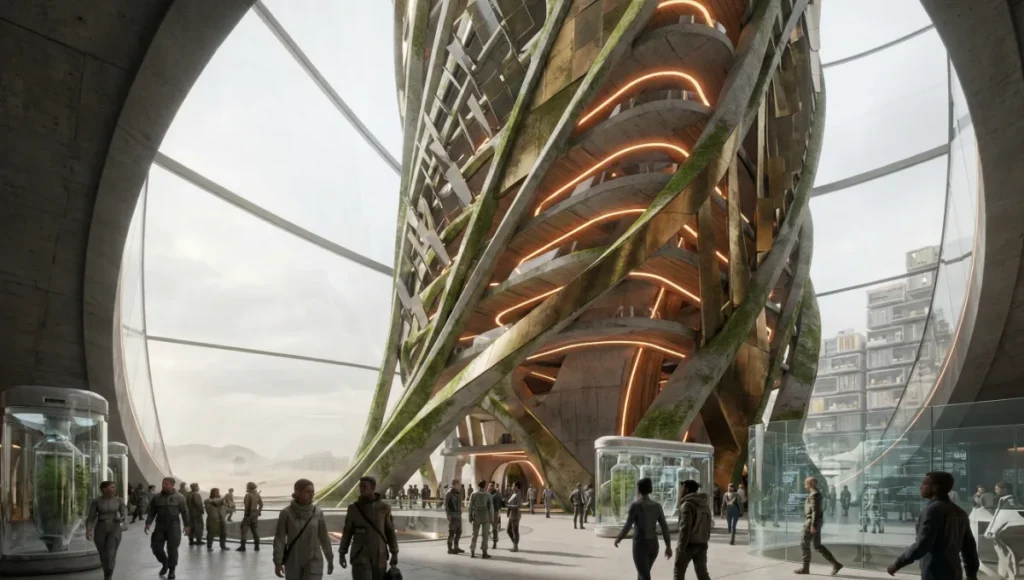
Concept Project Spotlight: Speculative / Internal Concept Study “Aether-Wing” by Nuvira Space
Project Overview
- Location: Neom/The Line (Speculative Extension)
- Typology: Vertical Transit-Oriented Development
- Vision: A skyscraper that functions as a carbon-scrubbing lung, governed entirely by atmospheric sensor feedback.
Design Levers Applied
- The Aero-Skin: A kinetic façade equipped with HAQA arrays that physically tilts to catch prevailing winds, filtering PM2.5 particles through integrated bio-moss filters.
- Pulse Logic: Lighting and climate control are slaved to anonymous LiDAR flow data, ensuring energy is only expended where humans are present.
Transferable Takeaway
“Aether-Wing” demonstrates that when sensors are integrated during the conceptual phase rather than as an afterthought, the architecture ceases to be a shell and becomes a participant in the ecosystem.
The Societal Impact of Sensory Design
We must move beyond the “efficiency” metric. True urban resilience is measured by the quality of the human experience. When sensors monitor the “sentiment” of a plaza or the “thermal comfort” of a low-income housing block, they become tools for equity.
By identifying “Urban Heat Islands” in real-time, city planners can deploy emergency cooling measures or prioritize the planting of vertical forests in the areas that need them most. This is the synthesis of sociology and technology—using the cold data of sensors to solve the warm, complex problems of human survival.
2030 Future Projection: The Autonomous Urban Organism
By 2030, we predict the “Invisible City” will become the dominant architectural paradigm. Buildings will no longer be static. They will be “Aware.” We are moving toward a period where the metropolitan fabric possesses a primitive form of consciousness. Your walk to work will be a series of seamless handoffs between sensors that adjust the temperature, the traffic light timing, and even the oxygen levels of the transit hub to ensure your physiological and psychological homeostasis.
In this future, the role of the Architect will shift from “Master Builder” to “Ecological Orchestrator.”
Comprehensive Technical FAQ
This article is part of our smart building technology guide, the state-of-play synthesis across generative AI, robotics, and sensing layers.
Q: How do smart city sensors handle extreme weather conditions?
A: Resilience is built into the “Elegant” design.
- IP68 Rating: All exterior nodes are hermetically sealed against moisture and dust.
- Thermal Regulation: Internal micro-heaters prevent sensor drift in sub-zero temperatures.
Q: What is the lifespan of an embedded urban sensor?
A: Typically 7 to 10 years.
- Modular Design: At Nuvira Space, we design “Sensor Cartridges” that can be swapped without demolishing the facade.
- Energy Harvesting: Many nodes utilize vibration or solar energy to operate indefinitely without external power.
Q: How is data security maintained across the metropolitan grid?
A: Through a decentralized “Mesh Network” architecture.
- End-to-End Encryption: Using AES-256 standards.
- Blockchain Verification: Ensuring data integrity so that traffic or pollution readings cannot be manipulated by third parties.
Q: Does the AIA provide specific contracts for smart city data?
A: The AIA Contract Documents division has begun providing guidance on the integration of smart city concepts in construction. They emphasize that construction professionals must shift their business philosophy toward infusing technology—including AI and BIM—into their models to ensure legal and operational clarity in data-driven projects.
Reclaim the Metropolitan Fabric
The era of “blind architecture” is over. We invite you to collaborate with Nuvira Space to integrate these sensory nervous systems into your next development. Let us move beyond the gridlock and the smog. Let us build cities that don’t just house people, but understand them.
Contact Nuvira Space today to begin the recalibration of your urban footprint.
3 thoughts on “10 Elegant Smart City Sensors for Sustainable Design”