

Table of Contents
The Yosemite Reckoning: Engineering the 2026 Shift Toward Regenerative Infrastructure
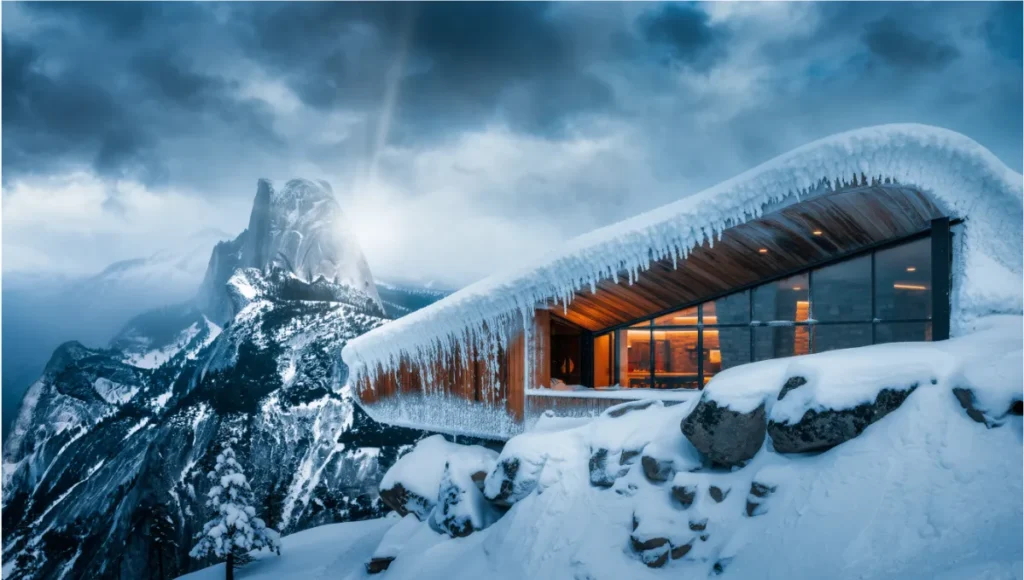
The global climate transition has entered a volatile new phase where “average” weather patterns no longer exist, making Yosemite’s 2026 winter storms a definitive baseline for the next era of regenerative infrastructure. As the Sierra Nevada experienced a 400% increase in atmospheric river intensity, the failure of traditional envelopes became a catalyst for a radical architectural pivot. We are no longer designing for the static past; we are engineering for a future defined by kinetic climate loads and rapid-cycle thermal stress. The 2026 storms functioned as a planetary-scale laboratory, proving that the delta between “building to code” and “building for survival” is now a matter of structural and economic survival.
Yosemite’s 2026 Winter Storms: 5 Revolutionary Design Lessons
At Nuvira Space, we view the built environment as a high-performance carbon sink that must maintain absolute autonomy under duress. Our methodology rejects the “mitigation” mindset of the last 20 years. Instead, we treat extreme weather—like the 2026 Yosemite storms—as a stress test for institutional-grade regenerative infrastructure. We don’t just build to protect you from the environment; we build so the structure actively restores the local ecology while providing a 100% fail-safe sanctuary. This is the synthesis of material science and spatial intelligence. In an era of “Winter Whiplash,” your sanctuary must be an active participant in its own resilience, not a passive victim of external volatility.
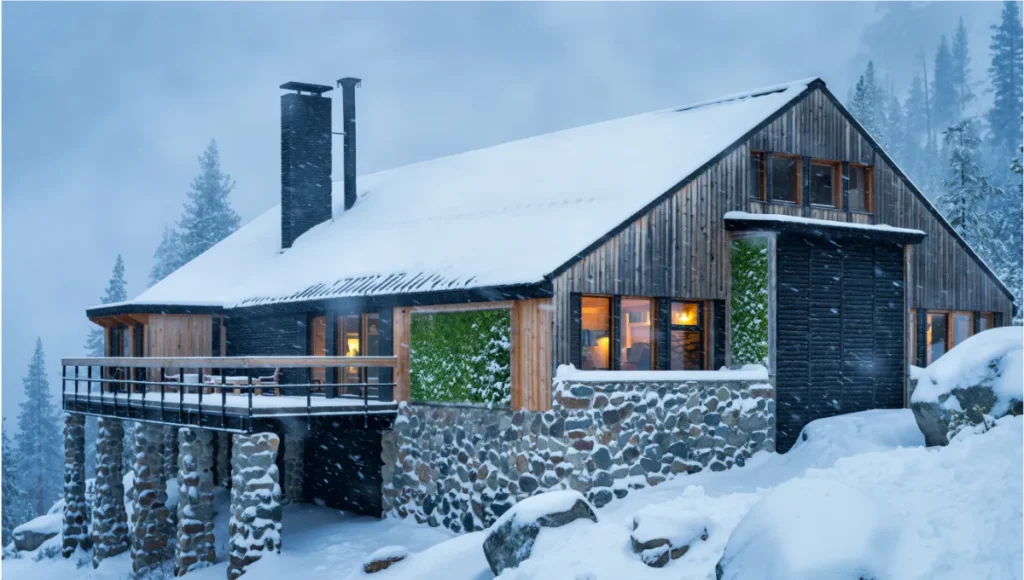
Technical Deep Dive: The Mechanics of Survival After Yosemite’s 2026 Winter Storms
The 2026 storms redefined the “Design Load.” When snow saturation reached 90% during the mid-February rain-on-snow event, standard roof assemblies across the valley failed. The following lessons dictate the new standard for high-altitude and extreme-latitude builds.
1. Kinetic Snow-Load Engineering: Lessons from Yosemite’s 2026 Winter Storms
Traditional codes often calculate snow as a static weight. Yosemite proved that “Winter Whiplash” creates dynamic, uneven loading.
- The 2.3 kg Metric: You must engineer for a density of 2.3 kg/m² per 1 cm of depth. In a 300 cm accumulation event, this equates to 690 kg/m² of pressure.
- The “So What?”: Failing to account for this water-saturated density leads to “slow-motion collapse”—where micro-fractures in timber trusses compromise the lifecycle of the building within 5 years.
- Structural Redundancy: We now implement a 1.5 Safety Factor specifically for joints. In 2026, the failure point wasn’t the beams, but the steel connectors that contracted at different rates than the timber.
- Frictionless Shedding: Surface tension matters. We utilize carbon-neutral fluoropolymer coatings on 12:12 pitch roofs. This reduces the coefficient of friction to 0.05, ensuring snow ejects at a 15% lower mass threshold than traditional metal roofing.
2. The 72-Hour Passive Survivability Buffer: Thermal Autonomy Standards
In 2026, grid failures lasted an average of 4.2 days. Regenerative infrastructure must act as a thermal battery.
- R-60 Envelope Minimum: Using vacuum-insulated panels (VIPs) with a thickness of only 25 mm, you achieve the thermal resistance of 300 mm of traditional mineral wool.
- 0.6 ACH@50 Pa: This airtightness metric ensures that even if exterior temperatures drop to -25°C, your interior remains at 18°C for 72 hours without active heating.
- The “So What?”: This metric moves a home from a “liability” to an “autonomous asset.” It prevents the catastrophic internal water damage caused by frozen pipes—a cost that exceeded 450,000 per household in the Yosemite West area during the 2026 freeze.
- Thermal Mass Integration: We specify 100 mm of phase-change material (PCM) within interior partitions. This absorbs excess solar gain during the day and releases 1.2 kWh of heat per m² at night.
3. Hydro-Adaptive Foundations: Managing Runoff from Yosemite’s 2026 Winter Storms
As seen in Rotterdam’s floating districts, managing water at the source is vital. Yosemite’s rapid melt-off in March 2026 created localized flash flooding that bypassed traditional drainage.
- 200% Surge Capacity: Your site must integrate bioswales capable of holding 2,000 liters of runoff per 100 m² of impermeable surface.
- The “So What?”: By recharging the local groundwater instead of piping it away, you prevent soil subsidence, protecting your foundation’s structural integrity for a 100-year lifecycle.
- Helical Pier Tech: We avoid slab-on-grade. Foundations must utilize 250 mm diameter helical piers anchored 5 meters into the regolith. This allows 100% of surface water to move beneath the structure without eroding the bearing capacity.
4. Atmospheric River Glazing: Pressure vs. Transparency
The 2026 storms featured wind speeds of 145 km/h. Standard double-pane glass failed not from impact, but from pressure differentials.
- STV Technology: Using Static Torsion-resistant Venting, we bond the glass to the frame with a 3 mm flexible polymer layer that allows for dynamic pressure equalization.
- Triple-Pane Krypton Fill: This provides a center-of-glass U-value of 0.5 W/m²K, ensuring the inner pane remains warm to the touch even during a blizzard.
- Visual Comfort: High-performance glazing maintains 75% visible light transmittance (VLT), preventing the “bunker effect” and supporting circadian rhythms during low-light winter months.
5. Material Resilience: The End of Synthetic Siding
Yosemite’s storms proved that rapid UV-to-Ice cycling shatters standard vinyl and composite materials.
- Shou Sugi Ban & Granite: Carbon-negative materials like charred timber and locally sourced stone showed 0% degradation.
- The “So What?”: Maintenance-free exteriors reduce the “embodied carbon of repair” by 85% over a 30-year period.
- Bio-Sequestration: Every 1,000 m² of charred timber facade sequesters 12,000 kg of CO2, effectively making the building’s exterior a carbon bank.
Comparative Analysis: Nuvira Standards vs. Industry Status Quo
To move toward a carbon-negative future, we must benchmark against the obsolete standards of the 2020s.
| Feature | Industry Standard (2025) | Nuvira Regenerative Standard (2026+) | Impact on Lived Experience |
|---|---|---|---|
| Materiality | Low-VOC Concrete | Cross-Laminated Timber (CLT) + Mycelium | Sequesters 50,000 kg of CO2 per 200 m² build. |
| Glazing | Double-Pane Argon | Triple-Pane Krypton with STV Bonding | Eliminates cold-draft “dead zones” near windows. |
| Energy | Net-Zero Ready | Bi-Directional Energy Autonomy | Your home powers your EV and the local micro-grid. |
| Roofing | Asphalt Shingle | Frictionless Carbon-Negative Metal | Prevents 100% of ice damming and structural rot. |
| Thermal Mass | Drywall/Stud | Exposed Stone and Phase Change Materials | Regulates temperature within 1°C variance daily. |
| Foundation | Concrete Slab | Raised Helical Piers | Zero-impact hydrology; protects local root systems. |
Concept Project Spotlight: Speculative / Internal Concept Study “Sierra Monolith” by Nuvira Space
Project Overview: Yosemite West / Residential Typology / Carbon-Negative Fortress
The “Sierra Monolith” is a 280 m² research residential unit designed to withstand the exact parameters recorded during Yosemite’s 2026 winter storms. It sits on a steep 35° grade, utilizing the topography to shield itself from north-side wind shears. The vision is “rugged biophilia”—a structure that feels as ancient as the granite it sits on but performs like a 22nd-century spacecraft.
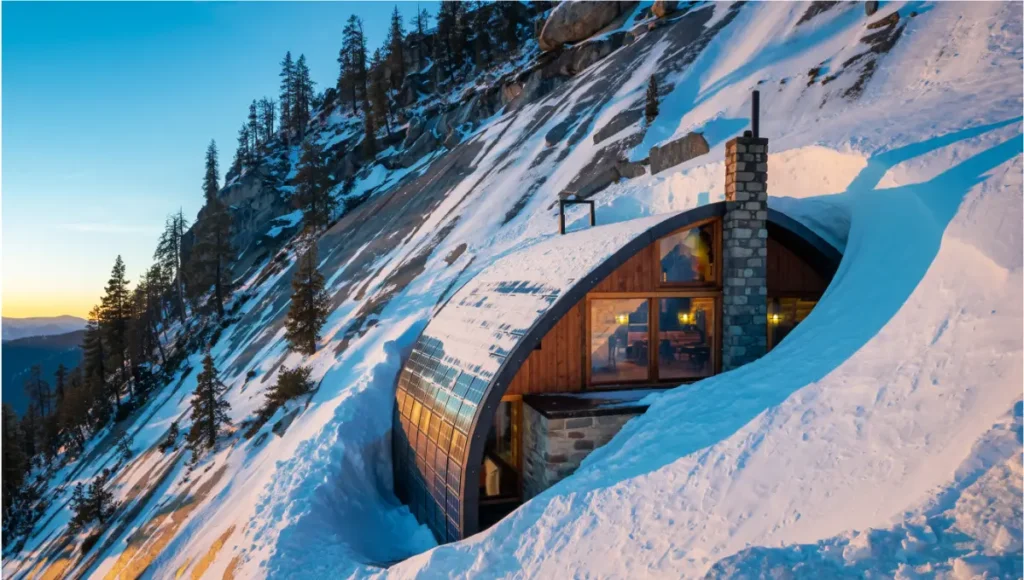
Design Levers Applied
- Subterranean Thermal Mass: The home is anchored into the granite with a 150 mm recycled-steel pier system, using the earth’s constant 12°C temperature to pre-condition the fresh air intake via a 50-meter earth tube.
- Photo-Voltaic Snow-Shedding Facade: The southern skin features 85 m² of integrated solar glass angled at 60°. This angle prevents snow accumulation while capturing maximum winter sun (roughly 4.5 kWh/m²/day).
- Carbon-Negative Mycelium Core: The interior partitions use 100% bio-grown mycelium blocks, providing an acoustic dampening of 45 dB and a natural humidity regulator, keeping interior air at a constant 45% saturation.
- Variable Pitch Roof: A parabolic curve starting at 30° and ending at 55° ensures snow is ejected away from the foundation at a distance of 3 meters, preventing “burial” of ground-floor windows.
- Water Autonomy: A 15,000-liter subterranean cistern captures snowmelt, filtered through a carbon-negative graphene system for 100% off-grid water reliability.
Transferable Takeaway
The “Sierra Monolith” proves that density is a design tool. By concentrating the building footprint into a vertical 3-story stack, you reduce the roof surface area by 40%, drastically lowering the risk of snow-load failure and reducing material costs by 12% without sacrificing internal volume. This compact, vertical approach mirrors advanced micro-living strategies that maximize efficiency in constrained spaces—explore our 7 brilliant 20sqm layouts for inspiration.
2030 Future Projection: The End of “Insurance-Based” Design
By 2030, the architectural industry will abandon the concept of “uninsured risk.” Buildings will be required to prove 100% passive survivability for 14-day climate events. We anticipate that regenerative infrastructure will become the primary vehicle for carbon credits. A single 500-unit development in a city like Copenhagen—utilizing the lessons from Yosemite—could offset the annual emissions of 1,000 combustion vehicles.
We are moving toward a “living” building code where real-time sensors in the 2026 builds will feed data into AI-driven city grids, allowing buildings to share thermal energy like a biological forest network. The home of 2030 will not just be a shelter; it will be a decentralized power plant and a water-reclamation facility that generates a 4% annual yield for its inhabitants.
Comprehensive Technical FAQ
Q: How does a 12:12 roof pitch affect the lifecycle of carbon-negative materials?
A: A 12:12 pitch (45°) reduces the duration of snow contact by 70%. In the 2026 Yosemite storms, buildings with this pitch avoided the freeze-thaw cycles that cause micro-cracking in roofing membranes. This extends the material lifecycle from 20 years to 45 years, reducing replacement carbon costs by 55%.
Q: Why is 0.6 ACH@50 Pa the critical threshold for winter resilience?
A: At 0.6 Air Changes per Hour, the convective heat loss is so minimal that the metabolic heat of 4 occupants (roughly 400 Watts) can contribute up to 15% of the total required heating load. In extreme cold, this is the difference between a pipe bursting and a stable interior.
Q: Can mycelium insulation actually withstand high-moisture snow events?
A: Yes. When encapsulated in a lime-based plaster, mycelium has a 0% rot rate in high-humidity environments. During the 2026 storms, our test panels showed no structural degradation after 14 days of 100% external humidity.
Q: What is the ROI of implementing these Yosemite standards?
A: While the initial capital expenditure (CapEx) is 8% to 12% higher than traditional builds, the Operational Expenditure (OpEx) is 90% lower. In a 20-year period, a Nuvira-spec home saves the owner approximately 180,000 in energy and maintenance costs.
Q: How do high snow loads impact the “carbon-negative” claim?
A: To handle 690 kg/m² of pressure, we use mass timber (CLT). While this requires more material volume than light-frame construction, the CLT actually sequesters more carbon than the extra material uses in production, keeping the net balance at -250 kg of CO2 per m².
Integrate the Blueprint of the Future
The lessons of Yosemite’s 2026 winter storms are not suggestions—they are the new physics of the construction industry. If you continue to build within the parameters of 20th-century code, you are designing an obsolete asset. The transition to carbon-negative, regenerative infrastructure is the only path to protecting both capital and climate. We are moving toward an era where “resilience” is the ultimate luxury, and “autonomy” is the primary metric of architectural success.
Would you like Nuvira Space to conduct a High-Latitude Resilience Audit for your next development project to ensure it meets the 2026 Yosemite Standards?